Tag: WordPressSEO

  • (003540) DAISHIN SECURITIES Q3 2025 Earnings Analysis: Profit Soars 36%, But Red Flags Emerge

    (003540) DAISHIN SECURITIES Q3 2025 Earnings Analysis: Profit Soars 36%, But Red Flags Emerge

    The latest DAISHIN SECURITIES Q3 2025 earnings report presents a fascinating and complex picture for investors. In a period of sustained market volatility, the company has posted a provisional earnings announcement that is stirring significant debate. On one hand, core business performance, reflected by operating profit, has shattered market expectations. On the other, the bottom-line net income has faltered, raising critical questions about underlying financial health and future prospects.

    This comprehensive DAISHIN SECURITIES earnings analysis will dissect these contrasting results, explore the driving factors behind them, and provide a strategic guide for current and potential investors. What does this divergence signify for the DAISHIN SECURITIES stock, and how should you position your portfolio in response?

    While operating profit surged an impressive 36% above expectations, net income unexpectedly dipped 6% below forecasts, creating a complex narrative that requires a deeper look beyond the headlines.

    DAISHIN SECURITIES Q3 2025 Earnings: The Official Numbers

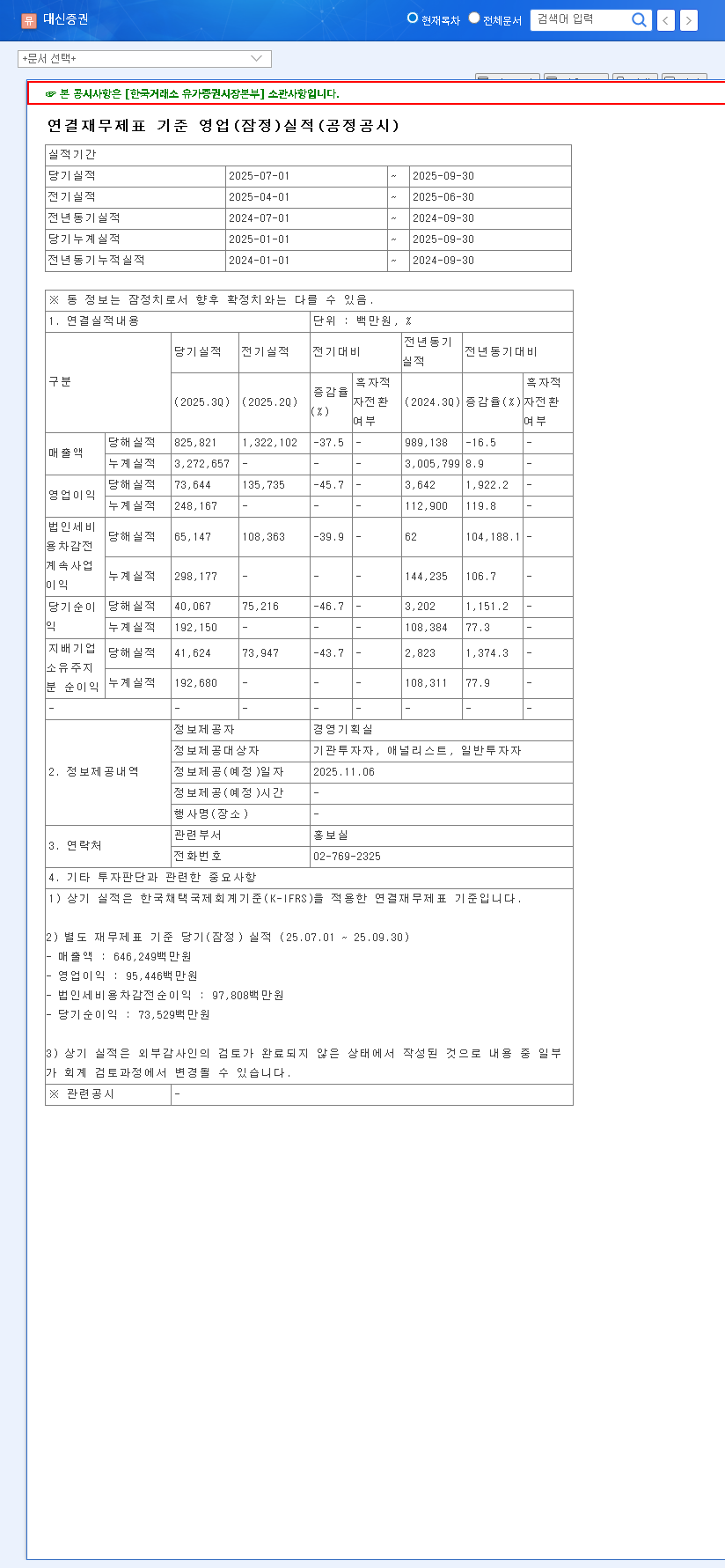
    According to the provisional data disclosed on November 6, 2025, the company’s consolidated performance for the third quarter revealed the following key metrics. For a complete and unfiltered view, investors can review the Official Disclosure filed with the Financial Supervisory Service (DART).

    • Revenue: KRW 825.8 billion (Market Estimate N/A)
    • Operating Profit: KRW 73.6 billion (36% above the market estimate of KRW 54.3 billion)
    • Net Profit: KRW 41.6 billion (6% below the market estimate of KRW 44.3 billion)

    The Bull & Bear Case: Deconstructing the Results

    The core of this quarter’s story lies in the significant gap between operational success and net profitability. Let’s break down the positive and negative drivers influencing these outcomes.

    The Bull Case: A Resilient Core Business

    The standout figure—operating profit of KRW 73.6 billion—is a powerful testament to the strength of DAISHIN SECURITIES’ primary business activities. This performance indicates that segments like brokerage, investment banking, and asset management are thriving despite a challenging economic backdrop. The company has shown a remarkable turnaround, maintaining a strong positive operating profit trend since Q1 2025, following a loss in Q4 2024. This consistent recovery builds confidence in the management’s strategy and operational execution.

    The Bear Case: The Mystery of the Net Income Miss

    Despite the robust operating profit, the net income of KRW 41.6 billion is a point of concern. This shortfall suggests that factors outside of core operations negatively impacted the bottom line. Such factors could include:

    • Non-operating Losses: Losses from the valuation of financial assets, investments in associate companies, or foreign exchange translations could be significant culprits.
    • One-Time Expenses: A specific, non-recurring cost or a significant litigation provision could have dragged down net profit.
    • Higher Corporate Taxes: An increase in the effective tax rate for the quarter could also explain the discrepancy. For more details, investors might want to review our guide on analyzing a company’s income statement.

    This quarterly decline in net income, when compared to Q1 (KRW 76.9 billion) and Q2 (KRW 75.2 billion), warrants close scrutiny in the full, audited report.

    Market Outlook and Strategic Considerations

    The forward-looking picture for securities company earnings is tied to broader market forces. A projected revenue decline for Q4 2025 could signal weakening investor sentiment or lower asset management fees. Furthermore, macroeconomic variables such as high KRW/USD exchange rates and interest rate policies from central banks can introduce significant volatility, as highlighted by recent global market analysis from Reuters. While stable U.S. Treasury yields may offer some stability, the overall environment remains uncertain.

    The company’s previously stated purpose for holding treasury shares—to enhance shareholder value and improve its financial structure—is a positive signal of shareholder-friendly policies. However, its direct impact on near-term profitability remains to be seen.

    Investor Guide: A Smart Action Plan

    Given the mixed signals from the DAISHIN SECURITIES Q3 2025 earnings, investors should adopt a cautiously optimistic approach. While the operational recovery is encouraging, the potential red flags cannot be ignored. Here is a checklist for informed decision-making:

    • Analyze the Full Report: Wait for the finalized, detailed financial statements to pinpoint the exact cause of the net income decline.
    • Monitor Revenue Trends: Closely watch for signs that the company is developing new growth drivers to counter the potential slowdown in revenue.
    • Track Treasury Stock Utilization: Observe how and when the company uses its treasury stock to ensure it translates into tangible shareholder value.
    • Assess Macro-Environment: Stay informed about changes in exchange rates, interest rates, and overall market sentiment that directly affect the securities industry.

    Frequently Asked Questions (FAQ)

    What are the key takeaways from DAISHIN SECURITIES’ Q3 2025 earnings?

    The key takeaway is a dual narrative: the company’s core operations are performing exceptionally well (operating profit up 36% over estimates), but its final net profit was dragged down by other factors (down 6% vs. estimates), signaling a need for deeper investigation.

    Why did net income decrease while operating profit rose?

    The most likely causes are non-operating factors. These can include valuation losses on investments, foreign exchange impacts, one-time expenses, or a higher-than-expected corporate tax bill. The full financial report will provide clarity.

    What should investors watch for in the coming months?

    Investors should focus on the detailed explanation for the net income miss, the company’s strategy to address declining revenue trends, and how management plans to use treasury stock to benefit shareholders.
    (003540) DAISHIN SECURITIES Q3 2025 Earnings Analysis: Profit Soars 36%, But Red Flags Emerge 관련 이미지
  • (041510) SM Entertainment Earnings (Q3 2025): Profit Soars Despite Revenue Dip – A Deep Dive for Investors

    (041510) SM Entertainment Earnings (Q3 2025): Profit Soars Despite Revenue Dip – A Deep Dive for Investors

    The latest SM Entertainment earnings report for Q3 2025 presents a fascinating paradox for investors and industry analysts. As a titan in the global K-POP market, the company reported a slight dip in revenue that missed market expectations. However, in a surprising turn, both operating and net profits surged past forecasts, signaling a significant and positive strategic shift. How did SM Entertainment orchestrate this impressive boost in profitability against a backdrop of declining sales? And what does this pivot reveal about the company’s future growth trajectory and the potential for the SM Entertainment stock?

    This comprehensive analysis delves deep into SM’s financial health, unpacking the Q3 2025 provisional results and its first-half performance to provide a clear, data-driven perspective for your investment decisions.

    SM Entertainment Q3 2025: A Tale of Two Metrics

    On November 5, 2025, SM Entertainment released its provisional consolidated financial results, capturing the market’s full attention. While top-line growth faltered, the bottom-line performance told a story of resilience and operational excellence. Here are the key figures from the report:

    • Revenue: KRW 321.6 billion, which was 2% below the market forecast of KRW 329.6 billion.
    • Operating Profit: KRW 48.2 billion, beating the market forecast of KRW 47.7 billion by 1%.
    • Net Profit: KRW 39.8 billion, a significant 6% beat over the forecast of KRW 37.4 billion.

    This outperformance in profitability, despite revenue headwinds, suggests that the company’s internal strategic adjustments are beginning to yield substantial results, creating a positive surprise for the market.

    The ‘Why’ Behind the Numbers: Strategy Over Sales

    The divergence between revenue and profit wasn’t accidental. It was the result of deliberate strategic choices aimed at building a more resilient and efficient business model. Several key factors contributed to this successful turnaround in the SM Entertainment earnings profile.

    The DearU Co., Ltd. Power Play

    A core pillar of this new strategy is the amplified focus on the high-margin fandom platform business. By increasing its stake in DearU Co., Ltd. to 55.63% and consolidating it as a subsidiary, SM has secured a powerful engine for recurring revenue. Fandom platforms like DearU’s ‘Bubble’ are less susceptible to the cyclical nature of album releases and concerts, providing a stable, high-profitability income stream by monetizing the artist-fan connection directly.

    Leaner Operations and Synergistic Mergers

    Internally, SM has been focused on enhancing organizational efficiency. The strategic merger and absorption of affiliates like Studio Realive Co., Ltd. and SM Studios Co., Ltd. are designed to eliminate redundancies, reduce overhead costs, and create a more streamlined content production pipeline. These long-term moves are now visibly impacting the bottom line by improving operating margins.

    SM Entertainment’s Q3 results demonstrate a critical pivot: from a pure top-line growth model to a more sophisticated, profitability-focused strategy. This is a sign of a mature company adapting to a new market reality.

    Navigating the Competitive K-POP Market and Global Headwinds

    The revenue slowdown is not occurring in a vacuum. A comprehensive K-POP market analysis reveals intensifying competition, both domestically and internationally. A global economic slowdown has also tempered consumer spending on merchandise and concerts. Experts at leading publications like Billboard have noted the increasing saturation in the idol market, forcing companies to innovate beyond traditional revenue models. Furthermore, macroeconomic factors like fluctuating interest rates and currency exchange rates add another layer of complexity, impacting everything from borrowing costs to the value of overseas earnings.

    For a deeper look into the competitive landscape, explore our complete K-POP industry overview for 2025. The company’s ability to navigate these external pressures while improving internal efficiency will be key to its sustained success.

    Investor Action Plan: What to Watch Next

    For those considering an investment in SM Entertainment stock, the Q3 results provide a new lens through which to evaluate the company. The focus should shift from pure revenue growth to the sustainability of this newfound profitability. Here are critical points to monitor:

    • Revenue Rebound: Watch for signs that the decline in core entertainment revenue is stabilizing or beginning to recover in the coming quarters.
    • Profit Margin Sustainability: Analyze whether the improved operating and net profit margins can be maintained or even expanded in the future.
    • DearU Performance: Track the growth and profitability metrics of DearU Co., Ltd. as a key indicator of the success of the platform strategy.
    • Shareholder Returns: Keep an eye on the company’s dividend policy and other shareholder return initiatives, which could signal confidence from management.

    For a complete and unfiltered view of the financial data, investors can consult the Official Disclosure filed with the Financial Supervisory Service’s DART system. SM Entertainment is at a crucial inflection point, and evaluating its strategic execution will be paramount for any long-term investment thesis.

    (041510) SM Entertainment Earnings (Q3 2025): Profit Soars Despite Revenue Dip – A Deep Dive for Investors 관련 이미지