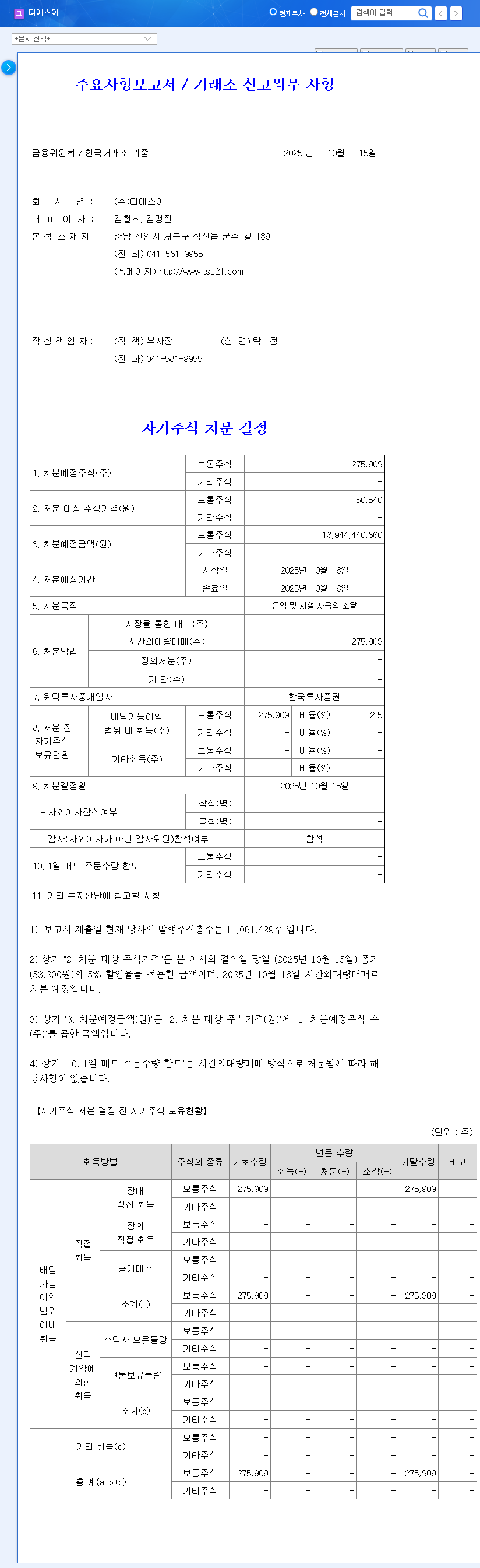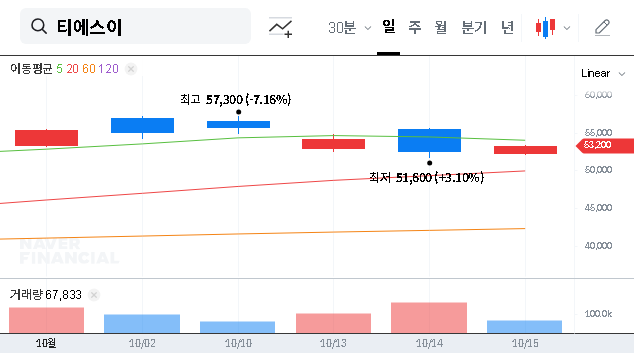
The recent announcement of the TSE treasury stock disposition has captured the attention of the market. TSE CO.,Ltd, a key player in semiconductor inspection equipment, has unveiled a plan to sell 13.9 billion KRW in treasury stock. This strategic financial maneuver, aimed at securing operational and facility funds, presents a critical juncture for the company and its investors. Is this a savvy move to fuel future growth, or does it signal underlying financial pressures that could lead to shareholder value dilution?
This comprehensive analysis will dissect the implications of TSE’s decision. We’ll explore the immediate impact on the TSE stock price, the long-term effects on corporate value, and the crucial signals investors must monitor. For full transparency, the company’s filing can be reviewed in the Official Disclosure (DART).
Understanding the TSE Treasury Stock Disposition
On October 15, 2025, TSE CO.,Ltd disclosed its plan to dispose of 275,909 of its own common shares, known as treasury stock. The transaction, valued at approximately 13.9 billion KRW and brokered by Korea Investment & Securities, effectively reintroduces these shares into the market. But why does a company buy back its own shares only to sell them later?
Treasury stock is often held for various corporate purposes, such as employee stock options or for use in acquisitions. A treasury stock sale like this one is primarily a capital-raising strategy. Instead of issuing new shares or taking on debt, the company sells existing assets (its own stock) to generate cash. The stated purpose for this infusion of capital is twofold: operational funding and facility investment.
Decoding the ‘Why’: Operational and Facility Funds
The company’s justification for the sale provides the first clues for our investor analysis. Let’s break down what these categories mean.
1. Securing Operational Funds
This refers to the cash needed for day-to-day business activities. While it could be a proactive measure to improve cash flow for large-scale projects or R&D, it can sometimes be interpreted as a signal that current operations are not generating sufficient cash. In the competitive semiconductor sector, this could mean funding advanced research into next-generation probe cards or test sockets to stay ahead of rivals.
2. Investing in Facility Funds
This is the forward-looking component. Facility investments are about growth—expanding production capacity, upgrading to more advanced manufacturing equipment, or building new testing centers. For TSE, this could mean acquiring state-of-the-art machinery to produce finer-pitch components for the latest generation of microchips. A successful facility investment can lead to significant revenue growth and market share gains.
The core question for investors is whether this 13.9 billion KRW is being used to patch a leak or build a new engine for growth. The answer will determine the long-term trajectory of the TSE stock price.
Potential Impacts on TSE’s Stock and Corporate Value
A TSE treasury stock disposition creates both opportunities and risks that investors must weigh carefully.
The Bull Case (Positive Impacts)
- •Strengthened Financial Health: An immediate 13.9B KRW cash injection bolsters the balance sheet, providing financial flexibility and reducing reliance on debt.
- •Fueling Future Growth: If invested wisely in high-ROI facility upgrades, this capital can secure long-term growth drivers, enhancing TSE’s competitive edge in the semiconductor market.
- •Positive Market Signaling: If the company effectively communicates a compelling growth story tied to this funding, it can boost investor confidence. For insights into broader market trends, it’s often helpful to consult resources like major financial news outlets.
The Bear Case (Potential Risks)
- •Shareholder Value Dilution: This is the most significant risk. By increasing the number of shares available on the market, the ownership stake and earnings per share (EPS) of existing shareholders are diluted, which can put downward pressure on the stock price.
- •Negative Signaling: If the market perceives the sale as a move to cover operational shortfalls rather than to fund growth, it can erode investor confidence and negatively impact the company’s valuation.
- •Execution Risk: The success of this move hinges on TSE’s ability to generate a return on this new capital that outweighs the cost of dilution. A poorly executed expansion plan could be detrimental.
Strategic Action Plan for Investors
Given the dual nature of this event, a prudent investor must remain vigilant. Here are the key areas to monitor:
- •Monitor Fund Usage Plans: Watch for subsequent company announcements that provide specific details on how the 13.9B KRW will be allocated. Vague plans are a red flag; concrete, strategic initiatives are a positive sign.
- •Analyze the Disposition Price: The price at which the shares are sold is critical. A sale at or above the current market price is favorable, while a significant discount could be a cause for concern.
- •Re-evaluate Company Fundamentals: This event should trigger a fresh look at TSE’s core business. For more on this, see our guide on how to conduct a fundamental stock analysis. Assess their profitability, competitive position, and the overall health of the semiconductor industry.
- •Watch Market and Analyst Reactions: Pay close attention to how institutional investors and securities analysts react. Their revised ratings and reports can provide valuable third-party perspectives on the TSE stock price.
In conclusion, TSE’s treasury stock disposition is a pivotal event, not merely a routine financial transaction. For informed investors, it’s a call to action—a time to dig deeper, ask critical questions, and position their portfolio based on a thorough understanding of the risks and rewards at play.