Tag: trading suspension

  • (208860) EnGIS Technologies Share Price Forecast (208860): A Deep Dive Post-Acquisition

    (208860) EnGIS Technologies Share Price Forecast (208860): A Deep Dive Post-Acquisition

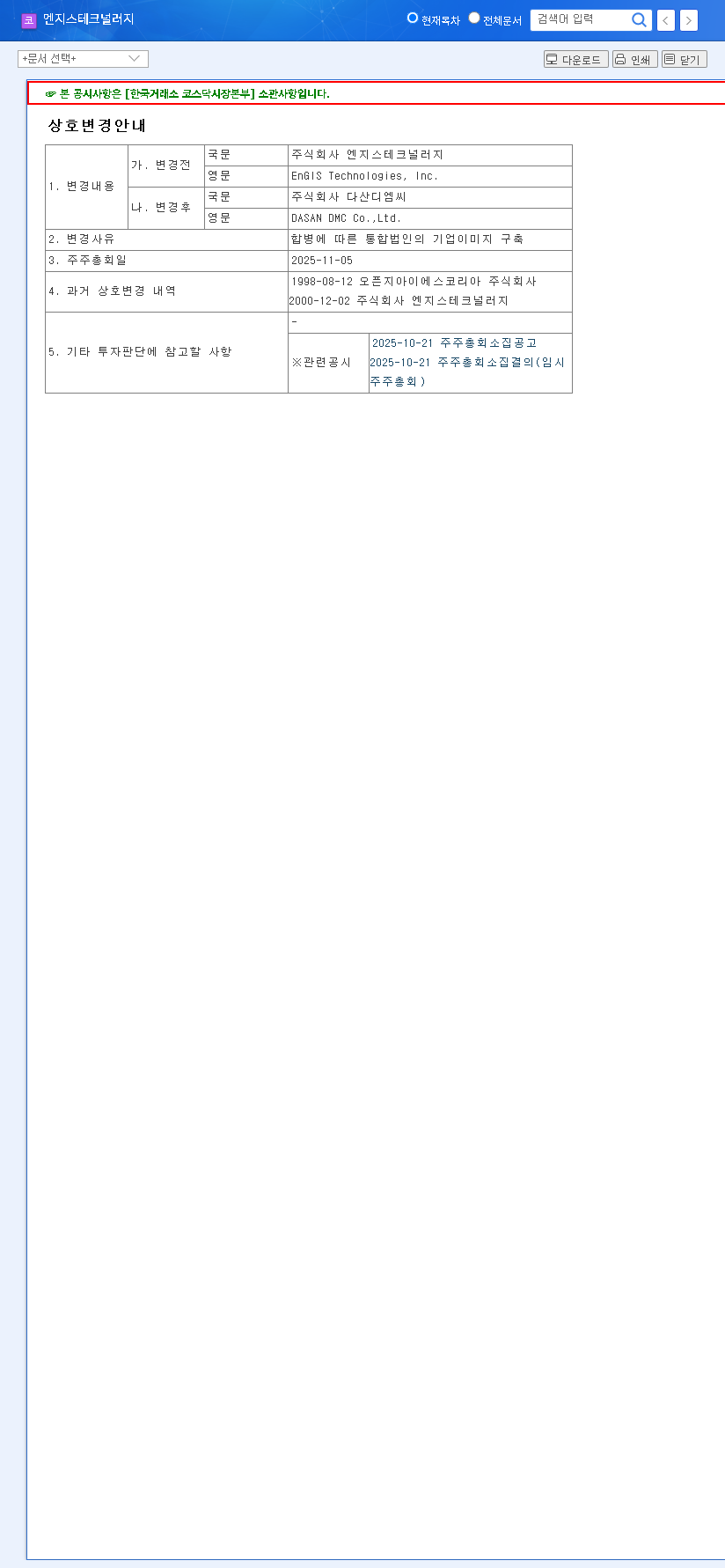
    This comprehensive EnGIS Technologies share price forecast delves into the critical factors shaping the future of stock ticker 208860. With its trading resumption on the horizon for July 7, 2025, investors are closely watching the recent shareholding adjustments by its largest shareholder, DASAN Networks. We will dissect the company’s fundamentals, analyze the transformative acquisition of DMC Co., Ltd., and weigh the significant financial risks to provide a clear, data-driven outlook for potential investors.

    Understanding the nuances of EnGIS Technologies’ fundamentals is more critical than ever, especially after a prolonged stock trading suspension. This analysis serves as an essential guide to navigating the opportunities and risks associated with its much-anticipated return to the market.

    Unpacking the Shareholding Changes by DASAN Networks

    On November 12, 2025, a report on large shareholdings revealed a notable shift. The largest shareholder, DASAN Networks, along with its special related parties, adjusted its stake in EnGIS Technologies, Inc. from 79.27% down to 78.17%. While a 1.1% reduction may seem minor, the stated purpose of ‘management influence’ warrants closer inspection. This change was the result of complex transactions including over-the-counter sales and on-exchange activities by related parties. For complete transparency, you can view the Official Disclosure on the DART system. While this doesn’t signal an immediate loss of control, it does suggest strategic repositioning among stakeholders, which could have ripple effects.

    In-Depth Fundamental Analysis of EnGIS Technologies

    A clear EnGIS Technologies share price forecast cannot be made without a thorough review of its corporate health. The company is at a pivotal crossroads, balancing explosive growth with significant financial challenges.

    The Bullish Case: DMC Acquisition and New Growth Engines

    The primary driver of optimism is the recent acquisition of DMC Co., Ltd. This strategic move has catalyzed immense external growth, transforming the company’s revenue streams.

    • Explosive Revenue Growth: Post-acquisition sales soared to KRW 42.799 billion, with an operating profit of KRW 3.377 billion, establishing the automotive parts sector as a new core business.
    • Future-Facing Technology: Entry into the Human Interface Module (HIM) business provides a strong engine for future growth, tapping into the next generation of automotive technology.
    • Path to Normalization: Key steps like terminating rehabilitation procedures and securing the largest shareholder’s pledge of mandatory retention are positive signals of returning stability.

    The Bearish Case: Financial Health and Profitability Hurdles

    Despite the top-line growth, significant risks loom beneath the surface, primarily concerning the company’s financial structure and core profitability.

    • Soaring Debt Ratio: The DMC acquisition was costly, causing the debt ratio to surge to a concerning 91.51%. This level of leverage introduces significant financial risk. For more on this topic, review our guide to Understanding Financial Ratios for Stock Analysis.
    • Persistent Operating Losses: Both the legacy Automotive Solution and the new HIM business units continue to post operating losses, highlighting an urgent need for widespread profitability improvements.
    • Macroeconomic Vulnerability: High debt makes the company susceptible to external shocks. Future interest rate hikes, as discussed by global financial authorities like the Federal Reserve, could substantially increase interest burdens and strain cash flow.

    EnGIS Technologies presents a classic high-risk, high-reward scenario. The success of its share price post-resumption hinges on management’s ability to translate acquisition-led growth into sustainable profitability while carefully managing its debt.

    Investor Strategy and Recommendations

    Given the complex situation, a prudent investment strategy is essential. The initial market reaction upon trading resumption will be a key barometer of investor sentiment. We recommend focusing on the following areas:

    • Monitor Trading Resumption: Closely observe trading volumes and price action on and after July 7, 2025, to gauge the market’s initial assessment of the EnGIS Technologies stock.
    • Track Fundamental Improvements: Scrutinize quarterly reports for evidence of synergy with DMC, improving profit margins, and a tangible reduction in the overall debt ratio.
    • Analyze Shareholder Actions: Keep an eye on any further reports from DASAN Networks. The rationale behind future stake changes will provide valuable insight into their long-term strategy.
    • Demand Transparency: Pay attention to the company’s investor relations activities and information disclosures. Proactive communication is vital for rebuilding trust after a delisting scare.

    Frequently Asked Questions (FAQ)

    Q1: When will EnGIS Technologies’ stock (208860) resume trading?

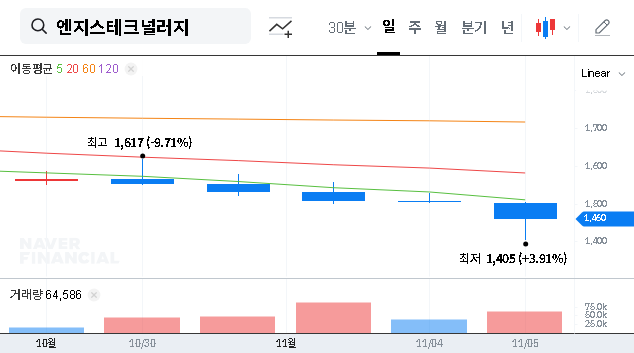
    Stock trading for EnGIS Technologies, which was suspended on April 7, 2021, is officially scheduled to resume on July 7, 2025. This event will be a critical test of market confidence.

    Q2: What is the biggest positive factor for the EnGIS Technologies share price forecast?

    The most significant positive factor is the external growth from the acquisition of DMC Co., Ltd. This has made the automotive parts sector a major revenue contributor and signals a bold strategic shift for the company.

    Q3: What is the primary risk facing EnGIS Technologies?

    The primary risk is its precarious financial health, highlighted by a debt ratio of 91.51% following the acquisition. This high leverage, combined with ongoing operating losses in key business units, makes the company vulnerable to economic downturns and rising interest rates.
    (208860) EnGIS Technologies Share Price Forecast (208860): A Deep Dive Post-Acquisition 관련 이미지
  • (007570) ILYANG PHARMACEUTICAL Delisting Risk (007570): A Complete Guide for Investors

    (007570) ILYANG PHARMACEUTICAL Delisting Risk (007570): A Complete Guide for Investors

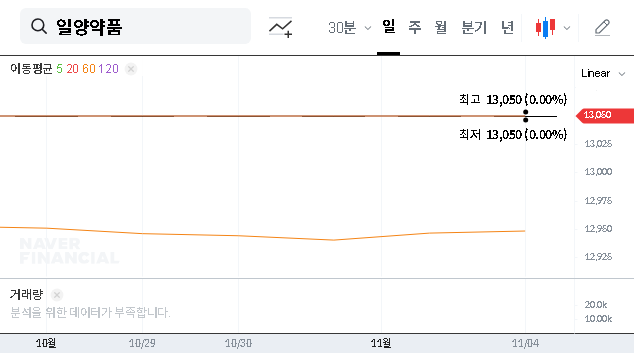
    Investors in ILYANG PHARMACEUTICAL CO.,LTD (007570) are facing a period of critical uncertainty. The company is now grappling with a significant ILYANG PHARMACEUTICAL delisting risk after a pivotal decision by the Korea Exchange. This comprehensive analysis will break down the situation, explore the underlying financial health, and provide clear, actionable advice for shareholders and potential investors.

    The Critical Event: An ‘Improvement Period’ is Granted

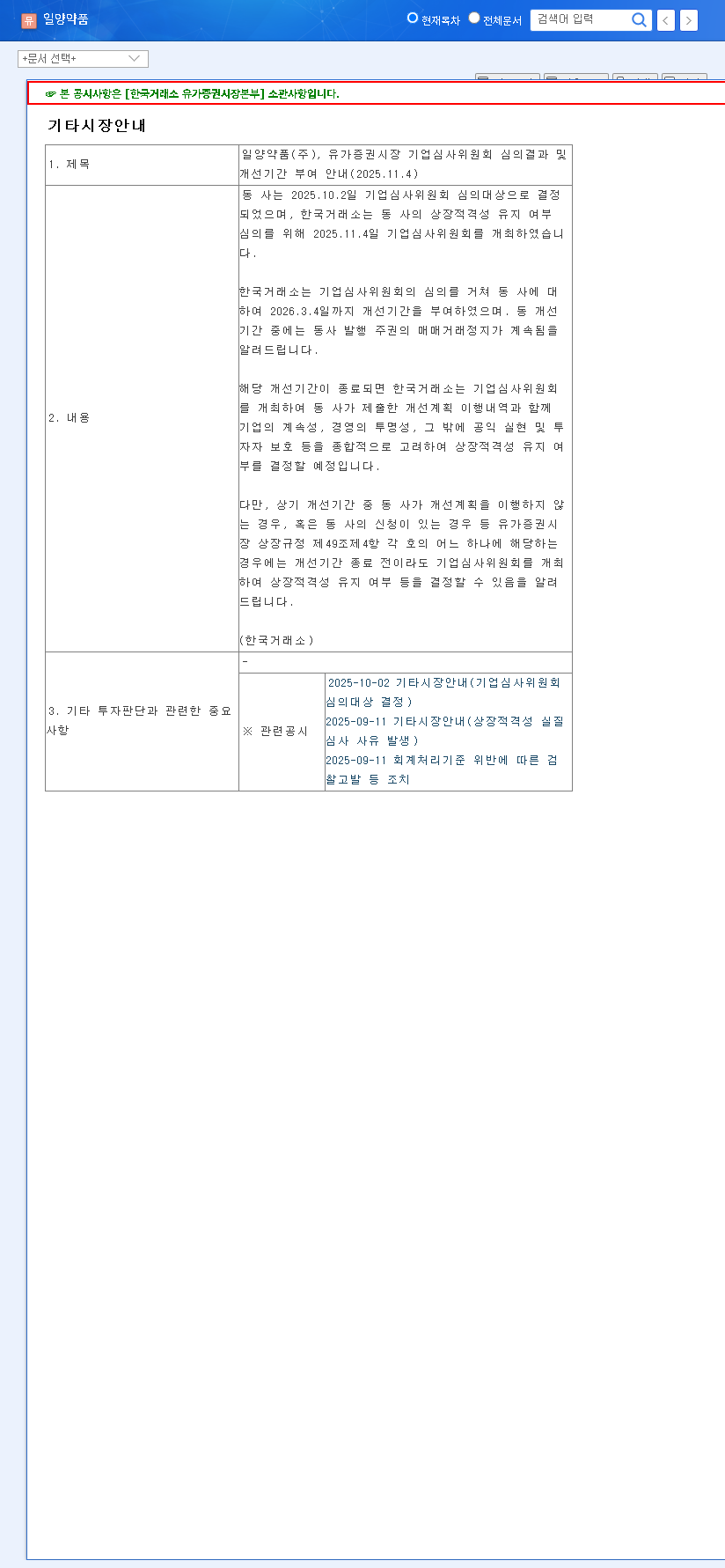
    On November 4, 2025, the Korea Exchange’s Corporate Review Committee made a crucial decision regarding ILYANG PHARMACEUTICAL’s future on the KOSPI market. Instead of an immediate delisting, the company was granted an ‘improvement period’ until March 4, 2026. This decision, detailed in the Official Disclosure from DART, provides a lifeline but also initiates a period of high risk and operational paralysis for investors.

    What This Means in Practice:

    • Complete Trading Suspension: The most immediate consequence is the halting of all trading for ILYANG PHARMACEUTICAL stock. Investors cannot buy or sell shares, effectively locking up their capital for the duration of the improvement period.
    • Mandate for Improvement: The company is now under immense pressure to formulate and execute a robust business improvement plan. This plan will be the sole basis for the final listing decision.
    • Final Judgment Awaits: After March 4, 2026, the Korea Exchange Corporate Review Committee will reconvene. They will scrutinize the company’s progress, management transparency, and overall business viability to make a final, binding decision on whether to delist or maintain the listing.

    Diagnosis: Why Did ILYANG Face Delisting Risk?

    The decision for a 007570 improvement period was not made in a vacuum. It stems from a combination of deteriorating financial metrics and operational challenges, despite some promising long-term prospects.

    While future growth drivers like the new drug pipeline exist, they are overshadowed by immediate financial instability and declining performance, creating a high-risk profile that triggered the review.

    Underlying Strengths (Future Growth Drivers)

    • Robust R&D Pipeline: Ongoing investment in flagship products like ‘Noltec’ and the market entry of ‘Supect’ in China represent significant long-term revenue potential. The R&D investment rate of 11.5% of sales is a strong indicator of this focus.
    • Vaccine Business Potential: The construction of a new vaccine plant and efforts to secure WHO PQ approval could unlock lucrative international markets.

    Critical Weaknesses (Current Financial Risks)

    • Performance Plunge: The first half of 2025 saw a worrying decline across key metrics, including revenue, operating profit, and net income. A sharp slowdown in exports was a major contributor.
    • Deteriorating Balance Sheet: A surge in inventory to KRW 73.195 billion and total borrowings reaching KRW 121.847 billion signals a serious strain on financial health. This level of debt creates significant cash flow pressure.
    • Macroeconomic Headwinds: As an exporter, the company is vulnerable to exchange rate fluctuations, which can erode margins and profitability.

    Investor Playbook: Navigating the Uncertainty

    The ILYANG PHARMACEUTICAL delisting risk fundamentally changes the investment thesis. The primary focus must shift from growth potential to risk management. The expert consensus is a ‘Highly Negative’ outlook, with a recommendation to reduce exposure.

    Guidance for Existing Shareholders

    The inability to trade during the suspension period is the core problem. While you cannot sell now, you must have a clear plan for when, and if, trading resumes. The probability of maintaining the listing is uncertain, and the stock price will likely face extreme downward pressure upon resumption. Hoping for a recovery is a high-risk strategy; preparing for loss mitigation is a more prudent one. You can use this time to read our guide on managing high-risk stock portfolios.

    Advice for Potential New Investors

    Attempting to invest in ILYANG PHARMACEUTICAL at this stage is exceptionally speculative. It is strongly advised to remain on the sidelines until the KOSPI delisting uncertainty is fully resolved. Await the final decision from the Korea Exchange and observe market reaction before considering any new position. Learn more about the general risks involved by reviewing the delisting process explained by high-authority sources.

    Frequently Asked Questions (FAQ)

    Q1: What exactly does ‘improvement period granted’ mean?
    A1: It’s a probationary period given by the stock exchange, allowing the company (ILYANG PHARMACEUTICAL) until March 4, 2026, to fix the issues that put it at risk of delisting. Trading is completely frozen during this time.

    Q2: When can I sell my ILYANG PHARMACEUTICAL stock?
    A2: Trading can only resume after the improvement period ends and only if the Corporate Review Committee decides to maintain the listing. An exact date is impossible to predict right now.

    Q3: Is it certain that ILYANG PHARMACEUTICAL will be delisted?
    A3: No, it is not certain. However, the risk is now significantly elevated. Delisting will occur if the improvement plan is unconvincing or poorly executed. The outcome is highly uncertain.

    Q4: What should I monitor during this period?
    A4: Watch for official company announcements regarding its improvement plan, any news on R&D successes or new contracts, and ultimately, the final verdict from the Korea Exchange after March 4, 2026.

    (007570) ILYANG PHARMACEUTICAL Delisting Risk (007570): A Complete Guide for Investors 관련 이미지
  • (234920) Zaigle Delisting Review (2025): Full Analysis, Stock Risks & Investor Guide

    (234920) Zaigle Delisting Review (2025): Full Analysis, Stock Risks & Investor Guide

    Investors in Zaigle Co., Ltd. (KOSDAQ) are facing a period of critical uncertainty. The recent announcement of a pending Zaigle delisting review has sent shockwaves through the investment community, raising serious questions about the company’s future and the safety of shareholder capital. This comprehensive analysis will break down the situation, from the initial disclosure to the underlying financial weaknesses, helping you understand the immense risks and formulate a rational strategy in these turbulent times.

    We will explore the company’s precarious fundamentals, the external market pressures, and the potential scenarios that could unfold, providing you with the insights needed to navigate this high-stakes event.

    What Happened? The Official Zaigle Delisting Review Announcement

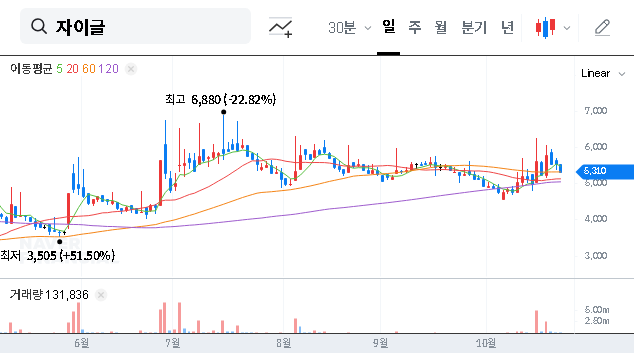
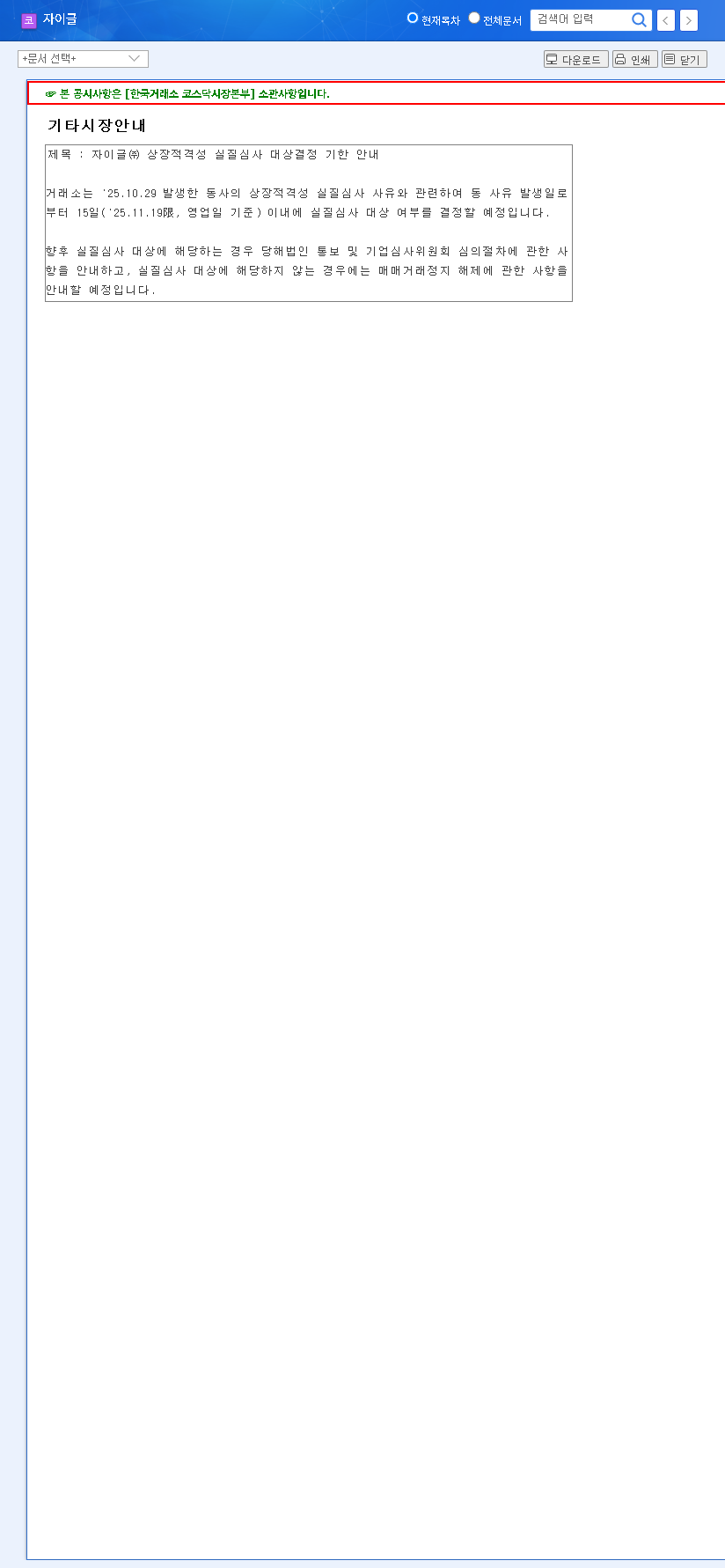
    On October 29, 2025, Zaigle Co., Ltd. filed a disclosure that triggered an alarm for every shareholder. The company officially announced the occurrence of a reason for a delisting eligibility substantial review. According to the filing, a decision on whether the company is subject to this formal review will be made by November 19, 2025. You can view the complete report directly from the source: Official Disclosure (DART).

    If the Korea Exchange (KRX) determines a formal review is unnecessary, the currently suspended trading of Zaigle stock will be lifted. However, if Zaigle is deemed subject to the review, it enters a high-risk deliberation process that could lead to severe consequences, including designation as an administrative issue or, in the worst-case scenario, complete delisting from the exchange.

    Why Is Zaigle Facing a Delisting Review? A Look at the Cracks

    This critical situation did not arise overnight. It is the culmination of deteriorating business fundamentals, questionable financial health, and a history of compliance issues that have eroded investor trust.

    Struggling Core Business & Uncertain New Ventures

    • Existing Business Slump: Sales of its flagship ‘Zaigle Grill’ and other well-being appliances have remained sluggish. The healthcare segment has also failed to gain traction, showing a decline in sales year-over-year.
    • Unproven New Ventures: While the company is pinning its hopes on new ventures like the ‘Zaigle On Simple’ medical device, their contribution to revenue is still negligible. More concerning is the collapse of its highly anticipated US secondary battery joint venture, which has amplified uncertainty. Plans for domestic LFP battery development remain on paper, with no clear path to production. For more information on market challenges, you can read about global supply chain disruptions.

    Alarming Financial Health Indicators

    • Deteriorating Profitability: With falling revenue and operating losses for two consecutive quarters in the first half of 2025, the company’s core profitability is in question.
    • Solvency Concerns: The debt-to-equity ratio climbed to a concerning 135.03% as of Q1 2025. This indicates the company is relying more on debt to finance its assets, which is a major red flag for financial stability.
    • Negative Cash Flow: Negative operating cash flow reveals that the company’s core business activities are not generating enough cash to sustain operations, forcing it to rely on financing or asset sales.
    • History of Sanctions: A past record of fines for dishonest disclosures has damaged corporate credibility, making investors wary of management’s transparency. If you want to learn more, check out our guide on how to analyze high-risk stocks.

    The combination of a failing core business, unproven ventures, and weak financials creates a perfect storm. The Zaigle delisting review is a direct consequence of these deep-seated issues.

    The Ripple Effect: Potential Impacts on Zaigle Stock and Business

    The outcome of this review will have profound and far-reaching consequences. Investors must prepare for significant volatility and potential downside.

    Direct Consequences

    • Stock Price Volatility: The uncertainty alone will likely lead to severe downward pressure on Zaigle’s stock price.
    • Trading Suspension: If subjected to the full review, a prolonged trading suspension is highly probable, locking up investor capital and creating immense liquidity risk.
    • Total Loss of Investment: In the worst-case scenario of delisting, the stock could become worthless, leading to a total loss for shareholders.

    Indirect Consequences

    • Credit Rating Downgrade: The situation could trigger a downgrade, making it harder and more expensive for Zaigle to raise capital.
    • Business Contraction: Partners, suppliers, and clients may become hesitant to do business with a company on the verge of being delisted, impacting contracts and revenue streams.

    Investor Playbook: Navigating the Uncertainty

    Given the high degree of investment risk, a cautious and defensive strategy is paramount.

    Potential Scenarios by November 19

    • Positive Scenario (Not Subject to Review): This would resolve immediate uncertainty and could cause a short-term relief rally. However, without a fundamental business turnaround, any gains may be short-lived.
    • Negative Scenario (Subject to Review): This is the worst outcome. It would trigger the formal Zaigle delisting review process, almost certainly leading to a trading suspension and a sharp drop in value if and when trading resumes.

    Recommendations for Investors

    For Potential Investors: Initiating a new position in Zaigle at this time carries an extremely high level of risk. It is strongly advised to stay on the sidelines until there is absolute clarity on the company’s listed status.

    For Existing Shareholders: The decision is more complex. You must assess your risk tolerance and be prepared for the possibility of a total loss. Monitoring the situation closely until the November 19 deadline is crucial. Any decision to sell or hold should be based on the understanding that the stock’s value is highly precarious.

    (234920) Zaigle Delisting Review (2025): Full Analysis, Stock Risks & Investor Guide 관련 이미지
  • (066790) CCS Sale (066790): An In-Depth Investment Analysis of KOREA CABLE T.V CHUNG-BUK SYSTEM CO., LTD.

    (066790) CCS Sale (066790): An In-Depth Investment Analysis of KOREA CABLE T.V CHUNG-BUK SYSTEM CO., LTD.

    In the turbulent landscape of regional media, the announcement of the KOREA CABLE T.V CHUNG-BUK SYSTEM CO., LTD. sale has sent ripples through the investment community. The company, better known as CCS (066790), is grappling with a perfect storm of management instability, declining performance, and a trading suspension. The public sale of its largest shareholder’s stake is being positioned as a crucial turning point. But for discerning investors, the key question remains: is this a genuine recovery play or the final chapter of a protracted decline?

    This comprehensive CCS investment analysis will dissect the intricate details behind the sale, evaluate the company’s precarious financial health, and weigh the potential opportunities against the significant risks. We aim to provide the clarity needed to navigate this high-stakes scenario and make an informed decision.

    The Catalyst: Unpacking the Major Shareholder Public Sale

    On October 24, 2025, CCS officially announced its intention to conduct a public sale of its major shareholder’s stake and associated parties. According to the Official Disclosure on DART, the primary stated goal is to enhance corporate governance and secure management transparency. The process is slated to conclude via a public bidding system by April 2026.

    This strategic move is a direct response to the company’s critical management deadlock. CCS has been unable to secure regulatory approval for its largest shareholder change under the Broadcasting Act, leaving it in a state of legal and operational limbo. The sale is a desperate, yet necessary, attempt to find a new, stable owner who can navigate the regulatory hurdles, stabilize the business, and inject much-needed growth capital.

    Diagnosing the Crisis: Why the CCS Sale is Happening

    The decision to pursue a sale was not made in a vacuum. It is the culmination of several deep-seated issues that have eroded the company’s value and investor confidence. Understanding these core problems is essential for any potential CCS investment analysis.

    1. Severe Governance and Legal Risks

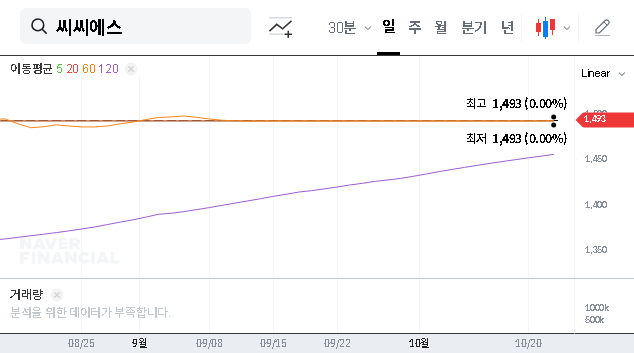
    The most immediate crisis stems from unstable management. The failure to get the new major shareholder, GreenBT Co., Ltd., approved has resulted in a corrective order from regulators. This situation escalated on June 23, 2025, when CCS was designated a non-compliance disclosure corporation, triggering a trading suspension and its classification as an administrative issue. This status severely damages credibility and creates significant liquidity risk. Lingering allegations of embezzlement and breach of trust from a previous ownership era further tarnish the company’s reputation.

    2. Persistent Financial Underperformance

    The company’s financial reports paint a grim picture. As of the 2025 semi-annual report, revenue had fallen 4.3% year-on-year to roughly 8.7 billion KRW, driven by a collapse in advertising sales. More alarmingly, the operating loss widened significantly to 1.55 billion KRW. This is a classic case of a business struggling to adapt, squeezed by the relentless rise of global OTT giants like Netflix and Disney+, a trend seen across the traditional media sector according to industry reports from sources like Reuters. A continued net loss of 1.29 billion KRW underscores a deep-rooted profitability problem.

    The core issue is that CCS’s business model appears ill-equipped for the modern media environment. The sale of the Chung-Buk System operator is less a strategic pivot and more a forced hand due to fundamental weaknesses.

    Weighing the Outcomes: Opportunity vs. Uncertainty

    The KOREA CABLE T.V CHUNG-BUK SYSTEM CO., LTD. sale presents a duality that investors must carefully consider. While it offers a potential path to recovery, the journey is fraught with peril.

    The Bull Case: Potential for a Turnaround

    • Governance Reset: A new, competent major shareholder could swiftly resolve the broadcasting law approval issues, creating a stable and transparent management structure.
    • Capital Injection: A financially robust acquirer could inject capital for infrastructure upgrades, content acquisition, or diversification, breathing new life into the business.
    • Improved Sentiment: The simple act of a successful sale could remove the cloud of uncertainty, potentially leading to a positive re-rating of the 066790 stock.

    The Bear Case: Persistent Risks

    • Sale Uncertainty: The process could fail to attract suitable buyers or become prolonged, extending the period of management paralysis and value erosion.
    • Fundamental Flaws: A new owner does not automatically fix a broken business model. The acquirer’s strategy and execution will be paramount, and a successful outcome is far from guaranteed.
    • Market Caution: Even with a sale, the stain of an administrative issue designation and poor performance will take time to wash away, potentially capping any short-term stock price appreciation.

    Investment Verdict: A Time for Cautious Observation

    Given the extreme uncertainty and severe fundamental weaknesses, a direct investment in KOREA CABLE T.V CHUNG-BUK SYSTEM CO., LTD. at this juncture carries an unacceptably high level of risk. The trading suspension itself is a red flag that cannot be ignored. For more information on evaluating such situations, you can review our guide on How to Analyze High-Risk Turnaround Stocks.

    Our recommendation is to remain on the sidelines. Before considering an investment, the following milestones must be achieved:

    • Successful completion of the sale to a credible buyer with a clear strategic plan.
    • Lifting of the administrative issue designation and resumption of normal trading.
    • Full regulatory approval for the new major shareholder under the Broadcasting Act.
    • At least two quarters of tangible improvement in financial performance post-acquisition.

    Until these conditions are met, the CCS major shareholder sale is a story to watch, not a stock to buy.

    (066790) CCS Sale (066790): An In-Depth Investment Analysis of KOREA CABLE T.V CHUNG-BUK SYSTEM CO., LTD. 관련 이미지
  • (377460) Winia Aid Delisting Averted? Analyzing the 10-Month Improvement Period for Stock (377460)

    (377460) Winia Aid Delisting Averted? Analyzing the 10-Month Improvement Period for Stock (377460)

    The ongoing saga of Winia Aid (377460) and its potential delisting from the stock market has taken a significant turn. For investors watching the suspended stock, a recent decision has provided a glimmer of hope. The Korea Exchange’s Corporate Review Committee has granted the company a 10-month improvement period, temporarily halting the immediate Winia Aid delisting threat. This decision raises a critical question: is this a genuine lifeline for a corporate turnaround, or merely a delay of the inevitable? This comprehensive analysis will explore the implications of this new development, the company’s deep-seated financial issues, and what investors should monitor over the coming months.

    A Decisive Moment: The 10-Month Improvement Period

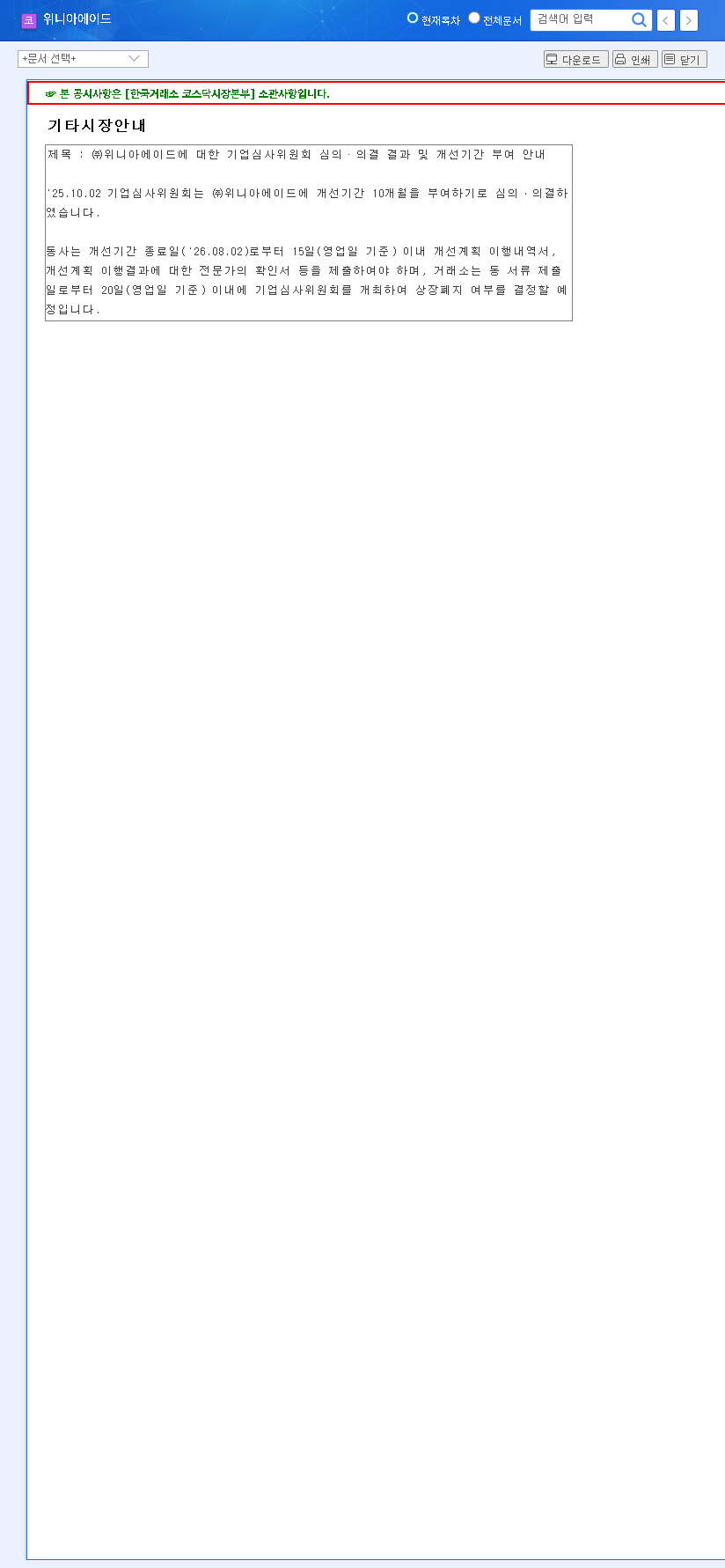
    On October 2, 2025, the Korea Exchange made its long-awaited resolution. As detailed in the Official Disclosure (DART), Winia Aid was granted a crucial Winia Aid improvement period lasting 10 months. This means the company has until August 2, 2026, to implement a comprehensive recovery plan. Following this period, Winia Aid must submit a detailed report on its progress, which will be the basis for the Exchange’s final verdict on its listing status. This provides a structured path forward but keeps the stakes incredibly high.

    The Core of the Crisis: Financial Deterioration and Past Failures

    Understanding the Winia Aid Delisting Risk

    Winia Aid’s troubles are not new. The company’s stock trading has long been suspended due to severe issues, most notably the submission of an audit report with a ‘disclaimer of opinion’. In the world of finance, this is a major red flag, indicating that auditors could not obtain sufficient evidence to form an opinion on the company’s financial statements. This, combined with persistent operational losses, pushed the Winia Aid stock to the brink of delisting.

    The December 2024 business report painted a grim picture: a staggering debt-to-equity ratio of 909.2% and a fragile current ratio of just 26.1%. Sales had plummeted by 57.6% year-over-year, and the company posted a significant operating loss. These figures highlight a company in deep financial distress, making the path to recovery a monumental challenge.

    Rehabilitation and a New Beginning?

    In response to the crisis, Winia Aid initiated rehabilitation proceedings in late 2023. A pivotal step came in August 2025 with the confirmation of its acquisition by the UAMCO-Hyundai Rental Care consortium. This M&A process introduced new leadership and the potential for a capital injection, signaling a fundamental shift in the company’s structure. The success of this corporate rehabilitation now hinges entirely on the new management’s ability to execute a viable turnaround strategy.

    The 10-month improvement period is not a guarantee of success, but rather a final opportunity. The new management’s execution over this period will be the sole determinant of Winia Aid’s future.

    Investment Implications: A High-Risk, High-Stakes Scenario

    For current and potential investors, the situation remains precarious. While the Winia Aid improvement period is a positive development that removes immediate delisting risk, the underlying fundamentals are still weak. The path to maintaining its listing requires tangible proof of recovery. For more information on general delisting procedures, investors can consult authoritative resources like the Korea Exchange (KRX) official guidelines.

    Key Factors to Monitor

    Navigating this period requires careful observation. Investors should focus on the following critical areas:

    • The Improvement Plan’s Viability: The company must present a clear, actionable plan. Vague promises won’t suffice; it needs detailed strategies for improving financial health, boosting profitability, and strengthening its core business.
    • New Management’s Performance: The UAMCO-Hyundai Rental Care consortium’s expertise will be under a microscope. Their ability to steer the company away from past failures and build a sustainable model is paramount.
    • Tangible Financial Turnaround: Monitor quarterly reports for concrete signs of improvement. Look for reduced debt, positive cash flow, and revenue growth. These metrics will be the ultimate proof of recovery.
    • Communication and Transparency: How the company communicates its progress to the market will be crucial for rebuilding trust. Regular, transparent updates are a must.

    In conclusion, while the threat of an immediate Winia Aid delisting has been paused, the journey ahead is arduous. This is a chance to restart, not a guaranteed revival. For a deeper dive into the mechanics of such situations, you can read our guide on understanding corporate rehabilitation processes.

    Frequently Asked Questions (FAQ)

    Q1: What does the 10-month improvement period mean for Winia Aid (377460)?

    It is a grace period granted by the Korea Exchange for Winia Aid to rectify the issues that led to its delisting risk. The company must execute a recovery plan to improve its financial and operational health. At the end of the period, the Exchange will review its progress to make a final decision on its listing status.

    Q2: When can trading of Winia Aid stock resume?

    There is no set date for trading resumption. It can only occur if Winia Aid successfully completes its improvement plan within the 10 months and the Corporate Review Committee decides to maintain its listing. Significant uncertainty remains until that final decision is made after August 2, 2026.

    Q3: Is investing in Winia Aid a good idea now?

    Investing in Winia Aid currently carries extremely high risk. The stock remains suspended and the possibility of delisting still exists if the turnaround fails. The improvement period is an opportunity, not a guarantee. Any investment decision should be made with extreme caution and a thorough understanding of the risks involved.

    (377460) Winia Aid Delisting Averted? Analyzing the 10-Month Improvement Period for Stock (377460) 관련 이미지
  • SysWorks Trading Suspension: A Reprieve or a Prelude to Delisting?


    SysWorks Trading Suspension: A Reprieve or a Prelude to Delisting? 대표 차트 이미지


    What Happened? The SysWorks Trading Suspension Explained

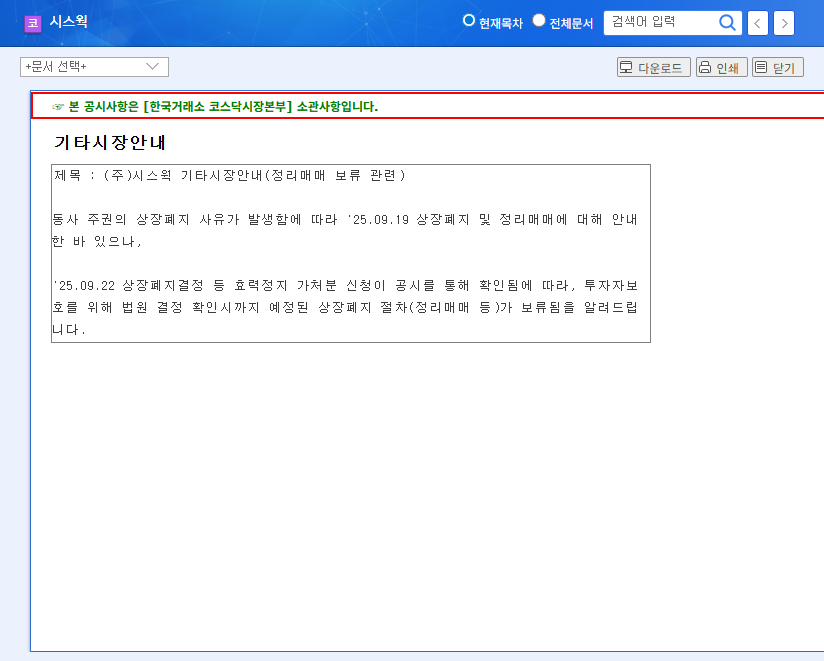
    On September 22, 2025, SysWorks announced that its delisting process has been suspended due to an injunction filed against the delisting decision. The delisting, scheduled for September 19th, has been temporarily postponed.

    Why the Suspension? Deteriorating Fundamentals and Legal Battles

    SysWorks is grappling with severe capital impairment (negative KRW 20.5 trillion), and its core business struggles led to an operating loss of KRW 104.3 billion in the first half of 2025. Restructuring attempts have repeatedly failed, and the company has received three consecutive audit disclaimers. This dire situation led to the delisting decision, which SysWorks is now challenging legally.

    What’s Next? Uncertainty and Opportunity Intertwined

    The trading suspension buys SysWorks some time, but the underlying problems remain. The situation could worsen depending on the court’s final decision. However, if the court rules in SysWorks’ favor or if the restructuring process proves successful, there might be a chance for a turnaround.

    • Positive aspects: Temporary reprieve from delisting, time gained for further action
    • Negative aspects: Continuing deterioration of fundamentals, ongoing uncertainty

    What Should Investors Do? Proceed with Extreme Caution

    Investing in SysWorks carries extremely high risks. Avoid impulsive decisions and closely monitor the court’s decision and the progress of the restructuring process. Existing investors should consider exit strategies, and potential new investors should proceed with extreme caution.


    FAQ

    Why was SysWorks’ trading suspended?

    Trading was suspended due to an injunction filed against the delisting decision, pending the court’s ruling.

    Does the trading suspension mean SysWorks has avoided delisting?

    No. It merely buys the company time. The fundamental problems persist, and the situation could deteriorate depending on the court’s decision.

    Should I invest in SysWorks?

    Investing in SysWorks is extremely risky. Careful consideration is crucial, and seeking professional advice is recommended.


    SysWorks Trading Suspension: A Reprieve or a Prelude to Delisting? 관련 이미지


  • CCS (066790) Injunction Dismissal: A Positive Sign? Key Analysis for Investors!


    CCS (066790) Injunction Dismissal: A Positive Sign? Key Analysis for Investors! 대표 차트 이미지


    What Happened with CCS?

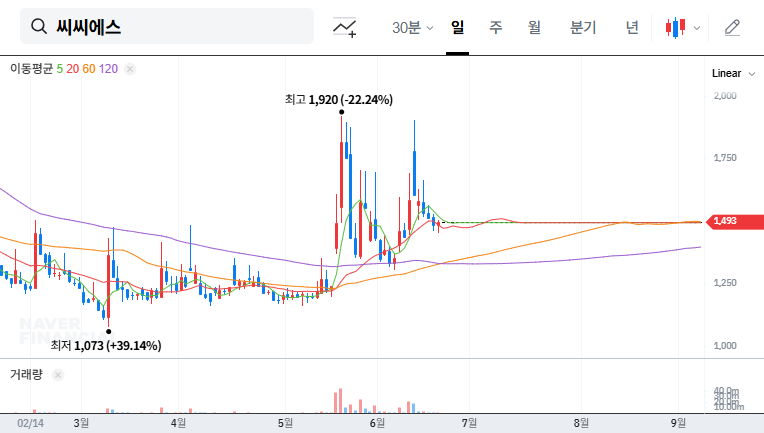
    On September 5, 2025, CCS announced that the court dismissed the injunction application filed against it (2025카합586). While this may appear as a resolution in the management dispute, an appeal has been filed, so it’s too early to be relieved.

    Why is the Dismissal Important?

    In the short term, the dismissal is positive as it reduces uncertainty surrounding the management dispute. However, CCS is still designated as a managed stock and trading remains suspended, with weak fundamentals. Therefore, it’s difficult to conclude that this dismissal alone solves CCS’s fundamental problems.

    What’s Next for CCS?

    • Ongoing Management Dispute: With the appeal filed, the management dispute is still ongoing.
    • Deteriorating Fundamentals: Poor operating performance and weakened financial health pose serious fundamental problems.
    • Delisting Risk: If the reasons for management designation are not resolved, CCS faces the risk of delisting.

    What Should Investors Do?

    Investors should not be swayed by short-term news and should carefully consider their investment decisions by closely monitoring CCS’s fundamental improvements, delisting possibility, and the final outcome of the management dispute. Hasty investments can lead to significant losses.


    FAQ

    Will the dismissal of the injunction positively impact CCS’s stock price?

    It may have a positive impact in the short term, but it’s unlikely to lead to a sustained rise as CCS’s fundamental problems remain unresolved.

    Is there a possibility of CCS being delisted?

    If the reasons for management designation are not resolved, there is a possibility of delisting. Investors should proceed with caution.

    Is it advisable to invest in CCS?

    Currently, investing in CCS carries a very high risk. Careful investment decisions are crucial.


    CCS (066790) Injunction Dismissal: A Positive Sign? Key Analysis for Investors! 관련 이미지


  • Axion Group: Delisting Crisis? Analysis of Substantive Examination Results and Investment Strategy

    1. What’s Happening? : Axion Group’s Substantive Examination Imminent

    Axion Group is facing a decision on whether it will be subject to a substantive examination for listing eligibility on September 5th. If it is determined to be subject to the review, trading will be suspended and additional review procedures will be followed. If not, guidance regarding the lifting of the trading suspension will be provided.

    2. Why is This Happening? : Axion Group Faces Uncertainty Amid Business Diversification Efforts

    Axion Group is pursuing business diversification through the acquisition of MJ Tech Co., Ltd., expanding into machinery equipment, piping construction, and industrial robot businesses to overcome the sluggish e-commerce business. However, the growth potential of the new business is uncertain, and the soaring debt ratio, decreased cash assets, and frequent changes in CEOs raise concerns about the company’s stability. In particular, the high debt ratio of the acquired MJ Tech (362.7%) is a significant burden.

    3. So What Happens Next? : Short-Term Plunge Potential, Long-Term Outlook Uncertain

    In the short term, a sharp drop in stock price is expected due to the possibility of trading suspension and a decline in investor sentiment if the company is determined to be subject to the substantive examination. In the long term, even if trading resumes, whether the company improves its financial soundness and stabilizes its new business will determine the direction of the stock price. If delisted, investors will suffer substantial losses.

    4. What Should Investors Do? : Careful Information Gathering and Risk Management Essential

    • Confirm the announcement of the substantive examination results on September 5th: Investment strategies should be adjusted based on the results.
    • Continuously check for improvements in the company’s fundamentals: Check for positive changes such as a decrease in the debt ratio and securing profitability in the new business.
    • Monitor macroeconomic variables: Pay attention to the impact of external factors such as exchange rate and interest rate fluctuations.
    • Recognize high investment risks and invest cautiously: Careful review and risk management are essential before making investment decisions.
    When will the results of Axion Group’s substantive examination be announced?

    It is scheduled to be announced on September 5th.

    What happens if the company is subject to the substantive examination?

    Trading will be suspended and the company will undergo further review.

    What are Axion Group’s main businesses?

    In addition to its existing e-commerce business, the company is recently attempting to diversify into machinery equipment, piping construction, and industrial robot businesses through the acquisition of MJ Tech.

    What are the precautions for investing in Axion Group?

    Investments should be made cautiously, considering the high debt ratio and uncertainties surrounding the new business.

  • PharmAbcine’s Surprise Earnings: What Investors Need to Know

    1. What Happened? PharmAbcine’s H1 2025 Earnings Release

    PharmAbcine announced its preliminary H1 2025 earnings on August 14, 2025, reporting revenue of KRW 2.1 billion, an operating loss of KRW 3.2 billion, and a net loss of KRW 1.9 billion. These figures significantly exceeded market expectations of KRW 0.

    2. Why Does it Matter? Surprise Earnings and Continued Trading Suspension

    While exceeding revenue expectations is positive, the continued operating loss raises concerns. More importantly, PharmAbcine’s stock remains suspended. The impact of this earnings announcement on the resumption of trading is uncertain.

    3. What Should Investors Do? Key Considerations

    • Information Asymmetry: A clear explanation is needed for the large discrepancy between market expectations and actual results.
    • Business Model Sustainability: Investors must assess the potential for sustainable revenue generation, rather than relying on one-off gains.
    • Trading Suspension: The reasons for the suspension and the plan for resumption are crucial factors to consider.

    4. Investor Action Plan

    Before making any investment decisions, thoroughly evaluate the likelihood of trading resumption, the progress of PharmAbcine’s drug development, and its future revenue model. Investing solely based on the surprising earnings figures could be risky.

    Q: Are PharmAbcine’s surprise earnings a positive sign?

    A: While exceeding revenue expectations is positive, the continued operating loss and trading suspension warrant caution. The possibility of one-time gains cannot be ruled out.

    Q: What is the outlook for PharmAbcine’s stock price?

    A: With trading currently suspended, predicting the stock price outlook is difficult. Significant volatility is expected depending on the resumption of trading and future business developments.

    Q: Should I invest in PharmAbcine?

    A: The investment decision is ultimately up to the individual. However, careful consideration should be given to the likelihood of trading resumption, progress in drug development, and the future revenue model.

  • Medicocks (054180) Stock: Trading Suspension and Disclaimer of Opinion – Urgent Investor Alert!

    1. What’s Happening with Medicocks?

    According to the semi-annual report of 2025, Medicocks received a disclaimer of opinion due to ‘significant doubts about the company’s ability to continue as a going concern.’ This is a serious situation that suggests the possibility of delisting. Furthermore, trading of Medicocks shares has been suspended due to allegations of embezzlement and breach of trust, and the initiation of a delisting review.

    2. Why is This Happening?

    Medicocks is facing a severe financial crisis. As of the first half of 2025, the company recorded sales of 7.6 billion KRW, an operating loss of 1.4 billion KRW, and a net loss of 3.7 billion KRW. It also faces severe capital impairment with accumulated losses of approximately 102.5 billion KRW. The sharp decline in sales in its main businesses, shipbuilding equipment and motors/generators, is also a major problem. Furthermore, new business ventures have yet to show tangible results.

    3. What is the Future of Medicocks?

    The current situation of Medicocks is very bleak. The combination of a disclaimer of opinion, trading suspension, and deteriorating performance makes the company’s survival uncertain. Short-term recovery seems difficult, and the medium- to long-term outlook is also highly uncertain.

    4. What Should Investors Do?

    Investing in Medicocks is currently extremely risky. Extreme caution is required for any potential investment. Investors should closely monitor the resolution of the disclaimer of opinion, the resumption of trading, and the company’s management improvement plan. If you are unable to tolerate these uncertainties, it’s advisable to reconsider your investment or consider cutting your losses.

    What does Medicocks’ disclaimer of opinion mean?

    A disclaimer of opinion signifies that the reliability of the company’s financial statements is questionable. This is a very negative signal for investors and raises the possibility of delisting.

    Can Medicocks shares be traded currently?

    No, trading of Medicocks shares is currently suspended due to allegations of embezzlement and breach of trust and the initiation of a delisting review.

    What is the future outlook for Medicocks?

    Medicocks is facing a severe financial crisis and business downturn, making its future outlook very uncertain. Unless there are positive changes such as the resolution of the disclaimer of opinion, management improvements, and earnings recovery, the possibility of recovery is low.