Tag: Taekwang Industrial

  • (018250) Aekyung Industrial Management Control: A Deep Dive into the Taekwang Acquisition for Investors

    (018250) Aekyung Industrial Management Control: A Deep Dive into the Taekwang Acquisition for Investors

    A seismic shift has occurred in the corporate landscape with the transfer of Aekyung Industrial management control to the formidable Taekwang Industrial Group. This landmark deal, finalized on October 28, 2025, saw Taekwang and its partners acquire a commanding 63.13% stake, fundamentally altering the future of the household goods and cosmetics giant. For investors holding or watching Aekyung Industrial stock, this isn’t just news; it’s a critical inflection point demanding a thorough investor analysis.

    What does this acquisition signal for Aekyung’s beloved brands like AGE20’S and Kerasys? Can the synergy between a chemical conglomerate and a consumer goods company unlock new value, or do unforeseen risks lie ahead? This comprehensive analysis will explore the mechanics of the deal, dissect the potential impacts, and offer a strategic roadmap for navigating this new chapter.

    The Landmark Deal: Taekwang Assumes Aekyung Industrial Management Control

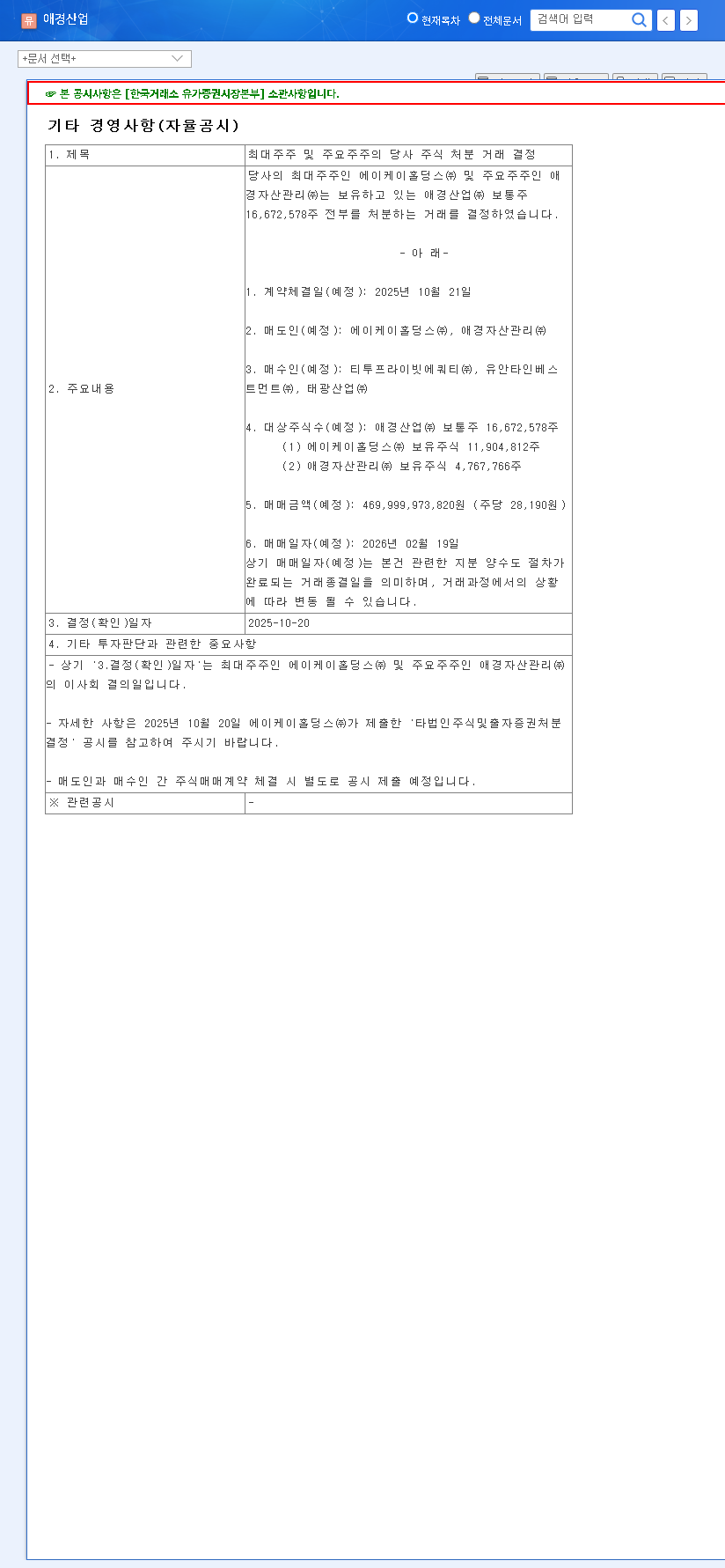
    The change was officially documented in a large shareholding report filed on October 28, 2025. The consortium, led by Taekwang Industrial and including Yuanta Investment and T2 Private Equity, executed an off-market transaction to acquire a 63.13% stake, explicitly for the purpose of influencing and directing management. This move effectively ends an era for Aekyung Industrial and begins a new one under the Taekwang Industrial Group’s strategic vision. The complete details can be reviewed in the Official Disclosure (DART).

    • Acquiring Parties: Taekwang Industrial Group (Taekwang Industrial, Yuanta Investment, T2 Private Equity)
    • Stake Acquired: 63.13% (from a previous holding of 0%)
    • Stated Purpose: To influence and exercise management control.
    • Implication: Full transfer of strategic and operational control.

    Analyzing the Impact on Aekyung Industrial Stock

    For investors, the central question is how this Aekyung Industrial acquisition will affect its valuation and stock performance. The outlook is a blend of significant opportunity and tangible risk.

    Potential Synergies and Upside (The Bull Case)

    The combination of Taekwang’s industrial might with Aekyung’s consumer-facing brands could create powerful synergies. As reported by financial analysts at authoritative sources like Bloomberg, such vertical integrations often unlock value.

    • Vertical Integration: Taekwang’s expertise in chemical materials could lead to cost savings and innovation in raw materials for Aekyung’s cosmetics and household goods.
    • Capital Injection: With the financial backing of a larger group, Aekyung can accelerate R&D, expand its marketing budget, and pursue more aggressive growth strategies, both domestically and internationally.
    • Operational Efficiency: New leadership often identifies and eliminates legacy inefficiencies, potentially improving margins and overall profitability.

    For investors, this acquisition transforms the narrative. The question is no longer just ‘What is Aekyung worth today?’ but rather ‘What can it become with Taekwang’s resources and strategic direction?’

    Navigating the Risks and Uncertainties (The Bear Case)

    Conversely, major corporate transitions are fraught with challenges. Investors must weigh these potential downsides before making any decisions regarding Aekyung Industrial stock.

    • Strategic Uncertainty: The new management’s vision has not been fully articulated. A drastic shift away from Aekyung’s core competencies could alienate its loyal customer base.
    • Corporate Culture Clash: Merging the cultures of an industrial manufacturer and a fast-moving consumer goods company can lead to internal friction, talent loss, and a period of instability.
    • The Humidifier Sterilizer Lawsuit: This significant legal overhang remains a major risk. It is unclear if Taekwang’s involvement will help resolve the issue or potentially expand the liability across the new parent group.

    A Prudent Investment Strategy Moving Forward

    Given the transfer of Aekyung Industrial management control, a passive ‘wait and see’ approach may not suffice. A proactive, informed strategy is essential. This new reality demands a re-evaluation of the company’s long-term prospects, similar to how one might approach a new IPO. For a deeper understanding of market dynamics, you can review our detailed analysis of the consumer goods market.

    Key Actions for Investors:

    • Monitor Communications: Pay close attention to official announcements from the new management team regarding their strategic vision, integration plans, and financial policies.
    • Analyze Financial Filings: Scrutinize upcoming quarterly reports for early signs of improved margins, cost savings, or changes in investment priorities.
    • Adopt a Long-Term View: Short-term stock volatility is almost certain. True value creation (or destruction) will unfold over several quarters. Base decisions on fundamental changes, not daily price swings.
    • Re-evaluate Valuation: The company’s old valuation models may no longer be relevant. It is crucial to build a new thesis based on the potential synergies and risks under the Taekwang Industrial Group.

    Disclaimer: This analysis is for informational purposes only and is based on publicly available data. It does not constitute financial advice. All investment decisions should be made with individual due diligence and consultation with a qualified financial advisor.
    (018250) Aekyung Industrial Management Control: A Deep Dive into the Taekwang Acquisition for Investors 관련 이미지
  • (018250) Aekyung Industrial Major Shareholder Change: In-Depth Analysis of Stock Price & Future Strategy

    (018250) Aekyung Industrial Major Shareholder Change: In-Depth Analysis of Stock Price & Future Strategy

    The landscape for Korean cosmetics and household goods giant Aekyung Industrial Co., Ltd. is undergoing a seismic shift. The recent confirmation of the Aekyung Industrial major shareholder change has sent ripples through the market, sparking intense speculation about the company’s future. With management rights transferring from AK Holdings to a private equity-led consortium, investors and industry watchers are keenly focused on what this means for the Aekyung Industrial stock price and its long-term business trajectory. This comprehensive analysis will break down the deal, explore the potential impacts, and identify crucial watchpoints for stakeholders.

    The Landmark Deal: Details of the Acquisition

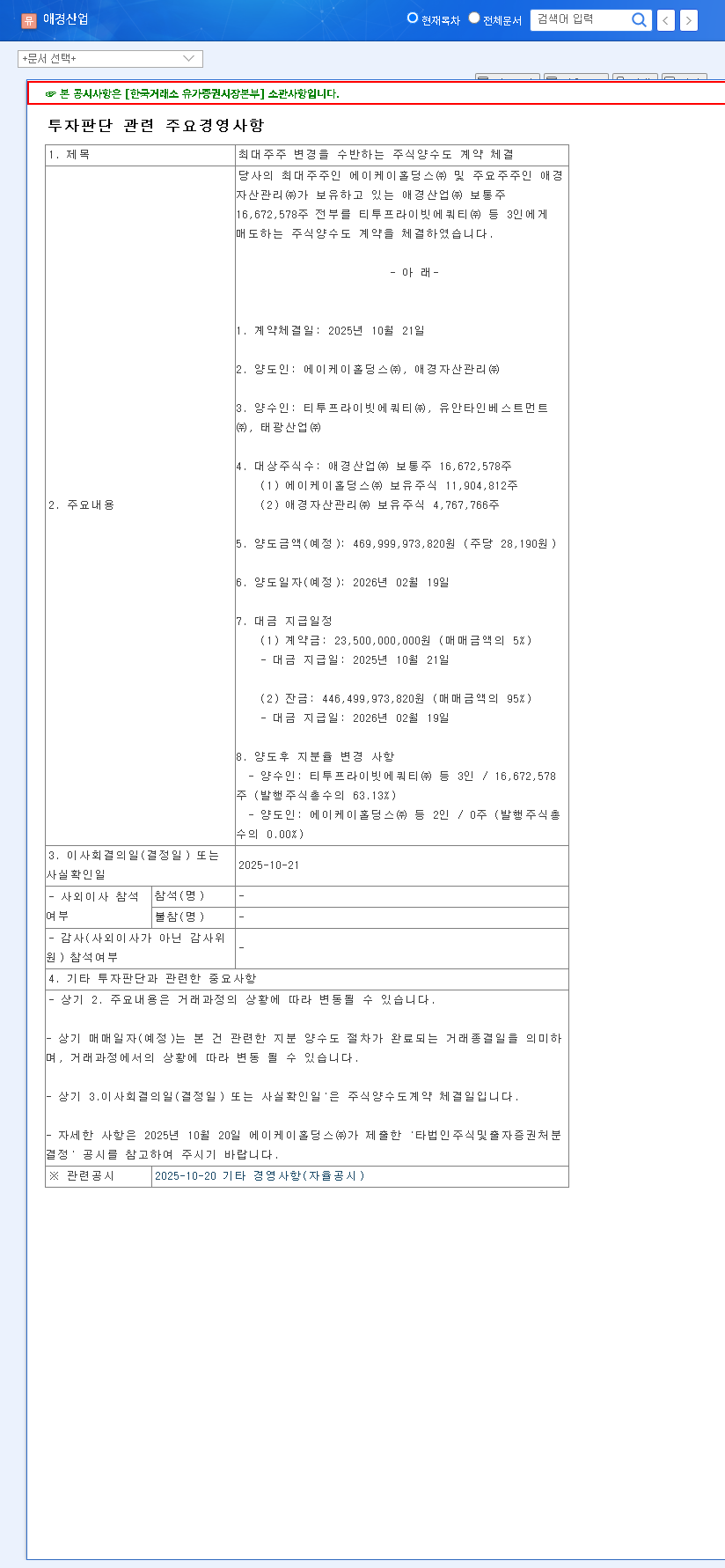
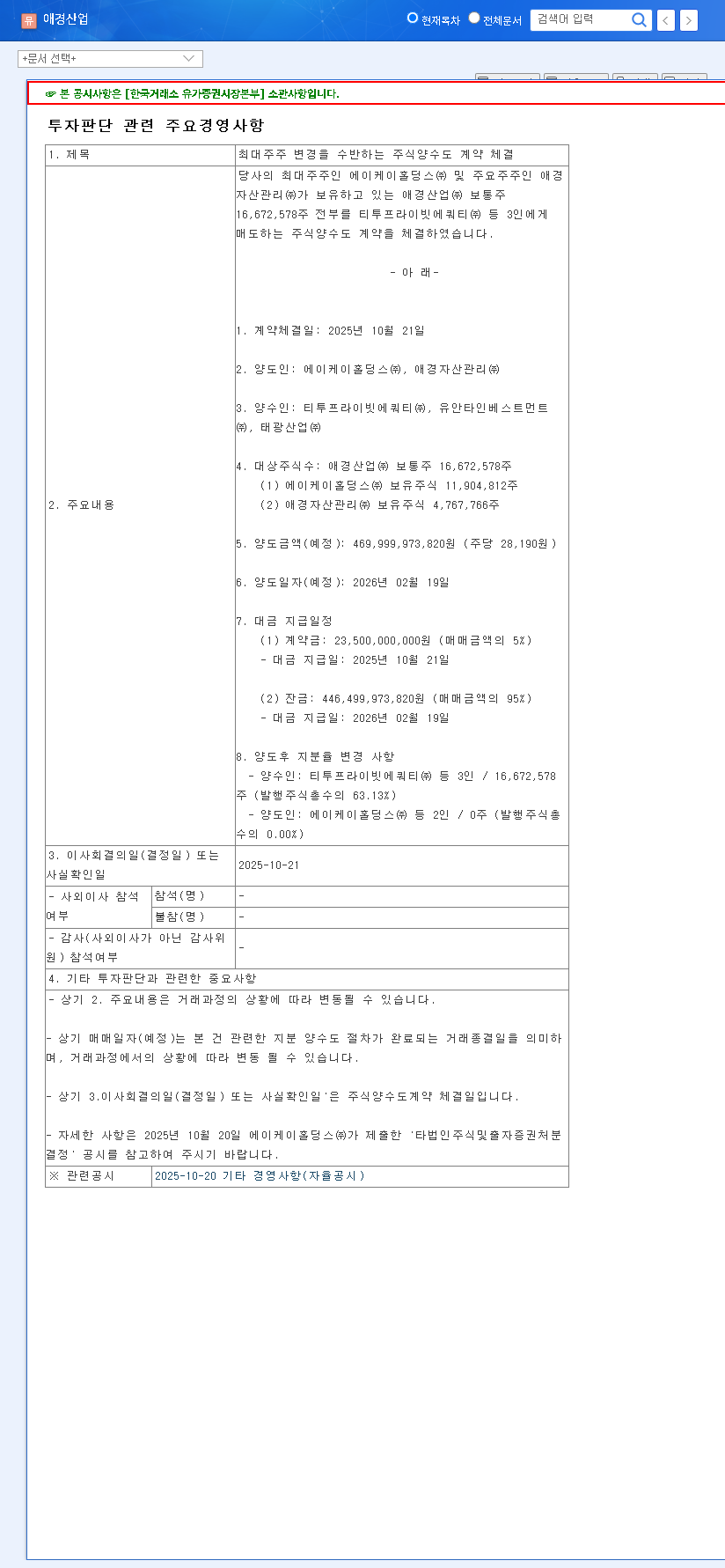
    On October 21, 2025, a definitive stock transfer agreement was signed, marking the end of an era for Aekyung Industrial. The existing majority shareholders, AK Holdings Co., Ltd., and Aekyung Asset Management Co., Ltd., agreed to sell their entire combined stake. This is not just a financial transaction; it’s a complete handover of control.

    Key Transaction Figures

    • Acquiring Entity: A consortium led by T2 Private Equity Co., Ltd., and including Yuanta Investment Co., Ltd., and Taekwang Industrial Co., Ltd.
    • Shares Transferred: 16,672,578 common shares, representing a controlling 63.13% stake.
    • Total Transfer Value (Est.): ₩469.9 billion KRW.
    • Price Per Share: ₩28,190 KRW, representing a significant premium over the market price at the time of announcement.
    • Expected Transfer Date: February 19, 2026.

    The full details of this transaction were made public through the official regulatory filing system. For complete transparency, investors can review the Official Disclosure (DART Report). This Aekyung Industrial acquisition effectively places the future of iconic brands like Kerasys, 2080, and LUNA in the hands of new leadership.

    This isn’t merely a change on the shareholder roster; it’s a fundamental pivot in corporate strategy, driven by private equity’s focus on value creation and operational efficiency. The next 24 months will be critical in defining Aekyung’s next decade.

    Potential Impacts of the New Leadership

    The involvement of a Private Equity Fund (PEF) like T2 Private Equity signals a likely shift from legacy management to a more aggressive, data-driven approach. This can be a double-edged sword, bringing both significant opportunities and notable risks.

    The Upside: A Catalyst for Growth?

    • Strategic Overhaul: The new owners will likely conduct a top-to-bottom review of operations, divesting underperforming assets and doubling down on high-growth areas like digital-native beauty brands and international expansion.
    • Capital Injection: PEFs bring access to new capital, which could fund much-needed R&D, marketing, and technology upgrades to compete more effectively in the fast-paced CPG market.
    • Improved Financial Discipline: A rigorous focus on margins, cost control, and efficient capital allocation could lead to a healthier balance sheet and improved profitability. More information on PEF strategies can be found on authoritative financial sites like Bloomberg.

    The Risks: Uncertainty and Restructuring

    • Short-Term Focus: PEFs operate on a finite investment horizon, typically 5-7 years. This can lead to strategies that prioritize short-term profit for a quick exit over sustainable, long-term brand building.
    • Aggressive Restructuring: To boost efficiency, the new management may implement significant restructuring, which could include workforce reductions or the sale of historic but less profitable business units.
    • Integration Challenges: The synergy between an industrial conglomerate like Taekwang and a consumer goods company like Aekyung is not immediately obvious, which could pose challenges during the post-merger integration phase.

    Investor Checklist: What to Watch Now

    This Aekyung Industrial major shareholder change presents a complex scenario. Investors must move beyond the initial headlines and monitor specific developments. For more on this, see our guide to evaluating post-acquisition company value.

    • Management’s Vision: Look for detailed announcements from the T2 consortium about their 100-day plan and long-term vision. Vague promises are a red flag.
    • Key Executive Appointments: Who will be appointed to the C-suite? Their track record will provide clues about the future direction of the company.
    • Asset Review Announcements: Keep an eye out for news regarding the potential sale of non-core assets or major investments in specific product lines.
    • Market Reaction vs. Fundamentals: Monitor how the Aekyung Industrial stock price reacts to news, but base decisions on fundamental changes in the business, not just market sentiment.

    Ultimately, the sale initiated by AK Holdings marks a pivotal moment. While fraught with uncertainty, it also opens the door to revitalization and renewed growth. Diligent monitoring and a clear-headed assessment of the new management’s actions will be key to navigating this new chapter for Aekyung Industrial.

    (018250) Aekyung Industrial Major Shareholder Change: In-Depth Analysis of Stock Price & Future Strategy 관련 이미지
  • (018250) Aekyung Industrial Stake Sale: A Deep Dive into the ₩470B Deal & Investor Strategy

    (018250) Aekyung Industrial Stake Sale: A Deep Dive into the ₩470B Deal & Investor Strategy

    The South Korean market is abuzz following the monumental news of the Aekyung Industrial stake sale, a transaction signaling a complete transfer of control for the household goods and cosmetics giant. AK Holdings, the largest shareholder, has agreed to sell its entire stake to a consortium, ushering in a new era for the company. This analysis will dissect the deal, explore the potential impacts on the Aekyung Industrial stock price, and provide a strategic framework for investors navigating this pivotal moment.

    This isn’t just a simple transfer of shares; it’s a fundamental shift in governance and strategy. Understanding the players involved and their motivations is crucial for anyone with an interest in Aekyung Industrial’s future trajectory.

    Unpacking the Landmark ₩470 Billion Deal

    The core of this event is the decision by AK Holdings Co., Ltd., and Aekyung Asset Management Co., Ltd. to divest their entire holdings in Aekyung Industrial. This significant move effectively hands over the reins to a new consortium. Here are the critical details of the transaction:

    • Sellers: AK Holdings Co., Ltd. and Aekyung Asset Management Co., Ltd.
    • Buyers: A consortium led by T2 Private Equity Co., Ltd., Yuanta Investment Co., Ltd., and strategic investor Taekwang Industrial Co., Ltd.
    • Shares Transferred: 16,672,578 common shares, representing approximately 38% of the total outstanding shares.
    • Transaction Value: Approximately KRW 469.9 billion, at a price of KRW 28,190 per share.
    • Official Source: The complete details of this transaction are available in the Official Disclosure filed with the regulatory body.

    Who Are the New Architects of Aekyung’s Future?

    The identity of the buyers provides crucial clues about the company’s future. The blend of private equity and a strategic industrial player suggests a multi-pronged approach to value creation.

    The Private Equity Powerhouses: T2 PE & Yuanta Investment

    Private Equity (PE) firms like T2 and Yuanta are not passive investors. Their primary goal is to acquire companies, streamline operations, enhance profitability, and exit the investment at a significant profit within a few years. For Aekyung Industrial, this likely means an intense focus on efficiency, shedding underperforming assets, and aggressive investment in high-growth areas like their successful cosmetics lines. Expect a data-driven approach to management and a potential overhaul of business processes.

    The Strategic Partner: Taekwang Industrial

    Taekwang Industrial’s involvement as a Strategic Investor (SI) adds another layer. Unlike PE firms, SIs typically have a long-term interest driven by business synergy. Taekwang, with its deep roots in the petrochemical and textile industries, could create powerful synergies. This might include supplying raw materials for Aekyung’s chemical products and packaging, collaborating on R&D for new materials, or leveraging shared distribution and manufacturing networks to cut costs.

    Forecasting the Impact of the Aekyung Industrial Acquisition

    Short-Term Impact: Stock Price Uncertainty

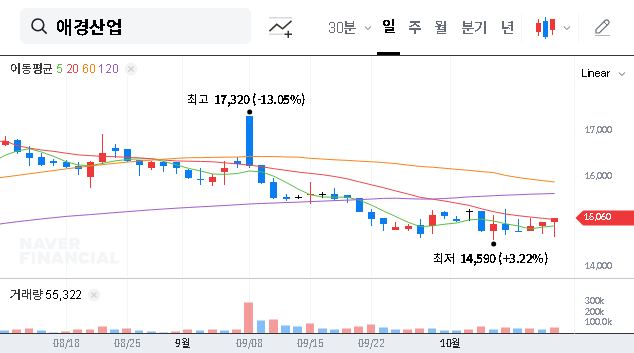
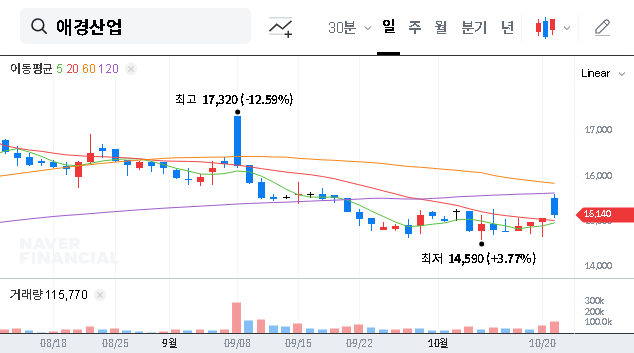
    Major ownership changes often create short-term volatility. The market may react cautiously to the uncertainty of a new Aekyung Industrial management change. Since the sale proceeds go to the former shareholders and not into Aekyung’s treasury, there is no immediate financial boost for the company. This could lead to downward pressure on the stock price until the new management unveils a clear and compelling strategic plan. The sale price of KRW 28,190 per share will serve as a key psychological benchmark for traders.

    Long-Term Outlook: A Catalyst for Revaluation

    The long-term success of the Aekyung Industrial stake sale hinges on the new owners’ ability to unlock value. If the PE-led strategy successfully enhances operational efficiency and the synergies with Taekwang Industrial materialize, Aekyung could see a significant revaluation. This could involve revitalizing established brands, expanding into new international markets, or making bold strategic acquisitions. For long-term investors, the key is to believe in the new leadership’s vision for transforming the company.

    This transaction is a pivotal moment. Investors should shift their focus from the company’s past performance to the strategic capabilities and track record of its new stewards.

    An Investor’s Playbook: How to Respond

    1. Deepen Your Due Diligence

    Go beyond the headlines. Research the past investments and operational strategies of T2 Private Equity and Yuanta Investment. Monitor all future company disclosures and press releases for clues about their strategic direction. It’s also wise to learn more about how to analyze company fundamentals during a management transition.

    2. Formulate a Clear Strategy

    For short-term investors: The expected volatility presents both risks and opportunities. A cautious approach is warranted. Consider setting clear entry and exit points based on technical analysis and news flow as the market digests the full impact of the Aekyung Industrial acquisition.

    For long-term investors: If you have confidence in the new management’s ability to drive growth and efficiency, periods of price weakness could present buying opportunities. Your investment thesis should be based on the long-term potential for value creation, not short-term market noise.

    Disclaimer: This analysis is based on publicly available information. All investment decisions carry risk and should be made based on your own research and judgment.

    (018250) Aekyung Industrial Stake Sale: A Deep Dive into the ₩470B Deal & Investor Strategy 관련 이미지
  • Taekwang Industrial (003240) Investment Analysis: Post-Injunction Dismissal Outlook


    Taekwang Industrial (003240) Investment Analysis: Post-Injunction Dismissal Outlook 대표 차트 이미지


    1. What Happened? – Case Overview

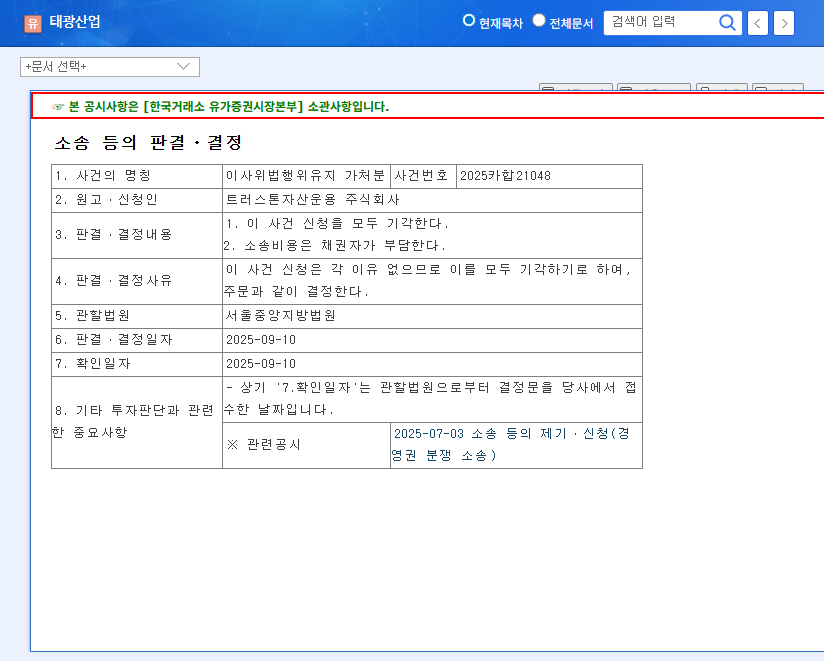
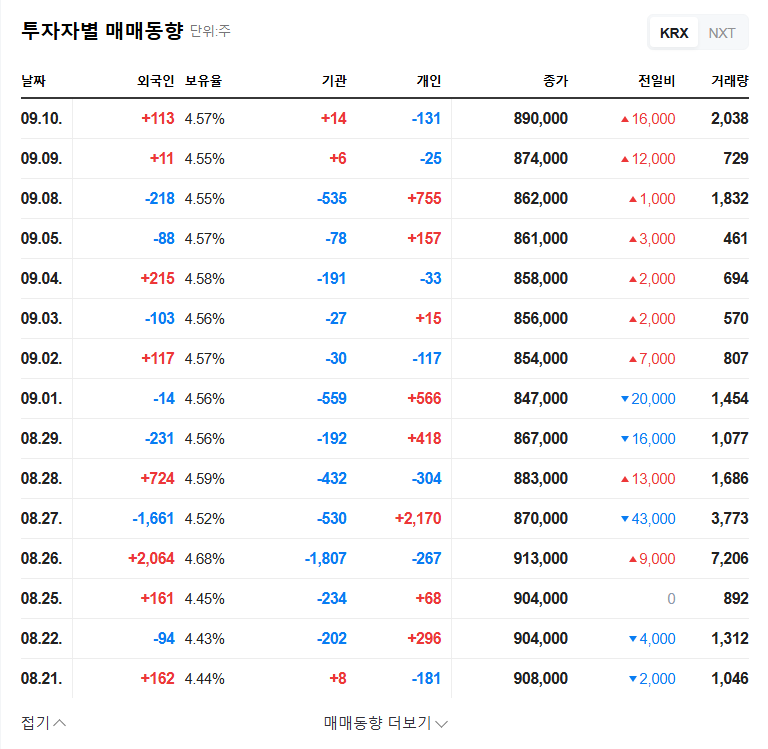
    Taekwang Industrial amended its December 2024 business report regarding its treasury stock. Key changes include revising the purpose of treasury stock holdings from ‘stock price stabilization’ to ‘securing resources in case of contingencies and shareholder return’. Following this, the company decided to dispose of treasury stock to fund new business investments, but this was halted by an injunction filed by Truston Asset Management. However, on September 10, 2025, the court dismissed Truston’s request, ruling in favor of Taekwang.

    2. Why is it Important? – Implications of the Ruling

    This ruling holds significant implications for Taekwang Industrial. In the short term, it is expected to alleviate investor concerns and contribute to stock price stabilization by removing uncertainty related to treasury stock disposal. In the long term, it is projected to positively impact securing growth momentum by facilitating the pursuit of new business investment plans. However, it’s also crucial to note that this ruling could be a starting point for shareholder activism.

    3. Should I Invest in Taekwang Now? – Fundamental Analysis and Future Outlook

    • Fundamentals: Taekwang maintains solid fundamentals, including sales and profit growth, and rising ROE/EPS. However, fluctuations in raw material prices and macroeconomic uncertainties remain risk factors.
    • Future Outlook: A positive trend is expected due to the removal of uncertainty and rising expectations for new business ventures following the dismissal of the injunction. However, the performance of new businesses needs to be monitored.

    4. Action Plan for Investors – Investment Considerations

    Before making investment decisions, carefully monitor changes in macroeconomic indicators, the progress of new business projects, and efforts to enhance shareholder value. This analysis is not an investment recommendation, and the final investment responsibility lies with the individual investor.


    FAQ

    What is the purpose of Taekwang Industrial’s treasury stock disposal?

    Taekwang plans to utilize treasury stock for securing resources in case of contingencies (strategic investments and business expansion) and implementing shareholder return policies.

    Will the dismissal of the injunction positively impact Taekwang’s stock price?

    Yes, in the short term, it’s expected to contribute to stock price stabilization by removing uncertainty, and in the long term, it will likely facilitate new business investments.

    What precautions should I take when investing in Taekwang Industrial?

    Carefully monitor changes in macroeconomic indicators, the progress of new business projects, and efforts to enhance shareholder value. Make investment decisions cautiously.


    Taekwang Industrial (003240) Investment Analysis: Post-Injunction Dismissal Outlook 관련 이미지
    Taekwang Industrial (003240) Investment Analysis: Post-Injunction Dismissal Outlook 관련 이미지


  • Taekwang Industrial: Injunction Filed Against Convertible Bond Issuance – Impact on Investors

    1. What Happened?

    On August 1, 2025, Truston Asset Management filed an injunction against Taekwang Industrial to block the issuance of convertible bonds worth approximately 300 billion won. This is part of Truston’s ongoing shareholder activism and a direct challenge to management decisions.

    2. Why Did This Happen?

    Truston Asset Management has been demanding improvements in Taekwang Industrial’s corporate governance and shareholder value. This injunction is part of that effort, aiming to prevent management from using convertible bonds to defend their control.

    3. What is the Impact on Investors?

    3.1 Short-Term Impact

    • Funding Disruption: If the bond issuance fails, Taekwang’s investment plans could be disrupted.
    • Increased Stock Volatility: Uncertainty surrounding the lawsuit’s outcome could increase stock price volatility.
    • Increased Management Uncertainty: The lawsuit could consume management’s time and resources.

    3.2 Long-Term Impact

    • Potential Corporate Governance Improvements: If Truston’s shareholder activism is successful, corporate governance could improve.
    • Potential Increase in Shareholder Value: Along with corporate governance improvements, shareholder return policies could also improve.
    • Changes in Management Strategy: Depending on the outcome of the lawsuit, changes in management strategy may be inevitable.

    4. What Should Investors Do?

    Investors should closely monitor the outcome of the lawsuit, Taekwang Industrial’s financial situation, and the market environment. It is wise to maintain a conservative investment strategy and make investment decisions after checking additional information. Consulting with a financial advisor is also recommended.

    Frequently Asked Questions

    What are convertible bonds?

    Convertible bonds are bonds that can be converted into shares of the issuing company’s stock.

    What is shareholder activism?

    Shareholder activism is the act of shareholders actively participating in corporate management to increase shareholder value.

    How will the outcome of this lawsuit affect Taekwang Industrial’s stock price?

    In the short term, uncertainty may increase stock price volatility, but in the long term, it has the potential to positively impact through improved corporate governance and increased shareholder value.

  • Taekwang Industrial Acquires 100% Stake in Taekwang Huaxian (Shangshu): China Expansion vs. Financial Burden?

    1. What Happened? 100% Stake Acquisition of Taekwang Huaxian (Shangshu)

    Taekwang Industrial announced on July 30, 2025, that it would acquire a 100% stake in its Chinese subsidiary, Taekwang Huaxian (Shangshu), for 100 billion KRW, representing 2.49% of Taekwang’s capital.

    2. Why This Decision? China Market Expansion and Management Efficiency

    This acquisition is analyzed as a strategy to strengthen Taekwang’s presence in the Chinese market and enhance management efficiency. It appears to be intended to accelerate decision-making and maximize synergy through full subsidiary integration.

    3. So, What’s the Impact? Coexistence of Opportunities and Risks

    • Opportunities: China market expansion, increased management efficiency, synergy creation
    • Risks: Financial burden from the 100 billion KRW investment, China’s economic slowdown and political risks, potential backlash from minority shareholders

    4. What Should Investors Do? Thorough Analysis and Prudent Investment

    Investors should consider Taekwang Huaxian (Shangshu)’s performance, the Chinese market situation, and Taekwang Industrial’s financial status comprehensively. It is important to be aware of the possibility of short-term stock price volatility and to establish an investment strategy from a long-term perspective.

    5. Key Analysis Points

    • Financial status and growth potential of Taekwang Huaxian (Shangshu)
    • Outlook for the Chinese petrochemical market
    • Taekwang Industrial’s financial soundness and funding plan
    • Relationship with minority shareholders and possibility of management disputes

    Frequently Asked Questions

    What is Taekwang Huaxian (Shangshu)?

    Taekwang Huaxian (Shangshu) is a subsidiary of Taekwang Industrial located in China, producing petrochemical products.

    How will this acquisition affect Taekwang Industrial’s stock price?

    In the short term, stock price volatility may increase due to concerns about the financial burden, but in the long term, there is potential for growth due to China market expansion.

    What are the key points to consider when investing?

    Consider the uncertainties in the Chinese market, Taekwang Industrial’s financial burden, and its relationship with minority shareholders.

  • Taekwang Industrial: Impact of Taekwang HwaSum’s Spandex Business Suspension

    1. What Happened? Taekwang HwaSum Suspends Spandex Operations

    Taekwang HwaSum, a subsidiary of Taekwang Industrial, will suspend its spandex business operations starting October 31, 2025. The scale of the suspension is significant, amounting to KRW 94.3 billion, which represents 4.45% of Taekwang Industrial’s total sales.

    2. Why the Suspension?

    The specific reason for the suspension has not been disclosed in the announcement. We will update this information as further details become available.

    3. How Will This Impact Taekwang Industrial?

    3.1 Financial Impact

    • Sales Decrease: Q4 sales are expected to decrease by at least KRW 94.3 billion.
    • Operating Profit Decrease: Decreased sales, coupled with fixed cost burdens and potential discounts on inventory sales, will inevitably lead to a decline in operating profit.
    • Cash Flow: While cash inflow from inventory sales is expected, the suspension of production lines and recovery costs may negatively impact cash flow.

    3.2 Non-Financial Impact

    • Damage to Corporate Image: The suspension raises concerns about the company’s stability and may amplify existing concerns regarding corporate governance, especially considering ongoing conflicts with minority shareholders.
    • Weakened Competitiveness: This provides competitors an opportunity to increase market share, and Taekwang HwaSum may face challenges in recovering its competitiveness after the suspension.
    • Negative Investor Sentiment: Stock price decline and potential withdrawal of foreign investors are likely.

    4. What About External Factors?

    External factors such as exchange rates, raw material prices, interest rates, and the global economic climate can also influence Taekwang Industrial. The USD/KRW exchange rate and crude oil price fluctuations, in particular, warrant close attention.

    5. What Should Investors Do?

    Investors should carefully analyze the short-term and long-term impacts of the suspension and continuously monitor future announcements and news to adjust their investment strategies. It is crucial to pay close attention to the company’s response strategy and its efforts to resolve conflicts with minority shareholders.

    Why is Taekwang HwaSum suspending its spandex business?

    The exact reason has not been disclosed yet. We will update this information as it becomes available through official announcements.

    How will the suspension affect Taekwang Industrial’s stock price?

    A short-term decline in stock price is expected. However, the long-term impact will depend on the company’s response strategy and external factors.

    How should investors react to this news?

    It’s advisable to continuously monitor relevant information, consult with financial professionals, and make informed investment decisions.