Tag: Stock Split

  • (460940) P&S Robotics Bonus Issue: Deep Dive on Stock Price Impact & 2025 Investment Strategy

    (460940) P&S Robotics Bonus Issue: Deep Dive on Stock Price Impact & 2025 Investment Strategy

    The recent announcement of the P&S Robotics bonus issue has captured significant investor attention. On October 24, 2025, the company disclosed a 1:1 bonus issue, effectively doubling the number of outstanding shares. This corporate action, detailed in their Official DART Disclosure, raises a critical question for current and potential shareholders: is this a signal of strength, or merely a financial maneuver? This article provides a comprehensive analysis of the bonus issue’s potential impact on the stock price and outlines a strategic investment approach.

    The core challenge for investors is to look beyond the immediate effects of the bonus issue and assess whether P&S Robotics’ underlying fundamentals can support long-term growth after the inevitable stock price dilution.

    What Exactly is a Bonus Issue?

    A bonus issue, also known as a scrip issue or capitalization issue, is a corporate action where a company distributes additional shares to existing shareholders, free of charge, in proportion to their current holdings. In this case, a 1:1 ratio means for every one share an investor owns, they will receive one new share. It’s crucial to understand that this is fundamentally an accounting adjustment. The company converts its reserves and retained earnings into share capital. As leading financial resources like Investopedia explain, no new cash is raised, and the company’s total market capitalization theoretically remains the same immediately after the issue.

    Companies typically do this to increase the liquidity of their shares by making them more affordable, which can attract a wider base of retail investors. However, it does not inherently increase the value of the company.

    P&S Robotics: A Fundamental Analysis (H1 2025)

    To understand the long-term implications of the P&S Robotics bonus issue, we must first analyze the company’s core health. P&S Robotics is a company with a compelling story but also faces notable headwinds.

    Core Strengths & Opportunities

    • Unique Technology: The company holds a strong competitive moat with its patents in patient-specific gait rehabilitation training robots.
    • Global Expansion: Exports to 16 countries and CE MDR certification provide credibility and a pathway for growth in lucrative overseas markets.
    • Product Diversification: New developments like the Healerbot and Babybot signal an expanding portfolio beyond their flagship products.
    • High Entry Barriers: The technology-intensive nature of the medical robotics industry protects against new competitors.

    Weaknesses & Potential Risks

    • Recent Performance Slowdown: Decreased revenue and operating profit in the first half of 2025 is a significant concern for investors.
    • High Export Dependence: Revenue is vulnerable to exchange rate volatility, particularly with the Euro and USD.
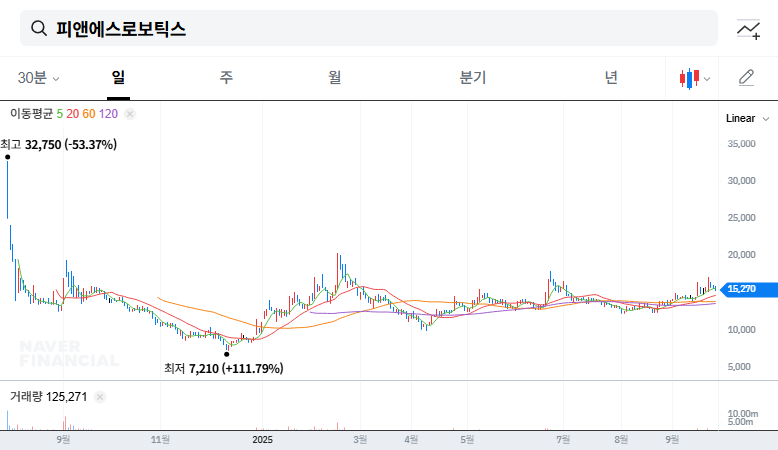
    • Declining Stock Price Trend: The persistent downtrend since its 2024 IPO indicates negative market sentiment that a bonus issue may not fix.
    • Rising Debt: An increase in the debt-to-equity ratio requires careful financial management going forward.

    Projected Impact of the Bonus Issue on Stock Price

    Short-Term Outlook: Dilution and Volatility

    The most immediate and certain effect will be stock price dilution. With double the number of shares, the price per share will theoretically be halved on the ex-bonus date to keep the market capitalization constant. For example, a stock trading at 10,000 KRW would adjust to 5,000 KRW. While this lower price point and increased share count might boost trading volume temporarily, any positive sentiment is likely to be short-lived as the market refocuses on the company’s actual performance.

    Mid- to Long-Term Outlook: Fundamentals are Key

    In the long run, the bonus issue is irrelevant to the company’s value. The stock’s trajectory will be dictated entirely by its ability to execute its business plan. A sustained recovery in stock price will depend on reversing the recent earnings slowdown, achieving commercial success with new products, and effectively managing its balance sheet. Macroeconomic factors, such as currency fluctuations and global interest rate policies, will also play a significant role given the company’s reliance on exports. For a broader view, you can explore our complete guide to the robotics industry.

    Investor Action Plan & Final Verdict

    Given the current context of declining profits and negative stock momentum, the P&S Robotics bonus issue should be viewed with prudence, not excitement. It is not a catalyst for a fundamental re-rating of the stock. Investors should focus on the following key performance indicators to make informed decisions:

    • H2 2025 and 2026 Earnings Reports: Is the company reversing its revenue decline and improving profitability?
    • New Product Revenue: Track the market adoption and sales figures for the Healerbot and Babybot.
    • Financial Health: Monitor the debt-to-equity ratio and cash flow statements for signs of stability or stress.
    • Market Share Growth: Assess whether the company is gaining ground in both domestic and key international markets.

    In conclusion, while the bonus issue increases share liquidity, it does not alter the fundamental investment case for P&S Robotics. A prudent strategy involves careful monitoring of the company’s operational performance before making any investment decisions based on this corporate action.

  • (000670) YOUNGPOONG (000670) Shareholding Change: Analysis, Stock Price Impact & Investment Strategy

    (000670) YOUNGPOONG (000670) Shareholding Change: Analysis, Stock Price Impact & Investment Strategy

    A significant YOUNGPOONG shareholding change has sent ripples through the investment community, signaling potential shifts in management control and creating uncertainty for the company’s future stock price. For investors in YOUNGPOONG CORPORATION (000670), understanding the nuances of this development is not just important—it’s critical. This comprehensive analysis will dissect the official disclosure, explore the underlying motivations, and provide a clear, actionable YOUNGPOONG investment strategy to navigate the path forward.

    The recent ‘Report on Large Shareholding Status’ is more than a procedural filing; it’s a window into the inner workings of the company, revealing a complex interplay of a stock split, insider sales, and dissolved partnerships. We will break down what these changes mean for the company’s stability and your portfolio.

    Decoding the Official Disclosure: A Major Shareholding Shift

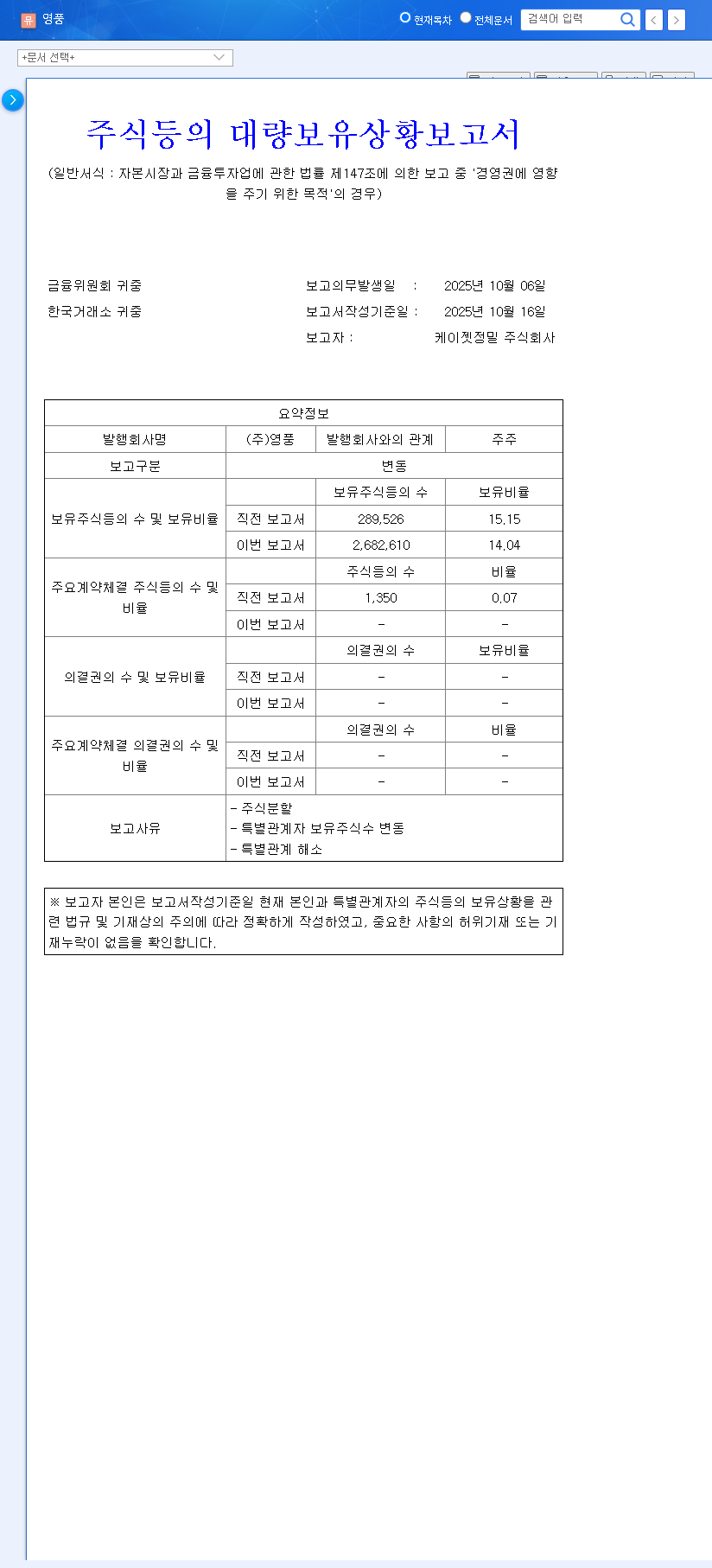
    On October 16, 2025, YOUNGPOONG CORPORATION filed a disclosure that warrants close inspection. The report, filed by K-Jet Precision, whose stated purpose of holding is ‘Influence over Management Rights,’ revealed a notable decrease in their consolidated stake. You can view the full filing here: Official Disclosure (Source: DART).

    Key Details of the Change

    • Reporting Entity: K-Jet Precision and related parties.
    • Previous Stake: 15.15%
    • Current Stake: 14.04%
    • Net Change: A decrease of 1.11%.
    • Notable Action: Key individual Choi Chang-gul sold 6,100 shares on the open market.

    The filing cites three primary reasons for this shift: a recent stock split, changes in shares held by related entities, and the dissolution of a special relationship. This combination of factors points to a significant realignment within the company’s key shareholder group, directly impacting the management control risk profile of YOUNGPOONG.

    Impact on YOUNGPOONG Stock Price: Bull vs. Bear Case

    How will the market digest this news? The implications for the YOUNGPOONG stock price are multifaceted, presenting both potential upsides and significant risks.

    The Bull Case (Potential Positives)

    Optimists may focus on the stock split, which increases the number of outstanding shares and lowers the per-share price. This typically improves liquidity and makes the stock more accessible to retail investors, potentially boosting demand. Furthermore, the dissolution of a ‘special relationship’ could be interpreted as a move toward a more transparent and simplified ownership structure, which the market often views favorably in the long run.

    The Bear Case (Potential Negatives)

    The bearish perspective, however, carries significant weight. The 1.11% stake reduction comes from a block whose stated goal is management influence. This reduction, coupled with open-market sales by a key figure like Choi Chang-gul, is a classic red flag. It suggests a potential loss of confidence or a strategic retreat, which can create a power vacuum and fuel speculation about management instability. Such uncertainty is a primary driver of stock price volatility and can lead to a sell-off as investors price in the heightened risk.

    While a stock split offers a cosmetic boost, the underlying signal from an insider sale and a reduced influential stake often speaks louder. The market’s immediate reaction will likely hinge on concerns over future management stability.

    A Strategic YOUNGPOONG Investment Strategy for Investors

    Given the uncertainty surrounding the YOUNGPOONG shareholding change, a prudent and analytical approach is required. Hasty decisions are ill-advised. Instead, focus on gathering more intelligence with the following action plan:

    • Analyze Corporate Fundamentals: Look beyond this single event. Scrutinize YOUNGPOONG’s latest financial statements. Is revenue growing? Are profit margins stable? A strong fundamental backdrop can help a company weather periods of management uncertainty. Check data from authoritative sources like Bloomberg for a comprehensive financial overview.
    • Monitor Insider and Institutional Activity: Choi Chang-gul’s sale is one data point. Continue to monitor for any further sales or purchases by insiders and large institutions. A pattern of selling is a much stronger signal than a one-off transaction.
    • Review Analyst Reports: Check recent reports from brokerage firms for their take on this 000670 analysis. Analysts may have insights into the relationships between the key players that are not publicly available.
    • Assess Technical Indicators: Pay close attention to the stock chart. Look for signs of support or resistance levels breaking, and monitor trading volume. Unusually high volume on down days can signal institutional selling. If you are new to this, learn more about key technical analysis patterns.

    Frequently Asked Questions (FAQ)

    Q1: What was the exact impact of the recent YOUNGPOONG shareholding change?

    The total stake of K-Jet Precision and its related parties decreased by 1.11%, from 15.15% to 14.04%. This is significant because this entity’s stated goal is influencing management, so a reduction suggests a shift in their strategic position.

    Q2: Why is Choi Chang-gul’s stock sale a concern for investors?

    The sale of 6,100 shares by a key individual involved with an influential shareholder group can be interpreted as a negative signal. It may indicate his personal lack of confidence in the company’s short-term prospects or be part of a larger strategic exit, raising questions about future stability.

    Q3: How should this event shape my YOUNGPOONG investment strategy?

    This event introduces a high degree of uncertainty. A cautious approach is best. Investors should prioritize further research into the company’s fundamentals and monitor market sentiment and insider activity before making any new investment decisions. The key is to wait for more clarity on the management control situation.

    (000670) YOUNGPOONG (000670) Shareholding Change: Analysis, Stock Price Impact & Investment Strategy 관련 이미지
  • (060900) DGP Stock Split (060900): A Deep Dive Analysis for Investors in 2026

    (060900) DGP Stock Split (060900): A Deep Dive Analysis for Investors in 2026

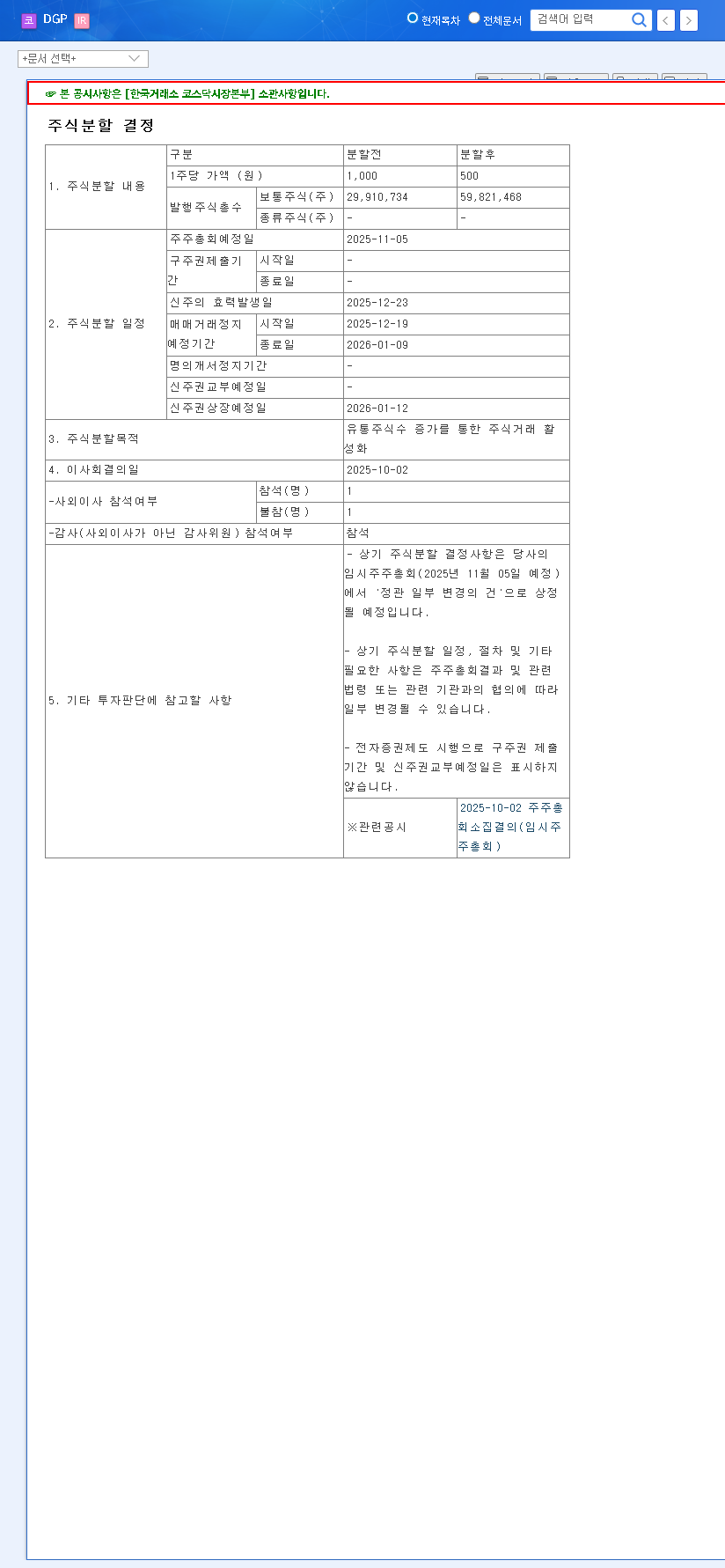
    The recent announcement of the DGP stock split has captured significant attention in the investment community. With the share par value set to halve from 1,000 KRW to 500 KRW, many investors are wondering if this makes DGP (060900) a more attractive buy. However, a lower price tag doesn’t automatically signal a better investment. This comprehensive analysis will look beyond the surface to examine what this corporate action truly means for shareholders, delving deep into the company’s fundamentals, prevailing market conditions, and the critical factors you must consider before making a decision.

    We’ll break down the potential benefits, the underlying risks, and provide a clear, actionable outlook for anyone considering an investment in DGP post-split.

    Understanding the DGP Stock Split Mechanics

    First, let’s clarify what a stock split is and what it isn’t. A stock split increases the number of a company’s shares outstanding while proportionally decreasing the price per share. Think of it like cutting a pizza: you can have four large slices or eight smaller ones, but you still have the same amount of pizza. The company’s total market capitalization and intrinsic value remain unchanged by the split itself. For a detailed explanation, you can read this guide from a high-authority financial education site.

    Key Dates and Details for DGP’s Split

    On October 2, 2025, DGP’s board announced its decision to proceed with a stock split. Here is the official timeline investors should be aware of:

    • Shareholder Approval: The decision is slated for approval at the General Meeting of Shareholders on November 5, 2025.
    • Trading Halt: Trading of DGP stock will be paused starting December 19, 2025.
    • Relisting Date: The stock is scheduled to be relisted and resume trading on January 12, 2026, at the new, split-adjusted price.

    Fundamental Analysis: The Story Behind the Split

    A DGP stock split cannot fix underlying business challenges. A thorough DGP stock analysis requires looking at the company’s health, strategy, and risk factors, much of which is detailed in the company’s disclosure. According to the Official Disclosure, several key areas warrant investor caution.

    Growth Strategy vs. Financial Burden

    DGP is strategically diversifying into promising sectors like green hydrogen, EV charging, and Energy Storage Systems (ESS). While this signals long-term ambition, these ventures are capital-intensive and carry significant market and technological risks. The financial burden from these new investments is a major concern, especially with the company’s current financial state. For more on this, consider reading our guide on how to analyze a company’s financial health.

    Financial Health and Glaring Risk Factors

    The H1 2025 report revealed several red flags. Most notably, cash flow from operating activities has worsened, a critical indicator of a company’s ability to generate cash from its core business. Furthermore, the company is saddled with risks from convertible bond obligations, ongoing litigation, and a concerning history of disingenuous disclosures, which has eroded investor trust.

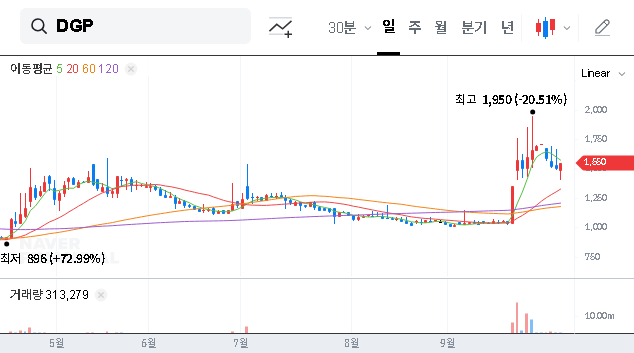
    While the stock price has fallen from over 12,000 KRW in 2020 to around 1,197 KRW in late 2024, this decline reflects deep-seated business uncertainties and performance that has consistently fallen short of market expectations.

    Potential Impact of the DGP Stock Split

    The Potential Positives

    • Increased Liquidity: A lower share price can make the stock more accessible to retail investors, potentially boosting trading volume.
    • Broader Investor Base: The psychological effect of a ‘cheaper’ stock could attract new market participants who were previously deterred by a higher price point.
    • Positive Signal (Short-Term): Some may interpret the split as a sign of management’s confidence, which could provide a temporary boost to sentiment.

    The Overriding Negatives and Limitations

    • No Change in Fundamental Value: The split does not impact the company’s assets, revenue, or profitability. The pie is the same size, just cut into more pieces.
    • Fundamentals Still Weak: The core issues—poor cash flow, investment risks, and a trust deficit—remain. The split is a distraction, not a solution.
    • Limited Price Upside: Without tangible improvements in business performance, any price rally from the split is likely to be short-lived and unsustainable.

    Conclusion: A Neutral Event Demanding Caution

    The DGP stock split is best viewed as a neutral event. It is a cosmetic change that fails to address the significant fundamental challenges confronting the company. A sustainable increase in shareholder value will not come from this split, but from management’s ability to execute on its growth strategy and fix its financial foundation.

    Investors should focus on the following key areas for any real DGP investment thesis:

    • Tangible Results: Look for concrete revenue and profit from the new hydrogen and EV charging businesses.
    • Financial Improvement: Monitor operating cash flow and debt levels in subsequent quarterly reports.
    • Restoring Trust: Demand transparent and credible communication from management to rebuild confidence.

    Ultimately, the responsibility for investment decisions rests with the individual. This report is intended to provide an objective perspective based on available information.

    (060900) DGP Stock Split (060900): A Deep Dive Analysis for Investors in 2026 관련 이미지
  • Kangnam Jevisco (000860) H1 2025 Earnings Analysis: Hidden Opportunities Amidst Uncertainty?

    1. What Happened? H1 2025 Performance Analysis

    Kangnam Jevisco recorded sales of KRW 161.6 billion, operating profit of KRW 6.4 billion, and net income of KRW 5.3 billion in H1 2025. Both sales and profitability decreased compared to the same period last year, with a particularly noticeable decline in the paint segment. Conversely, the synthetic resin segment maintained solid profitability, and the composite molding materials segment showed improved efficiency.

    2. Why These Results? Reasons for the Underperformance

    The sluggish performance of the paint segment is primarily attributed to declining demand in downstream industries due to macroeconomic factors such as the global economic slowdown, increased trade barriers, and deteriorating financial conditions. The downturn in paint-demanding industries like construction, shipbuilding, and automotive directly impacted the results. On the other hand, the strong performance of the synthetic resin segment can be attributed to successful strategies in developing eco-friendly and high-value-added products and expanding overseas markets.

    3. What’s Next? Future Outlook and Opportunities

    The performance in the second half hinges on the recovery of the paint segment. The steady growth of the synthetic resin segment and efficiency improvement efforts in the composite molding materials segment are positive factors. Increased liquidity from the stock split and continuous R&D investment are expected to act as mid- to long-term growth momentum.

    4. What Should Investors Do? Action Plan

    Investors should closely monitor the recovery of the paint segment, the performance of new products, and the maintenance of competitiveness in the synthetic resin segment. It is crucial to make informed investment decisions by continuously monitoring quarterly earnings announcements and changes in macroeconomic indicators.

    Q: How did Kangnam Jevisco perform in the first half of 2025?

    A: Sales were KRW 161.6 billion, operating profit was KRW 6.4 billion, and net income was KRW 5.3 billion, all showing a decline compared to the same period last year. The paint segment’s underperformance was particularly pronounced.

    Q: What were the main reasons for the decline in performance?

    A: The main reasons were declining demand in downstream industries due to the global economic slowdown, particularly the downturn in paint-demanding industries such as construction, shipbuilding, and automotive.

    Q: What is the outlook for Kangnam Jevisco?

    A: The recovery of the paint segment will be key. The growth of the synthetic resin segment and R&D investments are positive factors. Investors should monitor quarterly earnings and macroeconomic indicators.

  • LTC Announces Shareholder Return Policy: Cash & Stock Dividends + Stock Split

    1. What is LTC’s Shareholder Return Policy?

    On July 31, 2025, LTC announced plans to increase cash dividends, distribute LSE stock dividends, and implement a stock split to enhance shareholder value.

    • Cash Dividends: Dividend payout ratio increased to at least 15% (starting from FY2025), and 50% of LSE’s dividends will be distributed to LTC shareholders (assuming LSE is listed).
    • Stock Dividends: 10% of LSE’s IPO shares will be distributed as stock dividends to LTC’s common shareholders (excluding major shareholders and related parties, assuming LSE is listed).
    • Stock Split: A 100-200% stock split will be implemented to increase LTC’s trading volume (concurrently with cash/stock dividends).

    2. LTC Fundamentals and Market Conditions

    LTC’s Q1 2025 earnings were weaker year-over-year, but the order backlog for the equipment business is positive, and there is growth potential in new businesses. The current KRW/USD and KRW/EUR exchange rates are stable, but rising raw material prices and interest rates could impact LTC’s performance. The long-term growth outlook for the display and semiconductor industries is positive, but increased competition should be considered.

    3. How Will the Shareholder Return Policy Affect LTC’s Stock Price?

    Increased cash dividends could improve investor sentiment, but the actual dividend amount may vary depending on future earnings. LSE stock dividends offer additional investment opportunities, but LSE’s growth and listing status are key variables. The stock split could increase liquidity but also has the potential to dilute share prices.

    4. Investor Action Plan

    LTC’s shareholder return plan could be positive for the stock price in the short term, but investors should consider the potential dilution effect of the stock split and the uncertainty surrounding LSE’s listing and performance. It’s crucial to continuously monitor information related to LSE, LTC’s future earnings announcements, and market reactions to develop an effective investment strategy.

    LTC Shareholder Return Policy FAQs

    When will LTC shareholders start receiving increased cash dividends?

    The increased cash dividends, with a payout ratio of at least 15%, will be distributed starting from the fiscal year 2025.

    Who is eligible for the LSE stock dividends?

    Assuming LSE is listed, LTC’s common shareholders, excluding major shareholders and related parties, will be eligible for the LSE stock dividends.

    What is the potential impact of the stock split on the share price?

    The stock split will increase the number of outstanding shares, improving liquidity, but it also has the potential to dilute the share price.