Tag: Stock Disclosure

  • (225530) HC BoKwang Industry Stock Analysis: Shareholder Hope vs. Financial Reality

    The latest disclosure from HC BoKwang Industry Co.,Ltd (보광산업) has sent mixed signals across the market. On one hand, the company’s largest shareholder, HC Homesenta, has increased its stake—a move typically seen as a vote of confidence. On the other, the company is grappling with a severe financial downturn, marked by plummeting revenue and a worrying shift to operating losses in the first half of 2025. This raises a critical question for investors: Is this a sign of a coming turnaround or a minor positive in a sea of red flags?

    This comprehensive investment analysis delves into the nuances of HC BoKwang Industry’s current situation. We’ll dissect the shareholder filing, scrutinize the alarming financial performance, and explore the profound impact of the ongoing construction market downturn to provide a clear, actionable outlook on the company’s stock and future prospects.

    The Shareholder Stake Increase: A Closer Look

    On November 13, 2025, a public disclosure revealed a change in the equity held by HC BoKwang Industry’s primary shareholder, HC Homesenta. According to the Official Disclosure (DART), the stake saw a minor increase.

    Key Details of the Change

    • Previous Stake: 68.48%
    • New Stake: 68.58%
    • Net Change: +0.10%

    This adjustment was the result of on-market purchases, inheritance, and modifications to stock collateral agreements. Typically, an increase in a major shareholder’s position is a bullish signal, suggesting insider confidence and a commitment to long-term management stability. However, the fractional nature of this increase mutes its impact, especially when viewed against the company’s daunting financial performance.

    Analyzing the HC BoKwang Industry Financial Crisis: H1 2025

    The positive sentiment from the shareholder news is immediately overshadowed by the stark reality of HC BoKwang Industry’s first-half performance in 2025. The numbers paint a picture of a company under immense pressure, primarily due to a severe contraction in its core markets.

    The fundamentals are deeply concerning. A near 50% drop in revenue and a swing to a significant operating loss indicate that the company’s core business model is currently unprofitable amidst the market headwinds.

    Performance Breakdown

    • Revenue Collapse: The company reported revenue of just KRW 18.428 billion, a staggering 47.66% decrease compared to the previous year.
    • Operating Loss: HC BoKwang Industry transitioned from profit to an operating loss of KRW 1.681 billion.
    • Aggregates Business Crisis: The aggregates segment, a core pillar, saw its utilization rate plummet to a mere 16.49%, contributing a massive KRW 2.608 billion operating loss.
    • Worsening Debt Profile: The debt-to-equity ratio rose to 79.79%, and a KRW 20 billion convertible bond issuance looms, adding significant pressure to its balance sheet and short-term liquidity.

    The Root Cause: A Crippling Construction Market Downturn

    The struggles of HC BoKwang Industry are not happening in a vacuum. They are a direct symptom of a broader, systemic construction market downturn. Factors such as high interest rates, inflated material costs, and stalled real estate projects have decimated demand for essential construction materials like ready-mixed concrete, aggregates, and asphalt—the company’s primary products.

    As major construction projects are delayed or cancelled, demand for these materials evaporates, leaving suppliers with idle factories and mounting fixed costs. This is evident in HC BoKwang’s extremely low production capacity utilization across all segments. For a deeper understanding of market dynamics, investors can review analyses from authoritative sources like global economic reports from Reuters.

    Investment Outlook and Strategy

    Given the circumstances, what is the prudent investment strategy for the HC BoKwang Industry stock? While the shareholder confidence is a minor positive, it is far outweighed by severe fundamental weaknesses.

    Key Factors to Monitor

    • Macroeconomic Recovery: The company’s fate is inextricably linked to a rebound in the construction sector. Watch for signs of interest rate stabilization and renewed project funding.
    • Management’s Turnaround Plan: The company must demonstrate aggressive and effective strategies for cost reduction, business restructuring, and profitability enhancement.
    • Debt Management: How the company handles the financial burden from its debt and the KRW 20 billion convertible bond will be critical for its survival and recovery.

    In conclusion, a highly conservative and cautious approach is warranted. The shareholder stake change is not enough to offset the deep-seated operational and financial challenges. Investors should remain on the sidelines, closely monitoring for tangible signs of improvement in both the company’s performance and the wider market. To learn more about evaluating companies in this sector, you can read our guide on how to analyze construction sector stocks.

  • (407400) GGUMBI Inc. (407400) Shareholding Change: A Deep Dive Stock Analysis

    (407400) GGUMBI Inc. (407400) Shareholding Change: A Deep Dive Stock Analysis

    A significant development has emerged for investors tracking the baby products market: a disclosure concerning a GGUMBI Inc. shareholding change. The company (KRX: 407400), a prominent name in high-quality baby gear, announced an adjustment in the stake held by CEO Park Young-geon and related major shareholders. This event, while seemingly minor on the surface, offers a crucial window into the company’s internal confidence, management stability, and long-term strategic direction. This comprehensive GGUMBI stock analysis will dissect the disclosure, evaluate the company’s robust fundamentals, and provide a clear outlook for current and potential investors.

    The Core Event: Unpacking the Shareholder Disclosure

    On November 12, 2025, GGUMBI Inc. filed a mandatory Report on the Status of Large Shareholding of Stocks. The central takeaway from this report is a modest but meaningful increase of 0.40 percentage points in the stake held by CEO Park Young-geon and affiliated parties, moving their collective ownership from 38.60% to 39.00%. You can view the complete filing here: Official Disclosure (DART).

    This adjustment wasn’t a simple open-market purchase. It resulted from a combination of financial activities, including the extension of existing stock collateral agreements, strategic open market sales by some related parties, and a change in the total number of outstanding shares following a stock cancellation initiative aimed at boosting shareholder value.

    While the 0.40% increase seems small, it’s a powerful signal. An insider increase, especially from the CEO, often demonstrates a strong belief in the company’s future prospects and reinforces management’s commitment to long-term growth.

    Fundamental & Market Context for the 407400 Stock

    GGUMBI’s Strengthening Financial Health

    The GGUMBI Inc. shareholding change occurs against a backdrop of solid fundamental improvement. A review of the company’s 2025 half-year report reveals several positive trends:

    • Portfolio Diversification: Strategic expansion through consolidated subsidiaries is reducing reliance on a single product category and opening new revenue streams.
    • Improved Financial Structure: The company is maintaining a healthy balance sheet and stable financial position, crucial for weathering economic shifts.
    • Profitability Turnaround: GGUMBI has successfully returned to operating profit, demonstrating effective cost management and sustained revenue growth.

    Furthermore, the company is actively capitalizing on the resilient growth of the global baby products market by enhancing its proprietary brands and pushing for greater international market penetration. For more on this sector, see this in-depth report on baby care market trends.

    Macro-Economic Tailwinds and Headwinds

    Several external factors could influence GGUMBI’s performance. An anticipated trend of interest rate cuts in late 2025 could lower financing costs and boost investor sentiment. Conversely, volatility in international oil prices and freight indexes (like the China Containerized Freight Index) presents a risk, potentially impacting raw material and logistics costs for a company with a global supply chain.

    Investment Thesis: What This Means for Your Portfolio

    Impact on Stock Price and Stability

    This specific shareholding adjustment is unlikely to be a catalyst for dramatic short-term price swings. Its true value lies in reinforcing the investment narrative. The move bolsters management stability, assuring investors that the current leadership, which has guided the company to profitability, remains firmly in control and invested in its success. The long-term trajectory of the 407400 stock will be dictated more by sustained earnings growth and successful market expansion than this single event.

    Positive Factors vs. Risk Factors

    When conducting a GGUMBI stock analysis, it’s crucial to weigh the opportunities against the challenges.

    Key Strengths:

    • Proven management with a vested interest in the company’s success.
    • Strong, improving fundamentals with clear revenue and profit growth.
    • Strategic positioning in a durable and growing consumer market.

    Risks to Monitor:

    • Long-term demographic trends, such as declining birth rates in key markets.
    • Intensifying competition from both local and international brands.
    • Financial overhang from convertible bonds that could dilute equity if converted.

    Final Verdict & Investor Strategy

    The recent GGUMBI Inc. shareholding change is a net positive for the company’s investment case, primarily as a confirmation of leadership stability. For investors, the focus should remain on the bigger picture: the company’s ability to continue executing its growth strategy. Monitor quarterly earnings for continued profitability, watch for announcements on new market entries or product lines, and keep an eye on the macroeconomic factors mentioned. This event reinforces the idea that GGUMBI is a company with confident leadership at the helm, navigating a promising but competitive market. For a more detailed breakdown, you can read our Complete Guide to Investing in Consumer Goods Stocks.

    Disclaimer: This article is for informational purposes only and does not constitute investment advice. All investment decisions should be made based on your own research and judgment.

    (407400) GGUMBI Inc. (407400) Shareholding Change: A Deep Dive Stock Analysis 관련 이미지
    (407400) GGUMBI Inc. (407400) Shareholding Change: A Deep Dive Stock Analysis 관련 이미지
  • (100120) Vieworks Stock Analysis (2025): A Deep Dive into Bearings AM’s Stake Sale & H1 Report

    (100120) Vieworks Stock Analysis (2025): A Deep Dive into Bearings AM’s Stake Sale & H1 Report

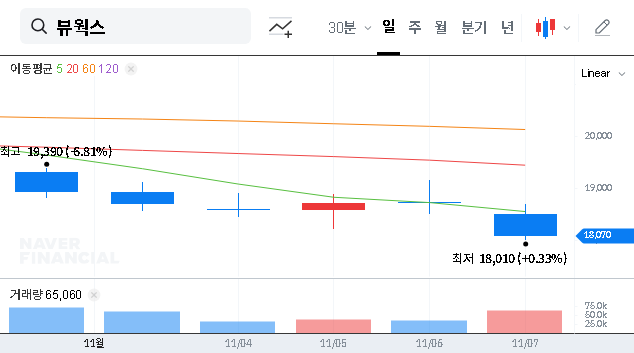
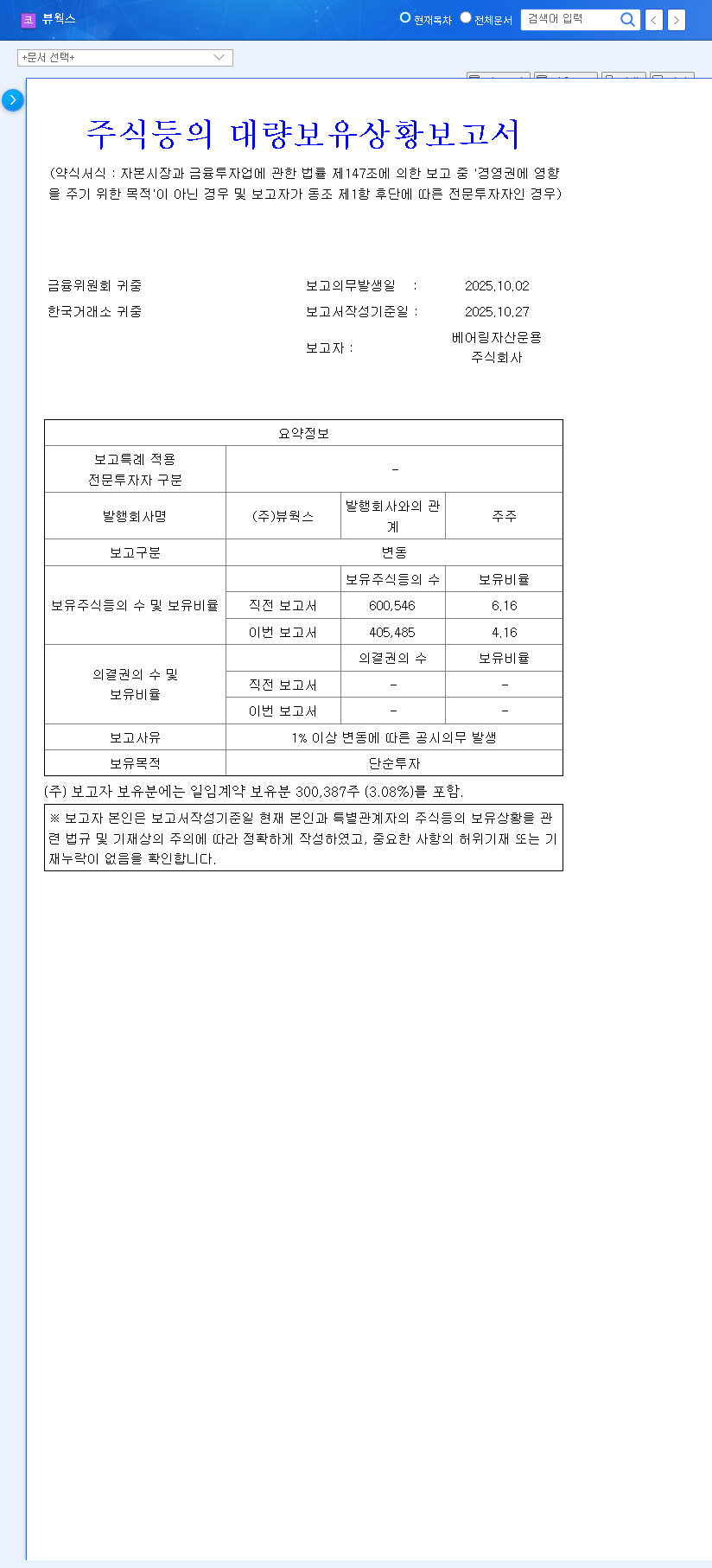
    This comprehensive Vieworks stock analysis for 2025 addresses a critical question shaking investor confidence: is a major stakeholder’s recent share reduction a warning sign? On November 7, 2025, a significant disclosure revealed that Bearings Asset Management, a prominent institutional investor, cut its stake in Vieworks Co., Ltd. from 6.16% to 4.16%. This 2-percentage-point drop, officially documented in a ‘Report on the Status of Large Shareholdings’ (Official Disclosure), has naturally created apprehension about the company’s future performance.

    Is this a strategic portfolio rebalance, or does it point to underlying weakness? To answer this, we will perform an in-depth analysis of Vieworks’ fundamentals, using its H1 2025 report as our guide. By examining its business performance, financial health, and the broader macroeconomic landscape, we aim to provide a clear, data-driven perspective for current and potential investors in Vieworks Co., Ltd.

    Unpacking Bearings Asset Management’s Stake Reduction

    The disclosure filed on November 7, 2025, confirmed that Bearings Asset Management‘s holding in Vieworks fell below the 5% threshold, a key reporting level. The shares were held within two specific funds: the ‘Bearings High Dividend Balanced 60’ and ‘Bearings High Dividend’ funds. The stated purpose of the holding was ‘simple investment.’ While this term suggests the investment was not for management control, a significant reduction by a respected institution often triggers market uncertainty and can lead to short-term selling pressure as retail investors follow the institutional lead.

    Fundamental Health: A Vieworks Stock Analysis of the H1 2025 Report

    To determine if Bearings AM’s move is justified by company performance, we must look directly at the numbers and strategic initiatives outlined in the Vieworks H1 2025 report. The company’s health appears multifaceted, with strong growth in some areas and notable risks in others.

    Core Business Performance and Growth Drivers

    Vieworks operates in the high-tech space of digital imaging solutions, primarily serving the medical (79% of business) and industrial (21%) sectors. In the first half of 2025, the company generated revenue of KRW 117.1 billion and an operating profit of KRW 8.6 billion.

    • Industrial X-ray Detectors: This segment was a standout performer, posting a significant revenue increase fueled by new client acquisition and robust market demand, particularly in sectors like non-destructive testing for EV batteries.
    • Medical Imaging Solutions: While facing slight negative growth, the medical division maintained its stable market position, demonstrating resilience in its core revenue stream.
    • Industrial Cameras: This unit showed stable growth, a commendable feat considering the contraction in the broader machine vision market.

    Strategic R&D and Future Markets

    Vieworks is actively investing in future growth. A key development is the approval of its high-resolution digital slide scanners, marking a strategic entry into the burgeoning digital pathology market. This move aligns with growing healthcare trends favoring digitization for faster, more accurate diagnostics. For more information, you can read our deep dive into the digital pathology market.

    Financial Health and Potential Risks

    While the top line is growing, the balance sheet reveals areas requiring caution:

    • Higher Leverage: The debt-to-equity ratio increased from 36.36% to 47.33%, indicating greater reliance on borrowing to fund operations and expansion.
    • Currency & Interest Rate Exposure: As a major exporter, a 10% change in exchange rates could swing pre-tax profit by KRW 7.4 billion. Similarly, a 1% change in interest rates could alter interest expenses by KRW 0.75 billion.
    • Liquidity Management: With KRW 93.4 billion in financial liabilities due within one year, effective short-term liquidity management is critical.

    Interpreting the Market’s Reaction

    The sale by Bearings Asset Management could be interpreted in two primary ways. Firstly, it could be seen as a negative signal, increasing short-term selling pressure and making other investors cautious. However, it’s equally plausible that the sale is unrelated to Vieworks’ fundamentals. It could be a simple act of profit-taking or a portfolio rebalancing act within the specific Bearings funds. Understanding these dynamics is key; you can learn more about institutional investor strategies from authoritative sources like Reuters.

    Despite short-term market noise from the stake sale, the core of this Vieworks stock analysis suggests the company’s long-term value hinges more on its fundamental performance and strategic execution than on one institution’s portfolio adjustment.

    Comprehensive Outlook and Investor Takeaways

    Investors should weigh the short-term supply/demand pressure against the company’s medium-to-long-term growth trajectory. The key is to focus on fundamental milestones rather than reacting to headlines.

    Key Factors to Monitor:

    • Future Earnings Reports: Pay close attention to profitability in the new digital pathology segment and continued growth in industrial detectors.
    • Institutional Investor Flow: Track whether other institutions are buying or selling, which will provide a broader sentiment indicator.
    • Macroeconomic Indicators: Keep an eye on exchange rates and interest rate policies, as they directly impact Vieworks’ bottom line.
    • Debt Management: Look for signs of deleveraging or effective management of the company’s increased financial liabilities in upcoming quarters.

    In conclusion, while the Bearings AM stake sale is a notable event causing temporary headwinds, Vieworks’ robust fundamentals, particularly its growth in key industrial sectors and strategic entry into new markets, suggest a resilient long-term outlook. Prudent investors will monitor the key factors listed above to make informed decisions.

    (100120) Vieworks Stock Analysis (2025): A Deep Dive into Bearings AM's Stake Sale & H1 Report 관련 이미지
  • (009190) DAIYANG METAL (009190) Stock Analysis: DYM Partners Increases Stake – What Investors Must Know

    (009190) DAIYANG METAL (009190) Stock Analysis: DYM Partners Increases Stake – What Investors Must Know

    DAIYANG METAL (009190): A Comprehensive Stock Analysis

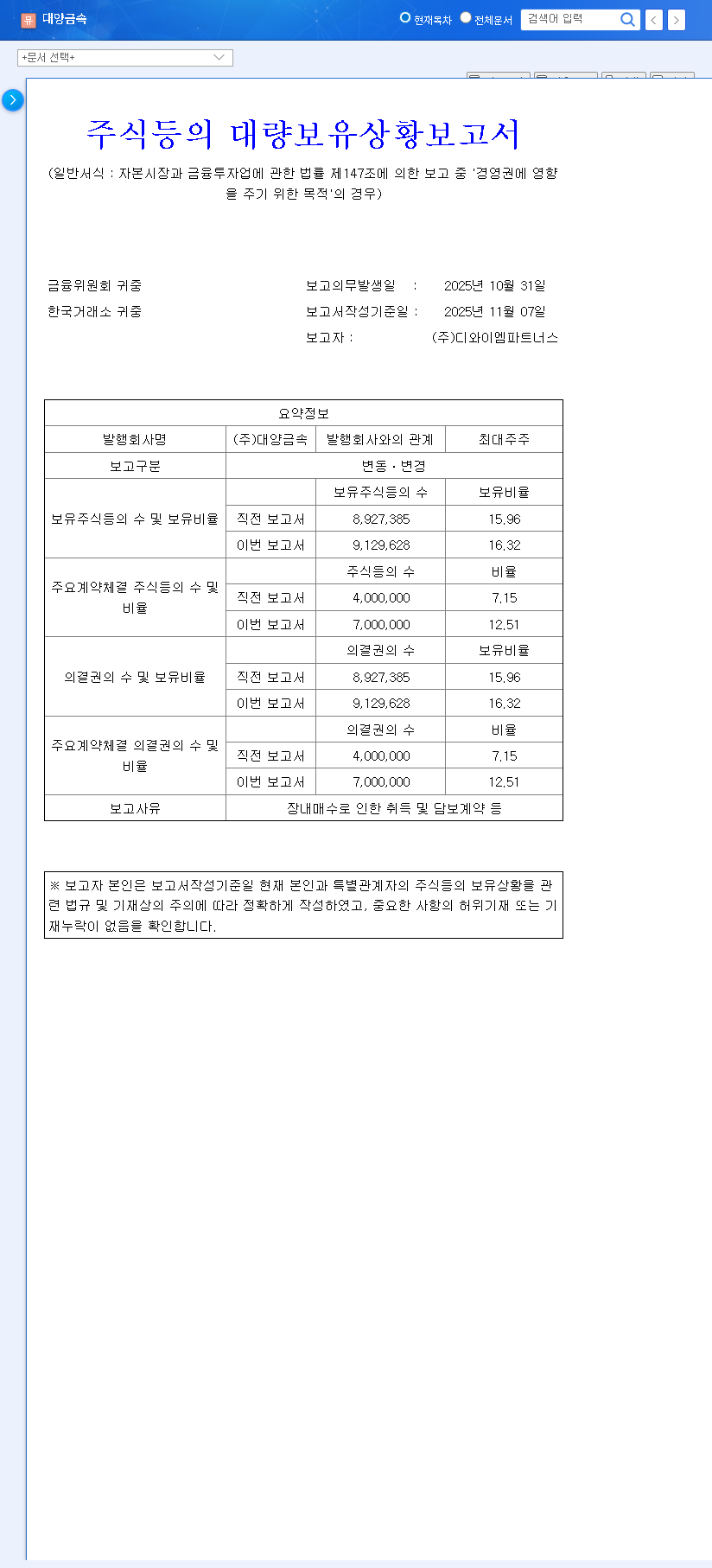
    A significant corporate development at DAIYANG METAL CO.,LTD (009190) has captured the market’s attention. DYM PARTNERS, a key shareholder, has strategically increased its holdings, signaling a clear intent to influence management and stabilize the company’s direction. This move has sparked crucial questions for investors: How will this affect the DAIYANG METAL stock price, and what does it mean for the company’s future trajectory?

    This in-depth analysis unpacks the recent public disclosure, examines the company’s improving fundamentals, evaluates the surrounding market environment, and provides a clear outlook to help you make informed investment decisions. We will explore the present strengths and future potential of DAIYANG METAL (009190).

    The Catalyst: Dissecting the Shareholding Change Disclosure

    On November 7, 2025, DYM PARTNERS filed a mandatory ‘Report on Status of Large Shareholder’s Holdings,’ a standard procedure for significant ownership changes. This filing is more than a formality; it’s a public declaration of intent. The key details are as follows:

    • Reporter: DYM PARTNERS
    • Holding Purpose: Explicitly stated as ‘Influence on management rights’
    • Stake Before Report: 15.96%
    • Stake After Report: 16.32% (an increase of 0.36%)
    • Reason for Change: Acquisition of 202,243 shares via open market purchases.

    The disclosure clearly indicates a calculated move by DYM PARTNERS to bolster its influence over the company’s strategic decisions. You can view the complete filing here: Official Disclosure (Source: DART).

    “When a major shareholder actively buys on the open market with the stated purpose of influencing management, it’s often a precursor to strategic shifts. This signals confidence and a desire for more direct involvement in steering the company towards long-term value creation.”

    DAIYANG METAL (009190) Fundamentals: A Deeper Look

    Turnaround Story: Profitability and Competitiveness

    This shareholder activity comes at a time when DAIYANG METAL’s financial health is markedly improving. The company has successfully shifted from losses to profitability, driven by increased sales of stainless steel cold-rolled sheets to global appliance manufacturers. This turnaround is supported by robust cost management, stable product pricing, and a strategic focus on high value-added products. A key technological advantage is its wide-width processing CPL (COIL POLISHING LINE), which offers a unique competitive edge and significant potential for future profit growth.

    Financial Stability and Identified Risks

    Financially, the company stands on solid ground with a stable adjusted debt-to-equity ratio of 45.81%, indicating a healthy balance sheet. However, investors in DAIYANG METAL (009190) should remain aware of potential headwinds. Lingering litigation from past management disputes, combined with uncertainty around new business ventures and a cautious approach to new investments, are risk factors that require careful monitoring.

    Market Environment and External Factors

    The performance of DAIYANG METAL stock is intrinsically linked to a complex web of macroeconomic factors. Understanding these is key to a complete DAIYANG METAL analysis.

    • Raw Material Prices: The price of nickel is a primary cost driver for stainless steel. Fluctuations in commodity markets, which can be tracked on sources like Reuters Commodities, directly impact profit margins.
    • Exchange Rates: With a high dependency on exports, the KRW/USD and KRW/EUR exchange rates are critical. A stronger foreign currency translates to higher revenue in KRW.
    • Global Freight Costs: Changes in the Baltic Dry Index and other shipping indices affect the cost of exporting goods, influencing the company’s bottom line.
    • Interest Rate Environment: Future changes in benchmark interest rates could increase borrowing costs and impact investment decisions.

    Investor Action Plan & Outlook

    Overall, the increased stake by DYM PARTNERS is a net positive, fostering expectations for management stability and a more focused long-term strategy. This could act as a significant tailwind for the DAIYANG METAL stock price. However, a prudent investor must look beyond the headline. Before making an investment, consider the following key areas:

    • Monitor Management’s Next Moves: Watch for any announcements regarding new strategic initiatives, changes in leadership, or a revised corporate vision.
    • Track New Business Progress: The company needs new growth engines. Closely follow any developments in diversification or expansion efforts.
    • Assess Macroeconomic Responses: Evaluate how effectively the company hedges against currency fluctuations and manages raw material cost volatility.
    • Observe Further Ownership Changes: Continue to track filings from DYM PARTNERS and other major shareholders to understand the evolving power dynamics.

    While this event provides positive short-term momentum, the long-term success of DAIYANG METAL (009190) will hinge on tangible improvements in business performance and strategic execution. For more on evaluating companies, see our guide to fundamental stock analysis.

    Frequently Asked Questions

    What was the recent disclosure about DAIYANG METAL (009190)?

    Major shareholder DYM PARTNERS reported increasing its stake from 15.96% to 16.32% through open market purchases, with the stated goal of influencing management rights.

    How could this stake increase impact DAIYANG METAL’s management?

    It is expected to lead to greater management stability and a more focused long-term growth strategy. This can improve operational efficiency and strengthen investor confidence in the company’s direction.

    What is the current state of DAIYANG METAL’s fundamentals?

    The company is in a period of fundamental improvement. It has returned to profitability, driven by strong sales and cost controls. Its financial structure is sound, with a stable debt-to-equity ratio.

    Are there any risks associated with this event for the stock price?

    While largely positive, the event itself does not immediately change revenue. Additionally, lingering uncertainties from past management disputes could cause short-term stock price volatility depending on the market’s interpretation of future actions.

    (009190) DAIYANG METAL (009190) Stock Analysis: DYM Partners Increases Stake – What Investors Must Know 관련 이미지
  • (039010) HYUNDAI HT CO,LTD. Stock Analysis: CEO Stake Increase & Future Outlook

    (039010) HYUNDAI HT CO,LTD. Stock Analysis: CEO Stake Increase & Future Outlook

    A recent disclosure from HYUNDAI HT CO,LTD. has captured the market’s attention: CEO Lee Geon-gu and his affiliates have increased their ownership stake. This move raises critical questions for investors. Is this a strategic maneuver to tighten management control, or is it a powerful signal of confidence in the company’s future value? This comprehensive HYUNDAI HT CO,LTD. stock analysis will delve into the specifics of this transaction, assess the company’s current financial health, and provide a clear outlook for potential investors.

    Understanding the context behind an insider purchase is crucial for making informed investment decisions. We will explore whether this is a precursor to a turnaround or merely a minor adjustment in a challenging market landscape.

    The Details of the Stake Increase

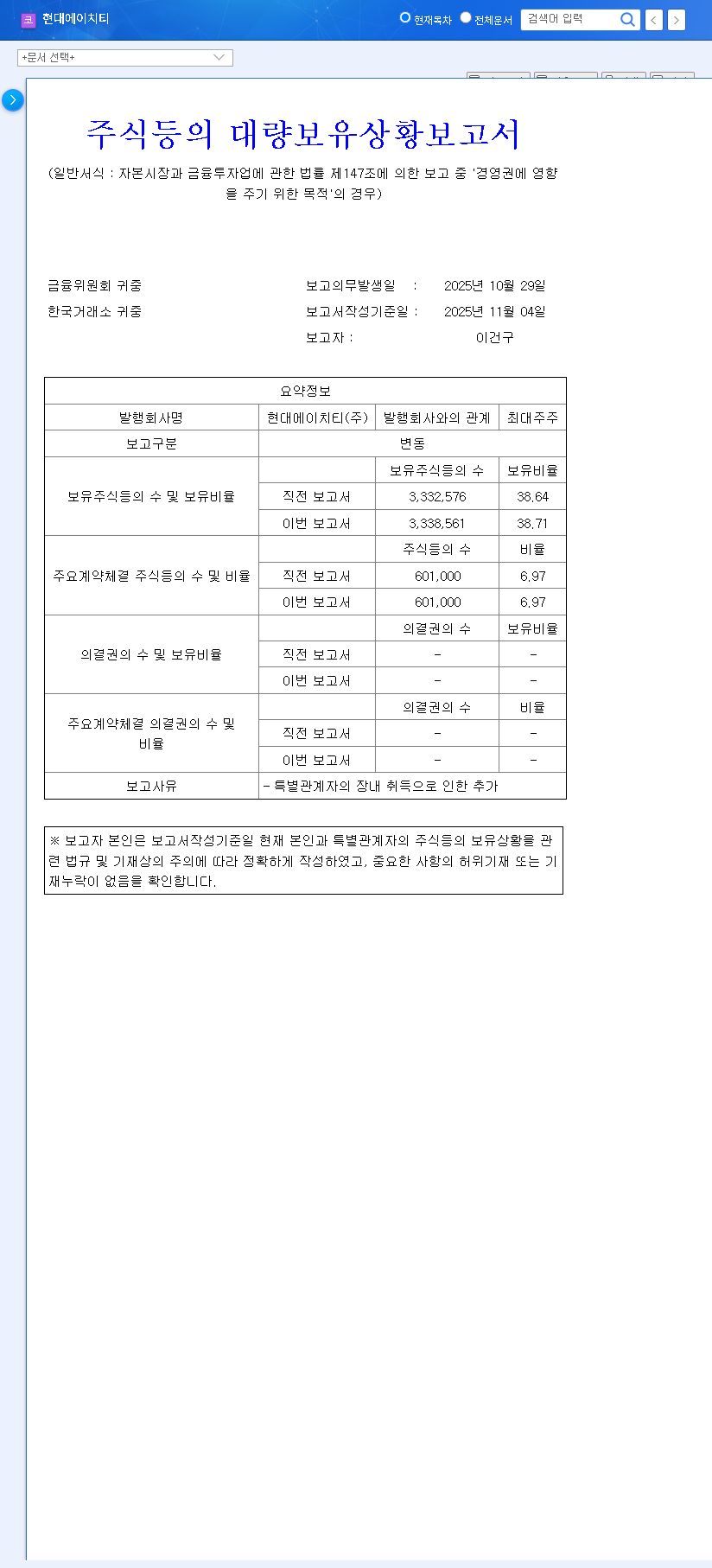
    According to the official filing, the transaction details are straightforward but significant in their intent. The details of this transaction were made public in an Official Disclosure filed with DART (Source) on November 4, 2025.

    • Reporting Entity: Lee Geon-gu (CEO) and special affiliate Lee Ju-ah.
    • Reason for Change: An on-market acquisition of 6,005 shares by special affiliate Lee Ju-ah between October 29 and October 31, 2025.
    • Purpose of Holding: Explicitly stated as ‘Influence over management’.
    • Resulting Change: The total stake increased marginally from 38.64% to 38.71%.

    While the 0.07% increase is small, the stated purpose—to influence management—is a clear declaration of intent. This move suggests a desire to solidify leadership’s role in steering the company’s future direction.

    Hyundai HT Financial Health & Business Fundamentals

    To properly evaluate the HYUNDAI HT CO,LTD. stock, we must look beyond this single event and analyze the company’s core business and financial standing.

    Core Business and Strategic Diversification

    HYUNDAI HT’s primary business is the manufacturing and sale of smart home systems, including wall pads, home networks, and integrated control solutions. Recognizing the slowdown in the domestic construction market, the company has been proactively diversifying into high-growth sectors. These new ventures include:

    • Electric Vehicle (EV) Charging Facilities: Tapping into the global shift towards sustainable transportation.
    • Smart Storage & Security Solutions: Leveraging their tech expertise for modern logistics and safety needs.
    • Digital Door Locks: A natural extension of their smart home ecosystem.

    The success of these diversification efforts is paramount to the company’s long-term growth and is a key area for investors to monitor. You can learn more about the smart home sector in our complete market analysis here.

    In-depth Financial Analysis (H1 2025 Data)

    The company’s latest financial report card presents a mixed picture. While the balance sheet shows some strength, profitability is a significant concern.

    • Balance Sheet: With total assets of KRW 133.8T and liabilities of KRW 30.5T, the company maintains a solid equity base. Positively, the debt ratio has improved, indicating better financial stability.
    • Profitability Crisis: Revenue (KRW 79.2B) and operating profit (KRW 5.0B) both saw year-on-year declines. This is a direct result of the slowdown in new housing starts, which hurts demand for their core smart home products.
    • Declining Efficiency: The trend of declining profits since 2022 is worrying. The estimated net profit margin for 2025 is a meager 0.97%, and a sharp drop in Return on Equity (ROE) points to significantly decreased capital efficiency.

    While an insider purchase is a bullish signal, it cannot single-handedly reverse a trend of declining fundamentals. Investors must look for concrete evidence of a business turnaround.

    Investment Implications and Market Outlook

    The CEO’s share purchase sends a message, but its impact is subject to the company’s performance and broader market forces.

    Why Insider Buying Matters

    Generally, when top executives buy their own company’s stock on the open market, it’s viewed as a strong vote of confidence. They have the most intimate knowledge of the company’s operations, challenges, and future prospects. This action signals to the market that they believe the stock is undervalued and poised for growth. You can read more about insider buying signals on high-authority sites like Investopedia.

    • Short-Term Impact: The news may cause a temporary spike in trading volume and stock price as other investors follow the insider signal.
    • Long-Term View: For a sustained rally, the company must deliver on its strategy. Management stability is a plus, but it must translate into improved corporate value and profitability. The declining performance metrics are a major headwind that confidence alone cannot fix.

    Investor Action Plan & Final Verdict

    The increase in stake by CEO Lee Geon-gu is a noteworthy positive signal. However, a prudent investment decision regarding HYUNDAI HT CO,LTD. stock demands a cautious and balanced approach.

    Key Factors to Monitor

    • Turnaround in Fundamentals: The single most important factor is a reversal of the profitability decline. Watch upcoming earnings reports for signs of life in the new business ventures (EV charging, etc.).
    • Continued Insider Activity: Will CEO Lee Geon-gu and his affiliates continue to acquire shares? Further buying would reinforce their confidence.
    • Market & Sector Trends: Keep an eye on the health of the construction market and the adoption rate of smart home technology.

    Conclusion: The CEO’s move is a vote of confidence, but the company is at a critical juncture. The positive signal from management is currently overshadowed by poor financial performance. Long-term investors should wait for clear, tangible proof of a business turnaround before considering a position. Short-term traders might capitalize on volatility, but the underlying weakness makes it a risky bet for sustained gains.

    (039010) HYUNDAI HT CO,LTD. Stock Analysis: CEO Stake Increase & Future Outlook 관련 이미지
  • (452190) HBL Corporation Shareholding Change: An In-Depth Stock Analysis

    (452190) HBL Corporation Shareholding Change: An In-Depth Stock Analysis

    In the dynamic world of stock market investing, an insider’s transaction can speak louder than a press release. The recent HBL Corporation shareholding change is a pivotal event that demands close attention. This report, detailing a reduction in CEO Kim Jeong-muk’s stake, offers critical clues about the company’s internal confidence, management stability, and future trajectory. For investors, understanding the nuances of this development is key to navigating what comes next for HBL Corporation’s stock price.

    This comprehensive analysis will dissect the official filing, evaluate the company’s current financial health, and project the potential short-term and long-term impacts, providing a clear roadmap for your investment strategy.

    The Catalyst: Deconstructing the Shareholding Report

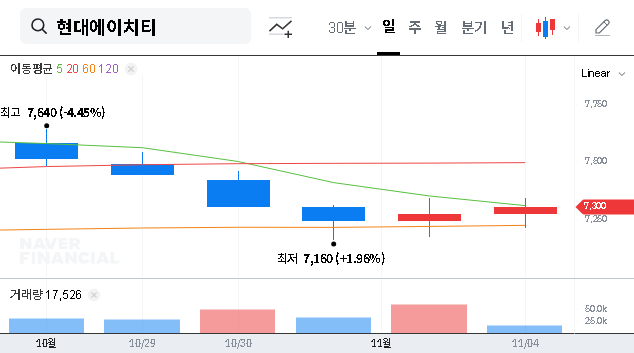
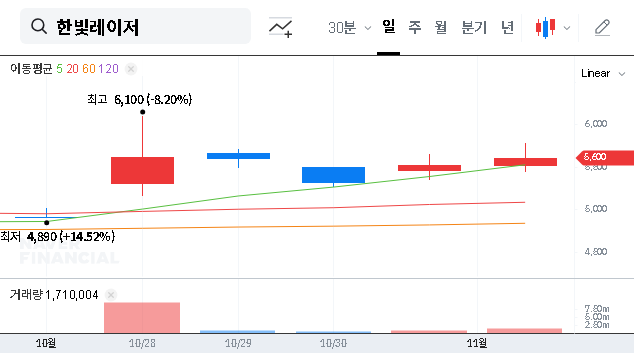
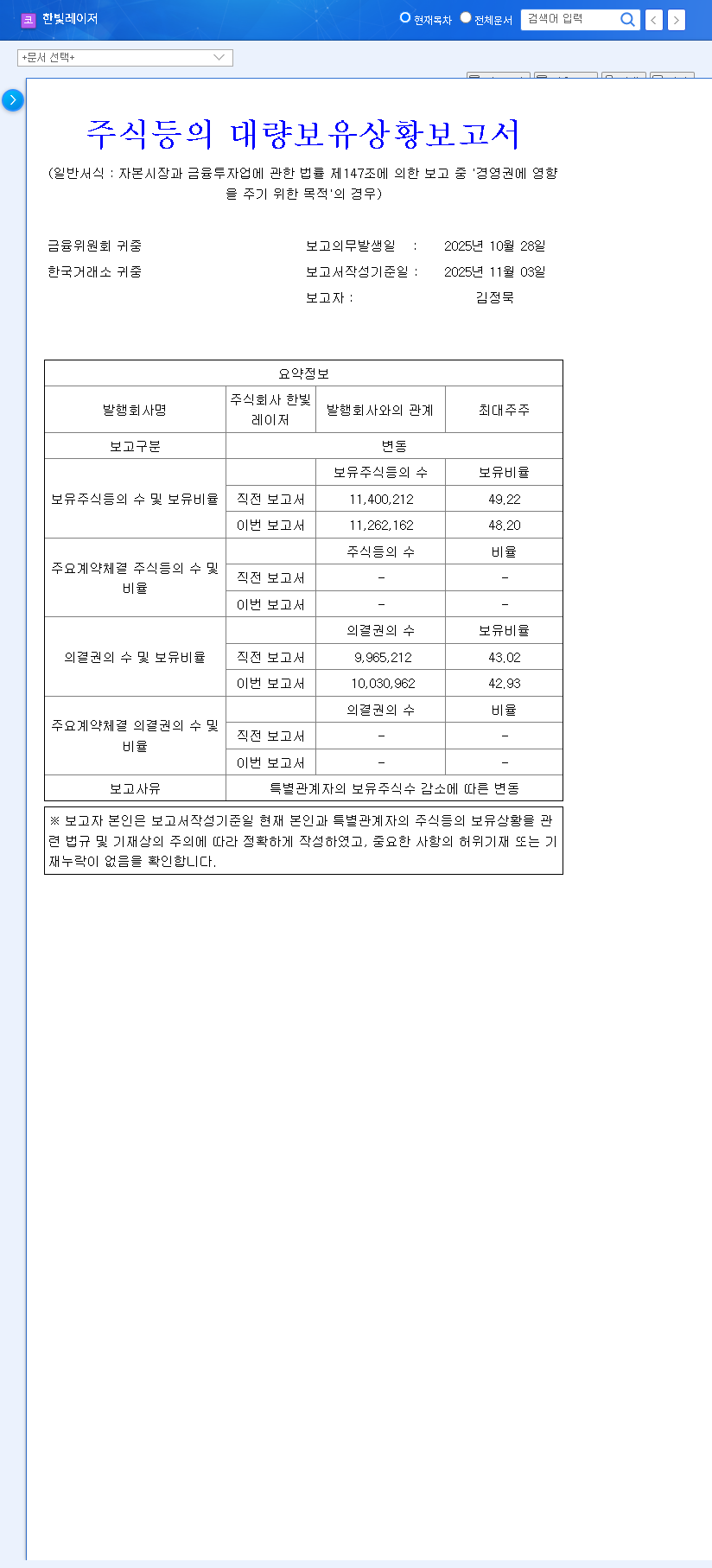
    On November 3, 2025, HBL Corporation (also known as 한빛레이저) filed a ‘Report on Large Shareholding Status’ concerning its CEO, Kim Jeong-muk. The core of this announcement was a change in his ownership stake, which is officially held for the purpose of ‘management influence.’ The change was triggered by the open market sale of 30,000 shares by a specially related party, Mr. Cho Young-hoon. You can view the Official Disclosure on the DART system for full details.

    • Shareholder: CEO Kim Jeong-muk (and related parties)
    • Ownership Before Report: 49.22%
    • Ownership After Report: 48.20%
    • Net Change: 1.02 percentage point decrease
    • Reason: Open market sale by a related party.

    HBL Corporation Fundamentals: A Tale of Headwinds and Hope

    This shareholding change doesn’t happen in a vacuum. A thorough HBL Corporation stock analysis must consider the company’s underlying financial health, which presents a mixed picture.

    Current Financial Challenges

    Based on the semi-annual report for 2025, HBL is navigating significant turbulence:

    • Revenue & Profitability Issues: A downturn in the automotive manufacturing equipment sector has led to declining revenue and an operating loss.
    • Rising Inventory: Sales stagnation is causing inventory to pile up, which can tie up capital and signal weakening demand.
    • High Leverage: The debt-to-equity ratio has climbed to a concerning 230.13%. While not an immediate liquidity crisis, this level of debt increases financial risk. For more on this metric, see this guide on understanding debt ratios from Investopedia.

    The Growth Engine: Secondary Battery Business

    Despite the challenges, HBL Corporation is not standing still. The company is making a strategic pivot into the high-growth secondary battery business, specifically manufacturing charging and discharging equipment. This move, supported by consistent R&D investment, represents a crucial effort to diversify revenue streams and tap into the burgeoning electric vehicle (EV) and energy storage markets. The success of this venture is arguably the most important factor for the company’s long-term future.

    Analyzing the Impact: Management, Sentiment, and Stock Price

    Is Management Control at Risk?

    With a remaining stake of 48.20%, CEO Kim Jeong-muk’s control over the company remains solid. A hostile takeover is highly unlikely. However, the signal this insider sale sends to the market is more psychological. When a key figure whose stated purpose is ‘management influence’ reduces their holdings—even through a related party—it raises questions about their long-term conviction. The lack of a clear reason for the sale only adds to this uncertainty.

    The market often interprets an insider sale as a sign of peaking confidence. While not always the case, it creates a headwind for investor sentiment, especially when a company’s fundamentals are already under pressure.

    Short-Term vs. Long-Term Stock Price Outlook

    In the short term, the HBL Corporation shareholding change is likely a negative catalyst. It gives skeptical investors another reason to sell or stay on the sidelines. The stock, already down significantly from its 2024 peak, may face additional downward pressure as the market digests this news.

    The long-term perspective, however, depends almost entirely on fundamental execution. A turnaround in the stock price will not be driven by shareholding reports, but by tangible business results. If HBL can demonstrate strong growth and profitability from its secondary battery business, this small ownership change will become a footnote in a larger success story. For more on this sector, read our guide to secondary battery investments.

    Investor Action Plan & Key Variables to Watch

    This event makes a cautious approach prudent. Investors should weigh the following factors:

    Bull Case (Opportunities)

    • High Growth Potential: The secondary battery market is expanding rapidly, and successful entry could transform HBL’s financial profile.
    • Stable Management: Despite the reduction, the CEO’s 48.20% stake ensures stable leadership for the foreseeable future.
    • Depressed Valuation: With the stock price already low, much of the negative news may already be priced in, offering potential value.

    Bear Case (Risks)

    • Weakening Fundamentals: The core business is struggling, and the turnaround is not yet proven.
    • Negative Insider Signal: The sale, regardless of size, undermines investor confidence.
    • Macroeconomic Headwinds: High interest rates and a global economic slowdown could further hamper the automotive sector and delay recovery.

    Ultimately, the HBL Corporation shareholding change serves as a warning sign that amplifies existing concerns. The path to stock price recovery will be paved with improved earnings and tangible success in new ventures, not by stabilizing shareholding reports. Investors should monitor quarterly earnings reports and any news related to the secondary battery division with extreme diligence.

    (452190) HBL Corporation Shareholding Change: An In-Depth Stock Analysis 관련 이미지
  • (088390) INNOXCorporation Shareholding Disclosure: In-Depth 2025 Stock Analysis

    (088390) INNOXCorporation Shareholding Disclosure: In-Depth 2025 Stock Analysis

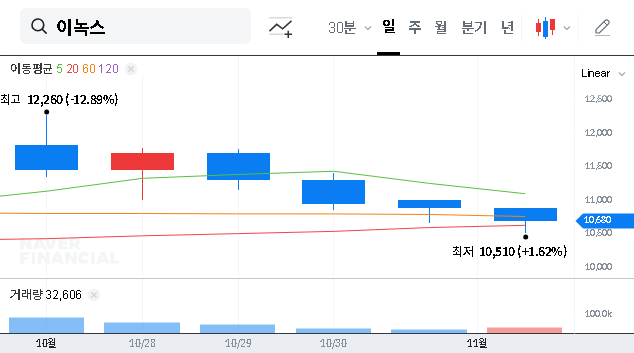
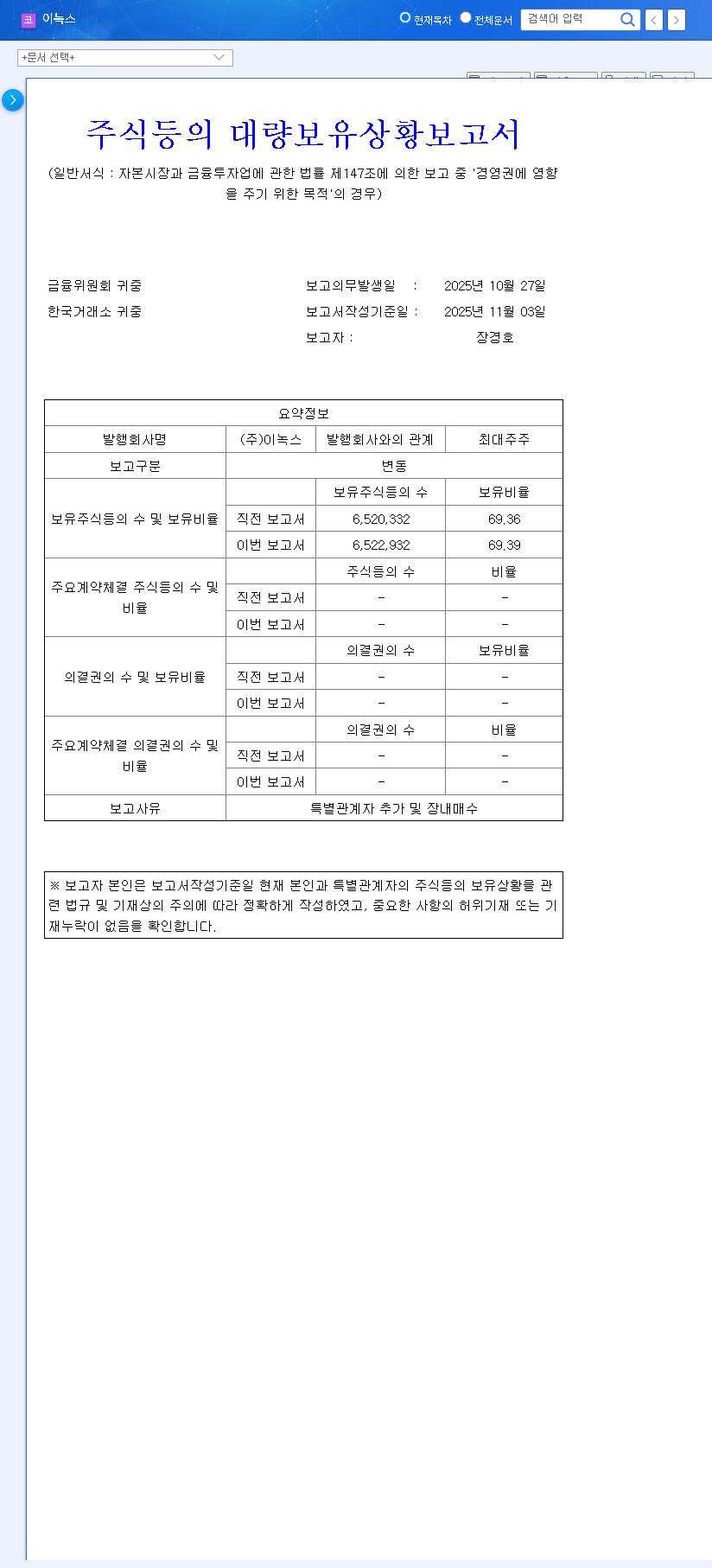
    The latest INNOXCorporation shareholding disclosure has sent ripples through the investment community. On November 3, 2025, a report revealed that CEO Jang Kyeong-ho and related parties have increased their stake, explicitly citing a desire to bolster management influence. While the increase is modest, the strategic intent behind it warrants a thorough analysis for any serious investor. This move could signal long-term confidence, a defensive posture, or the prelude to significant corporate action.

    This comprehensive analysis will unpack the details of the disclosure, evaluate INNOXCorporation’s current fundamentals, and explore the macroeconomic factors shaping its future. We’ll provide the critical insights you need to make an informed decision about your INNOX investment strategy.

    Deconstructing the INNOXCorporation Shareholding Disclosure

    The official ‘Report on Status of Large Shareholder’s Holdings’, filed on November 3, 2025, confirmed that CEO Jang Kyeong-ho and special related parties increased their collective ownership from 69.36% to 69.39%. This 0.03 percentage point rise was achieved via the inclusion of new related parties and strategic open market acquisitions. You can view the full report here: Official Disclosure.

    While the percentage seems minor, the stated purpose of ‘management influence’ is the key takeaway. In the world of corporate governance, such a declaration is a powerful statement. It suggests a proactive strategy to ensure stable leadership and shield the company from external pressures, reinforcing the management’s long-term vision and commitment to enhancing shareholder value. This move solidifies INNOX management control at a pivotal time.

    An insider share increase, even a small one, is often interpreted as a bullish signal. It demonstrates that those with the most intimate knowledge of the company believe its shares are undervalued and have strong future prospects.

    A Tale of Two Subsidiaries: INNOX’s Core Fundamentals

    As a holding company, INNOX’s health is directly tied to the performance of its subsidiaries. The current landscape presents a mixed but fascinating picture.

    Alton Co., Ltd. (Bicycle Business) – The Growth Engine

    Alton is riding a wave of success, capitalizing on the global shift towards green transportation. Its 2025 semi-annual performance was stellar, with revenue hitting KRW 21.8 billion (a 42% YoY increase) and operating profit turning positive at KRW 1.2 billion. This growth is fueled by the booming e-bicycle and shared bicycle markets. This subsidiary represents a strong, tangible growth story within the INNOX portfolio.

    INNOX Eco-M Co., Ltd. (Battery Materials) – The Strategic Challenge

    Conversely, the secondary battery anode material business faces significant headwinds. INNOX Eco-M reported a semi-annual revenue of KRW 2.7 billion (a 48% YoY decrease) and a continued operating loss. The primary culprits are geopolitical and regulatory: raw material supply instability from China and the stringent requirements of the US Inflation Reduction Act (IRA). The company’s future here depends on its ability to diversify its supply chain and adapt to new international trade policies, a critical test of management’s strategic agility.

    Investor Outlook & Strategic Checklist

    This INNOXCorporation shareholding disclosure is a vote of confidence from the top, likely to bolster investor sentiment. However, the direct short-term impact on stock price may be muted. The true value will be unlocked by fundamental performance. Investors should perform a thorough INNOX stock analysis by monitoring these key areas:

    • Subsidiary Turnaround: Can INNOX Eco-M navigate the IRA and supply chain challenges to achieve profitability? This is perhaps the most significant variable for future growth.
    • Sustained Growth: Will Alton Co. maintain its impressive growth trajectory in the competitive mobility market? Look for signs of market share expansion and innovation.
    • Affiliate Performance: The value of the KRW 206.6 billion investment in INNOX Advanced Materials is a major factor. The performance of this key affiliate will heavily influence the holding company’s balance sheet. For more on this, see our guide to evaluating holding company investments.
    • Macroeconomic Resilience: Monitor how management navigates global economic slowdowns, currency fluctuations (USD/VND), and rising interest rates. Their reinforced control should translate into decisive action.

    In conclusion, the decision by INNOX management to increase their stake is a clear message of commitment and stability. While external risks and subsidiary challenges persist, this act of leadership provides a layer of confidence for long-term investors. A prudent investment approach will involve continuous monitoring of the key performance indicators outlined above, using this disclosure as a foundational piece of the larger investment puzzle.

    (088390) INNOXCorporation Shareholding Disclosure: In-Depth 2025 Stock Analysis 관련 이미지
  • (004970) SILLA CO.,LTD Shareholding Disclosure: In-Depth Stock Analysis & 2025 Outlook

    (004970) SILLA CO.,LTD Shareholding Disclosure: In-Depth Stock Analysis & 2025 Outlook

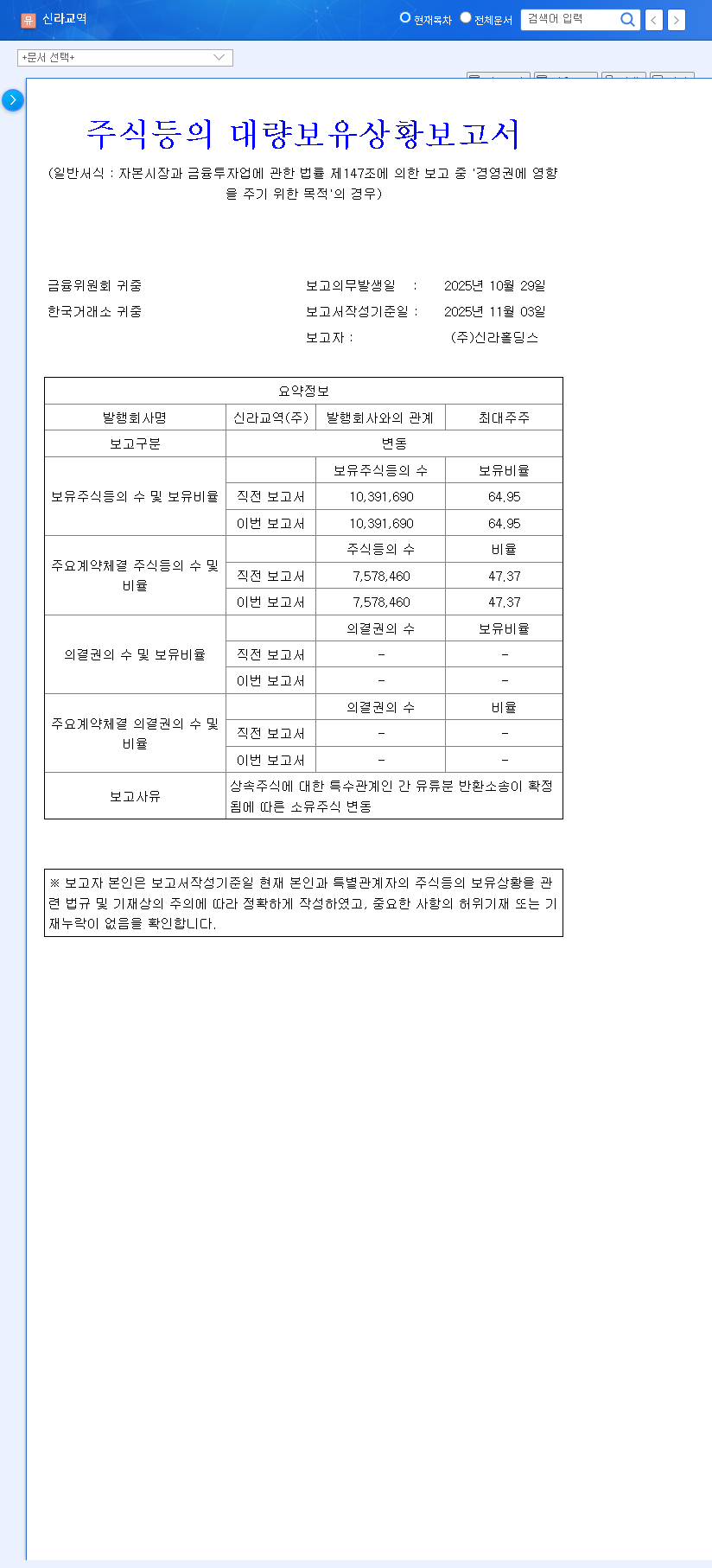
    The recent SILLA CO.,LTD shareholding disclosure has captured the attention of the market, leaving many investors to decipher its true meaning. While the report from major shareholder SILLA HOLDINGS indicates no change in ownership percentage, the underlying reason—a ‘clawback claim lawsuit’—introduces a layer of complexity. This analysis will dissect the disclosure, evaluate the company’s challenging H1 2025 performance, and provide a clear outlook on what this means for the SILLA CO.,LTD stock analysis and its future trajectory.

    Decoding the SILLA CO.,LTD Shareholding Disclosure

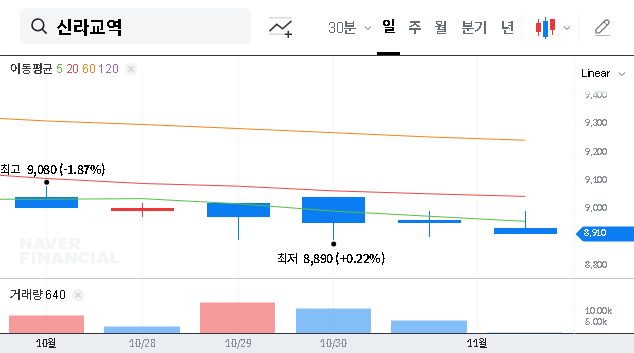
    On November 3, 2025, SILLA CO.,LTD (신라교역) filed a regulatory report that, on the surface, seemed uneventful. However, the details provide crucial context for understanding the company’s internal governance. The official filing can be reviewed directly via the DART system (Source: Official Disclosure).

    Key Details of the Report

    • Reporting Entity: SILLA HOLDINGS
    • Stated Purpose: To exert influence over management rights.
    • Shareholding Change: 64.95% before → 64.95% after. No actual change occurred.
    • Reason for Filing: Formal confirmation of a clawback claim lawsuit regarding inherited shares among specially related parties.

    Essentially, this disclosure is a procedural matter. It confirms that an internal legal process to formally settle inherited shares among family members has concluded. The critical takeaway is that this event does not alter the controlling stake held by SILLA HOLDINGS, thus preserving the current management structure.

    SILLA CO.,LTD Performance: A Challenging H1 2025

    To understand the limited impact of the disclosure, one must look at the company’s current financial state. The SILLA CO.,LTD performance in the first half of 2025 was marked by significant headwinds across its primary business segments.

    Profitability and Segment Breakdown

    The company experienced a sharp decline in profitability. Operating profit plummeted from 14.23 billion KRW to just 0.81 billion KRW, and net income swung to a loss of 10.49 billion KRW. This was driven by weakness in several core areas:

    • Ocean Fishing: Lower global fish prices and reduced catches directly impacted revenue, though this was partly offset by favorable currency exchange rates for the tuna longline business.
    • Seafood Distribution: This segment struggled with falling prices and difficulties securing orders due to restrictive US reciprocal tariff policies. For a broader view on market dynamics, you can read more about global seafood market trends.
    • Steel Business: A global economic slowdown and weak domestic demand led to reduced revenue and squeezed profit margins.
    • Restaurant Business (Bright Spot): Despite inflation, this division saw revenue growth, thanks to strategic menu development and customer-focused promotions.

    Despite the operational challenges and declining revenue, SILLA CO.,LTD maintains a remarkably strong balance sheet, with a debt-to-equity ratio of just 0.95%. This financial stability is a key pillar of support for the company during turbulent times.

    Macroeconomic Factors & Stock Impact

    SILLA CO.,LTD’s business is highly sensitive to external economic forces. A strong US dollar helps foreign exchange gains in its fishing division but hurts the cost of imported goods for distribution. As reported by leading financial outlets like Bloomberg, global freight and oil price volatility continues to pressure operating costs. Given these powerful external factors, the internal shareholding disclosure is unlikely to be a major catalyst for the stock price.

    The market understands that this report signals stability, not a fundamental shift. It confirms that management control is secure, which is a mild positive. However, investor sentiment will be overwhelmingly driven by the company’s ability to navigate the poor macroeconomic environment and demonstrate a tangible turnaround in its core business segments. The focus remains squarely on future earnings reports, not past legal formalities.

    Overall Assessment and Investor Takeaways

    The SILLA CO.,LTD shareholding disclosure is effectively a non-event for short-term stock price movement. It provides clarity and confirms management stability but does not solve the fundamental challenges facing the company. Investors should prioritize the following:

    • Monitor Fundamental Recovery: The key to a stock rebound lies in improved performance. Watch for signs of cost-cutting efficiencies, successful business diversification, and margin improvement in upcoming quarterly reports.
    • Watch Macro Indicators: Pay close attention to exchange rates, global commodity prices (fish, steel), and shipping costs, as these will directly dictate profitability.
    • Focus on Long-Term Stability: While performance is weak, the company’s low debt is a significant advantage. This disclosure reinforces that the management structure is stable, providing a predictable foundation for an eventual recovery.

    Frequently Asked Questions

    Q: What was the main point of the SILLA CO.,LTD disclosure?
    A: The disclosure confirmed there was no change in the 64.95% ownership stake held by the main shareholder, SILLA HOLDINGS. It was a formal report related to an internal inheritance settlement.

    Q: Will this disclosure negatively affect SILLA CO.,LTD’s stock price?
    A: The direct impact is expected to be minimal. The market is far more concerned with the company’s poor H1 2025 financial performance and the challenging macroeconomic environment.

    Q: What are the biggest challenges for SILLA CO.,LTD right now?
    A: The company is facing declining revenues and profitability in its core fishing, seafood distribution, and steel segments due to lower prices, reduced demand, and global economic pressures.

    Disclaimer: This analysis is for informational purposes only and is based on publicly available information. It does not constitute investment advice. All investment decisions should be made with independent research and consultation with a financial professional.

    (004970) SILLA CO.,LTD Shareholding Disclosure: In-Depth Stock Analysis & 2025 Outlook 관련 이미지
  • (042940) Sangji Construction Financial Crisis: Shareholder Sell-Off & Stock Analysis for Investors

    (042940) Sangji Construction Financial Crisis: Shareholder Sell-Off & Stock Analysis for Investors

    The unfolding Sangji Construction financial crisis has sent shockwaves through the investment community. A recent disclosure revealing a decrease in a major shareholder’s stake is not merely a routine filing; it’s a critical signal pointing to a company grappling with severe operational and financial distress. With revenues in freefall, staggering losses, and a precarious balance sheet, investors are left wondering if this is a temporary downturn or the beginning of the end. This comprehensive investor analysis for Sangji Construction will dissect the company’s current predicament, evaluate the implications of the shareholder movements, and provide a clear action plan for navigating this high-risk environment.

    The Catalyst: A Major Shareholder Stake Decrease

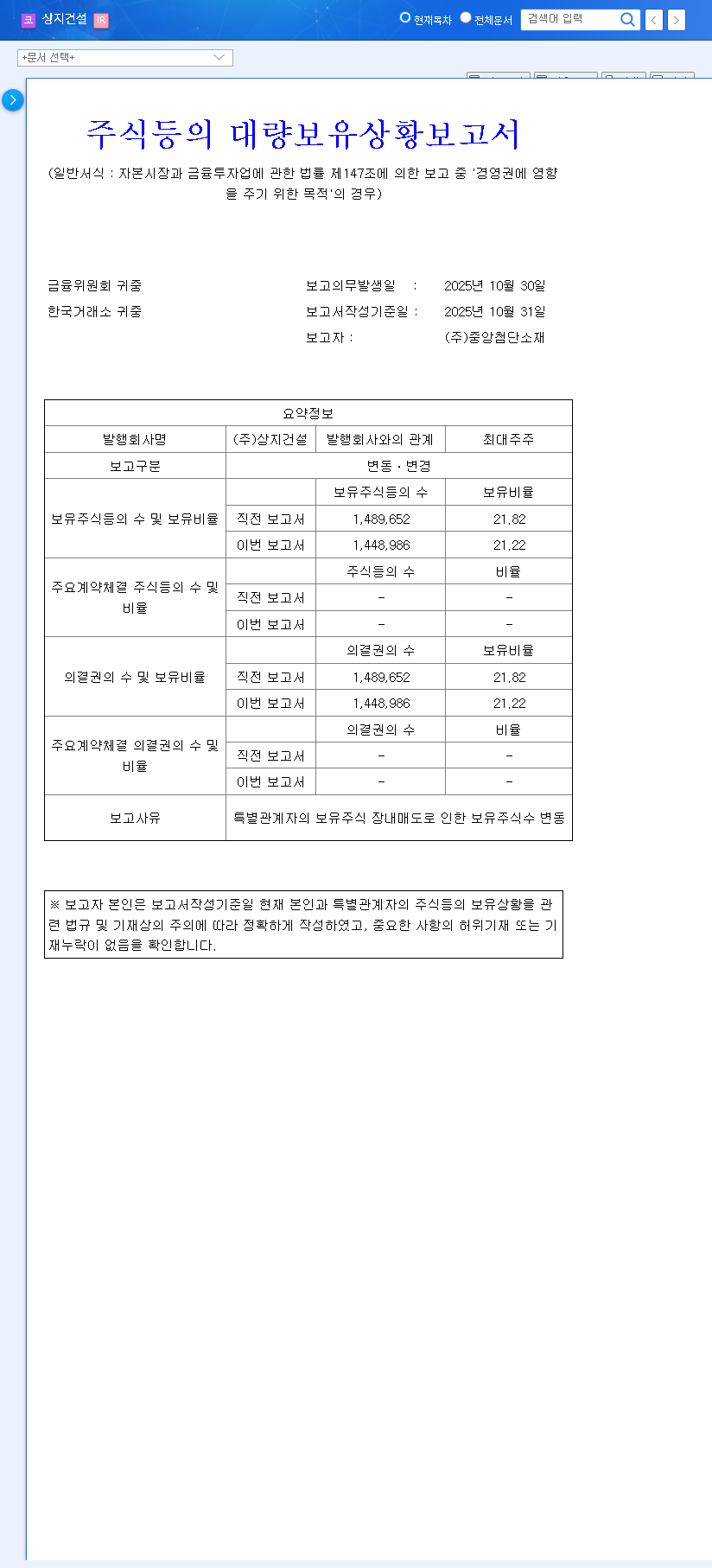
    On October 31, 2025, Sangji Construction, Inc. (Market Cap: KRW 53 billion) filed a significant equity change report. The disclosure, officially available on DART (Official Disclosure), revealed that the primary reporting party, Joongang Advanced Materials/Republic of Korea, reduced its stake from 21.82% to 21.22%. This 0.60 percentage point reduction resulted from open market sales by related parties. While the stated purpose remains ‘exercising management influence,’ the sale itself, occurring amidst a deep crisis, speaks volumes. It suggests a potential erosion of confidence from those with the most intimate knowledge of the company’s operations, a major red flag for the Sangji Construction stock.

    When insiders sell shares during a period of extreme financial duress, it often signals a belief that a near-term recovery is unlikely. This action can significantly amplify negative market sentiment and increase downward pressure on the stock price.

    Anatomy of the Sangji Construction Financial Crisis

    The shareholder sale is a symptom of a much deeper disease. An analysis of Sangji Construction’s Q1 2025 semi-annual report paints a grim picture of a company whose fundamentals are collapsing. Understanding these core issues is critical for any potential investor.

    Plummeting Revenue and Deepening Losses

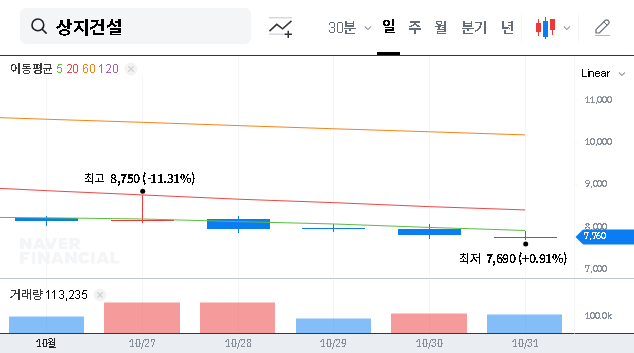
    The company’s top-line performance is alarming. Consolidated revenue for the first half of 2025 was a mere KRW 4.942 billion, a staggering 75% decrease from KRW 20.428 billion in the same period last year. This has led to a consolidated operating loss of KRW 4.762 billion and a net loss of KRW 2.305 billion. Most concerning is the construction for sale revenue, which went from KRW 3.456 billion to a negative KRW 345 million, indicating severe project struggles and potential reversals.

    Crushing Debt and Negative Cash Flow

    Financial health is deteriorating rapidly. Total liabilities stand at KRW 103.691 billion, with a liabilities-to-equity ratio of 93.70%. While this is a slight improvement, it remains a heavy burden. The most shocking figure is the operating cash flow, which recorded a negative -KRW 1.026 trillion. This indicates the company is burning through cash at an unsustainable rate, unable to generate funds from its core business operations. For a deeper understanding of these metrics, you can review our guide on analyzing a company’s financial statements.

    External Pressures and Operational Risks

    The crisis isn’t entirely self-inflicted. Sangji Construction faces significant headwinds from the broader market, as reported by authoritative sources like Bloomberg. These include:

    • Market Slowdown: A downturn in the construction and real estate sectors, coupled with rising interest rates, has stifled demand and project viability.
    • Rising Costs: Inflation in raw material costs for essentials like cement, rebar, and concrete is squeezing already thin profit margins.
    • Project Uncertainty: Many of the company’s secured projects are conditional, facing delays in project financing (PF) reviews, which creates significant uncertainty about future revenue streams.

    Previous attempts at financial restructuring, including capital increases and a name change from ‘Kailoom Co., Ltd.’ in 2024, have clearly been insufficient to address these deep-rooted fundamental problems.

    Investor Action Plan: Is the Sangji Construction Stock a Buy?

    Given the severe Sangji Construction financial crisis, compounded by negative insider signals and a hostile market environment, an extremely cautious and defensive investment approach is warranted. Investing now would be highly speculative and carry substantial risk.

    • Recommendation: Postpone & Observe. This is a high-risk period. Aggressive investment is ill-advised. It is prudent to remain on the sidelines and monitor for signs of a genuine, sustainable turnaround.
    • Monitor Key Developments: Keep a close watch on future shareholder filings, any announcements of concrete business restructuring or new financing, and the overall health of the real estate market.
    • Beware of Volatility: While shake-ups in management control can sometimes create short-term trading opportunities, the overwhelming weight of financial and operational risk is more likely to suppress the stock price than create a buying opportunity.

    In conclusion, the long-term viability of Sangji Construction hinges on a radical overhaul of its business model and a significant improvement in its financial health. Until there is clear, undeniable evidence of such a turnaround, investors are best served by exercising extreme caution and seeking opportunities elsewhere.

    (042940) Sangji Construction Financial Crisis: Shareholder Sell-Off & Stock Analysis for Investors 관련 이미지
  • (445680) Curiox Biosystems: CEO Increases Stake – An In-Depth Analysis for Investors

    (445680) Curiox Biosystems: CEO Increases Stake – An In-Depth Analysis for Investors

    A recent development at Curiox Biosystems has sent a significant signal to the market, capturing the attention of savvy investors. The focus is a noteworthy increase in shareholding by CEO Kim Nam-yong. In the world of finance, such a move by top leadership is rarely just a simple transaction; it’s a statement of confidence and a potential indicator of the company’s future trajectory. This deep-dive analysis unpacks the nuances of this development, examining what it means for Curiox Biosystems’ stock amidst current market challenges and future growth prospects.

    We’ll explore the company’s core technological strengths, confront its recent financial headwinds, and provide a balanced view on the implications of this CEO share increase. This is the essential investor analysis you need to understand the opportunities and risks ahead.

    The Disclosure: A Closer Look at the Numbers

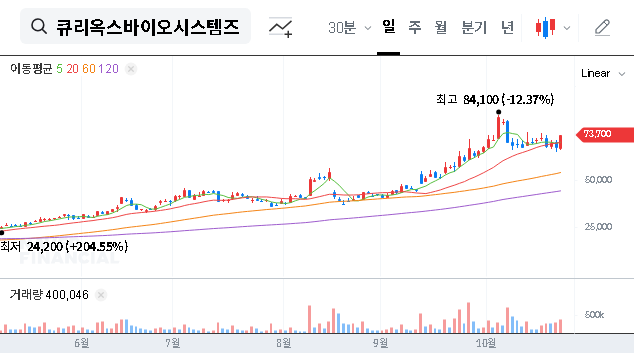
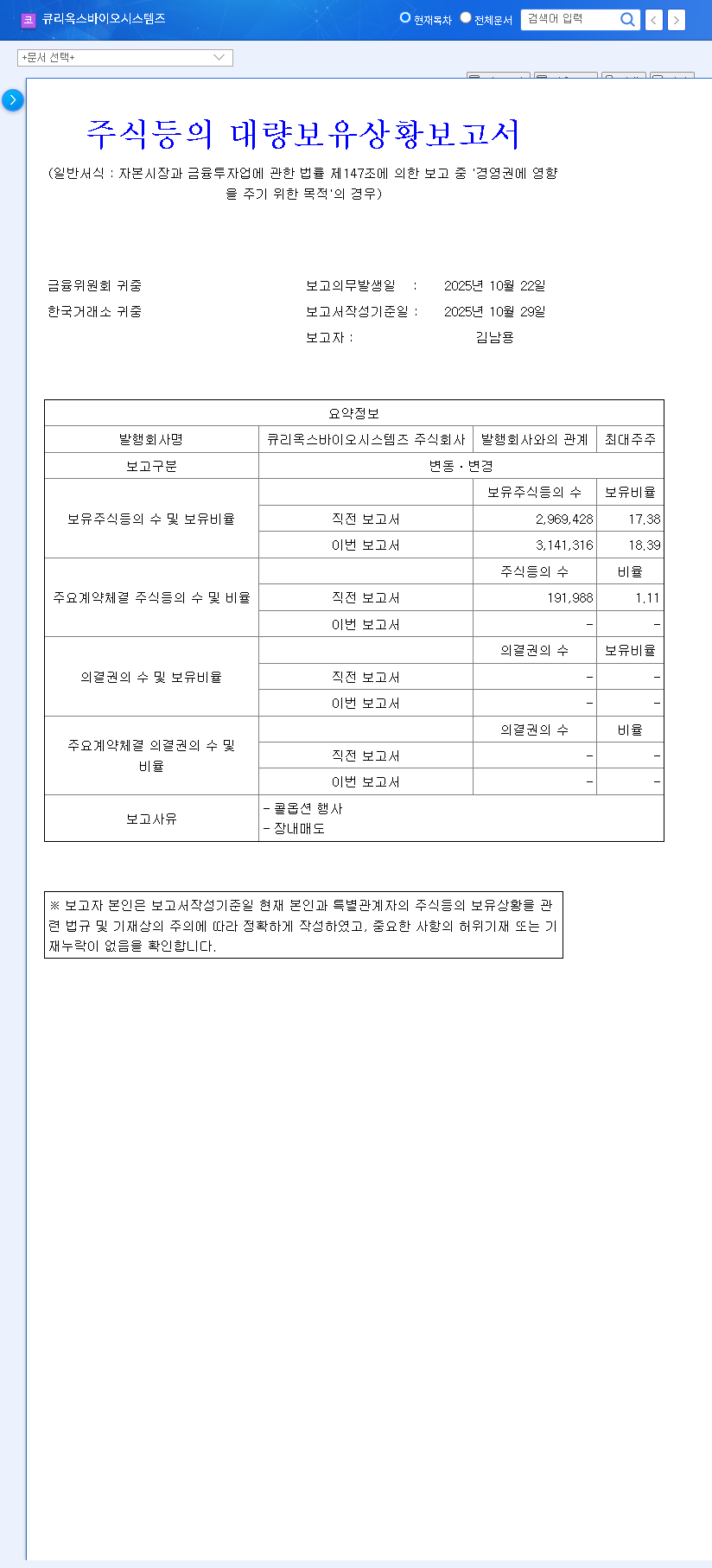
    On October 29, 2025, Curiox Biosystems Co., Ltd. filed a ‘Report on the Status of Large-Scale Shareholdings.’ The central figure in this report is CEO Kim Nam-yong. The transaction details, which are publicly available in the Official Disclosure (DART report), reveal a calculated move to solidify his position.

    • Previous Holdings: 17.38%
    • New Holdings: 18.39%
    • Net Increase: +1.01 percentage points
    • Method: A combination of exercising call options and on-market sales.
    • Stated Purpose: To strengthen influence over management rights.

    The key takeaway is a deliberate action by the CEO to increase his stake, signaling a long-term commitment despite concurrent on-market sales, which we will analyze later.

    Context is Key: Curiox Biosystems’ Fundamentals

    To truly understand the weight of this move, we must place it within the context of the company’s current operational and financial landscape. Curiox Biosystems is a company with a compelling technological foundation facing tangible market headwinds.

    Core Technology & Market Position

    The company’s crown jewel is its C-FREE™ technology, which automates centrifugation-free cell analysis. This is not just an incremental improvement; it’s a disruptive technology in fields like cell and gene therapy (CGT). By eliminating harsh centrifugation steps, it enhances cell viability and reproducibility—critical factors for therapeutic efficacy and research accuracy. With the CGT market expanding and AI/ML-driven analysis demanding higher quality data, Curiox’s technology is exceptionally well-positioned for long-term growth.

    Insider buying, especially from a CEO, is one of the most powerful positive indicators in the market. It demonstrates unwavering belief in the company’s intrinsic value, even when public sentiment is shaky.

    Recent Financial Headwinds

    Despite its technological promise, the company’s recent performance reflects broader market challenges. The first half of 2025 showed a revenue decline and widening operating losses. This is largely attributed to a contraction in the global biotech market, where many potential customers have reduced their capital expenditures (CAPEX). This trend is consistent with our broader analysis of biotech market trends. Furthermore, increased spending on R&D and SG&A, while vital for future innovation, has strained short-term profitability. The company’s balance sheet also shows rising liabilities, primarily from convertible bonds, which necessitates careful financial management moving forward.

    Implications of the CEO Share Increase

    So, what should an investor make of this? The CEO’s actions can be interpreted through two lenses: the bullish case and the points of caution.

    The Bull Case: A Vote of Confidence

    • Strengthened Leadership: Increasing the stake to 18.39% provides CEO Kim Nam-yong with firmer control to execute a long-term vision without being swayed by short-term market noise.
    • Enhanced Credibility: Actions speak louder than words. By investing more of his own capital, the CEO is directly signaling immense confidence in the company’s future value, a sentiment often echoed by market analysts at outlets like Reuters or Bloomberg.
    • Positive Stock Catalyst: Such insider buying often acts as a catalyst for a company’s stock, improving investor sentiment and potentially attracting new capital, which could lead to stock price appreciation.

    Points of Caution for Investors

    • Concurrent On-Market Sales: The disclosure notes that the CEO also sold some shares on the market. While this could be for personal financial planning, it adds a layer of complexity that requires further monitoring.
    • Underlying Financials: This vote of confidence does not erase the short-term financial challenges. The company must still navigate the tough market and demonstrate a clear path back to profitability and positive cash flow.
    • Convertible Bond Dilution: The exercise of call options is tied to previously issued convertible bonds. Investors should be aware of the potential for future share dilution as more of these bonds are converted.

    Conclusion: A Positive Signal Amidst Turbulence

    Ultimately, the CEO share increase at Curiox Biosystems is a net positive event. It demonstrates strong, committed leadership at a time when the company needs it most. While the path ahead includes overcoming financial hurdles, this move suggests that the person with the most insight into the company’s operations believes its best days are ahead. For investors, this is a moment to take notice. The challenge will be to balance this powerful insider signal with a diligent watch over the company’s execution on its strategic goals and its journey back to financial health.

    (445680) Curiox Biosystems: CEO Increases Stake – An In-Depth Analysis for Investors 관련 이미지