Tag: Stock Attachment

  • (016790) HYUNDAI FEED Inc. Stock Attachment: A Critical Investor Warning (016790 Analysis)

    (016790) HYUNDAI FEED Inc. Stock Attachment: A Critical Investor Warning (016790 Analysis)

    For a company already on the brink, the latest news surrounding HYUNDAI FEED Inc. (016790) serves as a critical alarm for investors. Already navigating the treacherous waters of severe capital impairment and a pending delisting decision, the company now faces a court-ordered HYUNDAI FEED Inc. stock attachment on its major shareholder’s holdings. This development dramatically escalates the existing 016790 investment risk profile, casting a dark shadow over its future management stability and survival on the stock market. What are the precise implications of this legal action, and how should current and potential investors navigate this high-stakes situation? This comprehensive analysis provides the answers.

    The Event: Unpacking the Major Shareholder Stock Attachment

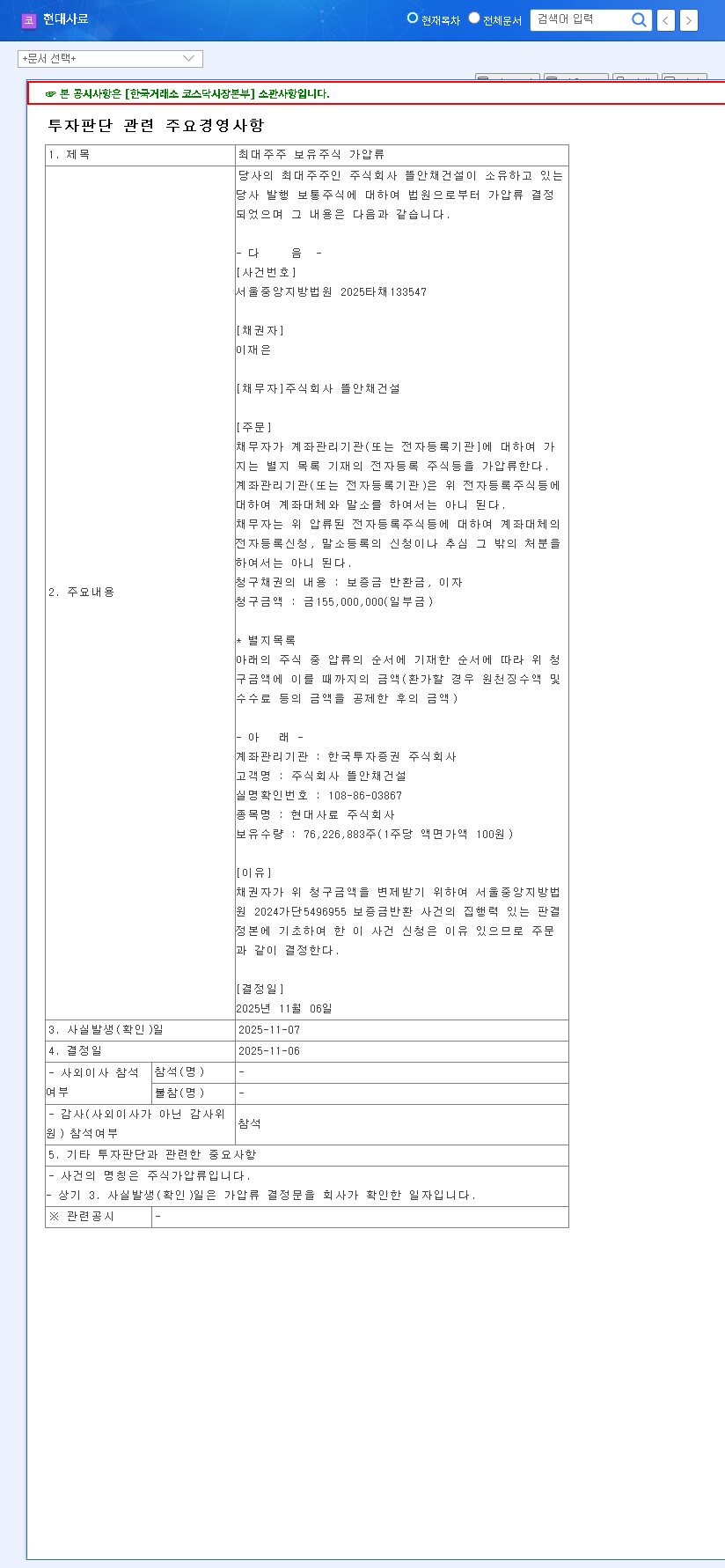
    On November 13, 2025, HYUNDAI FEED Inc. formally disclosed a ‘Key Management Matter’ concerning the attachment of its major shareholder’s shares. This is not a routine filing; it’s a significant event with potentially severe consequences. According to the Official Disclosure, the core details are:

    • Attached Asset: A court has ordered an attachment on 76,226,883 common shares of HYUNDAI FEED Inc. owned by the major shareholder, Tteuranchaechungseol Co., Ltd.
    • Underlying Claim: The legal action stems from a relatively small claim of 30,000,000 KRW for a lease deposit refund.
    • Core Concern: The primary fear is the significant uncertainty this introduces regarding the major shareholder’s ability to exercise management rights and the looming possibility of a forced equity sale.

    Why This Matters: A Perfect Storm of Red Flags

    This stock attachment is not an isolated incident. It pours fuel on an already raging fire of financial and operational crises at HYUNDAI FEED Inc. To understand the full gravity, we must look at the company’s fragile state.

    1. Devastated Corporate Fundamentals

    The company’s H1 2025 report painted a bleak picture. Revenue from its core compound feed business fell 17.8% year-over-year. More critically, as of June 2025, the company’s retained earnings were a staggering -433.88 billion KRW. This signifies a state of severe capital impairment, where accumulated losses have wiped out the company’s entire capital stock, a condition that threatens its very existence.

    2. The Impending HYUNDAI FEED Delisting Threat

    The company is not just financially weak; it is actively fighting for its life on the KOSDAQ market. A delisting decision was already made in August 2025, and HYUNDAI FEED Inc. is currently in a desperate appeal process. This stock attachment event could weaken its case and further jeopardize its chances of remaining a publicly traded company.

    The attachment of the major shareholder’s shares is a significant negative factor that maximizes business uncertainty and further erodes investor confidence in a company already on life support.

    Projected Impact on Investors and the Company

    The ripple effects of the HYUNDAI FEED Inc. stock attachment will be felt in both the short and long term, compounding the existing 016790 investment risk.

    Short-Term Impact (1-4 weeks)

    • Price Pressure: Expect immediate and significant downward pressure on the stock price as investor confidence plummets.
    • Heightened Volatility: Panic selling and speculative trading could lead to extreme price swings and erratic trading volumes.
    • Erosion of Trust: This event completely shatters any remaining market trust, making it nearly impossible for the company to attract new capital.

    Mid- to Long-Term Impact (Beyond 1 month)

    • Risk of Forced Sale: If the claim is not settled, the attached shares could be sold off, leading to a chaotic change in management control. For more on this, read our guide on how to analyze high-risk stocks.
    • Paralyzed Strategy: The uncertainty surrounding ownership will stall any meaningful financial restructuring or long-term business strategy.
    • Weakened Delisting Appeal: This instability could be viewed negatively by market authorities, potentially dealing a final blow to the company’s appeal to maintain its listing.

    Final Verdict & Investor Action Plan

    Given the confluence of severe financial distress, an active delisting threat, and now a destabilizing major shareholder stock attachment, the investment outlook for HYUNDAI FEED Inc. is exceptionally poor.

    Investment Opinion: ‘NOT RECOMMENDED / AVOID’

    We strongly advise against any new investment in HYUNDAI FEED Inc. The risks overwhelmingly outweigh any potential for speculative gains. The fundamental pillars of the company are crumbling, and this latest event has significantly increased the probability of a worst-case scenario, such as a complete wipeout of shareholder value through delisting.

    For Existing Shareholders: Extreme caution is warranted. The likelihood of further capital loss is high. Investors should closely monitor the delisting appeal process and any news regarding the resolution of the stock attachment. Preparing an exit strategy to minimize losses should be a top priority.
    (016790) HYUNDAI FEED Inc. Stock Attachment: A Critical Investor Warning (016790 Analysis) 관련 이미지
  • (016790) HYUNDAI FEED Stock Risk: Major Shareholder Provisional Attachment Explained (016790)

    (016790) HYUNDAI FEED Stock Risk: Major Shareholder Provisional Attachment Explained (016790)

    HYUNDAI FEED Inc. Stock Provisional Attachment: A Red Flag for Investors

    The recent news of a HYUNDAI FEED Inc. stock provisional attachment has raised significant concerns within the investment community. This legal action, targeting shares held by the company’s major shareholder, Tteulanchae Engineering & Construction, is more than a simple footnote in a financial report. It signals potential instability that could directly impact HYUNDAI FEED Inc.’s stock price, management, and overall corporate health. This comprehensive analysis will break down the official disclosure, explore the deep-rooted issues with the major shareholder, and provide a clear framework for how investors should approach this complex situation.

    Understanding the nuances of this event is crucial. This isn’t just about a shareholder’s private debt; it’s a critical test of HYUNDAI FEED’s corporate governance and resilience. We will delve into what this means for both short-term market volatility and long-term company stability, offering actionable insights for making informed decisions.

    Deconstructing the Disclosure: What Exactly Happened?

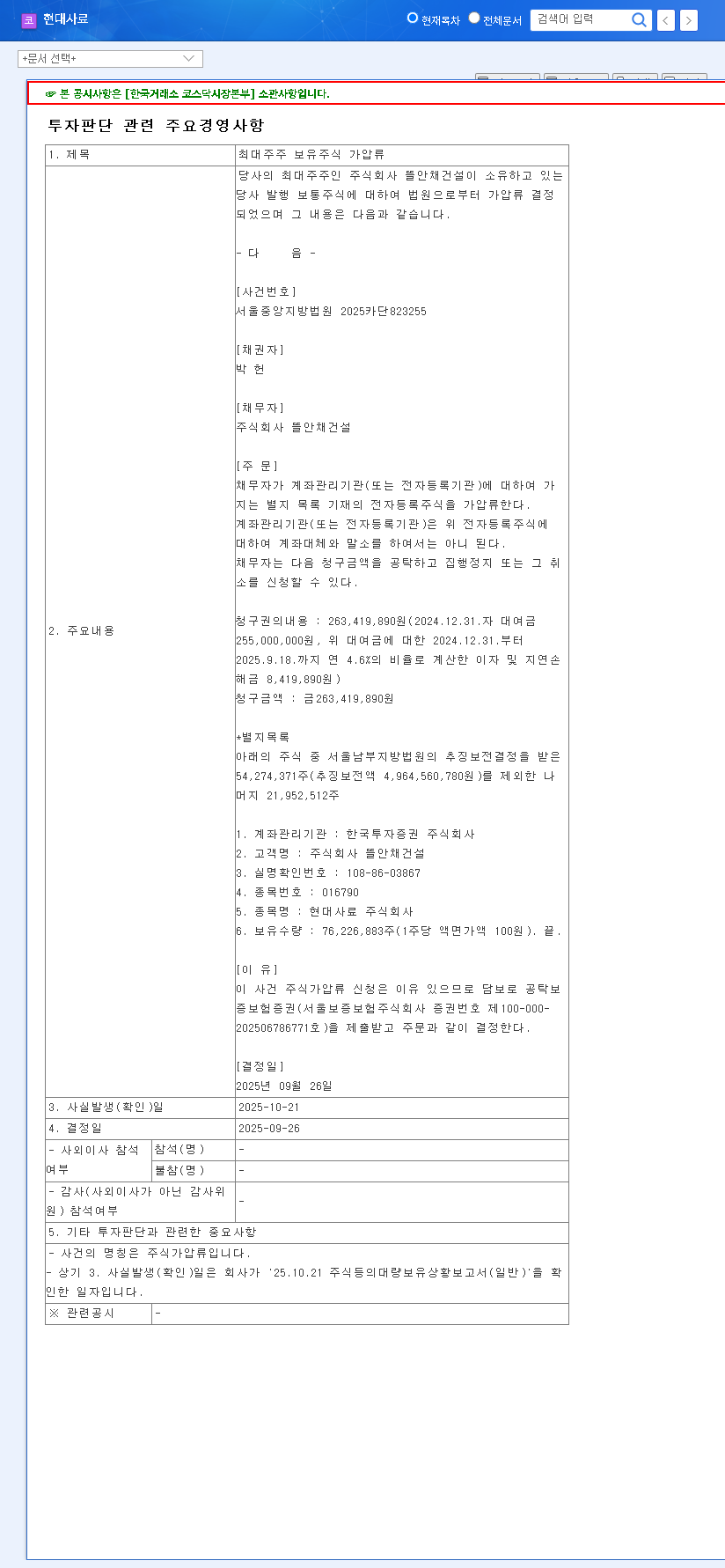
    On October 21, 2025, a critical disclosure was made public. A court granted a creditor’s request to place a provisional attachment on a significant portion of HYUNDAI FEED Inc. shares held by its largest shareholder. Let’s examine the key facts from the Official Disclosure:

    • Debtor: Tteulanchae Engineering & Construction Co., Ltd. (HYUNDAI FEED Inc.’s major shareholder).
    • Creditor: A private individual, Mr. Park Heon.
    • Claim Amount: Approximately 263.4 million KRW (including principal loan and interest).
    • Shares Attached: 21,952,512 common shares of HYUNDAI FEED Inc.
    • Effect: The shares are effectively frozen. They cannot be sold, transferred, or otherwise disposed of by Tteulanchae E&C until the legal matter is resolved.

    Crucially, this is not an isolated incident. These 21.9 million shares were the remaining portion of Tteulanchae’s holdings not already under a much larger legal restriction known as a ‘Chujingbojeon’ (추징보전), which affects over 54 million shares valued at nearly 5 billion KRW. This pattern points to severe and ongoing financial distress for the HYUNDAI FEED Inc. major shareholder.

    This second legal action against the shareholder’s assets suggests that their financial problems are systemic, creating a significant and sustained investor risk for anyone holding HYUNDAI FEED Inc. stock.

    The Ripple Effect: How Shareholder Woes Impact the Company

    The financial instability of a major shareholder can have profound and damaging effects on the company they control. These risks cascade from the shareholder to the company’s operations, stock price, and reputation.

    Short-Term Market Volatility

    The immediate impact is often felt in the market. News of a HYUNDAI FEED Inc. stock provisional attachment creates uncertainty, which investors dislike. This can lead to a sharp increase in stock price volatility as worried investors may sell off their holdings, putting downward pressure on the price. The shareholder’s inability to liquidate their attached shares also restricts their capacity to provide financial support to the company if needed.

    Long-Term Threats to Corporate Governance

    The more serious risks are long-term. If Tteulanchae E&C cannot settle its debts, the court could order the attached shares to be sold at auction. This could lead to a change in the controlling shareholder, potentially causing a complete overhaul of management and long-term business strategy. Such instability can derail growth plans and damage the company’s standing. Furthermore, these events erode trust with partners, suppliers, and customers, impacting the core business. This entire scenario highlights a critical failure in what is known as corporate governance, which refers to the systems by which a company is directed and controlled.

    Investor Action Plan: What to Do Now

    Given the heightened risk, investors should proceed with extreme caution. Hasty decisions are ill-advised. Instead, a period of diligent research and monitoring is essential. Before making any moves, focus on gathering the following critical information:

    • Major Shareholder’s Exact Stake: Determine the precise ownership percentage held by Tteulanchae E&C to understand how much control is truly at risk.
    • Tteulanchae E&C’s Financial Health: Look for any available financial statements or news about Tteulanchae E&C to assess their ability to repay their debts and resolve these legal issues.
    • HYUNDAI FEED Inc.’s Intrinsic Value: Analyze HYUNDAI FEED’s own business performance, profitability, and balance sheet, separate from its shareholder’s problems. Is the underlying business strong enough to weather this storm?
    • Legal Proceeding Updates: Closely monitor any further court rulings or disclosures related to both the provisional attachment and the larger ‘Chujingbojeon’ case. For more details, see our guide to analyzing financial disclosures.

    Conclusion: A Cautious Approach is a Prudent Approach

    The provisional attachment of the HYUNDAI FEED Inc. major shareholder’s stock is a material event with serious implications. It introduces significant short-term volatility and raises legitimate questions about the company’s long-term stability and governance. Investors must recognize the gravity of this situation and prioritize careful research over speculation. The key variables to watch are Tteulanchae E&C’s ability to resolve its financial obligations and the subsequent impact on its controlling stake in HYUNDAI FEED Inc. Until there is more clarity, a defensive and watchful stance is the most sensible strategy.

    (016790) HYUNDAI FEED Stock Risk: Major Shareholder Provisional Attachment Explained (016790) 관련 이미지
  • (016790) HYUNDAI FEED Inc. Delisting Crisis: Shareholder Stock Attachment Signals Deeper Trouble

    (016790) HYUNDAI FEED Inc. Delisting Crisis: Shareholder Stock Attachment Signals Deeper Trouble

    The ongoing HYUNDAI FEED Inc. delisting crisis has taken a dramatic and alarming turn. Already teetering on the edge of removal from the KOSDAQ market, the company now faces a severe new challenge: a court-ordered provisional attachment on its largest shareholder’s stock. This development is far more than a simple financial hiccup; it strikes at the heart of the company’s governance, stability, and very existence. For investors, this moment is a critical juncture demanding a clear-eyed assessment of the mounting risks.

    This in-depth analysis will dissect the latest events surrounding the HYUNDAI FEED Inc. stock attachment, explore its profound implications, and provide a clear outlook for anyone with a stake in the company’s uncertain future. We will explore whether HYUNDAI FEED can navigate this perfect storm or if it’s on an irreversible path to collapse.

    The Event: A Shareholder’s Crisis Becomes the Company’s Nightmare

    The Seoul Central District Court recently delivered a significant blow by approving a provisional attachment order on a massive block of HYUNDAI FEED Inc. shares. This legal action freezes the assets of the company’s largest shareholder, Tteulan Chae Construction Co., Ltd., directly impacting HYUNDAI FEED’s operational stability.

    Details of the Stock Attachment

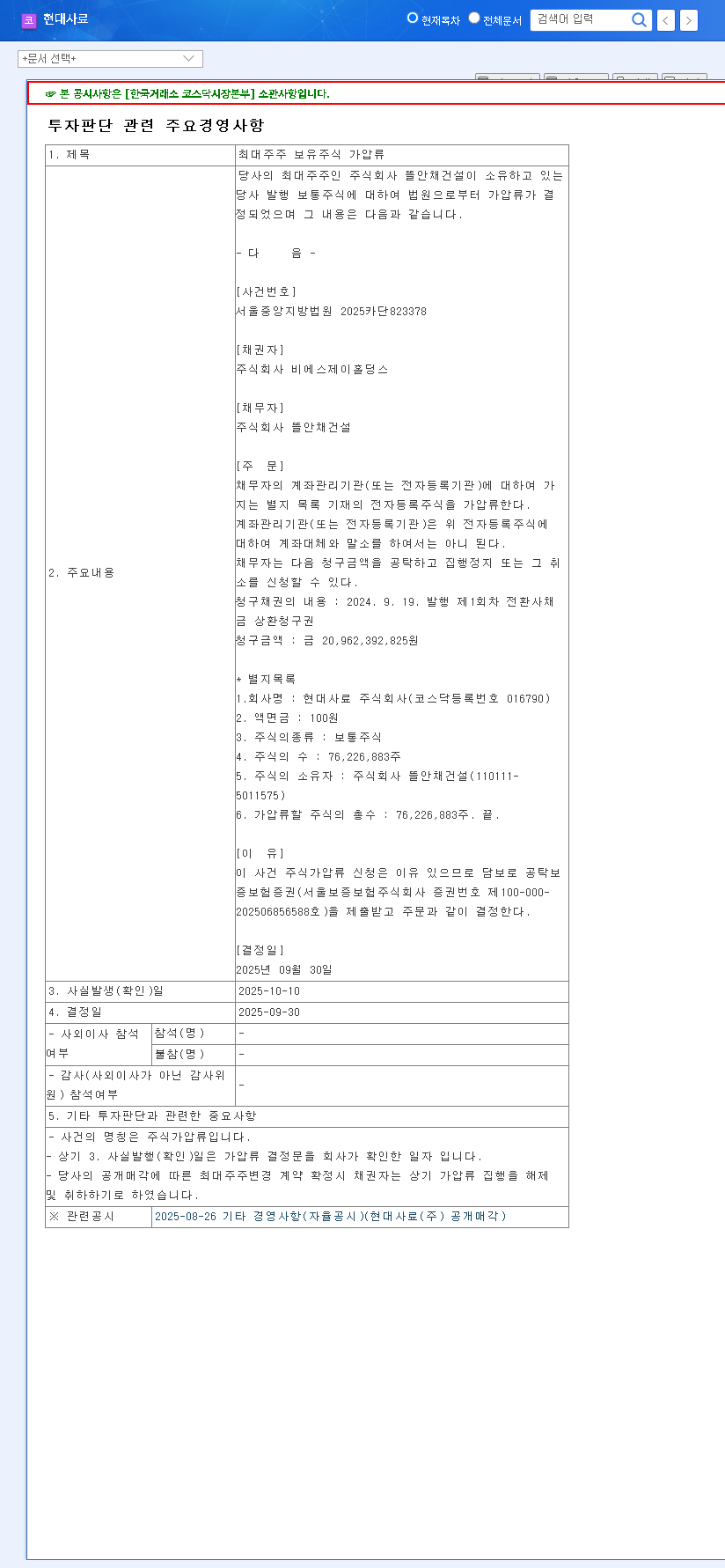
    According to the Official Disclosure filed with DART, the specifics of the court order are stark:

    • Attached Shares: 76,226,883 common stock shares of HYUNDAI FEED Inc.
    • Debtor (Shareholder): Tteulan Chae Construction Co., Ltd.
    • Creditor: BSJ Holdings Co., Ltd.
    • Underlying Cause: Failure to repay convertible bonds, with a claim amount of approximately KRW 20.96 billion.

    This action effectively prevents Tteulan Chae Construction from selling or transferring its shares, creating a leadership vacuum and casting a long shadow over the company’s decision-making capabilities.

    The Ripple Effect: Analyzing the Damage

    The attachment of a major shareholder’s stock is not an isolated event; it sends shockwaves through every facet of the company, compounding the already severe HYUNDAI FEED Inc. delisting crisis.

    This legal action moves beyond financial distress into a full-blown crisis of confidence, threatening the core stability and governance of HYUNDAI FEED Inc. and drastically increasing the probability of delisting.

    1. Severe Threat to Corporate Governance

    With the controlling shareholder’s voting power effectively paralyzed, HYUNDAI FEED’s management is left in limbo. This creates massive uncertainty around strategic direction, key appointments, and the ability to raise capital. Investor confidence, already fragile, is now likely shattered, making it nearly impossible to secure the funding needed for a turnaround. For more context on such market events, sources like Reuters Financial News provide extensive coverage of corporate governance challenges.

    2. Worsening Financial Health and Liquidity Crisis

    The root cause of the attachment—a KRW 20.9 billion debt default—paints a grim picture of HYUNDAI FEED Inc.’s financial health. This incident confirms deep-seated liquidity problems. The company will likely face a credit rating downgrade, soaring borrowing costs, and extreme difficulty in managing its cash flow for day-to-day operations. It raises fundamental questions about its ability to remain a going concern.

    3. Maximized Delisting Risk

    HYUNDAI FEED was already under intense scrutiny from market authorities due to an auditor’s opinion refusal and other compliance failures. This stock attachment adds fuel to the fire, providing regulators with another powerful reason to proceed with delisting. The company’s ability to present a credible recovery plan is now severely compromised. Investors interested in the mechanics of such situations can learn more about understanding corporate delisting procedures on our blog.

    Investor Playbook: Is There Any Hope?

    In light of these compounding crises, the investment outlook for HYUNDAI FEED Inc. is exceptionally bleak. The question is no longer about growth potential but about corporate survival.

    From an investment standpoint, HYUNDAI FEED Inc. is currently in the highest risk category, bordering on uninvestable. The combination of a pre-existing delisting threat and a paralyzed ownership structure creates a level of uncertainty that is difficult to justify for any portfolio.

    Key Factors to Monitor:

    • Delisting Committee Decisions: The final rulings from the KOSDAQ Market Committee will be the most critical near-term catalyst.
    • Resolution of the Attachment: Any news regarding the settlement of the KRW 20.96 billion debt could be a slight positive, but the damage to confidence is already done.
    • Further Disclosures: Watch for any announcements about asset sales, emergency funding, or management changes.

    For current shareholders, this is a time for proactive risk management to prevent further losses. For prospective investors, the red flags are too numerous and severe to ignore. Prudence and caution are paramount when dealing with a company facing an existential threat like the HYUNDAI FEED Inc. delisting crisis.

    (016790) HYUNDAI FEED Inc. Delisting Crisis: Shareholder Stock Attachment Signals Deeper Trouble 관련 이미지