Tag: StakeChange

  • (298040) Hyosung Heavy Industries Stock: Analysis of NPS Divestment & Future Outlook

    (298040) Hyosung Heavy Industries Stock: Analysis of NPS Divestment & Future Outlook

    Recent developments concerning Hyosung Heavy Industries (KRX: 298040) have presented a complex picture for investors. On one hand, an amended business report signals a welcome move towards greater corporate transparency. On the other, a notable share reduction by the National Pension Service (NPS) has raised questions. How should investors interpret these conflicting signals? This comprehensive analysis will explore the core issues, their impact on the company’s value, and provide a strategic roadmap for navigating the path ahead.

    Decoding the Two Key Events

    To understand the current investment climate for Hyosung Heavy Industries stock, we must first dissect the two pivotal events that have captured the market’s attention.

    1. Amended Business Report: A Commitment to Transparency

    Hyosung Heavy Industries recently filed an amendment to its business report, significantly expanding the details provided in its ‘Status of Single Sales/Supply Contract Execution’ section. This is more than just a procedural update; it’s a strong positive signal. The amendment now includes granular information such as contract names, counterparties, timelines, key terms, and specific financial figures. You can view the Official Disclosure on the DART system. This move directly addresses investor demand for clarity, enhancing trust and allowing for a more accurate assessment of the company’s revenue streams and operational health. For investors, learning how to analyze supply contracts is a crucial skill this report now supports.

    2. National Pension Service (NPS) Stake Reduction

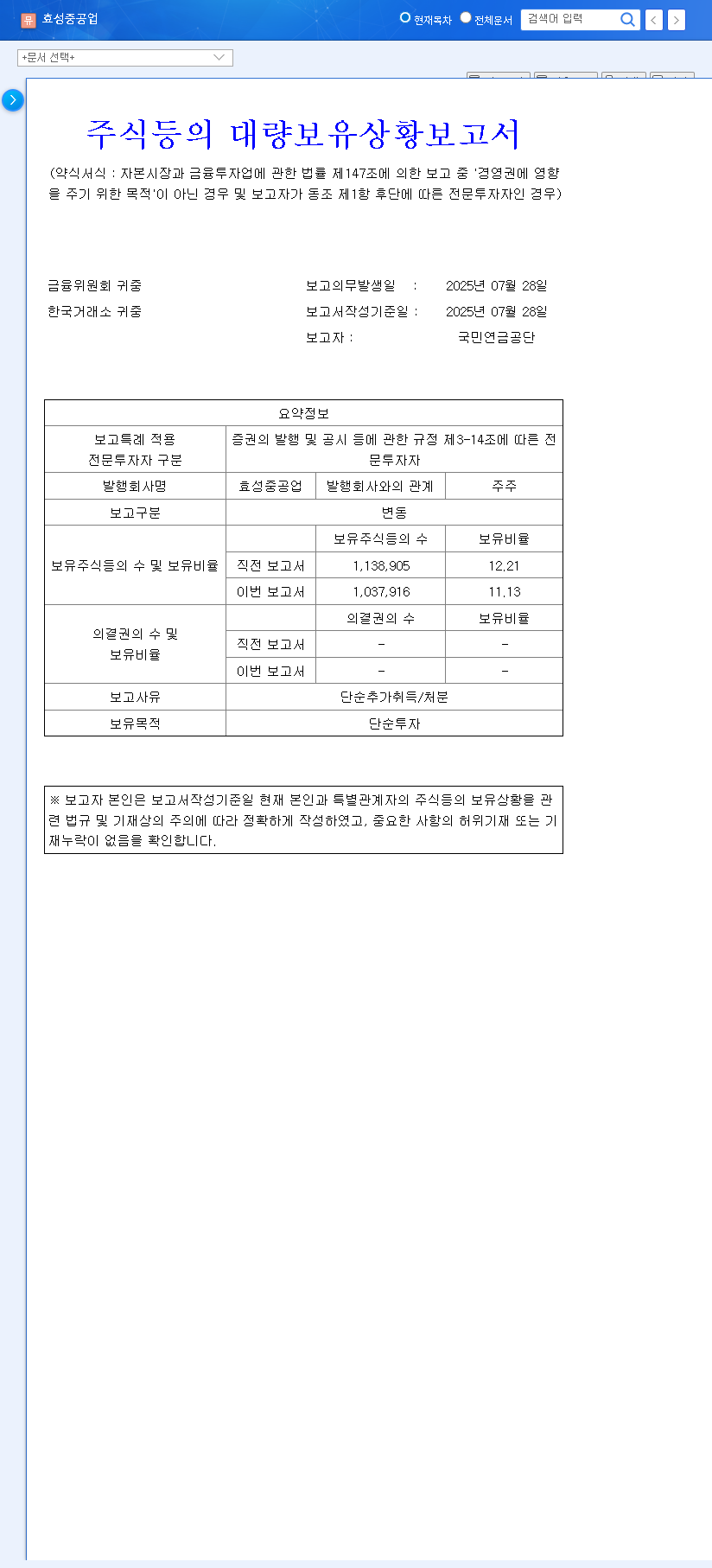
    Conversely, the National Pension Service (NPS) reported a decrease in its stake in Hyosung Heavy Industries, from 12.21% down to 11.13%. The stated purpose for the holding is ‘simple investment,’ and the change was due to ‘simple additional acquisition/disposal.’ While a share sale by a major institutional investor can create short-term selling pressure, the context is critical. This NPS divestment is likely part of a broader portfolio rebalancing strategy rather than a negative judgment on the company’s specific fundamentals. Large funds like the NPS regularly adjust their holdings across various sectors to manage risk and align with macroeconomic outlooks, a common practice in institutional investment strategy.

    While increased transparency builds long-term trust, the NPS share reduction introduces short-term market uncertainty. Understanding the nuances of both is key for any investor in Hyosung Heavy Industries.

    Impact on Fundamentals and Stock Outlook

    The enhanced reporting is an unambiguous positive for the company’s fundamentals. It increases the visibility of future revenue, clarifies business risks, and boosts management credibility. In contrast, the NPS stake reduction primarily affects short-term market sentiment and supply-demand dynamics. While it could lead to temporary price volatility, its long-term impact on the intrinsic value of Hyosung Heavy Industries is expected to be limited, provided the company’s core business remains strong.

    Macroeconomic Tailwinds for the Heavy Industries Segment

    The broader market environment offers significant opportunities for Hyosung Heavy Industries’ core business. The global push for carbon neutrality and the explosive growth of AI and data centers are fueling unprecedented demand for electricity. This directly translates to a need for robust power infrastructure, including the transformers, circuit breakers, and power generation facilities that are central to the company’s portfolio. The expansion of global power grids represents a powerful, long-term growth driver that aligns perfectly with the company’s expertise.

    A Strategic Investor’s Action Plan

    Given these factors, a prudent investor should adopt a long-term perspective. The fundamental growth story in the heavy industries segment appears intact, while the move toward transparency strengthens the investment case. The NPS divestment should be viewed as short-term market noise rather than a fundamental red flag. Consider the following actions:

    • Focus on Core Business Health: Prioritize analysis of the heavy industries segment’s order book and profitability over short-term stock fluctuations.
    • Monitor Macro Trends: Keep a close eye on global energy investments, data center construction trends, and commodity prices, as these are key performance indicators for the company.
    • Assess Financial Soundness: Use the newly transparent data to evaluate the company’s cash flow, debt levels, and risk management in its more volatile construction segment.
    • Adopt a Long-Term Perspective: Base investment decisions on the company’s intrinsic value and long-term growth potential rather than reacting to headlines about institutional ownership changes.

    Frequently Asked Questions (FAQ)

    Q1: Why is the amended business report so important for Hyosung Heavy Industries investors?

    The report provides unprecedented detail on specific contracts, allowing investors to more accurately forecast revenue, assess risk, and verify cash flow. This transparency reduces uncertainty and increases confidence in the company’s financial health and management.

    Q2: Should I be concerned about the NPS reducing its stake?

    While it can cause short-term price pressure, the fact that the NPS cited ‘simple investment’ purposes suggests it’s a portfolio management move, not a verdict on the company’s future. Its long-term impact on the value of Hyosung Heavy Industries stock is likely to be minimal.

    Q3: What are the biggest growth drivers for Hyosung Heavy Industries?

    The primary growth drivers are in the heavy industries segment. This includes rising global demand for power equipment (transformers, circuit breakers) driven by the renewable energy transition, grid modernization, and the power requirements of the rapidly growing AI and data center industries.
    (298040) Hyosung Heavy Industries Stock: Analysis of NPS Divestment & Future Outlook 관련 이미지
  • (352910) Obigo Stock: Jang Young-jun’s Stake Increase Signals ‘Management Influence’ – What Investors Must Know

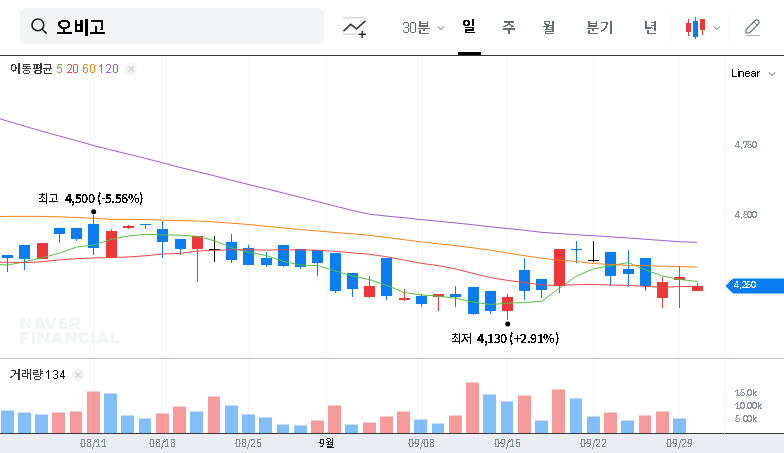
    (352910) Obigo Stock: Jang Young-jun's Stake Increase Signals 'Management Influence' – What Investors Must Know 대표 차트 이미지

    In the world of stock market analysis, even the smallest ripples can signify a coming tide. For investors watching Obigo stock, a recent filing has done just that. A seemingly minuscule 0.01% increase in stake by major shareholder Jang Young-jun has sparked significant interest, not because of its size, but because of its declared purpose: ‘influence over management.’ This strategic declaration transforms a routine transaction into a potential harbinger of change for the automotive software company.

    This article delves deep into this development, exploring what this move means for Obigo’s governance, the potential impact on its share price, and the strategic considerations for current and prospective investors. Is this the first step in a larger strategic play, or simply a reaffirmation of commitment? Let’s analyze the details.

    The Disclosure: A Closer Look at the Numbers

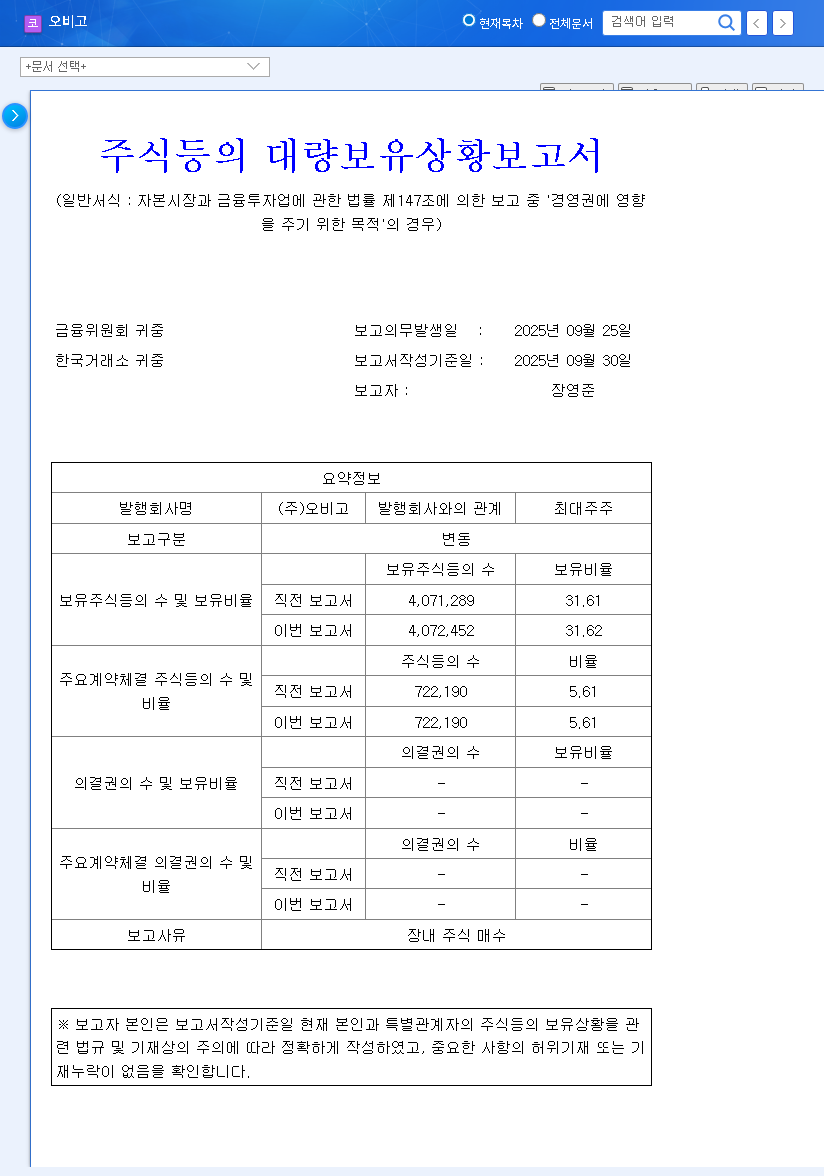
    On October 27, 2023, Obigo (KOSDAQ: 352910) filed a ‘Report on the Status of Large Shareholdings’ that detailed a change in ownership. The filing confirmed that major shareholder Jang Young-jun’s stake increased from 31.61% to 31.62%. This information was confirmed via the official disclosure filed with Korea’s Financial Supervisory Service (Source).

    • Reporting Party: Jang Young-jun
    • Transaction Date: September 25, 2023
    • Nature of Change: On-market purchase of 1,163 common shares by related party Hwang Do-yeon.
    • Stated Purpose: Influence over management.

    While the 0.01% change is financially negligible for a company with a market capitalization of over KRW 50 billion, the explicit mention of management influence is a critical signal that cannot be ignored.

    In corporate governance, intent is paramount. A public declaration of ‘management influence’ signals a shift from passive ownership to a potentially active role in shaping the company’s strategic direction. This is a clear message to the board and the market.

    Understanding Obigo and Its Market Position

    To grasp the implications of this Jang Young-jun stake increase, it’s essential to understand Obigo’s business. Obigo is a technology company specializing in smart car software platforms. They provide solutions like in-vehicle infotainment (IVI), web browsers for automotive systems, and application frameworks. The company operates at the intersection of the automotive and software industries, a sector poised for massive growth with the rise of electric vehicles (EVs) and autonomous driving technology. A clear strategy and strong leadership are vital to navigate this competitive landscape, which may be a motivating factor behind the desire for more direct management influence.

    Potential Impacts on Obigo Stock and Strategy

    How might this development affect the Obigo share price and market sentiment? The effects can be viewed through several lenses.

    Positive Signals for Investors

    The market often interprets a major shareholder’s increased investment as a vote of confidence. This move suggests that an insider with deep knowledge of the company believes in its long-term value. The ‘management influence’ clause further amplifies this, implying an intent to actively unlock that value, potentially through strategic pivots, improved operational efficiency, or better capital allocation. This can attract new investors and boost market sentiment, as seen in similar cases reported by financial outlets like Bloomberg.

    Points of Caution and Uncertainty

    Conversely, the change is extremely small. It’s not a hostile takeover bid or a dramatic power grab. A 0.01% increase doesn’t shift the balance of power in any meaningful way. Therefore, expecting an immediate, sharp rise in the Obigo stock price may be premature. The market will likely adopt a ‘wait-and-see’ approach, monitoring for follow-up actions, such as further share purchases or formal proposals at shareholder meetings. This move is part of a broader trend, which you can read about in our guide to shareholder activism.

    Investor Action Plan: Navigating the News

    For those holding or considering an investment in Obigo, this news warrants careful consideration rather than a knee-jerk reaction. A prudent strategy involves a multi-faceted approach:

    • Monitor Follow-Up Filings: Keep a close eye on DART and other financial news sources for any further changes in Jang Young-jun’s holdings or any official statements regarding his intentions.
    • Re-evaluate Obigo’s Fundamentals: Use this as a catalyst to review the company’s financial health. Analyze recent quarterly reports for revenue growth, profit margins, and cash flow. Is the underlying business strong enough to support a higher valuation?
    • Analyze the Competitive Landscape: Assess Obigo’s position relative to competitors in the automotive software space. What are its unique selling propositions and potential vulnerabilities?
    • Look for Strategic Announcements: The true impact will be revealed through action. Watch for announcements about new business strategies, board member nominations, or shareholder proposals leading up to the next general meeting.

    In conclusion, Jang Young-jun’s minor stake increase is a classic example of a signal that outweighs its substance. While the 0.01% figure itself is inconsequential, the declared intent for ‘management influence’ opens a new chapter of possibilities for Obigo. For investors, this is not a time for speculation, but for diligent research and heightened awareness. The next moves by Jang Young-jun and the company’s board will ultimately determine whether this small ripple grows into a wave of value creation.

    (352910) Obigo Stock: Jang Young-jun's Stake Increase Signals 'Management Influence' – What Investors Must Know 관련 이미지
    (352910) Obigo Stock: Jang Young-jun's Stake Increase Signals 'Management Influence' – What Investors Must Know 관련 이미지
  • Actro (290740) CEO Increases Stake: A Sign of Growth Momentum?

    1. What Happened?

    On August 22, 2025, Actro’s CEO, Dong-gil Ha, acquired an additional 3,971 shares, increasing his stake from 38.33% to 38.37%. The purpose of the acquisition was stated as ‘influence on management rights’.

    2. Why Does It Matter?

    The CEO’s stake increase can be interpreted as a positive signal, indicating stronger commitment to responsible management and confidence in the company’s future. Actro has recently faced challenges with the smartphone market slowdown and declining profitability. In this context, the CEO’s share purchase can provide reassurance to shareholders. However, the marginal increase of 0.04%p may limit the short-term impact on stock price.

    3. Actro’s Current Situation

    3.1. Positive Factors

    • Growth of the actuator business due to the trend of high-performance smartphones
    • Growth potential of new businesses such as secondary battery materials and THz inspectors
    • Improvement in cash flow from operating activities

    3.2. Negative Factors

    • Declining profitability (increase in cost of sales and SG&A expenses)
    • High customer dependency (Samsung Electro-Mechanics 91.27%)
    • Slowdown in inventory and accounts receivable turnover
    • Foreign exchange volatility risk

    4. What Should Investors Do?

    While the CEO’s increased stake is a positive sign, continuous monitoring of Actro’s fundamentals is crucial. Pay close attention to improvements in profitability, customer diversification, and the performance of new businesses. A long-term investment perspective is recommended rather than a short-term one, and investors should also keep an eye on further stake purchases and changes in the macroeconomic environment.

    Frequently Asked Questions

    Q: What is Actro’s main business?

    A: Actro primarily manufactures camera actuators used in smartphones and tablet PCs.

    Q: What is Actro’s future growth outlook?

    A: The trend towards high-performance smartphones, including foldable phones and high-magnification zoom cameras, is expected to positively impact Actro’s actuator business. The growth potential of new businesses, such as secondary battery materials and THz inspectors, is also highly regarded. However, risk factors such as declining profitability and customer dependency should be considered.

    Q: Should I invest in Actro?

    A: While the CEO’s increased stake can be interpreted as a positive sign, careful investment decisions are necessary considering the uncertainties surrounding the company’s fundamentals. It is important to closely monitor future earnings improvements and the visibility of new business performance.

  • TXRobotics Stock Analysis: Opportunity or Threat After Large Holding Report?

    1. What Happened?

    DT&Investment sold 15,010 shares of TXRobotics through three investment partnerships. This was done for ‘simple investment’ purposes and is not related to management participation.

    2. Why the Sell-off?

    The exact reason for the sale is unknown, but it’s interpreted as a change in DT&Investment’s investment strategy. Possible reasons include short-term profit-taking or portfolio adjustments. Selling off over 1% of the shares can put downward pressure on the stock price in the short term.

    3. What Does This Mean for TXRobotics?

    Increased short-term volatility is expected. However, it’s important to note that there’s no significant change in the company’s fundamentals. TXRobotics continues to show positive momentum with improved financial structure, entry into the service robot business, and securing exclusive sales contracts. The growth of the logistics automation and robotics market also creates a favorable environment for TXRobotics. Declining international oil prices and shipping costs could alleviate cost burdens.

    4. What Should Investors Do?

    • Be mindful of short-term volatility: The stock price may decline as the market absorbs the sold shares.
    • Focus on long-term growth potential: Considering the solid fundamentals and growth momentum, the long-term investment outlook remains positive.
    • Monitor for further information: Continuously monitor for similar large holding reports and other disclosures in the future.
    • Analyze company value: Comparing the current stock price with the company’s intrinsic value is crucial for making investment decisions.

    Frequently Asked Questions

    Will this sell-off negatively impact TXRobotics’ future?

    Short-term stock price volatility is expected, but it’s unlikely to significantly affect the company’s fundamentals. TXRobotics continues to maintain positive growth momentum.

    When is a good time to invest in TXRobotics?

    The optimal investment timing depends on individual investor goals and risk tolerance. If you can tolerate short-term volatility, the current situation might present a buying opportunity. However, carefully analyze the company’s value and market conditions before making any investment decisions.

    What is the outlook for TXRobotics?

    Considering the growth of the logistics automation and robotics market, and the company’s new business ventures, the long-term growth potential is considered high.