Tag: Soosung Asset Management

  • (138080) OE Solutions Stake Reduction: An In-Depth 2025 Investor Analysis

    (138080) OE Solutions Stake Reduction: An In-Depth 2025 Investor Analysis

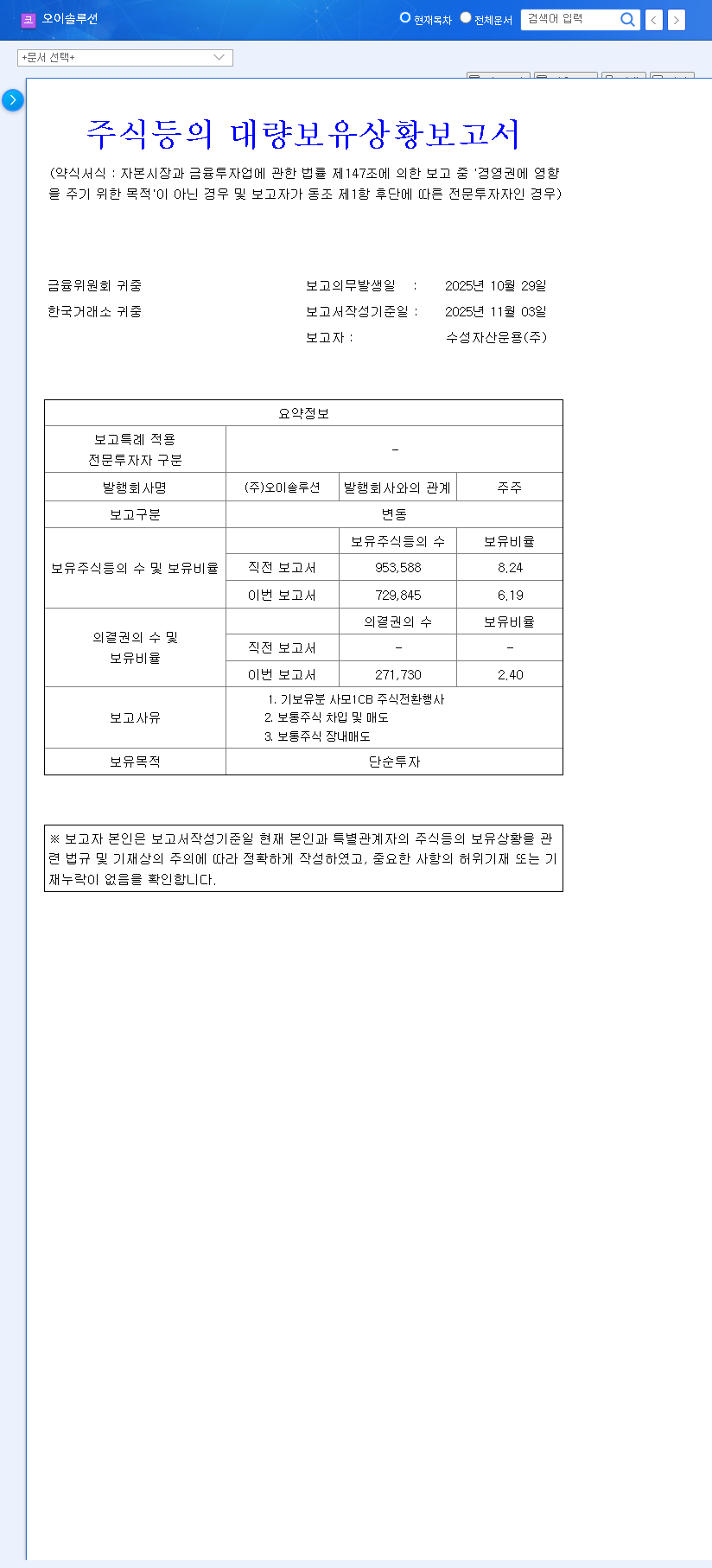
    The recent OE Solutions stake reduction by major shareholder Soosung Asset Management has sent ripples through the investment community, prompting a necessary re-evaluation of the company’s stock and future prospects. This significant move, which saw the asset manager decrease its holding from 8.24% to 6.19%, is more than a simple portfolio adjustment; it’s a critical signal that warrants a thorough investigation. For current and prospective investors, understanding the context behind this divestment is paramount.

    This comprehensive analysis unpacks the implications of Soosung’s move. We will dissect OE Solutions’ current fundamentals, explore the potential impact on investor sentiment and stock price, and outline a strategic framework to help you navigate this period of uncertainty. Is this a warning sign of deeper issues, or a buying opportunity in disguise? Let’s find out.

    The Catalyst: Unpacking Soosung Asset Management’s Divestment

    On November 4, 2025, the market took note as Soosung Asset Management formally disclosed a sale of approximately 2.05 percentage points of its shares in OE Solutions. According to the Official Disclosure (DART), this reduction was achieved through a combination of strategies, including exercising conversion rights on convertible bonds (CBs) and direct market sales. While the stated purpose was for investment, a large-scale divestment by an institutional investor is often interpreted as a bearish signal, reflecting a potential lack of confidence in the company’s near-term growth or valuation.

    Institutional investors are often considered the “smart money,” and their actions can heavily influence market psychology. A significant sell-off can trigger a cascade of selling from retail investors, creating short-term downward pressure on the OE Solutions stock price. Understanding this dynamic is the first step in a sound OE Solutions investor analysis.

    A Tale of Two Halves: OE Solutions’ Current Fundamentals

    To understand the context of the OE Solutions stake reduction, we must examine the company’s financial health and strategic direction as of its H1 2025 report. The picture is complex, with impressive top-line growth overshadowed by persistent profitability challenges.

    The core dilemma for OE Solutions is clear: Revenue is soaring on the back of market diversification and innovation, but the bottom line remains elusive due to heavy investment in future growth and high operational costs.

    Positive Momentum: Growth and Innovation

    • Impressive Revenue Growth: H1 2025 revenue surged to KRW 29.9 billion, a remarkable 92.1% year-over-year increase. This is a direct result of successful market diversification beyond 5G into high-demand sectors like FTTH (Fiber to the Home), CATV, and Datacenters.
    • Investing in the Future: OE Solutions is aggressively pursuing next-generation technologies. Key projects include ELSFP for Co-Packaged Optics (CPO), 100Gbps DCO optical modules, and cutting-edge 400G coherent transceivers. These are critical components for the future of data transmission. For more on this technology, you can read our guide on The Future of Optical Transceivers.
    • New Ventures & Integration: The company is expanding into new markets like LiDAR light sources for autonomous driving and strengthening its supply chain through the vertical integration of core optical components.

    Concerning Headwinds: Profitability and Financial Health

    • Persistent Losses: Despite the revenue boom, H1 2025 saw an operating loss of KRW 9.7 billion and a net loss of KRW 10.7 billion. This indicates that the cost of growth—high R&D spending and SG&A expenses—is currently outweighing income.
    • Financial Strain: The company’s debt-to-equity ratio is on the rise, primarily due to the issuance of convertible bonds to fund operations and R&D. Continuous losses raise valid concerns about long-term financial soundness.
    • Uncertain Monetization Timeline: While the R&D pipeline is exciting, these advanced technologies require lengthy development and customer approval cycles. The timeline for them to generate meaningful profit remains uncertain.

    Investment Strategy: Navigating the Uncertainty

    Given the conflicting signals, a nuanced investment strategy is required. The market’s reaction to the OE Solutions stake reduction creates short-term risks but also highlights long-term performance indicators to monitor.

    Short-Term Outlook: Caution is Key

    In the immediate future, investors should brace for increased volatility. The overhang from Soosung’s sale, combined with the potential for further CB conversions, creates significant selling pressure. A cautious, wait-and-see approach is advisable until the market absorbs this new supply of shares. According to market behavior studies from Reuters, institutional sell-offs can depress a stock for several quarters.

    Mid-to-Long-Term Outlook: Focus on Execution

    The long-term success of OE Solutions hinges on its ability to convert its technological prowess into profit. Investors should shift their focus from short-term stock movements to a few key performance indicators:

    • Path to Profitability: Watch for sequential improvements in operating margins in upcoming quarterly reports. Is the company gaining control over its costs?
    • Commercialization Milestones: Look for announcements of customer acquisitions or design wins for their next-generation products (CPO, 400G modules, LiDAR).
    • Financial De-risking: Monitor the company’s efforts to manage its debt and improve its financial structure.

    Conclusion: A Critical Juncture for OE Solutions

    Soosung Asset Management’s stake reduction serves as a potent reminder of the challenges facing OE Solutions. While the company’s innovation and revenue growth are undeniable strengths, the lack of profitability and financial pressures are significant risks that cannot be ignored. For investors, this is a time for diligence, not panic. The key is to monitor the company’s progress on its path to profitability and its ability to execute its ambitious technology roadmap. The coming quarters will be pivotal in determining whether OE Solutions can translate its vision into sustainable value for shareholders.
    (138080) OE Solutions Stake Reduction: An In-Depth 2025 Investor Analysis 관련 이미지
  • (065650) Hyper Corporation Inc. Shareholder Divestment: A 2025 Deep Dive

    (065650) Hyper Corporation Inc. Shareholder Divestment: A 2025 Deep Dive

    A significant Hyper Corporation Inc. shareholder divestment has sent ripples through the market, prompting urgent questions from investors. The complete exit by a major stakeholder, Soosung Asset Management, raises concerns about the company’s future trajectory and the stability of Hyper Corp stock. This analysis breaks down the event, explores the underlying reasons, and provides a strategic roadmap for investors trying to navigate the resulting uncertainty.

    The Breaking News: A Major Shareholder Makes a Full Exit

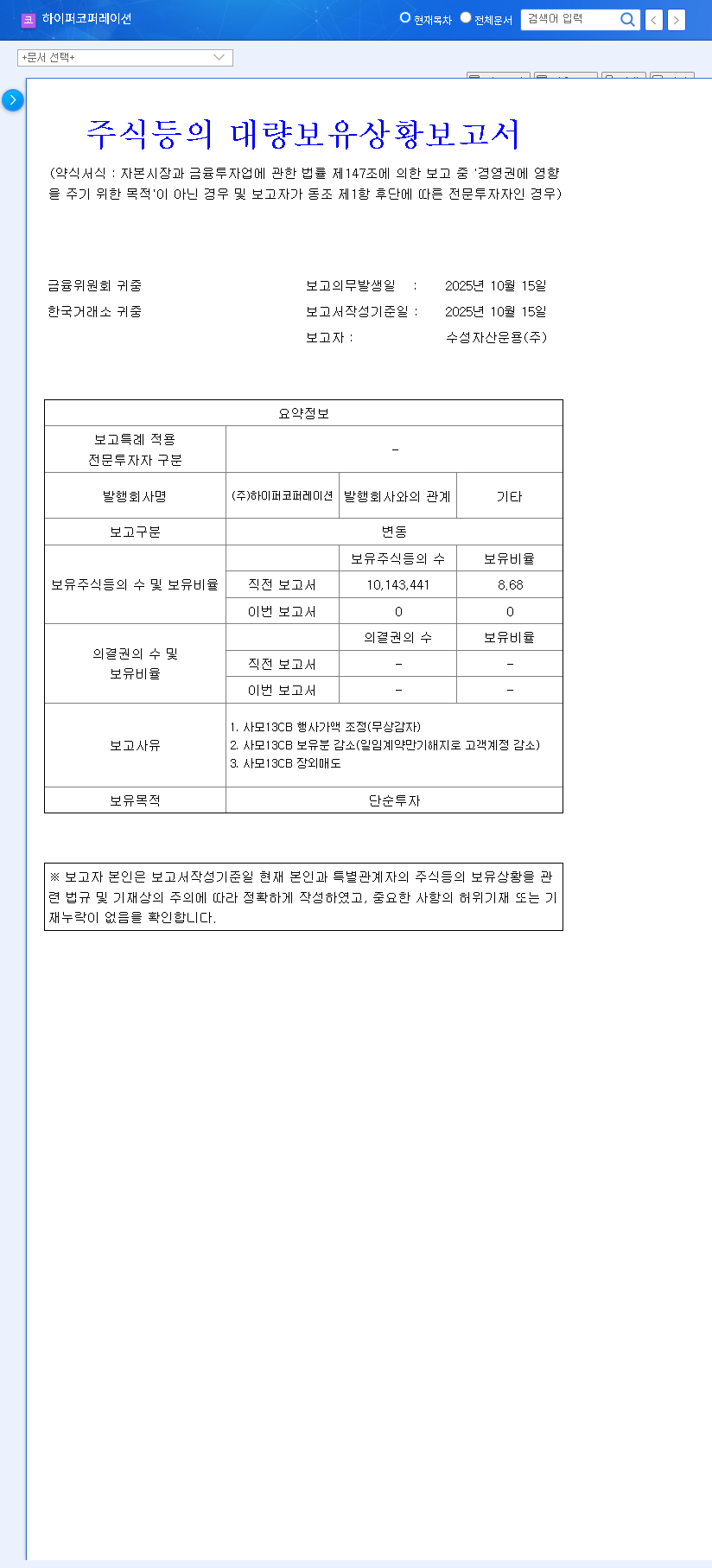
    On October 16, 2025, Hyper Corporation Inc. filed a disclosure that confirmed a monumental shift in its ownership structure. According to the ‘Report on the Status of Large Shareholdings’, two key entities, Soosung Asset Management and the NH-Soosung No. 1 Mezzanine New Technology Investment Association, have liquidated their entire positions in the company. The most impactful change was Soosung Asset Management’s stake plummeting from 8.68% to zero. This full divestment was executed via an off-market sale of 1,216,692 shares of Private Placement 13th Convertible Bonds (CBs) directly back to Hyper Corporation Inc. itself. You can view the Official Disclosure (DART) for complete details.

    Decoding the Divestment: Why Did Soosung Sell?

    Understanding the motivation behind such a significant convertible bond sale is crucial for a complete investor analysis. The official report points to a combination of technical and strategic factors rather than a single dramatic event.

    Key Drivers Behind the Stake Sale

    • CB Exercise Price Adjustment: The report mentions a ‘capital reduction without consideration,’ which necessitated an adjustment to the exercise price of the convertible bonds. This is a technical financial maneuver that can sometimes trigger portfolio rebalancing.
    • Expiry of Investment Contracts: The holdings were reduced partly due to the expiration of a discretionary investment contract, leading to a decrease in managed client accounts and the need to liquidate assets.
    • Fund Recovery via Off-Market Sale: The direct sale to Hyper Corporation Inc. provided an efficient way for Soosung Asset Management to recover its investment funds without the volatility of selling on the open market.

    While the reasons appear procedural, the market often interprets a major shareholder’s complete exit as a bearish signal, regardless of the stated rationale. The key question is whether this is simple profit-taking or a sign of deeper concerns.

    Analyzing the Impact on Hyper Corp Stock

    The Hyper Corporation Inc. shareholder divestment will likely have distinct short-term and long-term consequences for the company’s valuation and financial structure. Investors must separate immediate market sentiment from fundamental business health.

    Short-Term Outlook: Expect Increased Volatility

    In the immediate term, negative pressure on the stock price is probable. A large stake sale can signal a loss of confidence to the broader market, potentially triggering panic selling among retail investors. This event introduces a large volume of shares (via the CBs) back to the company, creating uncertainty and likely leading to higher trading volumes and significant price swings. While the company repurchasing its own bonds can be seen as a sign of self-confidence, the concurrent capital reduction may dilute per-share value, adding to the downward pressure.

    Mid-to-Long-Term Financial Health

    Looking ahead, the effects are more nuanced. By repurchasing and potentially retiring the convertible bonds, Hyper Corporation Inc. reduces its potential debt burden, which can be a net positive for its financial soundness. For a deeper understanding of these financial instruments, you can read our guide on how convertible bonds work. However, the exit of a major institutional investor may make it harder to attract future capital and could signal a need for investors to re-evaluate the company’s long-term management strategy and growth prospects.

    Strategic Guide for Investors

    Given the circumstances, a measured and analytical approach is paramount. Knee-jerk reactions can be costly. Here’s how to proceed.

    • Adopt a Conservative Stance: In the short term, caution is advised. Wait to see how the market digests this news and monitor the company’s official communications for clarity and reassurance.
    • Demand Transparency: Look for follow-up announcements from Hyper Corporation Inc. Why did they repurchase the bonds? How does this fit into their capital management strategy? A clear, confident response can restore investor trust.
    • Re-evaluate Fundamentals: This event serves as a catalyst to reassess the company’s core business. Dig into their latest earnings reports, analyze their competitive position, and consult third-party analysis from sources like Bloomberg or other financial news outlets. Is the underlying business still strong despite this ownership shake-up?

    In conclusion, the Hyper Corporation Inc. shareholder divestment is a pivotal moment that warrants close attention. While short-term turbulence is expected for Hyper Corp stock, long-term value will be determined by the company’s fundamental strength and the clarity of its strategic response.

    (065650) Hyper Corporation Inc. Shareholder Divestment: A 2025 Deep Dive 관련 이미지
  • (170920) LTC Stock Forecast: Institutional Sell-Off & In-Depth Investment Analysis

    (170920) LTC Stock Forecast: Institutional Sell-Off & In-Depth Investment Analysis

    The latest news surrounding LTC stock (170920) has sent ripples through the investment community. Soosung Asset Management, a significant institutional player, has officially reduced its holdings, a move that demands careful consideration from every current and prospective investor. This action can influence short-term market sentiment and raises critical questions about the company’s long-term trajectory. Is this a red flag signaling underlying issues, or a fleeting market event that creates a prime buying opportunity?

    This comprehensive LTC investment analysis will dissect the situation, exploring the immediate impacts, the company’s core fundamentals, and what this means for your investment strategy. We’ll provide the clarity you need to navigate the uncertainty and make an informed decision about the future of your LTC stock position.

    Understanding the News: Soosung’s Stake Reduction

    The Official Disclosure: What Changed?

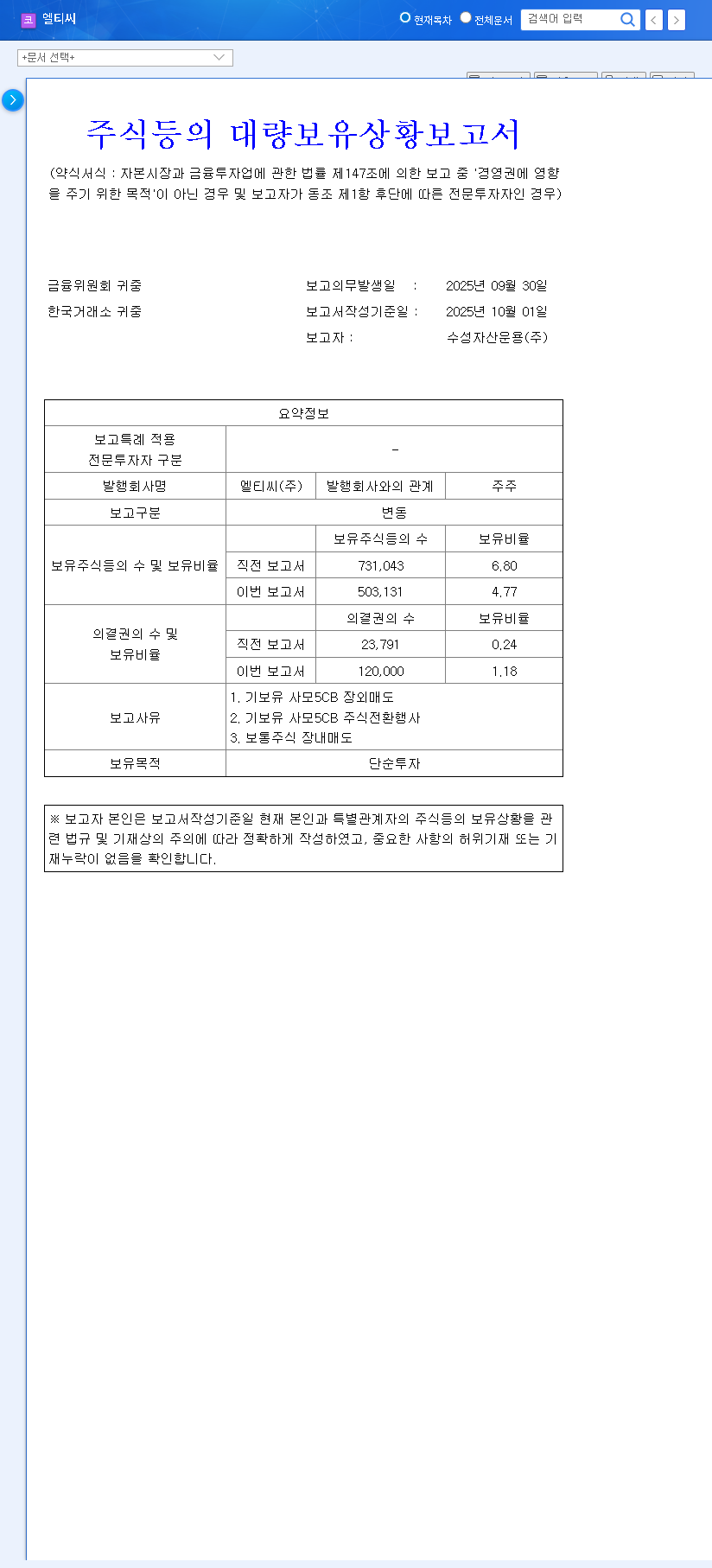
    On October 2, 2025, a significant disclosure was made. Soosung Asset Management announced a decrease in its holdings of LTC shares from 6.80% down to 4.77%. This 2.03 percentage point reduction is not a trivial adjustment and represents a substantial transaction that the market is bound to notice. You can view the Official Disclosure (DART Source) for complete transparency.

    Potential Reasons for the Sale

    An institutional sell-off is rarely driven by a single factor. The analysis points to a combination of strategic financial maneuvers:

    • Convertible Bond (CB) Strategy: Soosung executed a multi-part strategy involving its privately placed Convertible Bonds. A portion was sold off-market, while another was converted into shares, directly impacting the overall holding percentage as part of a standard CB investment cycle.
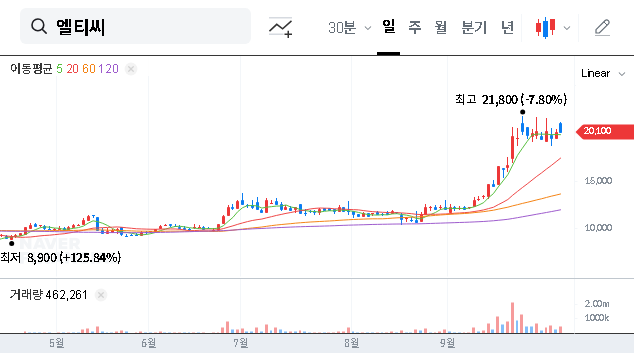
    • Profit Realization & Rebalancing: Over 200,000 common shares were sold directly on the open market. This could be a classic case of realizing profits after a period of growth or a strategic rebalancing of their portfolio to manage risk and allocate capital to other opportunities.

    It’s crucial to distinguish between a strategic portfolio adjustment by an institution and a flight from a company with failing fundamentals. Often, the former creates opportunity for retail investors.

    Analyzing the Impact on the LTC Share Price

    Immediate Market Reaction: The Supply Pressure Effect

    In the short term, news of a major investor reducing their stake can weaken investor sentiment. The on-market sale of over 200,000 shares introduces significant selling pressure. This sudden increase in supply, without an equivalent increase in demand, could lead to a temporary dip in the LTC share price. Traders should be prepared for heightened volatility.

    The Bigger Picture: Is This a Fundamental Shift for LTC Stock?

    While the short-term noise is important, long-term investors must look deeper. The 2% stake reduction is significant but may not signal a complete loss of faith in LTC’s core business. The crucial factor is whether the company’s fundamentals remain intact. While the converted CBs create a potential for future share supply (an ‘overhang’), this is a technical market factor, not necessarily a reflection of poor business performance. The real determinants of long-term value will be LTC’s operational results and broader market trends, such as those covered by financial authorities like Bloomberg’s market analysis.

    A Deep Dive into LTC’s Core Fundamentals (H1 2025)

    To truly gauge the LTC stock forecast, we must look past this single event and examine the company’s health. The H1 2025 report provides a solid foundation:

    • Resilient Revenue: Consolidated revenue reached 137.2 billion KRW, maintaining year-on-year growth. While the pace has slowed, indicating potential headwinds in the semiconductor and display sectors, the top line remains robust.
    • Improved Profitability: Operating profit showed positive improvement. This suggests strong cost management and a successful focus on higher-margin products, a sign of operational efficiency.
    • Future-Focused Investment: LTC maintains a stable capital structure while actively investing in R&D and new business ventures to secure future growth engines.

    These fundamentals suggest that the company’s intrinsic value proposition has not been fundamentally altered by Soosung’s recent sale. For more on evaluating company health, you can read our guide to fundamental analysis.

    Strategic LTC Investment Analysis: Your Action Plan

    So, how should you position yourself? Your approach to this LTC stock news depends heavily on your investment horizon.

    For the Short-Term Trader

    Caution is the word of the day. The selling pressure from Soosung could lead to price drops and volatility. Consider a wait-and-see approach or be prepared to implement strict stop-loss orders to manage downside risk if you decide to enter a position.

    For the Mid-to-Long-Term Investor

    This is where the opportunity may lie. If you believe in LTC’s solid fundamentals and its long-term strategy, a temporary price dip caused by this market event could be an attractive entry point. A patient investor who is not swayed by short-term noise may find this an ideal moment to initiate or add to a position, focusing on the recovery of the semiconductor industry and the performance of LTC’s new business ventures.

    (170920) LTC Stock Forecast: Institutional Sell-Off & In-Depth Investment Analysis 관련 이미지
  • LTC Stock Forecast: Is Soosung Asset Management’s Stake Sale a Buying Opportunity or a Warning Sign?

    1. What Happened?

    Soosung Asset Management converted its convertible bonds (CBs) in LTC into shares and then sold them on the open market, reducing its stake from 8.41% to 6.80%. While this could be a simple profit-taking move, the market may interpret it as a concern about LTC’s future prospects.

    2. Why Did They Reduce Their Stake?

    The official reason is ‘customer account decrease’ and ‘exercise of convertible bonds.’ Convertible bonds can be converted into shares at maturity, and recovering funds through this method is a common strategy for asset management companies. However, considering the recent upward trend in LTC’s stock price, the possibility of profit-taking cannot be ruled out.

    3. What Impact Will This Have on the Stock Price?

    • Short-term impact: Soosung Asset Management’s stake sale could negatively impact the stock price in the short term. A large sell-off could create downward pressure on the price.
    • Long-term impact: The long-term impact depends on LTC’s fundamentals. If the growth trend in the semiconductor and display markets continues, LTC’s earnings improvement could lead to a stock price increase.

    4. What Should Investors Do?

    Short-term investors should be wary of increased price volatility. Long-term investors should make investment decisions based on a comprehensive consideration of LTC’s business growth potential, profitability improvement, and changes in the macroeconomic environment. It is crucial to carefully review LTC’s 2025 half-year earnings announcement and monitor the specific performance of its new business ventures and profitability improvement efforts.

    What does Soosung Asset Management’s stake sale in LTC signify?

    Soosung Asset Management reduced its stake in LTC from 8.41% to 6.80% by converting convertible bonds into shares and selling them. This could be part of their investment strategy, but it can be interpreted as a negative signal by the market.

    What is the outlook for LTC’s stock price?

    In the short term, downward pressure on the stock price is expected due to the stake sale. However, the long-term direction of the stock price will depend on LTC’s fundamentals and market conditions.

    What should investors consider when investing in LTC?

    Investors should comprehensively analyze LTC’s business growth, profitability, financial structure, and macroeconomic environment. They should also be mindful of short-term price volatility.

  • Hanchang Paper Stock Forecast: Is Soosung Asset Management’s CB Investment a Blessing or a Curse?

    1. What Happened?

    Soosung Asset Management acquired a 5.71% stake in Hanchang Paper through a private placement of convertible bonds (CBs). While they stated the purpose as a simple investment, the market interprets this investment in various ways.

    2. Why Did They Invest?

    Soosung Asset Management appears to be focusing on Hanchang Paper’s growth potential. Efforts to secure future growth engines, such as developing eco-friendly paper products, are viewed positively. Also, this CB issuance allows Hanchang Paper to anticipate improvements in its financial structure.

    3. So What Happens Next?

    In the short term, Soosung Asset Management’s investment is likely to positively impact the stock price. However, the weak Q1 earnings remain a concern. The medium to long-term stock price trend depends on whether fundamentals improve. In particular, the possibility of CB conversion and the resulting stock dilution effect should be considered.

    • Positive Factors:
      • Funding and improved financial structure
      • Potential upward momentum in stock price
      • Increased investor confidence
    • Negative/Cautionary Factors:
      • Weak Q1 2025 earnings
      • Potential stock dilution from CB conversion
      • Economic slowdown and deteriorating industry environment

    4. What Should Investors Do?

    A ‘wait-and-see’ approach is appropriate at this point. Investors should be mindful of the possibility of increased short-term stock price volatility and closely monitor future earnings announcements and management performance. In particular, whether earnings improve after Q2 will be an important investment decision criterion.

    How will Soosung Asset Management’s CB investment affect Hanchang Paper?

    In the short term, positive momentum in the stock price and improvements in financial structure can be expected, but in the long term, whether fundamentals improve is more important. The possibility of stock dilution due to CB conversion should also be considered.

    How were Hanchang Paper’s Q1 2025 earnings?

    Hanchang Paper recorded weak earnings with a decline in sales and an operating loss. The economic slowdown and increased cost burden are analyzed as the main causes.

    Should I invest in Hanchang Paper?

    A ‘wait-and-see’ approach is appropriate for now. It is recommended to confirm the trend of earnings improvement after Q2 before making an investment decision.

  • Sungho Electronics: Investment from Soosung Asset Management – A Turning Point or a Red Flag? Q3 2025 Earnings and Investment Analysis

    1. What Happened? Soosung Asset Management Acquires Sungho Electronics Stake

    Soosung Asset Management has acquired a 7.90% stake in Sungho Electronics through a private equity fund. While officially stated as a passive investment, the possibility of future management participation cannot be ruled out.

    2. Why the Investment? A Hidden Opportunity Amidst Troubling Earnings?

    Sungho Electronics’ Q3 2025 earnings were disappointing, reporting a net loss on a consolidated basis. Declining sales, deteriorating profitability, and weakening financial health all raise red flags. Despite this, Soosung Asset Management’s investment suggests a belief in Sungho Electronics’ underlying potential or future business plans.

    3. What’s Next? Opportunities and Risks in Uncertain Times

    The impact of Soosung Asset Management’s investment on Sungho Electronics remains uncertain. While a short-term stock price increase is possible, the long-term outlook hinges on improvements in Sungho Electronics’ fundamentals. If the investment contributes to restructuring, diversification, and increased management efficiency, positive synergy can be expected. However, the opposite is also true.

    • Positive Scenario: Restructuring and new business ventures driven by Soosung Asset Management’s involvement.
    • Negative Scenario: Continued poor performance and increased investment losses.

    4. What Should Investors Do? Careful Analysis and Risk Management are Key

    Investors should carefully analyze Sungho Electronics’ fundamental improvement strategy, Soosung Asset Management’s investment strategy, and external factors before making investment decisions. Continuous monitoring of external variables such as raw material prices, exchange rates, and interest rate fluctuations is crucial.

    Frequently Asked Questions

    What is Soosung Asset Management’s investment objective?

    Officially, it’s stated as a passive investment, but the possibility of future management involvement can’t be ruled out.

    How was Sungho Electronics’ performance in Q3 2025?

    Sungho Electronics reported a net loss on a consolidated basis, with declining sales, deteriorating profitability, and weakening financial health.

    How will this investment impact Sungho Electronics’ stock price?

    While it could lead to a short-term price increase, the long-term impact depends on improvements in the company’s fundamentals. Both positive and negative outcomes are possible depending on the investment’s results.

  • Oheim & Company Stock Forecast: Opportunity or Crisis After Soosung Asset Management’s Divestment?

    Why did Soosung Asset Management divest its Oheim & Company shares?

    Soosung Asset Management exercised its call option on privately placed convertible bonds (CBs), selling 354,485 shares of Oheim & Company in an off-market transaction. This reduced their stake from 6.24% to 4.16%. Typically, large-scale selling by institutional investors can put short-term downward pressure on stock prices.

    Impact on Stock Price: Short-term decline vs. Long-term growth

    While a short-term price drop is possible, the direct impact on Oheim & Company’s fundamentals in the long term is limited. The influx of funds from the call option exercise could actually be positive for financial soundness. The growth of new businesses like “Irop” and the brand expansion strategy are expected to maintain long-term growth momentum.

    What should investors do? Key Investment Points

    • Q2 2025 and beyond earnings improvement: Future earnings announcements should be monitored to confirm continued growth.
    • Management changes and litigation risks: Constant monitoring is necessary.
    • Macroeconomic factors: The impact of external factors such as exchange rates, interest rates, and international oil prices should be considered.

    More accurate investment decisions can be made through additional financial information and market analysis.

    Frequently Asked Questions

    Does Soosung Asset Management’s stake sale only have a negative impact on Oheim & Company’s stock price?

    While short-term downward pressure is expected, the direct impact on fundamentals in the long run is limited, and the cash inflow can be positive for financial soundness.

    What is the outlook for Oheim & Company’s stock price?

    Factors such as Q2 2025 earnings and beyond, management changes, litigation risk, and macroeconomic factors need to be comprehensively considered. The growth of new businesses like “Irop” and the brand expansion strategy are positive factors.

    What additional information should I review before making an investment decision?

    Refer to additional financial information, market analysis, and securities company reports to make informed investment decisions.