Tag: Share Sale

  • (003550) LG Electronics India IPO: A Deep Dive for Investors on Share Sale & Stock Impact

    The recent announcement of the LG Electronics India IPO has sent ripples through the investment community. As the South Korean tech giant plans a partial share sale of its highly successful Indian subsidiary, LG stock holders and potential investors are asking a crucial question: What does this strategic move mean for my portfolio? This comprehensive guide breaks down the rationale behind the share sale, analyzes the potential impact on LG’s stock price, and provides a clear action plan for navigating this pivotal event.

    What Happened? The LG Electronics India IPO Announcement

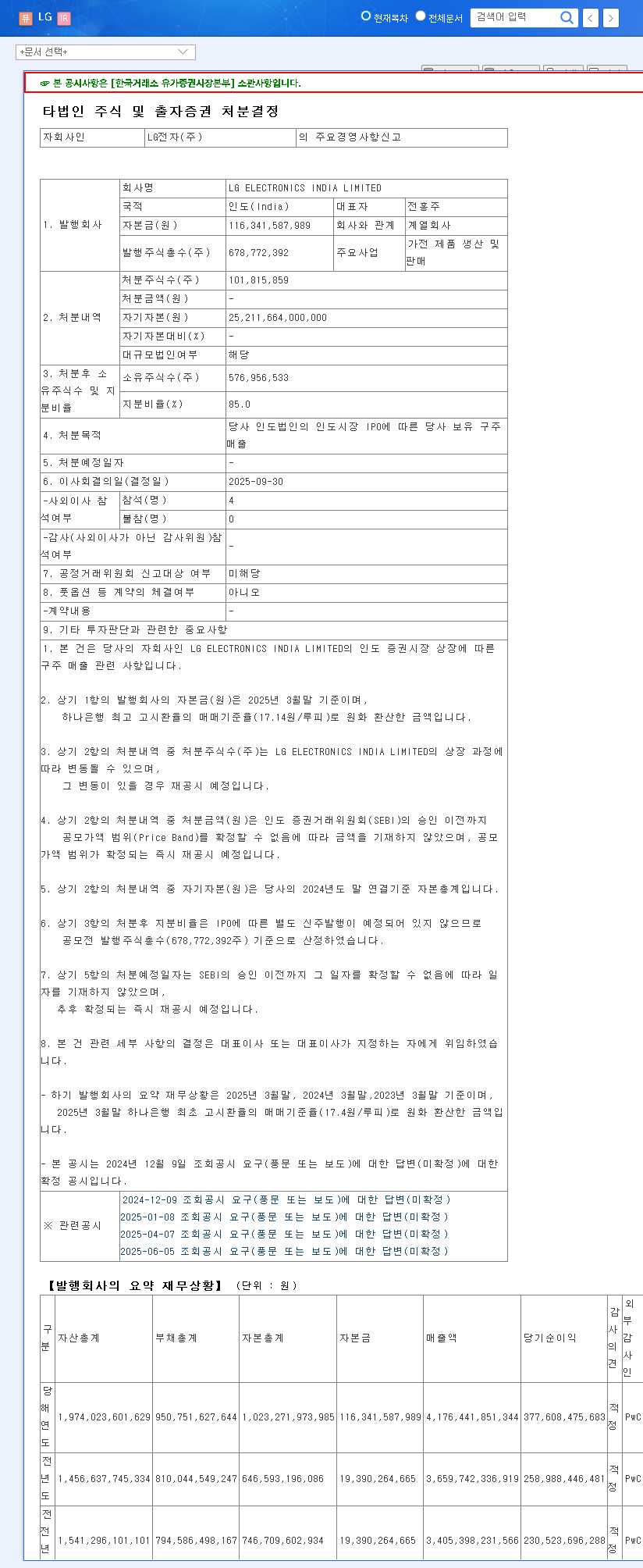
    LG Electronics officially confirmed its decision to pursue an Initial Public Offering (IPO) for its Indian subsidiary, LG ELECTRONICS INDIA LIMITED, on the Indian stock market. This strategic maneuver involves selling a portion of its existing shares to the public. While LG Electronics will retain a commanding majority stake of 85.0% post-offering, the move is designed to unlock significant value and raise capital. The business in question encompasses the production and sale of home appliances and consumer electronics, a sector where LG is a dominant player in India.

    This IPO is more than a financial transaction; it’s a strategic realignment to capitalize on the Indian market’s immense growth potential while simultaneously injecting fresh capital into LG’s global innovation pipeline.

    Strategic Rationale: Why This Share Sale Makes Sense

    The decision to list the Indian arm is multifaceted, driven by a combination of financial strategy and market opportunity. Understanding these drivers is key to any LG IPO analysis.

    1. Unlocking Shareholder Value and Boosting Liquidity

    The primary benefit is a significant infusion of cash. The funds raised from the LG India share sale can be strategically redeployed across LG’s global operations. This could mean accelerating R&D in future-growth sectors like electric vehicle components and AI, paying down debt to strengthen the balance sheet, or funding other high-priority investments. This improved financial flexibility is a major positive for the parent company.

    2. Capitalizing on India’s High-Growth Market

    The Indian consumer market is one of the fastest-growing in the world. By listing locally, LG Electronics India can have its value properly assessed by a market that intimately understands its potential. A successful IPO will not only establish a high market valuation for the subsidiary but also enhance its brand visibility and corporate governance profile within India, ultimately contributing to the parent company’s overall value.

    Navigating the Risks: Potential Downsides for LG Stock

    While the upside is clear, investors must also consider potential risks that could affect the LG stock impact. The success of the IPO is not guaranteed and market dynamics can be unpredictable.

    • Dilution Concerns: Although an 85% stake is substantial, the market may perceive any sale of shares as a potential first step towards further dilution of control. This could create uncertainty among some investors.
    • IPO Market Volatility: The final offering price and market reception are subject to prevailing market conditions. A lukewarm response or a lower-than-expected valuation could dampen the positive effects and lead to short-term negative pressure on LG’s stock price.
    • Execution Risk: The entire IPO process, from regulatory approvals to roadshows, requires flawless execution. Any hiccups could affect investor confidence.

    An Action Plan for Investors

    Given that key financial details like the exact disposal amount and valuation are still pending, a cautious and informed approach is essential. This is a critical time to be an engaged investor.

    What to Monitor in this LG Investor Guide

    • Official Disclosures: The most crucial information will come from official filings. Investors should monitor the primary source for this event. You can view the initial announcement here: Official Disclosure (DART Report).
    • Valuation & Pricing: Keep a close eye on the proposed IPO price band and the implied valuation of the Indian subsidiary. Compare this with industry peers.
    • Use of Proceeds: Once disclosed, scrutinize LG’s plans for the capital raised. A clear, growth-oriented strategy will be a strong positive signal.
    • Expert Analysis: Follow reports from major financial news outlets like Reuters and consult with financial advisors to gain a broader market perspective. For more foundational knowledge, you can review our guide on How to Analyze an IPO.

    In conclusion, the LG Electronics India IPO is a significant strategic move that holds considerable promise for unlocking value. For investors, the key is to stay informed, analyze the forthcoming details rigorously, and approach the situation with a long-term perspective.
    (003550) LG Electronics India IPO: A Deep Dive for Investors on Share Sale & Stock Impact 관련 이미지
  • SMCG Share Sale: What Does It Mean for Investors?


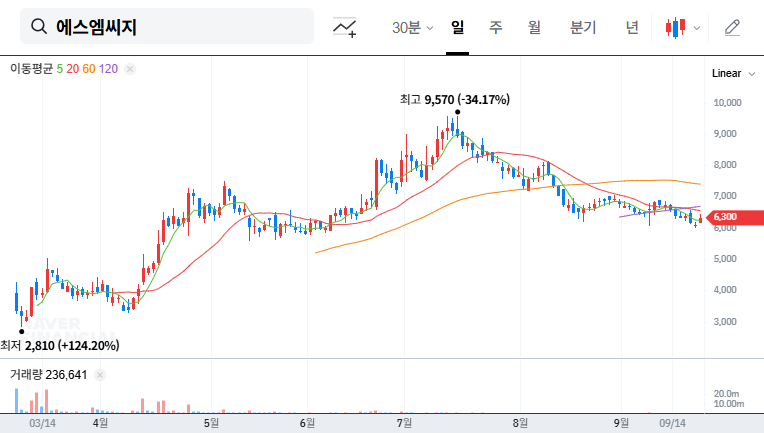
    SMCG Share Sale: What Does It Mean for Investors? 대표 차트 이미지


    What Happened at SMCG?

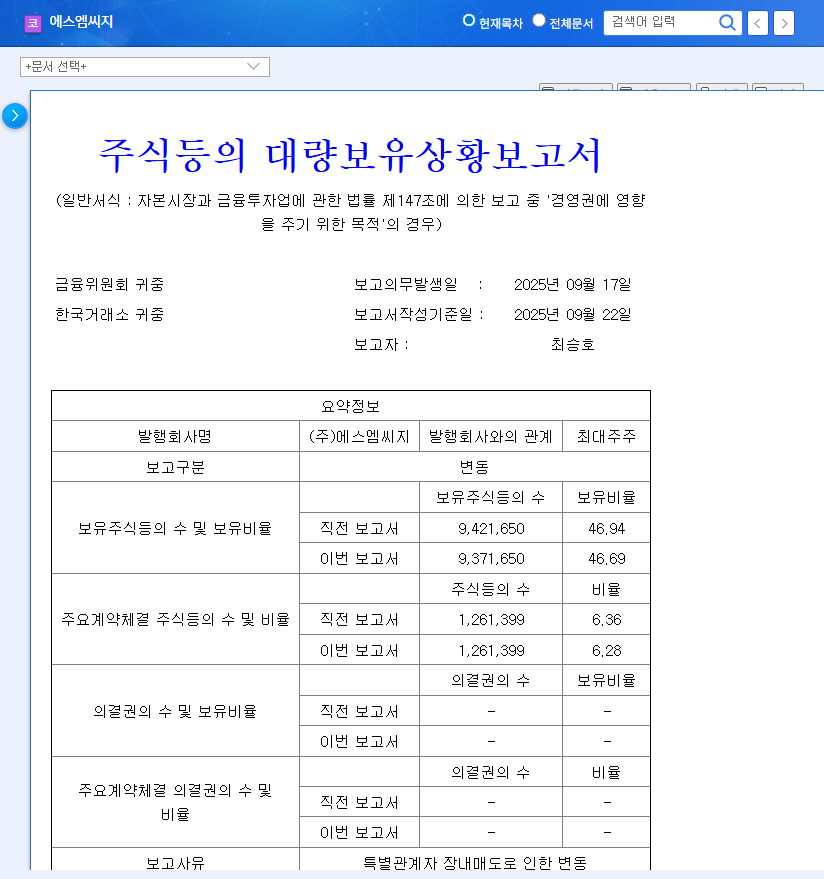
    On September 22, 2025, Yong-bae Kim, a close associate of SMCG’s largest shareholder, sold 50,000 shares (0.25%p) of the company. This slightly decreased the combined stake held by related parties, including CEO Seung-ho Choi, from 46.94% to 46.69%.

    Why the Sale, and What’s the Market Impact?

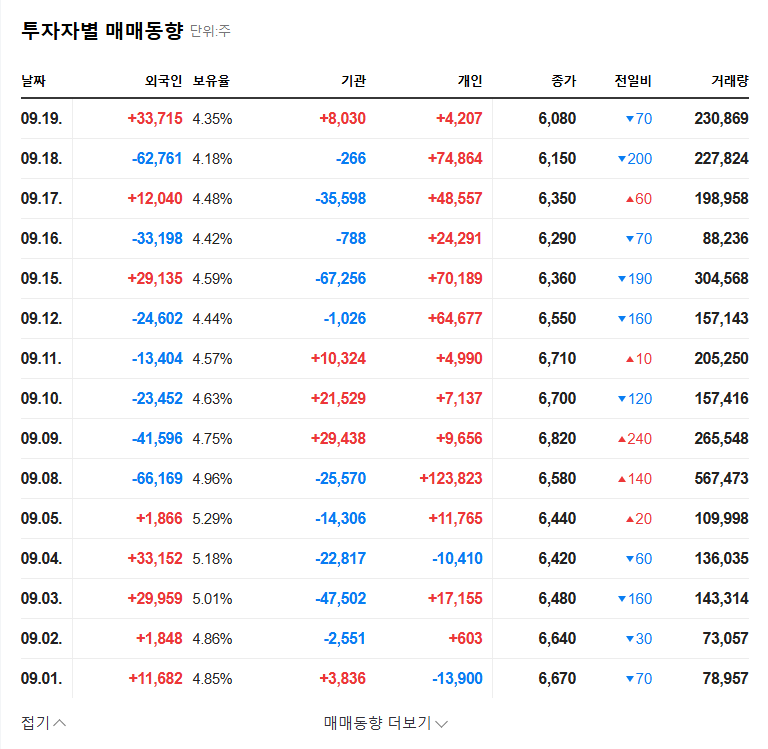
    The reason for Kim’s sale hasn’t been officially disclosed. While it could be for personal financial reasons, investors should consider various scenarios, including potential changes in management control. This sale could negatively impact SMCG’s stock price in the short term. Insider selling often creates uncertainty and dampens investor sentiment.

    Is SMCG Still an Attractive Investment?

    Despite the short-term risks, SMCG remains an attractive investment opportunity. In the first half of 2025, the company’s revenue and operating profit increased by 57.9% and 174.7% year-over-year, respectively, demonstrating robust growth. Positive factors include the K-Beauty boom, increasing demand for eco-friendly glass containers, and the expansion of the premium cosmetics market. The company’s financial structure has also improved since its KOSDAQ listing.

    What Should Investors Do?

    Investors considering SMCG should be aware of potential short-term price volatility. It’s crucial to carefully monitor the possibility of further share sales, potential management changes, and shifts in fundamental indicators. A long-term investment perspective is recommended. Pay close attention to any further sales by Kim, the company’s official stance on management control, and changes in key financial metrics.


    FAQ

    Why did Yong-bae Kim sell his shares?

    The official reason for the sale has not been disclosed. It may be for personal financial management, but investors should consider all possibilities.

    What is the outlook for SMCG’s stock price?

    The stock price might experience volatility in the short term due to the sale. However, the company’s long-term growth potential should be considered.

    What should investors be aware of when considering SMCG?

    Investors should monitor further share sales, potential management changes, and changes in the company’s key financial indicators.


    SMCG Share Sale: What Does It Mean for Investors? 관련 이미지
    SMCG Share Sale: What Does It Mean for Investors? 관련 이미지


  • HS Hyosung Insider Share Sale: Impact and Investment Strategy

    HS Hyosung Insider Share Sale: Impact and Investment Strategy 대표 차트 이미지

    1. What Happened?

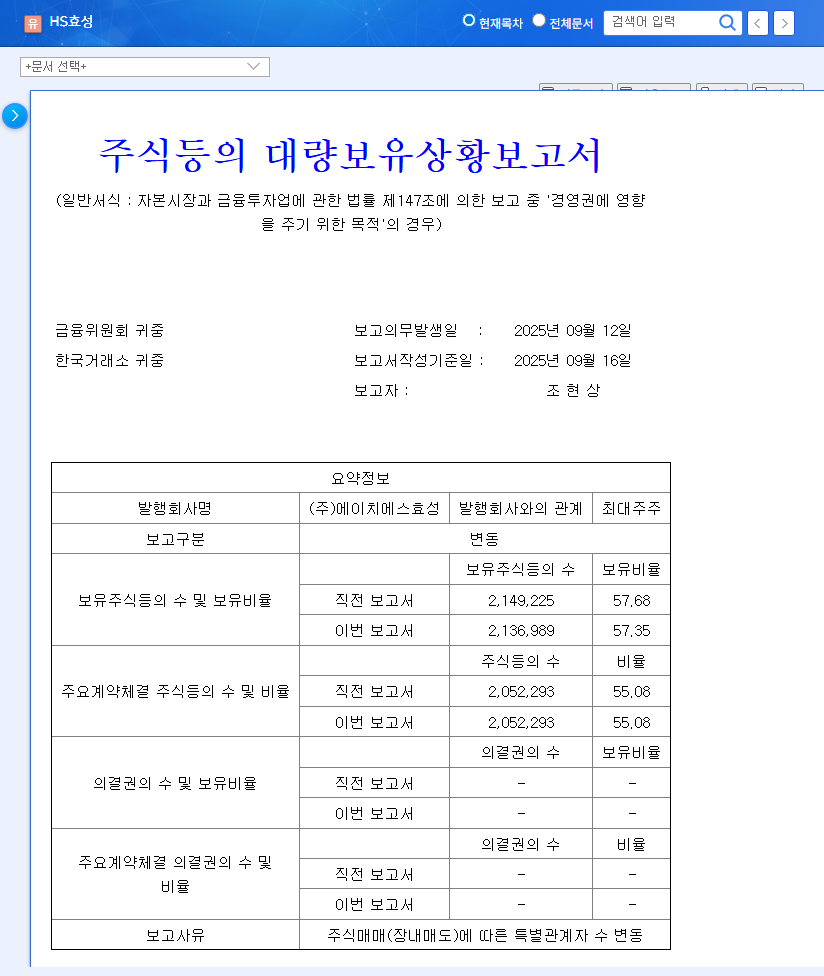
    Key stakeholders, including HS Hyosung CEO Cho Hyun-sang, sold a total of 9,513 shares from September 10th to 12th. This reduced their total stake from 57.68% to 57.35%. The stated purpose of the sale was “influence on management rights.”

    2. Why the Sale?

    While the exact reason remains unclear beyond the official statement, several possibilities exist. Recent stock price trends, stakeholders’ individual financial needs, or potential shifts in business strategy could be contributing factors. However, the currently disclosed reason is “Changes in the number of related parties due to stock trading (over-the-counter sales),” necessitating further information.

    3. Impact on Stock Price?

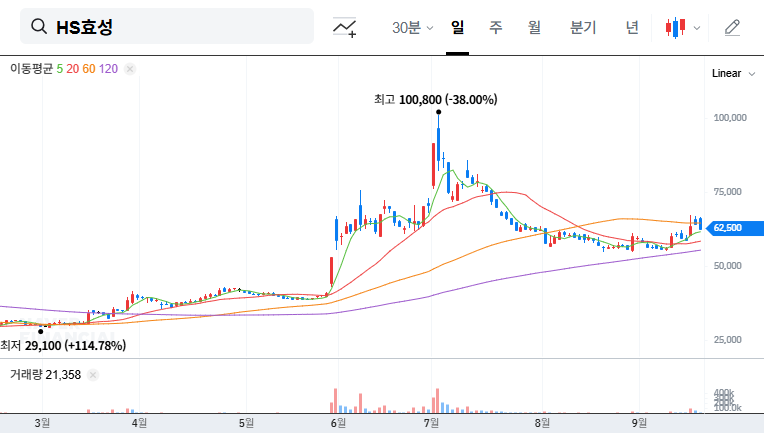
    • Short-term Impact: Share sales for “influence on management rights” can negatively impact investor sentiment, potentially putting downward pressure on the stock price. While the volume of shares sold is relatively small, it could increase investor caution.
    • Long-term Impact: Continued selling could signal potential long-term changes in corporate governance. Declining investor confidence could also indirectly hinder future fundraising and business expansion.

    4. What Should Investors Do?

    • Monitor Further Sales: Closely watch for any additional share sales by key stakeholders.
    • Prepare for Volatility: Be aware of potential short-term stock price fluctuations.
    • Watch for Official Announcements: Pay attention to any further explanations or future business plans announced by HS Hyosung.
    • Analyze Fundamentals: Continuously assess HS Hyosung’s financial performance, including declining sales and cash flow challenges.
    Why is the HS Hyosung insider share sale significant?

    Changes in management’s stake can be interpreted as signals about the company’s future direction. The stated purpose of “influence on management rights” particularly raises concerns about potential changes in corporate governance.

    How will this sale affect HS Hyosung’s stock price?

    In the short term, decreased investor confidence could lead to downward pressure on the stock price. However, the relatively small volume of shares sold necessitates a comprehensive analysis of future selling trends and the company’s fundamentals.

    Should I invest in HS Hyosung?

    Investment decisions are ultimately personal. However, it’s crucial to make informed choices based on a thorough analysis of not just this share sale, but also the company’s financial health, business outlook, and external market factors.

    HS Hyosung Insider Share Sale: Impact and Investment Strategy 관련 이미지
    HS Hyosung Insider Share Sale: Impact and Investment Strategy 관련 이미지
  • Ildong Holdings Insider Sells Stake: What Investors Need to Know (September 2025 Analysis)


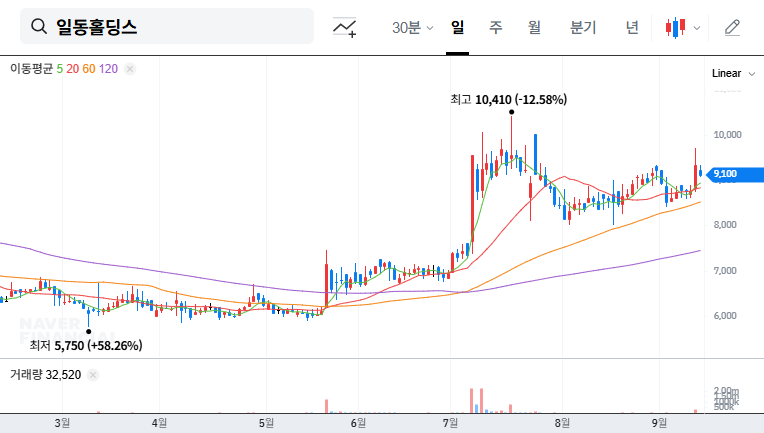
    Ildong Holdings Insider Sells Stake: What Investors Need to Know (September 2025 Analysis) 대표 차트 이미지


    What Happened?

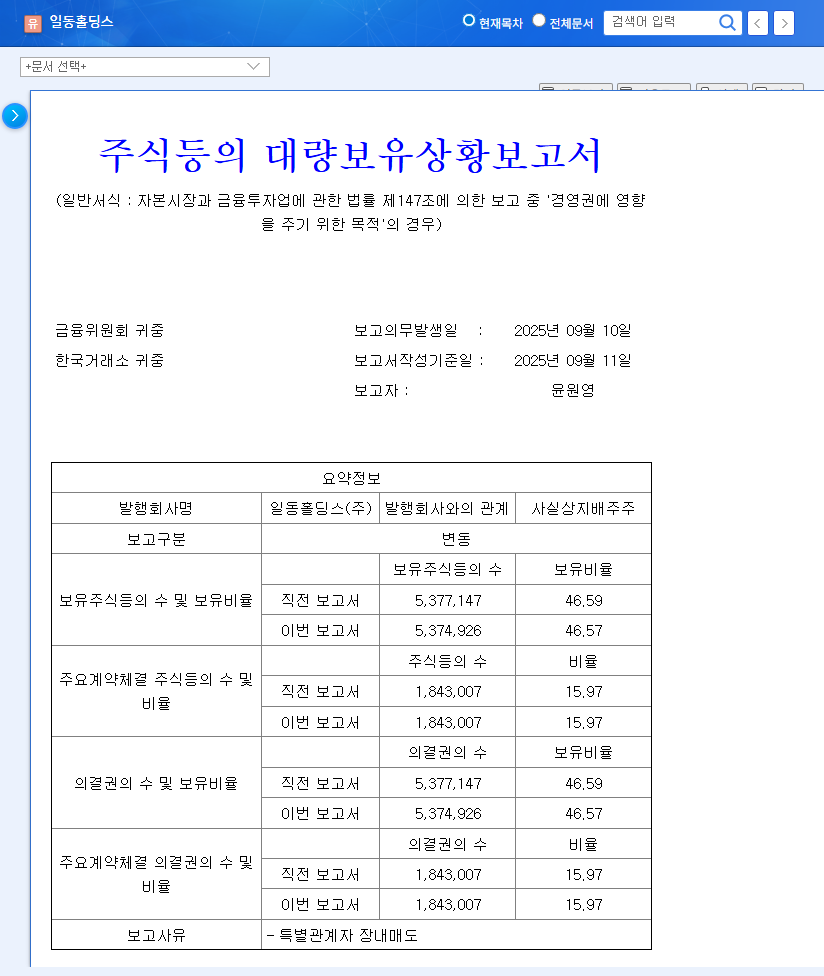
    On September 10, 2025, Ildong Holdings insider Lee Jang-hwi sold 2,221 shares. This slightly decreased the total stake held by insiders, including CEO Yoon Won-young, from 46.59% to 46.57%.

    Why the Sale, and What Does It Mean?

    The sale represents a very small portion of the insider’s total holdings and is not significant enough to impact management control. While it may exert minor downward pressure on the stock price in the short term, the overall impact on investor sentiment is expected to be limited.

    Current Status and Future Outlook of Ildong Holdings

    Ildong Holdings reported decreased sales and a net loss for the first half of 2025. High debt ratios and derivative liabilities remain a financial burden. However, the approval of Ildong Pharmaceutical’s COVID-19 treatment ‘Xocova’ in Japan and Singapore, and its FDA Fast Track designation in the US, are positive developments. The successful commercialization of ‘Xocova’ will be a critical factor in future growth.

    What Should Investors Do?

    We maintain a “Neutral” rating on Ildong Holdings. Investors should consider both the opportunities, such as successful commercialization of ‘Xocova’ and improvements in financial structure, as well as risks, including continued poor performance and high debt. Careful monitoring of ‘Xocova’ sales, financial health, and insider shareholding trends is recommended.


    How will the insider’s sale affect Ildong Holdings’ stock price?

    The sale is small, so while there may be minor short-term downward pressure, the impact is not expected to be significant.

    What is the outlook for Ildong Holdings?

    The success of ‘Xocova’ is key, and the company’s efforts to improve its financial structure are also important to watch.

    What should investors watch out for?

    Investors should monitor ‘Xocova’ sales performance, financial health, and shareholding trends.


    Ildong Holdings Insider Sells Stake: What Investors Need to Know (September 2025 Analysis) 관련 이미지
    Ildong Holdings Insider Sells Stake: What Investors Need to Know (September 2025 Analysis) 관련 이미지


  • Kolon Mobility Group: Insider Share Sale – Fundamental Analysis vs. Market Sentiment

    Kolon Mobility Group: Insider Share Sale - Fundamental Analysis vs. Market Sentiment 대표 차트 이미지

    1. What Happened?

    On August 26, 2025, an insider at Kolon Mobility Group, ‘Jo Jin,’ reduced their stake from 78.44% to 78.41% (0.03%p) through on-market sales. The stated purpose of the sale was ‘influence on management rights.’

    2. Why the Sale? What’s the Impact on Stock Price?

    While the change in ownership is minimal, the stated purpose of ‘influence on management rights’ could raise concerns in the market. In the short term, this selling pressure could lead to a stock price decline. However, if the company’s fundamentals remain strong, the long-term impact is expected to be limited. Kolon Mobility Group reported strong H1 2025 results with consolidated revenue of KRW 1.1367 trillion (+7.2%) and operating profit of KRW 159 billion (+91.7%). The decision to cancel treasury stock also suggests a focus on shareholder value. However, investors should be mindful of declining standalone revenue, high consolidated debt-to-equity ratio, and foreign exchange volatility.

    3. What Should Investors Do?

    Investors should closely monitor any further share sales, the company’s explanation for the sale, and changes in fundamental indicators. Further sales without a clear explanation could negatively impact investor sentiment. The continued strength of the company’s fundamentals will be a key factor for long-term investment decisions.

    Q: How will the insider share sale affect the stock price?

    A: In the short term, selling pressure could lead to a price decline. However, if fundamentals remain strong, the long-term impact is expected to be limited. Monitor for further sales and company explanations.

    Q: What is the current state of Kolon Mobility Group’s fundamentals?

    A: The company reported strong consolidated H1 2025 results and is canceling treasury stock. However, declining standalone revenue and high consolidated debt-to-equity ratio are points of caution.

    Q: What should investors watch for?

    A: Investors should closely monitor further share sales, explanations from the company regarding the sale, and any changes in key fundamental indicators.

    Kolon Mobility Group: Insider Share Sale - Fundamental Analysis vs. Market Sentiment 관련 이미지
    Kolon Mobility Group: Insider Share Sale - Fundamental Analysis vs. Market Sentiment 관련 이미지
  • Adbiotech’s Major Shareholder Sells 4.42% Stake: What Investors Need to Know

    1. What Happened?

    Golden Core No. 1 sold 476,190 shares of Adbiotech on August 12, 2025, through an off-market transaction. This reduced their stake from 8.87% to 4.45%.

    2. Why the Sale?

    While Golden Core No. 1 stated the reason as a change in ‘simple investment’ objectives, the specific reason remains unclear. Speculations range from profit-taking to a shift in investment strategy, creating uncertainty and concern among investors.

    3. What Does This Mean for the Stock Price?

    The large sell-off could exert downward pressure on the stock price in the short term, potentially leading to a supply-demand imbalance and dampened investor sentiment. However, Adbiotech’s Q1 sales growth and efforts to improve its financial structure could be positive factors. The growth potential of the next-generation antibody-based animal pharmaceuticals market is also noteworthy.

    • Direct Impact: Downward pressure on stock price, supply-demand imbalance.
    • Indirect Impact: Weakened investor sentiment.

    4. What Should Investors Do?

    • Short-Term Strategy: Wait and see, seek additional information.
    • Long-Term Strategy: Continuous fundamental analysis, monitor profitability improvements.

    In the short term, it’s advisable to wait and see how the market digests the news of the share sale. Investors should closely monitor any further disclosures from Adbiotech’s management or Golden Core No. 1. For the long term, continuous monitoring of the company’s fundamentals – core technology, pipeline development, and new business performance – is crucial. Pay close attention to whether Adbiotech achieves profitability and strengthens its financial health.

    Does the sale of shares by Golden Core No. 1 affect Adbiotech’s financial status?

    The sale itself does not directly impact Adbiotech’s fundamental or financial status.

    What is the outlook for Adbiotech’s stock price?

    While downward pressure is expected in the short term, the long-term outlook depends on the company’s fundamental performance and profitability improvements.

    Should I invest in Adbiotech?

    A wait-and-see approach is recommended for the short term. Long-term investment decisions should be based on careful monitoring of the company’s fundamentals and profitability.

  • PSK Holdings Insider Sells Shares: What Does it Mean for Investors?

    1. What Happened?

    PSK Holdings insider Kang Sa-yoon sold 250 common shares on July 31st. The sale did not affect the majority ownership percentage of 67.24% and has no impact on management control.

    2. Why Does This Matter?

    While 250 shares represent a small fraction of the total outstanding shares, insider selling can influence market sentiment. It could be part of a routine investment strategy, but the lack of clarity around the sale necessitates close monitoring of future price movements.

    3. What’s the Current State of PSK Holdings? (Fundamentals & Stock Analysis)

    Positives: PSK Holdings saw increased operating and net profits in Q1 2025 due to lower raw material prices and favorable exchange rates. The company also maintains a strong cash position.
    Negatives: Revenue decreased compared to Q1 2024. The share buyback program initiated in the second half of 2024 provided a short-term boost to the stock price, but its long-term impact on fundamentals remains uncertain. The inherent volatility of the semiconductor market also poses a risk.

    The stock price shows a long-term upward trend, but with high volatility. It has been on an upward trajectory recently (H2 2024 – July 2025). Analyzing the stock price movement immediately following the sale will be crucial to understanding its short-term impact.

    4. What’s Next? (Outlook & Investor Action Plan)

    While the impact of this sale on fundamentals is expected to be minimal, investors should be mindful of potential short-term price fluctuations. Continuous monitoring of external factors such as the semiconductor market, raw material prices, and exchange rates is recommended. Thoroughly consider additional information, including the reasons for the revenue decline and the long-term effects of the share buyback strategy, before making investment decisions.

    Q: Will Kang Sa-yoon’s stock sale negatively impact PSK Holdings’ share price?

    A: The small scale of the sale suggests a limited direct impact, but market sentiment can be influenced, requiring careful observation.

    Q: Are PSK Holdings’ fundamentals strong?

    A: Q1 2025 results were positive, but risks remain, including declining revenue and semiconductor market uncertainty.

    Q: Should I invest in PSK Holdings?

    A: Investment decisions are ultimately the responsibility of the individual investor. Carefully consider this analysis and other available information before making a decision.

  • Oheim&Company CEO Dumps Shares: What it Means for Investors

    1. Why Did the CEO Sell His Shares?

    CEO Nah significantly reduced his stake in Oheim&Company through Oheim Investment Partnership. Officially, this was due to the withdrawal of some partners and a change in investment objectives from management influence to simple investment. However, the market speculates about potential management instability and internal issues, especially considering the ongoing lawsuit with the former CEO.

    2. How Will This Impact Oheim&Company?

    In the short term, downward pressure on the stock price is anticipated due to increased management uncertainty. The long-term impact will depend on various factors such as the growth of new businesses like ‘Irop,’ the outcome of the lawsuit, and future management strategies.

    • Positive Factors: Diversified brand portfolio, strengthened content marketing, growth potential of ‘Irop’
    • Negative Factors: Increased competition, talent drain, lawsuit with former CEO, management instability

    3. What Should Investors Do?

    Investors should closely monitor stock price fluctuations following the share dump announcement, any additional disclosures, management changes, and the outcome of the lawsuit. It’s crucial to analyze the company’s fundamentals and growth potential rather than reacting impulsively to short-term market volatility. Consult with financial advisors and develop a prudent investment strategy.

    Q: What does the CEO’s share sale signify?

    A: The significant reduction in the CEO’s stake suggests potential management changes and increased uncertainty for investors.

    Q: What is the outlook for Oheim&Company’s stock price?

    A: While downward pressure is expected in the short term, the long-term outlook depends on factors like new business growth and the lawsuit’s outcome.

    Q: What should investors be mindful of?

    A: Investors should monitor further disclosures, management changes, and the lawsuit’s result, avoiding impulsive investment decisions.

  • Kakao CEO Brian Kim Sells Shares: Impact on Stock Price and 2025 Investment Strategy

    Kakao CEO’s Share Sale: What Happened?

    On July 25, 2025, Kakao CEO Brian Kim sold 1,700 shares, slightly reducing his stake from 24.26% to 24.16%. The official reason cited was ‘simple acquisition/disposal,’ indicating no change in management control.

    The Reasons Behind the Sale and Q1 Earnings Analysis

    Kakao’s weak Q1 2025 earnings may be a factor behind the sale. Revenue decreased year-over-year, primarily due to the economic downturn, slowing platform growth, and intensified competition in the content market. However, cost optimization efforts led to increased operating profit and a return to net profit.

    • Platform Segment: Talk Biz showed robust growth, but economic slowdown and intensifying competition remain threats.
    • Content Segment: Kakao is pursuing profitability improvements through IP acquisition and global market expansion strategies.
    • Financial Segment: The continued losses of Kakao Pay Securities and Kakao Pay Non-life Insurance are challenges to overcome.

    Impact on Stock Price and Fundamentals: What’s Next?

    Brian Kim’s small stake sale may have a short-term negative psychological impact on the stock price. However, the minimal scale of the sale and the lack of management change suggest a limited impact. The Q1 operating profit increase could even act as a positive factor. The long-term fundamentals, however, depend on navigating intensified platform competition, improving profitability in the financial segment, and weathering the overall economic downturn.

    Action Plan for Investors: Navigating the Kakao Landscape

    Investors considering Kakao should closely monitor the following:

    • Market expectations and analyst reports
    • Progress of Kakao’s management strategies
    • Impact of macroeconomic indicator changes

    This analysis is based on currently available information and may change depending on market conditions.

    Frequently Asked Questions

    How will Brian Kim’s share sale affect Kakao’s stock price?

    The impact is expected to be limited in the short term due to the small scale of the sale and the fact that it doesn’t affect management control. However, market sentiment can lead to increased volatility.

    What are the key takeaways from Kakao’s Q1 earnings?

    While revenue decreased, cost optimization efforts increased operating profit, and the company returned to net profit. Intensifying platform competition and losses in the financial segment remain key challenges.

    What should investors consider when investing in Kakao?

    Investors should consider a comprehensive view of Kakao’s management strategies, market expectations, and macroeconomic indicators before making investment decisions.

  • SCM Lifescience: Major Shareholder Sells Stake – What Investors Need to Know (July 2025 Analysis)

    What Happened? The Background of the Share Sale

    Song Gi-ryeong, formerly the largest shareholder of SCM Lifescience, sold 183,000 common shares on July 21st, reducing her stake from 17.15% to 10.06%. This resulted in her losing her position as the largest shareholder and her removal as a person with special relationship to the company. This suggests a reduction in her management participation and the potential for future changes in the management structure.

    Why is This Happening? Q3 Earnings and Fundamental Analysis

    SCM reported declining sales, operating losses, and net losses in Q3 2025. The main factors contributing to this are sluggish sales of stem cell therapies, high R&D expenses, and increased sales and administrative expenses. The high debt ratio raises concerns about financial stability, although fundraising through a rights offering is expected to mitigate short-term liquidity risks. While clinical trial results for the atopic dermatitis stem cell therapy are positive, the time to market remains uncertain. The dermacosmetics division is growing, but its small size limits its impact on overall profitability.

    What’s Next? Analyzing the Impact of the Share Sale

    The sale of the major shareholder’s stake is likely to negatively impact the stock price in the short term. Concerns about management uncertainty and decreased investment attractiveness could grow. However, in the long term, this could prevent management disputes and lead to a more transparent management structure. Financial restructuring through a rights offering, successful development of stem cell therapies, and growth in the dermacosmetics business could contribute to long-term stock price appreciation.

    What Should Investors Do? Action Plan

    Before making any investment decisions, carefully review SCM’s future business strategies and financial improvement plans. The outcome of the administrative trial regarding restrictions on participation in national R&D projects is also a crucial variable to monitor. Conducting additional research, such as competitor analysis and market forecast reports, is essential to gather the necessary information for informed investment decisions.

    How will the sale of SCM Lifescience’s major shareholder’s stake affect the stock price?

    While a short-term price drop is likely, the long-term impact depends on various factors, including management restructuring, financial improvements, and the success of new drug development.

    How did SCM Lifescience perform in Q3?

    SCM reported declining sales, operating losses, and net losses, primarily due to poor stem cell therapy sales and high R&D costs.

    Is it a good idea to invest in SCM Lifescience?

    Investors should carefully consider SCM’s business strategy, financial plans, and external environment changes before making investment decisions. Conducting further research is crucial.