Tag: Share Divestment

  • (038500) SAMPYO Cement Co., Ltd. Stock (038500): Shareholder Divestment Deep Dive & 2025 Outlook

    (038500) SAMPYO Cement Co., Ltd. Stock (038500): Shareholder Divestment Deep Dive & 2025 Outlook

    In a significant development for investors monitoring the SAMPYO Cement Co., Ltd. stock (KRX: 038500), news of a major shareholder divestment has sent ripples through the market. With the company already navigating a challenging construction downturn, this move by KMUS One Co., Ltd. introduces a new layer of uncertainty. This analysis will break down the specifics of the share sale, explore the underlying causes, and evaluate the potential short-term and long-term impact on SAMPYO Cement’s share price and management stability.

    This isn’t just a simple transaction; it’s a critical signal about insider confidence amidst severe market headwinds. Understanding the context is paramount for any current or prospective investor.

    The Catalyst: A Major Shareholder Makes an Exit

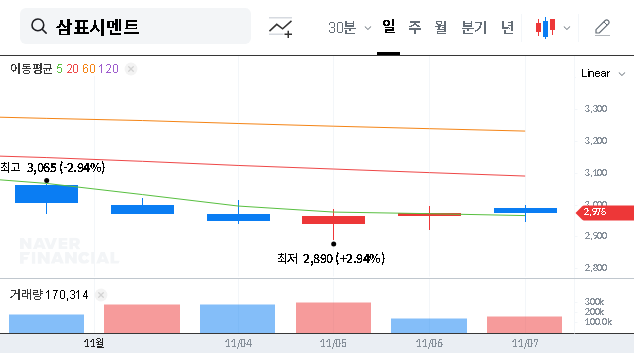
    On November 10, 2024, an official disclosure confirmed that KMUS One Co., Ltd., a significant shareholder in SAMPYO Cement, drastically reduced its holdings. The stake was cut from 8.71% down to just 3.89%—a substantial decrease of 4.82 percentage points. Critically, KMUS One’s original holding purpose was cited as ‘management influence,’ which makes this sale more than a simple portfolio rebalancing. It signals a strategic withdrawal, raising immediate questions about the company’s future leadership and stability. The transaction was officially documented in a ‘Report on the Status of Large-scale Shareholding,’ which can be viewed in the Official Disclosure (DART).

    Why Now? A Perfect Storm of Challenges

    The decision by KMUS One was not made in a vacuum. It comes at a time when SAMPYO Cement is facing a convergence of internal performance issues and external market pressures, creating a ‘perfect storm’ for the company.

    Severe Deterioration in Corporate Fundamentals

    The company’s 2025 semi-annual report paints a bleak picture. Revenue plummeted by a staggering 58.3% year-over-year, while operating profit fell by an even more alarming 70.6%. This decline is not isolated to one segment; both the core Cement and Ready-Mixed Concrete businesses have suffered from a severe construction market slump. Despite a drop in some raw material costs, falling cement prices combined with rising electricity costs have squeezed profit margins. Furthermore, lower production volumes have increased the fixed cost burden per unit, eroding profitability from multiple angles.

    Unfavorable Macroeconomic Environment

    The broader economic landscape offers little relief. While there are hints of future interest rate cuts, current high rates continue to suppress new construction projects. A strengthening US Dollar and Euro against the Korean Won reflects a broader ‘risk-off’ sentiment in global markets. While falling international oil prices could reduce logistics and operational costs, this benefit is partially offset by market volatility and the overarching weakness in demand that it signals. For more on market trends, investors often consult sources like Bloomberg’s economic analysis.

    Analysis: The Impact on SAMPYO Cement Co., Ltd. Stock

    The large-scale SAMPYO Cement shareholder divestment is a bearish signal that is likely to amplify negative market sentiment and exert significant downward pressure on the stock price in the short term. Key consequences include:

    • Eroding Investor Confidence: A major insider cashing out raises red flags, suggesting a lack of faith in the company’s near-term recovery prospects.
    • Increased Selling Pressure: The process of offloading a large block of shares can create a supply-demand imbalance, potentially leading to further price declines as the market absorbs the new float.
    • Compounding Negative Momentum: This news, combined with the already poor financial performance, creates a powerful negative narrative that could scare away potential buyers and encourage existing shareholders to sell.
    • Management Stability Concerns: The exit creates a power vacuum. While it could eventually lead to a new strategic investor, the immediate future is filled with uncertainty about who will fill the void.

    While SAMPYO Cement has made positive strides in ESG management and R&D, these long-term initiatives are likely to be overshadowed by the immediate negative sentiment. Investors interested in how such factors are weighed can read about our analysis of ESG investing trends.

    Investor Action Plan & Strategic Outlook

    Given the circumstances, a cautious and highly observant approach is warranted for anyone invested in or considering the SAMPYO Cement Co., Ltd. stock. A prudent strategy should involve the following steps:

    • Brace for Volatility: Expect heightened price swings in the coming weeks. Avoid making large, emotionally-driven trades and consider risk management tools like stop-loss orders.
    • Monitor Management News: Pay close attention to any announcements regarding the buyer of the divested shares. A strategic corporate buyer would be viewed more favorably than a simple financial investor.
    • Focus on Fundamental Triggers: Long-term recovery will depend entirely on a rebound in the construction market and improved company performance. Watch key industry indicators and the company’s next quarterly earnings report for signs of a turnaround.
    • Re-evaluate ESG Impact: Continue to assess if the company’s sustainability efforts are translating into tangible financial benefits or simply serving as corporate talking points.

    In conclusion, the divestment by KMUS One Co., Ltd. is a significant negative catalyst that will likely weigh on the SAMPYO Cement Co., Ltd. stock in the short term. Investors should prioritize caution, monitor new information closely, and wait for clear evidence of a fundamental business recovery before making any significant investment decisions.
  • (049630) JAEYOUNG SOLUTEC Stock: Expert Analysis of Major Shareholder Sale & Future Outlook

    (049630) JAEYOUNG SOLUTEC Stock: Expert Analysis of Major Shareholder Sale & Future Outlook

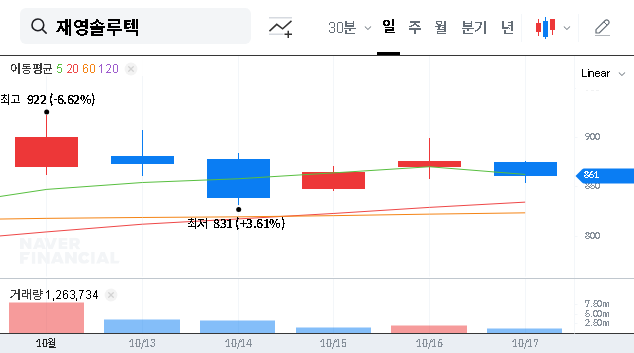
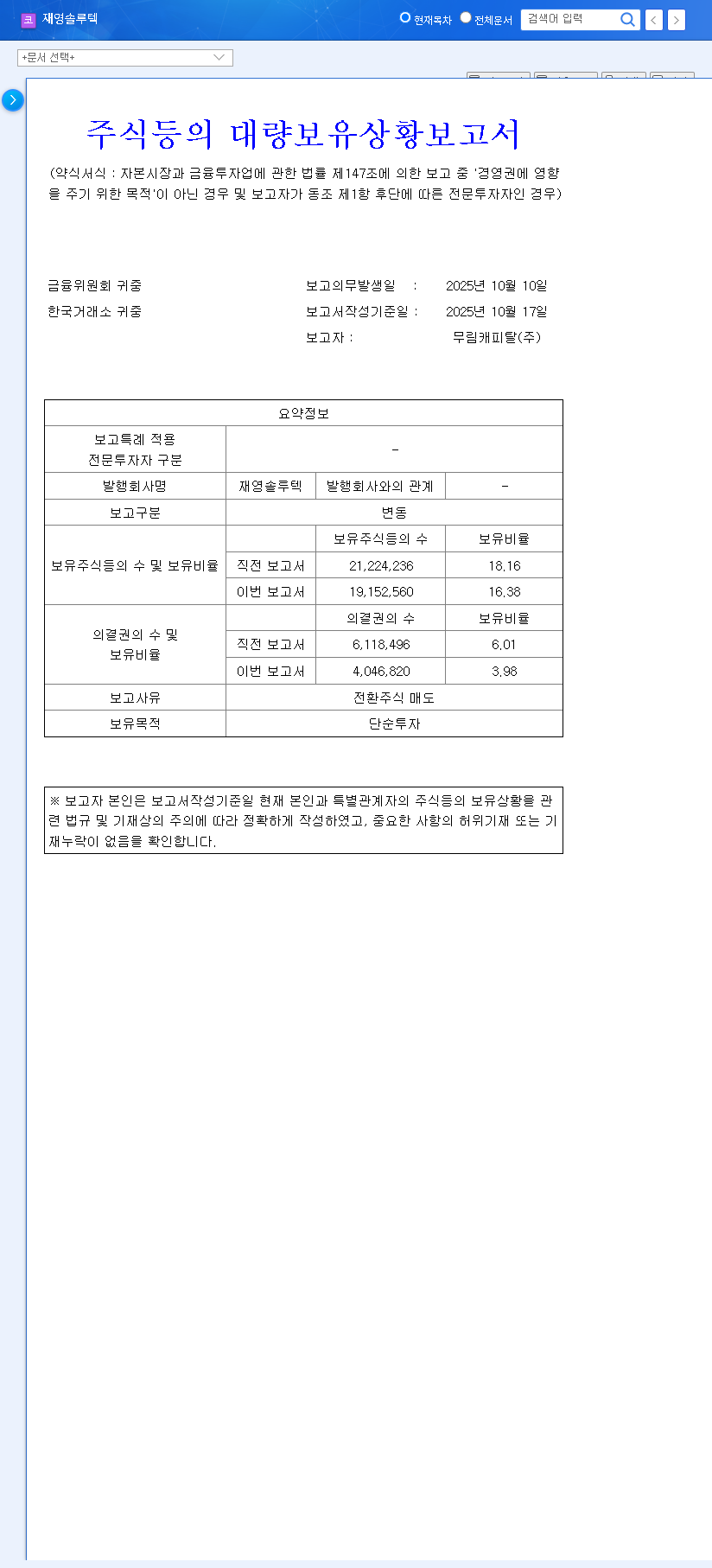
    The recent large-scale divestment by a major shareholder has sent ripples through the investment community, putting JAEYOUNG SOLUTEC stock under the microscope. On October 24, 2025, an official disclosure revealed that Murim Capital/Republic of Korea sold a significant portion of its holdings, raising critical questions about the company’s future. For current and prospective investors, understanding the implications of this move is paramount. What does this sale signal about the company’s health, and what is the strategic path forward for those with capital at stake?

    This comprehensive JAEYOUNG SOLUTEC analysis will dissect the shareholder sale, evaluate the company’s underlying fundamentals, and provide a clear, actionable plan. We will explore both the immediate market reaction and the long-term strategic challenges, offering crucial insights to guide your investment decisions.

    The Divestment Event: A Closer Look

    The pivotal event occurred when JAEYOUNG SOLUTEC’s major shareholder, ‘Murim Capital/Republic of Korea’, executed a significant sell-off. According to the Official DART Disclosure, the entity sold 4,046,820 common shares through open market transactions. These shares were newly converted from convertible bonds, a detail that adds another layer of complexity. This sale reduced their total stake in the company from 16.38% down to 12.92%. Such a large transaction from an informed party is a signal the market cannot ignore.

    Company Fundamentals: The Core Business Under Pressure

    To understand the context of the sale, we must examine the company’s financial and operational health. Based on the H1 2025 semi-annual report, JAEYOUNG SOLUTEC presents a mixed but concerning picture.

    Profitability and Business Structure

    While top-line revenue grew by a respectable 17.7% year-on-year, this growth did not translate to the bottom line. Operating profit saw a significant decline, pushing the company into a net loss. The strategic pivot to concentrate on the nano-optics division, which produces key actuators for smartphone cameras, is a high-stakes bet. The discontinuation and sale of the legacy mold business incurred one-off costs that have heavily impacted recent profitability metrics.

    Financial Health and Debt

    The company’s balance sheet is a key area of concern. Although the debt-to-equity ratio has improved slightly to 168.53%, it remains high for the industry. A significant overhang exists from outstanding convertible bonds, which can lead to future share dilution and financing costs. Investors considering a JAEYOUNG SOLUTEC investment must be aware of this financial burden. For more information on these complex financial instruments, read our guide on understanding convertible bonds.

    A major shareholder sale, especially of shares converted from debt instruments, often signals a lack of confidence in the company’s near-term ability to generate cash flow and improve profitability.

    Impact of the Shareholder Sale on JAEYOUNG SOLUTEC Stock

    Short-Term: Heightened Stock Price Pressure

    The immediate effect of this news is almost certainly negative. A large supply of shares hitting the market creates downward pressure on the JAEYOUNG SOLUTEC stock price. This is amplified by weakened investor sentiment, as the market interprets the sale as an insider’s bearish outlook. The fact that these were freshly converted shares suggests a desire to exit the position, raising concerns about further selling pressure in the near future.

    Long-Term: Questions of Governance and Recovery

    While the sale was by an investment association and not a core member of management, a reduced major shareholder stake can introduce uncertainty. The key long-term question is whether the company’s strategic focus on nano-optics can offset its financial weaknesses. The market will be watching closely to see if management can execute its turnaround plan and restore faith in the company’s fundamental competitiveness. A failure to do so could lead to a protracted decline.

    Investor Action Plan & Strategic Outlook

    Given the circumstances, a disciplined and cautious approach is essential. The JAEYOUNG SOLUTEC shareholder sale acts as a major red flag that must be weighed against any potential for future growth.

    Investment Thesis & Key Monitorables

    • Short-Term (1-3 Months): A ‘Hold’ or ‘Sell’ rating is prudent. The risk of further price decline is high. Avoid new positions until the selling pressure subsides and a clear price floor is established.
    • Mid-to-Long-Term (6-18 Months): A cautious, ‘Wait-and-See’ approach is advised. Before considering an investment, look for tangible proof of a turnaround. This includes at least two consecutive quarters of positive operating profit and a measurable increase in market share for the nano-optics division.

    Primary Risk Factors to Consider

    • Additional Divestments: The remaining 12.92% stake could be sold, creating another supply shock.
    • Competitive Pressure: The nano-optics market is highly competitive. Failure to innovate could erode margins.
    • Macroeconomic Headwinds: Global economic shifts can impact demand for smartphones, directly affecting JAEYOUNG’s core business. For context, see the latest market analysis from authoritative sources like Bloomberg.
    • Financial Instability: The high debt load and remaining convertible bonds pose an ongoing risk to financial stability.

    In conclusion, while the potential for a turnaround exists within JAEYOUNG SOLUTEC’s focused strategy, the major shareholder sale is a significant bearish signal. Investors should prioritize capital preservation and demand clear evidence of fundamental improvement before committing to the stock.

    Disclaimer: This analysis is for informational purposes only and is based on publicly available data. All investment decisions should be made with the consultation of a qualified financial advisor.

    (049630) JAEYOUNG SOLUTEC Stock: Expert Analysis of Major Shareholder Sale & Future Outlook 관련 이미지
  • (393970) DAEJIN ADVANCED MATERIALS Stock Analysis: Shareholder Divestment Sparks Crisis Concerns

    (393970) DAEJIN ADVANCED MATERIALS Stock Analysis: Shareholder Divestment Sparks Crisis Concerns

    The recent news surrounding DAEJIN ADVANCED MATERIALS stock has sent ripples of concern through the investment community. A significant divestment by a major shareholder, SJ Investment Partners, has cast a spotlight on the company’s precarious financial health and declining performance. For investors, this raises a critical question: is this a temporary storm to weather or a signal of a deeper, more systemic crisis?

    This comprehensive DAEJIN ADVANCED MATERIALS analysis will dissect the shareholder sale, evaluate the company’s fundamental weaknesses, explore the potential of its new CNT business, and provide a clear, actionable investment outlook. We will navigate the complexities to help you understand the risks and potential pathways forward.

    Understanding the SJ Investment Partners Divestment

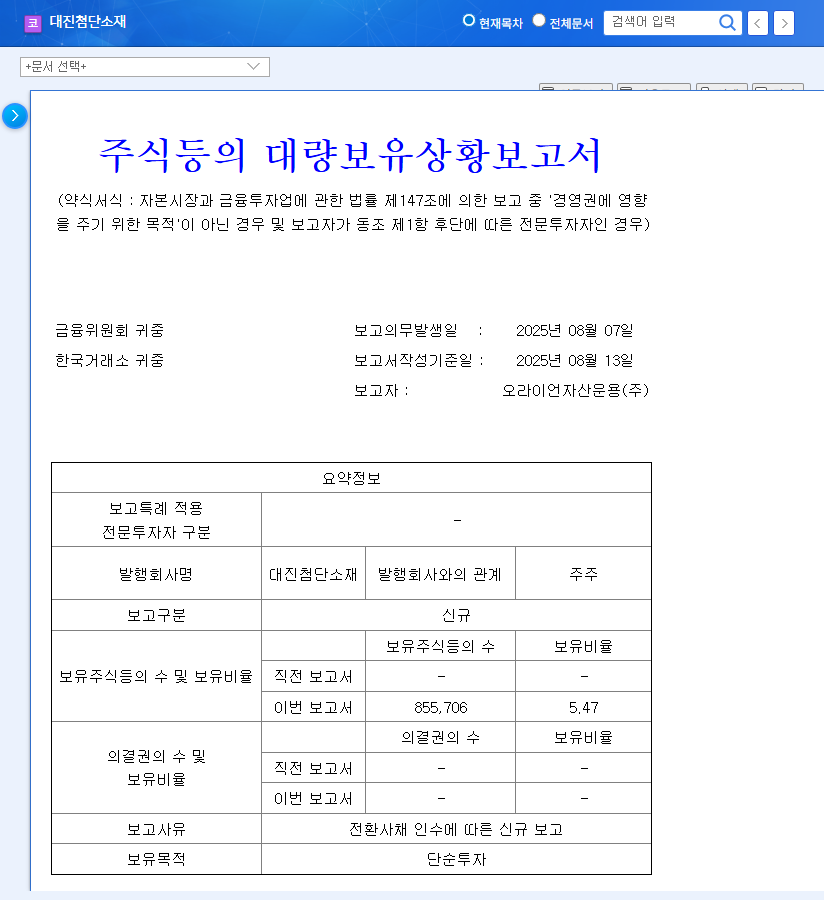
    On October 24, 2025, SJ Investment Partners, a key institutional shareholder, executed an open-market sale of a substantial block of its shares in DAEJIN ADVANCED MATERIALS Inc. This transaction, conducted across four separate funds, reduced their total stake from 13.60% to 11.82%. This move was formally documented in an Official Disclosure. A shareholder divestment of this magnitude is rarely a trivial event; it often serves as a barometer of institutional confidence and can trigger immediate negative sentiment and selling pressure in the market.

    A Company in Crisis: DAEJIN ADVANCED MATERIALS’ Fundamental Status

    DAEJIN ADVANCED MATERIALS Inc. specializes in advanced composite materials, primarily for secondary battery processes and automotive components. While the company is pinning its future hopes on the high-growth Carbon Nanotube (CNT business), its current financial reality, as revealed in the H1 2025 results, is deeply troubling. The underlying fundamentals paint a picture of a company facing severe headwinds.

    The combination of a sharp revenue decline, a swing to significant losses, and a ballooning debt ratio suggests that the major shareholder’s sale may be a reaction to deteriorating corporate fundamentals.

    Key Financial Red Flags

    • Severe Revenue Contraction: H1 2025 revenue plummeted to 32.54 billion KRW, a staggering 63.4% decrease year-over-year. This collapse is linked to the “chasm” phenomenon in the EV and secondary battery markets, where initial growth has stalled before mass adoption, exacerbated by a wider economic slowdown.
    • Profitability Erased: The company swung from profit to a significant operating loss of 3.418 billion KRW. The net loss was even more severe at 10.501 billion KRW, indicating deep-seated issues with cost control and operational efficiency.
    • Deteriorating Financial Health: Total liabilities surged by 27.5% to 103.531 billion KRW. The debt-to-equity ratio climbed to a concerning 135.72%, limiting the company’s ability to raise new capital and fund future growth initiatives. For more on this metric, see this guide on financial ratios.

    Stock Price Impact: Short-Term Pain & Long-Term Uncertainty

    The impact of the shareholder divestment on DAEJIN ADVANCED MATERIALS stock is likely to be felt across multiple time horizons.

    Immediate & Short-Term Outlook

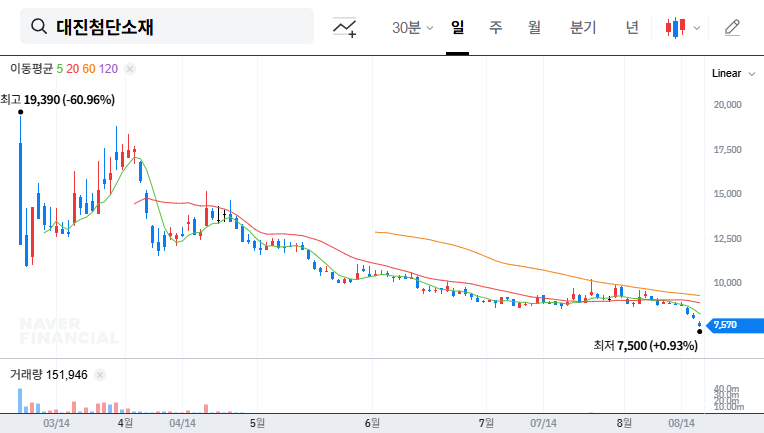
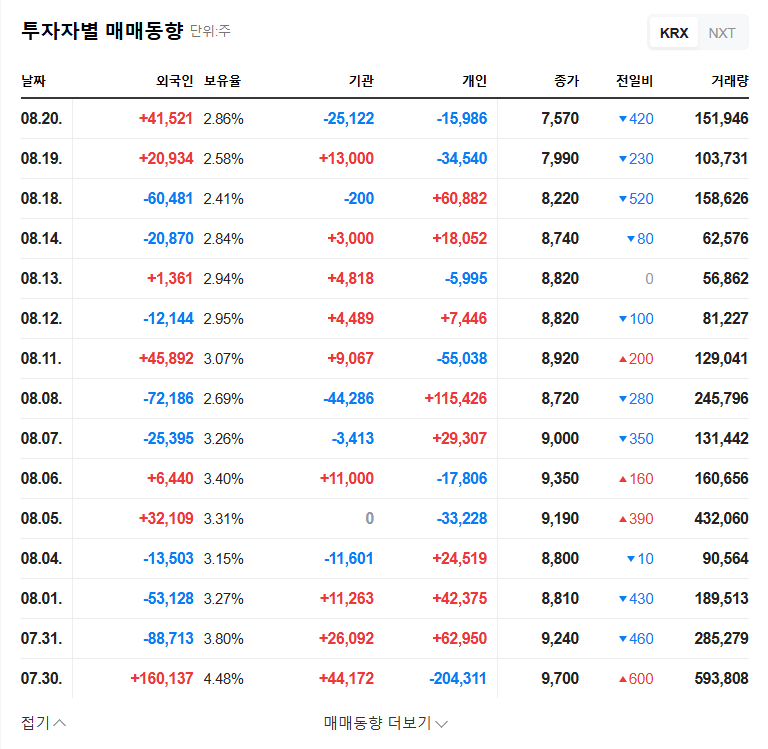
    In the short term, increased stock price volatility and significant downward pressure are expected. The sale by a major institution like SJ Investment Partners acts as a strong negative signal, which can erode investor confidence and trigger follow-on selling from retail and other institutional investors. The stock’s existing downward trend since its 2025 KOSDAQ listing is likely to be amplified by this news.

    Mid-to-Long-Term Implications

    Looking further ahead, the divestment raises questions about the company’s long-term viability and strategy. If the fundamental weaknesses persist, the market may re-evaluate the company’s valuation downwards. The success or failure of the high-stakes CNT business will become the single most important catalyst for any potential recovery. Without tangible results from this new venture, regaining investor trust and rebuilding corporate value will be an uphill battle. You can learn more by reading our comprehensive guide to investing in advanced materials.

    Investor Action Plan: A ‘Watch’ Stance is Warranted

    Given the confluence of negative factors—poor financial performance, high debt, and a significant vote of no-confidence from a major shareholder—a cautious ‘Watch’ position on DAEJIN ADVANCED MATERIALS stock is prudent. The risk of further downside is considerable.

    A potential turnaround hinges on several key factors that investors must monitor closely:

    • Market Recovery: A rebound in demand from the secondary battery and electric vehicle industries is essential for top-line growth.
    • CNT Business Commercialization: The company must demonstrate tangible, profitable results from its new growth engine. Press releases are not enough; revenue and profit are required.
    • Financial Discipline: A clear and credible plan to reduce debt and improve profitability is non-negotiable.
    • Transparent Communication: Management must proactively address investor concerns with clear, honest communication about their recovery strategy.

    Until these green shoots of recovery are clearly visible, investors should remain on the sidelines, aware that short-term volatility could present even deeper challenges. Prudent investment decisions must be based on verified fundamental improvements, not speculation.

    (393970) DAEJIN ADVANCED MATERIALS Stock Analysis: Shareholder Divestment Sparks Crisis Concerns 관련 이미지
    (393970) DAEJIN ADVANCED MATERIALS Stock Analysis: Shareholder Divestment Sparks Crisis Concerns 관련 이미지