Tag: Share Dilution

  • (102940) KOLON LIFE SCIENCE Convertible Bond: 2025 Investor’s Deep Dive & Stock Impact Analysis

    (102940) KOLON LIFE SCIENCE Convertible Bond: 2025 Investor’s Deep Dive & Stock Impact Analysis

    The recent announcement of the KOLON LIFE SCIENCE convertible bond (CB) issuance for ₩30 billion has sent ripples through the investment community. This strategic financial move is designed to fuel future growth but introduces critical variables that investors must understand. This deep-dive analysis will dissect the CB issuance, explore its potential impact on the KOLON LIFE SCIENCE stock price, and outline a comprehensive investment strategy to navigate the opportunities and risks ahead, including the crucial concern of share dilution.

    Understanding the ₩30 Billion CB Issuance

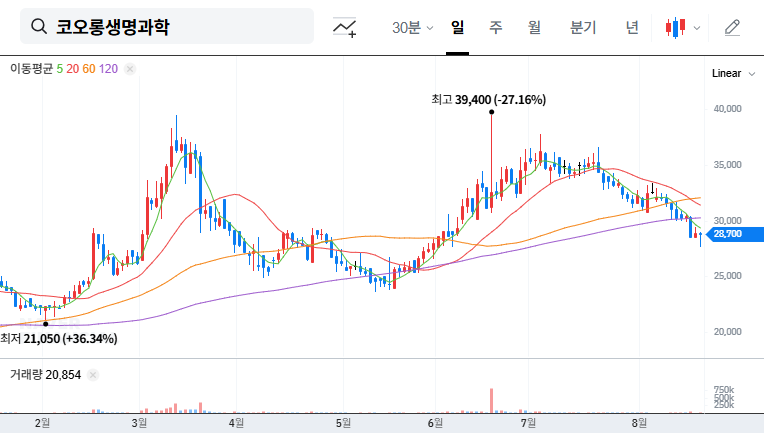
    On November 11, 2025, KOLON LIFE SCIENCE Inc. finalized its decision to raise ₩30 billion through a private placement of convertible bonds. But what does this mean? A convertible bond is a hybrid security that acts like a bond, providing regular interest payments, but can be converted into a predetermined number of the company’s common stock. It offers investors the safety of a bond with the upside potential of an equity investment. For more on the mechanics, you can review this comprehensive guide on convertible securities.

    Key Terms of the KOLON LIFE SCIENCE Convertible Bond

    The specifics of this CB issuance are crucial for any investment analysis. Here are the core details as per the Official Disclosure from DART:

    • Issuance Amount: ₩30 billion, representing about 6.85% of the company’s total capital.
    • Issuance Method: Private placement to specific funds, including Green ESG Growth and Woori Corporate Financial Stability funds.
    • Conversion Price: ₩32,820, set at a slight premium to the stock price at the time of announcement (₩32,400).
    • Coupon & Maturity Rates: A 0.0% coupon rate (no regular interest payments) but a 5.0% yield-to-maturity, incentivizing conversion.
    • Conversion Period: From November 26, 2026, to October 26, 2055.

    Analysis: The Bull vs. Bear Case

    This capital injection presents a classic risk/reward scenario. How the market prices the KOLON LIFE SCIENCE stock will depend on which narrative gains more traction.

    The Bull Case: Fueling Future Growth

    Optimists will point to the strategic use of funds. The capital is widely expected to be funneled into the company’s Bio business, specifically for pipeline development and commercialization. The 0% coupon rate is a significant vote of confidence; it implies that investors are betting on capital appreciation through stock conversion rather than seeking fixed income. This structure reduces the immediate financial burden on KOLON LIFE SCIENCE, allowing it to invest heavily in R&D, which could unlock substantial long-term value.

    The Bear Case: The Specter of Share Dilution

    The primary concern is share dilution. When bondholders convert their bonds into stock, new shares are created. This increases the total number of shares outstanding, potentially reducing the ownership percentage and earnings per share (EPS) for existing shareholders. If the stock price fails to rise above the conversion price, the company faces a maturity repayment burden, which could strain finances if the capital hasn’t generated sufficient returns. Furthermore, this issuance does not resolve pre-existing risks, such as the ongoing Invossa-related litigation, which remain a drag on sentiment.

    For investors, the issuance represents a classic risk/reward scenario: weigh the near-term risk of share dilution against the long-term potential for R&D-fueled growth.

    Updated Investment Strategy & Outlook

    A prudent investment strategy requires careful monitoring of key catalysts and risk factors. The short-term impact on the stock is likely to be negative to neutral as the market digests the potential for dilution. However, the mid-to-long-term trajectory will be dictated by the company’s execution.

    What Investors Should Monitor:

    • Fund Utilization Plan: Demand transparency from the company on exactly which R&D projects will receive funding. Progress and milestones in the Bio pipeline are now paramount.
    • Conversion Tracking: As the conversion period begins in 2026, keep an eye on the volume of conversions. This will be the clearest indicator of the actual rate of share dilution.
    • Risk Management: Look for updates on the Invossa litigation and other fundamental risks. Positive developments could serve as powerful catalysts. For more on this, see our guide to evaluating risk in biotech stocks.

    Ultimately, this KOLON LIFE SCIENCE convertible bond is a bet on the company’s future. If management can effectively deploy this capital to accelerate its Bio business and achieve key milestones, the long-term value created could far outweigh the short-term concerns of dilution.
    (102940) KOLON LIFE SCIENCE Convertible Bond: 2025 Investor's Deep Dive & Stock Impact Analysis 관련 이미지
  • (083660) CSA COSMIC Rights Offering (083660): An In-Depth Stock Analysis for Investors

    (083660) CSA COSMIC Rights Offering (083660): An In-Depth Stock Analysis for Investors

    The recent announcement of the CSA COSMIC rights offering has sent ripples through the investment community. On one hand, the 10 billion KRW capital injection signals a proactive step by CSA COSMIC CO., LTD. (KRX: 083660) to mend its finances and fuel growth. On the other, it presents existing shareholders with the immediate and unwelcome reality of shareholder dilution. This creates a critical dilemma: is this a strategic pivot towards a brighter future or a desperate measure with significant downside risk? This in-depth analysis will dissect the offering, evaluate the company’s fundamentals, and provide a strategic roadmap for investors.

    Unpacking the CSA COSMIC Rights Offering

    On November 10, 2025, CSA COSMIC CO., LTD. formally announced its plan for a rights offering to raise 10 billion KRW. This move involves issuing new shares to specific investors at a predetermined price, a common method for companies to raise capital without taking on new debt. However, the specifics of this deal are crucial for a complete stock analysis. Here are the key details:

    • Shares to be Issued: 1,436,781 new common shares.
    • Issuance Price: 696 KRW per share, a significant discount to recent trading prices.
    • Total Capital Raised: 10 billion KRW.
    • Key Investors: KB&N Holdings and Nian.
    • Important Dates: Payment on November 18, 2025; New shares listed on December 3, 2025.

    For complete, verified details, investors should review the Official Disclosure (DART Report).

    The Rationale: Why is CSA COSMIC Raising Capital?

    A company doesn’t undertake such a significant financial maneuver without compelling reasons. The decision for a rights offering stems from a combination of financial distress, strategic necessity, and a history of restructuring efforts.

    Deteriorating Financial Health

    The company’s H1 2025 financial report painted a grim picture. Declining revenue combined with mounting operating and net losses revealed deep-seated issues. The primary culprit was a sharp downturn in its core cosmetics business, which its more stable construction materials segment could not offset. This performance indicates an urgent need for liquidity to stabilize operations and fund a potential turnaround.

    The most significant risk is the immediate shareholder dilution. By issuing new shares at a price far below market value, the ownership stake and per-share value for every existing investor is automatically reduced.

    A Pattern of Restructuring and Management Instability

    This is not the company’s first attempt to right the ship. An 8 billion KRW convertible bond was issued in June 2025, also aimed at securing capital. However, the deeply discounted prices of both the bonds and this rights offering suggest that raising funds has been challenging. Compounding these financial concerns is a history of frequent management changes. A new major shareholder is expected through this rights offering, adding another layer of uncertainty about strategic consistency and long-term vision.

    A Strategic Action Plan for Investors

    Given the complexities of the CSA COSMIC rights offering, a prudent investment approach is essential. Investors must weigh the potential for a turnaround against the significant, tangible risks. For more on this topic, you can read our guide on how to evaluate a rights offering.

    The Bull Case: A Path to Recovery?

    Optimists might see this capital injection as the catalyst needed for a new beginning. Potential positive outcomes include:

    • Improved Financials: The 10 billion KRW will immediately strengthen the balance sheet, providing runway to execute a new strategy.
    • Investment in Growth: Funds can be used for R&D, new brand launches, or marketing to revive the struggling cosmetics division.
    • New Management Vision: A change in leadership could bring fresh ideas and a more effective business plan.

    The Bear Case: Navigating the Significant Risks

    Conversely, the risks are substantial and cannot be ignored. The primary concerns are:

    • Guaranteed Dilution: Existing shareholders will see their ownership percentage decrease. Learn more about shareholder dilution from Investopedia.
    • Execution Risk: There is no guarantee that the new capital will be used effectively or that past performance issues will be resolved.
    • Market Headwinds: Intense competition in cosmetics and macroeconomic pressures could hinder any recovery efforts.
    • Stock Volatility: The low issuance price is likely to cause significant short-term price fluctuations.

    Frequently Asked Questions (FAQ)

    Q1: What exactly is the CSA COSMIC rights offering?

    It is a corporate action where CSA COSMIC CO., LTD. is issuing 1.44 million new shares at 696 KRW each to raise 10 billion KRW. This capital is intended to improve its financial stability and provide funds for future business investments.

    Q2: How does this rights offering impact existing CSA COSMIC shareholders?

    The primary impact is shareholder dilution, as the issuance of new shares at a low price reduces the value and ownership percentage of existing shares. Shareholders should also expect increased stock price volatility in the short term.

    Q3: What should investors monitor going forward?

    Investors should closely monitor how the 10 billion KRW is utilized, the strategic vision of the new management team, and whether there are tangible improvements in quarterly earnings reports, especially in the cosmetics division.

    (083660) CSA COSMIC Rights Offering (083660): An In-Depth Stock Analysis for Investors 관련 이미지
  • (039830) AURORA WORLD Treasury Share Disposal: Deep Dive into its KRW 17B Exchangeable Bonds Strategy

    (039830) AURORA WORLD Treasury Share Disposal: Deep Dive into its KRW 17B Exchangeable Bonds Strategy

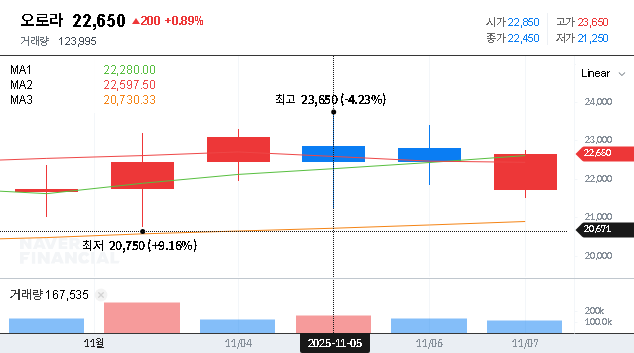
    In a significant strategic financial maneuver, AURORA WORLD Corporation (039830) has announced a major decision regarding its capital structure. The company plans an AURORA WORLD treasury share disposal of 655,105 shares, valued at approximately KRW 17 billion. These shares are not being sold on the open market; instead, they will serve as the underlying asset for a new issuance of exchangeable bonds (EBs). This move, detailed in their Official Disclosure, has sent ripples through the investment community, prompting a crucial question: is this a masterstroke for future growth or a potential pitfall for existing shareholders?

    This comprehensive analysis will dissect the layers of this decision, exploring the mechanics of AURORA WORLD’s exchangeable bonds, the company’s underlying financial health, the potential for both upside gains and shareholder dilution, and what investors must monitor moving forward.

    Understanding Exchangeable Bonds (EBs)

    Before diving into the specifics of AURORA WORLD’s situation, it’s essential to understand what exchangeable bonds are. Unlike convertible bonds, which convert into new shares of the issuing company, EBs are hybrid debt securities that can be exchanged for shares of a different entity. In this unique case, however, AURORA WORLD is using its own treasury shares—shares the company had previously repurchased from the market. This means bondholders can exchange their bonds for existing shares of AURORA WORLD at a predetermined price and time. This is a nuanced corporate finance strategy that allows a company to raise capital without immediately increasing the total number of shares outstanding.

    Analyzing the Rationale: Why This Move, and Why Now?

    AURORA WORLD’s decision is not arbitrary; it’s rooted in its current financial standing and strategic ambitions. A detailed 039830 financial analysis reveals several key drivers.

    1. Pressing Need for Capital Amid High Debt

    The company’s balance sheet tells a clear story. At the end of 2024, its consolidated debt-to-equity ratio was a concerning 269.3%. This high leverage indicates a significant reliance on debt to fund its operations, particularly its extensive overseas production and sales subsidiaries, which are fundamental to the character toy business model.

    2. Navigating Mixed Profitability Signals

    While operating profit saw a healthy increase of 8.9% in 2024 to KRW 30.97 billion, the bottom line was hit hard. Net profit fell by 31.3% to KRW 4.16 billion. The primary culprit was a sharp rise in financial costs, which ballooned to KRW 25.09 billion. This disparity underscores the urgent need to optimize the company’s capital structure and reduce the burden of interest payments.

    3. Fueling Global Expansion and Hedging Risk

    AURORA WORLD is actively pursuing growth, as seen with its acquisition of US premium infant brand Mary Meyer. With over 70% of its revenue generated overseas, especially in North America, the company is highly exposed to global economic shifts. As noted by leading financial analysts at authoritative sources like Bloomberg, fluctuating US interest rates and currency exchange rates (KRW/USD) can dramatically impact earnings. Securing flexible, long-term funding through EBs provides a strategic buffer and capital to invest through these cycles.

    This AURORA WORLD treasury share disposal places the company at a strategic crossroads: leveraging debt for ambitious growth versus managing the immediate risk of diluting existing shareholder value.

    Potential Impacts for Investors: A Balanced View

    This corporate action presents a duality of outcomes for investors, with compelling arguments on both sides.

    The Bull Case (Positive Outlook)

    • Strengthened Financials: The capital infusion can be used to pay down high-interest debt, immediately improving the balance sheet and reducing financial costs, which could boost net profit.
    • Growth Investment: Funds can be channeled into strategic acquisitions, R&D, or market expansion, creating long-term value that far outweighs the potential dilution.
    • Delayed Dilution: Unlike a direct share offering, the dilution only occurs if and when bondholders exchange their bonds, giving the company time to grow its value before the shares enter the market.

    The Bear Case (Negative Risks)

    • Inevitable Shareholder Dilution: The primary risk is the eventual conversion of these bonds into stock. This increases the total number of shares, potentially reducing the earnings per share (EPS) and diluting the ownership stake of existing shareholders.
    • Increased Interest Burden: While potentially lower than bank loans, EBs are still debt and come with interest payments that will be a recurring expense on the income statement.
    • Negative Market Sentiment: In a high-interest-rate environment, the market may interpret any new debt issuance, even a strategic one, as a sign of financial strain, leading to short-term negative pressure on the stock price.

    An Investor’s Checklist: Key Factors to Watch

    For those invested in or considering an investment in AURORA WORLD, prudent decision-making requires diligent monitoring of the following:

    • EB Issuance Terms: Scrutinize the fine print. The interest rate, maturity date, and, most importantly, the conversion price will determine the financial burden and the threshold at which shareholder dilution becomes likely.
    • Use of Proceeds: Demand clarity from the company on exactly how the KRW 17 billion will be allocated. Vague plans are a red flag; specific, high-ROI projects are a green light.
    • Macroeconomic Indicators: Keep a close watch on currency exchange rates and global interest rate trends, as these directly influence AURORA WORLD’s profitability and debt servicing costs.
    • Management Commentary: Pay attention to future earnings calls and press releases for management’s narrative and performance metrics related to this new capital.

    Ultimately, the AURORA WORLD treasury share disposal is a pivotal move. It’s a calculated risk designed to fortify the company’s financial foundation and fuel its next phase of growth. For investors, success hinges on the company’s ability to execute its strategy and generate returns that significantly eclipse the cost of this new capital and its dilutive effects. Continuous monitoring and a deep understanding of the underlying factors are essential. For more foundational knowledge, consider reading our guide on evaluating corporate debt strategies.

    (039830) AURORA WORLD Treasury Share Disposal: Deep Dive into its KRW 17B Exchangeable Bonds Strategy 관련 이미지
  • (069920) Exion Group Convertible Bond Exercise (069920): A Deep Dive on Share Dilution & Investment Strategy

    (069920) Exion Group Convertible Bond Exercise (069920): A Deep Dive on Share Dilution & Investment Strategy

    The recent Exion Group convertible bond exercise (KRX: 069920) has sent ripples through the investment community. The company’s announcement to issue over 4 million new shares is a pivotal moment that warrants a closer look. This isn’t merely a financial transaction; it’s a strategic move that will directly influence Exion Group’s stock valuation, financial stability, and the trajectory of its ambitious growth plans.

    For investors, this event presents both potential challenges, such as share dilution, and significant opportunities tied to the company’s future. This comprehensive analysis will unpack the direct and indirect impacts of the CB exercise, providing the critical insights needed to navigate this changing landscape and make informed decisions.

    The Mechanics of the Convertible Bond Exercise

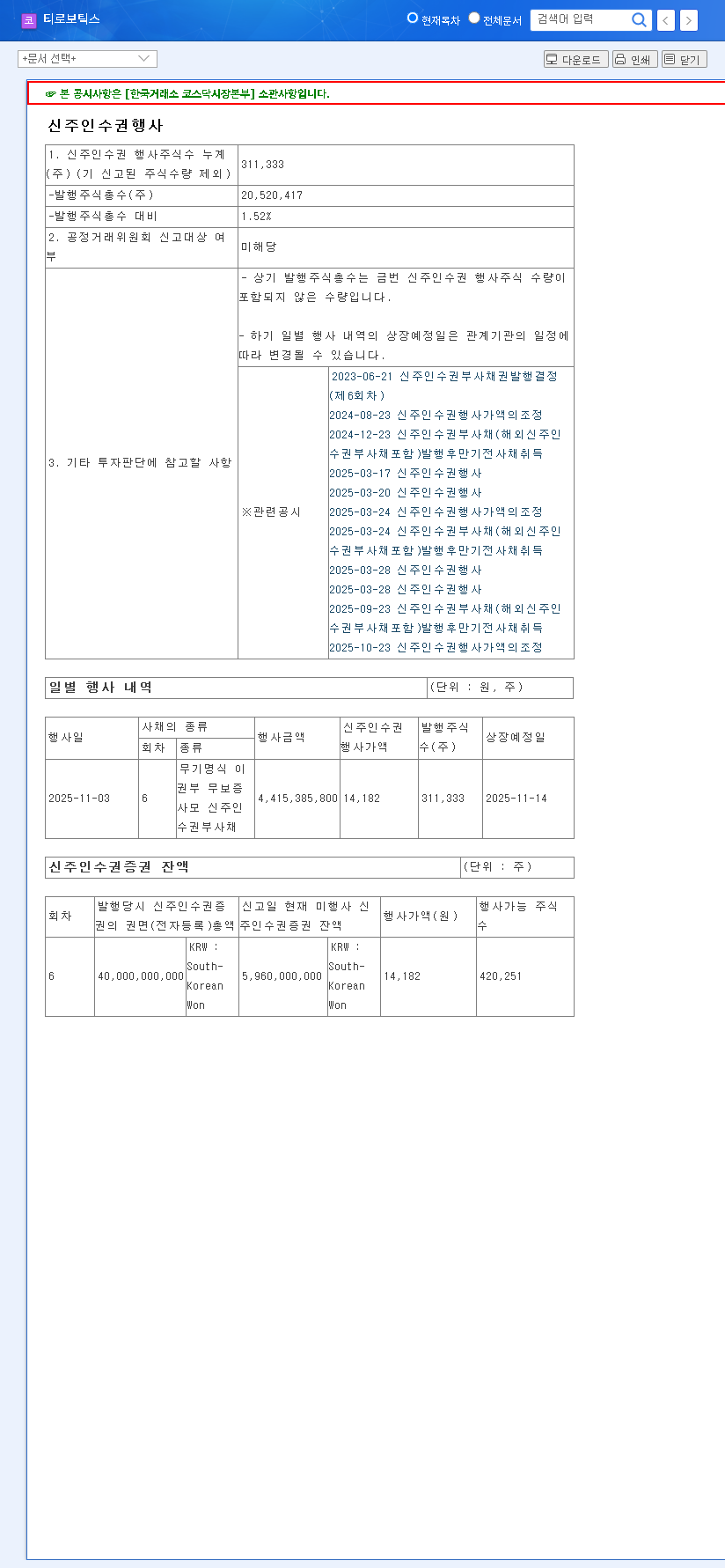
    According to the company’s filing on November 7, 2025, a total of 4,017,531 shares will be newly listed, originating from the conversion of outstanding bonds. This represents a substantial 9.85% of the current market capitalization. The key figures to note are a conversion price of 1,369 KRW per share and a scheduled conversion date of November 26, 2025. You can view the Official Disclosure for complete details.

    At the heart of this event is the conversion of debt into equity. Understanding this trade-off is crucial. While the market reacts to the influx of new shares, the company is simultaneously strengthening its balance sheet for the long term.

    Direct Impact: Navigating Exion Group Share Dilution

    1. Share Dilution and Investor Sentiment

    The most immediate consequence of issuing nearly 4 million new shares is the dilution of existing stock. This increase in the total number of shares outstanding can lead to a decrease in Earnings Per Share (EPS), a key metric used to value a company. This can create a psychological overhang on the stock, as existing shareholders see their ownership percentage shrink. The current stock price of 1,271 KRW is below the conversion price of 1,369 KRW, which temporarily mitigates immediate selling pressure from converters seeking a quick profit.

    2. Increased Market Float and Liquidity

    Once converted, these new shares will enter the public market, increasing the stock’s float (the number of shares available for trading). In the short term, this could create selling pressure. However, over the long run, higher liquidity can be a positive factor, making it easier for investors to buy and sell shares and potentially attracting larger institutional investors.

    3. From Debt to Equity: A Healthier Balance Sheet

    A significant, often overlooked, benefit of an Exion Group convertible bond exercise is the financial restructuring it entails. A convertible bond is essentially debt that can become stock. By converting, the company extinguishes debt from its balance sheet and increases its equity base. This reduces the debt-to-equity ratio, a key indicator of financial health, signaling greater stability to the market and reducing future interest payment burdens.

    Indirect Impact: Fueling Future Growth

    This capital event doesn’t happen in a vacuum. It is strategically tied to Exion Group’s aggressive diversification and growth initiatives. The capital raised and the improved financial flexibility are likely intended to fund key ventures that could redefine the company’s future revenue streams.

    • MJ Tech Acquisition: Bolstering their core technology and market position.
    • Sports Apparel Expansion: Tapping into new consumer markets with high growth potential.
    • Overseas Resource Development: Securing raw materials and expanding the company’s global footprint.

    An Investor’s Strategic Checklist for Exion Group (069920)

    Given the complexities of the Exion Group convertible bond exercise, investors should adopt a strategic, forward-looking approach. While short-term volatility is possible, the long-term thesis depends on the successful execution of the company’s strategy. For a deeper understanding, review our guide on how to analyze a company’s financial health. Consider these key factors:

    • Price vs. Conversion Point: Monitor if the stock price can sustainably rise above the 1,369 KRW conversion price, as this will influence the behavior of bondholders.
    • Execution on New Ventures: Look for tangible results and revenue growth from the new business segments. Are they meeting milestones and contributing to the bottom line?
    • Financial Discipline: Track the company’s efforts to manage its debt levels and improve profitability metrics post-conversion.
    • Macro-Economic Headwinds: Keep an eye on interest rates, currency fluctuations, and commodity prices, which can all impact Exion Group’s diverse operations.

    In conclusion, this event is a crucial turning point. By balancing an understanding of short-term Exion Group share dilution with an appreciation for the long-term strategic goals, investors can make wiser, more confident decisions.

    (069920) Exion Group Convertible Bond Exercise (069920): A Deep Dive on Share Dilution & Investment Strategy 관련 이미지
  • (114450) GREEN LIFESCIENCE Treasury Stock Disposal: 2025 Analysis for Investors

    (114450) GREEN LIFESCIENCE Treasury Stock Disposal: 2025 Analysis for Investors

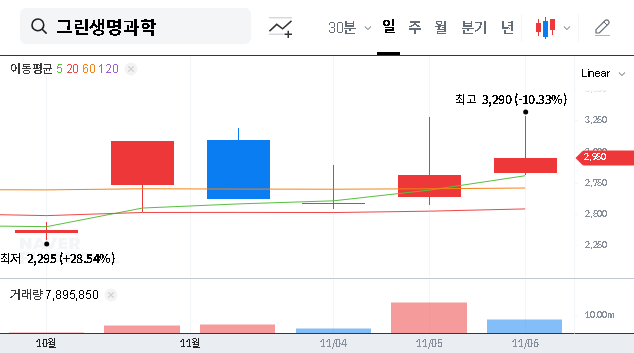
    Investors in GREEN LIFESCIENCE CO., LTD. (114450) are closely examining a recent pivotal announcement: a significant GREEN LIFESCIENCE treasury stock disposal. This decision, aimed at securing 1.3 billion KRW in operating funds, presents a complex scenario. While it may offer a short-term financial lifeline, it simultaneously raises critical questions about underlying profitability, financial stability, and the potential for share dilution. This comprehensive analysis will dissect the decision, explore the company’s current financial health, and provide a strategic roadmap for investors navigating this uncertain period.

    Understanding the nuances of such a corporate action is crucial. We will delve into the potential market impact, weigh the pros and cons, and outline key metrics to monitor, ensuring you have the insights needed to make well-informed investment decisions regarding your position in GREEN LIFESCIENCE CO., LTD.

    The Details of the Treasury Stock Disposal

    On November 6, 2025, GREEN LIFESCIENCE CO., LTD. formally announced its board’s decision to dispose of 450,000 of its common shares held in treasury. This block of shares represents approximately 2.25% of the total issued shares and is expected to raise 1.3 billion KRW. The official stated purpose, as per their disclosure, is to secure essential operating funds and fortify the company’s overall financial structure. The transaction is being managed by Kyobo Securities. You can view the complete filing here: Official Disclosure (DART).

    This move is widely interpreted by market analysts as a measure to secure short-term liquidity, signaling that the company is facing immediate financial pressures that require swift capital injection.

    Analyzing the ‘Why’: GREEN LIFESCIENCE’s Financial Crossroads

    To fully grasp the implications of the GREEN LIFESCIENCE treasury stock disposal, we must examine the company’s recent performance. As a fine chemical company specializing in pharmaceuticals, agrochemicals, and electronic materials, its financial health has shown conflicting signals.

    1. The Paradox of Growth and Profitability

    The H1 2025 financial report presented a mixed picture. On one hand, revenue saw impressive growth, increasing by 23.2% year-over-year. This was driven by new business lines and an expansion of its Contract Manufacturing Organization (CMO) services. However, this top-line growth did not translate to bottom-line success. The core issue is a sharp decline in profitability:

    • Shift to Operating Loss: The company reported an operating loss of 1.122 billion KRW for H1 2025, a stark reversal from previous profitability.
    • Compounding Factors: This deficit was not due to a single issue but a convergence of rising raw material costs, increased investment in R&D, and significant inventory valuation losses.

    2. Escalating Financial Health Concerns

    The balance sheet reveals further warning signs. As of H1 2025, inventory assets had ballooned to 6.01 billion KRW, which subsequently led to a valuation loss of 0.605 billion KRW. This suggests issues with product demand or inventory management. Concurrently, a rise in short-term borrowings and an increasing debt-to-equity ratio are flashing red lights about the company’s financial stability, making this capital raise a necessity rather than an option.

    Impact Analysis: The Double-Edged Sword of Treasury Stock Sales

    Selling treasury stock is a tool with both positive and negative consequences that investors must carefully weigh. For a deeper understanding of this financial maneuver, you can read more from high-authority sources like Investopedia’s guide on treasury stock.

    Potential Positives: A Short-Term Reprieve

    • Immediate Liquidity: The 1.3 billion KRW provides immediate cash to cover operational expenses and improve the company’s financial structure.
    • Inventory Burden Relief: The new capital could help manage and potentially reduce the burdensome inventory levels, mitigating further valuation losses.

    Inevitable Negatives: Dilution and Market Sentiment

    • Share Dilution: Re-introducing 450,000 shares into the market increases the total number of shares outstanding. This dilutes the ownership percentage of existing shareholders and can put downward pressure on Earnings Per Share (EPS) and the stock price.
    • Negative Market Signal: Fundraising during a period of poor performance can be perceived as a sign of distress, potentially spooking investors and worsening market sentiment.
    • Band-Aid Solution: If this capital is used merely to stay afloat without addressing the root causes of unprofitability, it will fail to create long-term corporate value.

    Strategic Action Plan for Investors

    Given the circumstances, a prudent and cautious investment strategy is paramount. While the GREEN LIFESCIENCE treasury stock disposal provides temporary relief, the path to a fundamental recovery is fraught with challenges. For more tips on evaluating company stability, you can review our guide to analyzing financial health.

    • Monitor Capital Allocation: Watch closely how the 1.3 billion KRW is utilized. Is it being used to pay down debt, streamline operations, or simply cover losses? Look for tangible improvements in the financial structure.
    • Demand Profitability Improvement: The key to long-term value is a return to operating profit. Scrutinize future quarterly reports for signs that the company has a credible plan to control costs and improve margins.
    • Track Macroeconomic Headwinds: Keep an eye on external factors like KRW/USD exchange rates, interest rate movements, and raw material prices, as these will continue to impact profitability.
    • Re-evaluate Valuation: Factor the effect of share dilution into your valuation models. The company’s market capitalization might stay the same initially, but your individual share represents a smaller piece of the pie.

    In conclusion, GREEN LIFESCIENCE CO., LTD. is at a critical juncture. This treasury stock disposal is a necessary but not sufficient step toward recovery. A sustained turnaround in stock price and corporate value hinges entirely on the management’s ability to restore profitability and enhance fundamental business competitiveness. Investors are advised to exercise caution, conduct thorough due diligence, and continuously monitor the company’s performance against these key recovery indicators.

    (114450) GREEN LIFESCIENCE Treasury Stock Disposal: 2025 Analysis for Investors 관련 이미지
  • (187660) Hyundai ADM Bio Inc. Convertible Bond: A Guide to Share Dilution vs. Liquidity

    (187660) Hyundai ADM Bio Inc. Convertible Bond: A Guide to Share Dilution vs. Liquidity

    Hyundai ADM Bio Inc. has just executed a significant financial maneuver by exercising its convertible bond rights, a move that injects fresh capital but also introduces over a million new shares to the market. For investors, this creates a critical dilemma: is this a strategic cash infusion that will fuel growth, or a desperate measure that will lead to significant share dilution? This comprehensive analysis will dissect the Hyundai ADM Bio Inc. convertible bond event, examine the company’s precarious financial health, and provide actionable strategies for investors navigating this pivotal moment.

    The Core Event: A Closer Look at the Convertible Bond Exercise

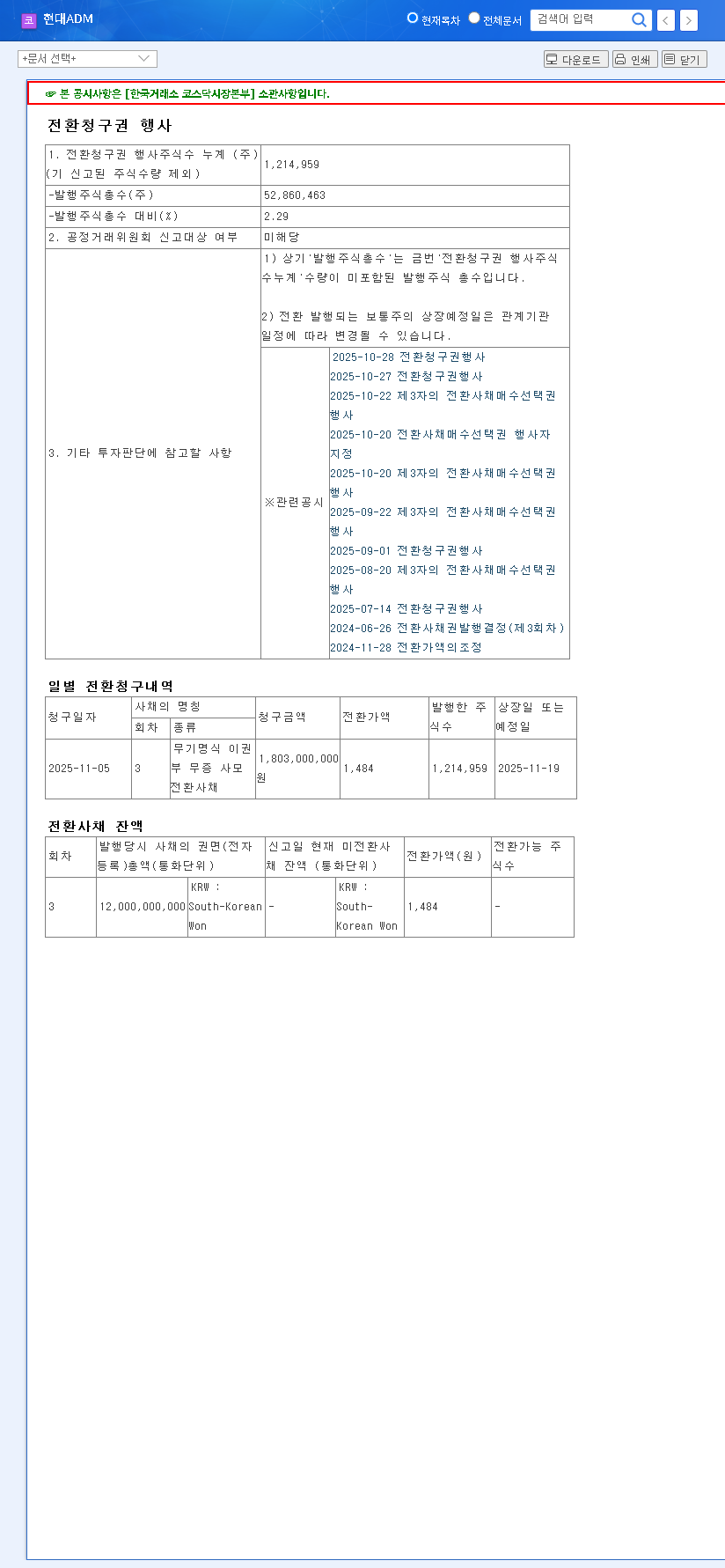
    On November 5, 2025, Hyundai ADM Bio Inc. confirmed the exercise of conversion rights for its outstanding convertible bonds. In simple terms, bondholders are choosing to swap their debt for equity, betting on the future value of the company’s stock. This move has immediate and tangible consequences for the company’s capital structure and stock market dynamics.

    The core conflict for investors is weighing the short-term benefit of ₩1.8 billion in liquidity against the long-term risk of share value erosion from 1.2 million new shares flooding the market.

    Key Details of the Issuance

    Understanding the specifics is crucial for any investor strategy. Here are the official details from the company’s disclosure:

    • Company: Hyundai ADM Bio Inc.
    • New Shares Issued: 1,214,959 (representing 2.29% of market cap)
    • Conversion Price: ₩1,484 per share
    • Total Capital Raised: Approx. ₩1.8 billion
    • Expected Listing Date: November 19, 2025
    • Source: Official Disclosure (DART Report)

    Analyzing Hyundai ADM’s Shaky Fundamentals

    The impact of a financing event like this cannot be judged in a vacuum. The company’s underlying health is the most critical factor. Unfortunately, Hyundai ADM Bio Inc.’s fundamentals are showing signs of significant strain, which magnifies the risks associated with this share issuance.

    Struggling Business Segments

    The company’s core operations are facing headwinds. The CRO (Contract Research Organization) business is experiencing a revenue decline of 14.4% year-over-year amid fierce competition. Meanwhile, its future growth engine—the anti-cancer drug development in its Bio Business—is still pre-revenue and fraught with uncertainty, including recent clinical trial setbacks. This paints a picture of a company whose primary revenue stream is shrinking while its future prospects remain speculative.

    Deteriorating Financial Health

    A look at the financial statements reveals a worrying trend that makes this Hyundai ADM Bio Inc. convertible bond exercise look more like a necessity than a strategic choice.

    • Expanding Losses: Operating losses have widened to ₩-4.37 billion, signaling deep profitability issues.
    • High Debt: The debt-to-equity ratio stands at a concerning 178.73%, and this bond conversion only addresses a fraction of its total debt.
    • Negative Cash Flow: With an operating cash flow of ₩-2.856 billion, the company is burning through cash, raising serious liquidity concerns.

    Investor Playbook: Navigating the Aftermath

    Given the weak fundamentals, investors must approach this situation with extreme caution. The short-term influx of shares will likely create downward pressure on the stock price around the November 19th listing date.

    Short-Term Strategy (High Risk)

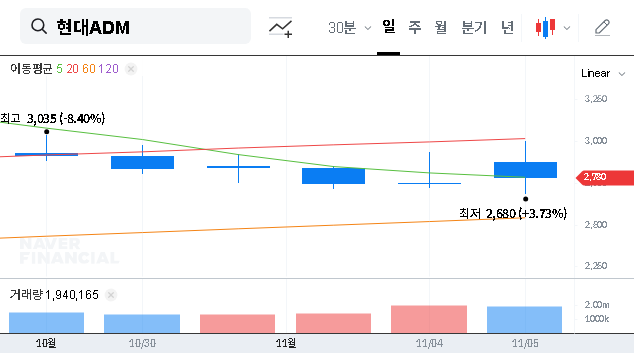
    Traders should be wary of the supply overhang. The arbitrage opportunity—with the current stock price (₩2,780) well above the conversion price (₩1,484)—means bondholders have a strong incentive to sell their newly acquired shares for a quick profit. This could trigger a sell-off. Monitoring trading volume and price action closely on and after the listing date is paramount for anyone considering a short-term position.

    Long-Term Investment Outlook

    Long-term investors should disregard the noise of the bond conversion and focus entirely on fundamental improvements. Before considering an investment, look for tangible evidence of a turnaround. For more information on what makes these instruments tick, you can review this comprehensive guide to convertible bonds from a reputable financial source. Key milestones to watch for include:

    • Positive clinical trial data or partnerships in the bio-business.
    • A stabilization or return to growth in the CRO segment.
    • A clear plan for debt reduction and a path to positive cash flow.

    Without these fundamental shifts, the company’s long-term prospects remain dim. Investors interested in this sector should also read our internal guide on How to Analyze Biotech Stocks for broader context.

    Final Verdict: A Warning Sign for Investors

    The Hyundai ADM Bio Inc. convertible bond exercise is not a signal of strength. While it provides a temporary liquidity patch, it fails to address the deep-seated problems within the company’s business model and financial structure. The immediate risk of share dilution and supply pressure outweighs the modest benefit of the capital injection. Until Hyundai ADM Bio Inc. demonstrates a credible and sustained operational turnaround, this event should be viewed as a warning sign rather than a catalyst for growth. The company’s future stock performance will be dictated by fundamental execution, not financial engineering.

    (187660) Hyundai ADM Bio Inc. Convertible Bond: A Guide to Share Dilution vs. Liquidity 관련 이미지
  • (138360) Hyupjin Co., Ltd. Convertible Bond Exercise: A Deep Dive for Investors

    (138360) Hyupjin Co., Ltd. Convertible Bond Exercise: A Deep Dive for Investors

    The recent announcement of the Hyupjin Co., Ltd. convertible bond exercise has sent ripples through the investment community. This pivotal financial event, officially disclosed on November 4, 2025, presents a complex scenario for shareholders. On one hand, it signals potential stock dilution; on the other, it points towards a strengthening financial foundation. For investors, this raises a critical question: is this a short-term risk to be navigated carefully or a long-term opportunity signaling corporate confidence? This comprehensive analysis will explore the details of the convertible bond conversion, assess Hyupjin’s improving fundamentals, and provide a strategic roadmap for making informed decisions.

    The Details: Understanding the Convertible Bond Conversion

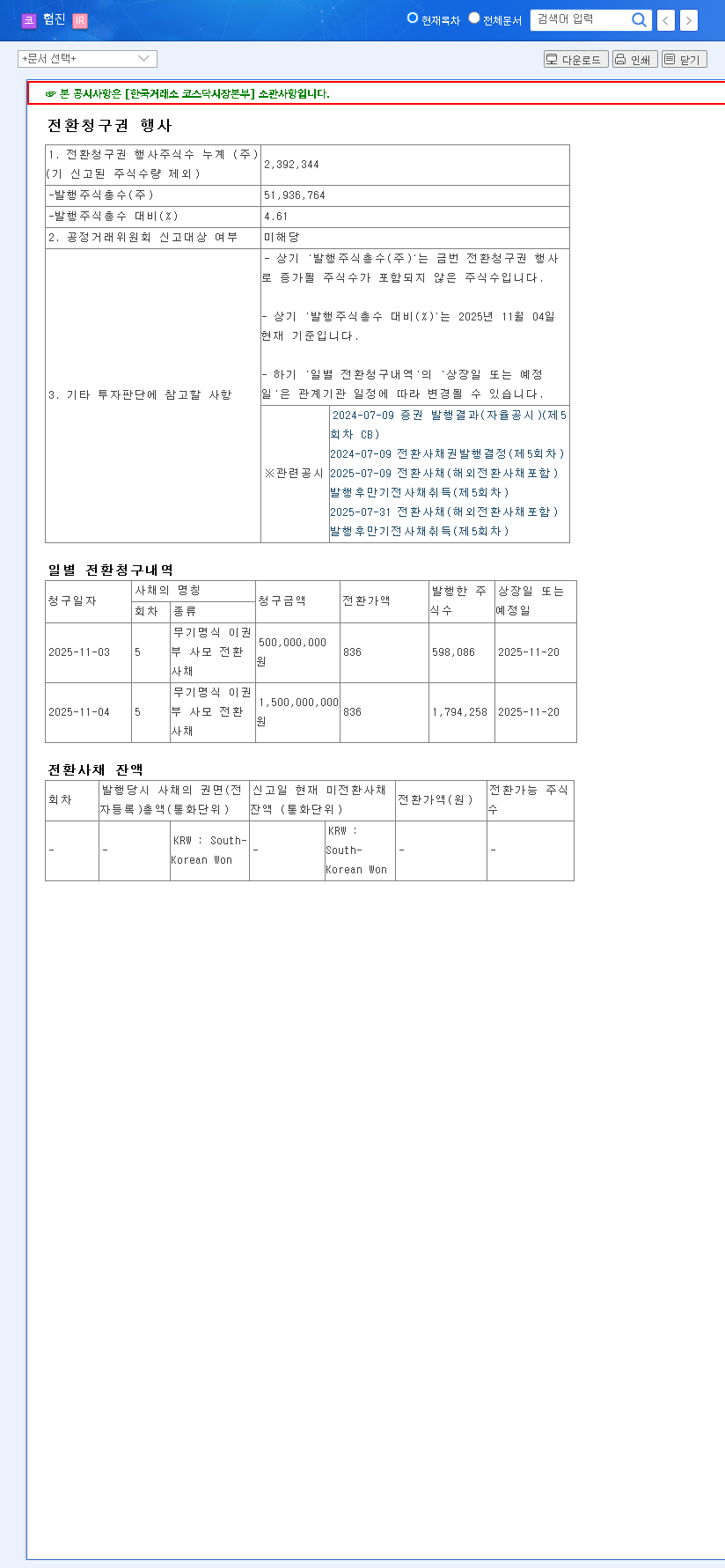
    On November 4, 2025, Hyupjin Co., Ltd. formally announced a ‘Claim for Conversion Rights’. This action allows holders of the company’s convertible bonds to exchange their debt instruments for equity shares. As detailed in the Official Disclosure filed on DART, the key figures are as follows:

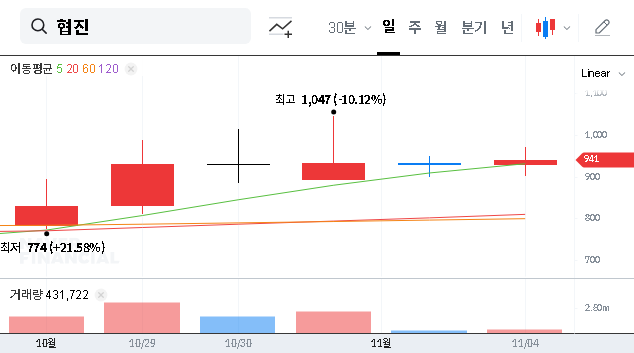
    • Company: Hyupjin Co., Ltd. (Market Cap: KRW 48.9 billion)
    • Shares to be Converted: 2,392,344 shares
    • Conversion Price: KRW 836 per share
    • Dilution Impact: Approx. 4.61% of total outstanding shares
    • Expected Listing Date: November 20, 2025

    The conversion price of KRW 836 is notably lower than the recent stock price of KRW 941. This price difference creates a clear incentive for bondholders to exercise their rights, as it allows them to acquire stock at a discount and potentially realize immediate profits by selling on the open market. This is a primary driver behind the timing of this large-scale conversion.

    Why Now? A Look at Hyupjin’s Improving Financial Health

    While an event like the Hyupjin Co., Ltd. convertible bond exercise might initially spook the market due to stock dilution fears, it’s crucial to analyze it within the context of the company’s strengthening fundamentals. The December 2024 business report reveals several positive developments that paint a more optimistic picture.

    Strengthened Financial Structure

    Hyupjin has made significant strides in bolstering its financial stability. Through a combination of capital increases and strategic convertible bond issuance, the company has increased its cash reserves while simultaneously reducing its debt-to-equity ratio. This convertible bond conversion further reduces debt from its balance sheet, converting it into equity and signaling a healthier financial posture. For more on this topic, see our guide to analyzing corporate balance sheets.

    Improved Profitability and Diversification

    The company’s 2024 performance showed a remarkable turnaround, with a substantial revenue increase leading to a net profit. A significant portion of this success can be attributed to profitable investments in associate companies like ‘Kwangmu’. This diversification strategy is paying off, creating revenue streams beyond its core business and contributing positively to Hyupjin’s bottom line and Return on Equity (ROE).

    The conversion of debt to equity is a double-edged sword: it dilutes existing shares but simultaneously de-risks the company by lowering its debt obligations, potentially paving the way for future growth investments.

    Impact Analysis: Stock Price, Financials, and Operations

    The immediate effect of this event will be felt across several areas of the company. Investors should anticipate both short-term pressures and long-term strategic shifts.

    Short-Term Stock Price and Dilution

    The listing of nearly 2.4 million new shares will cause a stock dilution of approximately 4.61%. In simple terms, the company’s net income will be spread across more shares, which can lead to a decrease in Earnings Per Share (EPS). This, combined with the potential for newly converted shareholders to sell their stock to lock in profits, could exert downward pressure on the stock price in the days following November 20, 2025.

    Long-Term Financial and Business Impact

    Financially, the move is a net positive for stability. Reducing debt lowers interest expenses and improves the company’s credit profile, which can reduce future borrowing costs. This improved financial flexibility can be a catalyst for growth. The capital can be channeled into R&D for its core food processing machinery business or used to expand its facility, as noted by leading industry analysts at authoritative sources like the Financial Times. Operationally, the core business remains unaffected, but a stronger balance sheet provides the fuel for strategic expansion.

    A Strategic Guide for Investors

    A comprehensive investor analysis must weigh the short-term dilution against the long-term benefits of enhanced financial health. While the immediate market reaction may be negative, the underlying fundamentals suggest a more resilient company is emerging. Investors should consider the following:

    • Monitor Sell-Offs: Keep an eye on trading volume around the listing date. A massive sell-off could create a buying opportunity if you believe in the long-term story.
    • Evaluate Macro-Factors: Favorable macroeconomic conditions, such as expected interest rate cuts, could improve overall market sentiment and mitigate some of the downward pressure on the stock.
    • Assess Risk Factors: It is critical to remember Hyupjin’s past. A history of administrative stock designation and auditors’ remarks on revenue recognition are risk factors that demand cautious optimism.

    In conclusion, the Hyupjin Co., Ltd. convertible bond exercise is a pivotal moment. For the patient investor, looking beyond the immediate stock dilution reveals a company actively working to strengthen its financial base, which is the cornerstone of sustainable, long-term growth.

    (138360) Hyupjin Co., Ltd. Convertible Bond Exercise: A Deep Dive for Investors 관련 이미지
  • (025620) Jayjun Cosmetic (025620) Convertible Bonds: A Deep Dive into Sangsangin Bank’s 5% Stake

    (025620) Jayjun Cosmetic (025620) Convertible Bonds: A Deep Dive into Sangsangin Bank’s 5% Stake

    The recent disclosure surrounding a major investment in Jayjun Cosmetic (025620) convertible bonds has sent ripples through the market. Sangsangin Savings Bank, a notable financial institution, has acquired a significant 5.05% stake through this strategic move, sparking intense debate among investors. For a company like Jayjun Cosmetic, which has been navigating a period of fundamental instability, this capital injection could be a pivotal turning point—or a new layer of complexity. This analysis delves deep into the implications of this event, dissecting the financial, strategic, and governance impacts to provide a clear roadmap for investors.

    This investment by Sangsangin Savings Bank presents a critical juncture for Jayjun Cosmetic, introducing both a lifeline for financial restructuring and the potential for increased shareholder uncertainty. Understanding the nuances is key.

    The Core Event: A 5.05% Stake Acquired

    On November 4, 2024, Sangsangin Savings Bank officially reported its new large shareholding in Jayjun Cosmetic Co., Ltd. The acquisition, made through convertible bonds (CBs), was declared for ‘simple investment purposes’, as detailed in the Official Disclosure (DART). Crossing the 5% ownership threshold triggered the mandatory disclosure, bringing this significant financial maneuver into the public eye and raising questions about the bank’s long-term intentions and the future of Jayjun Cosmetic.

    Why Convertible Bonds? A Strategic Choice

    The choice of convertible bonds is particularly insightful. For Jayjun Cosmetic, it’s a flexible way to raise capital at potentially lower interest rates than traditional loans, without immediately diluting existing shareholder equity. For Sangsangin Savings Bank, it offers a hybrid investment vehicle: they receive interest payments like a bondholder but retain the upside potential to convert the bonds into stock if Jayjun’s share price appreciates. This structure provides a degree of security while preserving the opportunity for significant returns, a strategy often employed in volatile markets. To learn more, you can read our guide on Understanding Convertible Bonds for Retail Investors.

    Comprehensive Analysis: Impact on Jayjun Cosmetic (025620)

    This investment cannot be viewed in isolation. Its true impact must be assessed across Jayjun’s financial health, business strategy, and governance structure, especially considering the company’s recent challenges in the competitive cosmetics sector.

    1. Financial Structure and Performance

    The infusion of capital via the Jayjun Cosmetic (025620) convertible bonds brings both potential benefits and risks.

    • Positive Outlook: Conversion of the bonds into equity would decrease the company’s debt-to-equity ratio, strengthening its balance sheet. This improved financial stability could attract further investment and provide the necessary capital to fund new growth initiatives.
    • Potential Drawbacks: Until conversion, Jayjun must service the interest on these bonds, potentially increasing its financial expenses. Furthermore, the overhang of potential conversion can create uncertainty. The conversion price will be a key metric to watch, as a low price could lead to significant dilution for existing shareholders upon exercise.

    2. Business Strategy and Growth Outlook

    Jayjun has been attempting to diversify beyond its core, yet sluggish, cosmetics business into healthcare and financial investments. This move by a savings bank could act as a catalyst.

    • Opportunity for Synergy: Sangsangin’s financial expertise could provide valuable guidance or even partnership opportunities as Jayjun explores new ventures. The investment validates these diversification efforts to some extent, signaling market confidence.
    • Pressure to Perform: With a sophisticated financial institution now on its cap table, management will face heightened pressure to deliver tangible results from both its core business and new ventures. The market will demand a clearer, more executable strategy.

    3. Shareholder Value and Corporate Governance

    Existing shareholders of the 025620 stock are right to be concerned about share dilution. If all the bonds are converted, the total number of outstanding shares will increase, which could dilute the earnings per share (EPS) and the ownership percentage of current investors. However, the presence of an institutional investor can also enhance corporate governance, as they provide a new layer of oversight on management decisions, potentially leading to increased transparency and better long-term strategy.

    Investor Checklist & Final Verdict

    While this development introduces an opportunity for revitalization, a cautious and watchful approach is paramount. The investment in Jayjun Cosmetic (025620) convertible bonds is not a guaranteed signal of a turnaround. Investors should monitor the following key areas before making any decisions:

    • Sangsangin’s Future Actions: Monitor any further disclosures from the bank regarding their intentions. Will they convert, sell, or hold the bonds to maturity?
    • New Business Milestones: Track concrete progress in Jayjun’s healthcare and financial investment ventures. Announcements of partnerships or revenue generation will be critical signals.
    • Core Business Revival: Look for signs of improvement in the cosmetics division’s sales and profitability in upcoming quarterly reports.
    • Macroeconomic Factors: Keep an eye on interest rate trends from central banks like the U.S. Federal Reserve, as this influences corporate financing costs and overall market sentiment.

    In conclusion, Sangsangin Savings Bank’s investment is a double-edged sword. It provides Jayjun with much-needed capital and a strategic partner, but it also introduces complexities like potential share dilution and heightened performance expectations. A wait-and-see approach, grounded in diligent monitoring of the factors above, is the most prudent strategy for now.

    (025620) Jayjun Cosmetic (025620) Convertible Bonds: A Deep Dive into Sangsangin Bank's 5% Stake 관련 이미지
  • (117730) T-Robotics CB/BW Conversion: A Deep Dive into Share Dilution & Stock (117730) Analysis

    (117730) T-Robotics CB/BW Conversion: A Deep Dive into Share Dilution & Stock (117730) Analysis

    The recent T-Robotics CB/BW conversion announcement has sent ripples through the investment community. For stakeholders in T-Robotics co., Ltd. (117730), the news of over 570,000 new shares hitting the market raises critical questions about share dilution, stock price volatility, and the company’s long-term viability. This comprehensive analysis will dissect the official disclosure, evaluate the company’s precarious financial health, and provide a clear robotics investment strategy for navigating the challenges ahead.

    We will explore the immediate risks and potential long-term benefits of this financial maneuver, offering investors a data-driven perspective to inform their next steps concerning their T-Robotics stock holdings.

    Understanding the T-Robotics CB/BW Conversion Details

    On November 3, 2025, T-Robotics officially disclosed the exercise of conversion rights for its Convertible Bonds (CBs) and Bonds with Warrants (BWs). This is not just financial jargon; it’s a significant event with tangible consequences for the market. To understand why, let’s break down the numbers.

    • New Shares Issued: A total of 574,881 new shares are set to be listed.
    • Listing Date: The new shares will officially begin trading on November 14, 2025.
    • Market Impact: This issuance represents approximately 2.80% of the company’s total outstanding shares, a notable increase that directly leads to concerns about share dilution.
    • Conversion Price: The shares were converted at a price of KRW 8,767 each.

    The specifics of this event can be verified via the company’s Official Disclosure (Source: DART). Understanding these instruments is key; for more information, you can read our guide on how convertible bonds impact stock value.

    A Deep Dive into T-Robotics’ Troubling Fundamentals

    The timing of this conversion is critical because it coincides with a period of significant financial distress for T-Robotics. A thorough 117730 stock analysis reveals a company grappling with several fundamental weaknesses.

    1. Worsening Profitability and Revenue Decline

    In the first half of 2025, T-Robotics reported a 14.1% year-on-year drop in sales to KRW 23.64 billion. More alarmingly, the company’s profitability has cratered, swinging from a profit to an operating loss of KRW -0.73 billion and a staggering net loss of KRW -17.24 billion. This decline is not an isolated issue but is rooted in sluggish sales of its core products—vacuum and logistics robots—and exacerbated by rising financial costs associated with its CBs and BWs.

    2. Precarious Financial Health

    The balance sheet paints an equally grim picture. Total liabilities have swelled to KRW 82.05 billion, pushing the debt-to-equity ratio to a worrying 247.1%. Simultaneously, substantial net losses have eroded total equity by over 33%. This combination of rising debt and shrinking equity signals heightened financial instability and potential liquidity risks that investors cannot ignore.

    The core issue is that the T-Robotics CB/BW conversion is happening not from a position of strength, but during a period of significant operational and financial weakness, amplifying the risk of share dilution.

    Stock Price Impact: Short-Term Pain vs. Long-Term Gain?

    The influx of new shares will inevitably impact the T-Robotics stock price. The key is to differentiate between immediate reactions and the long-term outlook.

    Short-Term: The Shadow of Share Dilution

    In the short term, the market’s primary fear is share dilution. With over 570,000 new shares available, the supply increases, which can place downward pressure on the stock price. This is especially true when bondholders who converted at KRW 8,767 decide to sell their shares to lock in profits, given the current market price is significantly higher. This potential wave of selling, combined with the company’s poor fundamentals, could lead to heightened price volatility and a negative sentiment among existing shareholders.

    Long-Term: A Path to Recovery?

    Despite the short-term headwinds, there is a potential silver lining. Converting debt to equity helps clean up the balance sheet by reducing the company’s debt burden. This can improve financial stability over the long run. Furthermore, T-Robotics still possesses a technological edge, particularly in the OLED vacuum robot sector, which holds significant growth potential. For this potential to be realized, however, the company must demonstrate a clear and decisive turnaround in its business operations and profitability. According to market analysis from authoritative sources like Bloomberg, investor confidence hinges on a company’s ability to execute a recovery plan effectively.

    Investment Strategy: What Should Investors Do Now?

    Navigating this period requires a clear-eyed and strategic approach. The correct action depends on your position and risk tolerance.

    • Existing Shareholders: Brace for potential short-term volatility. It is crucial to re-evaluate your investment thesis. Is your belief in the company’s long-term technology story strong enough to withstand the current financial turmoil?
    • Potential Investors: Extreme caution is advised. This is not the time for speculative buying. A prudent approach would be to wait for concrete signs of a business recovery, such as improved quarterly earnings reports and a stronger balance sheet, before considering an entry point.
    • The Company’s Role: T-Robotics management must engage in proactive and transparent communication with the market. Presenting a credible turnaround plan is essential to restoring investor confidence and mitigating the negative impact of the share issuance.

    Disclaimer: This analysis is for informational purposes only and does not constitute investment advice. All investment decisions should be made based on your own research and financial situation. No responsibility is assumed for any investment outcomes.

    (117730) T-Robotics CB/BW Conversion: A Deep Dive into Share Dilution & Stock (117730) Analysis 관련 이미지
  • (148250) RN2 Technologies Stock (148250): A Deep Dive into RHC’s CB Acquisition & Future Outlook

    (148250) RN2 Technologies Stock (148250): A Deep Dive into RHC’s CB Acquisition & Future Outlook

    The outlook for RN2 Technologies stock (KRX: 148250) has entered a new phase of speculation and analysis following a significant financial maneuver. RHC Investment Partners has acquired a substantial stake via convertible bonds (CBs), prompting investors to question the future trajectory of the company’s share price and fundamental value. This deep-dive report unpacks the event, analyzes its potential impact, and provides a clear investment strategy to navigate the opportunities and risks ahead.

    We’ll explore everything from the specifics of the deal to the core business of RN2 Technologies, ensuring you have the comprehensive insight needed for informed decision-making.

    The Catalyst: RHC’s Convertible Bond Acquisition

    On November 3, 2025, the market took notice when RHC Investment Partners filed a large-scale holding report concerning RN2 Technologies Co., Ltd. According to the Official Disclosure, the core of this event is the acquisition of new convertible bonds that, if converted, would represent a 7.05% stake in the company. While the stated purpose is ‘simple investment,’ such a move always warrants closer inspection.

    • Reporting Entity: RHC Investment Partners
    • Target Company: RN2 Technologies Co., Ltd. (148250)
    • Key Detail: New acquisition of convertible bonds (CBs) for a 7.05% potential stake.
    • Stated Purpose: Simple investment.

    Who is RN2 Technologies? A Look at the Core Business

    To understand the investment, one must first understand the company. RN2 Technologies is a specialized manufacturer of radio frequency (RF) components. These are not everyday consumer items but are critical building blocks for advanced technology, primarily in the telecommunications and defense industries. Their products, such as couplers, attenuators, and terminators, are essential for managing signal power in 5G base stations and sophisticated military radar systems. While the company has demonstrated consistent revenue growth, driven by the global 5G rollout, its profitability has been a persistent challenge, making this new capital infusion a pivotal event.

    Understanding Convertible Bonds: A Double-Edged Sword

    A convertible bond is a hybrid security—it starts as a loan (a bond) that pays interest, but it gives the holder the option to convert it into a predetermined number of common shares. This unique structure presents both opportunities and risks. You can learn more about the technicals from high-authority sources like Investopedia.

    The Upside: A Vote of Confidence and Flexible Capital

    RHC’s investment signals a positive assessment of RN2 Technologies’ future. They are betting on the company’s growth potential. For RN2, this provides crucial capital that can be used for R&D, expanding production, or improving its financial structure without the immediate dilution that a direct stock offering would cause.

    The Downside: The Threat of Future Share Dilution

    The primary risk for existing shareholders is dilution. If and when RHC converts these bonds into stock, the total number of outstanding shares will increase. This can decrease the ownership percentage and earnings per share for existing investors, potentially putting downward pressure on the stock price.

    While the entry of a new, significant investor is a vote of confidence, the path for RN2 Technologies stock is now influenced by the dual forces of growth potential and the overhang of potential dilution.

    Analyzing the Impact on RN2 Technologies Stock

    The immediate impact on the RN2 Technologies stock price is likely neutral to slightly positive, driven by market sentiment. However, the long-term direction will depend entirely on how events unfold.

    Short-Term Market Reaction

    In the short term, the news may attract traders and generate positive buzz. However, savvy investors will remain cautious, aware of the potential for dilution. This creates a balance between buying interest and watchful waiting, likely leading to increased volatility but no major breakout without further news.

    Medium to Long-Term Fundamental Drivers

    The long-term performance hinges on two factors: RHC’s strategy and RN2’s execution. Will RHC remain a passive investor, or will they seek to influence management? More importantly, can RN2 Technologies use this opportunity to finally solve its profitability challenges and capitalize on its strong position in the 5G market? The ultimate driver of the stock price will be tangible improvements in the company’s intrinsic value.

    A Prudent Investment Strategy

    Given the mix of potential and risk, a cautious and well-researched approach is essential. Investors should consider the following steps:

    • Monitor CB Conversion Terms: Keep a close eye on the conversion price and maturity date of the bonds. Any moves by RHC to convert will be a significant market signal.
    • Track Fundamental Performance: Focus on quarterly earnings reports. Look for margin improvements and updates on new contracts or technological advancements. This is more important than the daily stock price fluctuations.
    • Analyze the Broader Sector: The performance of the RN2 Technologies stock is tied to the 5G and defense sectors. Read our latest analysis of 5G component manufacturers for broader context.
    • Adopt a Long-Term Perspective: This event is not a short-term catalyst for a massive price surge. Real value creation will take time. Only invest if you believe in the company’s long-term ability to improve its fundamentals.

    Frequently Asked Questions (FAQ)

    Q1: What is the single most important event for RN2 Technologies right now?

    A1: The acquisition of convertible bonds representing a potential 7.05% stake by RHC Investment Partners. It introduces a significant new investor and potential for both capital infusion and share dilution.

    Q2: Is this CB acquisition good or bad for RN2 Technologies stock?

    A2: It’s neutral with both positive and negative potential. It’s positive because it shows confidence from an institutional investor. It’s negative due to the risk of future share dilution, which could harm existing shareholders’ value.

    Q3: How does this affect existing shareholders?

    A3: If the bonds are converted to stock, the total number of shares increases, which can dilute the value and ownership percentage of existing shareholders. The stock price may become more volatile as the market anticipates the conversion.

    Q4: What should I watch for as an investor?

    A4: Focus on the company’s fundamental improvements—specifically, whether they can improve profitability. Also, monitor any news regarding RHC’s investment strategy and the timing of a potential bond-to-stock conversion.

    (148250) RN2 Technologies Stock (148250): A Deep Dive into RHC's CB Acquisition & Future Outlook 관련 이미지