Tag: Share Buyback

  • (055550) Shinhan Financial Group Stock: 2025 H1 Earnings & Dividend Analysis (HOLD)

    (055550) Shinhan Financial Group Stock: 2025 H1 Earnings & Dividend Analysis (HOLD)

    The latest financial release from Shinhan Financial Group has sent ripples through the investment community. With an impressive consolidated net profit of KRW 3.0374 trillion for the first half of 2025 and a confirmed quarterly dividend, the banking giant presents a complex picture of robust performance mixed with underlying risks. For investors, the key question is clear: Does this signal a prime buying opportunity, or are there hidden challenges that warrant caution?

    This comprehensive analysis dissects the 2025 H1 earnings report, evaluates the dividend decision’s impact, and provides a clear, actionable investment thesis. We will explore the fundamental strengths driving growth, scrutinize the potential risks on the horizon, and offer a strategic roadmap for navigating your investment in Shinhan Financial Group stock.

    Unpacking the 2025 H1 Earnings & Dividend Announcement

    On October 28, 2025, Shinhan Financial Group released its half-year performance figures and declared its shareholder return plan. These announcements are crucial indicators of the company’s health and strategic direction. Let’s break down the essential details from the Official Disclosure.

    Core Financial Highlights

    • Consolidated Net Profit: A remarkable KRW 3.0374 trillion, marking a solid 10.6% increase year-on-year.
    • Quarterly Dividend Per Share: KRW 570 for common stock, providing a tangible return to investors.
    • Dividend Record Date: November 4, 2025.
    • Dividend Payment Date: November 28, 2025.
    • Capital Adequacy (CET1 Ratio): A healthy 13.59%, indicating strong financial stability.

    The Bull vs. Bear Case: A Balanced Investment Analysis

    A thorough investment analysis requires looking beyond the headlines. While the profit growth is encouraging, a prudent investor must weigh the positive drivers against potential headwinds.

    Positive Factors: Pillars of Strength

    Several factors contribute to a positive outlook for Shinhan Financial Group.

    • Diversified Income Growth: The 10.6% profit increase wasn’t solely reliant on interest income. Significant gains in securities trading, foreign exchange, and derivatives showcases a well-balanced and resilient business model.
    • Aggressive Shareholder Returns: Beyond the quarterly dividend, the group’s KRW 800 billion share buyback and cancellation program is a powerful statement of its commitment to enhancing shareholder value. This can provide strong support for the stock price.
    • Digital Dominance: Achieving 27.5 million Monthly Active Users (MAU) across its digital platforms (like Shinhan SOL Bank) is a significant competitive advantage. This expanding user base is key to future growth in a digital-first banking landscape.

    Concerning Factors: Potential Risks to Monitor

    Despite the strong performance, certain challenges could impact future profitability.

    • Profitability Drag from Shinhan Card: A 35.0% year-on-year profit decrease at Shinhan Card is a major red flag. This is a result of a triple-threat: higher funding costs (what the company pays to borrow money), rising loan delinquencies requiring more cash to be set aside (provisioning), and costly infrastructure investments. This subsidiary’s performance is a critical variable for the group.
    • Macroeconomic Uncertainty: The global economic climate remains a significant risk. As major economies like the U.S. signal potential interest rate cuts, this could compress bank lending margins. For an overview of current trends, investors often consult sources like Reuters’ global economic coverage.

    Strategic Outlook & Investment Thesis

    Synthesizing these factors, we can form a clear investment opinion and action plan. The consistent Shinhan dividend and stable earnings are attractive, but risks necessitate a balanced approach.

    Investment Opinion: HOLD (Neutral)

    While Shinhan Financial Group’s fundamentals are solid and shareholder returns are strong, the pronounced weakness in its card subsidiary and looming macroeconomic uncertainties prevent a full-throated BUY recommendation. We advise a HOLD position, suggesting that current investors maintain their holdings while new investors wait for a clearer picture regarding the resolution of these risks.

    Action Plan for Investors

    Investors should adopt a strategy of active monitoring. For those looking to deepen their understanding, reviewing our guide on analyzing bank stocks can provide a valuable framework.

    • Short-Term Focus: Be mindful of potential price volatility around the ex-dividend date (after Nov 4, 2025). Short-term traders may see opportunities, but long-term investors should not be swayed by these minor fluctuations.
    • Long-Term Focus: Keep a close eye on Shinhan Card’s quarterly delinquency rates and Net Interest Margin (NIM). Any signs of stabilization or improvement here would be a strong positive catalyst. Also, track the group’s progress in new business ventures and ESG initiatives, as these are key to long-term sustainable growth.

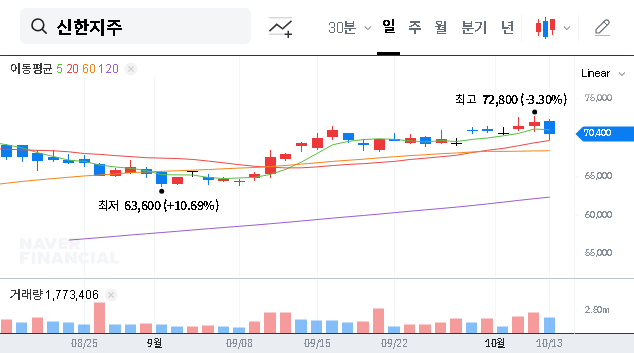
    (055550) Shinhan Financial Group Stock: 2025 H1 Earnings & Dividend Analysis (HOLD) 관련 이미지
  • (175330) JB Financial Group Stock: A Deep Dive on the ₩30B Share Buyback & 2025 Investment Outlook

    (175330) JB Financial Group Stock: A Deep Dive on the ₩30B Share Buyback & 2025 Investment Outlook

    The recent announcement of a significant ₩30 billion share buyback has put JB Financial Group squarely in the spotlight for investors. This strategic move, coupled with solid financial performance in H1 2025, raises a critical question: is now the opportune moment to invest? This comprehensive analysis explores the group’s core fundamentals, the direct implications of this shareholder-friendly action, and the broader macroeconomic environment to provide a clear investment outlook for 2025 and beyond.

    We’ll dissect the numbers, evaluate the risks, and offer an expert opinion on what investors should monitor, helping you determine if a JB Financial Group investment aligns with your financial strategy.

    H1 2025 Financial Performance: A Story of Stability

    In the first half of 2025, JB Financial Group demonstrated resilient growth, with its consolidated total assets reaching an impressive ₩70.188 trillion. The consolidated net profit stood at ₩370.4 billion, marking a slight but steady year-on-year increase. This stability was bolstered by strong performances from key subsidiaries, including Jeonbuk Bank (+3.4%) and JB Woori Capital (+6.6%).

    Key profitability metrics remain best-in-class, with a Return on Equity (ROE) of 13.1% and a Return on Assets (ROA) of 1.11%. These figures signal exceptional efficiency in generating profits from shareholder equity and total assets. Furthermore, the group’s capital adequacy ratios, such as the Common Equity Tier 1 (CET1) ratio of 12.40%, indicate a robust and healthy financial foundation capable of weathering economic shifts.

    Despite the strong overall picture, it’s crucial to note the 6.2% decrease in separate net profit, largely attributed to a declining Net Interest Margin (NIM) of 2.61%. Additionally, a rise in JB Woori Capital’s Non-Performing Loan (NPL) ratio to 2.71% warrants careful observation.

    The ₩30 Billion Share Buyback: A Signal of Confidence

    On October 27, 2025, JB Financial Group made a pivotal announcement: a decision to acquire and cancel 1,298,543 of its own common shares, valued at ₩30 billion. This strategic maneuver, detailed in the company’s Official Disclosure (DART), is a powerful tool for enhancing shareholder value. But what does a share buyback truly mean for investors?

    Essentially, by reducing the number of outstanding shares, the company increases the value of each remaining share. This mechanically boosts key metrics like Earnings Per Share (EPS) and Book Value Per Share (BPS). As explained by financial experts at Investopedia, it’s also a strong signal from management that they believe the company’s stock is undervalued, projecting confidence in future financial health.

    Potential Positive Impacts on JB Financial Group Stock

    • Enhanced Shareholder Value: A direct increase in EPS makes the stock more attractive.
    • Improved Investor Sentiment: The move is seen as a commitment to shareholder returns, which can attract new investors.
    • Stock Price Support: Reducing the supply of shares can create upward pressure on the stock price, especially in the short term.

    Core Analysis: The Bull vs. The Bear Case

    Key Strengths (The Bull Case)

    The long-term JB Financial Group outlook is supported by several fundamental strengths. Its stable capital structure provides a cushion against economic volatility, while industry-leading profitability metrics showcase its efficiency. The group is also actively diversifying its business into non-banking sectors and expanding into high-growth Southeast Asian markets. Coupled with an accelerated digital transformation and a commitment to ESG management, these factors position the company for sustainable growth.
    Potential Threats (The Bear Case)

    However, potential headwinds must be considered. The primary concern is sustained pressure on Net Interest Margin (NIM) if benchmark interest rates continue to fall. Risks associated with real estate project financing (PF) require vigilant monitoring to prevent a rise in non-performing assets. Finally, fierce competition within the financial sector and broad macroeconomic uncertainty, including global slowdowns, pose ongoing challenges to profitability and growth.

    Investment Opinion and Path Forward

    JB Financial Group presents a compelling case built on robust fundamentals and a proactive shareholder return policy. The share buyback is an undeniable positive, likely to provide short-term support for the stock price and bolster investor confidence. However, the persistent macroeconomic uncertainties and industry-specific risks, particularly interest rate sensitivity, cannot be ignored.

    Therefore, our investment opinion remains Neutral. While the foundation is solid, investors should proceed with caution. The market may have already priced in some of the positive news from the buyback. For those considering a JB Financial Group investment, it is crucial to monitor several key areas. To learn more about evaluating bank performance, you might find our guide on analyzing key financial metrics useful.

    Key Monitoring Points for Investors:

    • Asset Quality Trends: Keep a close watch on the NPL ratio and real estate PF risk management.
    • Interest Rate Environment: Track central bank policies and their impact on the group’s NIM.
    • Growth Engine Performance: Evaluate the success of overseas expansion and digital initiatives.
    • Shareholder Return Policy: Look for continued commitment to shareholder-friendly actions beyond this buyback.

    Frequently Asked Questions (FAQ)

    Q1: What are the highlights of JB Financial Group’s H1 2025 performance?

    A1: JB Financial Group reported stable growth with total assets of ₩70.188 trillion and a net profit of ₩370.4 billion. It boasts industry-leading profitability with an ROE of 13.1% and ROA of 1.11%, though a declining Net Interest Margin (NIM) is a point of concern.

    Q2: How will the ₩30 billion share buyback affect the stock?

    A2: The share buyback is designed to increase shareholder value by reducing the number of shares, which boosts key metrics like Earnings Per Share (EPS). It signals management’s confidence and can lead to improved investor sentiment and potential short-term upward momentum for the stock price.

    Q3: What are the primary risks for a JB Financial Group investment?

    A3: The main risks include continued pressure on profitability from falling interest rates (NIM compression), potential credit quality issues related to real estate project financing, intense market competition, and overarching macroeconomic uncertainties that could impact the entire financial sector.

    Q4: What is the current investment consensus on JB Financial Group?

    A4: The current consensus is ‘Neutral’. While the company’s fundamentals are strong and the share buyback is a positive catalyst, significant macroeconomic risks justify a cautious approach. Investors are advised to monitor key performance indicators before making a final decision.

    Disclaimer: This content is for informational purposes only and is based on publicly available data. It should not be construed as financial advice or a solicitation to buy or sell any securities. The final responsibility for investment decisions rests with the individual investor.

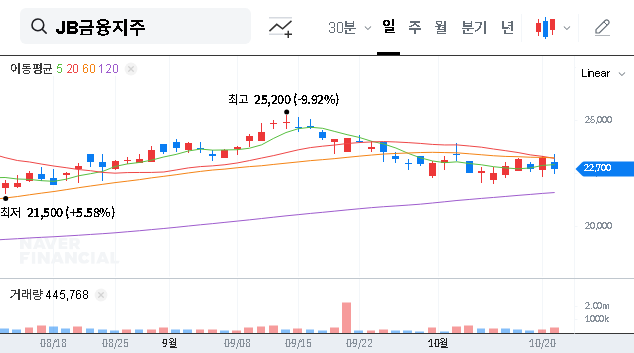
    (175330) JB Financial Group Stock: A Deep Dive on the ₩30B Share Buyback & 2025 Investment Outlook 관련 이미지
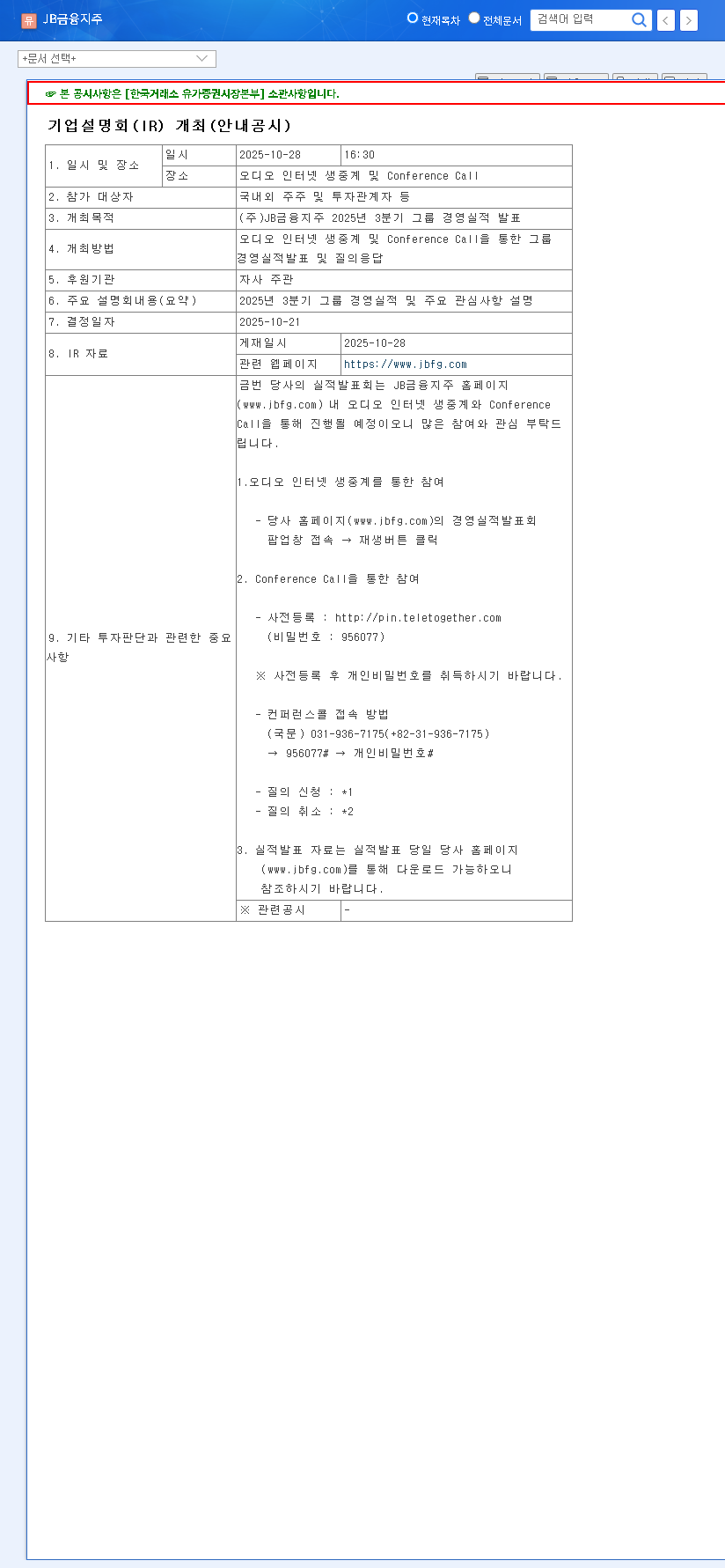
  • (006980) WOOSUNG Share Buyback (2.3B KRW): A Deep Dive for Investors | Stock Analysis & Outlook

    (006980) WOOSUNG Share Buyback (2.3B KRW): A Deep Dive for Investors | Stock Analysis & Outlook

    In a dynamic stock market, corporate actions like a share buyback send powerful signals to investors. When a company decides to repurchase its own stock, it’s more than a financial transaction; it’s a statement of confidence. This is precisely the case with WOOSUNG CO., LTD. (WooSung), which recently reaffirmed its commitment to shareholder value by extending its significant 2.3 billion KRW share buyback trust contract. For current and potential investors, understanding the nuances of this move is critical.

    This comprehensive WOOSUNG stock analysis will explore the full implications of the share buyback program. We’ll examine its potential impact on the stock price, dissect the company’s underlying fundamentals, and provide a strategic outlook to help you make well-informed investment decisions.

    Understanding the 2.3 Billion KRW WOOSUNG Share Buyback

    On October 24, 2025, WOOSUNG officially announced its decision to extend its share repurchase trust contract with KEB Hana Bank. This is not a new initiative but a continuation of an existing commitment, signaling long-term dedication to its strategy. The key objective, as stated in the disclosure, is to achieve “stock price stabilization and enhance shareholder value.”

    Key Contract Details

    • Company: WOOSUNG CO., LTD. (Market Cap: 51.7 billion KRW)
    • Contract Amount: 2.3 billion KRW (representing a substantial 4.42% of market capitalization)
    • Contract Purpose: Stock price stabilization and shareholder value enhancement
    • Extended Period: October 28, 2025, to October 28, 2026
    • Official Source: Click to view DART report

    A share buyback of this magnitude (4.42% of market cap) is a significant capital allocation. It implies that management believes the company’s shares are currently undervalued by the market, making it a compelling investment for the company itself.

    Analyzing WOOSUNG’s Fundamentals

    While a share buyback is a positive signal, it must be evaluated against the company’s core financial health. A look at the December 2024 business report reveals a mixed but improving picture for WOOSUNG’s fundamentals. For a deeper understanding, investors should consult our complete guide to analyzing financial reports.

    Financial Highlights (YoY)

    • Revenue: 606.199 billion KRW (↓ 4.5%)
    • Operating Profit: 8.592 billion KRW (↑ 51.2%)
    • Net Income: 19.691 billion KRW (↑ 78.1%)
    • Financial Health: Equity ratio improved to 46.5%, and the debt-to-equity ratio decreased to 115.1%.

    The most critical observation is the contrast between declining revenue and soaring profits. This profit surge was partly driven by one-time events, including gains from asset disposals and insurance payouts. Therefore, the key question for long-term WOOSUNG investment is the sustainability of this profitability. The revenue decline must be addressed through core business growth for the positive trend to continue.

    Short-Term vs. Long-Term Impact for Investors

    The WOOSUNG share buyback program will have different effects over different time horizons. As reported by financial news outlets like Bloomberg, such programs often create predictable market reactions.

    Short-Term Outlook (3-6 Months)

    In the short term, the buyback is unequivocally positive. The consistent purchasing pressure from the 2.3 billion KRW fund should provide a solid floor for the stock price and mitigate downside volatility. It improves investor sentiment and signals that management is actively working to support WOOSUNG shareholder value.

    Long-Term Outlook (12+ Months)

    Long-term value creation depends entirely on fundamental business performance. Key factors to monitor include:

    • Core Business Growth: Can the company reverse the revenue decline and demonstrate sustainable profitability without one-off gains?
    • Strategic Investments: Will investments, like the 113.2 billion KRW in the Nonsan new factory, translate into future revenue and profit streams?
    • Market Headwinds: The company’s feed business is sensitive to exchange rate volatility (KRW/USD, KRW/EUR), and a high-interest-rate environment could increase borrowing costs.

    Conclusion: An Investor’s Playbook

    WOOSUNG’s decision to extend its share repurchase contract is a commendable, shareholder-friendly action that provides a short-term catalyst and support for the stock. However, savvy investors should view this as one piece of a larger puzzle.

    The prudent approach is to balance the optimism from the buyback with a critical WOOSUNG stock analysis of its operational performance. Watch upcoming quarterly earnings reports closely for signs of a turnaround in revenue and evidence of sustainable profit margins. While the buyback provides a safety net, long-term capital appreciation will be driven by fundamental business success.

    (006980) WOOSUNG Share Buyback (2.3B KRW): A Deep Dive for Investors | Stock Analysis & Outlook 관련 이미지
    (006980) WOOSUNG Share Buyback (2.3B KRW): A Deep Dive for Investors | Stock Analysis & Outlook 관련 이미지
  • (114810) Hansol IONES Share Buyback: An Investor’s Guide to Strategy & Value

    (114810) Hansol IONES Share Buyback: An Investor’s Guide to Strategy & Value

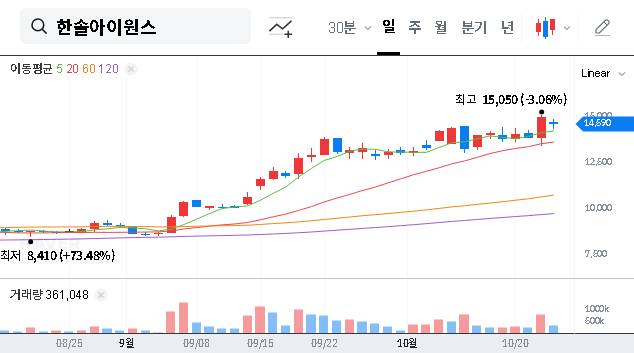
    The recent Hansol IONES share buyback announcement has captured the attention of investors. Corporate decisions to repurchase treasury shares are significant events, often signaling management’s confidence and a commitment to boosting shareholder value. On May 15, 2024, Hansol IONES Co., Ltd. (한솔아이원스) unveiled its plan, prompting crucial questions about its impact on the company’s stock price and the right investment strategy moving forward. This comprehensive analysis will break down the details, explore the potential consequences, and provide a clear playbook for investors.

    Deconstructing the Hansol IONES Share Buyback Announcement

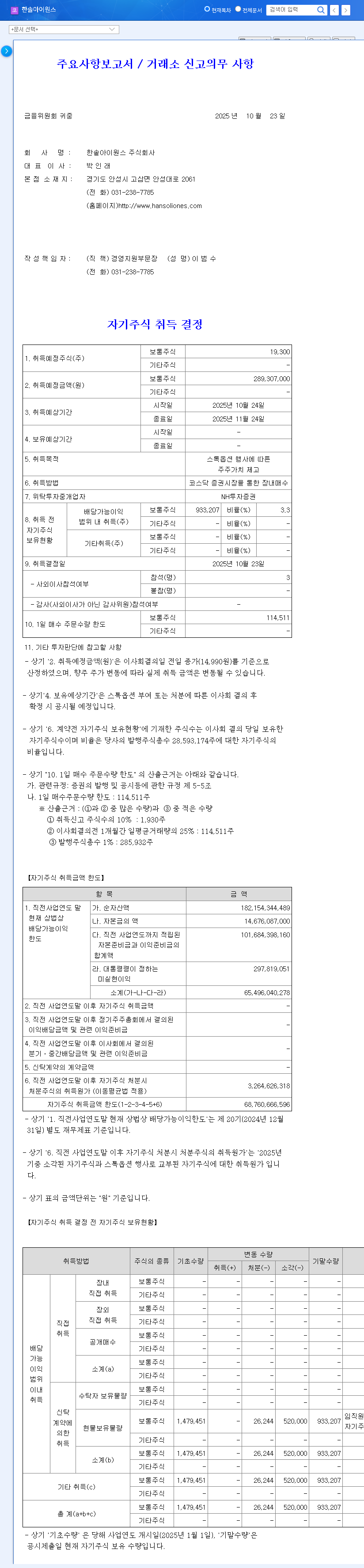
    Hansol IONES officially disclosed its intention to acquire its own treasury shares, citing the primary goal of enhancing shareholder value in light of upcoming stock option exercises. The specifics of this corporate action, as detailed in the official disclosure, are crucial for a complete understanding.

    • Shares & Value: The company plans to acquire 19,300 common shares, representing a total value of 300 million KRW.
    • Method: The shares will be purchased on the open market via the KOSDAQ stock exchange.
    • Acquisition Period: The buyback is scheduled to run until October 23, 2025, giving the company a long window to execute the purchases.
    • Broker: The transaction will be managed by NH Investment & Securities.
    • Official Source: Investors can verify these details directly through the Official Disclosure on DART.

    Why This Buyback Matters: Purpose & Implications

    The company’s stated reason—’enhancement of shareholder value due to stock option exercise’—is key. This points directly to a strategy of mitigating stock option dilution. When employees exercise stock options, the company issues new shares, which can dilute the ownership stake of existing shareholders. By repurchasing a similar number of shares from the market, the company effectively neutralizes this dilution, protecting the value of each existing share.

    A share buyback acts as a powerful signal. It tells the market that the company’s own management believes the stock is undervalued and represents a good use of corporate capital, all while directly supporting key financial metrics.

    The Bull Case: Potential Upsides for Investors

    From an investor’s perspective, this Hansol IONES share buyback presents several positive indicators:

    • EPS Accretion: By reducing the total number of shares outstanding, the company’s Earnings Per Share (EPS) will increase, assuming profits remain constant. A higher EPS is often correlated with a higher stock price.
    • Vote of Confidence: A company spending its own cash to buy its stock is a strong declaration that the board believes its shares are currently trading below their intrinsic value.
    • Shareholder-Friendly Policy: This action demonstrates a direct commitment to returning capital to shareholders and enhancing their returns, which can attract long-term investors.

    The Bear Case: Important Considerations and Risks

    However, a prudent investment strategy requires looking at the full picture. The immediate impact may be muted by several factors:

    • Modest Scale: A 300 million KRW buyback is relatively small compared to the company’s overall market capitalization. Its direct effect on supply and demand dynamics might be limited in the short term.
    • Opportunity Cost: Could this capital have generated higher returns if invested in research and development, strategic acquisitions, or debt reduction? This is a question investors should consider.
    • Market Headwinds: A share buyback does not make a company immune to broader market trends. If the overall market or industry faces a downturn, the stock price may still fall despite the buyback program. For a deeper understanding of how these programs work, see Investopedia’s guide to share buybacks.

    Your Investment Strategy: An Actionable Guide

    While the Hansol IONES share buyback is a positive development, it should be viewed as one piece of a larger puzzle. A sound investment decision requires further due diligence.

    Investor Action Plan

    • Analyze Company Fundamentals: Look beyond the announcement. Dive into Hansol IONES’s recent financial statements. Assess revenue growth, profit margins, and debt levels. A guide on understanding corporate financial statements can be a great starting point.
    • Monitor Market Reaction: Keep a close watch on the stock’s price and volume following the announcement. Pay attention to analyst reports and news coverage to gauge institutional sentiment.
    • Adopt a Long-Term View: Avoid making rash decisions based on a single news event. The true impact of this buyback will unfold over its duration until 2025. Base your investment on the company’s long-term growth potential and intrinsic value.

    In conclusion, Hansol IONES’s decision to repurchase its own treasury shares is a clear, shareholder-friendly move. While its immediate impact on the stock price may be limited due to its scale, it provides a valuable signal about management’s confidence and commitment to preventing shareholder value dilution. For the discerning investor, this news should serve as a catalyst for deeper fundamental research, not as a standalone buy signal.

    (114810) Hansol IONES Share Buyback: An Investor's Guide to Strategy & Value 관련 이미지
  • (114840) iFamilySC Share Buyback: A Deep Dive into the ₩3B Plan for Stock Price Stabilization

    (114840) iFamilySC Share Buyback: A Deep Dive into the ₩3B Plan for Stock Price Stabilization

    In a significant move capturing the market’s attention, iFamilySC Co., Ltd., a notable player in the cosmetics and wedding industries, has announced a major iFamilySC share buyback program. The company has committed to a 3 billion KRW self-stock acquisition, a strategic decision often interpreted as a strong signal of confidence and a commitment to stock price stabilization. But what does this corporate maneuver truly mean for investors and the company’s future? This comprehensive analysis will explore the mechanics of this decision, its potential benefits, the inherent risks, and a strategic roadmap for current and prospective shareholders.

    The Details: A ₩3 Billion Commitment to Shareholder Value

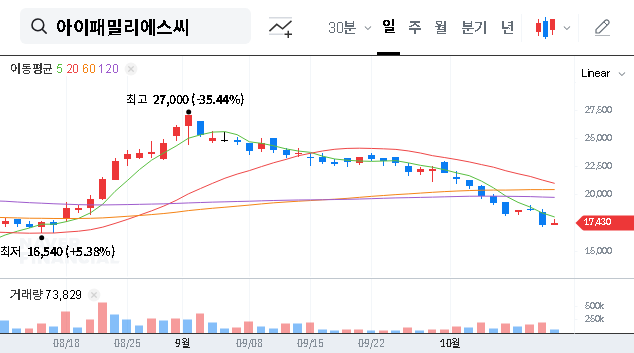
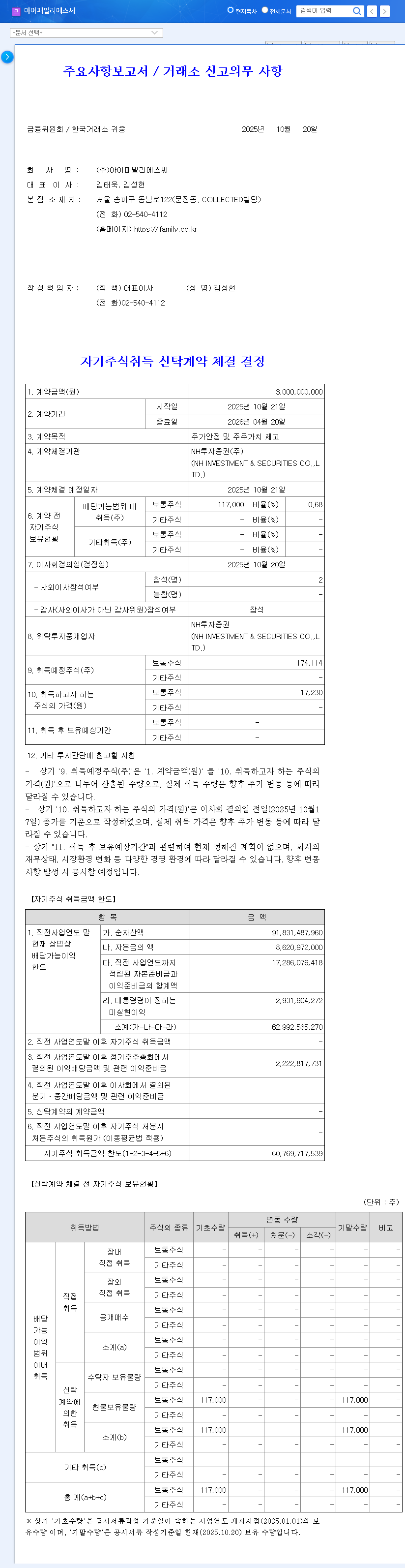
    On October 20, 2025, iFamilySC officially disclosed the execution of a 3 billion KRW self-stock acquisition trust agreement with NH Investment & Securities. This information was made public through an Official Disclosure filed with DART. The allocated amount represents approximately 1.01% of the company’s total market capitalization. The buyback program is scheduled to be implemented over a six-month period, from October 21, 2025, to April 20, 2026. This deliberate timeline is designed to methodically reduce the number of outstanding shares without causing abrupt market shocks.

    A share buyback, or repurchase, is a corporate action in which a company buys back its own outstanding shares from the open market. This reduces the number of shares available, a move that can have profound effects on the company’s financial metrics and stock valuation.

    Analyzing the Upside of the iFamilySC Share Buyback

    The primary motivations behind any share buyback are almost always centered on stock price stabilization and the enhancement of shareholder value. For iFamilySC, this strategy is expected to yield several positive outcomes:

    • Improved Supply-Demand Dynamics: By purchasing its own shares, iFamilySC reduces the total supply of stock available on the market. With demand remaining constant or increasing, this scarcity can provide strong support for the stock price, acting as a buffer during periods of market volatility.
    • Enhanced Shareholder Value via EPS Growth: A lower number of outstanding shares can lead to a higher Earnings Per Share (EPS), a key metric investors use to assess profitability. Since net income is divided by fewer shares, each remaining share represents a larger portion of the company’s earnings. For more on this, you can read about how EPS is calculated and why it matters.
    • A Powerful Signal of Confidence: This self-stock acquisition is a declaration from management that they believe their company’s stock is undervalued. It signals internal confidence in future prospects and profitability, which can significantly boost investor morale and attract new capital.

    Weighing the Potential Risks and Considerations

    While the iFamilySC share buyback is a positive development, prudent investors must also consider the potential downsides and underlying factors that could limit its effectiveness.

    The Opportunity Cost of Capital

    The 3 billion KRW allocated for this buyback is capital that cannot be used for other growth-oriented activities. Investors should question if this is the most efficient use of funds. Could this capital have generated a higher return if invested in research and development, new market expansion for its cosmetics line, or strategic acquisitions to bolster its wedding business? This is a critical consideration for long-term growth.

    A Temporary Fix or a Long-Term Solution?

    A share buyback can provide a temporary lift to the stock price, but it is not a substitute for fundamental business performance. Without genuine growth in revenue, market share, and profitability, the positive effects of the buyback may be short-lived. The true test of shareholder value creation lies in the company’s operational excellence, a topic we explored in our Analysis of iFamilySC’s Core Business Strategy.

    Market-Wide Headwinds

    In a bearish market or during periods of economic uncertainty, the impact of a share buyback can be muted. If overall investor sentiment is weak, a single corporate action may not be enough to reverse a downward trend. The success of this initiative will partially depend on the broader macroeconomic environment over the next six months.

    Investor Action Plan: Key Questions to Ask

    For those invested in iFamilySC stock, this announcement warrants a review of your investment thesis. Here are key questions to consider:

    • Does the company’s core business performance justify this capital allocation?
    • What are the company’s plans for future growth beyond this buyback?
    • Is this the beginning of a more consistent shareholder-friendly policy, such as dividends?
    • How does the company’s valuation compare to its peers after accounting for this buyback?

    The iFamilySC share buyback is a strategically positive signal. It provides a degree of downside protection and signals management’s confidence. However, long-term success will ultimately be dictated by the company’s ability to innovate and execute within its core markets. Continuous monitoring of financial reports and strategic communications is essential.

    Disclaimer: This material is for informational purposes only and does not constitute investment advice. Investment decisions should be made based on the investor’s own judgment and responsibility.

    (114840) iFamilySC Share Buyback: A Deep Dive into the ₩3B Plan for Stock Price Stabilization 관련 이미지
  • (336570) WON TECH Share Buyback: An In-Depth Analysis of the ₩6B Plan to Boost Shareholder Value

    (336570) WON TECH Share Buyback: An In-Depth Analysis of the ₩6B Plan to Boost Shareholder Value

    In a significant move for investors, leading medical aesthetics device company WON TECH CO.,Ltd. has announced a major share buyback program. This strategic decision to repurchase ₩6 billion of its own shares sends a powerful message to the market about the company’s confidence in its future and its commitment to enhancing shareholder value. But what does a stock repurchase of this scale truly mean for the company’s stock price, its financial health, and the average investor? This comprehensive analysis unpacks the details of the WON TECH share buyback, explores the underlying motives, and provides a clear action plan for investors.

    A share buyback is often seen as a direct signal from management that they believe the company’s stock is undervalued, representing a tangible investment in their own success.

    Deconstructing the WON TECH Share Buyback Announcement

    On October 20, 2025, WON TECH formalized a trust agreement with Samsung Securities to acquire ₩6 billion worth of its own treasury shares. This stock repurchase initiative is slated to run for six months, concluding on April 20, 2026. According to the company’s Official Disclosure, this amount corresponds to approximately 0.79% of WON TECH’s market capitalization at the time of the announcement. While seemingly modest, the strategic timing and intent behind this move warrant closer examination.

    The Core Objectives Behind the Stock Repurchase

    Companies don’t spend billions of Won without clear goals. WON TECH’s management has outlined three primary motivations for this significant financial maneuver:

    • Stabilizing the Stock Price: By actively buying its own shares from the open market, the company introduces a consistent source of demand. This can help absorb selling pressure, reduce volatility, and signal a price floor that management is willing to defend.
    • Boosting Shareholder Value: A buyback reduces the total number of outstanding shares. This simple act of subtraction mechanically increases key financial metrics like Earnings Per Share (EPS), which can make the stock appear more attractive and potentially lead to a higher valuation over time.
    • Incentivizing Employees: The acquired treasury shares are often earmarked for employee stock option plans or other performance-based compensation. This aligns the interests of employees with those of shareholders, motivating them to drive long-term company growth.

    A Balanced View: Potential Upsides vs. Crucial Considerations

    While the news is broadly positive, a prudent investor must weigh both the potential benefits and the inherent limitations of such a program. This balanced perspective is key to making an informed decision.

    The Bull Case: Why This is a Positive Signal

    The WON TECH share buyback can be interpreted as a strong vote of confidence from the inside. Management is essentially stating that the best use of the company’s capital right now is to invest in itself. This can build investor trust and signal a belief in future profitability that exceeds current market expectations. Furthermore, the commitment to improving EPS demonstrates a shareholder-friendly capital allocation strategy, which is often rewarded by the market in the long run.

    The Bear Case: Important Caveats to Consider

    However, it’s crucial to maintain perspective. A buyback of 0.79% of the market cap, while substantial in absolute terms, may not be large enough to create significant, sustained upward price pressure on its own. Its effectiveness can be neutralized by broader market downturns or industry-specific headwinds. Investors must also consider the opportunity cost—could that ₩6 billion have generated a higher return if invested in R&D, strategic acquisitions, or debt reduction? A thorough review of the company’s financials is necessary to assess the impact on its cash reserves and overall financial flexibility. For more on market trends, investors often consult resources like Bloomberg’s market analysis section.

    Investor Action Plan: How to Approach This News

    This announcement is a single, albeit important, data point. A wise investment strategy involves continuous monitoring and analysis. Here’s what to focus on next:

    • Monitor Corporate Filings: Pay close attention to upcoming quarterly reports. Look for details on cash flow, debt levels, and any commentary from management on the progress of the buyback.
    • Analyze Core Fundamentals: Look beyond the buyback. Is the company growing revenue? Are profit margins healthy? A stock repurchase cannot fix a flawed business model. To learn more, read our complete guide to fundamental analysis.
    • Track Treasury Share Utilization: The value enhancement is greatest if the shares are permanently retired (cancelled). If they are re-issued for acquisitions or compensation, the effect on EPS is diluted. Watch for announcements on the final disposition of these shares.

    In conclusion, the WON TECH share buyback is a positive development that demonstrates management’s commitment to creating shareholder value. However, it is not a silver bullet. Investors should view it as one part of a much larger puzzle, using it as a catalyst to perform deeper due diligence on the company’s long-term prospects.

    (336570) WON TECH Share Buyback: An In-Depth Analysis of the ₩6B Plan to Boost Shareholder Value 관련 이미지
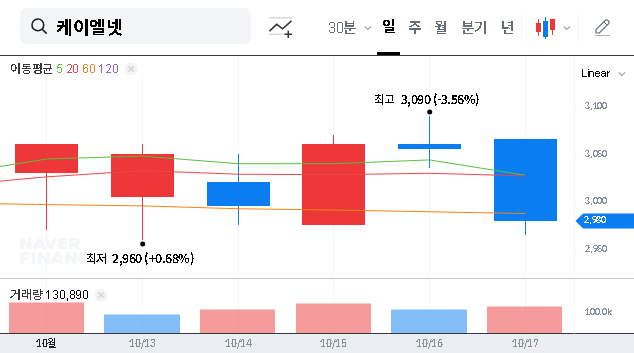
  • (039420) KL-Net Share Buyback (039420): A Deep Dive on Shareholder Value & Future Strategy

    (039420) KL-Net Share Buyback (039420): A Deep Dive on Shareholder Value & Future Strategy

    Analyzing the KL-Net Share Buyback Extension

    In a significant move for investors, KL-Net Corp. (039420), a leading player in maritime logistics IT services, has announced a one-year extension of its share buyback trust agreement. This decision, involving a substantial KRW 3 billion, is a clear signal to the market about the company’s commitment to enhancing shareholder value. But what does this corporate action truly mean for the company’s stock price and long-term health? This comprehensive analysis explores the strategic implications of the KL-Net share buyback, offering critical insights for current and potential investors.

    Understanding the mechanics and motivations behind such a decision is key to navigating the investment landscape. We will delve into the positive effects, potential considerations, and a go-forward action plan to help you make informed decisions.

    What Exactly is a Share Buyback Trust?

    Before dissecting KL-Net’s specific move, it’s crucial to understand the financial instrument at play. A share buyback, or share repurchase, is when a company buys its own outstanding shares from the open market. A share buyback trust is a specific method where the company entrusts a third-party financial institution, in this case KB Securities, to execute the buyback on its behalf over a set period. This approach provides flexibility and demonstrates a sustained commitment. The primary goal, as explained by financial experts at sites like Investopedia, is often to return value to shareholders and signal management’s confidence in the company’s future prospects.

    The Core Details of KL-Net’s Announcement

    On October 17, 2023, KL-Net Corp. formalized its decision to extend the contract, now valid until October 17, 2026. This move was officially recorded, and you can view the Official Disclosure for complete transparency. Here are the key parameters:

    • Contract Value: KRW 3 billion, which represents approximately 4.07% of the company’s market capitalization.
    • Extended Period: One additional year, from October 18, 2024, to October 17, 2026.
    • Stated Purpose: Primarily aimed at stock price stabilization and the direct enhancement of shareholder value.

    Why This Move is a Positive Signal

    A company’s decision to repurchase its own shares is multi-faceted and generally viewed positively by the market for several reasons. For KL-Net Corp., this extension serves as a powerful message.

    1. Increased Earnings Per Share (EPS): By reducing the number of shares outstanding, the company’s net income is divided among fewer shares. This mechanically increases the EPS, a key metric investors use to gauge profitability. A higher EPS can make the stock appear more attractive, potentially leading to a higher valuation.

    2. Stock Price Support: The trust agreement creates a consistent source of buying pressure in the market. When the stock price dips, the trust can step in to purchase shares, providing a floor and mitigating volatility. This stock price stabilization is a major benefit for long-term investors.

    Perhaps most importantly, a share buyback signals that the company’s management believes its own stock is undervalued. It’s a tangible demonstration of internal confidence in future business prospects and growth.

    Important Considerations and Potential Downsides

    While the KL-Net share buyback has clear benefits, astute investors must also consider the potential limitations. A buyback is a financial tool, not a substitute for fundamental business growth.

    Dependence on Core Business Performance

    A buyback can support a stock price, but it cannot create sustained growth on its own. The long-term trajectory of KL-Net’s stock will ultimately depend on its ability to innovate, win contracts, and grow revenue in the competitive maritime IT sector. Without these fundamental drivers, the buyback’s effect may be temporary. This is why it’s crucial to also read our deep dive into their recent earnings report.

    Opportunity Cost and Financial Health

    The KRW 3 billion allocated for the buyback could have been used for other purposes, such as research and development, strategic acquisitions, or paying down debt. Investors should monitor KL-Net’s financial health, particularly its cash flow generation, to ensure that this expenditure does not compromise its ability to invest in future growth opportunities.

    An Action Plan for KL-Net Corp. Investors

    Given this development, here is a strategic checklist for investors to consider:

    • Analyze Fundamentals: Look beyond the buyback. Scrutinize KL-Net’s business model, competitive advantages, and the growth outlook for the maritime logistics industry.
    • Review Financial Statements: Pay close attention to operating cash flow and the company’s debt-to-equity ratio. Ensure the buyback is being funded from a position of financial strength.
    • Monitor Market Reaction: Observe how the market digests this news over the coming months. A short-term positive reaction is common, but sustained positive momentum will depend on subsequent company performance.

    In conclusion, KL-Net Corp.’s decision to extend its share buyback trust is a decidedly pro-shareholder move that should provide confidence and price stability. However, it should be viewed as one piece of a much larger puzzle. The ultimate success for investors will be determined by the company’s ability to execute on its core business strategy and deliver fundamental growth over the long term.

    (039420) KL-Net Share Buyback (039420): A Deep Dive on Shareholder Value & Future Strategy 관련 이미지
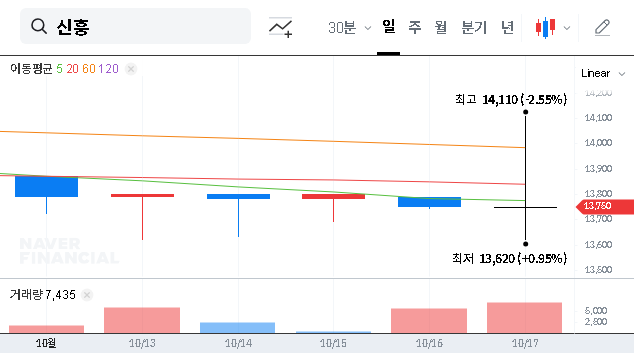
  • (004080) SHINHUNG Share Buyback: An Expert Analysis of Stock Price & Shareholder Value

    (004080) SHINHUNG Share Buyback: An Expert Analysis of Stock Price & Shareholder Value

    Investors are taking a keen interest in SHINHUNG CO.,LTD following a significant corporate action. The recent announcement of a SHINHUNG share buyback has sparked discussions about its potential effects on the company’s stock price and the overall return for investors. This comprehensive analysis will explore the mechanics of this treasury stock acquisition, dissect the potential market reactions, and provide a clear roadmap for shareholders to navigate this event. We aim to deliver actionable insights to help you make well-informed investment decisions.

    First, What is a Share Buyback?

    A share buyback, or treasury stock acquisition, is a corporate action where a company repurchases its own outstanding shares from the open market. This reduces the number of shares available, a move that can have several strategic implications. Companies often initiate buybacks when they believe their stock is undervalued or when they have excess cash and wish to return value to their shareholders without committing to a long-term dividend increase.

    By reducing the supply of shares, a buyback can increase the earnings per share (EPS) and often signal management’s confidence in the company’s future prospects, which can be a powerful catalyst for the stock price.

    SHINHUNG’s Share Buyback: The Key Details

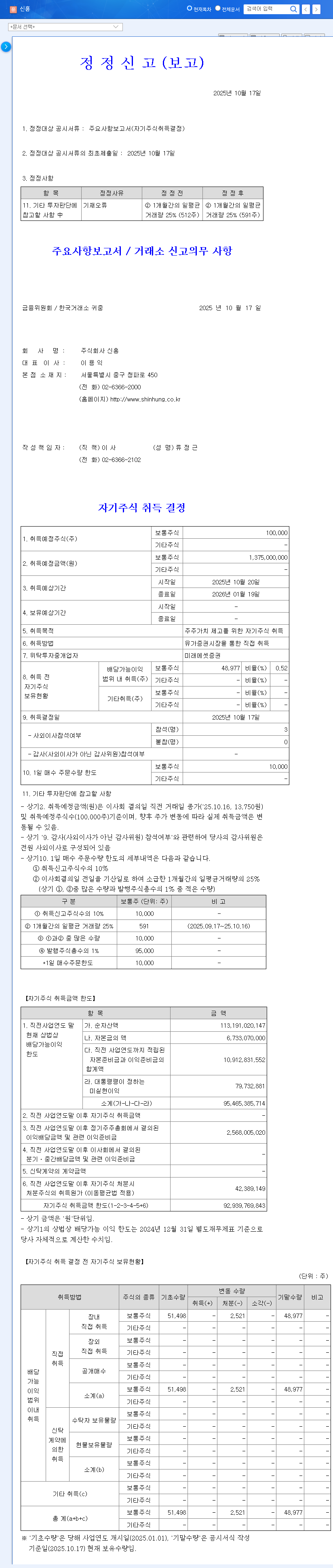
    On October 17, 2025, SHINHUNG CO.,LTD formally announced its decision to acquire its own treasury shares. The full details were released in an Official Disclosure (Source) on the DART system. Here are the core facts of the announcement:

    • Company: SHINHUNG CO.,LTD (Market Cap: KRW 131 billion)
    • Number of Shares: 100,000 common shares
    • Total Acquisition Value: KRW 1.4 billion
    • Stated Purpose: To enhance shareholder value
    • Acquisition Method: Direct purchase via the stock market
    • Ratio to Market Cap: 1.05%

    Analyzing the Impact on SHINHUNG’s Stock Price

    The decision to initiate a share buyback can influence a company’s stock and valuation in multiple ways. Let’s examine the potential scenarios for SHINHUNG.

    The Positive Case: A Boost to Shareholder Value

    The most direct benefit is the potential for an increased Earnings Per Share (EPS). With fewer shares outstanding, the company’s net income is divided by a smaller number, mathematically boosting the EPS. This is a key metric investors use for valuation, and a higher EPS is generally viewed favorably. For a detailed explanation, you can review this guide from a leading financial education site. Furthermore, the act of buying back shares creates demand in the market, which can provide support for the SHINHUNG stock price and potentially cushion it against market downturns. Finally, it sends a strong signal of confidence from management to the market, suggesting they believe the shares are currently undervalued.

    The Neutral Case: A Modest but Limited Impact

    While positive, the scale of the buyback is important. An acquisition of KRW 1.4 billion, representing 1.05% of the market cap, is significant enough to be noticed. However, it may not be large enough to trigger an immediate, dramatic surge in the stock price. The market may view this as a good first step but will likely wait for signs of further buybacks or other shareholder-friendly initiatives. The long-term impact will depend on whether this is a one-off event or part of a larger, ongoing strategy to enhance shareholder value.

    Potential Concerns and Considerations

    While unlikely to be negative, investors should consider the opportunity cost. The capital used for the SHINHUNG share buyback could have been used for other purposes, such as research and development, capital expenditures for expansion, or debt reduction. If the company is forgoing high-growth investment opportunities to repurchase stock, it could raise questions about its future growth trajectory. However, without more information on the company’s cash reserves and investment pipeline, this remains purely speculative.

    Actionable Checklist for SHINHUNG Investors

    For current and prospective investors, the announcement of a treasury stock acquisition warrants a strategic review. Here is a checklist to guide your analysis:

    • Analyze Financial Health: Dig into the company’s balance sheet. Does SHINHUNG have ample cash reserves to fund this buyback without straining its operational finances? You can learn more about how to evaluate corporate financial statements here.
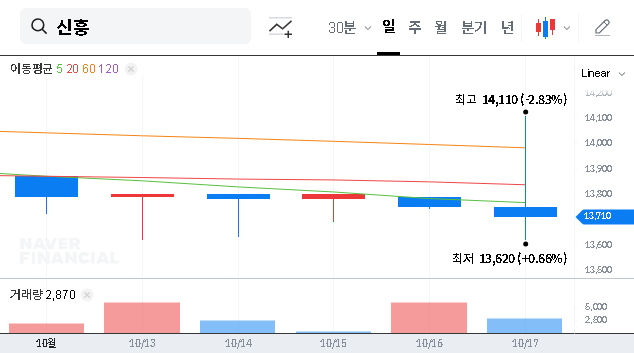
    • Monitor Market Reaction: Keep a close eye on the SHINHUNG stock price and trading volume in the days and weeks following the buyback period. Is the market reacting positively, or is the event being met with indifference?
    • Look for Future Signals: Pay attention to subsequent corporate communications. Does management hint at additional buybacks or other measures to increase shareholder value? This initial buyback could be the start of a larger trend.
    • Review Analyst Reports: Check for updated reports from financial analysts. Their revised price targets and ratings can provide insight into how the professional investment community views this development.

    Frequently Asked Questions

    Q: What is the primary purpose of SHINHUNG CO.,LTD’s share buyback?

    A: The company has officially stated the purpose is to ‘enhance shareholder value.’ This is a clear signal of intent to increase per-share value by reducing the total number of outstanding shares and boosting investor confidence.

    Q: Is the scale of this buyback large enough to impact the stock price?

    A: At 1.05% of the market cap, the buyback is substantial enough to provide price support and create positive sentiment. While it may not cause a dramatic, immediate price surge, it is a fundamentally positive action that supports long-term shareholder value.

    Disclaimer: This analysis is based on publicly available information and is intended for informational purposes only. It should not be construed as investment advice. All investment decisions are the sole responsibility of the individual investor.

    (004080) SHINHUNG Share Buyback: An Expert Analysis of Stock Price & Shareholder Value 관련 이미지
  • (004080) SHINHUNG Treasury Stock Acquisition (004080): An In-Depth Analysis for Investors

    (004080) SHINHUNG Treasury Stock Acquisition (004080): An In-Depth Analysis for Investors

    The recent announcement of the SHINHUNG treasury stock acquisition has sent ripples through the investment community, focusing significant attention on the specialized medical device company, SHINHUNG CO.,LTD (004080). A stock buyback is a powerful corporate action, often interpreted as a bullish signal from management. But for discerning investors, it’s crucial to look beyond the headlines. Is this a genuine move to enhance shareholder value based on deep confidence, or is it a short-term financial tactic? This comprehensive analysis will dissect the details, explore the potential upside, weigh the inherent risks, and provide actionable insights to guide your investment decisions regarding SHINHUNG’s future.

    Unpacking the SHINHUNG Stock Buyback Announcement

    First, let’s establish the facts. A company’s decision to repurchase its own shares from the open market is a significant financial event. Here are the core details of SHINHUNG’s plan, as outlined in their public filing.

    Key Details of the Acquisition

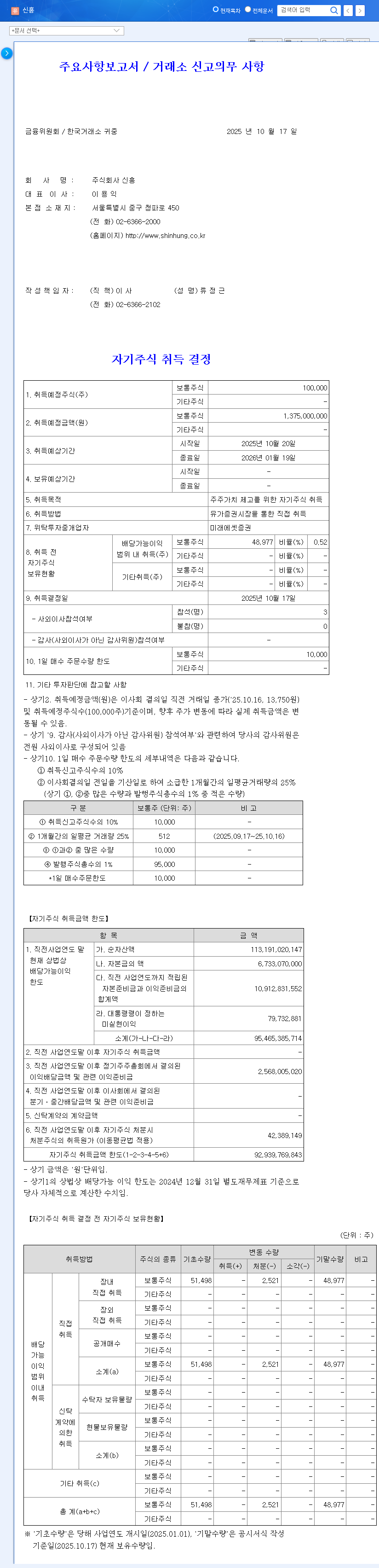
    • Decision Date: October 17, 2025
    • Primary Purpose: Enhancement of shareholder value and stock price stabilization.
    • Number of Shares: 100,000 common shares.
    • Estimated Value: Approximately KRW 1.4 billion (representing about 1.05% of the current market capitalization).
    • Acquisition Method: Direct purchase on the KOSPI market.
    • Brokerage Partner: Mirae Asset Securities.

    By removing these shares from circulation, SHINHUNG effectively reduces the total number of outstanding shares. This simple act of supply reduction has several important implications for the company’s financial metrics and stock valuation. This decision was formally filed, and interested parties can review the Official Disclosure for complete details.

    The Bull Case: Why This Is a Positive Signal

    From an investor’s perspective, a SHINHUNG stock buyback can be interpreted in several positive ways, suggesting underlying strength and a commitment to its shareholders.

    1. Direct Boost to Shareholder Value Metrics

    With fewer shares outstanding, the company’s net income is divided among a smaller pool of equity. This automatically increases key performance indicators like Earnings Per Share (EPS). A higher EPS can make the stock appear more attractive on a valuation basis and can lead to a higher dividend per share, directly increasing returns to shareholders.

    2. A Strong Signal of Management Confidence

    When a company’s leadership team, who has the most intimate knowledge of its operations and future prospects, decides to buy its own stock, it sends a powerful message. It implies they believe the current stock price is undervalued and that they expect future growth that the market has not yet priced in. This act of ‘putting your money where your mouth is’ can significantly boost investor confidence.

    A well-executed treasury stock acquisition can create a positive feedback loop: the buyback boosts per-share metrics, which signals confidence, attracting new investors and potentially driving the stock price higher.

    The Bear Case: A Prudent Investor’s Checklist of Risks

    However, a thorough 004080 stock analysis demands a balanced view. While the upside is clear, there are potential risks and alternative interpretations that should be carefully considered before making an investment decision.

    1. The Opportunity Cost of Capital

    The KRW 1.4 billion allocated for this buyback is a significant sum. Investors must ask: could this capital have generated a higher return if used elsewhere? For instance, it could have funded R&D for new medical devices, been used for a strategic acquisition to expand market share, or been applied to paying down debt to strengthen the balance sheet. A buyback’s return is only superior if the stock price appreciates significantly.

    2. Masking Weaker Fundamentals?

    In some cases, companies use stock buybacks as a form of financial engineering to artificially inflate EPS when organic earnings growth is slowing. It is critical for investors to analyze if SHINHUNG’s core business is healthy and growing, or if the buyback is a tactic to distract from underlying operational challenges. A rising EPS from buybacks is less valuable than one driven by increased sales and profitability.

    Conclusion: A Calculated Move That Requires Monitoring

    The SHINHUNG treasury stock acquisition is a clear and positive step towards enhancing shareholder value. On balance, it is a favorable development that is likely to provide support for the stock price in the near term. However, the long-term impact on corporate value hinges on whether this is the most efficient use of capital and if the company’s fundamental growth story remains intact. Prudent investors should view this as one important piece of a much larger puzzle. Continuous monitoring of financial performance, market reaction, and management’s future capital allocation decisions is essential. For a deeper look into the sector, you may find value in our complete guide to analyzing medical device stocks.

    (004080) SHINHUNG Treasury Stock Acquisition (004080): An In-Depth Analysis for Investors 관련 이미지
  • (134380) MIWON CHEMICALS Share Buyback: An Expert Analysis for Investors

    (134380) MIWON CHEMICALS Share Buyback: An Expert Analysis for Investors

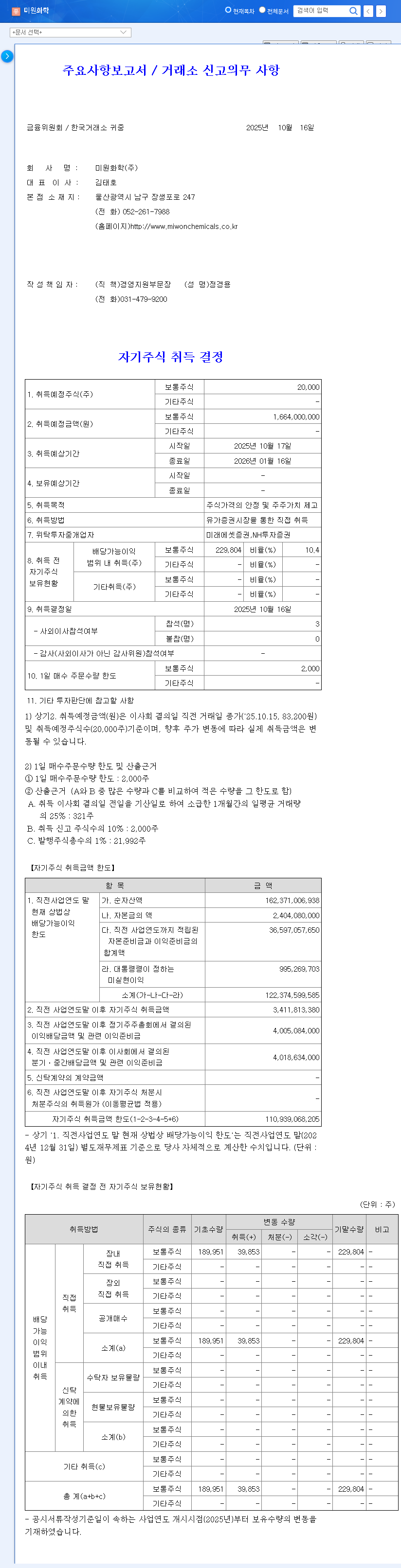
    In the dynamic world of corporate finance, a MIWON CHEMICALS share buyback has captured significant investor attention. On October 16, 2025, the company announced a strategic plan to repurchase its own shares, a move often interpreted as a strong vote of confidence in its own future. This decision to acquire shares worth approximately 1.7 billion Korean Won is intended to bolster stock price stability and enhance overall shareholder value. But what does this corporate maneuver truly mean for the company’s stock trajectory and for you, the investor? This comprehensive analysis will unpack the details, implications, and crucial considerations surrounding this pivotal financial event.

    A share buyback, or stock repurchase, is a clear signal from a company’s management that they believe their stock is undervalued, representing a strategic investment in their own enterprise.

    The Details of the MIWON CHEMICALS Share Buyback

    According to the official disclosure filed with Korea’s Financial Supervisory Service, MIWON CHEMICALS CO., LTD. has committed to a direct acquisition of 20,000 of its own common shares from the KOSPI market. The total value of this transaction is approximately 1.7 billion KRW (roughly $1.25 million USD), which constitutes about 0.91% of the company’s market capitalization at the time of the announcement. The stated purpose, as per the filing, is twofold: achieving stock price stabilization and delivering enhanced shareholder value. You can view the complete filing here: Official Disclosure (DART Source).

    Why a Stock Repurchase Sends Positive Market Signals

    A company’s decision to buy back its own shares is rarely a trivial one. It is a calculated move that sends several powerful messages to the market and its stakeholders. Understanding these signals is key to interpreting the potential impact of the MIWON CHEMICALS share buyback.

    Boosting Key Financial Metrics

    By reducing the number of shares outstanding on the open market, a buyback can automatically increase the company’s Earnings Per Share (EPS). A higher EPS is often viewed favorably by analysts and can make the stock appear more attractive to new investors. This mechanical boost is a direct and immediate benefit of a stock repurchase program.

    A Statement of Confidence

    Perhaps the most significant signal is one of confidence. Management is essentially stating that they believe the company’s shares are currently undervalued by the market. By investing company capital into its own stock, they are betting on its future growth and profitability. This can inspire trust and confidence among existing shareholders and attract value-oriented investors.

    Demonstrating Financial Strength

    A share buyback requires significant cash reserves. The ability to execute such a program without compromising operational needs or future growth investments suggests that MIWON CHEMICALS possesses a robust balance sheet and healthy cash flow. It’s a public demonstration of financial stability and prudent capital management.

    Limitations and Broader Context

    While the MIWON CHEMICALS share buyback is a positive development, investors must maintain a balanced perspective. The scale of the buyback, at 0.91% of market cap, is relatively modest. While it can provide a supportive floor for the stock price and help absorb selling pressure, it is unlikely to trigger a dramatic, immediate surge in value on its own. A gradual stabilizing effect is a more realistic expectation. Furthermore, the company’s stock price will still be heavily influenced by broader market trends, industry-specific challenges, and macroeconomic factors. A buyback is a tool for support, not a shield against all market volatility.

    An Investor’s Due Diligence Checklist

    For those considering a long-term investment, the share buyback announcement should be the start, not the end, of your research. Use this event as a catalyst to dig deeper into the company’s fundamentals. For more on this, consider our guide on How to Read a Company’s Annual Report. Here are key areas to investigate:

    • Financial Health Deep Dive: Scrutinize the company’s cash flow statements. Is this buyback being funded by surplus operational cash, or is the company taking on debt? Ensure it doesn’t compromise capital for crucial R&D or expansion projects.
    • Historical Precedent: Has MIWON CHEMICALS conducted share buybacks in the past? If so, analyze the stock’s performance in the months following those announcements. Was it an effective strategy?
    • Competitive Landscape: How does this move compare to the actions of competitors in the chemical industry? Are others also returning capital to shareholders, or are they aggressively reinvesting in growth? This provides valuable context.
    • Future Intentions: Will the repurchased shares be retired permanently (reducing the share count) or held as ‘treasury stock’ for potential future use, such as in employee compensation or acquisitions? This distinction matters for long-term dilution.

    In conclusion, the MIWON CHEMICALS share buyback is a constructive and shareholder-friendly action. It underscores management’s confidence and provides a degree of support for the stock price. However, savvy investors will view it as one piece of a much larger puzzle, using it as a cue to conduct thorough due diligence on the company’s overall financial health and strategic direction.

    (134380) MIWON CHEMICALS Share Buyback: An Expert Analysis for Investors 관련 이미지