Tag: Semiconductor

  • Seojin System Announces ₩10 Billion Stock Buyback: A Sign of Recovery?


    Seojin System Announces ₩10 Billion Stock Buyback: A Sign of Recovery? 대표 차트 이미지


    1. Seojin System’s Stock Buyback: What’s Happening?

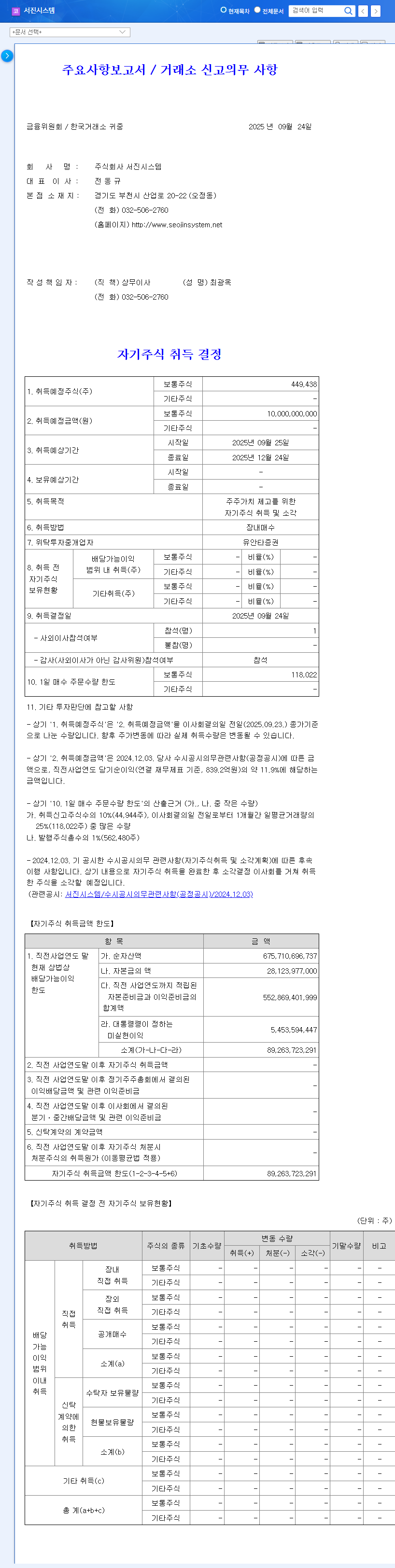
    Seojin System announced on September 24th its decision to repurchase and retire ₩10 billion worth of its own shares. A total of 449,438 shares will be acquired through on-market purchases facilitated by Yuanta Securities.

    2. Why the Buyback?

    The official objective is to ‘enhance shareholder value’. By reducing the number of outstanding shares through repurchasing and retiring stock, Seojin System aims to increase earnings per share (EPS) and book value per share (BPS), potentially leading to a rise in stock price. It also sends a positive signal to investors amidst difficult market conditions and demonstrates a commitment to defending the stock price.

    3. Potential Impact of the Buyback

    • Positive Impacts: Potential stock price boost, enhanced shareholder value, improved investor sentiment.
    • Negative Impacts: Increased financial burden due to the ₩10 billion expenditure, difficulty in securing long-term stock price growth without fundamental business improvements.

    The key lies in ‘fundamental business improvement’. Seojin System currently faces challenges such as declining sales, net losses, and increasing debt ratios. While the buyback may offer a short-term boost to the stock price, long-term growth necessitates fundamental management improvements, including the recovery of the ESS business and successful development of new businesses.

    4. What Should Investors Do?

    While the stock buyback can be a short-term positive factor, investors should remember that ‘all investment decisions and their consequences are the investor’s responsibility’. Instead of being swayed by short-term stock price fluctuations, it’s crucial to make informed investment decisions based on a comprehensive consideration of Seojin System’s mid-to-long-term business outlook, financial status, and market conditions.


    FAQ

    What are Seojin System’s main businesses?

    They manufacture ESS equipment, semiconductor equipment, communication equipment, and electric vehicle components. They are also exploring the container box business.

    When will the repurchased shares be retired?

    The exact retirement schedule has not yet been announced. Investors should check the retirement schedule and plan.

    What is Seojin System’s current financial status?

    Based on the 2025 semi-annual report, they are facing challenges such as declining sales, net loss, and increasing debt ratio. However, they are striving to improve their financial structure and secure future growth engines through active fundraising and new business development.
    Seojin System Announces ₩10 Billion Stock Buyback: A Sign of Recovery? 관련 이미지


  • Costecs Signs ₩2 Billion Deal with NXP: Stock Forecast and Investment Analysis


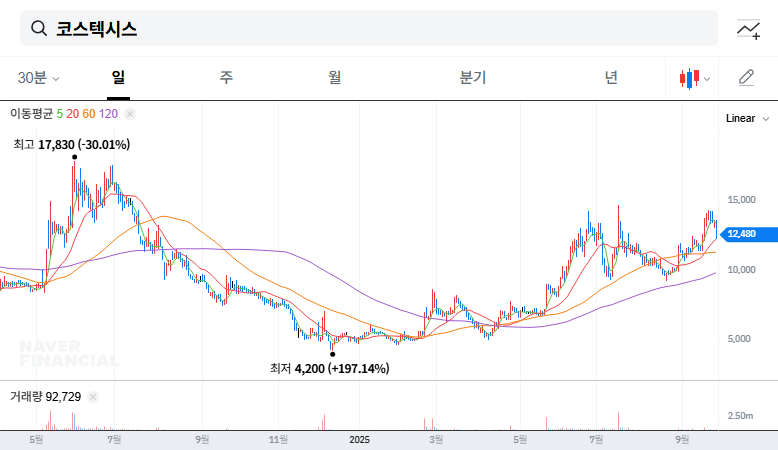
    Costecs Signs ₩2 Billion Deal with NXP: Stock Forecast and Investment Analysis 대표 차트 이미지


    Costecs and NXP’s ₩2 Billion Deal: What’s it all about?

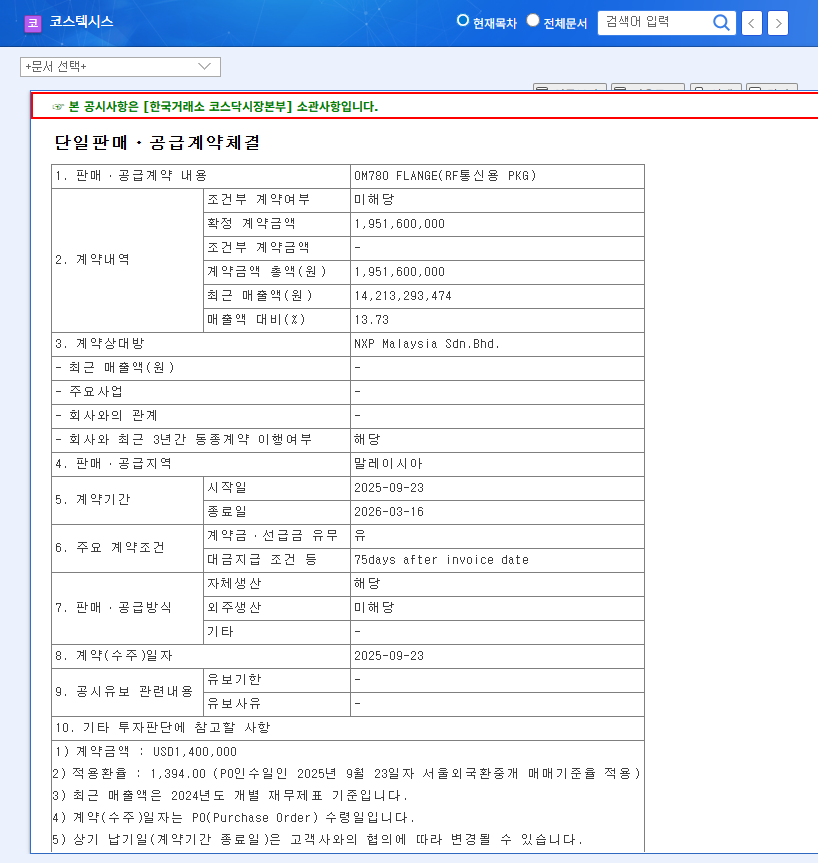
    Costecs has signed a contract to supply OM780 FLANGE, an RF communication package, to NXP in Malaysia. The contract is valued at ₩2 billion and runs from September 23, 2025, to March 16, 2026.

    What does this deal mean for Costecs?

    • Revenue Growth and Profitability Improvement: The ₩2 billion contract is expected to directly impact revenue in the second half of 2025. This could also contribute to reducing fixed cost burdens and improving profitability.
    • Global Market Expansion: The agreement with a global player like NXP raises Costecs’ profile and increases the potential for future business opportunities.
    • Strengthened Business Portfolio: Expanding into the RF communication sector helps diversify Costecs’ business.

    What should investors consider?

    Despite the positive outlook, investors should consider several risk factors.

    • Exchange Rate Fluctuations: Costecs, with its high proportion of exports, is sensitive to exchange rate movements.
    • Raw Material Price Volatility: Fluctuations in raw material prices can lead to increased cost burdens.
    • Macroeconomic Environment: A global economic slowdown could affect the semiconductor industry as a whole.
    • Intensifying Competition: The increasingly competitive semiconductor packaging market demands continuous technological development.

    Action Plan for Investment Decisions

    While this contract is expected to positively impact Costecs, investors should carefully consider the risk factors mentioned above. It is crucial to continuously monitor Costecs’ earnings announcements and any further business contracts for informed investment decisions.


    FAQ

    What is the size of this contract?

    ₩2 billion, which represents 13.73% of Costecs’ projected 2025 revenue.

    Who is the counterparty to this contract?

    NXP Malaysia Sdn.Bhd., a global semiconductor company.

    What are the key considerations for investors?

    Investors should consider factors such as exchange rate fluctuations, raw material price volatility, the macroeconomic environment, and intensifying competition.


    Costecs Signs ₩2 Billion Deal with NXP: Stock Forecast and Investment Analysis 관련 이미지


  • SAMCNS Designated as Overheated Stock: Investment Strategies?


    What’s Happening with SAMCNS?

    On September 23, 2025, SAMCNS was designated as an overheated stock by the Korea Exchange. This indicates that the stock price has experienced rapid increases over the past three trading days, showing signs of speculative overheating. As a result, SAMCNS will be traded under a single-price trading method for three days, a measure designed to limit price volatility and encourage cautious investment.

    Why the Overheating?

    The surge in SAMCNS’s stock price is attributed to the combined effect of positive expectations for growth in the HBM (High Bandwidth Memory) market and the company’s strong performance in the first half of 2025. With a high proportion of ceramic STF for NAND probe cards and improved profitability efforts, SAMCNS recorded sales of KRW 34.5 billion (YoY +41.1%) and operating profit of KRW 4.9 billion (YoY +34.0%) in Q2 2025. The development and expansion of ceramic substrates for HBM are particularly anticipated as key growth drivers for the company.

    Implications of the Overheated Stock Designation

    • Increased Short-Term Volatility: The designation serves as a warning signal, potentially leading to investor anxiety and profit-taking, thus increasing price volatility.
    • Reduced Trading Volume and Volatility: The single-price trading method restricts trading volume and price fluctuations, potentially hindering price discovery in the short term.
    • Limited Impact on Fundamentals: The designation itself does not necessarily undermine the company’s intrinsic value.

    Investor Action Plan

    • Short-Term Investors: Proceed with caution, considering the potential for profit-taking and increased selling pressure.
    • Long-Term Investors: Continuously monitor the company’s fundamentals and competitiveness in the HBM market, potentially using price fluctuations as opportunities for staggered purchases.


    FAQ

    What does it mean to be designated as an overheated stock?

    It’s a regulatory measure to curb speculative trading in stocks that have experienced excessive price increases in a short period. Designated stocks are traded under a single-price trading method for a specific duration.

    What is single-price trading?

    It’s a trading method where orders are collected and executed at a single price at a designated time. It limits price fluctuations, mitigating sharp rises and falls.

    What is the outlook for SAMCNS?

    While SAMCNS has a strong growth driver in the expanding HBM market, short-term price volatility may increase. Long-term investors should monitor the company’s performance in the HBM market and its technological competitiveness.


  • Surplus Global Announces Treasury Stock Disposal: Impact on Stock Price and Investment Strategy

    Surplus Global Announces Treasury Stock Disposal: Impact on Stock Price and Investment Strategy 대표 차트 이미지

    1. What Happened? : Decoding the Treasury Stock Disposal

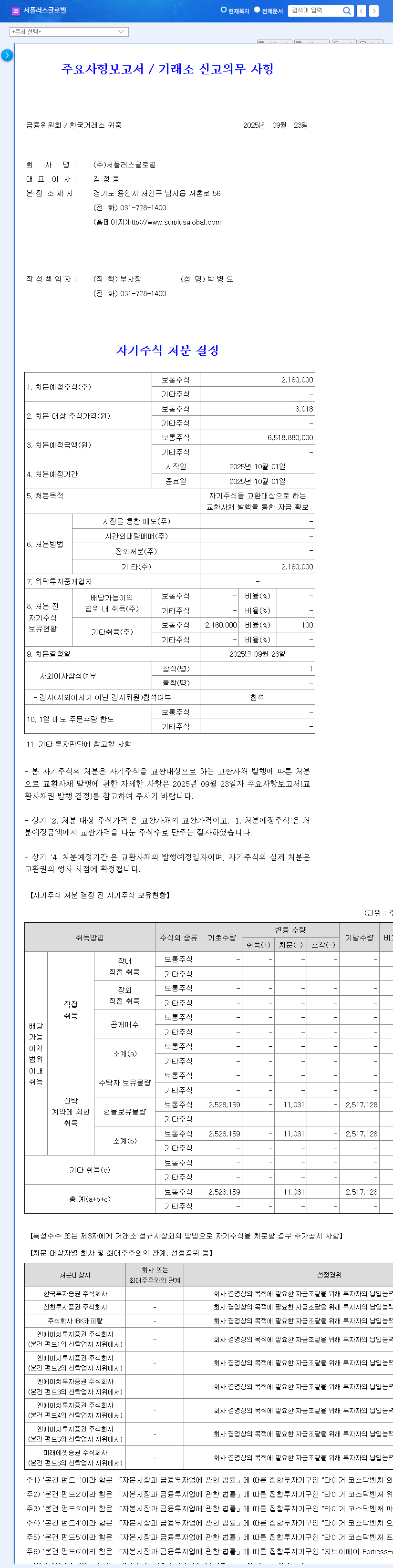
    On September 23, 2025, Surplus Global announced its decision to dispose of 2,160,000 common shares, representing 5.84% of its total outstanding shares. This equates to approximately 6.5 billion won and aims to secure funds for issuing exchangeable bonds (EB).

    2. Why This Decision? : Uncovering the Background and Implications

    Surplus Global is currently facing financial challenges, including declining sales, operating losses, and weakened cash flow. In this context, the decision to raise capital through treasury stock disposal is interpreted as a necessary step to secure short-term liquidity and fund new business ventures. The company appears to be prioritizing investment in new growth engines such as the used semiconductor equipment parts business and the establishment of a global marketplace.

    3. So, What About the Stock Price? : Market Impact Analysis

    • Positive Aspects: Securing short-term liquidity and the potential for growth momentum through new business investments.
    • Negative Aspects: Potential stock dilution from EB issuance and the possibility of continued struggles in existing businesses.

    Ultimately, this treasury stock disposal could have both positive and negative short-term impacts on the stock price. The key lies in how effectively the raised funds are utilized. Successful new business ventures and financial restructuring could act as catalysts for stock price appreciation. Conversely, failure to achieve these goals could exacerbate downward pressure on the stock.

    4. What Should Investors Do? : Investment Strategy Recommendations

    Investors should closely monitor the following:

    • Terms and outcome of the EB issuance
    • Specific use and execution of the raised funds
    • Performance of new businesses and recovery of existing businesses
    • Overall market conditions and macroeconomic indicator changes

    It’s crucial to focus on the company’s long-term growth potential rather than short-term stock price volatility when making investment decisions. Investment strategies should be formulated based on careful analysis and prudent judgment.

    Frequently Asked Questions

    What is treasury stock disposal?

    Treasury stock disposal refers to a company selling its own repurchased shares back into the market. This can be done to increase the value of remaining shares by reducing the number outstanding or to raise capital.

    What are exchangeable bonds (EB)?

    Exchangeable bonds are bonds that give the holder the right to exchange them for shares of a company other than the issuer, or for another asset. Investors receive interest payments until maturity and have the option to exchange the bonds for stock, potentially profiting from price appreciation.

    What is the outlook for Surplus Global’s stock price?

    Raising capital through treasury stock disposal can have both positive and negative effects on the stock price in the short term. The success of new business ventures and financial restructuring will be key factors in determining the stock’s direction. Investors should closely monitor the company’s future business strategy and performance.

    Surplus Global Announces Treasury Stock Disposal: Impact on Stock Price and Investment Strategy 관련 이미지
    Surplus Global Announces Treasury Stock Disposal: Impact on Stock Price and Investment Strategy 관련 이미지
  • Surplus Global Issues ₩6.5B Convertible Bonds: A Strategic Move or a Desperate Gamble?


    Surplus Global Issues ₩6.5B Convertible Bonds: A Strategic Move or a Desperate Gamble? 대표 차트 이미지


    1. What Happened at Surplus Global?

    On September 23, 2025, Surplus Global announced the issuance of ₩6.5 billion in convertible bonds. The conversion price is set at ₩3,018, approximately 18.4% higher than the current stock price. Key investors include Korea Investment & Securities, Shinhan Investment Corp., and IBK Capital.

    2. Why Issue Convertible Bonds?

    Surplus Global’s performance in the first half of 2025 was weak. Sales decreased by 58.8% year-on-year, and both operating income and net income turned to losses. The high debt ratio and increasing inventory levels raise concerns about financial soundness. In this situation, issuing convertible bonds appears to be an inevitable choice to secure short-term working capital and raise funds for new business investments.

    3. Convertible Bonds: Opportunity or Risk?

    • Positive Aspects:
      • Securing short-term liquidity.
      • Potential for securing growth engines through investment in new businesses.
    • Negative Aspects:
      • Increased financial burden due to a higher debt ratio.
      • Pressure on stock price due to the high conversion price compared to the current market price.
      • Risk of future interest rate hikes and exchange rate fluctuations.

    4. What Should Investors Do?

    While the issuance of convertible bonds can provide a short-term cash injection, long-term growth cannot be guaranteed without fundamental improvements in business competitiveness. Investors should carefully monitor the following:

    • Conversion of convertible bonds.
    • Performance of new businesses (used semiconductor equipment cluster, global open market).
    • Recovery trend of the semiconductor market.
    • Future profitability improvement.

    Currently, it is advisable to maintain a cautious wait-and-see approach and take a conservative perspective, considering the additional financial burden and the high conversion price.


    FAQ

    What are convertible bonds?

    Convertible bonds are bonds that give the holder the right to convert them into shares of the issuing company’s stock. Investors can hold the bonds to maturity and receive principal and interest, or they can convert them into stock within a specified period.

    How will this convertible bond issuance affect Surplus Global’s stock price?

    In the short term, it could be positive due to increased liquidity. However, in the long term, there is the possibility of stock dilution due to bond conversion. The company’s earnings improvement will likely have a greater impact on the stock price.

    What should investors be aware of?

    It’s important to consider the company’s financial restructuring efforts, the performance of new businesses, and the overall semiconductor market conditions when making investment decisions.


    Surplus Global Issues ₩6.5B Convertible Bonds: A Strategic Move or a Desperate Gamble? 관련 이미지
    Surplus Global Issues ₩6.5B Convertible Bonds: A Strategic Move or a Desperate Gamble? 관련 이미지


  • Surplus Global Issues ₩8.3B Convertible Bonds: Dilution Risk or Growth Catalyst?


    Surplus Global Issues ₩8.3B Convertible Bonds: Dilution Risk or Growth Catalyst? 대표 차트 이미지


    1. Surplus Global’s ₩8.3B CB Issuance: What Happened?

    On September 23, 2025, Surplus Global announced the issuance of ₩8.3 billion worth of convertible bonds (CBs). The conversion price is set at ₩2,602, with payment due on October 1st. This CB issuance will be conducted privately, with the primary investors being KOSDAQ venture-related private equity trusts.

    2. Why Issue CBs?: Background and Objectives

    Surplus Global recorded an operating loss of ₩18.3 billion in the first half of 2025, marking a shift into the red. This is a direct result of the semiconductor downturn. The CB issuance is analyzed as a move to secure operating funds and investment resources for new businesses. In particular, investments to secure new growth engines, such as the launch of the ‘Semimarket’ online platform and the Parts business, are urgent.

    3. Impact on Investors: Opportunity vs. Risk

    • Positive Aspects:
      • Improving financial structure and expanding investment in new businesses through secured funding
    • Negative Aspects:
      • Potential stock dilution due to conversion of bonds
      • Increase in short-term financial burden

    4. Investment Strategy: How Should Investors Respond?

    Investors should be wary of increased stock volatility in the short term. In the medium to long term, the success of new businesses and the recovery of the semiconductor industry will determine the stock’s direction. Before making investment decisions, a thorough review of the specific use plan for the CB funds and the growth roadmap for new businesses is essential.


    FAQ

    What are Convertible Bonds (CBs)?

    Convertible Bonds (CBs) are issued as debt but give the holder the option to convert them into shares of the issuing company’s stock after a certain period.

    How will Surplus Global’s CB issuance affect its stock price?

    In the short term, there are concerns about stock dilution due to potential conversion. However, in the long term, business expansion through funding could drive stock price increases.

    What is the outlook for Surplus Global?

    The recovery of the semiconductor market and the success of new businesses are expected to significantly impact Surplus Global’s future performance and stock price.


    Surplus Global Issues ₩8.3B Convertible Bonds: Dilution Risk or Growth Catalyst? 관련 이미지
    Surplus Global Issues ₩8.3B Convertible Bonds: Dilution Risk or Growth Catalyst? 관련 이미지


  • Sanga Frontech’s Exchangeable Bond Issuance: Opportunity or Risk? Investment Strategy Analysis

    Sanga Frontech's Exchangeable Bond Issuance: Opportunity or Risk? Investment Strategy Analysis 대표 차트 이미지

    1. Sanga Frontech’s Exchangeable Bond Issuance: What’s Happening?

    Sanga Frontech is issuing 8.2 billion KRW in exchangeable bonds through a private placement. The conversion price is 20,681 KRW, with a 0% coupon rate. The conversion period begins on November 1, 2025, and ends on September 1, 2030.

    2. Why Issue Exchangeable Bonds?

    Sanga Frontech has recently experienced declining sales and profitability. This bond issuance is likely aimed at securing operating funds, improving financial structure, and financing investments in new businesses. The low 0% interest rate will minimize the cost of borrowing.

    3. What’s the Impact on Investors?

    • Positive Impacts:
      • Low-cost financing
      • Potential for conversion profits if share price rises
      • Increased growth potential through new business investments
    • Negative Impacts:
      • Potential stock dilution upon conversion
      • Increased short-term share price volatility

    4. What Should Investors Do?

    Investors should consider a long-term perspective rather than focusing on short-term price fluctuations. It’s crucial to monitor whether the funding leads to actual business performance improvements, particularly the recovery of profitability in the components business and the performance of new ventures. An investment strategy considering the difference between the conversion price and the current share price, and the potential for conversion upon share price appreciation, is recommended.

    What are exchangeable bonds?

    Exchangeable bonds are bonds that grant the holder the right to exchange them for shares of the issuing company’s stock. Investors can either hold the bond to maturity and receive interest payments or exchange it for shares within a specified period to potentially profit from price appreciation.

    How will this bond issuance affect the stock price?

    Short-term stock price volatility may increase. The positive aspect is the improvement of the financial structure and securing growth momentum through low-cost financing. The negative aspect is the potential for stock dilution upon conversion to shares.

    What are the key considerations for investment?

    It is important to analyze the company’s fundamentals and growth potential from a long-term perspective, rather than reacting to short-term price fluctuations. It is particularly crucial to closely monitor whether the funding will lead to actual business performance improvements.

    Sanga Frontech's Exchangeable Bond Issuance: Opportunity or Risk? Investment Strategy Analysis 관련 이미지
  • Wonik Materials: VIP Asset Management Acquires 5% Stake – Opportunity or Not?

    Wonik Materials: VIP Asset Management Acquires 5% Stake - Opportunity or Not? 대표 차트 이미지

    1. What Happened?

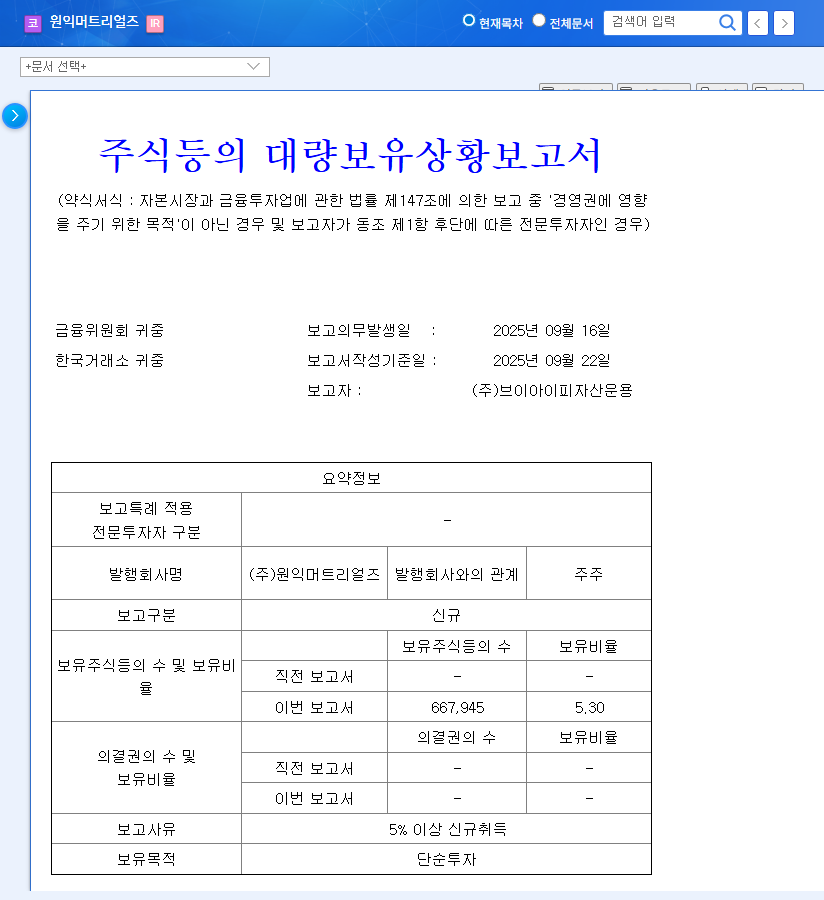
    On September 23, 2025, VIP Asset Management acquired a 5.30% stake in Wonik Materials, triggering a disclosure obligation. Wonik Materials, with a market capitalization of KRW 401.6 billion, supplies specialty gases to the semiconductor and display industries.

    2. Why Did VIP Asset Management Invest? (Opportunities)

    Wonik Materials maintains a stable debt ratio and capital structure. Its accumulated technology and continuous R&D investment in specialty gases are considered future growth drivers. Long-term partnerships with major clients and efforts to develop next-generation materials are also positive factors. VIP Asset Management likely recognized this growth potential.

    3. What are the Risks? (Threats)

    Wonik Materials is experiencing declining sales due to the poor performance of its major customers, and improving profitability is urgent. Exchange rate volatility and investment property-related spending can also be short-term burdens. Furthermore, as VIP Asset Management’s investment objective is ‘simple investment,’ the possibility of enhancing corporate value through management participation is low.

    4. What is the Macroeconomic Environment?

    • Interest Rate and Bond Market: Rising interest rates can increase corporate borrowing costs, but considering Wonik Materials’ financial status, the impact is expected to be minimal.
    • Exchange Rate Fluctuations: Exchange rate fluctuations can affect foreign currency assets and liabilities, but the impact is expected to be limited due to the company’s exchange rate risk management policies.
    • Raw Materials and Transportation: Although international oil price volatility exists, stable raw material supply and transportation costs are positive factors.

    5. What Should Investors Do? (Action Plan)

    This investment by VIP Asset Management can positively impact stock prices in the short term, but caution is needed from a mid- to long-term investment perspective. It is crucial to make investment decisions by closely monitoring Wonik Materials’ earnings improvement and market conditions. Investors should pay attention to further moves by institutional investors and the company’s earnings announcements. The current investment opinion is ‘Neutral (HOLD).’

    What does VIP Asset Management’s investment mean for Wonik Materials?

    This investment can be interpreted as a sign that institutional investors view Wonik Materials’ growth potential positively. It can attract market attention and provide short-term stock price momentum.

    What are the main risk factors for Wonik Materials?

    Wonik Materials currently faces challenges such as continuous sales decline and the need to improve profitability. Exchange rate volatility and investment property-related spending are also risk factors.

    What should investors pay attention to?

    Investors should pay attention to Wonik Materials’ future earnings announcements, semiconductor and display market conditions, and further moves by institutional investors.

    Wonik Materials: VIP Asset Management Acquires 5% Stake - Opportunity or Not? 관련 이미지
    Wonik Materials: VIP Asset Management Acquires 5% Stake - Opportunity or Not? 관련 이미지
  • Pharmcell Secures $39M Contract with Doosan: Taking Off in the AI Era?

    Pharmcell Secures $39M Contract with Doosan: Taking Off in the AI Era? 대표 차트 이미지

    1. Pharmcell and Doosan’s $39M Deal: What Happened?

    Pharmcell inked a contract with Doosan Electronics BG to supply electronic materials worth $39 million. The contract period runs from September 23, 2025, to December 31, 2025, representing 6.01% of Pharmcell’s 2024 revenue.

    2. Why is This Contract Significant?

    This contract directly relates to Pharmcell’s bio-chemical business, specifically the supply of electronic materials. This aligns with the rapid growth of the IT and semiconductor industries, particularly the market for low dielectric constant materials for AI accelerators, highlighting Pharmcell’s future growth engine. The contract with a major corporation like Doosan validates Pharmcell’s technology and market competitiveness, increasing the likelihood of future orders.

    3. Pharmcell’s Future After the Contract?

    This contract is expected to positively impact Pharmcell’s performance in 2025. While a short-term agreement, it can lead to increased sales, customer diversification, and enhanced credibility. However, the short three-month contract period and the ongoing deficit in the bio-medical business division are factors to consider.

    4. What Should Investors Do?

    This contract could positively influence Pharmcell’s stock price in the short term. However, caution is advised. Investment decisions should be made considering the limitations of the short-term contract, the potential for continued losses in the bio-medical business, and macroeconomic volatility. A long-term investment perspective should consider the company’s sustainable growth potential and the potential value of its bio-medical business.

    What is the contract value between Pharmcell and Doosan?

    $39 million.

    How long is the contract period?

    From September 23, 2025, to December 31, 2025 – three months.

    Will this contract positively impact Pharmcell?

    It is expected to positively impact short-term sales and competitiveness, but its long-term impact depends on securing further contracts.

    Pharmcell Secures $39M Contract with Doosan: Taking Off in the AI Era? 관련 이미지
    Pharmcell Secures $39M Contract with Doosan: Taking Off in the AI Era? 관련 이미지
  • KOSES (089890) After-Hours Trading Surge: Foreign Buying, or Hidden Risks?

    1. After-Hours Trading Analysis

    On September 22, 2025, 170,000 shares of KOSES (₩2.6 billion) were traded after hours. Foreign investors were net buyers (₩3.4 billion), while institutional investors were net sellers (₩3.1 billion). This suggests positive sentiment from foreign investors, but further analysis is needed to understand the institutional selling.

    2. Fundamental and Market Analysis

    2-1. Improving Fundamentals: Growth in Secondary Batteries

    Based on the first half of 2025, KOSES demonstrated improved fundamentals, achieving a turnaround in operating profit and increased net income despite a decrease in sales. The growth in the secondary battery equipment segment is particularly noteworthy. The stability of the semiconductor equipment division also adds to the investment appeal. Financial soundness is also at a healthy level.

    2-2. Market Environment: Opportunities and Threats

    The growth outlook for the semiconductor and secondary battery equipment markets is positive. However, the possibility of a global economic slowdown and uncertainty in the semiconductor industry are threats. The rising exchange rate could be both an opportunity and a threat for KOSES, an export-oriented company.

    3. Investment Opinion and Future Observations

    3-1. Investment Opinion: Neutral

    KOSES’s improved fundamentals and growth momentum in secondary batteries are positive. However, given the global economic uncertainty and the need for further analysis of institutional selling, the investment opinion is neutral.

    3-2. Future Observations

    • Continued foreign buying
    • Identity and reasons for institutional selling
    • Future earnings outlook and guidance
    • Semiconductor and secondary battery market trends
    • Exchange rate and interest rate volatility
    What are KOSES’s main businesses?

    KOSES operates in semiconductor equipment, secondary battery equipment, laser application equipment, and A/S and Modify. The growth of the secondary battery equipment segment is particularly notable.

    Who were the main investors involved in this after-hours trading?

    Foreign investors were net buyers, and institutional investors were net sellers. While foreign buying is positive, analysis of the institutional selling is necessary.

    What are the key considerations for investing in KOSES?

    Investors should consider global economic uncertainty, semiconductor market volatility, and the reasons behind the institutional selling.