Tag: Semiconductor IP

  • (320000) HanWool Semiconductor Convertible Bond: An In-Depth Stock Analysis for Investors

    (320000) HanWool Semiconductor Convertible Bond: An In-Depth Stock Analysis for Investors

    Amid a challenging global economic climate, HanWool Semiconductor, Inc. has announced a significant financial maneuver: the issuance of ₩5 billion in private convertible bonds. This decision prompts a critical question for stakeholders and potential investors: is this a strategic move to secure future growth, or a necessary measure to navigate a crisis? This comprehensive HanWool Semiconductor stock analysis will dissect the details of the HanWool Semiconductor convertible bond, evaluating its short-term benefits, long-term implications, and the crucial factors investors must consider before making their next move.

    The Details: A ₩5 Billion Convertible Bond Issuance

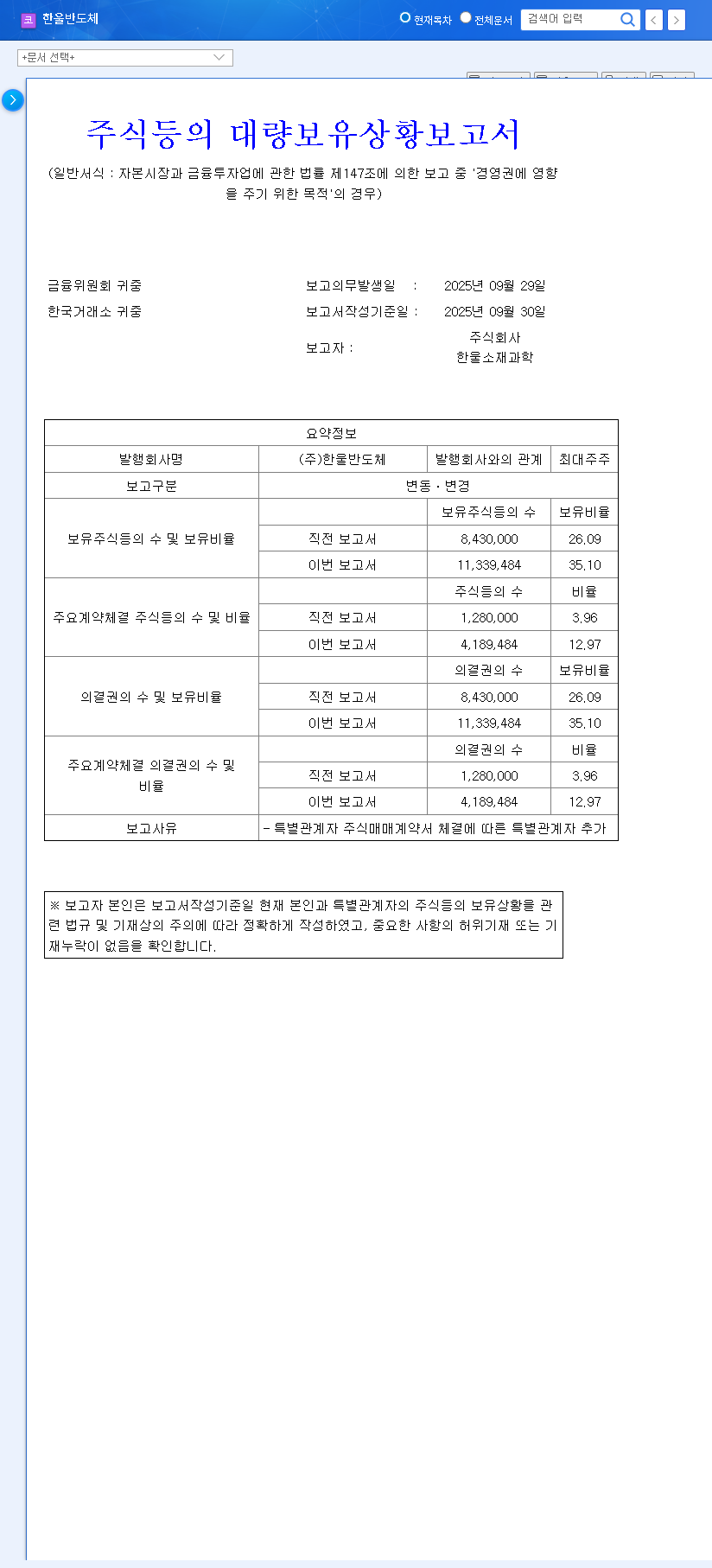
    On November 13, 2025, HanWool Semiconductor officially announced its decision to issue private placement convertible bonds (CBs) valued at ₩5 billion. This sum is notable, representing approximately 7.43% of the company’s market capitalization. A convertible bond is a type of debt security that the holder can convert into a specified number of shares of common stock in the issuing company. This private placement is designated for a single entity, Global Lowell Union. The key terms are outlined in the Official Disclosure (DART) and summarized below:

    • Issuance Amount: ₩5 billion
    • Issuance Method: Private placement to Global Lowell Union
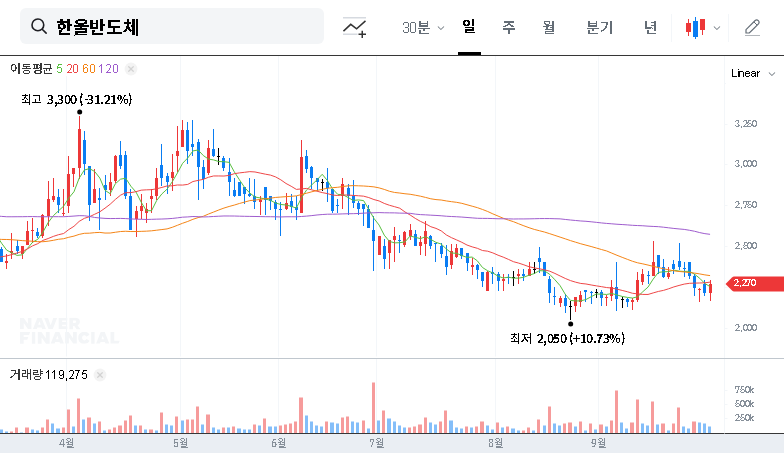
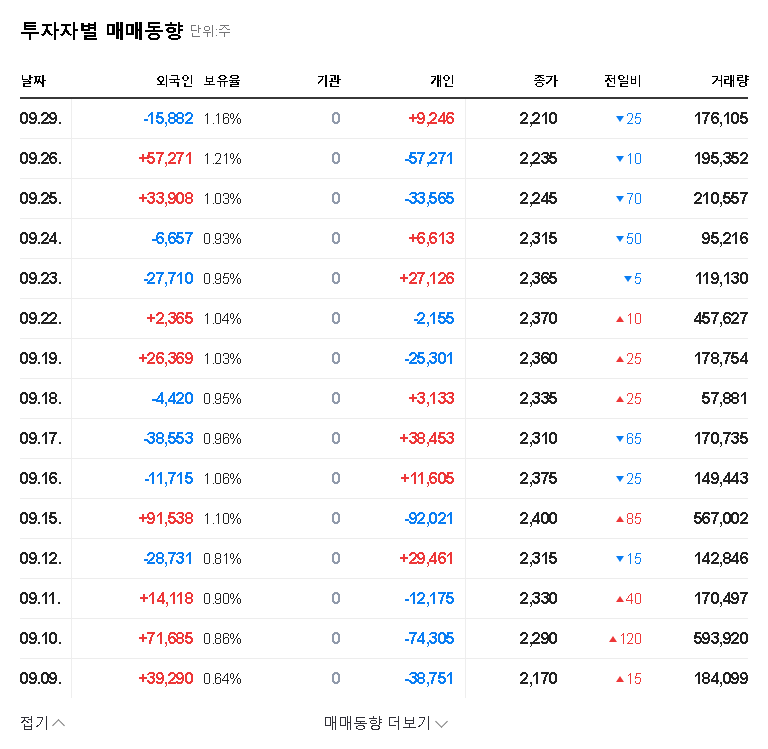
    • Conversion Price: ₩1,928 per share (below the current market price of ₩2,200)
    • Coupon/Maturity Interest Rate: 3%
    • Conversion Period: December 12, 2026 – November 12, 2028

    The conversion price being set below the current stock price is a critical detail. It creates a strong incentive for the bondholder to convert the debt into equity, which signals confidence but also introduces the risk of stock dilution down the line.

    The ‘Why’: Underperformance and Urgent Liquidity Needs

    This HanWool Semiconductor CB issuance is not happening in a vacuum. It’s a direct response to the company’s recent financial struggles and the broader industry downturn. Performance in the first half of 2025 was sluggish, marked by declining sales and a growing operating loss. The core reasons include:

    • Front-End Market Contraction: A significant reduction in investment from the semiconductor and display industries has directly hurt sales, particularly in HanWool’s Film inspection equipment division.
    • Rising Operational Costs: An increase in selling, general, and administrative (SG&A) expenses has further squeezed profitability.
    • Uncertainty in New Ventures: While strategic pivots into AI machine vision and semiconductor IP are promising for the long term, they are in early stages and unlikely to generate revenue soon.

    While the company’s debt ratio has improved, its cash reserves have dwindled. This capital injection is therefore crucial for managing operational liquidity and stabilizing the balance sheet while it navigates these challenges.

    This bond issuance is a classic double-edged sword: it provides a vital short-term cash lifeline but simultaneously places immense pressure on the company to deliver on its long-term growth promises to justify the potential shareholder dilution.

    An Actionable Guide for Investors

    For investors, the HanWool Semiconductor convertible bond news requires a nuanced perspective. While it addresses immediate liquidity concerns, the ultimate success depends on execution. Here’s what to monitor:

    Potential Upsides & Investment Points

    • New Business Success: The most significant catalyst would be tangible progress in the AI machine vision and semiconductor IP businesses. Look for milestones, partnerships, and early revenue generation.
    • Efficient Use of Capital: Track how the ₩5 billion is deployed. Investments in R&D and strategic initiatives that enhance long-term value are positive signs.
    • Industry Recovery: An upturn in the broader semiconductor market, as detailed in our previous semiconductor industry forecast, would lift HanWool’s core inspection equipment business.

    Critical Risks to Consider

    • Prolonged Industry Downturn: If the macroeconomic environment worsens, the industry’s recovery could be delayed, further straining HanWool’s finances. Learn more about market dynamics from authoritative sources like McKinsey’s Global Economics Intelligence.
    • Stock Dilution Overhang: While not immediate, the potential conversion of bonds into nearly 2.6 million new shares creates a supply overhang that could pressure the stock price in the future.
    • Failure to Execute: If the new ventures fail to gain traction, the company will have increased its debt (via interest payments) and potentially diluted shareholders without a corresponding increase in corporate value.

    Final Verdict: ‘Neutral’ with a Cautious Approach

    Our investment opinion on HanWool Semiconductor, Inc. is ‘Neutral’. The CB issuance is a necessary and positive step for securing short-term operational stability. However, the company’s underlying fundamentals remain weak, and its future hinges on unproven business ventures. A positive investment case cannot be made on this fundraising alone.

    A cautious approach is warranted. Investors should wait for concrete evidence of financial improvement and tangible results from the new business segments. Closely monitoring quarterly earnings reports, the specific use of the CB funds, and progress updates on the AI and IP initiatives will be essential for making an informed decision. The path forward is laden with both risk and potential reward, demanding careful and continuous due diligence.
    (320000) HanWool Semiconductor Convertible Bond: An In-Depth Stock Analysis for Investors 관련 이미지
    (320000) HanWool Semiconductor Convertible Bond: An In-Depth Stock Analysis for Investors 관련 이미지
  • (320000) HanWool Semiconductor Convertible Bond: A 2025 Investor’s Deep Dive

    (320000) HanWool Semiconductor Convertible Bond: A 2025 Investor’s Deep Dive

    The recent announcement of the HanWool Semiconductor convertible bond (CB) issuance has sent ripples through the investment community. The decision to raise KRW 5 billion through a privately placed CB raises a critical question: is this a savvy move to fuel future growth, or does it signal underlying financial strain and pose a significant dilution risk for current shareholders? This comprehensive guide will dissect every facet of this financial instrument, analyze the company’s strategy, and provide a clear roadmap for investors navigating this pivotal moment.

    We’ll explore the immediate implications and long-term potential, ensuring you have the data-driven insights needed to make an informed decision about your investment in HanWool Semiconductor.

    The Details: Breaking Down the HanWool Semiconductor CB Issuance

    On November 13, 2025, HanWool Semiconductor, Inc. officially confirmed its plan to issue a privately placed convertible bond valued at KRW 5 billion. As detailed in the Official Disclosure on DART (Source), the key terms are critical for investors to understand:

    • Investor: The entire issuance is allocated to ‘Excel Fund No. 1’.
    • Conversion Price: Set at KRW 1,928, which is a discount from the prevailing market price of KRW 2,200 at the time of the announcement.
    • Coupon & Maturity Rate: A fixed rate of 3% for both.
    • Payment & Conversion Timeline: Payment is due December 12, 2025, with the conversion period opening one year later on December 12, 2026.

    A convertible bond is a hybrid security that starts as a bond but can be converted into a specified number of common shares. The discounted conversion price (KRW 1,928) creates a strong incentive for the bondholder to convert to stock if HanWool’s share price remains above this level, leading to potential equity dilution. For more on this, see this comprehensive guide from Investopedia.

    Why Now? The Strategy Behind the Capital Injection

    This fundraising initiative is not happening in a vacuum. A look at HanWool’s 2025 semi-annual report reveals a company at a crossroads, facing significant headwinds but actively pivoting towards new, high-growth sectors.

    Confronting Financial Challenges

    The company has been battling declining revenue and widening operating losses. This is primarily due to a slowdown in the broader semiconductor and display industries, which has depressed sales of its core Film inspection equipment. Compounding this issue are rising administrative costs and the unpredictable nature of global exchange rates, which impacts a company with a 53% export ratio.

    Investing in a High-Tech Future

    Despite these pressures, HanWool is not standing still. The KRW 5 billion from the HanWool Semiconductor convertible bond is earmarked as strategic capital to fuel its expansion into promising new ventures:

    • AI Machine Vision: A rapidly growing field essential for automated quality control and inspection in advanced manufacturing.
    • Semiconductor IP: Developing and licensing intellectual property for chip designs, a high-margin business that leverages its core expertise.
    • Advanced Materials: Innovating in the materials space, which is fundamental to the next generation of semiconductors.

    This financing is a calculated move to bridge the gap from a challenging present to a potentially lucrative future, powered by innovation.

    The Investor’s Dilemma: Opportunity vs. Risk

    The Bull Case: Fuel for Growth

    The primary positive outcome is the injection of vital capital. This KRW 5 billion infusion improves liquidity and provides the necessary funds for R&D and strategic investments. If the new ventures in AI and semiconductor IP succeed, they could transform HanWool’s revenue streams and lead to significant long-term appreciation in shareholder value. This aligns with the company’s efforts to improve its financial health, as seen in previous capital increases and a focus on its extensive patent portfolio.

    The Bear Case: Dilution and Debt

    The most significant risk is equity dilution. If and when the bonds are converted, the total number of outstanding shares will increase, which can decrease the value and ownership stake of each existing share. The 3% interest on the bonds also adds a new financial burden. If the company’s turnaround is delayed, these interest payments could become a strain on cash flow. The private placement nature of the deal also means less transparency for retail investors. For more analysis on this topic, consider our guide to analyzing semiconductor stocks.

    Investor Takeaway: A Cautious but Watchful Approach

    The HanWool Semiconductor convertible bond is a double-edged sword. It presents a clear path to funding innovation but comes with the unavoidable risk of future dilution.

    The key factor for investors is execution. Your focus should be on monitoring the tangible progress of HanWool’s new business divisions. Are they securing contracts? Are they hitting R&D milestones? Is the capital being deployed effectively to generate future revenue?

    While the conversion price suggests a short-term stock price collapse is unlikely, the overhang of potential new shares will persist. A prudent strategy involves closely tracking the company’s quarterly reports for signs of fundamental improvement while keeping an eye on macroeconomic factors like the recovery of the front-end semiconductor industry. This is an investment that requires patience and diligent monitoring.

    (320000) HanWool Semiconductor Convertible Bond: A 2025 Investor's Deep Dive 관련 이미지
    (320000) HanWool Semiconductor Convertible Bond: A 2025 Investor's Deep Dive 관련 이미지
  • (432720) QUALITAS SEMICONDUCTOR’s ₩1B IP License Deal in Europe: An Investor’s Deep Dive

    (432720) QUALITAS SEMICONDUCTOR’s ₩1B IP License Deal in Europe: An Investor’s Deep Dive

    The semiconductor industry is buzzing as QUALITAS SEMICONDUCTOR CO., LTD., a leader in cutting-edge semiconductor Intellectual Property (IP), announces a monumental ₩1 billion IP license contract, marking its strategic entry into the European market. This deal is far more than a revenue boost; it serves as a powerful validation of the company’s advanced technology and lays a critical foundation for future global growth. But what does this mean for investors and the company’s long-term valuation?

    This comprehensive analysis will dissect the contract’s details, explore the strategic implications for the Qualitas Semiconductor stock, and weigh the promising outlook against the company’s current financial challenges to provide a balanced perspective for informed investment decisions.

    The European Breakthrough: Deconstructing the ₩1 Billion Deal

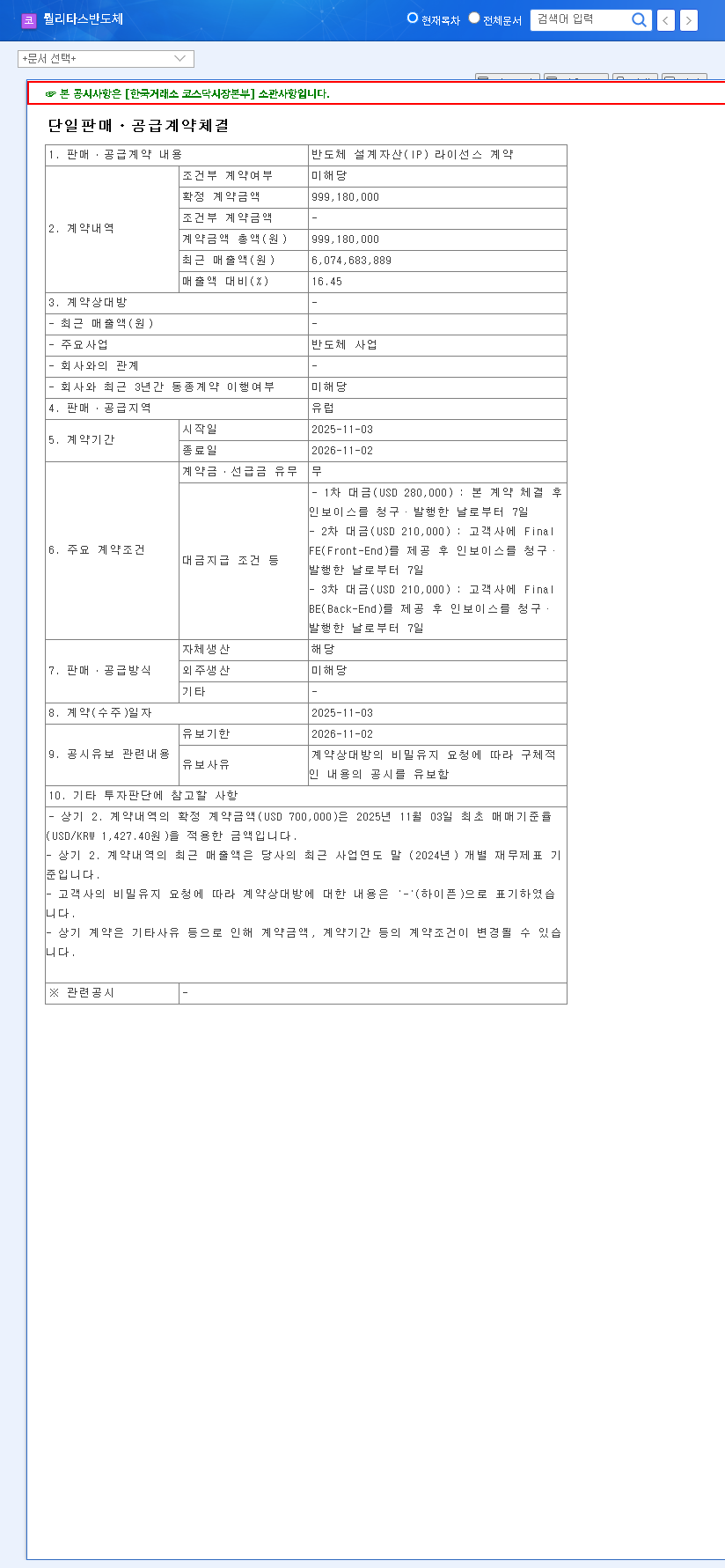
    On November 4, 2025, QUALITAS SEMICONDUCTOR formally announced a significant semiconductor IP license contract valued at ₩1 billion (approximately $750,000 USD) with an as-yet-undisclosed company in Europe. According to the Official Disclosure, the agreement is valid for one year, from November 3, 2025, to November 2, 2026. The magnitude of this single contract cannot be overstated, representing approximately 35.8% of the company’s entire revenue from the first half of 2025.

    Key Contract Details:

    • Contract Type: Single Sale/Supply Contract (Semiconductor IP License)
    • Contract Value: ₩1,000,000,000 KRW
    • Supply Region: Europe
    • Contract Period: Nov 3, 2025 – Nov 2, 2026

    Core Technology & Strategic Impact

    This deal is a victory for QUALITAS SEMICONDUCTOR’s technological prowess. The company specializes in high-speed interconnect IP licensing, which is the critical technology that allows different components within a chip or system to communicate at lightning-fast speeds. This is the digital backbone for high-growth industries like Artificial Intelligence (AI), High-Performance Computing (HPC), and data centers. Their portfolio, featuring standards like MIPI, PCIe, and the emerging Universal Chiplet Interconnect Express (UCIe), positions them at the forefront of innovation.

    Securing a major IP license agreement in the competitive European market is a clear validation of a company’s technology. It signals to investors that the R&D investment is translating into commercially viable and globally recognized products.

    Why the European Market Matters

    Entering the European semiconductor market is a strategic masterstroke. Beyond simple revenue diversification, it opens doors to the region’s massive automotive, industrial, and telecommunications sectors, all of which are undergoing rapid digital transformation. This foothold serves as a launchpad for future IP sales and design service opportunities, reducing the company’s reliance on a concentrated client base.

    The Investor’s Dilemma: Growth vs. Profitability

    Despite the celebratory news, a prudent investor must examine the full financial picture. As of H1 2025, QUALITAS SEMICONDUCTOR reported revenue of ₩2.795 billion but posted an operating loss of ₩11.415 billion. This persistent deficit is largely driven by an aggressive R&D expenditure, which sits at a staggering 421.40% of revenue. While this heavy investment is crucial for maintaining a technological edge in the fast-evolving semiconductor space, it creates a significant drag on short-term profitability.

    A single ₩1 billion contract, while significant, is not a silver bullet for these accumulated losses. The path to profitability will require a series of such wins. Investors should also be mindful of macroeconomic headwinds, such as the global semiconductor market’s recovery pace and currency fluctuations, which are explored in reports from authorities like the Semiconductor Industry Association (SIA).

    Frequently Asked Questions (FAQ)

    What does QUALITAS SEMICONDUCTOR specialize in?

    QUALITAS SEMICONDUCTOR is a specialized semiconductor Intellectual Property (IP) company. They design and license high-speed interconnect technology (e.g., MIPI, PCIe, UCIe) that enables rapid data transfer in advanced electronics for AI, HPC, and automotive applications.

    How significant is this new European contract?

    The ₩1 billion IP license contract is highly significant. It represents about 35.8% of the company’s revenue from the first half of 2025, provides a crucial entry into the strategic European market, and validates the commercial appeal of its technology on a global stage.

    What are the main risks for Qualitas Semiconductor stock investors?

    The primary risk is the company’s current lack of profitability due to high R&D spending. While this new contract is a positive step, sustained revenue growth from multiple new contracts is needed to overcome the operating losses. Investors should monitor the company’s ability to convert its technological lead into consistent financial performance.

    What should investors watch for next?

    Key monitoring points include:

    • Disclosure of the European partner’s identity and potential for follow-on deals.
    • The pace of securing additional contracts in Europe and other new markets.
    • Quarterly financial reports showing a clear trend towards profitability.
    • Progress on turning its R&D investment into tangible, profitable revenue streams.

    (432720) QUALITAS SEMICONDUCTOR's ₩1B IP License Deal in Europe: An Investor's Deep Dive 관련 이미지
  • (094360) Chips&Media AI NPU IP Drives Record Q3 Earnings: A 2025 Investment Analysis

    (094360) Chips&Media AI NPU IP Drives Record Q3 Earnings: A 2025 Investment Analysis

    The semiconductor landscape is buzzing, and at the center of the conversation is Chips&Media, Inc., a leading semiconductor IP company that just posted impressive preliminary third-quarter 2025 earnings. After navigating a challenging start to the year, the company has demonstrated a remarkable recovery, driven by the powerful momentum of its Chips&Media AI NPU IP (Neural Processing Unit Intellectual Property). This surge not only surpasses market expectations but also solidifies the company’s position as a key player in the future of on-device AI.

    This in-depth analysis unpacks the latest Chips&Media earnings report, explores the revolutionary technology behind its success, and provides a comprehensive Chips&Media stock analysis for investors considering its future value.

    A Closer Look at the Q3 2025 Earnings Triumph

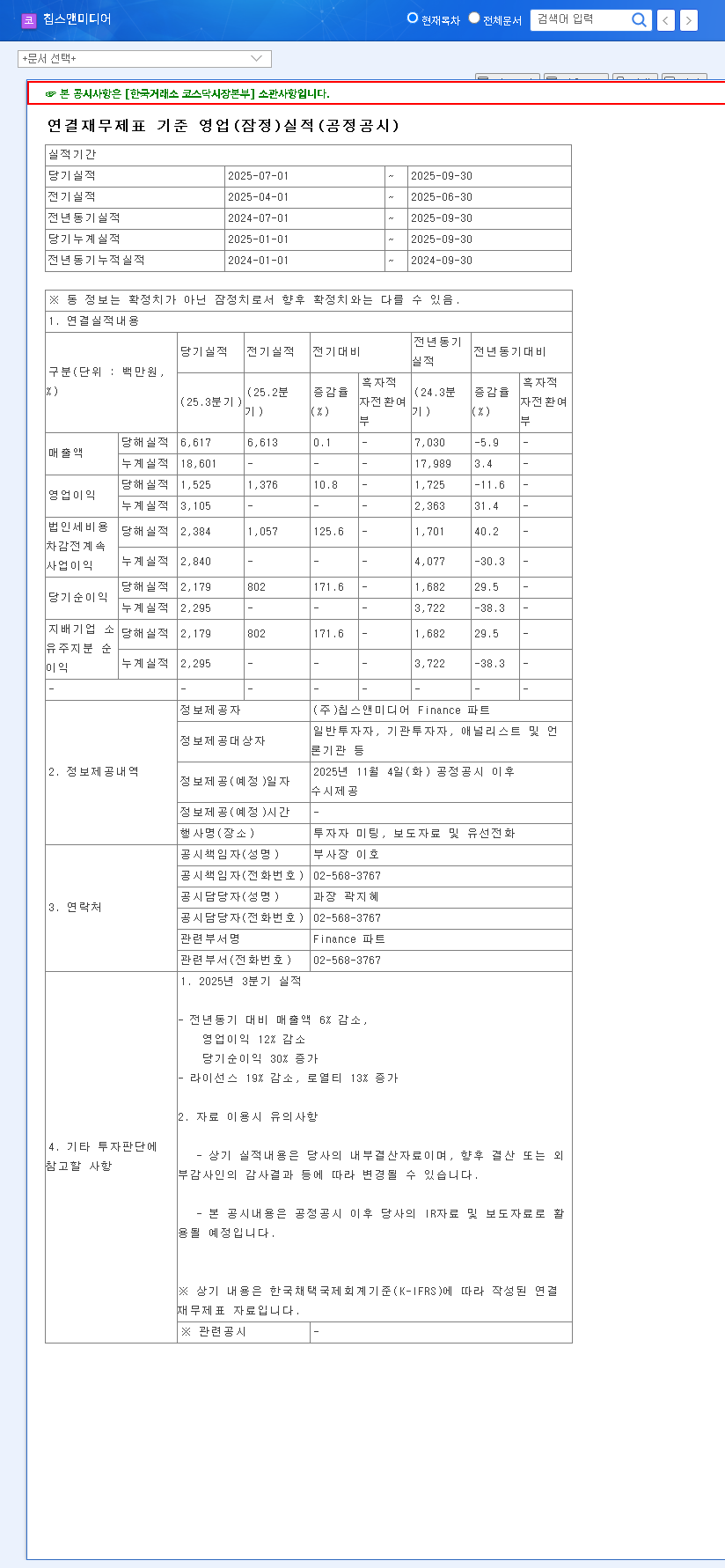
    On November 4, 2025, Chips&Media disclosed its preliminary consolidated Q3 earnings, painting a picture of robust financial health and a strong upward trajectory. The numbers speak for themselves, as detailed in their Official Disclosure (DART).

    • Revenue: KRW 6.6 billion (Consistent with Q2, demonstrating stability)
    • Operating Profit: KRW 1.5 billion (A healthy increase from KRW 1.4 billion in Q2)
    • Net Profit: KRW 2.2 billion (A massive surge from KRW 0.8 billion in Q2)

    This performance marks a significant turnaround from a subdued Q1. The sustained revenue combined with a dramatic leap in net profitability points to improved operational efficiency and the successful commercialization of high-margin products, namely the highly anticipated Chips&Media AI NPU IP.

    The Game Changer: Decoding the Chips&Media AI NPU IP Advantage

    The stellar Q3 results are not just a financial event; they are a validation of Chips&Media’s strategic pivot towards artificial intelligence. The new growth engine is undoubtedly its proprietary NPU IP, designed for the exploding market of on-device AI. Unlike cloud-based AI which sends data to remote servers, on-device AI performs computations directly on the hardware (like a smartphone or car), offering faster responses, enhanced privacy, and lower operational costs.

    Chips&Media’s unique competitive advantage lies in its NPU IP’s ability to process complex AI data without requiring DRAM access. This innovation significantly reduces power consumption and chip size, making it a highly attractive solution for device manufacturers.

    The generation of its first license revenue from this technology in 2025 marks a pivotal moment, shifting the Chips&Media AI NPU IP from a promising R&D project to a tangible, revenue-generating asset that fuels future growth.

    Investment Outlook: Chips&Media Stock Analysis

    For investors, these earnings have both immediate and long-term implications. Understanding the context of the broader semiconductor IP market is crucial.

    Short-Term Momentum

    The significant beat on net profit is likely to generate positive investor sentiment and create upward pressure on the stock price. The clear evidence of the AI NPU IP business contributing to the bottom line could attract a new wave of investors focused on the AI sector.

    Mid-to-Long-Term Value Proposition

    The long-term appeal is even more compelling. Chips&Media is positioning itself perfectly to capitalize on the growth of on-device AI, a market projected to grow exponentially. Key factors for long-term growth include:

    • Stable Core Business: The company’s leadership in video codec IP (HEVC, AV1) provides a stable revenue stream, particularly from the Chinese market, which funds innovation.
    • Expanding AI Portfolio: As the company secures more design wins for its NPU IP, royalty revenues will begin to layer on top of license fees, creating a highly profitable, recurring revenue model.
    • Attractive Fundamentals: Continuous performance improvements strengthen the company’s balance sheet and overall investment appeal.

    Navigating Potential Risks

    No investment is without risk. Investors should monitor macroeconomic variables like KRW/USD exchange rate fluctuations, which can impact an export-heavy company. Furthermore, the global semiconductor market is notoriously competitive and cyclical. Competition from larger players like Arm and Synopsys in the NPU space, as discussed by industry analysts at Gartner, remains a key factor to watch.

    Frequently Asked Questions (FAQ)

    Q1: What is the main takeaway from Chips&Media’s Q3 2025 earnings?

    The key takeaway is the significant jump in net profit to KRW 2.2 billion, which signals a major improvement in profitability and validates the company’s strategic investment in its new Chips&Media AI NPU IP business.

    Q2: Why is the AI NPU IP business so important for Chips&Media’s future?

    It targets the high-growth on-device AI market. Its unique technology, which processes data without DRAM access, offers a powerful competitive advantage in efficiency and cost, positioning the company as a key enabler of next-generation smart devices.

    Q3: What should investors monitor going forward?

    Investors should track the rate of new customer acquisitions and design wins for the AI NPU IP. Monitoring the competitive landscape and macroeconomic trends like exchange rates and global semiconductor IP demand is also crucial for a complete Chips&Media stock analysis.

    Conclusion: A Positive Outlook with Key Variables to Watch

    Chips&Media’s Q3 2025 preliminary earnings are unequivocally positive, showcasing a company in a strong recovery phase with a powerful new growth driver. The successful monetization of the Chips&Media AI NPU IP is a critical milestone that improves fundamentals and enhances its long-term corporate value. While investors should remain mindful of market risks, the current trajectory suggests that Chips&Media is well-positioned to carve out a significant niche in the future of artificial intelligence.

    (094360) Chips&Media AI NPU IP Drives Record Q3 Earnings: A 2025 Investment Analysis 관련 이미지
  • (432720) QUALITAS SEMICONDUCTOR (432720): Is a $3M Semiconductor IP Deal the Key to a Financial Turnaround?

    (432720) QUALITAS SEMICONDUCTOR (432720): Is a $3M Semiconductor IP Deal the Key to a Financial Turnaround?

    In the dynamic world of high-speed interconnect technology, all eyes are on QUALITAS SEMICONDUCTOR CO., LTD. (432720). The company recently announced a landmark $3 million (KRW 3 billion) semiconductor IP license agreement with a major U.S. client. This isn’t just another line item on a quarterly report; it represents a potential catalyst that could fundamentally reshape the company’s financial health and solidify its position as a global leader in next-generation chip technology.

    With this single contract accounting for nearly half of its semi-annual revenue, can QUALITAS SEMICONDUCTOR finally pivot from a period of heavy R&D investment and operational losses to a new era of sustained profitability? This analysis explores the profound significance of this deal, the cutting-edge technology behind it, and the key factors investors must consider.

    The Game-Changing $3M Semiconductor IP Contract

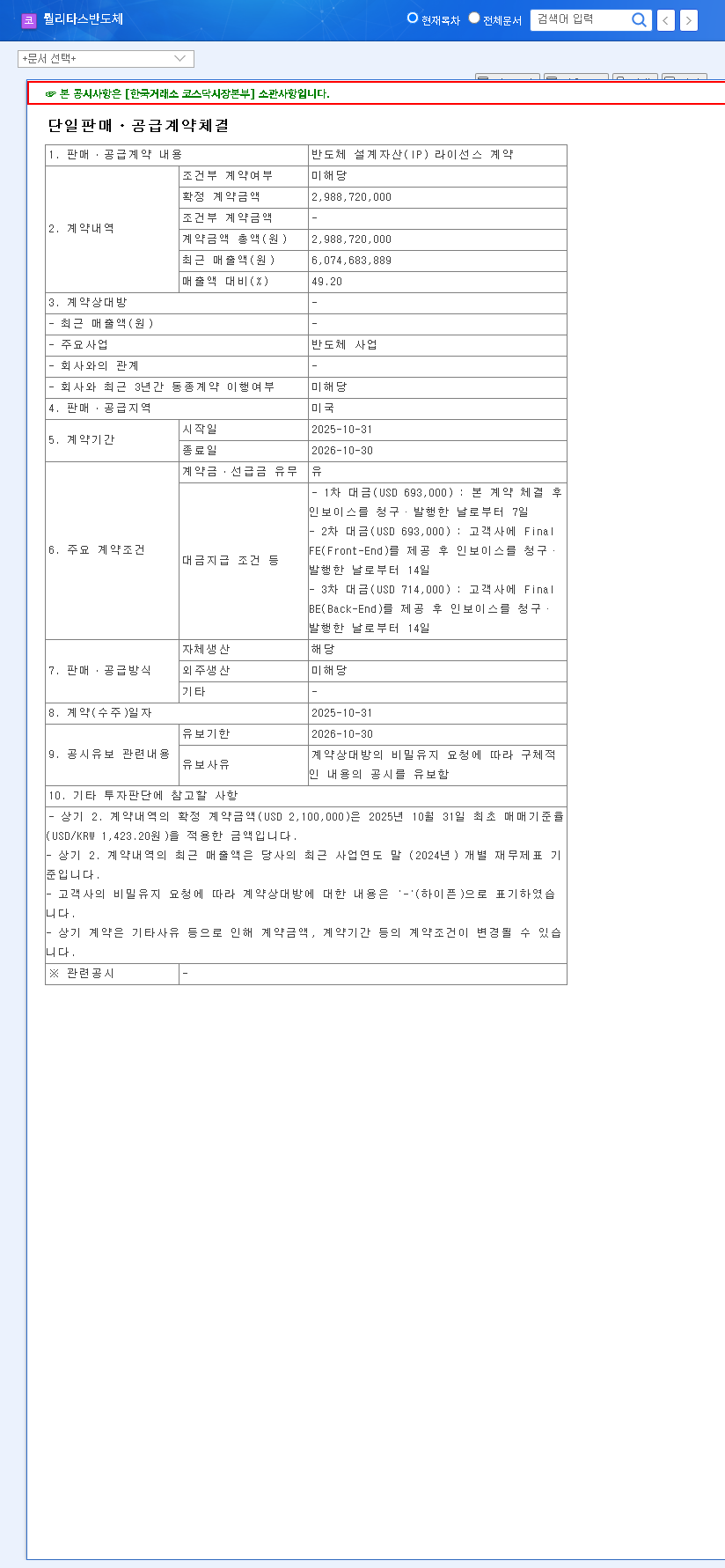
    QUALITAS SEMICONDUCTOR officially disclosed the signing of a major semiconductor Intellectual Property (IP) license agreement on October 31, 2025. The contract, detailed in the Official Disclosure (DART), outlines a pivotal partnership with a U.S.-based client. Let’s break down the core details:

    • Contract Value: KRW 3 billion (approx. $2.2 million USD), a figure representing a substantial 49.20% of the company’s 2025 semi-annual revenue.
    • Contract Scope: Licensing of high-speed interconnect IP, the company’s core technological strength.
    • Contract Period: A one-year term from October 31, 2025, to October 30, 2026.

    This agreement is far more than a simple transaction. It is a powerful validation of QUALITAS SEMICONDUCTOR’s intensive R&D efforts, demonstrating that its proprietary technology is not only cutting-edge but also commercially sought-after on the global stage.

    This contract marks a critical inflection point where years of strategic R&D investment begin to translate into significant, tangible revenue, signaling a potential financial turnaround for the company.

    Path to Profitability: Impact on Financial Health

    The first half of 2025 was challenging for QUALITAS SEMICONDUCTOR, marked by sales of KRW 2.795 billion (a 53.2% decrease YoY) and a significant operating loss of KRW 11.414 billion. This loss was largely driven by an aggressive R&D investment ratio of 421.40% relative to revenue. While this level of spending is common for deep-tech companies building a competitive moat, it creates immense pressure on financial stability.

    The new KRW 3 billion contract acts as a powerful counterbalance. It is expected to be recognized as revenue across the second half of 2025 and the first half of 2026, directly addressing the sales decline and dramatically narrowing the operating loss. This injection of high-margin licensing revenue is the most direct path to achieving quarterly profitability and stabilizing the company’s financial foundation.

    The Technology Driving Growth: High-Speed Interconnect IP

    QUALITAS SEMICONDUCTOR specializes in the foundational technology that enables different components within a computer system or between systems to communicate at blistering speeds. Their portfolio of semiconductor IP includes critical standards like MIPI, PCIe, and, most notably, UCIe.

    • UCIe (Universal Chiplet Interconnect Express): This is arguably the company’s crown jewel. As the semiconductor industry moves towards chiplet-based designs to power AI and high-performance computing, a universal standard for connecting these chiplets is essential. QUALITAS’s pioneering development of UCIe 2.0 PHY IP places them at the heart of this revolution.
    • PCIe (Peripheral Component Interconnect Express): The standard for connecting high-speed components like GPUs and SSDs. The company’s work on PCIe 6.0 prototypes keeps it at the forefront of data center and PC architecture.

    This contract validates the market’s demand for these advanced technologies, which are essential for the next generation of AI accelerators, autonomous vehicles, and data centers. According to the Semiconductor Industry Association, the demand for specialized processing continues to be a major growth driver for the entire market.

    Investor Outlook and Potential Risks

    The KRW 3 billion deal is an overwhelmingly positive development. For investors, it re-affirms the company’s growth narrative and provides a clear sign of impending financial improvement. However, a comprehensive view requires acknowledging potential headwinds.

    Key Watch Points & Risk Factors

    • Contract Sustainability: The one-year term raises questions about follow-on business. Investors should monitor for announcements of extensions, new projects, or additional licensing deals with this key U.S. client.
    • Market Conditions: The global semiconductor market is notoriously cyclical. While QUALITAS SEMICONDUCTOR is in a high-growth niche, broad market downturns could impact client R&D budgets and future licensing opportunities.
    • Exchange Rate Fluctuations: As the contract is with a U.S. company, shifts in the KRW/USD exchange rate could affect the final recognized revenue in Korean Won.

    Conclusion: A ‘Positive’ Outlook

    In the short term, this contract is expected to significantly boost market sentiment and provide a much-needed financial lifeline. In the long term, it serves as a powerful testament to the global competitiveness of QUALITAS SEMICONDUCTOR’s technology. The key to sustained growth will be the company’s ability to convert this major win into a pipeline of recurring, high-value licensing agreements. For now, this deal firmly places the company on a path toward a financial turnaround and validates its position as a critical enabler of the future of computing.

    Disclaimer: This analysis is based on publicly available information. All investment decisions should be made at the investor’s own discretion and responsibility. Investing involves risks.

    (432720) QUALITAS SEMICONDUCTOR (432720): Is a $3M Semiconductor IP Deal the Key to a Financial Turnaround? 관련 이미지
  • (432720) Qualitas Semiconductor Stock Analysis: Decoding the Major Shareholding Report

    (432720) Qualitas Semiconductor Stock Analysis: Decoding the Major Shareholding Report

    In the dynamic world of semiconductor investments, corporate disclosures are critical signals for discerning investors. A recent filing from Qualitas Semiconductor CO., LTD., a key player in the high-speed interface IP market, has captured significant attention. The ‘Report on the Status of Major Shareholding’ is more than just a formality; it’s a window into the company’s internal dynamics and potential future direction. This deep-dive analysis will dissect the report, explore its implications for the Qualitas Semiconductor stock price and management control, and provide a strategic outlook for investors.

    We will move beyond the surface-level data to uncover the strategic nuances behind these changes, offering a comprehensive perspective on what this means for the future of Qualitas Semiconductor.

    Deconstructing the Major Shareholding Report

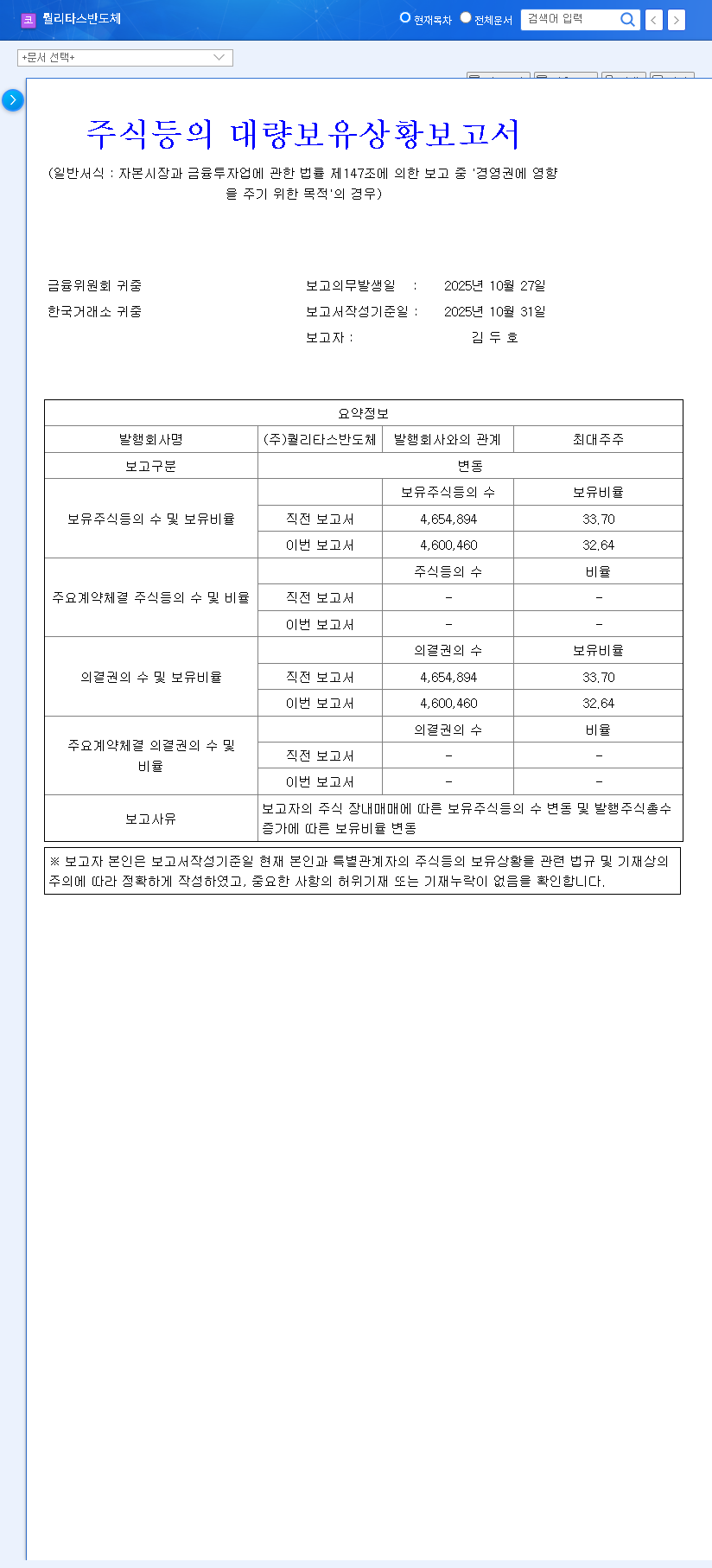
    On October 31, 2025, Qualitas Semiconductor filed its ‘Report on the Status of Major Shareholding (General)’. This document, available via the official disclosure channel, provides transparent insight into ownership changes. You can view the full filing here: Official Disclosure (DART). The key takeaways from the report are:

    • Primary Reporting Person: CEO Doo Ho Kim, with the stated purpose of ‘influence on management’.
    • Shift in Shareholding: A decrease in the CEO’s stake from 33.70% to 32.64%, representing a net reduction of 1.06 percentage points.
    • Stated Reasons for Change: The reduction is attributed to a combination of on-market trading by the reporting person and a dilution effect from an increase in the total number of outstanding shares. This also includes notable short-term selling activity by Mr. Kwang Chun Choi.

    Analyzing the ‘Why’: Drivers Behind the Shareholding Shift

    To understand the impact, we must analyze the underlying reasons for these changes.

    1. CEO Doo Ho Kim’s Stake Reduction

    A CEO selling shares can be a red flag for the market, often interpreted as a lack of confidence. While this 1.06%p decrease could create short-term negative sentiment, it’s crucial to consider the context. A remaining stake of 32.64% is still a formidable position, ensuring stable management control. The sale could be for personal financial planning, portfolio diversification, or tax purposes, rather than a bearish outlook on Qualitas Semiconductor itself.

    2. Increase in Total Outstanding Shares

    The increase in total shares points to dilution, likely from capital increases or the exercise of convertible bonds. In the short term, this can pressure the stock price by lowering earnings per share (EPS). However, for a high-growth tech company like Qualitas Semiconductor, this is often a strategic move to fund critical R&D, expand operations, or enter new markets. The long-term success of this strategy depends entirely on how effectively this new capital is deployed to generate future growth, a key metric for investors to watch.

    3. The Competitive Landscape and Market Position

    Qualitas Semiconductor operates in the fiercely competitive semiconductor IP market. Its focus on high-speed interconnect technology is timely, with soaring demand from high-growth sectors like AI, data centers, and high-performance computing (HPC). The company’s ability to innovate and secure design wins against established players is fundamental to its value proposition. Government R&D support provides a tailwind, but sustained execution is paramount. For more on this sector, you can read our primer on semiconductor IP investments.

    While short-term volatility is expected, the long-term growth of Qualitas Semiconductor stock hinges on its ability to convert ambitious R&D spending into tangible market success and profitability.

    Impact on Stock Price and Investor Strategy

    Considering the disclosure and the company’s fundamentals, we can project potential impacts and formulate a strategy.

    Short-Term vs. Long-Term Stock Price Outlook

    • Short-Term (Weeks to Months): Negative sentiment from the CEO’s sale and share dilution could create downward pressure or increased volatility for the Qualitas Semiconductor stock. Traders should exercise caution.
    • Mid-to-Long-Term (Quarters to Years): The stock’s performance will be driven by fundamentals, not this single disclosure. Key drivers will be the successful commercialization of new IPs, improvements in profitability, and revenue growth fueled by R&D investments.

    Action Plan: A ‘Neutral’ Stance with Vigilance

    Given the high growth potential balanced by short-term uncertainties and profitability challenges, a ‘Neutral’ rating is appropriate at this juncture. This means holding existing positions while closely monitoring key developments.

    Key Monitoring Points for Investors:

    • Quarterly Earnings Reports: Scrutinize revenue growth, profit margins, and updates on R&D progress.
    • New IP Licensing Agreements: Major new contracts are the lifeblood of the business and a strong positive catalyst.
    • Further Management Shareholding Changes: Any significant follow-up sales or purchases by insiders will be a crucial signal.

    Frequently Asked Questions (FAQ)

    Q1: What is the main takeaway from the Qualitas Semiconductor shareholding report?

    The report shows CEO Doo Ho Kim’s stake decreased by 1.06% to 32.64% due to on-market trading and an increase in total shares, signaling potential short-term stock price volatility.

    Q2: Is the CEO’s stake reduction a major concern for management stability?

    No. While a CEO selling shares can affect sentiment, a stake of over 32% is generally considered more than sufficient to maintain stable control over the company’s management and strategic direction.

    Q3: Is the increase in outstanding shares good or bad for Qualitas Semiconductor stock?

    It’s a double-edged sword. In the short term, it’s negative as it dilutes per-share earnings. However, if the raised capital is used effectively for R&D and expansion, it can create significant long-term value, making it a net positive.

    Disclaimer: This analysis is for informational purposes only and is based on publicly available information. It does not constitute investment advice. All investment decisions should be made based on your own research and judgment.

    (432720) Qualitas Semiconductor Stock Analysis: Decoding the Major Shareholding Report 관련 이미지
  • (320000) HanWool Semiconductor Rights Offering: A Deep Dive into AI Growth & Stock Impact

    (320000) HanWool Semiconductor Rights Offering: A Deep Dive into AI Growth & Stock Impact

    In the fiercely competitive semiconductor landscape, HanWool Semiconductor, Inc. has initiated a significant strategic maneuver: a rights offering aimed at funding its next wave of innovation. This decision, announced amidst challenging financial headwinds, signals a definitive pivot towards high-growth sectors like AI machine vision and semiconductor intellectual property (IP). This comprehensive analysis of the HanWool Semiconductor rights offering will explore the intricate details, its potential impact on stock performance, and the long-term vision for the company’s growth, providing investors with the critical insights needed to navigate this pivotal moment.

    📈 Unpacking the Rights Offering: The Details and Rationale

    On October 24, 2025, HanWool Semiconductor formally announced its decision to raise capital through a rights offering, a method where existing shareholders are given the right to purchase additional new shares of the company’s stock at a predetermined price. This move is fundamentally a tool to inject fresh capital directly from its investor base. The primary drivers are twofold: to shore up its balance sheet after a period of financial difficulty and, more importantly, to aggressively fund its expansion into new, promising markets.

    Key Details of the Offering

    • Official Disclosure: The complete details were filed in a major disclosure report. (Source: Official DART Report)
    • Company: HanWool Semiconductor, Inc. (Market Cap: 73.3 billion KRW)
    • Shares Issued: 490,196 common shares
    • Issue Price: 2,040 KRW per share
    • Total Capital Raised: Approximately 1 billion KRW
    • Key Investor: JP1 Fund

    The capital infusion is earmarked to address the challenging HanWool Semiconductor financials reported in its 2025 semi-annual report, which noted a revenue decrease of 25.39% year-over-year and widening operating losses. Beyond stabilizing its finances, these funds represent seed money for a strategic pivot toward future-proof technologies.

    A Company at a Crossroads: Financial Health and Future Growth

    While the immediate financial picture reveals pressures such as decreased revenue and a high debt burden, HanWool Semiconductor’s strategy is focused on leveraging its core strengths to build a more resilient future. The company holds over 20 patents and has consistently invested in R&D, demonstrating a foundational technological prowess.

    This rights offering is less a defensive maneuver and more an offensive play. The goal is to transform from a company surviving market cycles to one that leads in the next generation of semiconductor technology.

    The Promise of New Ventures: AI and IP

    The true excitement behind this capital raise lies in the target markets. AI machine vision is a rapidly expanding field where intelligent systems can ‘see’ and interpret visual information, crucial for automation, robotics, and quality control. Furthermore, the semiconductor IP investment marks a strategic shift towards a higher-margin, scalable business model. Instead of only selling physical chips, the company aims to design and license intellectual property blocks to other manufacturers, a market projected to see explosive growth according to industry analysts at firms like Gartner. This dual-pronged approach diversifies revenue streams and positions HanWool at the forefront of innovation.

    Stock Price Impact: Short-Term Volatility vs. Long-Term Value

    For investors, a rights offering presents a classic risk-reward scenario. The impact on the HanWool Semiconductor stock price must be viewed through two distinct lenses: the immediate and the prospective.

    Short-Term Outlook: Dilution and Uncertainty

    In the short term, the introduction of new shares can lead to share dilution, where the ownership percentage of existing shareholders decreases. This often puts downward pressure on the stock price as the market absorbs the new supply. The 2% issuance ratio is modest, but investor sentiment and concern over the company’s existing debt may fuel volatility in the weeks following the offering.

    Mid-to-Long Term Potential: The Growth Catalyst

    The long-term outlook is entirely dependent on execution. If the capital is deployed effectively and the HanWool Semiconductor AI growth strategy yields tangible results—new products, contracts, or licensing deals—the market will likely re-evaluate the company’s intrinsic value. Success in the semiconductor IP space, in particular, could fundamentally alter the company’s profitability profile and lead to significant appreciation in corporate and stock value. For a deeper understanding of market dynamics, you can read our guide on How to Analyze Semiconductor Stocks.

    Investment Strategy and Key Monitorables

    Navigating the HanWool Semiconductor rights offering requires a forward-looking and diligent approach. Investors should consider the following key points:

    • Monitor Capital Deployment: Watch for specific announcements about how the ~1 billion KRW is being used. Are they hiring top AI talent? Are they acquiring smaller IP firms? Tangible actions are key.
    • Track New Business Milestones: Look for early indicators of success, such as pilot programs, partnerships, or initial revenue from the AI machine vision or semiconductor IP divisions.
    • Assess Financial Health Improvements: Beyond the new ventures, it’s crucial to see improvements in the core business, including debt reduction and a return to profitability.

    In conclusion, this rights offering is a significant turning point for HanWool Semiconductor. While it introduces short-term risks, it also paves the way for a potentially transformative journey into the most exciting sectors of the technology industry. Whether this gamble pays off will depend on masterful execution and a clear vision for the future.

    (320000) HanWool Semiconductor Rights Offering: A Deep Dive into AI Growth & Stock Impact 관련 이미지
    (320000) HanWool Semiconductor Rights Offering: A Deep Dive into AI Growth & Stock Impact 관련 이미지
  • (394280) Open-Edge Technology’s ₩2 Billion IP Deal: A Deep Dive for Investors

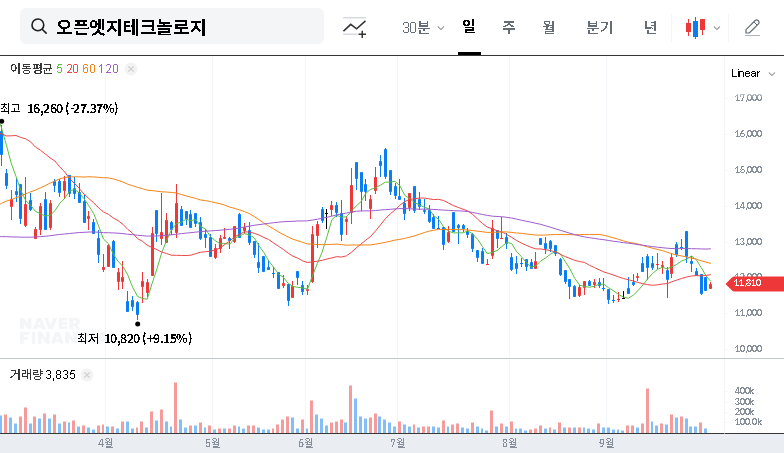
    (394280) Open-Edge Technology's ₩2 Billion IP Deal: A Deep Dive for Investors 대표 차트 이미지

    In a significant move for the global semiconductor market, South Korean leader Open-Edge Technology has secured a major overseas Intellectual Property (IP) license agreement. This deal not only injects substantial revenue but also serves as a powerful validation of its cutting-edge technology on the world stage. For investors and industry watchers, understanding the nuances of this contract is key to gauging the company’s future trajectory.

    This comprehensive analysis will dissect the agreement’s details, explore the profound financial and strategic implications, and provide a clear action plan for those monitoring Open-Edge Technology stock.

    This landmark IP license agreement is more than a financial win; it’s a strategic milestone that enhances Open-Edge Technology’s global credibility and paves the way for sustained international expansion.

    The Landmark Deal: Unpacking the ₩2 Billion Agreement

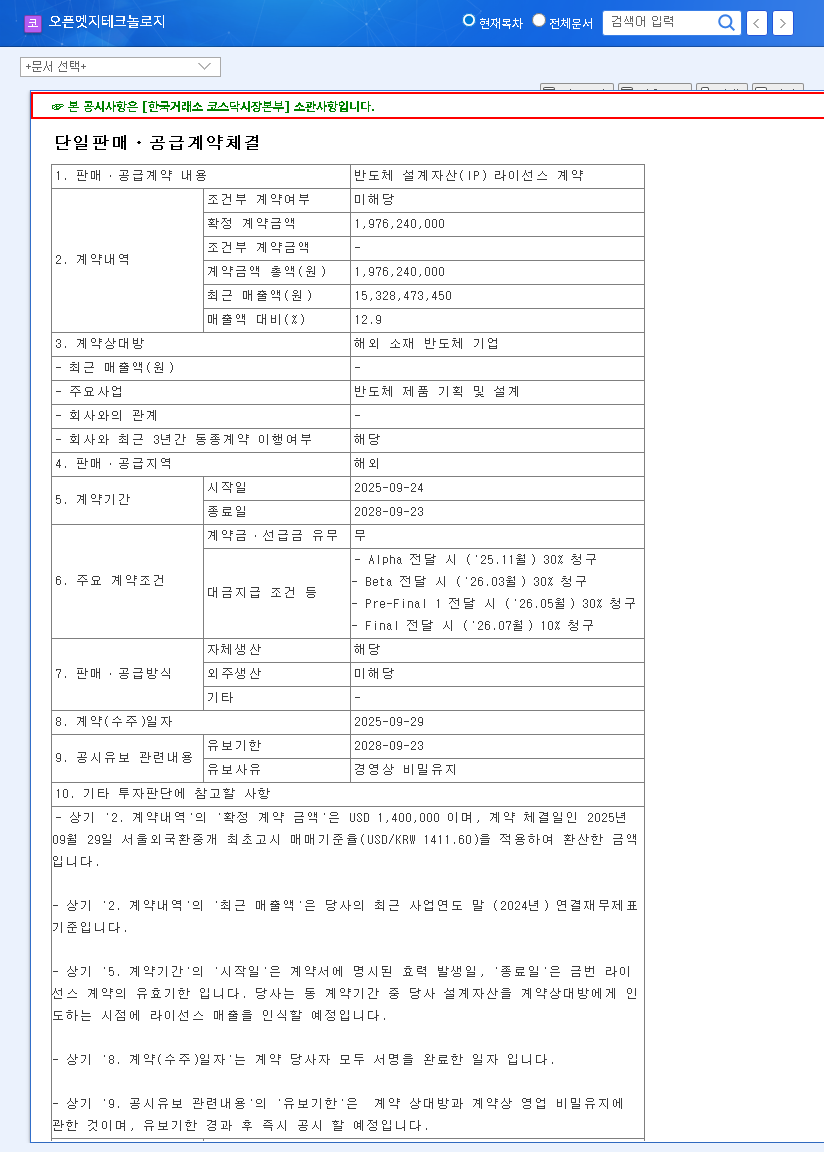
    Open-Edge Technology has formally entered into a semiconductor IP license agreement valued at approximately ₩2 billion with a prominent, unnamed international semiconductor firm. The contract’s terms, as detailed in the Official Disclosure (DART), specify a three-year duration, running from September 24, 2025, to September 23, 2028.

    The financial weight of this single deal is substantial, representing an estimated 12.9% of the company’s recent annual revenue. This immediately establishes a stable, long-term revenue stream and significantly de-risks future income projections, a factor investors highly value in the volatile tech sector.

    Beyond the Numbers: Strategic Implications for Global Growth

    While the revenue is a clear victory, the strategic implications of this IP license agreement are arguably more impactful for the company’s long-term success and global expansion.

    Cementing Global Credibility & Market Position

    Securing a large-scale contract with a major overseas player is the ultimate form of technological validation. It proves that Open-Edge Technology’s semiconductor IP is not just competitive but world-class. This stamp of approval enhances market trust, strengthens its brand reputation, and can serve as a powerful case study to attract other top-tier international clients. It effectively lowers the barrier to entry for future negotiations in new markets.

    The High-Margin Advantage of Semiconductor IP

    Unlike hardware manufacturing, semiconductor IP licensing is an exceptionally high-margin business. Once the IP is developed, the cost of licensing it to multiple clients is minimal. This business model leads to superior profitability and cash flow, which can be reinvested into research and development to maintain a technological edge. This deal will likely have a disproportionately positive effect on Open-Edge Technology’s bottom line.

    Investor Insight: What This Means for Open-Edge Technology Stock

    For current and prospective investors, this news provides a strong positive signal. However, a prudent investment strategy requires a forward-looking and analytical approach. For broader context on industry health, it’s wise to consult reports from organizations like the Semiconductor Industry Association.

    Actionable Monitoring Plan for Investors

    Beyond the initial market reaction, diligent investors should focus on the following key areas:

    • Future Contract Announcements: Is this a one-off event or the start of a trend? Watch for news of other international partnerships that would confirm a successful global expansion strategy.
    • Quarterly Earnings Reports: Monitor how this revenue is recognized over the contract’s life and its direct impact on profit margins and earnings per share (EPS).
    • R&D Investment Levels: Check if the company increases its R&D spending, using the new capital to fuel innovation and widen its competitive moat in the semiconductor IP space.
    • Competitor Landscape: Analyze how competitors react. Understanding the broader semiconductor IP market dynamics is crucial for contextualizing the company’s performance.

    Frequently Asked Questions (FAQ)

    Q1: What is the core announcement from Open-Edge Technology?

    Open-Edge Technology has signed a three-year semiconductor Intellectual Property (IP) license agreement with a major overseas company, valued at approximately ₩2 billion.

    Q2: How significant is this contract financially?

    The deal represents about 12.9% of the company’s annual revenue, providing a stable, high-margin income stream that is expected to significantly boost profitability.

    Q3: What does this deal mean for Open-Edge Technology’s global strategy?

    It serves as a powerful validation of its technology, enhances corporate credibility on a global scale, and strengthens its position to secure more international business opportunities, accelerating its global expansion.

    In conclusion, this overseas IP agreement is a pivotal moment for Open-Edge Technology. It provides not only a financial uplift but also the strategic credibility needed to compete and win on the global stage. For investors, it signals a promising new chapter, warranting close attention in the months and years ahead.

    (394280) Open-Edge Technology's ₩2 Billion IP Deal: A Deep Dive for Investors 관련 이미지
    (394280) Open-Edge Technology's ₩2 Billion IP Deal: A Deep Dive for Investors 관련 이미지