Tag: Satellite Communication

  • (218410) RFHIC CORPORATION (218410) Stock: Deep Dive into Q3 2025 Earnings Surprise & Future Outlook

    (218410) RFHIC CORPORATION (218410) Stock: Deep Dive into Q3 2025 Earnings Surprise & Future Outlook

    The latest Q3 2025 earnings report from RFHIC CORPORATION (218410) has sent ripples through the market, presenting investors with a complex but intriguing picture. While top-line revenue slightly missed consensus, a significant ‘earnings surprise’ in operating profit has captured attention. However, this was contrasted by a shortfall in net income, raising important questions about the company’s underlying financial health and future trajectory.

    This comprehensive analysis unpacks the RFHIC earnings for Q3 2025, exploring the fundamental drivers, technological advantages in GaN semiconductor technology, and the strategic risks that lie ahead. For current and prospective investors, understanding these nuances is critical to navigating the future of RFHIC stock.

    Dissecting the RFHIC CORPORATION Q3 2025 Earnings Report

    The preliminary Q3 2025 figures reveal a multi-faceted performance. The headline news was the impressive beat on operating profit, suggesting strong core operational efficiency or a favorable product mix. Let’s examine the key metrics against market forecasts:

    Key Performance Indicators (vs. Forecast)

    • Revenue: KRW 40.5 billion (1% below forecast of KRW 40.8 billion)
    • Operating Profit: KRW 7.4 billion (23% ABOVE forecast of KRW 6.0 billion) – A significant earnings surprise.
    • Net Income: KRW 5.7 billion (24% BELOW forecast of KRW 7.5 billion)

    The divergence between operating and net income suggests that while the company’s core business operations were more profitable than expected, non-operating factors likely weighed on the bottom line. This could include foreign exchange losses, higher interest expenses on debt, or other one-off financial costs. The full preliminary report can be accessed via this Official Disclosure from DART for further detail.

    The Engine Room: Core Strengths & GaN Technology Edge

    RFHIC CORPORATION’s ability to generate strong operating profit is rooted in its deep technological expertise, particularly in Gallium Nitride (GaN) semiconductors. GaN technology offers superior efficiency, power density, and frequency performance compared to traditional silicon-based chips, making it essential for next-generation applications.

    RFHIC’s unique position as the only domestic Korean company with end-to-end GaN transistor capabilities—from design to mass production—forms a powerful competitive moat in high-growth global markets.

    Primary Growth Pillars

    • Defense & Radar: A robust order backlog of KRW 148.2 billion for GaN power amplifiers in radar systems provides excellent revenue visibility and stability.
    • Wireless Communication: The ongoing global rollout of 5G infrastructure continues to demand high-performance GaN components, a core market for RFHIC.
    • New Frontiers: Strategic expansion into the burgeoning satellite communication and spacecraft sectors secures long-term growth drivers, tapping into a market projected to reach USD 580 billion by 2040. You can read more about the future of the satellite communications industry in our related analysis.

    Navigating Headwinds: Challenges on the Horizon

    Despite its strengths, RFHIC CORPORATION faces several challenges that investors must monitor closely. These risks could impact future profitability and stock performance if not managed effectively.

    Key Risks for RFHIC Stock

    • Revenue Concentration & Decline: A recent decline in the core ‘GaN Power Amplifiers’ segment is a concern. Reversing this trend is critical for sustained growth.
    • Reduced R&D Investment: The R&D expense ratio dropped significantly from 15.61% in 2023 to 6.49% in H1 2025. In a fast-evolving tech industry, sustained innovation is non-negotiable, and this trend could threaten long-term competitiveness. Discover more about the power of next-generation GaN semiconductors from authoritative sources like IEEE.
    • Inventory Management: A rising inventory level (from KRW 78.8 billion to KRW 88.9 billion) needs careful management to avoid potential write-downs and cash flow constraints.
    • Macroeconomic Pressures: While a weaker Korean Won helps export competitiveness, it also increases the cost of imported raw materials. Persistent high interest rates globally add to the company’s financial burden.

    Investment Outlook: What’s Next for RFHIC CORPORATION?

    The Q3 earnings report offers both catalysts and cautions. The operating profit beat provides a potential short-term boost to stock momentum, validating the company’s core operational strength. However, the market will be looking for confirmation that this is a sustainable trend and not a one-off event driven by cost-cutting.

    Key Investor Checklist

    Moving forward, investors should focus on these critical points in upcoming reports and company communications:

    • Q4 2025 Performance: Look for continued strength in operating profit and, crucially, a recovery in revenue from the GaN Power Amplifier segment.
    • New Business Monetization: Track progress on when new ventures in satellite and space will begin contributing meaningfully to the top and bottom lines.
    • Commitment to Innovation: Monitor R&D spending in future quarters. A return to higher investment levels would be a positive signal for long-term technological leadership.

    Disclaimer: This analysis is for informational purposes only and is based on publicly available data. It does not constitute investment advice. All investment decisions should be made based on your own research and judgment.
    (218410) RFHIC CORPORATION (218410) Stock: Deep Dive into Q3 2025 Earnings Surprise & Future Outlook 관련 이미지
  • (218410) RFHIC Corporation Inks $6.5M LIG Nex1 Contract for Cheollian Satellite No. 5

    (218410) RFHIC Corporation Inks $6.5M LIG Nex1 Contract for Cheollian Satellite No. 5

    In a significant development for the aerospace and defense sectors, RFHIC Corporation has officially announced a landmark supply contract with LIG Nex1, a premier name in South Korea’s defense industry. This pivotal agreement, centered on the upcoming Cheollian Satellite No. 5 project, not only represents a substantial financial injection but also solidifies RFHIC’s position as a leader in advanced satellite communication technology. The deal underscores the company’s unique technological prowess and marks a strategic deepening of its role in high-stakes national infrastructure projects.

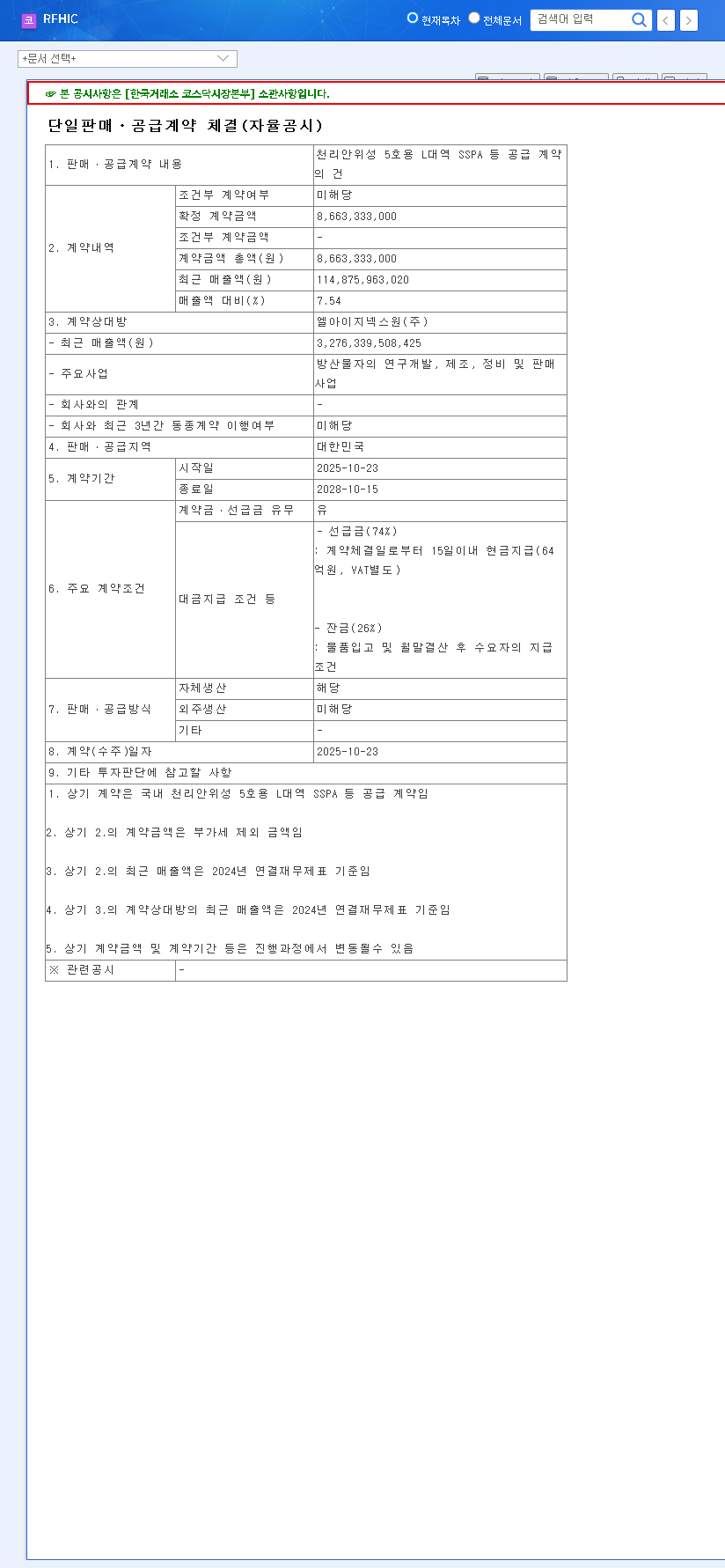
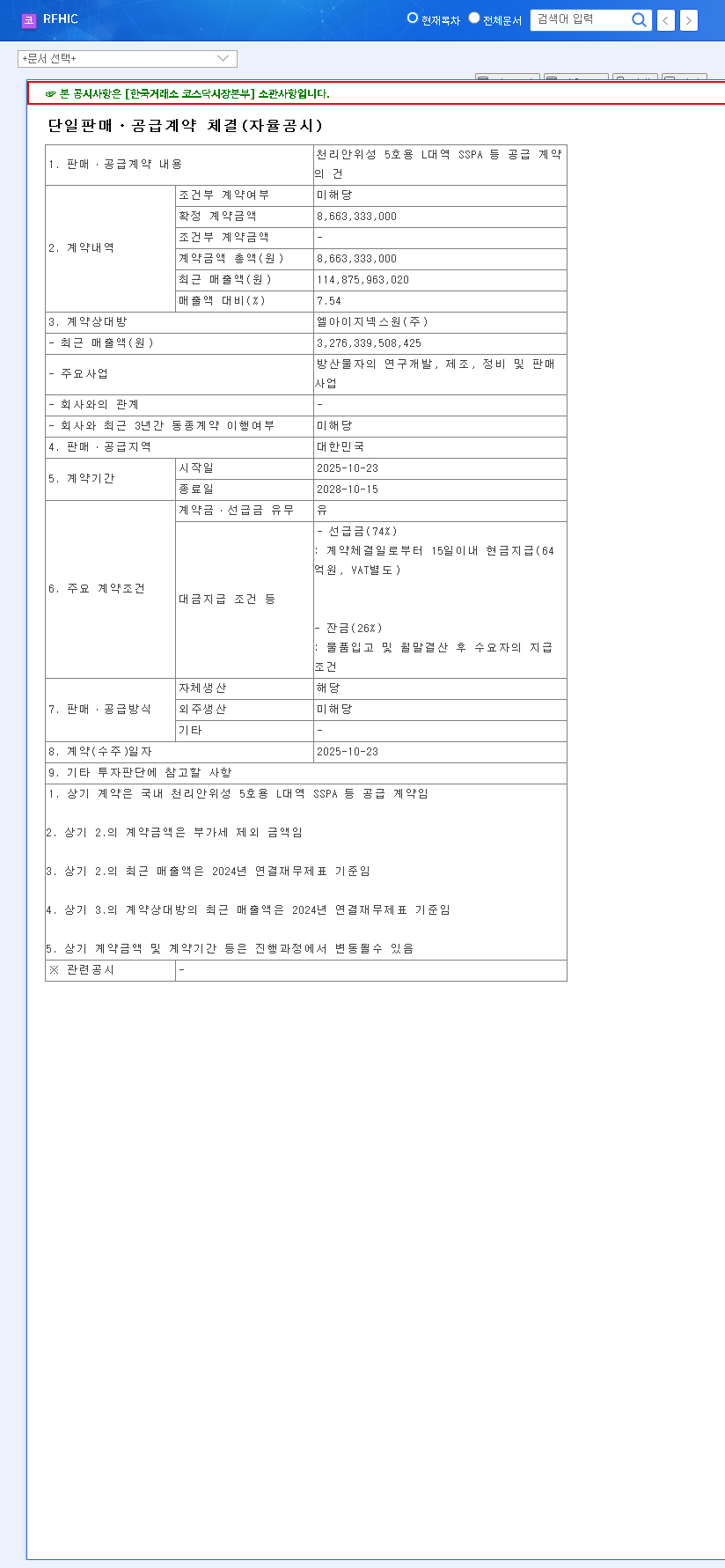
    On October 23, 2025, RFHIC Corporation disclosed the signing of a ‘Supply Contract for L-band SSPA, etc., for Cheollian Satellite No. 5’ with LIG Nex1 Co., Ltd. The official filing provides complete transparency on this major development. (Source: Official DART Disclosure).

    Contract Details: A Landmark Agreement

    This LIG Nex1 contract is a testament to the trust placed in RFHIC Corporation’s capabilities. The specifics of the agreement paint a clear picture of its importance:

    • Contract Value: 8.7 billion KRW (approximately $6.5 million USD), providing a significant and predictable revenue stream.
    • Contract Period: A three-year term from October 23, 2025, to October 15, 2028, ensuring long-term project stability.
    • Financial Scale: The contract is equivalent to 7.54% of RFHIC’s most recent annual revenue, marking a substantial contribution to its top line.

    Decoding the Technology: The Critical Role of the L-band SSPA

    At the heart of this contract is the L-band SSPA (Solid State Power Amplifier), a mission-critical component for modern satellite communication. An SSPA is responsible for amplifying the radio frequency signals that a satellite transmits back to Earth, ensuring clear and reliable communication. The ‘L-band’ refers to a specific frequency range (1-2 GHz) prized for its reliability in various weather conditions, making it ideal for essential services like GPS, mobile satellite phones, and surveillance.

    Developing and manufacturing these components requires immense technological expertise, precision engineering, and robust quality control. By securing this contract, RFHIC Corporation publicly validates its leadership in this high-value, high-barrier-to-entry market segment. For more on satellite technology, authoritative sources like the European Space Agency provide excellent background information.

    This contract is more than a financial win; it’s a strategic validation of RFHIC Corporation’s technological dominance in the competitive satellite communication landscape and a cornerstone for future growth with LIG Nex1.

    Strategic Implications and Future Outlook

    The ripple effects of this deal extend far beyond the immediate revenue boost. The collaboration on the Cheollian Satellite No. 5 project creates a powerful synergy and opens doors for future opportunities.

    Strengthening a Key Partnership

    LIG Nex1 is a titan in South Korea’s defense industry, involved in everything from guided missiles to radar and avionics. A successful, long-term collaboration with such a partner enhances RFHIC’s business stability and positions it favorably for future defense and space-related government contracts. This partnership is a key growth driver that investors should watch closely.

    Market Validation and Enhanced Corporate Image

    Participation in a critical national project like a geostationary satellite enhances technological credibility and public recognition. It solidifies RFHIC Corporation’s image as a cutting-edge technology provider, capable of meeting the most stringent quality and performance standards. This can be a major advantage when competing for international contracts. To learn more about RFHIC’s core technologies, you can read our guide on GaN-on-SiC technology in RF applications.

    Potential Risks and Considerations

    While overwhelmingly positive, it is prudent to consider potential challenges:

    • Supply Chain Stability: Fluctuations in the price or availability of raw materials for components could impact profitability.
    • Execution Excellence: Satellite projects demand absolute adherence to strict delivery schedules and flawless quality control.
    • Competitive Landscape: The advanced technology sector is dynamic; continuous innovation is necessary to stay ahead of competitors.

    Investor Takeaway

    This LIG Nex1 contract is a clear positive catalyst for RFHIC Corporation. It provides short-term financial stability while laying the groundwork for long-term dominance in the advanced satellite communication market. Investors should monitor the smooth execution of this contract and look for signs of further collaboration between RFHIC and LIG Nex1 as key indicators of future performance.

    Disclaimer: This content is based on publicly available report information and is for informational purposes only. It does not constitute investment advice. Investment decisions should be made based on independent research and professional judgment.

    (218410) RFHIC Corporation Inks $6.5M LIG Nex1 Contract for Cheollian Satellite No. 5 관련 이미지
  • (218410) RFHIC Exchangeable Bond: In-Depth 2025 Analysis for Investors

    (218410) RFHIC Exchangeable Bond: In-Depth 2025 Analysis for Investors

    The recent announcement of the RFHIC exchangeable bond issuance has sent ripples through the investment community. RFHIC, a global leader in Gallium Nitride (GaN) semiconductors, plans to raise 31 billion KRW through private exchangeable bonds (EB). This strategic financial maneuver raises a critical question for current and potential investors: is this a launchpad for unprecedented growth, or does it introduce unforeseen risks? This comprehensive analysis will dissect every facet of the issuance, providing the data-driven insights you need to make an informed decision.

    The Issuance Unpacked: Key Details of the RFHIC Exchangeable Bond

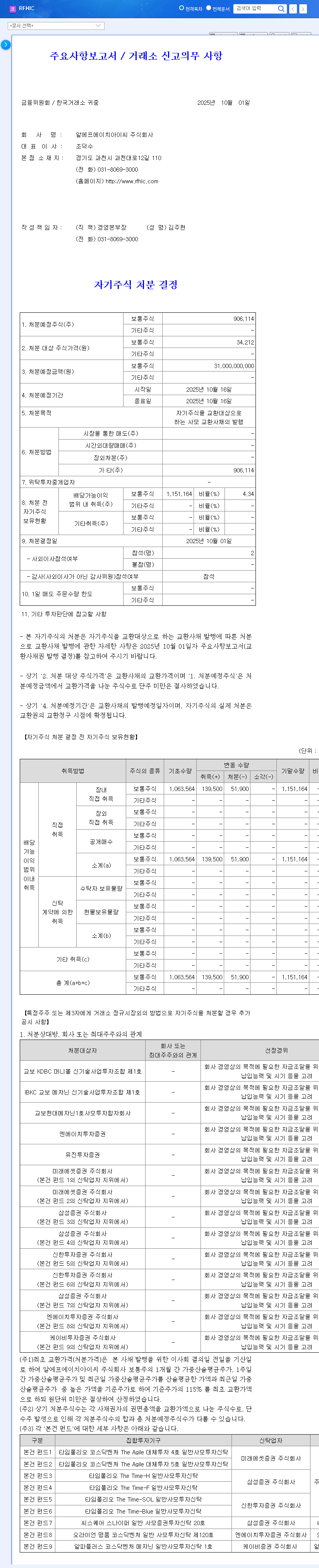
    On October 1, 2025, RFHIC officially announced its decision to issue KRW 31 billion in private exchangeable bonds. An exchangeable bond is a type of hybrid debt security that can be exchanged for a specific number of shares of a different company’s stock (in this case, RFHIC’s own treasury stock) at specified times. The move is designed to secure funding for future growth initiatives. For full transparency, investors can review the Official Disclosure on the DART system.

    Source: The complete details of this issuance are publicly available via the official filing with Korea’s Financial Supervisory Service (DART). This filing serves as the primary source for the data analyzed in this report.

    Core Terms of the Bond Issuance

    • Total Value: KRW 31 billion
    • Investor: A private equity fund associated with Timefolio Asset Management
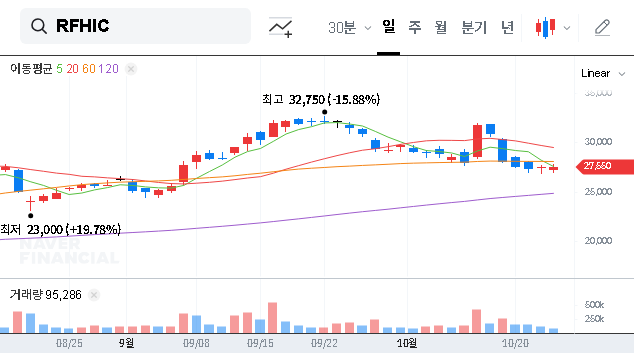
    • Exchange Price: KRW 34,212 (a 17.97% premium over the KRW 29,000 stock price at the time of announcement)
    • Coupon Rate & Yield to Maturity: 0% (zero interest burden for RFHIC)
    • Exchange Period: November 3, 2025, to September 16, 2028

    Decoding RFHIC’s Strategy: Why Now?

    This fundraising initiative isn’t happening in a vacuum. It’s a calculated move based on RFHIC’s current financial position, core technological strengths, and ambitious plans for future markets.

    Financial Health: A Mixed But Solid Picture

    RFHIC’s recent financials present a fascinating paradox. The first half of 2025 saw a ~33% year-over-year decline in revenue, likely due to a global slowdown in 5G infrastructure spending and customer inventory adjustments. However, during the same period, operating profit surged to KRW 12.041 billion. This was achieved through disciplined cost management and a reduction in SG&A expenses. While a significant cut in R&D spending (from 15.6% of revenue in 2023 to 6.5% in 1H 2025) is a point of concern for long-term innovation, the company’s overall financial structure remains robust, with decreasing debt and growing total equity.

    Core Competitiveness: The GaN Semiconductor Advantage

    RFHIC’s true competitive edge is its mastery of Gallium Nitride (GaN) semiconductor technology. Unlike traditional silicon, GaN offers higher efficiency, power density, and frequency operation, making it essential for next-generation technology. The demand for GaN semiconductors is exploding across high-value sectors:

    • 5G Communications: Powering the massive MIMO base stations that form the backbone of 5G networks.
    • Defense & Radar: Enabling more powerful and accurate radar systems for military applications.
    • Satellite Communications: Critical for the growing ‘New Space’ industry, including low-earth orbit (LEO) satellite constellations. For more on this technology, you can consult authoritative sources like the IEEE Spectrum.

    The funds from the RFHIC exchangeable bond are expected to directly fuel expansion in these areas, particularly in the burgeoning satellite communication market, which the company recently added as a core business objective.

    Investor Impact Analysis

    Zero-Interest Capital and Institutional Confidence

    The 0% coupon rate is a massive win for RFHIC. It allows the company to secure KRW 31 billion in long-term capital without incurring any interest expense, preserving cash flow for R&D and strategic investments. Furthermore, the participation of a respected institutional investor like Timefolio Asset Management acts as a strong vote of confidence in RFHIC’s long-term vision and growth potential. This can significantly boost positive market sentiment. For a deeper look at market sentiment indicators, consider exploring our guide to technical analysis in stock trading.

    Stock Price Implications

    The exchange price of KRW 34,212 sets a clear target. It signals that both the company and the investor anticipate significant stock price appreciation before the bond’s maturity in 2028. This premium may attract short-term speculative interest. However, the ultimate driver of the stock price will be performance. If RFHIC successfully executes its growth strategy in the satellite and 5G markets, reaching and exceeding this price is highly plausible. If not, the bonds will be repaid in cash, preventing shareholder dilution but indicating a failure to meet growth expectations.

    Potential Risks to Monitor

    While the outlook is promising, a prudent RFHIC stock analysis must consider the potential headwinds:

    • Revenue Volatility: The company’s revenue is heavily tied to cyclical capital expenditures in the telecom and defense industries.
    • R&D Investment Levels: The recent reduction in R&D spending must be temporary. A sustained decrease could erode RFHIC’s technological lead.
    • Execution Risk: Success in the new satellite communications venture is not guaranteed and requires flawless execution.
    • Market & Exchange Rate Factors: As a major exporter, RFHIC is exposed to KRW/USD exchange rate volatility and broader macroeconomic trends.

    Conclusion: Strategic Outlook for Investors

    The RFHIC exchangeable bond issuance is a net positive, signaling strong institutional confidence and providing zero-cost fuel for its high-growth ventures. For investors, the strategy depends on your time horizon:

    Short-Term Traders may find opportunities in the volatility and positive sentiment surrounding the announcement, but should remain cautious given the gap between the current stock price and the high exchange price.

    Long-Term Investors should focus on the fundamentals. The key metrics to watch will be the recovery of revenue growth, a return to higher R&D investment, and tangible progress in the satellite communications business. If RFHIC can leverage its GaN dominance and execute effectively, the period leading up to the 2028 maturity date could be very rewarding.

    (218410) RFHIC Exchangeable Bond: In-Depth 2025 Analysis for Investors 관련 이미지
  • Intellian Technologies Q2 Earnings Shock: What Investors Need to Know

    1. What Happened? : Q2 Earnings Breakdown

    Intellian Technologies reported Q2 2025 revenue of KRW 74.7 billion, operating profit of KRW 1.8 billion, and a net loss of KRW 4.1 billion. While revenue was in line with market expectations, the substantial net loss triggered an earnings shock.

    2. Why Did This Happen? : Reasons for the Decline

    The primary driver was a sharp decline in sales of maritime satellite communication antennas. Factors like the global decrease in maritime cargo volume and slowdown in shipbuilding orders contributed to a 47.6% year-over-year decrease in revenue, reaching KRW 78.9 billion (for the first half of the year). Although the land antenna segment showed growth potential due to the expanding LEO/MEO market, it couldn’t offset the maritime sector’s struggles. High debt and increasing inventory levels also posed financial challenges.

    3. What’s Next? : Future Outlook and Investment Strategies

    In the short term, downward pressure on stock price and weakened investor sentiment are anticipated. However, long-term positive factors include LEO/MEO market growth and potential returns from R&D investments. Key variables to watch are the timing of the maritime sector’s recovery and improvements in financial health.

    4. What Should Investors Do? : Action Plan

    • Short Term: Closely monitor stock price volatility following the earnings announcement and adopt a wait-and-see approach.
    • Long Term: Carefully track the growth trends in the LEO/MEO market, the potential recovery of the maritime sector, R&D investment outcomes, and changes in key financial health indicators.

    Frequently Asked Questions

    Why did Intellian Technologies’ Q2 earnings disappoint?

    A sharp decline in sales within the maritime satellite communication antenna segment was the main driver, significantly impacted by the global decrease in maritime cargo volume and a slowdown in new shipbuilding orders.

    What is the outlook for Intellian Technologies?

    While downward pressure on the stock price is expected in the short term, there is potential for recovery in the long term driven by growth in the LEO/MEO market. The recovery of the maritime sector and improvements in financial health are key factors to monitor.

    How should investors react?

    A cautious approach is recommended in the short term. Long-term investors should closely monitor growth trends in the LEO/MEO market, the potential for maritime sector recovery, and changes in key financial indicators.

  • Intellian Technologies Lands $21M Satellite Antenna Contract: What it Means for Investors

    What Happened? 🤔

    Intellian Technologies announced a $21 million contract with AST SpaceMobile on August 11, 2025, to supply Direct-to-Device (D2D) satellite communication gateway antennas. The contract period runs from August 8, 2025, to December 31, 2026.

    Why Does it Matter? 🧐

    This contract provides Intellian Technologies with a new growth driver. It offsets the recent downturn in the maritime and land-based satellite antenna markets and provides a foothold in the emerging D2D market. Furthermore, partnering with a global company validates their technology and increases the likelihood of securing future contracts.

    What’s Next? 🔮

    Representing 10.88% of the company’s annual revenue for 2025, this contract is expected to contribute to short-term performance improvement. However, the success of AST SpaceMobile’s business, currency fluctuations, and increased competition are factors to watch.

    What Should Investors Do? 💡

    • Investors should be mindful of short-term stock volatility and consider investing with a medium to long-term perspective.
    • Monitor the progress of AST SpaceMobile’s business and confirm actual revenue growth.
    • Continuously track global satellite communication market trends and changes in the competitive landscape.
    • Consider the impact of currency fluctuations on profitability.

    Frequently Asked Questions

    What is the value of this contract?

    $21 million.

    Who is the contract partner?

    AST SpaceMobile.

    What are the key details of the contract?

    Supplying AST SpaceMobile with D2D satellite communication gateway antennas.