Tag: SAMSUNG ELECTRONICS CO

  • (005930) Samsung Electronics Stock: In-Depth Analysis of C&T Stake Sale & Future Outlook

    (005930) Samsung Electronics Stock: In-Depth Analysis of C&T Stake Sale & Future Outlook

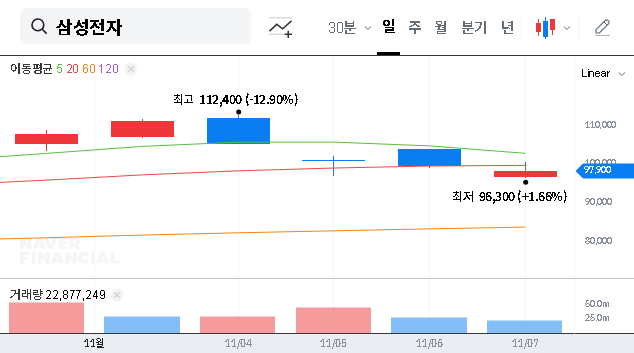
    The latest disclosure regarding the Samsung Electronics stake sale has sent ripples through the investment community, raising critical questions about the future of Samsung Electronics stock and its intricate governance structure. On November 7, 2025, a ‘Report on Large Shareholding Status’ revealed significant share disposals by Samsung C&T and key family members. While this may cause short-term market anxiety, a deeper analysis reveals a more nuanced picture involving family succession, tax obligations, and the company’s robust underlying fundamentals. This report provides a comprehensive breakdown of the event and strategic guidance for investors navigating this complex landscape.

    The Official Disclosure: Deconstructing the Stake Sale

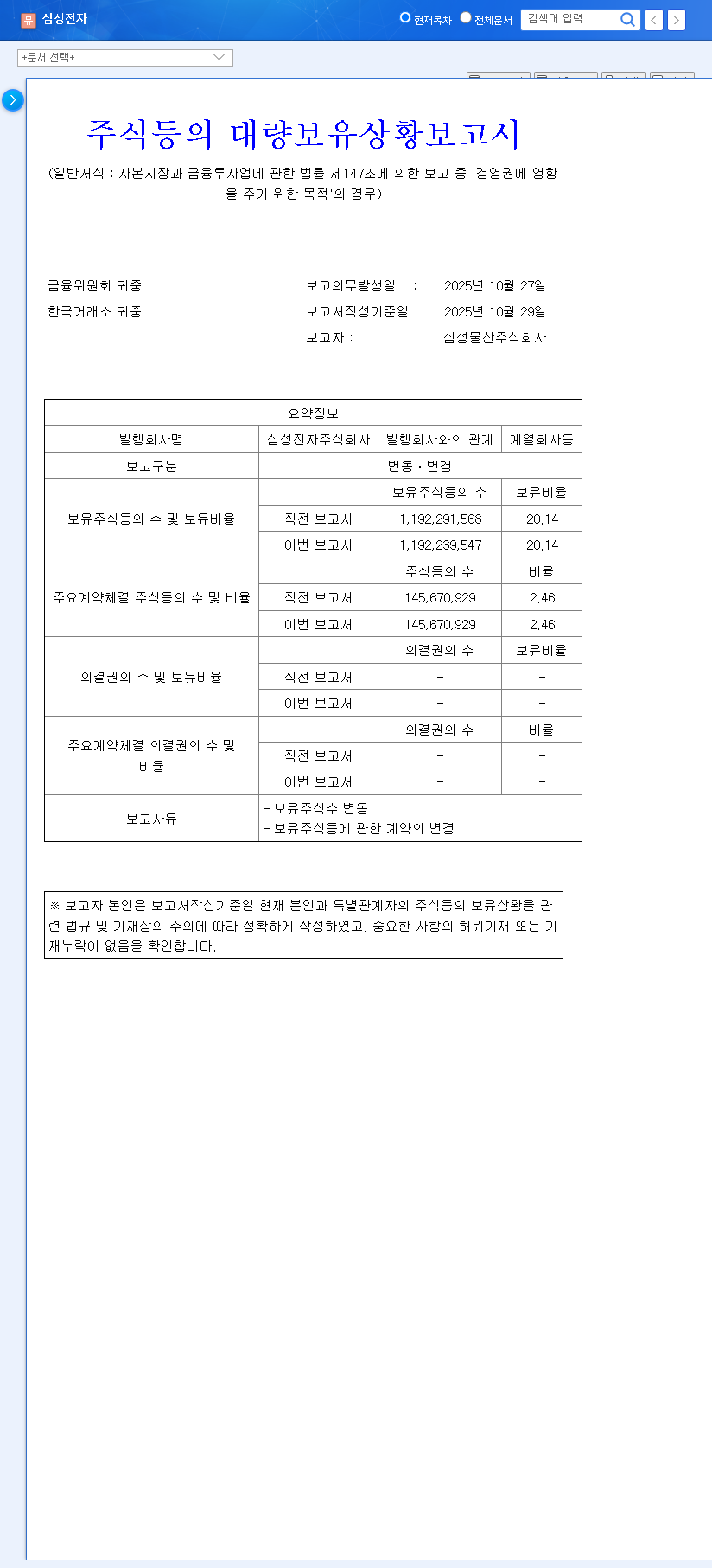
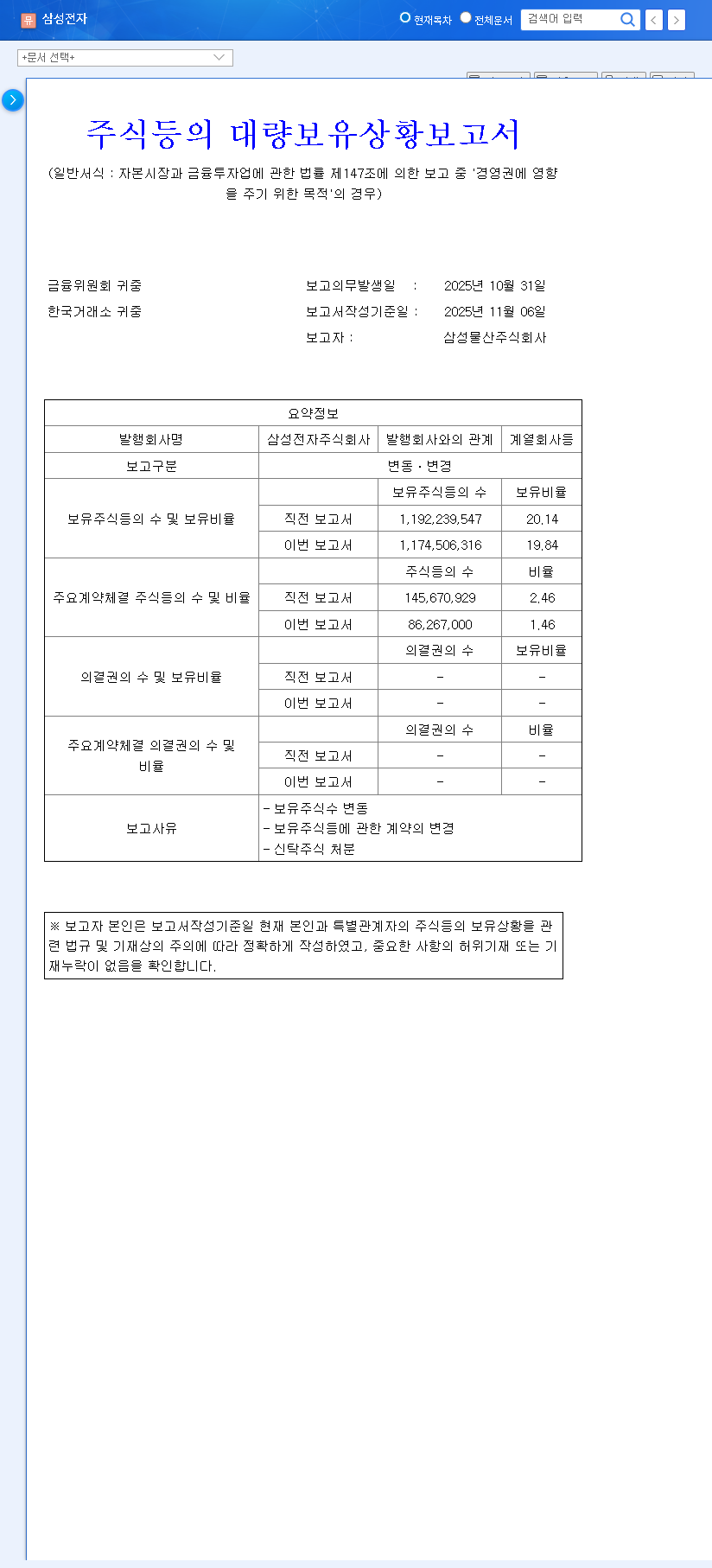
    The filing, submitted for Samsung Electronics, a behemoth with a market capitalization of KRW 579.53 trillion, detailed several key transactions. The complete filing can be reviewed in the Official Disclosure (DART Report). The primary changes are as follows:

    • Samsung C&T: The de facto holding company of the Samsung group, reduced its stake by 0.30 percentage points, from 20.14% down to 19.84%. The stated purpose of holding remains ‘influence on management rights.’
    • Samsung Life Insurance: Engaged in net selling of 13,991 shares between November 4 and 6, 2025.
    • Family Members’ Divestment: Through after-hours trading, significant blocks were sold by Lee Boo-jin (6,000,000 shares), Lee Seo-hyun (1,716,000 shares), and Hong Ra-hee (10,000,000 shares), the wife of the late chairman Lee Kun-hee.

    Analyzing the Impact on Stock and Management Control

    The central concern for investors is how this shift in Samsung shareholding affects both the stock’s stability and the family’s grip on the conglomerate.

    Is Samsung Management Control Under Threat?

    The 0.30%p reduction by Samsung C&T is, in isolation, not substantial enough to pose an immediate threat to Samsung management control. The remaining 19.84% stake is a powerful position. However, any reduction from the entity whose stated purpose is ‘influence’ sends a signal to the market, prompting speculation about long-term strategy and governance evolution. The reasons cited, such as trust share disposals, often point towards liquidity needs or financial restructuring rather than a strategic retreat from control.

    Market Supply and the Inheritance Context

    The large-scale sales by family members are more likely to create short-term volatility. This sudden influx of shares can create downward pressure on Samsung Electronics stock. However, it’s crucial to view this within the context of South Korea’s notoriously high inheritance tax laws. As reported by financial news outlets like Bloomberg, the Samsung heirs face a multi-billion dollar tax bill, often necessitating share sales to raise the required funds. This suggests the sales are driven by personal financial obligations rather than a loss of faith in the company’s future.

    While share sales by major stakeholders can spook the market, it’s vital to differentiate between personal liquidity events and a fundamental shift in corporate strategy. In this case, the context points heavily towards the former.

    Beyond the Sale: Samsung’s Core Fundamentals Remain Strong

    Investors should look past the short-term noise and focus on Samsung’s robust business fundamentals. The company’s strength is diversified across its two main pillars: the Device eXperience (DX) division, which includes mobile phones and home appliances, and the Device Solutions (DS) division, the semiconductor powerhouse. Long-term growth is underpinned by leadership in AI, the expansion of High Bandwidth Memory (HBM) for data centers, and a growing presence in the automotive electronics sector. For more on this, see our guide to understanding semiconductor market cycles.

    Investment Strategy: A Prudent Approach

    Given the circumstances, a two-pronged investment strategy is advisable for those holding or considering Samsung Electronics stock.

    • Short-Term Caution: Monitor the market’s absorption of the newly available shares. Further price dips are possible, which could present a buying opportunity for those with a long-term horizon. Avoid panic-selling based on this news alone.
    • Long-Term Focus: Base your primary investment thesis on Samsung’s technological leadership, market position, and financial health. The company’s ability to innovate in high-growth areas like AI and foundry services remains its core value driver, independent of these shareholding adjustments.

    Frequently Asked Questions (FAQ)

    Q1: What does this Samsung Electronics stake sale disclosure mean?

    A1: It signifies that Samsung C&T and key members of the founding family have sold a portion of their shares. This is widely believed to be related to personal financial planning, including raising funds to pay substantial inheritance taxes, rather than a negative outlook on the company.

    Q2: Is Samsung’s management control at risk?

    A2: The current reduction is minor and does not pose an immediate threat to management control. The Samsung C&T stake remains the cornerstone of the group’s governance structure, and at 19.84%, it is still a formidable controlling position.

    Q3: How will the large-scale selling affect the stock price?

    A3: In the short term, it can increase market supply and potentially lead to price drops or increased volatility as the market absorbs the shares. However, the long-term price will be driven by the company’s performance and fundamentals.

    Q4: What should investors do in response to this news?

    A4: Short-term investors should be cautious and watch for selling pressure to subside. Long-term investors should focus on Samsung’s strong business fundamentals, technological leadership, and growth prospects, as these factors will ultimately determine the stock’s value.
    (005930) Samsung Electronics Stock: In-Depth Analysis of C&T Stake Sale & Future Outlook 관련 이미지
  • (005930) Samsung Electronics Stock Analysis (2025): Future Growth, Shareholding & AI Outlook

    (005930) Samsung Electronics Stock Analysis (2025): Future Growth, Shareholding & AI Outlook

    This comprehensive Samsung Electronics stock analysis provides a meticulous look into the company’s current standing and future trajectory. Following a recent large shareholding report from Samsung C&T, investors are keen to understand the implications for management stability, stock performance, and long-term value. Simply looking at share percentages misses the bigger picture.

    We will dissect the details of this report, evaluate Samsung Electronics’ fundamentals based on its H1 2025 performance, and identify the key Samsung Electronics future growth engines. We’ll also examine how macroeconomic variables could shape its path forward, offering an expert perspective for savvy investors.

    Unpacking the Samsung C&T Shareholding Report

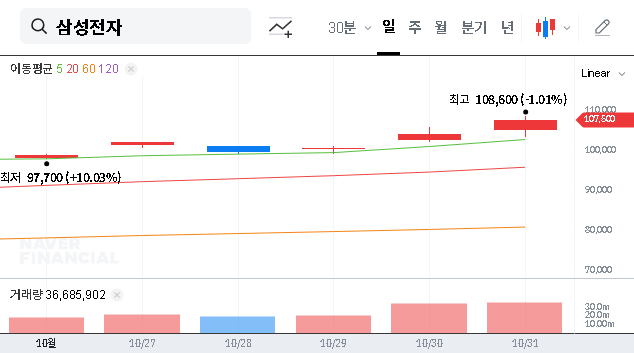
    On October 31, 2025, Samsung C&T filed a ‘Report on the Status of Large Shareholdings’ concerning Samsung Electronics. The filing, available via this Official Disclosure, confirmed that Samsung C&T’s stake in Samsung Electronics Co., Ltd. remained unchanged at 20.14%. The primary reason cited for the report was minor changes in share-related contracts and small-scale transactions by related parties, not a strategic shift in ownership.

    The key takeaway from the report is not change, but stability. It reaffirms a consistent governance structure, which is a crucial factor for long-term investors conducting a thorough Samsung Electronics stock analysis.

    What This Signifies for Governance and Stability

    The report explicitly states the holding purpose as ‘Influence over Management.’ This is a clear signal of Samsung C&T’s enduring commitment to participating in Samsung Electronics’ core strategic decisions. As a central entity in the group’s governance, this ensures a consistent and stable management direction. The minor share transactions by Samsung Life Insurance were part of routine portfolio adjustments and are too small to have any meaningful impact on the Samsung Electronics stock price or overall ownership structure.

    Deep Dive: Samsung Electronics’ Robust Fundamentals (H1 2025)

    Beyond governance, the company’s H1 2025 performance reveals powerful growth drivers that are solidifying its role as a leader in the AI era. These fundamentals are the true engine behind the company’s value.

    Powering the AI Revolution: The DS (Device Solutions) Division

    The semiconductor division is at the heart of Samsung Electronics future growth. Surging demand for AI servers has fueled impressive sales of high-bandwidth memory like HBM3E and high-capacity DDR5 modules. The company is also pushing the boundaries of technology by launching 2nm foundry products for mobile applications, strengthening its competitive edge against rivals. This positions Samsung to capture a significant share of the expanding AI chip market, which market analysts predict will see exponential growth.

    Dominating Consumer Tech: DX, SDC, and Harman

    Samsung’s other divisions continue to perform strongly:

    • DX (Device Experience): Continued leadership in the TV and mobile markets, highlighted by an expanded AI TV lineup and enhanced Galaxy AI features that are defining the next generation of smartphones.
    • SDC (Samsung Display): The OLED panel business is thriving, with diversification into IT, automotive, and foldable device applications ensuring a broad revenue base.
    • Harman: Showing impressive growth in lifestyle audio and successfully nurturing its automotive components business for next-gen vehicles.

    Navigating Macroeconomic Headwinds

    While the Samsung C&T shareholding news has a limited short-term impact, global economic factors will play a more significant role. Investors should monitor several key variables:

    • Interest Rates: Potential rate cuts by the US Federal Reserve (policy rate at 4.00%) could boost investor sentiment and appetite for tech stocks. The correlation with Korea’s policy rate (2.50%) will be crucial.
    • Exchange Rate Fluctuations: A strong US dollar against the Korean Won (KRW/USD ~1,648) benefits export profitability but introduces volatility risk for a global operator like Samsung.
    • Commodity & Shipping Costs: Volatility in oil prices and changes in shipping costs, reflected by indicators like the Baltic Dry Index, directly impact manufacturing and logistics expenses.

    Conclusion: Investor Outlook for Samsung Electronics

    This event should be viewed as a confirmation of long-term stability rather than a trigger for short-term price movement. Our Samsung Electronics stock analysis concludes that the company’s intrinsic value and future growth potential are the primary factors to consider. The company is strategically positioned to capitalize on the AI boom, supported by a diverse portfolio and a stable governance structure.

    Investors should focus on the execution of its AI and advanced semiconductor strategies while keeping an eye on the broader economic environment. To understand the market better, consider reading our complete guide to investing in the semiconductor sector. Samsung Electronics’ technological leadership and market dominance suggest a strong capacity for sustained growth, provided it continues to manage global risks effectively.

    (005930) Samsung Electronics Stock Analysis (2025): Future Growth, Shareholding & AI Outlook 관련 이미지
  • (005930) Samsung Electronics Stock: Analysis of Treasury Stock Disposition & H1 2025 Performance

    (005930) Samsung Electronics Stock: Analysis of Treasury Stock Disposition & H1 2025 Performance

    For investors evaluating Samsung Electronics stock, a recent corporate action—the disposition of treasury stock—offers a valuable lens through which to view the company’s strategy and health. While seemingly a minor event, it provides crucial context when paired with the company’s strong H1 2025 performance and the broader macroeconomic landscape. This analysis will dissect what this move signifies for employee incentives, future growth, and overall investment value.

    We will move beyond a simple news brief to provide an in-depth examination of Samsung’s corporate fundamentals, market position, and the potential impact of global economic trends, empowering you with the insights needed for an informed investment strategy.

    The key for investors is to understand how small corporate actions, like a treasury stock disposition, fit into the larger picture of a company’s financial strength and long-term vision.

    Unpacking the Treasury Stock Disposition

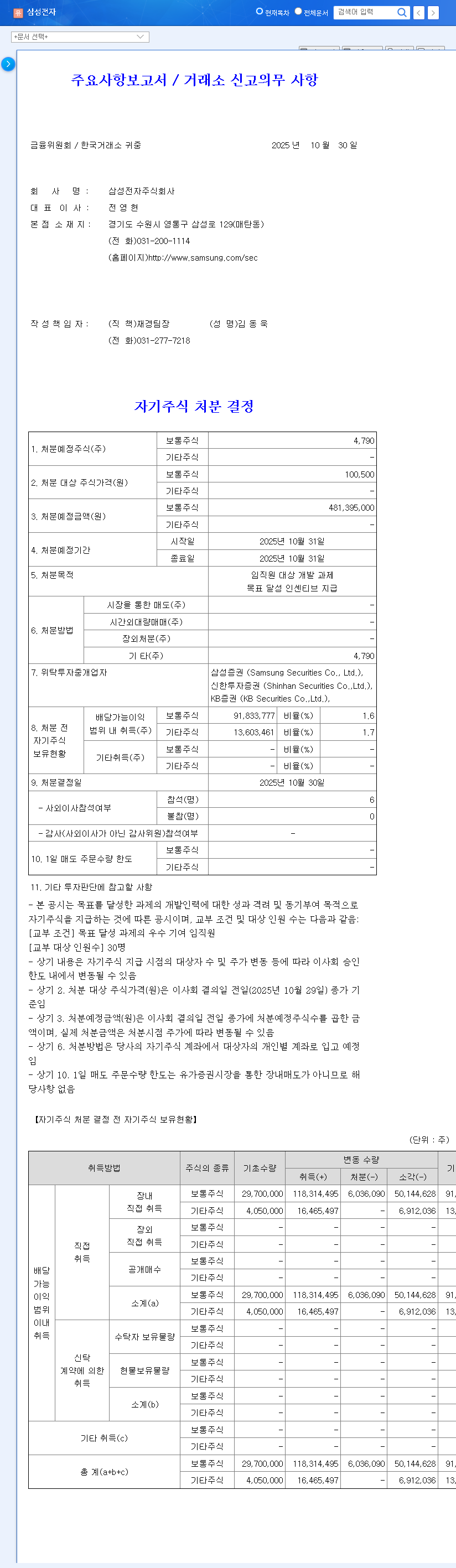
    On October 30, 2025, Samsung Electronics filed a disclosure regarding a Treasury Stock Disposition Decision. This event, while modest in scale, is a deliberate strategic move. The official report can be viewed directly from the source (Source: Official Disclosure).

    Key Details of the Disposition

    • Purpose: To provide performance-based incentives for employees who achieved key development project goals.
    • Shares Disposed: 4,790 common shares.
    • Total Value: Approximately 500 million KRW.
    • Intermediaries: Samsung Securities, Shinhan Investment Corp., KB Securities.

    The primary implication is positive: Samsung is using its own equity to reward and retain top talent, directly aligning employee performance with shareholder interests. Given the minuscule number of shares relative to the total outstanding, concerns about share dilution are negligible. This is less about financial engineering and more about fostering a culture of innovation and excellence.

    Analyzing Samsung Electronics Stock Performance & H1 2025 Fundamentals

    The company’s fundamentals provide a robust backdrop to this corporate action. Samsung Electronics reported impressive financial results for the first half of 2025, showcasing resilience and growth. Sales reached 153.71 trillion KRW, a solid 5.3% increase year-over-year.

    Core Growth Drivers

    • Device eXperience (DX) Division: This consumer-facing segment, including mobiles and electronics, grew by 6.6%, signaling strong brand loyalty and product appeal.
    • Device Solutions (DS) Division: Growing by 2.5%, this division was significantly boosted by the explosive demand for AI-oriented servers. This has led to increased sales of high-performance server DRAM and SSDs, a critical area for future growth. For more on this trend, read our detailed analysis of the semiconductor market.
    • Technological Leadership: Continuous R&D investment is paying off with the mass production of 6th-gen 10nm-class DRAM and the development of GDDR7 DRAM, keeping Samsung at the forefront of the memory market.

    Navigating Macroeconomic Headwinds

    No company operates in a vacuum, and Samsung’s performance is influenced by global economic conditions. As reported by leading financial news outlets, factors like currency fluctuations, interest rates, and commodity prices create a complex operating environment. The volatility of the Korean Won against the US Dollar and Euro directly impacts import costs and export revenues. While stable policy interest rates are a positive, global economic uncertainty and geopolitical risks remain persistent concerns that savvy investors must monitor.

    Investment Outlook: A Mid-to-Long Term Perspective

    The outlook for Samsung Electronics stock remains positive, underpinned by its solid H1 2025 performance and strategic positioning in high-growth markets like AI. The recovery of the semiconductor industry, coupled with aggressive R&D and shareholder-friendly policies, enhances its investment appeal.

    Key Takeaways for Investors

    • Focus on Fundamentals: The treasury stock disposition is a minor event. The real story lies in the company’s strong divisional performance and technological edge.
    • AI is the Catalyst: The DS division’s growth, fueled by AI server demand, is a powerful indicator of Samsung’s alignment with the most significant tech trend of the decade.
    • Adopt a Long-Term View: Short-term market noise from macroeconomic data should be weighed against the company’s long-term growth potential in AI, automotive semiconductors, and its foundry business.

    In conclusion, while the Samsung treasury stock disposition is a positive signal of its corporate culture, investors should anchor their decisions in the company’s robust business fundamentals. With a strong foothold in the burgeoning AI market and a recovering semiconductor industry, Samsung Electronics presents a compelling case for those with a mid-to-long-term investment horizon.

    (005930) Samsung Electronics Stock: Analysis of Treasury Stock Disposition & H1 2025 Performance 관련 이미지
  • (005930) SAMSUNG ELECTRONICS Stock: Investment Strategy After ₩1.15B Donation & ESG Analysis

    (005930) SAMSUNG ELECTRONICS Stock: Investment Strategy After ₩1.15B Donation & ESG Analysis

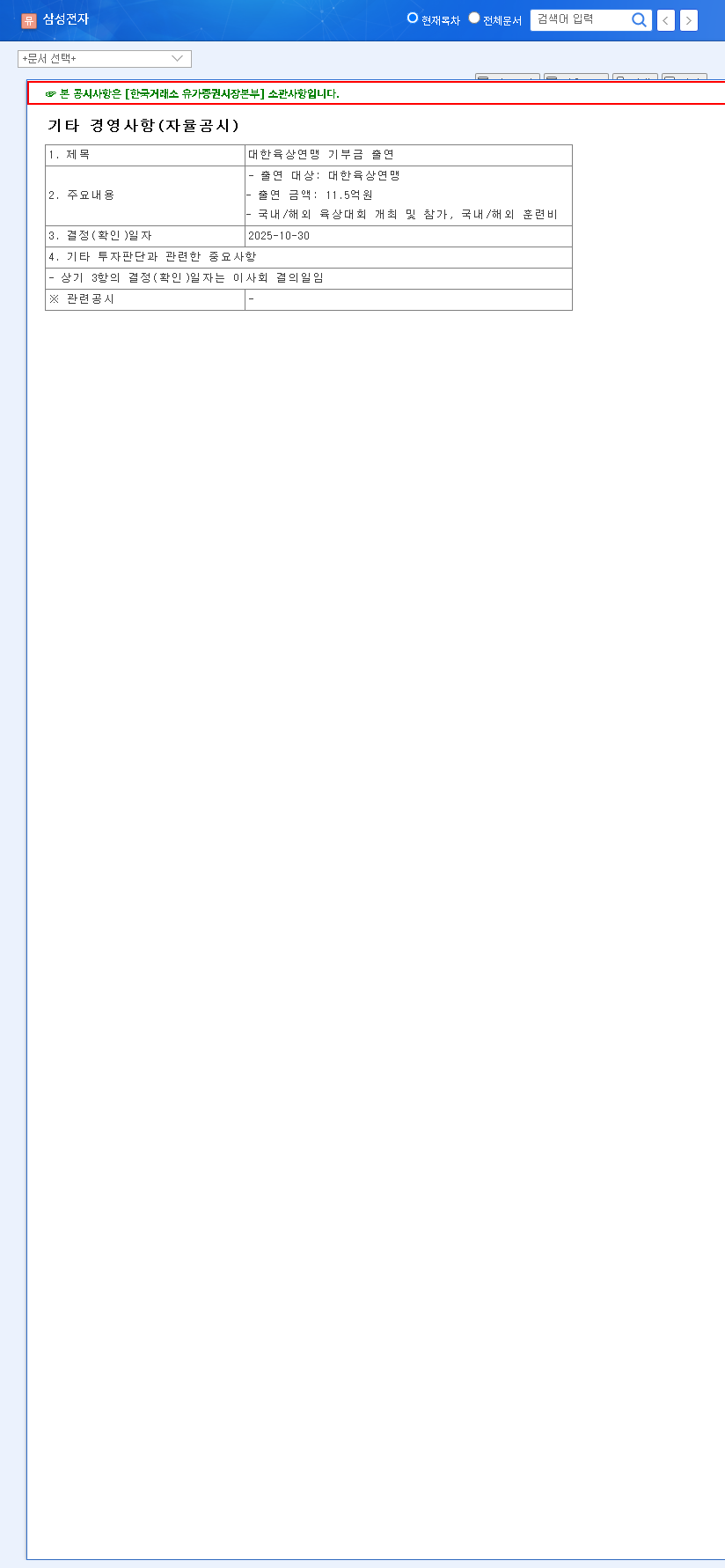
    Tech giant Samsung Electronics recently made headlines with a significant ₩1.15 billion donation to the Korea Athletics Federation. While this act of corporate social responsibility (CSR) is commendable, astute investors are asking a crucial question: What does this mean for SAMSUNG ELECTRONICS stock and the company’s long-term value? This news, though seemingly minor against Samsung’s massive scale, offers a valuable window into its strengthening commitment to ESG (Environmental, Social, and Governance) principles—a factor of growing importance in modern investment analysis.

    In this comprehensive analysis, we will move beyond the headlines to dissect the real impact of this donation. We’ll explore the immediate (and likely minimal) effect on stock volatility, the significant long-term benefits for Samsung’s corporate image and ESG profile, and how this fits into a broader Samsung investment strategy based on its robust financial fundamentals and the current macroeconomic landscape.

    The Event: A Strategic Donation to National Athletics

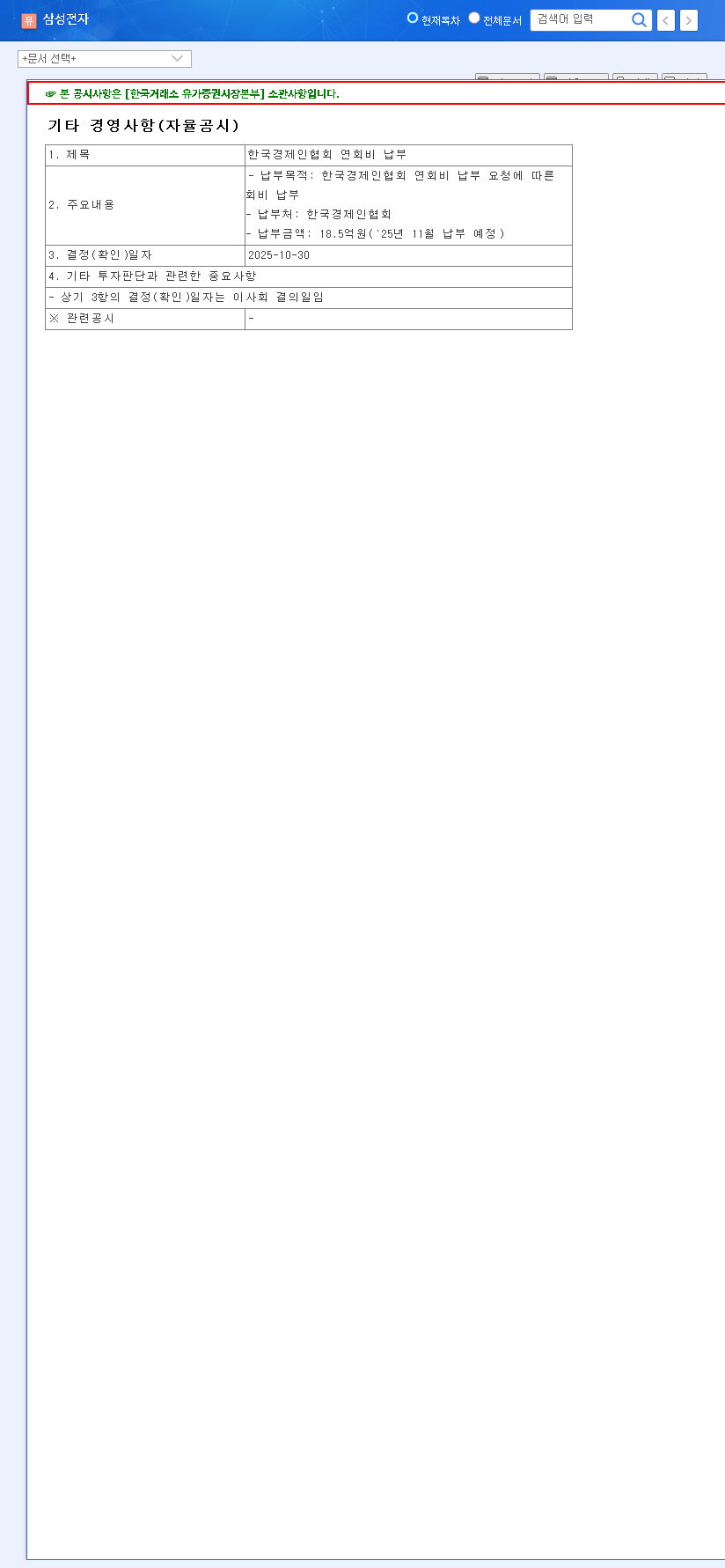
    On October 30, 2025, Samsung Electronics formally announced its ₩1.15 billion contribution to the Korea Athletics Federation. According to the company’s official disclosure, this funding is earmarked to bolster the entire track and field ecosystem in Korea. The support will cover hosting national competitions, facilitating participation in international events, and directly funding athlete training programs. This is a clear move by Samsung to reinforce its role as a key corporate citizen in its home country. You can view the Official Disclosure (DART) for more details. While a positive public relations move, its true investment value lies deeper.

    Analyzing the Impact on SAMSUNG ELECTRONICS Stock

    Short-Term Volatility: A Non-Event for the Market

    For a behemoth like Samsung, a donation of ₩1.15 billion (approximately $850,000 USD) is financially negligible. It will not materially affect the company’s quarterly earnings, cash flow, or balance sheet. Consequently, the direct, short-term impact on the SAMSUNG ELECTRONICS stock price is expected to be minimal to non-existent. The market is far more concerned with semiconductor demand, smartphone sales, and global economic indicators. Any positive sentiment from the news is unlikely to translate into a sustained stock price movement on its own.

    Long-Term Value: The Growing Power of Samsung ESG

    The real story here is the contribution to Samsung’s ESG profile. ESG investing is no longer a niche strategy; it’s a mainstream requirement for many of the world’s largest institutional investors. This donation directly strengthens the ‘S’ (Social) pillar of Samsung’s ESG rating.

    Consistent and visible social contributions enhance corporate reputation, build brand loyalty, and attract long-term, stable capital from ESG-focused funds. This, in turn, can reduce investment risk and support a higher valuation for the company over time.

    Furthermore, this partnership could create marketing synergies, aligning the high-performance image of athletics with Samsung’s technology brand. For investors, a strong Samsung ESG track record is a proxy for good governance and forward-thinking management, making it a more attractive long-term holding.

    Beyond the News: A Look at Samsung’s Core Fundamentals

    A sound Samsung investment strategy must be rooted in its fundamental financial health, not single news events. The H1 2025 report reveals a resilient and forward-looking company. While the semiconductor (DS) division faced headwinds, the mobile and home appliance (DX) division showed strong growth, powered by premium AI-integrated products. Crucially, demand for AI server components like DRAM and SSDs is a powerful tailwind for the future.

    The company’s financial position is exceptionally strong:

    • Rock-Solid Balance Sheet: A minuscule debt-to-equity ratio of just 0.264% indicates immense financial stability and low risk.
    • Massive Cash Generation: Operating cash flow stood at an impressive ₩33.9 trillion, providing ample capital for R&D, strategic investments, and shareholder returns.
    • Shareholder Commitment: A clear policy of returning 50% of free cash flow, alongside annual dividends of ~₩9.8 trillion, underscores its investor-friendly stance.

    These fundamentals are the true drivers of the SAMSUNG ELECTRONICS stock value. For a broader view on market conditions, investors often consult sources like global economic reports from Reuters to understand macroeconomic trends.

    Investment Strategy & Recommendations

    Given this analysis, the donation news should be viewed as a positive but minor data point. It reinforces the qualitative strengths of the company but does not alter the quantitative investment thesis. A prudent strategy involves:

    • Focus on the Core Business: Base investment decisions on the outlook for the semiconductor cycle, AI-driven demand, and competition in the mobile device market. These factors will have a far greater impact on revenue and profit. For more on this sector, see our complete guide to investing in semiconductor stocks.
    • Monitor ESG as a Long-Term Catalyst: Continue to track Samsung’s ESG initiatives. An improving score can attract more institutional capital and de-risk the investment over the long haul.
    • Watch Macroeconomic Indicators: Keep an eye on currency fluctuations (USD/KRW), global interest rate policies, and raw material costs, as these external variables significantly influence Samsung’s profitability.

    Disclaimer: This article is for informational purposes only and does not constitute investment advice. All investment decisions should be made with the consultation of a qualified financial advisor.

    (005930) SAMSUNG ELECTRONICS Stock: Investment Strategy After ₩1.15B Donation & ESG Analysis 관련 이미지
  • (005930) Samsung Electronics Stock Price: 2025 Analysis & Investment Strategy

    (005930) Samsung Electronics Stock Price: 2025 Analysis & Investment Strategy

    Analyzing the Samsung Electronics stock price requires a multi-faceted approach, moving beyond simple earnings reports. With its robust 2025 first-half performance and a significant new social contribution, investors are weighing the company’s fundamentals against a complex global economic backdrop. This analysis provides a deep-dive into Samsung’s current standing, the real-world impact of its ESG initiatives, and a forward-looking Samsung investment strategy for savvy investors.

    We’ll explore the key drivers behind its recent success, the long-term significance of its corporate social responsibility, and the macroeconomic headwinds that could influence future Samsung corporate value. This will equip you with the critical insights needed to make informed decisions about this tech giant.

    Unpacking the Samsung 2025 Performance Report

    Samsung Electronics showcased formidable strength in its 2025 Half-Year report, with both its DX (Device eXperience) and DS (Device Solutions) divisions demonstrating significant performance improvements. This solidifies its market leadership and points to powerful growth engines for the future.

    Key Division Highlights and Growth Drivers

    • DX (Device eXperience): The consumer-facing division continues its global dominance, marking 19 consecutive years as the top TV seller and 14 years in mobile shipments. The strategic integration of AI across its device ecosystem and innovation in foldable form factors are not just features; they are crucial elements solidifying market share and creating new revenue streams.
    • DS (Device Solutions): The semiconductor division is benefiting immensely from the recovery of the memory market and the explosive demand for AI servers. This is a primary driver impacting the Samsung Electronics stock price. Furthermore, its expansion into automotive semiconductors and enhanced competitiveness in advanced Foundry processes signal robust, long-term growth potential.
    • Samsung Display & Harman: SDC is poised to capitalize on the growing OLED market, while Harman’s focus on software-defined vehicle (SDV) technology positions it perfectly for the future of the automotive industry.

    The Strategic Value of Samsung’s ESG Commitment

    On October 30, 2025, Samsung announced a donation of 3.79 billion KRW to the Hoam Foundation. According to the Official Disclosure filed with DART, this reinforces its commitment to social contribution. While the financial sum is negligible for a company of Samsung’s scale, its strategic importance in enhancing the company’s Samsung ESG profile cannot be overstated.

    In the mid-to-long term, a strong ESG record is crucial. It improves corporate image, attracts large institutional investors who have ESG mandates, and can lead to a higher overall Samsung corporate value. Supporting talent through the prestigious Samsung Hoam Prize also contributes to an innovation ecosystem that indirectly benefits Samsung’s future competitiveness. This is a key part of any modern Samsung investment strategy.

    While the donation won’t move the needle on this quarter’s earnings, its true value lies in building a resilient brand and attracting long-term, stable investment capital. ESG is no longer a footnote; it’s a core component of risk management and brand equity.

    Navigating Macroeconomic Headwinds

    Despite Samsung’s strong fundamentals, its stock price is not immune to the wider economic environment. Investors must monitor these external factors, which often have a more immediate impact than internal corporate actions. For a broader view on market trends, investors often consult sources like Reuters Financial News.

    Key Risks to Consider:

    • Currency Volatility: As a major exporter, a stronger Korean Won can negatively impact Samsung’s repatriated earnings and profitability.
    • High Interest Rates: Elevated rates increase corporate borrowing costs for things like new fabrication plants and can dampen consumer demand for high-end electronics.
    • Global Economic Slowdown: General inflation and reduced consumer spending power can directly impact sales of smartphones, TVs, and other core products.
    • Intense Competition: The pressure on pricing and market share from competitors in every segment, especially semiconductors, is a constant challenge.

    Investor Outlook & Action Plan

    In conclusion, the Samsung Electronics stock price will be shaped by the interplay between its stellar fundamentals and challenging macroeconomic conditions. The ESG donation is a positive long-term signal, but investors should focus on core metrics like the semiconductor market rebound and global economic trends.

    A sound Samsung investment strategy involves recognizing the company’s long-term growth potential in AI and automotive tech while remaining agile in response to external risks. Continuous monitoring of global inflation, monetary policy, and future earnings reports is essential. For those looking to broaden their knowledge, consider reading our guide to analyzing large-cap tech stocks. Samsung’s robust structure and innovation pipeline support a positive long-term outlook, provided it can adeptly navigate an uncertain global landscape.

    (005930) Samsung Electronics Stock Price: 2025 Analysis & Investment Strategy 관련 이미지
  • (005930) Samsung Electronics Investment Analysis: H1 2025 Report & Stock Forecast

    (005930) Samsung Electronics Investment Analysis: H1 2025 Report & Stock Forecast

    Welcome to our comprehensive Samsung Electronics investment analysis for the first half of 2025. In an era defined by artificial intelligence and macroeconomic shifts, understanding the core fundamentals of a tech giant like Samsung is crucial. This detailed review of the Samsung H1 2025 report unpacks the performance of each business division, from semiconductors to mobile, providing investors with the critical insights needed to evaluate the company’s future trajectory and potential stock performance.

    We will connect current achievements with historical patterns to offer a clear perspective on Samsung’s present state and highlight key considerations for your investment strategy. Let’s explore the present and future of Samsung Electronics together.

    Samsung’s H1 2025 performance signals a strong recovery in its semiconductor division, fueled by AI demand, which is a pivotal factor for any forward-looking Samsung stock forecast.

    Decoding the Samsung H1 2025 Report: A Divisional Deep Dive

    Samsung Electronics showcased robust operations in H1 2025, navigating global uncertainties with strategic finesse. The pronounced growth in the Device Experience (DX) Division and a significant recovery in the Device Solutions (DS) Division are key highlights, signaling positive momentum.

    Device Experience (DX) Division: AI-Powered Premium Strategy

    The DX Division continues to fortify its market leadership through a dual focus on premium products and AI innovation. In the TV and home appliance sector, Samsung extended its remarkable 19-year streak as the top global TV seller. The expansion of ultra-large TV lineups and the integration of new AI technologies underscore its commitment to innovation. On the mobile front, the sustained growth of foldable phones and the rollout of ‘Galaxy AI’ demonstrate a clear Samsung AI strategy aimed at enhancing service competitiveness in a mature market. While these efforts are promising, a projected slowdown in 2025 TV market demand and geopolitical risks in the smartphone market present potential challenges.

    Device Solutions (DS) Division: The Engine of Recovery

    The DS Division is at the heart of Samsung’s resurgence, led by a rebound in the memory market. This recovery is driven by voracious AI market demand and renewed data center investments. Key points include:

    • Memory Leadership: Surging demand for HBM3E and high-capacity DDR5 products is boosting memory prices and improving profitability, a critical factor for any Samsung stock forecast.
    • System LSI & Foundry: Strategic expansion into the automotive semiconductor market and advancements in 2nm and 3nm GAA processes position Samsung for long-term growth. This is crucial for competing with industry leaders, as detailed in reports from sources like Reuters on the global chip war.

    Macro Environment & Samsung’s Fundamentals

    The global economic landscape significantly influences Samsung’s performance. The weaker Korean Won (USD/KRW 1,431.30) positively impacts export price competitiveness. Moreover, Samsung’s remarkably stable financial structure, a key aspect of its Samsung fundamentals, provides a strong defense against rising interest rates.

    Analyzing Samsung’s Financial Health

    As of H1 2025, Samsung’s financial health remains impeccable. With total assets of KRW 504.9 trillion against liabilities of KRW 105.3 trillion, the resulting debt-to-equity ratio is a low 49.38%. This financial stability is a cornerstone of the company’s resilience. Additionally, a substantial R&D investment of KRW 18.1 trillion (11.8% of sales) underscores a commitment to future growth, aligning with its past patterns of heavy investment in innovation. For verifiable figures, investors can review the Official Disclosure (DART report).

    Actionable Investor Takeaways & Considerations

    This Samsung Electronics investment analysis reveals a company at a pivotal moment. The recovery in semiconductors, driven by AI, is a powerful tailwind. However, investors must remain vigilant.

    • Monitor Macro Trends: Keep a close eye on global inflation, interest rates, and geopolitical tensions, which can impact consumer demand and supply chains.
    • Track the AI Arms Race: Samsung’s success hinges on its ability to compete in the high-stakes AI and semiconductor markets. For more on this, see our deep dive into the global semiconductor market.
    • Value Shareholder Policies: Samsung’s consistent dividend payouts and share buybacks are positive indicators of its commitment to shareholder value.

    Disclaimer: This analysis is based on the provided information, and investment decisions should be made at the investor’s own discretion and responsibility.

    Frequently Asked Questions

    Q1: Which division had the best performance in Samsung’s H1 2025 report?
    The DS (Semiconductor) Division showed the most positive performance, driven by the memory market’s recovery due to strong AI demand and data center investments, which significantly improved profitability.

    Q2: What is the state of Samsung Electronics’ financial health?
    Samsung maintains an exceptionally stable financial structure. As of H1 2025, its debt-to-equity ratio is a low 49.38%, a consistent strength that provides resilience.

    Q3: What are Samsung’s key areas for future growth?
    Samsung is heavily focused on its Samsung AI strategy (e.g., Galaxy AI), expanding into the automotive semiconductor market, and capturing the growing IT and automotive OLED display markets.

    (005930) Samsung Electronics Investment Analysis: H1 2025 Report & Stock Forecast 관련 이미지
  • (005930) Samsung Electronics Q3 2025 Dividend: Complete Investor Analysis & Stock Outlook

    (005930) Samsung Electronics Q3 2025 Dividend: Complete Investor Analysis & Stock Outlook

    The recent Samsung Electronics Q3 2025 Dividend announcement has captured the attention of investors globally. While the commitment to consistent Samsung shareholder return is a welcome sign of stability, it arrives amidst a backdrop of declining operating profits revealed in the latest semi-annual report. This creates a complex picture for current and prospective shareholders. Does this dividend signal underlying financial strength, or does it mask deeper performance challenges?

    This comprehensive guide provides a detailed Samsung stock analysis, dissecting the Q3 2025 dividend decision, evaluating the company’s recent performance, and forecasting the potential impact on its stock price and long-term corporate value. We will equip you with the insights needed to make informed investment decisions regarding one of the world’s leading technology giants.

    Official Q3 2025 Dividend Announcement Details

    Samsung Electronics has reaffirmed its dedication to shareholder returns with the formal declaration of its quarterly cash dividend. The official announcement, filed and available for public review, provides the following key details. You can view the full report here: Official Disclosure.

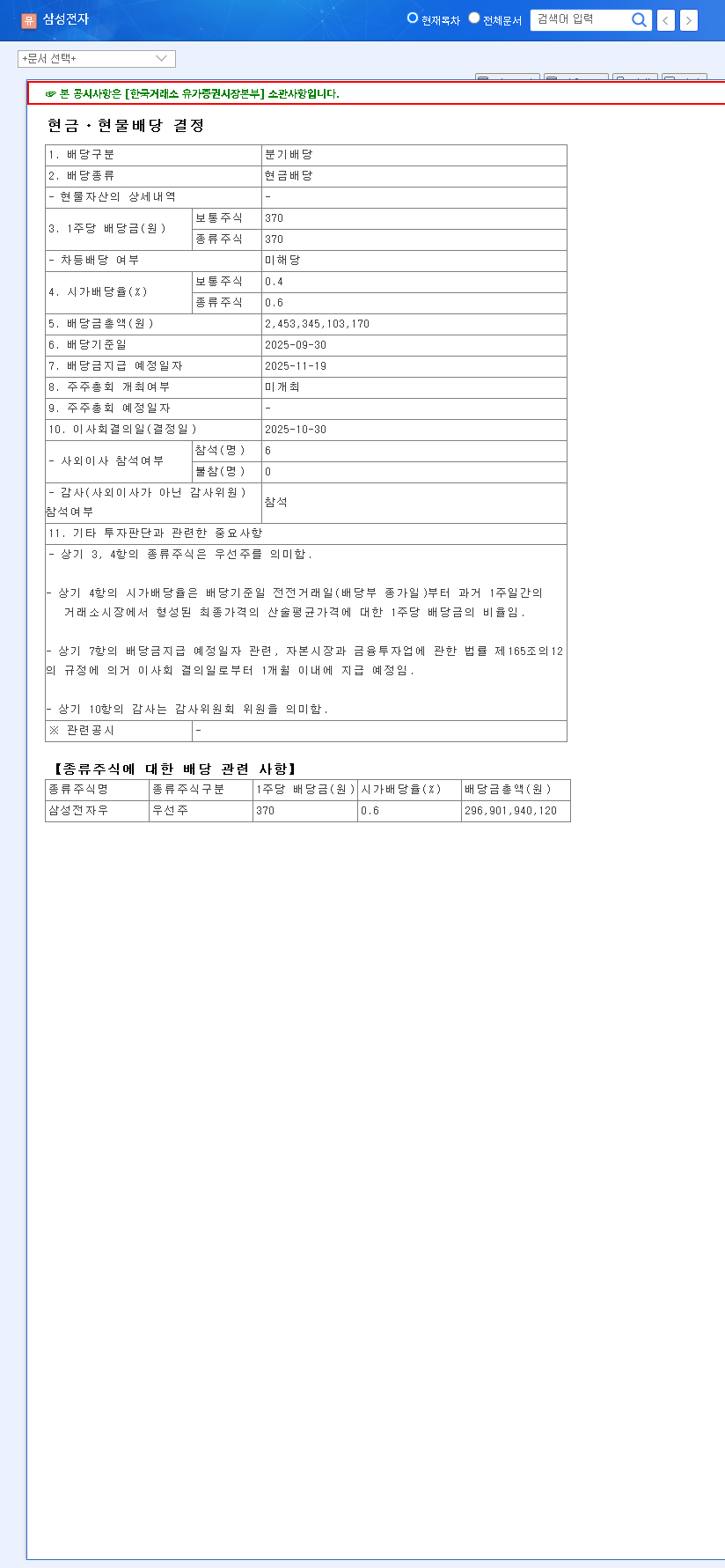
    • Dividend Amount: KRW 370 per common share (0.4% yield) & KRW 370 per preferred share (0.6% yield).
    • Record Date: September 30, 2025.
    • Payment Date: November 19, 2025.
    • Announcement Date: October 30, 2025.

    Performance Deep Dive: A Tale of Two Metrics

    To understand the context of the Samsung Electronics Q3 2025 Dividend, we must analyze the company’s performance in the first half of 2025. While revenue grew to KRW 153.71 trillion, operating profit fell to KRW 11.36 trillion, painting a mixed but concerning picture.

    The Semiconductor Headwind

    The primary driver of the profit decline is the Device Solutions (DS) division, the heart of Samsung’s semiconductor business. This segment is facing significant headwinds from a cyclical downturn in memory chip prices and fierce global competition. The volatility of the semiconductor market, a topic frequently covered by authoritative sources like Reuters, directly impacts Samsung’s bottom line. While the Device eXperience (DX) division, which includes mobile phones and TVs, maintained its market leadership, it couldn’t fully offset the DS division’s struggles.

    Underlying Strengths and Core Fundamentals

    Despite these challenges, Samsung’s foundations remain strong. The company’s massive operating cash flow of KRW 33.94 trillion provides substantial financial flexibility. Furthermore, its market dominance in consumer electronics is undisputed, and strategic integration of AI technology into its products is enhancing future competitiveness. In semiconductors, its technological leadership in advanced processes and expansion into high-growth areas like automotive chips represent significant long-term opportunities. For a broader view, you can read our complete 2025 semiconductor market analysis.

    The dividend decision is less about celebrating current profits and more about signaling confidence in long-term cash generation and a steadfast commitment to shareholder value.

    Impact on Stock Price and Investor Outlook

    The dividend acts as a stabilizing force. In the short term, it can bolster investor sentiment and provide a floor for the stock price by highlighting the reliable Samsung shareholder return policy. However, long-term valuation will be dictated by a recovery in Samsung earnings and its ability to navigate the competitive landscape.

    Given the current operating profit trend, a significant, dividend-driven stock rally is unlikely. Instead, investors should view this as a component of a larger picture. The minimal impact on Samsung’s vast cash reserves means the dividend is sustainable, but the market will be looking for more fundamental catalysts for growth.

    Investment Thesis and Key Factors to Watch

    Our investment opinion remains Neutral. The dividend confirms financial stability, but the headwinds in the core semiconductor business warrant caution. The future trajectory of Samsung’s stock will depend heavily on the following factors:

    • Semiconductor Market Recovery: The timing and strength of the rebound in memory chip demand and pricing are the most critical catalysts.
    • AI and New Growth Ventures: Tangible progress and revenue from AI-related technologies, advanced foundry services, and automotive semiconductors.
    • Global Macroeconomic Conditions: Geopolitical tensions, trade policies, and global consumer demand will continue to influence performance.

    Investors should closely monitor Samsung’s quarterly earnings reports and industry-wide indicators to make strategic decisions. While the dividend provides a measure of security, the real growth story lies in the company’s ability to innovate and execute through the current industry cycle.

    Frequently Asked Questions (FAQ)

    Q: How was SAMSUNG ELECTRONICS’ performance in the first half of 2025?

    A: In H1 2025, revenue increased year-over-year, but operating profit saw a significant decrease. This decline is primarily attributed to the challenging conditions in the semiconductor market affecting the Device Solutions (DS) division.

    Q: What is the primary impact of this dividend decision on Samsung’s stock?

    A: In the short term, it positively reinforces investor confidence and demonstrates a commitment to shareholder returns. However, long-term stock performance is more dependent on fundamental earnings improvement and growth prospects rather than the dividend itself.

    Q: What should investors monitor when considering an investment in Samsung?

    A: Beyond the dividend, investors should carefully track the recovery of the semiconductor market, tangible results from new growth areas like AI, and shifts in the global macroeconomic and geopolitical landscape to make well-informed decisions.

    (005930) Samsung Electronics Q3 2025 Dividend: Complete Investor Analysis & Stock Outlook 관련 이미지
  • (005930) SAMSUNG ELECTRONICS Earnings H1 2025: In-Depth Analysis of Surprise Growth & Stock Outlook

    (005930) SAMSUNG ELECTRONICS Earnings H1 2025: In-Depth Analysis of Surprise Growth & Stock Outlook

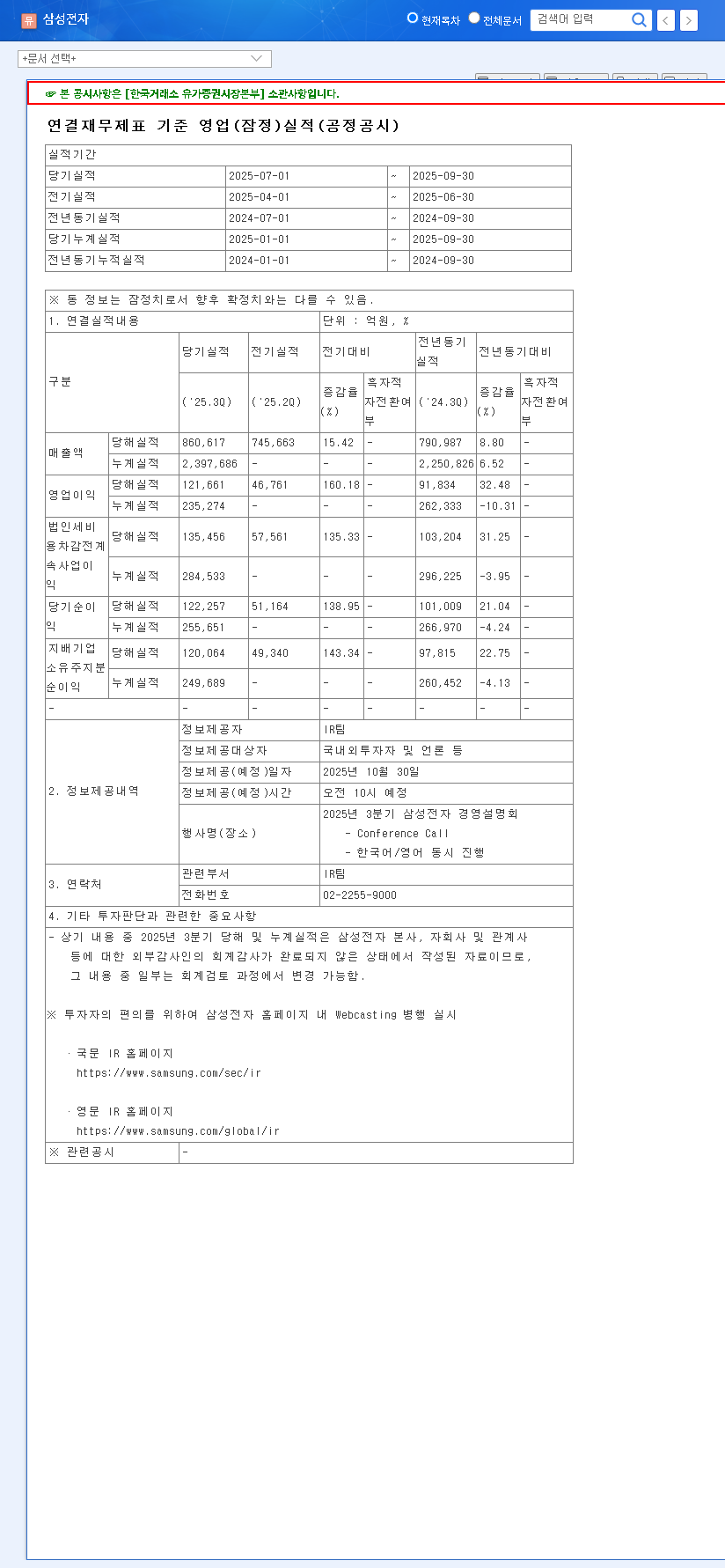
    The latest SAMSUNG ELECTRONICS earnings report for the first half of 2025 has sent a clear message to the market: the tech giant is not just resilient, it’s thriving. Defying global economic headwinds, Samsung delivered a stunning ‘earnings surprise,’ significantly outperforming analyst expectations. This comprehensive analysis will dissect the factors behind this remarkable performance, evaluate the potential risks on the horizon, and provide a strategic outlook for investors weighing their position in Samsung’s stock performance.

    H1 2025 Financial Highlights: A Decisive Beat

    In the first half of 2025, SAMSUNG ELECTRONICS posted consolidated results that painted a picture of robust health and operational excellence. The figures, confirmed by the company’s official filing, reveal significant outperformance. You can view the complete data in the Official Disclosure from DART.

    • Revenue: KRW 860.617 trillion (a 2.7% beat over market consensus)
    • Operating Profit: KRW 121.661 trillion (an impressive 20.4% beat)
    • Net Profit: KRW 120.064 trillion (a staggering 33.8% beat)

    Crucially, the operating profit margin held strong at approximately 14.1%. This indicates that Samsung successfully defended its profitability through strategic pricing and cost management, even as concerns about falling product prices lingered in the market.

    With operating profit soaring over 20% above consensus, Samsung has unequivocally demonstrated its strategic prowess and operational resilience in a volatile global market. This is a testament to its diversified business and technology leadership.

    Analyzing the Key Growth Drivers

    This outstanding SAMSUNG ELECTRONICS earnings report wasn’t an accident. It was the result of a powerful combination of internal strategic execution and a more favorable external economic climate.

    Internal Strengths: Dominance and Efficiency

    • Dual-Engine Growth: Both the Device Solutions (DS) division, home to its crucial semiconductor business, and the Device eXperience (DX) division, covering mobiles and home appliances, fired on all cylinders. A strong recovery in memory chip demand coincided with sustained premium sales from the DX side.
    • High-Value Product Strategy: Samsung focused on high-margin products, such as HBM (High Bandwidth Memory) for AI servers and its flagship Galaxy S series smartphones. This premium mix was vital for maintaining a high operating profit margin.
    • Cost Optimization: Efficient supply chain management and disciplined cost controls across the organization helped buffer against inflationary pressures on raw materials.

    External Tailwinds: A Favorable Macro Shift

    The broader economic environment also played a supportive role. Anticipation of interest rate stabilization from central banks, as reported by major financial outlets like Reuters, helped improve overall investment sentiment and reduce corporate borrowing costs. Furthermore, Samsung’s consistent shareholder return policies, including dividends and share buybacks, bolstered investor confidence and provided a stable floor for its stock performance.

    Navigating Potential Risks and Headwinds

    Despite the stellar H1 2025 results, a prudent Samsung investor outlook must acknowledge several unavoidable risks that require careful monitoring.

    • Exchange Rate Volatility: A strengthening Korean Won (KRW) against the US Dollar can negatively impact the profitability of exports, as revenues earned in dollars translate into fewer won.
    • Geopolitical & Macro Uncertainty: Ongoing global trade tensions and the persistent risk of a broader economic slowdown could dampen consumer demand and disrupt supply chains.
    • Intense Competition: The semiconductor market is fiercely competitive. Samsung faces constant pressure from rivals in both the memory and foundry sectors, requiring massive, ongoing investments in R&D and capital expenditures (CAPEX) to maintain its edge. For more on this, read our deep dive into the 2025 semiconductor market trends.

    Future Outlook: The AI Revolution and Beyond

    Looking ahead, the primary catalyst for Samsung’s growth is undoubtedly the artificial intelligence boom. The explosive demand for generative AI is fueling an unprecedented need for high-performance semiconductors, positioning Samsung’s DS division at the epicenter of this technological shift. Dominance in HBM and advancements in next-generation process nodes are critical Samsung growth drivers. Concurrently, its push into new markets like automotive semiconductors and continued innovation in foldable phones and premium home appliances provide diversified avenues for long-term expansion.

    Frequently Asked Questions (FAQ)

    Q1: By how much did the SAMSUNG ELECTRONICS earnings exceed forecasts in H1 2025?

    A1: The company delivered a significant ‘earnings surprise,’ beating market expectations by 20.4% for operating profit and 33.8% for net profit, showcasing a very strong performance.

    Q2: What were the main reasons for Samsung’s strong H1 2025 results?

    A2: Key factors included a sharp recovery in the semiconductor (DS) division, particularly in memory chips for AI, combined with steady, high-margin sales from the mobile and home appliance (DX) division. Efficient cost management also played a crucial role.

    Q3: What are the primary risks for Samsung’s stock performance going forward?

    A3: Investors should monitor currency risks from a stronger Korean Won, potential global economic slowdowns, geopolitical tensions impacting trade, and intense competition within the semiconductor industry.

    Q4: What are Samsung’s most important future growth drivers?

    A4: The biggest growth driver is the surging demand for AI, which requires Samsung’s advanced semiconductors like HBM. Other key areas include its leadership in premium smartphones, expansion into automotive chips, and innovations in its foundry business.

    (005930) SAMSUNG ELECTRONICS Earnings H1 2025: In-Depth Analysis of Surprise Growth & Stock Outlook 관련 이미지
  • (005930) SAMSUNG ELECTRONICS Stock Analysis: C&T Stake Disclosure & Future Forecast (HOLD)

    (005930) SAMSUNG ELECTRONICS Stock Analysis: C&T Stake Disclosure & Future Forecast (HOLD)

    A recent corporate filing has sent ripples through the investment community, focusing all eyes on the future of SAMSUNG ELECTRONICS stock. SAMSUNG C&T, a major shareholder, disclosed a significant update regarding its substantial stake in the tech giant. This report will dissect the disclosure, analyze SAMSUNG ELECTRONICS’ current fundamentals from its H1 2025 report, and provide a comprehensive outlook and investment strategy for investors navigating this complex landscape.

    Amid a challenging macroeconomic environment, understanding these developments is crucial for evaluating the company’s long-term value. We will explore both the immediate market reaction and the potential long-term shifts in corporate governance and strategy that could impact Samsung’s trajectory.

    Deconstructing the SAMSUNG C&T Stake Disclosure

    On October 24, 2025, SAMSUNG C&T filed an official ‘Report on the Status of Large-Scale Stock Ownership,’ confirming its 20.14% stake in SAMSUNG ELECTRONICS CO,.LTD. While the percentage of ownership remained unchanged, the filing’s details have ignited speculation among market analysts. You can view the Official Disclosure here (Source).

    The report explicitly states the purpose of holding the stake is for ‘influencing management’. The reason cited for the new filing was a ‘change in contracts regarding the held shares’.

    This subtle change in language suggests a potential shift in the strategic alignment between the two Samsung affiliates. While not a direct change to fundamentals, this governance-related event signals that investors should pay close attention to future corporate actions, which could have a lasting impact on the SAMSUNG ELECTRONICS stock price and overall business direction.

    In-Depth Analysis of SAMSUNG ELECTRONICS Fundamentals (H1 2025)

    Beyond the disclosure, a thorough SAMSUNG ELECTRONICS analysis requires a deep dive into its core business performance. The first half of 2025 presented a mixed but compelling picture of the company’s strengths and weaknesses.

    Strengths & Opportunities Driving Growth

    • Dominant DX Division: The Device Experience (DX) division, covering TVs and smartphones, remains a powerhouse, contributing 62.0% of H1 revenue. The integration of AI and innovative product releases are poised to defend market share and bolster profitability.
    • Semiconductor Leadership (DS): Despite market volatility, the Device Solutions (DS) division’s technological edge in HBM3E, advanced DRAM, and V-NAND provides a strong foundation. Massive investments (KRW 23.1 trillion) in future-proof areas like automotive chips and On-Device AI underscore its long-term growth ambitions. This aligns with trends discussed in our deep dive into the semiconductor industry.
    • Rock-Solid Financials: A remarkably low debt-to-equity ratio of 26.4% provides a sturdy buffer against macroeconomic headwinds and enables sustained investment in R&D.
    • Shareholder Returns: Consistent share repurchases, cancellations, and dividend payments signal a strong commitment to enhancing shareholder value.

    Headwinds & Risks to Consider

    • Pricing Pressure & Market Slowdown: Declining Average Selling Prices (ASP) for key products like TVs and OLED panels could squeeze margins. A global economic slowdown, as reported by institutions like the World Bank, poses a threat to consumer electronics demand.
    • Intense Foundry Competition: The semiconductor foundry market is fiercely competitive, and geopolitical tensions, particularly the US-China tech rivalry, create significant demand uncertainty for the DS division.
    • Macroeconomic Volatility: Fluctuating exchange rates, persistent high-interest rates, and rising logistics costs are external variables that can directly impact profitability and create a challenging operational environment.

    Overall Assessment & Investment Strategy (HOLD)

    Considering the balance of factors, our outlook for SAMSUNG ELECTRONICS stock remains neutral. The company’s robust fundamentals, technological leadership, and investments in future growth sectors are highly compelling for the long term. However, the short-term picture is clouded by significant macroeconomic uncertainties and intense competition that cannot be ignored.

    The SAMSUNG C&T stake disclosure adds a layer of complexity focused on governance. While its immediate financial impact is negligible, it necessitates closer monitoring of inter-company relationships and strategic decisions. Therefore, we recommend a ‘HOLD’ rating.

    Key Monitoring Points for Investors:

    • Semiconductor Cycle Recovery: Track the pace of recovery in the memory market and the DS division’s ability to capitalize on it in H2 2025 and beyond.
    • Future Growth Monetization: Look for concrete progress and revenue generation from new ventures in AI, robotics, and automotive semiconductors.
    • Macro-Response Strategies: Evaluate how effectively management navigates external pressures like currency fluctuations and rising interest rates.
    • Governance Developments: Stay informed about any further disclosures related to the SAMSUNG C&T contract and its potential influence on management strategy.

    In conclusion, a cautious and patient investment approach is advised. While the long-term Samsung stock forecast has positive drivers, investors should wait for greater clarity on macroeconomic conditions and the tangible results of its future-focused initiatives before adopting a more bullish stance.

  • (005930) Samsung C&T & Samsung Electronics Shares: A Deep Dive into the 2025 Stake Adjustment

    (005930) Samsung C&T & Samsung Electronics Shares: A Deep Dive into the 2025 Stake Adjustment

    The intricate web of Samsung C&T Samsung Electronics shares is a critical barometer for understanding the conglomerate’s governance and future direction. Recently, a minor yet significant fluctuation in this shareholding, detailed in a ‘Report on Major Shareholding,’ has captured the market’s attention. While the change appears negligible on the surface, the stated purpose of ‘influencing management’ signals that every move warrants close scrutiny. This deep-dive analysis unpacks the event, exploring its potential impact on Samsung Electronics’ management control and offering a clear roadmap for investors.

    We will move beyond the headlines to interpret the subtle cues within the official disclosure, assess the short-term and long-term consequences, and provide actionable insights for navigating this complex corporate landscape.

    Breaking Down the Share Fluctuation: What Happened?

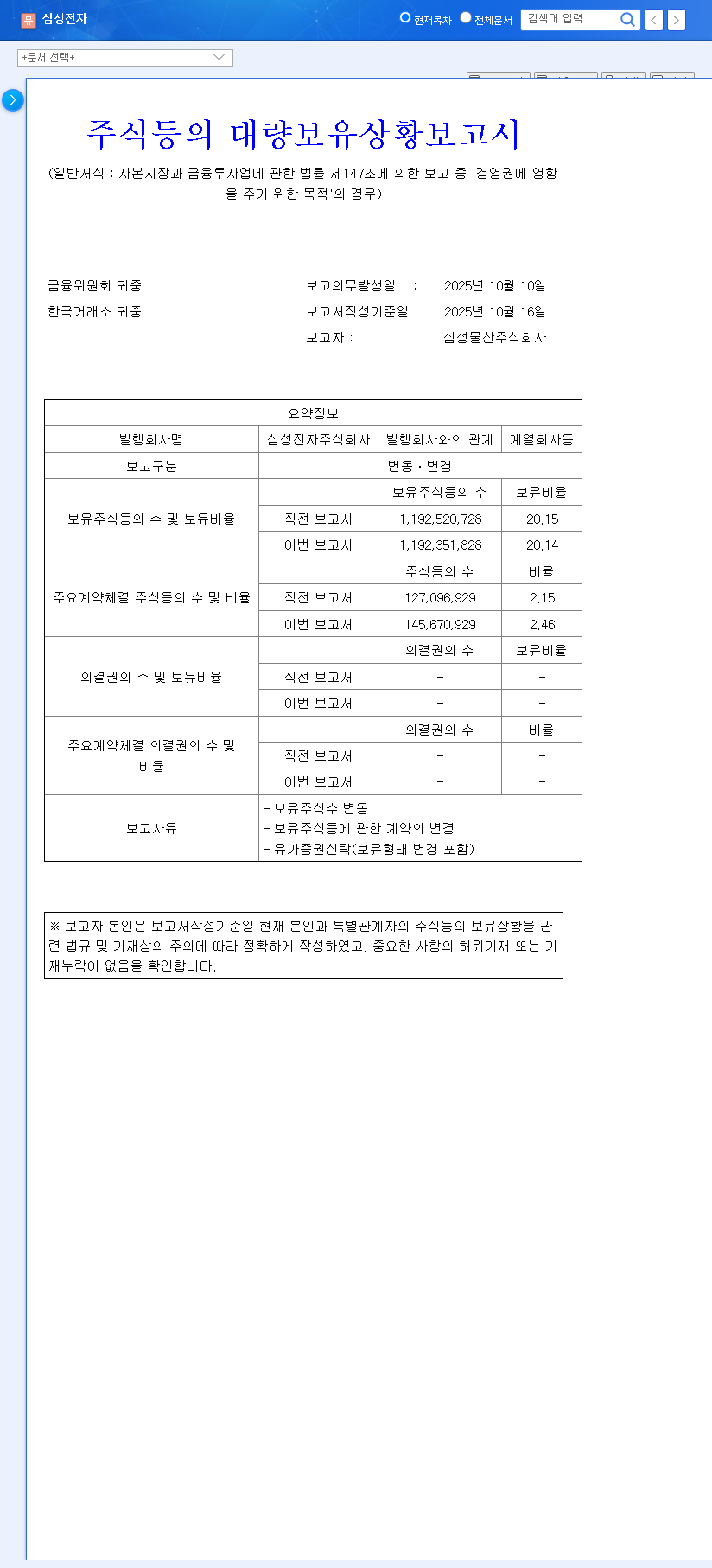
    On October 17, 2025, Samsung C&T filed a mandatory ‘Report on Major Shareholding’ regarding its stake in SAMSUNG ELECTRONICS CO., LTD. This report, now public, is the catalyst for the current market discussion. Let’s examine the core details.

    The Official Filing Details

    The filing revealed a minor decrease in Samsung C&T’s stake in Samsung Electronics by 0.01 percentage points, moving from 20.15% to 20.14%. The transaction details, executed through Samsung Life Insurance, show a series of sales and purchases over three days, resulting in a net sale of 80,013 shares. The stated reasons for the change were listed as ‘change in the number of shares held,’ ‘change in contracts related to shares held,’ and ‘securities trust (including change in holding type).’

    For transparency and direct verification, investors can review the complete filing directly from the source. The Official Disclosure (DART Report) provides the unabridged details of the transaction.

    The most critical piece of information in the report is the stated ‘purpose of holding: influencing management.’ This phrase transforms a seemingly trivial transaction into a strategic signal that cannot be ignored by serious investors.

    Analyzing the Strategic Implications

    A 0.01% change is mathematically insignificant for control, so why the market chatter? The answer lies in the context of Samsung corporate governance, where Samsung C&T acts as the de facto holding company and a linchpin in the founding family’s control over the vast electronics empire.

    Short-Term Impact: Minimal Stock Volatility

    In the immediate term, the impact on Samsung Electronics’ stock price is expected to be minimal. The sale is too small to trigger any significant sell-off or suggest a loss of confidence. There might be a temporary uptick in trading volume as algorithms and day traders react to the news, but this is unlikely to affect the stock’s fundamental trajectory. The market understands that Samsung C&T’s 20.14% stake still represents an ironclad position of control.

    Mid-to-Long-Term Impact: A Test of Governance Stability

    The long-term view is more nuanced. While this specific event does not threaten Samsung Electronics’ management control, it could be a precursor to more significant structural adjustments. The mention of ‘securities trust’ and ‘change in contracts’ may hint at complex financial or estate planning strategies within the Samsung ownership structure. These are often long-term plays that unfold over years, not days. Therefore, while stability is the current status, this filing serves as a reminder to investors to remain vigilant about the evolving dynamics of the Samsung C&T shareholding structure.

    Investor Action Plan: How to Respond

    Given the limited information, a reactionary investment decision is ill-advised. Instead, a prudent approach involves deeper research and continuous monitoring. Here are key steps for investors to take:

    • Monitor Follow-Up Disclosures: Look for any subsequent filings from Samsung C&T or related entities that might clarify the nature of the ‘contract changes’ or ‘securities trust’ arrangements. This is where the real story may lie.
    • Analyze Market Commentary: Follow analyses from reputable financial news sources like Bloomberg and institutional research reports. Expert commentary can often provide crucial context that isn’t apparent from the filing alone.
    • Focus on Fundamentals: Remember that this event is about shareholding structure, not Samsung Electronics’ operational performance. Continue to base your primary investment thesis on the company’s earnings, product pipeline, and competitive position in the semiconductor and electronics markets.
    • Understand the Broader Context: For a deeper perspective, it’s helpful to learn more about the unique dynamics of South Korean conglomerates. Our guide on Understanding Chaebol Governance Structures provides essential background information.

    Conclusion: A Minor Move with Major Implications

    In conclusion, the 0.01% reduction in the Samsung C&T Samsung Electronics shares is not an immediate cause for alarm regarding management stability or stock performance. However, its classification as a move to ‘influence management’ firmly places it in the realm of strategic maneuvering. It serves as a valuable data point for investors, reinforcing the need to look beyond the numbers and appreciate the intricate governance dynamics at play. The prudent path forward is not to overreact, but to enhance due diligence and remain watchful for the next chapter in Samsung’s corporate evolution.

    (005930) Samsung C&T & Samsung Electronics Shares: A Deep Dive into the 2025 Stake Adjustment 관련 이미지