Tag: SAMJIN PHARMACEUTICAL CO.

  • (005500) SAMJIN PHARMACEUTICAL Treasury Stock Disposal: A Deep Dive into the Strategic Alliance & Future Stock Value

    (005500) SAMJIN PHARMACEUTICAL Treasury Stock Disposal: A Deep Dive into the Strategic Alliance & Future Stock Value

    The recent announcement of the SAMJIN PHARMACEUTICAL treasury stock disposal has sent ripples through the investment community. This isn’t just a routine financial maneuver; it’s a clear signal of the company’s ambition to forge a ‘strategic business alliance’ that could redefine its growth trajectory. For investors, this decision raises critical questions: What does this move truly signify? How will it impact the stock’s value? And what is the smartest way to navigate this pivotal moment? This comprehensive analysis will explore the details of the disposal, the company’s underlying fundamentals, and provide an actionable roadmap for investors looking to understand the future of SAMJIN PHARMACEUTICAL CO.,LTD.

    The Announcement Decoded: A Closer Look at the Disposal

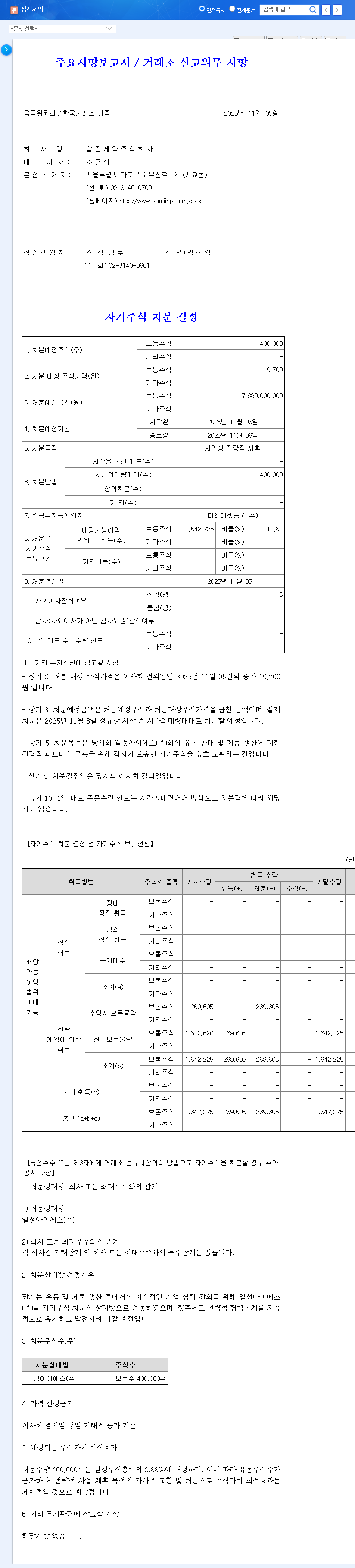
    On November 5, 2025, SAMJIN PHARMACEUTICAL CO.,LTD formally announced its decision to dispose of 400,000 of its common shares. This transaction, valued at approximately KRW 7.9 billion, represents a significant 2.88% of the company’s total issued shares. The explicit goal, as stated in their official filing, is to fund a strategic business alliance. The deal is being managed by Mirae Asset Securities Co., Ltd., a prominent underwriter. For those seeking primary source verification, the company has made the details public. Official Disclosure (DART).

    The core purpose behind this large-scale treasury stock disposal is not merely financial restructuring, but a proactive investment in future growth through a powerful strategic partnership.

    Analyzing SAMJIN PHARMACEUTICAL’s Financial Health

    To understand the impact of this alliance, we must first assess the company’s current state. In the first half of 2025, SAMJIN PHARMACEUTICAL reported sales of KRW 145.47 billion, a modest 1.5% year-over-year increase. While its core pharmaceutical business remains robust and new ventures into health foods and cosmetics show promise, operating profit saw a 3.6% decrease to KRW 12.79 billion. This dip is largely attributed to rising Selling, General, and Administrative (SG&A) expenses, fueled by essential investments in R&D and new business development. This context makes the timing of the alliance critical, as it could provide the necessary capital and synergy to turn these investments into substantial profits.

    The R&D Pipeline: A Glimpse into the Future

    A key strength for SAMJIN is its forward-looking R&D pipeline. The company is actively investing in next-generation technologies like AI-driven drug discovery and cutting-edge Antibody-Drug Conjugate (ADC) technology. Moreover, its blood cancer treatment, ‘SJP1604’, has already received Orphan Drug Designation from the US FDA and is advancing towards Phase 3 clinical trials. A strategic partnership could supercharge these initiatives, providing additional expertise, funding, and pathways to global markets.

    Stock Price Impact and Investor Strategy

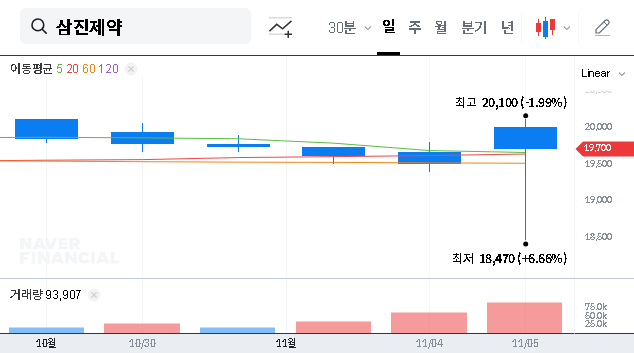
    The market’s initial reaction to the SAMJIN PHARMACEUTICAL treasury stock disposal is likely to be positive, given the promising nature of a ‘strategic alliance.’ This could create short-term upward momentum. However, this optimism is contingent on the details. The identity of the partner and the specifics of the collaboration will be the true test. If the alliance falls short of market expectations, a sell-off is possible. Investors should watch for increased volatility as more information becomes available.

    An Actionable Plan for Investors

    Navigating this period requires a clear and disciplined strategy. Rather than reacting to market noise, focus on the fundamentals and long-term potential. For more foundational knowledge, consider reviewing our guide to pharmaceutical stock analysis.

    • Analyze the Alliance Details: Once revealed, scrutinize the partner’s strengths, the scope of cooperation, and the projected synergies. Does the partner bring new technology, market access, or R&D capabilities?
    • Monitor Financial Performance: Track quarterly earnings reports closely. Look for tangible evidence that the alliance is improving key metrics like operating profit margins and net income.
    • Track R&D Milestones: Keep an eye on progress reports for key assets like SJP1604. Positive clinical trial results or regulatory approvals will be significant long-term value drivers.
    • Evaluate Macro-Economic Factors: While direct foreign exchange risk is limited, shifts in interest rates and overall market sentiment can still affect stock performance. Understand the broader context of your investment. For more information, external resources like Investopedia provide excellent macroeconomic analysis.

    Frequently Asked Questions (FAQ)

    What is the main goal of this treasury stock disposal?

    The primary purpose is to raise capital (approx. KRW 7.9 billion) to finance a strategic business alliance aimed at securing new growth engines and strengthening the company’s long-term competitive position.

    How might this decision affect SAMJIN PHARMACEUTICAL’s stock price?

    Initially, the news is expected to be a positive catalyst, potentially boosting the stock price. However, the long-term effect will depend entirely on the quality of the alliance partner and the tangible financial and operational benefits that result from the partnership.

    What are the company’s core strengths right now?

    SAMJIN PHARMACEUTICAL’s strengths include a stable core business, significant investment in high-potential R&D areas like AI drug discovery, and a robust financial structure. The development of ‘SJP1604’ for blood cancer is a key potential growth driver.

    In conclusion, the SAMJIN PHARMACEUTICAL treasury stock disposal is a decisive and forward-looking move. Its success hinges on the execution of the strategic alliance. For investors, this is a time for diligent research and careful monitoring, not speculation. The coming months will be crucial in revealing whether this strategic pivot will unlock a new era of growth for the company.
    (005500) SAMJIN PHARMACEUTICAL Treasury Stock Disposal: A Deep Dive into the Strategic Alliance & Future Stock Value 관련 이미지
  • (005500) In-Depth SAMJIN PHARMACEUTICAL Stock Analysis: Decoding the Latest Shareholding Disclosure

    A recent disclosure from SAMJIN PHARMACEUTICAL CO.,LTD has captured the attention of the investment community, detailing CEO Choi Seung-joo’s unwavering stake and a curious, minor share transaction. The official report, filed on October 24, 2025, cited a ‘change in major contract terms,’ sparking speculation about the company’s future direction. This deep-dive analysis unpacks the implications of these developments for SAMJIN PHARMACEUTICAL, examining its management stability, fundamental health, and stock outlook amidst a challenging macroeconomic landscape.

    Investors can review the complete filing directly from the source for full transparency. Official Disclosure: Click to view the DART report.

    Deconstructing the Shareholding Disclosure

    The core of the recent market chatter revolves around the ‘Report on the Status of Large Shareholdings.’ Let’s dissect the two main components and what they signal for the company.

    CEO Choi Seung-joo’s Unchanged 9.90% Stake

    CEO Choi Seung-joo confirmed his stake remains at 9.90%, held for the stated purpose of ‘management influence.’ This is a significant indicator of leadership stability. For investors, a steady hand at the helm suggests a consistent long-term vision and reduces the risk of abrupt strategic shifts, providing a foundation of predictability for SAMJIN PHARMACEUTICAL in the near term.

    The Mystery of the 12,000 Share Transaction

    A seemingly minor transaction involved Song Hae-gang and Song Hae-seong selling a combined 12,000 shares to Choi Ji-yoon. While the volume is too small to impact market dynamics, the reported reason—’change in major contract terms’—is what raises eyebrows. This phrasing could hint at several possibilities, from adjustments in shareholder agreements to groundwork for future strategic partnerships or licensing deals. This warrants close monitoring of subsequent announcements from the company.

    While the CEO’s stable ownership provides comfort, the ambiguity surrounding the ‘change in major contract terms’ introduces a layer of uncertainty that the market will be keen to resolve.

    Fundamental Health Check: A SAMJIN PHARMACEUTICAL Analysis

    Beyond the disclosure, a company’s underlying fundamentals provide the true long-term picture. Based on the 2025 semi-annual report, here’s where SAMJIN PHARMACEUTICAL stands.

    Financial Performance Snapshot (H1 2025)

    • Revenue: KRW 145.47 billion, a modest 1.5% year-over-year increase.
    • Operating Profit: KRW 12.79 billion, down 3.6% due to rising selling and administrative costs.
    • Net Income: KRW 8.401 billion, a sharp 69.9% decrease, largely skewed by a one-off tax refund in the previous year.
    • Profitability: An operating profit margin of 8.8% highlights a clear need for efficiency improvements.

    Future Growth Engines & Financial Soundness

    Despite margin pressures, the company’s commitment to the future is evident. R&D spending stands at an impressive 11.59% of sales, funding a promising pipeline that includes an in-licensed Alzheimer’s treatment (AR1001). This level of investment is crucial for long-term growth in the competitive pharmaceutical sector. For a deeper understanding of industry R&D cycles, investors can review resources from authoritative bodies like the Pharmaceutical Research and Manufacturers of America (PhRMA). Financially, the company’s debt-to-equity ratio of 66.2% remains sound, providing a stable base for these growth initiatives.

    Market Outlook & Investor Strategy

    The stock’s performance will likely be influenced by a confluence of internal developments and external macroeconomic pressures.

    Navigating Macroeconomic Headwinds

    Two major external risks loom over SAMJIN PHARMACEUTICAL:

    • Currency Volatility: A rising KRW/USD and KRW/EUR exchange rate increases the cost of importing raw materials and servicing foreign currency debt, directly threatening profitability.
    • High-Interest Rates: Sustained high rates in Korea and the U.S. elevate borrowing costs for funding R&D and capital expenditures, while also dampening overall investor sentiment in growth-oriented sectors.

    Key Monitoring Points for Investors

    Moving forward, investors should focus on several key areas. For more on valuation metrics, you might want to read our guide on How to Value Pharmaceutical Stocks.

    • Clarification on Contract Terms: Any follow-up disclosures explaining the ‘change in major contract terms’ will be a primary stock catalyst.
    • Profitability Improvements: Future earnings reports must show a clear path to improving operating and net profit margins.
    • R&D Progress: Watch for clinical trial updates and progress reports on the new drug pipeline, especially the Alzheimer’s treatment.

    Frequently Asked Questions (FAQ)

    Q1: Did CEO Choi Seung-joo sell any of his SAMJIN PHARMACEUTICAL shares?
    No, the disclosure confirmed that CEO Choi Seung-joo maintained his 9.90% stake, signaling continuity in management control for the short term.

    Q2: What is the significance of the 12,000 share transaction?
    The transaction volume itself is negligible. Its importance comes from the stated reason: a ‘change in major contract terms,’ which hints at potential underlying strategic shifts that are not yet public.

    Q3: Is SAMJIN PHARMACEUTICAL financially healthy?
    The company shows modest revenue growth but faces profitability challenges due to rising costs. However, its debt levels are manageable, and it is investing heavily in R&D, which is a positive sign for future growth.

    Disclaimer: This content is for informational purposes only and is based on publicly available information. It should not be construed as financial advice. All investment decisions should be made at the investor’s own discretion and responsibility.