Tag: Real Estate Investment

  • (004960) HANSHIN CONSTRUCTION (004960) Stock Analysis: A Deep Dive into the ₩76.7B Sihung Project

    (004960) HANSHIN CONSTRUCTION (004960) Stock Analysis: A Deep Dive into the ₩76.7B Sihung Project

    The recent announcement that HANSHIN CONSTRUCTION CO.,LTD (004960) has won the contract for the Sihung 1-dong 859 Redevelopment Project has stirred significant interest among investors. Valued at approximately ₩76.7 billion, this project represents a notable 5.1% of the company’s recent sales revenue. While any major contract win is positive news, savvy investors are asking the critical question: Is this a true catalyst for growth, or just a temporary headline? This detailed HANSHIN CONSTRUCTION stock analysis will dissect the project’s impact, evaluate the company’s precarious financial health, and provide a comprehensive outlook for potential investors.

    We will explore whether this achievement can pave the way for a turnaround, considering the broader challenges in the construction market and the company’s fundamental weaknesses. If you’re looking to make an informed decision about HANSHIN CONSTRUCTION CO.,LTD (004960), this analysis provides the essential data and context you need.

    Project Deep Dive: The Sihung 1-dong Contract

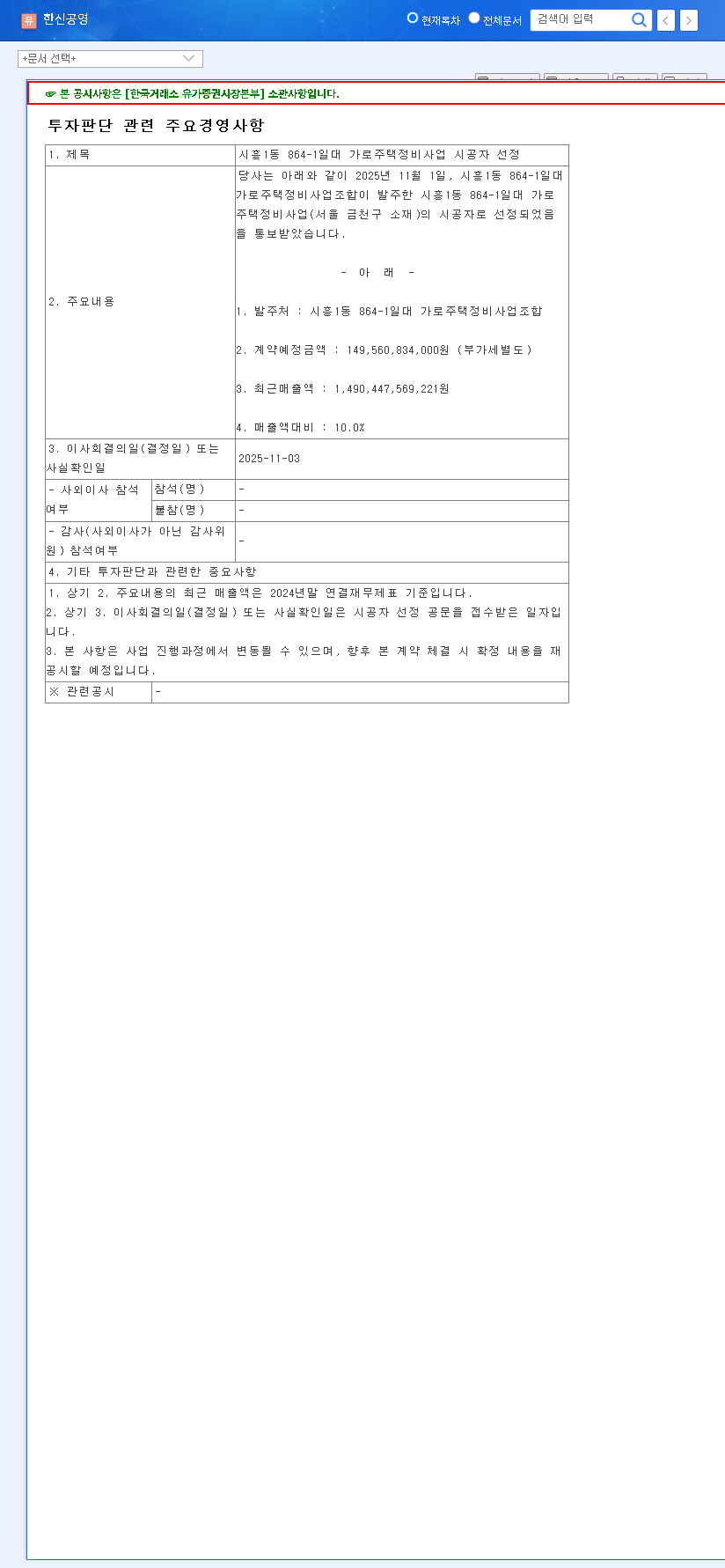
    On November 1, 2025, HANSHIN CONSTRUCTION officially secured its role as the primary contractor for the Sihung 1-dong project. According to the Official Disclosure on DART, the contract is valued at ₩76.7 billion. While this figure is significant, its true importance lies in its strategic implications.

    Strategic Significance Beyond the Numbers

    This isn’t just another entry in the order book. Winning a competitive redevelopment bid in the Seoul metropolitan area, near Geumcheon-gu, offers several key advantages:

    • Enhanced Competitiveness: A successful project in a high-profile urban area serves as a powerful reference, boosting the company’s reputation and improving its chances of winning similar, lucrative contracts in the future.
    • Stable Revenue Stream: In a volatile market, this multi-year project provides a predictable revenue stream, contributing to top-line growth and helping to offset the company’s currently low order backlog.
    • Improved Investor Confidence: The recent business report amendment, which clarified contract details, coupled with this win, enhances transparency and may help rebuild trust with investors who have been wary of the company’s financial state.

    Financial Health: A Cautious Outlook for HANSHIN CONSTRUCTION

    Despite the positive news, a thorough HANSHIN CONSTRUCTION stock analysis must confront the company’s challenging financial situation. The ₩76.7 billion contract, while helpful, is not a magic bullet for the underlying issues. The company’s fundamentals reveal several red flags that require careful consideration.

    The contract’s immediate impact on the overall financial structure is limited. Given the company’s low profitability and high debt ratio, meticulous management of this project’s profitability is absolutely critical to its long-term success.

    Key Financial Metrics (2022-2023)

    • Profitability Collapse: Revenue and operating profit saw a marked decline from 2022 to 2023. More alarmingly, Return on Equity (ROE) plummeted from 19.11% to just 6.04%, indicating a sharp drop in its ability to generate profit from shareholder equity.
    • High Leverage: The Debt-to-Equity ratio remains stubbornly high at 271% in 2023. While projected to improve, this level of debt poses significant risks, especially if interest rates rise or project cash flows are delayed.
    • Valuation Concerns: While a Price-to-Book (PBR) ratio of 0.75x suggests the stock is undervalued relative to its assets, the Price-to-Earnings (PER) ratio of 39.83x in 2023 is high, reflecting poor earnings. Future PER projections show high volatility, signaling market uncertainty about future profitability.

    Market Context and Investor Takeaway

    The broader construction stock analysis reveals a tough environment. The South Korean construction market is grappling with high raw material costs and a potential slowdown in the housing sector. For a deeper look at global economic trends affecting this sector, sources like Reuters Business provide excellent macroeconomic data.

    While stabilizing interest rates could ease borrowing pressures, HANSHIN’s high debt load remains a primary concern. The company’s future hinges on its ability to execute the Sihung 1-dong project with exceptional efficiency and cost control. Proving they can deliver this project profitably is paramount.

    Investor Perspective: Key Points to Watch

    • Short-Term Outlook: Do not expect a dramatic, immediate surge in the HANSHIN CONSTRUCTION stock price. The market will likely adopt a ‘wait-and-see’ approach, pending tangible results.
    • Mid-to-Long-Term Catalysts: The key drivers for future value will be the successful and profitable execution of the Sihung project, disciplined cost management, and the ability to secure a pipeline of similar new orders.
    • Monitor Profit Margins: Pay close attention to quarterly earnings reports for any improvement in operating and net profit margins. This will be the first concrete sign that the company is turning a corner.

    In conclusion, the Sihung 1-dong project is a significant and positive step for HANSHIN CONSTRUCTION CO.,LTD (004960). It provides a much-needed potential boost to revenue and market reputation. However, it is an opportunity, not a guarantee. The company must navigate its weak financial position and a challenging market. For investors, this is a story of potential turnaround that requires patience and close monitoring of execution and profitability.
    (004960) HANSHIN CONSTRUCTION (004960) Stock Analysis: A Deep Dive into the ₩76.7B Sihung Project 관련 이미지
  • (475230) NRB, inc Stock Analysis: Can the ₩29.9B LH Project Fuel a Rebound?

    (475230) NRB, inc Stock Analysis: Can the ₩29.9B LH Project Fuel a Rebound?

    After a turbulent period following its KOSDAQ listing, NRB, inc has captured the market’s attention with a landmark announcement. The company has secured a large-scale housing construction agreement with the esteemed Korea Land and Housing Corporation (LH), a deal that represents far more than just a number on a balance sheet. For investors and market watchers, the critical question is whether this collaboration can genuinely overhaul NRB, inc’s financial structure, reverse its persistent losses, and act as the much-needed catalyst for a sustained stock rebound.

    This comprehensive analysis delves into the specifics of the NRB-LH contract, scrutinizes the company’s fundamentals, and outlines the critical factors investors must monitor. We will explore how NRB, inc aims to leverage this pivotal opportunity within a dynamic market environment and what the future may hold for its stock.

    The Landmark Deal: NRB, inc & LH’s ₩29.9 Billion Partnership

    Project Overview: A Major Public Housing Initiative

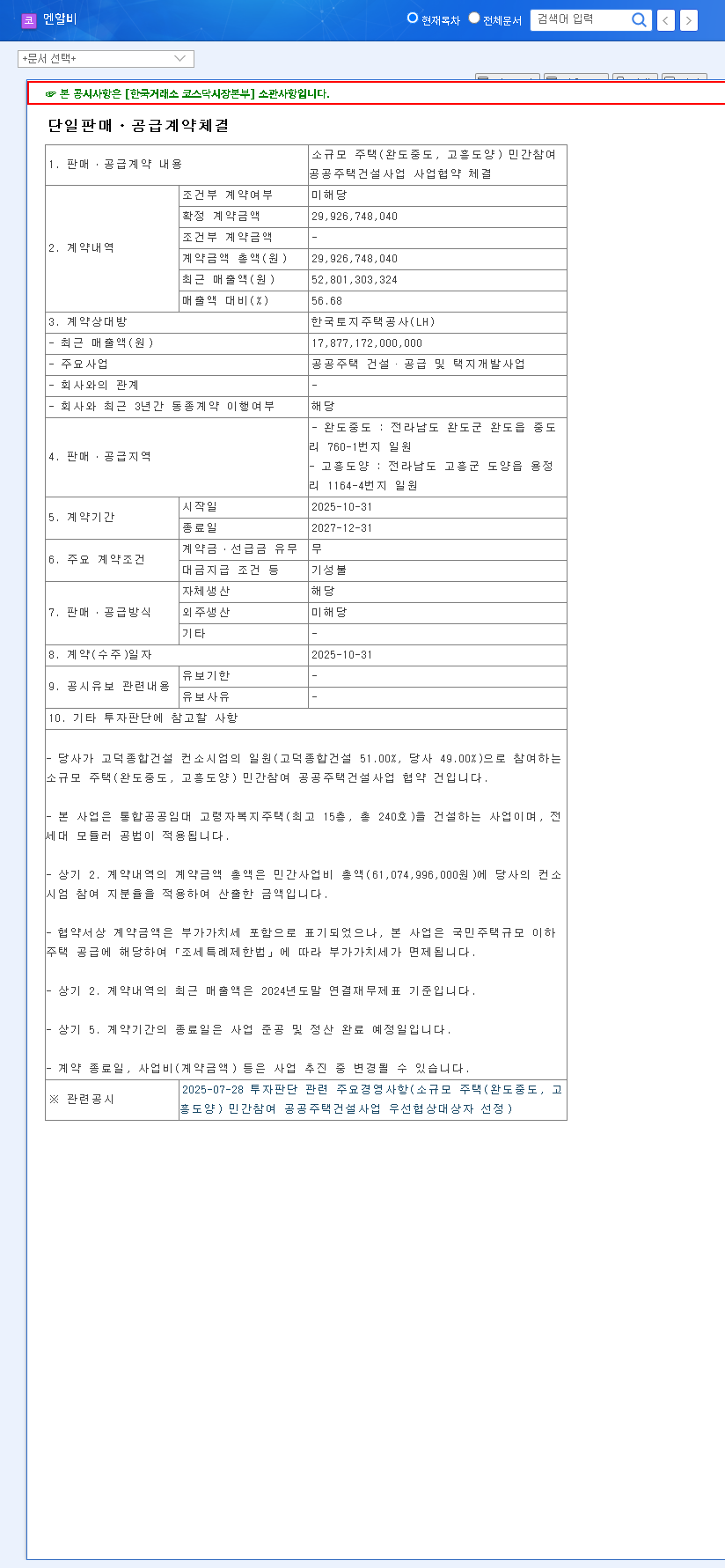
    On October 31, 2025, NRB, inc officially announced the signing of a business agreement with the Korea Land and Housing Corporation (LH). This partnership is for private-sector participation in small-scale public housing construction projects in the ‘Wandojungdo’ and ‘Goheungdoyang’ regions. The news, confirmed in the company’s Official Disclosure, marks a significant milestone.

    • Total Contract Value: ₩29.9 billion (approx. $22 million USD)
    • Contract Period: October 31, 2025, to December 31, 2027 (2 years, 2 months)
    • Scale Significance: This single contract is equivalent to a staggering 56.68% of NRB, inc’s entire 2024 annual revenue.

    This agreement is more than a simple revenue boost; it’s a powerful endorsement. Partnering with a major public entity like LH officially validates NRB, inc’s modular construction technology and project management capabilities. This recognition is a critical stepping stone that could unlock a pipeline of future public and private sector contracts, positioning the company as a leader in innovative building solutions.

    This isn’t just a contract; it’s a seal of approval. The LH partnership provides NRB, inc with a crucial revenue stream and the credibility needed to pursue larger, more ambitious projects in the burgeoning modular construction market.

    NRB, inc’s Financial Health: A Tale of Opportunity and Concern

    Positive Catalysts for Growth

    • Technological Edge: NRB, inc holds core technologies in PC Ramen modular methods and seismic performance, making it a strong contender for modern construction projects like the ‘Green Smart Future School’ initiative.
    • Improved Capital Access: A successful KOSDAQ listing and issuance of convertible bonds have improved the company’s ability to raise funds for crucial investments in factory expansion and production capacity.

    Persistent Headwinds and Risks

    • High Debt Load: With a debt-to-equity ratio of approximately 285%, the company is highly leveraged. This means significant financial costs can eat into profitability, especially in a volatile interest rate environment.
    • Profitability & Efficiency Issues: The company posted a net loss in the first half of 2025, compounded by a very low factory utilization rate of just 17.5%. This signals significant inefficiency in its current production pipeline.
    • Competitive Market: The modular market is intensely competitive, and expanding into new areas like electrical and fire facility construction requires costly recruitment of specialized personnel.

    Investor Guide: Navigating the Future of NRB, inc Stock

    The LH contract is undeniably a positive development for NRB, inc. It provides a clear revenue path and validates its market position. The global modular construction market is projected to grow significantly, and this deal places NRB at the forefront of that trend in Korea. For investors, this creates a compelling but complex opportunity.

    However, the underlying financial concerns remain. A single contract, no matter how large, does not instantly solve issues of high debt and low operational efficiency. The long-term success of the NRB, inc stock will depend entirely on flawless execution and strategic management.

    Key Monitoring Points for a Potential Stock Rebound

    • Quarterly Profitability: Watch for a clear trend of improving margins. Is the LH project translating into actual profit, or are costs running higher than expected?
    • Factory Utilization Rate: This is a critical metric. The company must demonstrate that this contract is significantly boosting its factory output above the current 17.5% level.
    • Debt Reduction Strategy: Look for announcements or actions from management regarding plans to use new cash flow to pay down its substantial debt.
    • Future Contract Wins: The true test will be if NRB, inc can leverage the LH deal to secure a steady stream of new orders, proving this is not a one-off success. For more insights, see our guide to Investing in the KOSDAQ Market.

    In conclusion, this event offers NRB, inc a golden opportunity to transform its trajectory. While the short-term stock price may see a positive reaction, sustainable growth hinges on the company’s ability to execute flawlessly and translate this massive project into tangible, long-term financial health.

    Frequently Asked Questions

    Q1: What is the nature of the contract NRB, inc signed with LH?

    A1: On October 31, 2025, NRB, inc signed a business agreement with the Korea Land and Housing Corporation (LH) for private-sector participation in small-scale public housing construction projects in the ‘Wandojungdo’ and ‘Goheungdoyang’ regions, utilizing modular construction technology.

    Q2: How significant is this contract for NRB, inc’s operations?

    A2: The contract value is ₩29.9 billion, a substantial order equivalent to 56.68% of NRB, inc’s 2024 annual revenue. It is expected to be a major contributor to revenue growth and performance improvement.

    Q3: What is NRB, inc’s current financial health?

    A3: The company faces challenges, including a high debt-to-equity ratio of approximately 285% and a history of recent losses. However, it is also actively raising funds and investing in business expansion to fuel future growth.

    Q4: How might this contract affect the NRB, inc stock price?

    A4: News of a large order can positively impact the stock price in the short term. However, long-term performance will be heavily influenced by successful project execution, achieving real profitability, and improving factory utilization rates.

    (475230) NRB, inc Stock Analysis: Can the ₩29.9B LH Project Fuel a Rebound? 관련 이미지
  • (290690) Solux Property Acquisition: A Deep Dive into the ₩15B Seongsu-dong Deal

    (290690) Solux Property Acquisition: A Deep Dive into the ₩15B Seongsu-dong Deal

    The recent Solux property acquisition has sent ripples through the market, prompting both optimism and scrutiny from investors. Solux Co., Ltd., a company navigating a strategic pivot from its traditional lighting business, announced a significant ₩15 billion investment in Seoul’s coveted Seongsu-dong district. This move is seen as a bold step towards diversification and asset appreciation, but the reliance on convertible bonds for financing raises critical questions about the company’s short-term financial health. This analysis delves into the specifics of the deal, the strategic rationale, and the key considerations for anyone tracking this evolving story.

    Details of the Landmark Seongsu-dong Deal

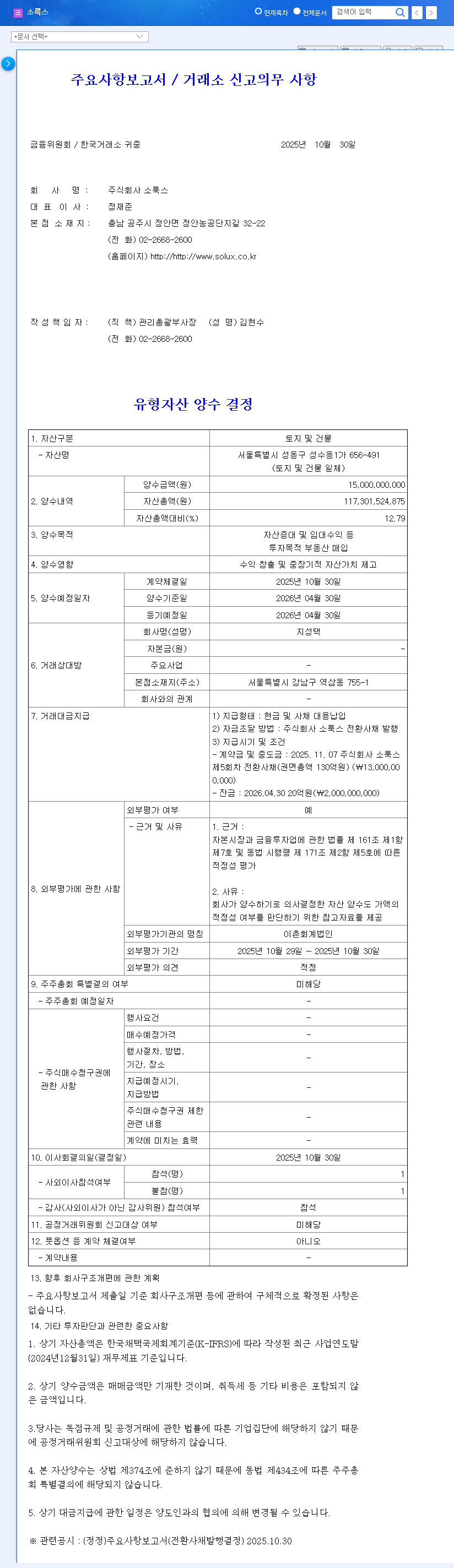
    Solux Co., Ltd. formally disclosed its decision to acquire land and buildings at 656-491 Seongsu-dong 1-ga, Seongdong-gu, Seoul. The total acquisition price of ₩15 billion represents a substantial 12.79% of the company’s total assets, signaling a major capital allocation. The deal, signed on October 30, 2025, with counterparty Jisungtaek, is primarily funded by the issuance of ₩13 billion in convertible bonds, with the remaining ₩2 billion covered by the company’s cash reserves. The full details of the transaction were made public in an Official Disclosure on the DART system.

    Why Seongsu-dong Real Estate is a Prime Target

    The choice of Seongsu-dong is highly strategic. Once a district of aging factories and warehouses, Seongsu-dong has undergone a remarkable transformation, earning it the nickname “the Brooklyn of Seoul.” It is now a vibrant hub for art galleries, high-end fashion boutiques, tech startups, and trendy cafes, attracting significant foot traffic and corporate interest. Investing in Seongsu-dong real estate provides Solux with a tangible asset in a location with a high potential for long-term value appreciation and a steady stream of potential rental income, which could provide a crucial buffer as the company develops its newer, more volatile business ventures.

    This Solux property acquisition is a classic diversification play. While prime real estate can be a powerful hedge against core business volatility, the financing structure via convertible bonds is the critical factor that will determine whether this becomes a strategic triumph or a financial misstep.

    The Double-Edged Sword: Financing with Convertible Bonds

    The decision to fund 87% of the acquisition through the 5th series of Solux convertible bonds is a major point of concern. Convertible bonds are a hybrid security that starts as debt but can be converted into company stock at a later date. While this allows Solux to raise capital without immediate share dilution, it presents future risks.

    • Increased Debt Burden: Until conversion, these bonds add ₩13 billion to Solux’s liabilities, increasing interest expenses and straining a financial structure already weakened by declining sales in its core business.
    • Future Share Dilution: If bondholders convert their bonds to equity, it increases the total number of shares outstanding. This dilutes the ownership stake of existing shareholders and can put downward pressure on the stock price.
    • Capital Diversion: This large-scale investment in real estate raises questions about whether capital is being diverted from the company’s ambitious new ventures in medical lighting, construction, and degenerative brain disease treatments, which require significant R&D and operational funding to succeed.

    A Guide for Investors: Key Factors to Monitor

    For investors conducting a Solux financial analysis, this acquisition introduces new variables that require careful monitoring. While the long-term potential is clear, the short-term risks are significant. It is essential to weigh the stability of real estate against the execution risks in the company’s new growth sectors. This strategy is part of a broader trend of global corporate real estate investment as a diversification method.

    Here are the critical points to watch moving forward:

    • New Business Performance: The success or failure of Solux’s ventures in medical and construction will determine if the company can service its increased debt and grow into its valuation. Tangible revenue and profit from these areas are crucial.
    • Convertible Bond Status: Keep a close eye on the bond’s conversion price and any signs of early conversion. This will be a key indicator of future stock performance and shareholder dilution.
    • Property Utilization Plan: Monitor the company’s plans for the Seongsu-dong asset. Will it be leased out quickly? What is the projected rental yield? A clear and profitable plan will help alleviate financial concerns. For more on this, see our guide on evaluating corporate diversification strategies.
    • Financial Metrics: Track changes in the debt-to-equity ratio, interest coverage ratio, and free cash flow in the upcoming quarterly reports to gauge the immediate impact of this acquisition.

    In conclusion, the Solux Co., Ltd. investment in Seongsu-dong is a defining moment for the company. If managed correctly, it could secure the company’s financial future with a high-value asset. However, the heavy reliance on debt financing in a challenging economic climate means that investors must remain vigilant and critically assess the company’s ability to execute its broader diversification strategy.

    (290690) Solux Property Acquisition: A Deep Dive into the ₩15B Seongsu-dong Deal 관련 이미지
  • (021320) KCC ENGINEERING & CONSTRUCTION (021320) Analysis: Inside the ₩144B Seongsu Project & Stock Outlook

    (021320) KCC ENGINEERING & CONSTRUCTION (021320) Analysis: Inside the ₩144B Seongsu Project & Stock Outlook

    In a challenging market marked by a global construction slowdown, discerning investors are closely watching companies that secure major contracts as indicators of resilience and future growth. A prime example is KCC ENGINEERING & CONSTRUCTION CO., LTD. (021320), which recently announced a substantial project win, capturing significant market attention. This deep-dive analysis explores what the ₩144 billion contract for the Seongsu-dong Complex truly means for the KCC E&C stock and its long-term trajectory.

    This article provides a comprehensive breakdown of the new contract, its impact on the company’s fundamentals, and a strategic outlook for investors. If you’re looking to understand the current standing and future potential of KCC ENGINEERING & CONSTRUCTION, this analysis is essential reading.

    The Landmark Contract: A ₩144 Billion Deal in Seongsu-dong

    On October 29, 2025, KCC ENGINEERING & CONSTRUCTION CO., LTD. formally announced the signing of a major sales and supply contract with Heungkuk Life Insurance Co., Ltd. The agreement covers the construction of the ambitious ‘Seongsu-dong Complex Facility Construction Project.’ The contract, valued at a substantial ₩144 billion, represents approximately 7.88% of the company’s recent annual revenue. The project is scheduled to run for three years, from January 30, 2026, to January 30, 2029. This significant undertaking in one of Seoul’s most dynamic districts has sent a strong signal of confidence throughout the industry. The full details were disclosed publicly, as per regulatory requirements (Source: Official Disclosure).

    This contract is more than a financial figure; it’s a strategic win that reinforces KCC E&C’s market leadership and provides a clear revenue pipeline for the next three years, bolstering investor confidence.

    Why This Deal Is a Game-Changer for KCC E&C

    To understand the full impact, we must look beyond the headline number and analyze the contract’s effect on KCC E&C’s core business and financial health.

    Reinforcing a Stable and Growing Business Portfolio

    The company’s strength lies in its diverse and robust portfolio. As of the first half of 2025, the architectural segment—the company’s core—recorded ₩756.8 billion in sales, a 2.9% year-on-year increase. The civil engineering segment is also emerging as a powerful growth driver, with a 22.3% revenue contribution increase. Securing the Seongsu-dong Complex Project not only bolsters the architectural division but also demonstrates a continued ability to win large-scale, high-value contracts in a competitive environment. This success supports the company’s strategic expansion into new ventures like information and communication services.

    A Catalyst for Improving Financial Health

    This contract win arrives at a time when KCC ENGINEERING & CONSTRUCTION is already demonstrating significant financial discipline and improvement. Key indicators point towards a strengthening balance sheet:

    • Increased Total Equity: As of H1 2025, total equity rose to ₩528.1 billion, a 3.8% increase from the previous year.
    • Improved Debt-to-Equity Ratio: The ratio improved significantly, dropping from 65.9% to 55.8%, signaling enhanced financial stability.
    • Positive Operating Cash Flow: The company generated ₩83.9 billion in positive operating cash flow, proving its operational efficiency.

    Future Outlook: Short-Term Gains vs. Long-Term Risks

    Short-Term Impact: A Likely Boost for KCC E&C Stock

    The immediate market reaction to the contract announcement is expected to be positive for the KCC E&C stock (021320). A deal of this magnitude validates the company’s project-winning capabilities and provides clear revenue visibility, which typically boosts investor confidence and can lead to a near-term rally in the stock price.

    Mid-to-Long-Term Impact and Potential Headwinds

    While the successful execution of this project will be a cornerstone for future growth, investors must remain aware of potential market risks. The broader construction industry faces challenges that could impact KCC E&C. For context on global economic trends affecting this sector, sources like Reuters’ economic analysis can provide valuable insights.

    • PF Loans & Market Volatility: With a total guarantee limit of ₩689 billion in PF loan and completion guarantees, the company is exposed to project financing risks. For a deeper look, see our guide on Understanding Construction Sector PF Loan Risks.
    • Profitability Management: Efficient cost and process management will be critical to ensure this project delivers on its expected profit margins.
    • Intensified Competition: The tendency towards low-price bidding in a competitive market remains a persistent threat to profitability across the industry.

    Action Plan for Investors in KCC ENGINEERING & CONSTRUCTION

    For long-term corporate value to increase, a proactive approach is necessary. We recommend investors monitor the following key areas:

    • Proactive Financial Management: Continued diligence in managing PF contingent liabilities and transparent reporting will be key to maintaining market trust.
    • Profitability-Focused Execution: Focus should remain on maximizing contract profitability through efficiency, not just winning bids at any cost.
    • Synergy with New Ventures: Look for evidence of how new business lines in IT and engineering are being integrated to create additional value.
    • Consistent Market Communication: Regular updates on project milestones, completion rates, and profitability will be crucial for sustaining investor confidence.

    Conclusion: A Cautiously Optimistic Outlook

    The ₩144 billion Seongsu-dong contract is undeniably a major positive catalyst for KCC ENGINEERING & CONSTRUCTION. It solidifies the company’s revenue stream, showcases its competitive strength, and aligns with its improving financial health. While investors should remain mindful of broader industry risks, this development positions KCC E&C favorably for sustained growth and offers a compelling reason for a positive re-evaluation of its stock potential.

    (021320) KCC ENGINEERING & CONSTRUCTION (021320) Analysis: Inside the ₩144B Seongsu Project & Stock Outlook 관련 이미지
  • (293940) Deep Dive: Shinhan Alpha REIT Q3 2025 Report Analysis & Investment Strategy

    (293940) Deep Dive: Shinhan Alpha REIT Q3 2025 Report Analysis & Investment Strategy

    The release of the Shinhan Alpha REIT Q3 2025 report offers investors a critical window into the health and strategic direction of one of South Korea’s premier office REITs. In an investment landscape marked by economic uncertainty, Real Estate Investment Trusts (REITs) represent a compelling option for those seeking stable, income-generating assets. This report is more than a regulatory filing; it’s a detailed roadmap outlining asset growth, profitability trends, and the financial pressures shaping the company’s future. For anyone considering a position, a thorough Shinhan Alpha REIT analysis is essential for making an informed decision.

    This deep dive will dissect the key findings from the Q3 report, contextualize them within the broader market, and provide an actionable framework for your REIT investment strategy. We’ll explore the balance between impressive portfolio expansion and the persistent headwinds of rising interest rates and operational costs.

    Key Highlights from the Q3 2025 Financial Disclosure

    On October 29, 2025, Shinhan Alpha REIT Co,. Ltd. published its quarterly performance data, a standard procedure for maintaining transparency with its stakeholders. While not an event that typically generates specific market forecasts, this disclosure provides the factual basis for assessing the company’s fundamental strength. The complete data was made public via the DART system. For those interested in the raw data, you can view the Official Disclosure (Source).

    The core tension for investors is balancing Shinhan’s impressive portfolio growth against the rising tide of financial costs in a volatile interest rate environment. The Q3 report puts this dynamic into sharp focus.

    Fundamental Analysis: Growth & Headwinds

    Our Shinhan Alpha REIT analysis reveals a narrative of strategic expansion coupled with macroeconomic challenges. Here’s a breakdown of the critical areas detailed in the report.

    1. Asset Portfolio Expansion and Quality

    The REIT’s commitment to growth is evident. The successful integration of assets like the BNK Tower, noted in previous reports, continues to bolster the portfolio’s total value and rental income potential. As a leading Korean office REIT, maintaining a portfolio of prime, well-located properties is crucial.

    • Positive Signal: Steady growth in asset under management (AUM) contributes directly to higher potential operating revenue and long-term capital appreciation. Occupancy rates across core assets remain remarkably high, reflecting the quality of the properties.
    • Key Concern: Each acquisition brings additional debt. Investors must scrutinize the loan-to-value (LTV) ratio and the terms of new financing to ensure growth isn’t coming at the cost of excessive financial risk.

    2. Profitability Under Pressure

    While top-line revenue from rental income shows a healthy trajectory, the net profit tells a more complex story. The challenge highlighted in the semi-annual report—rising operating and financial costs—appears to persist. This is a critical factor for any dividend-focused REIT investment strategy.

    • Revenue Growth: Increased rental income from new assets and stable occupancy from existing ones are positive drivers.
    • Cost Challenges: The global interest rate environment directly impacts borrowing costs. The Q3 report should be carefully examined for details on interest coverage ratios and the management’s hedging strategies against rate volatility. Any increase in property management fees or other operational expenses will further squeeze margins. For more on this, see our Guide to Analyzing REIT Financials.

    3. Financial Health and Debt Management

    The balance sheet remains a primary focus. Key metrics from the semi-annual report, such as the debt ratio and retained earnings, serve as a baseline. The Q3 report provides an update on whether the REIT is strengthening its financial position or facing further deterioration. Investors should look for any management commentary on plans for refinancing upcoming debt maturities or potential capital raising initiatives.

    Investor Action Plan: What to Do Now

    The release of the Shinhan Alpha REIT Q3 2025 report is a call to action for current and prospective investors. A prudent approach involves a comprehensive evaluation of the data.

    • Validate the Thesis: For long-term holders, confirm that the core strengths—high-quality assets and strong occupancy—remain intact. The continued portfolio growth is a significant positive.
    • Monitor the Risks: Pay close attention to the trajectory of financial costs. If net profit continues to decline despite revenue growth, it could impact future dividend payouts, a cornerstone of REIT investing as explained by financial authorities like Investopedia.
    • Assess Market Reaction: Observe how the market digests this information. A muted or negative stock price reaction could indicate that concerns about profitability and debt outweigh the positive news of asset growth.
    • Look Ahead: Scour the report for management’s outlook. Any guidance on future acquisitions, divestments, or financing strategies provides invaluable insight into the company’s forward-looking plans.

    Frequently Asked Questions (FAQ)

    Q1: What is the main takeaway from the Shinhan Alpha REIT Q3 2025 Report?

    The report confirms Shinhan Alpha REIT’s continued strategic growth in assets but also highlights the significant pressure on profitability from rising financial costs. It’s a mixed picture that requires careful analysis by investors.

    Q2: Are there immediate red flags for investors in this report?

    The primary area of caution is the trend of declining net profit margins. While not a red flag signifying immediate distress, it is a crucial trend to monitor as it could impact the sustainability of dividend growth if not addressed through cost management or improved financing terms.

    Q3: How does Shinhan Alpha REIT compare to other Korean office REITs?

    Shinhan Alpha REIT is known for its high-quality portfolio of prime office buildings and strong occupancy rates. However, like its peers, it is exposed to the same macroeconomic headwinds. A comparative analysis should focus on differences in debt structure, LTV ratios, and dividend yields.

    (293940) Deep Dive: Shinhan Alpha REIT Q3 2025 Report Analysis & Investment Strategy 관련 이미지
  • (013580) KYE-RYONG CONSTRUCTION Secures ₩89.2B Gajaeul 9 Redevelopment Project: A 2025 Stock Analysis

    (013580) KYE-RYONG CONSTRUCTION Secures ₩89.2B Gajaeul 9 Redevelopment Project: A 2025 Stock Analysis

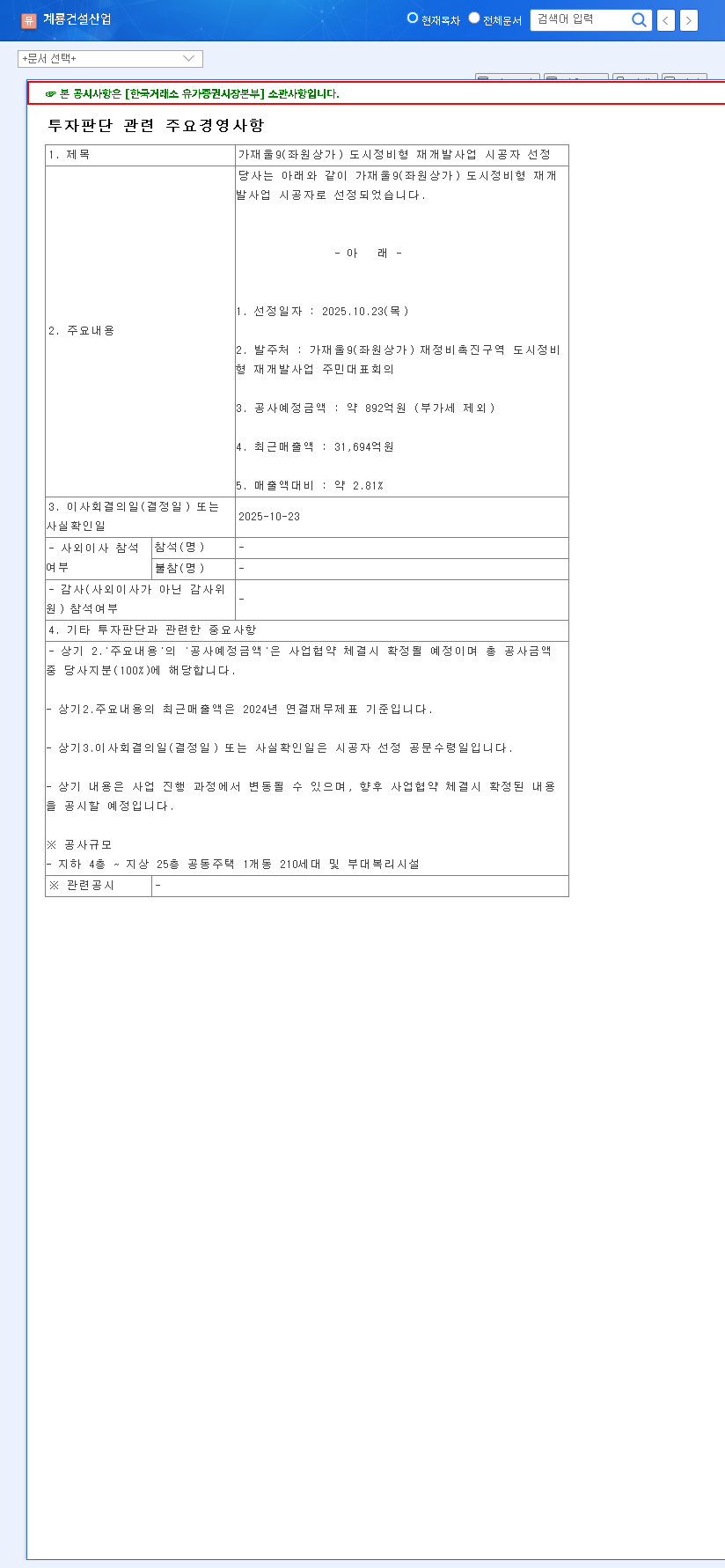
    In a significant development for the South Korean construction sector, KYE-RYONG CONSTRUCTION INDUSTRIAL CO.,LTD has officially secured a major contract for the ‘Gajaeul 9 (Jwaweon Sangga) Urban Redevelopment Project’. This strategic win, valued at approximately ₩89.2 billion, not only reinforces the company’s market position but also signals a robust period of growth. This analysis will delve into the specifics of this contract, its financial implications, and what it means for investors keeping a close eye on the company’s trajectory.

    We will provide a comprehensive breakdown of the project’s impact on KYE-RYONG CONSTRUCTION’s revenue stream, its role in diversifying their business portfolio, and a forward-looking perspective for potential investors. Understanding the nuances of this construction contract win is key to evaluating the company’s long-term value proposition in the competitive urban redevelopment landscape.

    Project Breakdown: The Gajaeul 9 Redevelopment Project

    On October 23, 2025, KYE-RYONG CONSTRUCTION was officially selected by the Resident Representative Council of the Gajaeul 9 Redevelopment Promotion District. The contract, valued at ₩89.2 billion (excluding VAT), tasks the company with transforming the Jwaweon Sangga area into a modernized urban space. This type of urban redevelopment is critical for revitalizing city centers and represents a lucrative niche for experienced construction firms.

    This contract win is not just another number on the balance sheet; it’s a testament to KYE-RYONG CONSTRUCTION’s expertise in complex urban projects and a significant step in strengthening its order backlog for the coming years.

    Key Project Details:

    • Project Name: Gajaeul 9 (Jwaweon Sangga) Urban Redevelopment Project
    • Contract Value: Approximately ₩89.2 billion (excluding VAT)
    • Significance: Represents ~2.81% of the company’s recent annual revenue of ₩3.1694 trillion.
    • Official Source: Click to view the DART report

    Financial and Strategic Impact Analysis

    While 2.81% of total revenue may seem modest, its impact is multifaceted. For a large company like KYE-RYONG CONSTRUCTION, securing a steady pipeline of such projects is fundamental to maintaining financial stability and growth momentum. Let’s explore the key benefits.

    Bolstering Revenue and Cash Flow

    The ₩89.2 billion injection into the company’s order book provides a predictable revenue stream over the project’s lifecycle. Construction contracts typically involve phased payments tied to project milestones. This structure ensures a stable and predictable cash flow, which is vital for managing operational costs, investing in new equipment, and funding other projects. This stability is often viewed favorably by the market and can contribute to a positive KR stock analysis.

    Enhancing Market Position and Expertise

    Successfully winning the Gajaeul 9 Redevelopment Project enhances KYE-RYONG CONSTRUCTION’s reputation as a leader in the urban renewal space. Each successful project serves as a powerful case study, strengthening their bids for future large-scale redevelopment contracts across the country. This win diversifies their portfolio beyond standard residential or infrastructure projects, reducing risk and demonstrating versatility. For more on market trends, you can explore reports from industry leaders like McKinsey’s engineering and construction analysis.

    An Investor’s Guide: What to Consider Next

    While this news is overwhelmingly positive, savvy investors must conduct thorough due diligence. A single contract win should be viewed within the broader context of the company’s overall financial health and market conditions.

    • Review Company Fundamentals: Analyze KYE-RYONG’s latest financial statements. Look at their debt-to-equity ratio, profit margins, and existing order backlog to assess overall stability. A deep dive into their fundamentals can be found in our complete guide to construction stock investing.
    • Assess Market Expectations: Monitor reports from securities firms and financial analysts following this announcement. Is this win already priced into the stock, or does it represent new, unexpected value?
    • Consider Project Risks: Urban redevelopment can face challenges such as permit delays, fluctuating raw material costs, and local community concerns. Investors should factor these potential risks into their evaluation.
    • Monitor Project Execution: Keep an eye on news related to the project’s start date, progress, and adherence to timelines. Successful and timely execution will be the ultimate measure of this contract’s value.

    In conclusion, the Gajaeul 9 contract is a significant and positive catalyst for KYE-RYONG CONSTRUCTION. It solidifies their revenue pipeline, enhances their industry reputation, and presents a compelling story for growth. However, a comprehensive investment decision should be based on a holistic analysis of the company’s fundamentals and the broader market landscape.

    (013580) KYE-RYONG CONSTRUCTION Secures ₩89.2B Gajaeul 9 Redevelopment Project: A 2025 Stock Analysis 관련 이미지
  • (263700) Carelabs Senior Care Business: A KRW 62B Bet on the Future | In-Depth Stock Analysis

    (263700) Carelabs Senior Care Business: A KRW 62B Bet on the Future | In-Depth Stock Analysis

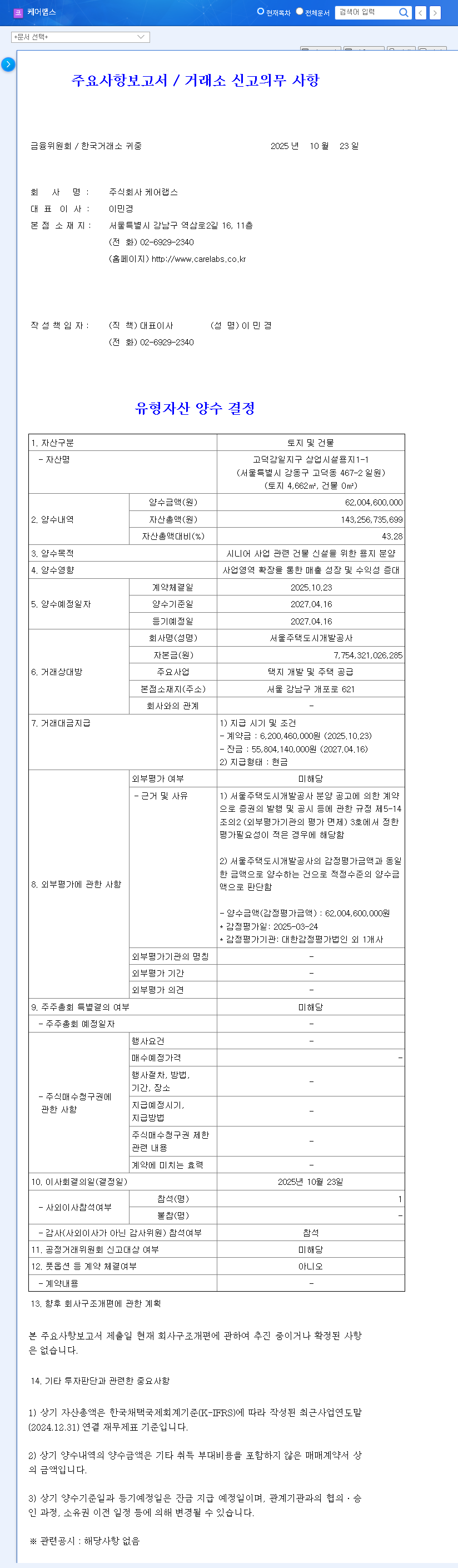
    Carelabs Co.,Ltd has made a pivotal move that could redefine its future, announcing a massive KRW 62 billion investment into the Carelabs senior care business. This strategic land acquisition, representing over 43% of the company’s total assets, signals a significant pivot towards South Korea’s rapidly expanding senior living market. For investors, this bold strategy presents both immense opportunity and considerable risk. This in-depth analysis will dissect the investment, explore the market dynamics, and provide a clear outlook on what this means for Carelabs’ stock value.

    The Landmark KRW 62 Billion Announcement

    On October 23, 2025, Carelabs Co.,Ltd formalized its decision to acquire 4,662㎡ of commercial land in Godeok-dong, Seoul, from the Seoul Housing & Communities Corporation. The price tag—a staggering KRW 62 billion—underscores the scale of this commitment. The purpose is clear: to construct a state-of-the-art facility dedicated to the senior care business, aiming to capture a new revenue stream and enhance long-term profitability. You can view the Official Disclosure (Source) for complete details.

    This isn’t just a real estate purchase; it’s a strategic declaration. Carelabs is positioning itself to become a major player in the silver economy, a market fueled by undeniable demographic shifts.

    Why the Pivot to Senior Care? Market Context

    Carelabs’ move is a calculated response to one of South Korea’s most significant societal trends: population aging. As the nation’s demographic profile shifts, the demand for high-quality senior healthcare, housing, and leisure services is projected to explode. According to data from institutions like the World Bank, this demographic transition is creating a robust ‘silver economy.’ By entering this space, Carelabs aims to diversify its portfolio away from existing ventures and tap into a sustainable, long-term growth engine.

    Strategic Rationale:

    • Market Preemption: Gaining a first-mover advantage in a high-potential urban area before the market becomes saturated.
    • Portfolio Diversification: Reducing reliance on current business lines and building a more resilient corporate structure.
    • Tangible Asset Growth: Significantly boosting the company’s asset base, which can improve its financial standing and borrowing power.

    Analyzing the Upside: Potential Growth Catalysts

    If executed successfully, the Carelabs senior care business could deliver substantial returns. The direct revenue from operating the new facility is the most obvious benefit, but the strategic advantages run deeper. Owning the property insulates Carelabs from rising rental costs and provides a valuable, appreciable asset on its balance sheet. A successful launch could send a powerful signal to the market about the management’s foresight and execution capabilities, potentially leading to a positive re-rating of the company’s stock.

    Navigating the Headwinds: Key Risks for Investors

    An investment of this magnitude is not without significant risks. The most immediate concern is the financial burden. The KRW 62 billion payment, with a large balance due in 2027, will test the company’s liquidity management. Beyond financing, execution risk is paramount.

    Primary Risk Factors:

    • Financial Strain: A significant cash outflow could pressure working capital and limit other investment opportunities in the short term.
    • Operational Uncertainty: The senior care market is competitive. Success depends on a well-defined business model, effective marketing, and superior service delivery, which are currently unproven for Carelabs.
    • Construction & Timeline Risks: Delays or cost overruns in the building phase could negatively impact projected returns and delay revenue generation.
    • Real Estate Market Volatility: While an asset, the property’s value is subject to fluctuations in the Seoul real estate market.

    An Investor’s Playbook: What to Watch Next

    For current and prospective investors, the path forward requires diligent monitoring. The long-term success of the Carelabs senior care business hinges on the company’s ability to navigate the short-term financial pressures while executing its long-term vision. It’s crucial to analyze how this large-scale investment fits into a broader portfolio. For more insights, you might read our guide on evaluating capital-intensive projects in growth stocks.

    Key Monitoring Points:

    • Funding Plan: Watch for announcements on how Carelabs will fund the 2027 balance payment. Will it be through cash flow, debt, or equity?
    • Business Model Transparency: Look for detailed disclosures on the specific services, pricing structure, and target demographic for the new facility.
    • Stakeholder Communication: Assess how transparently management communicates progress, challenges, and timelines to the investment community.

    Ultimately, Carelabs’ KRW 62 billion land acquisition is a high-stakes venture. The long-term growth potential is significant, but investors must remain aware of the considerable financial and operational hurdles that lie ahead. Careful and continuous analysis will be the key to making an informed investment decision.

    (263700) Carelabs Senior Care Business: A KRW 62B Bet on the Future | In-Depth Stock Analysis 관련 이미지
  • (034830) Korea Real Estate Investment & Trust & the LH REITs AMC Deal: An Investor’s Deep Dive

    (034830) Korea Real Estate Investment & Trust & the LH REITs AMC Deal: An Investor’s Deep Dive

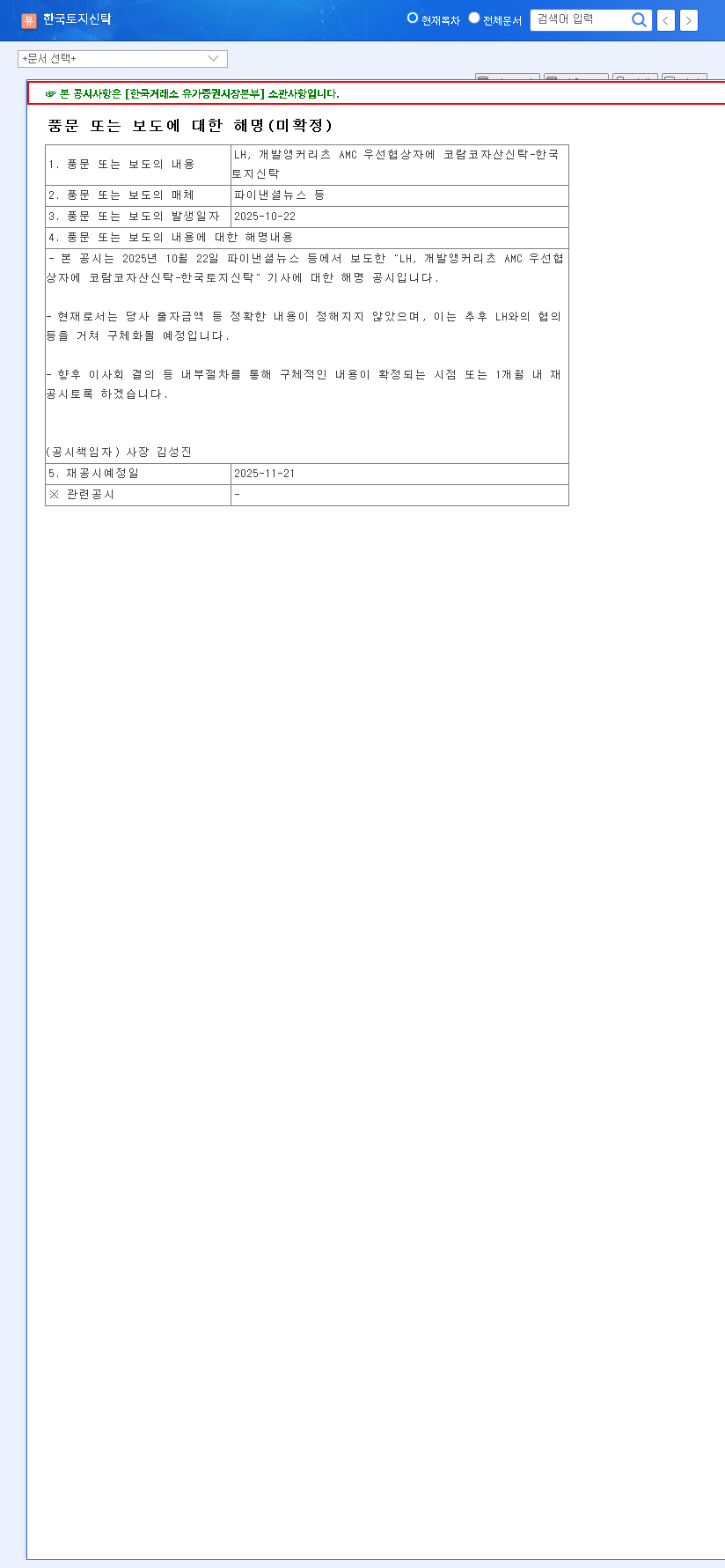
    Recent market chatter has centered on a potentially transformative deal involving Korea Real Estate Investment & Trust and a major government-led initiative. Media reports named the company as a preferred bidder for the LH (Korea Land and Housing Corporation) Development Anchor REITs AMC, a move that could significantly reshape its future. However, an official clarification stating that “nothing is confirmed” has left investors seeking clarity.

    This in-depth analysis unpacks the entire situation, from the initial reports to the potential financial implications. We will explore what the LH Development Anchor REITs AMC business entails and provide a balanced view of the opportunities and risks for Korea Real Estate Investment & Trust, helping you make more informed decisions.

    The News vs. The Reality: What’s Confirmed?

    On October 22, 2025, financial news outlets reported that Korea Real Estate Investment & Trust, along with Koramco Asset Trust, was selected as a preferred bidder for the LH Development Anchor REITs AMC. This news suggested a major step into large-scale public real estate development projects, a lucrative and stable sector.

    In a swift response, the company issued a formal clarification to manage market expectations. The disclosure, titled “Explanation regarding rumors or press reports (Unconfirmed),” clarified the official position. According to the Official Disclosure (Source), key details regarding investment amounts and project specifics remain undecided and are subject to future negotiations with LH. A follow-up re-disclosure is promised within one month, or as soon as details are confirmed.

    Why the LH Development Anchor REITs AMC is a Game-Changer

    To understand the excitement, it’s crucial to grasp the significance of this opportunity. An Asset Management Company (AMC) for a development anchor REIT is not merely a passive asset manager. It is the operational brain behind large-scale real estate development, involved from planning and financing to execution and profit generation. Success in securing this role for Korea Real Estate Investment & Trust would be a monumental achievement.

    “Partnering with a state-backed entity like LH offers unparalleled stability and access to a pipeline of strategic development projects, effectively de-risking long-term growth for the chosen asset manager.”

    Key Strategic Advantages

    • Access to Prime Projects: Participation guarantees a significant role in major public real estate developments, providing a stable, long-term revenue stream from management fees and development profits.
    • Portfolio Diversification: It allows Korea Real Estate Investment & Trust to expand beyond its traditional trust operations into the dynamic real estate asset management space, hedging against market cycles. Learn more about diversifying in our guide to Korean REITs investment.
    • Enhanced Market Credibility: A successful partnership with LH significantly boosts the company’s reputation, strengthening its position to win other large-scale public and private sector contracts in the future.
    • Synergistic Partnership: Collaborating with Koramco Asset Trust, another industry leader, could create powerful synergies by combining complementary strengths in finance, development, and asset management.

    A Balanced Analysis: Potential Upsides vs. Downsides

    The Bull Case (Potential Positives)

    If the KREIT LH deal is finalized on favorable terms, the upside is substantial. It would establish a major new growth engine, leading to predictable fee income and a share in development profits. The enhanced corporate image and solidified market position could attract further institutional investment and improve the company’s valuation multiples over the long term.

    The Bear Case (Potential Risks)

    The primary risk is the current uncertainty. Negotiations could result in less favorable terms, a smaller-than-expected investment role, or even fall through completely. Furthermore, large-scale development requires significant capital. A substantial capital injection could place a temporary strain on the company’s balance sheet. As noted by sources like the Financial Times, real estate development is subject to macroeconomic risks, including interest rate fluctuations and regulatory changes, which must be expertly managed.

    Investor Strategy: What to Watch For

    A prudent approach is essential. The market will be closely watching for the re-disclosure, scheduled for before November 21, 2025. This document will be the single most important catalyst for the stock in the near term.

    Key Metrics in the Upcoming Disclosure:

    • Investment Scale: The exact capital commitment required from Korea Real Estate Investment & Trust.
    • Profit Structure: How fees and development profits will be shared among the partners.
    • Project Scope: The size, timeline, and nature of the real estate projects involved.
    • Governance: The roles and responsibilities of each partner in the consortium.

    Ultimately, investors should adopt a long-term perspective. Evaluate whether this strategic move aligns with the company’s core competencies and can genuinely enhance its intrinsic value beyond the short-term stock price volatility. Investment decisions should always be based on thorough due diligence and your own personal risk tolerance.

    (034830) Korea Real Estate Investment & Trust & the LH REITs AMC Deal: An Investor's Deep Dive 관련 이미지
  • (365550) ESR Kendall Square REIT Acquisition of Icheon Logistics Center: A 2025 Investor Analysis

    (365550) ESR Kendall Square REIT Acquisition of Icheon Logistics Center: A 2025 Investor Analysis

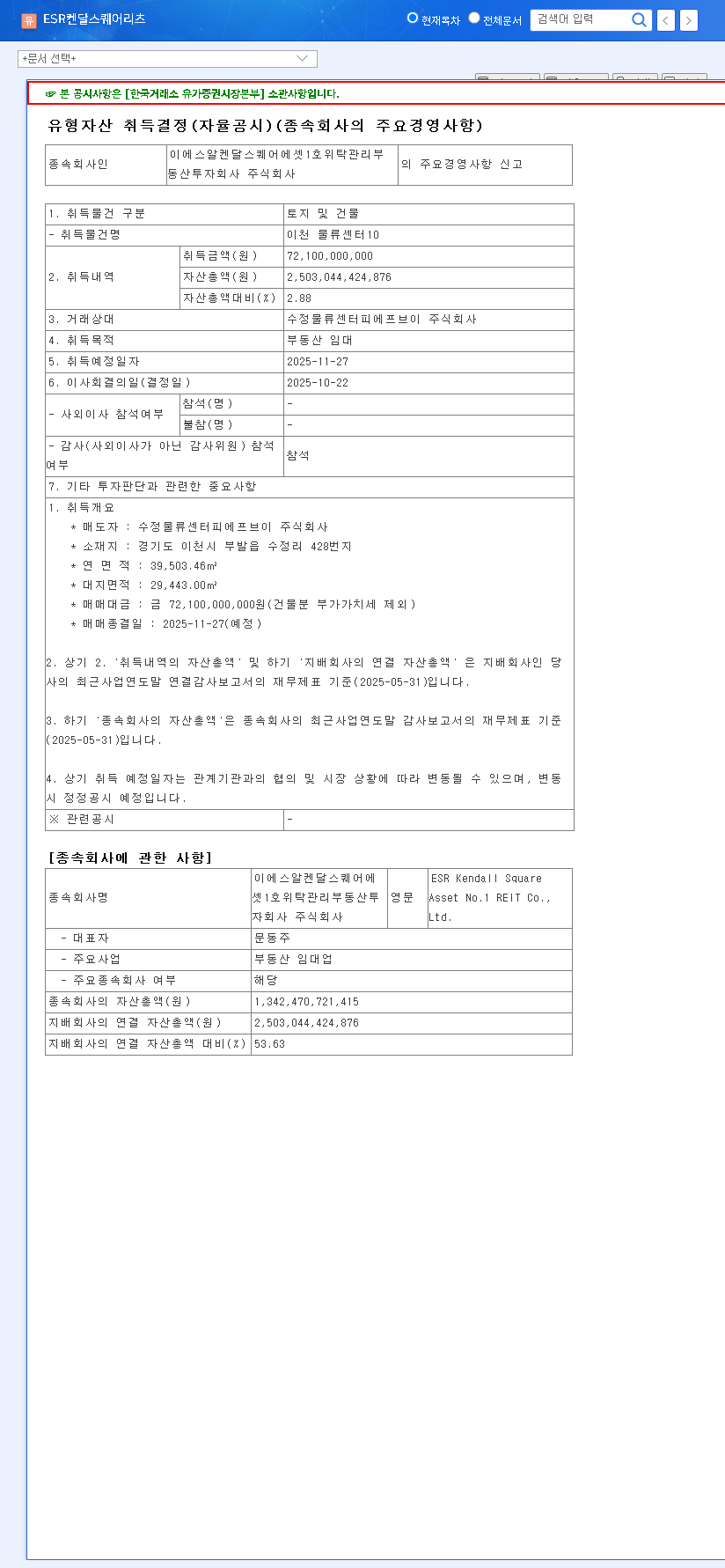
    ESR Kendall Square REIT, a major player in the logistics real estate sector, has just announced a significant move. The ESR Kendall Square REIT acquisition of the Icheon Logistics Center 10 for a substantial ₩72.1 billion is a strategic decision that warrants close examination by current and prospective investors. This deal represents a continued commitment to expanding its portfolio, but does it signal robust growth or introduce new financial risks in a shifting economic landscape? This comprehensive analysis will dissect the transaction, evaluate its potential impacts, and provide a clear roadmap for investor due diligence.

    Transaction Overview: The Core Details

    On October 22, 2025, the company disclosed its intent to acquire the Icheon Logistics Center 10 through a subsidiary. This move is squarely aimed at bolstering its core real estate leasing business. Here are the critical facts of the deal at a glance:

    • Acquired Asset: Icheon Logistics Center 10 (Land and Buildings)
    • Acquisition Price: ₩72.1 billion KRW
    • Purpose: Expansion of real estate leasing operations.
    • Asset Proportion: Represents 2.88% of the REIT’s total assets.
    • Scheduled Closing: November 27, 2025

    The acquisition from Sujeong Logistics Center PFV Co., Ltd. is a clear indicator of the REIT’s strategy to deepen its footprint in key logistical corridors within South Korea, aiming to capture the sustained growth in e-commerce and third-party logistics (3PL).

    Potential Impact: A Double-Edged Sword for Investors

    A ₩72.1 billion investment is never a minor event. This ESR Kendall Square REIT acquisition presents both compelling opportunities and notable risks that require careful consideration.

    The Bull Case: Fueling Future Growth

    • Enhanced Portfolio Strength: Adding a modern logistics facility in Icheon—a prime logistics hub near the Seoul metropolitan area—diversifies the portfolio and reduces single-asset risk. This strengthens the REIT’s ability to generate stable, long-term rental income.
    • Profitability Boost: Assuming successful leasing at market rates, the new asset will directly contribute to higher revenue and Funds From Operations (FFO), a key metric for REIT profitability and dividend potential.
    • Strategic Market Positioning: Continuous, strategic acquisitions reinforce ESR Kendall Square’s market leadership and create economies of scale in property management, ultimately driving operational efficiency. For more on market trends, see the latest analysis from authoritative financial news sources.

    The Bear Case: Financial Strain and Execution Risks

    • Increased Financial Leverage: Funding such a large purchase often involves taking on new debt. This increases the REIT’s leverage and financial risk, especially in a rising interest rate environment where higher interest expenses can erode profitability.
    • Asset Management Hurdles: The success of the Icheon Logistics Center 10 hinges on effective management. Risks like tenant vacancies, downward pressure on rental rates, or unexpected capital expenditures could negatively impact projected returns.
    • Capital Inefficiency: If the asset fails to generate returns that exceed its cost of capital (including interest on debt), it will destroy shareholder value. The efficiency of this capital deployment is paramount.

    The long-term success of this acquisition will ultimately depend on operational synergy. It’s a test of whether ESR Kendall Square REIT can leverage its existing network and expertise to maximize the value of the Icheon Logistics Center 10.

    Investor Action Plan: Your Due Diligence Checklist

    Making an informed decision requires digging deeper than the press release. Investors should adopt a cautious, research-driven approach. Here are the key areas to investigate before forming a final judgment on this REIT investment analysis:

    • Scrutinize the Funding Plan: How is the ₩72.1 billion being financed? Look for details on debt-to-equity mix, interest rates on new loans, and the impact on the REIT’s balance sheet. The best place to start is the Official Disclosure (Source: DART).
    • Assess Asset-Level Details: Investigate the Icheon Logistics Center 10 itself. What is its current occupancy rate? Who are the tenants and what are the lease terms? What is the projected Net Operating Income (NOI) and cap rate?
    • Analyze Market Competitiveness: Research the Icheon logistics market. What is the supply and demand dynamic? How does this asset compare to competing facilities in the area?
    • Review Management’s Track Record: How have past acquisitions performed? Understanding the REIT’s history of integrating new properties can provide insight into their execution capabilities. For more background, you can review our Beginner’s Guide to Investing in REITs.

    In conclusion, the acquisition of Icheon Logistics Center 10 is a classic growth-oriented move for ESR Kendall Square REIT. It offers a clear path to increased revenue but comes with tangible financial and operational risks. A prudent investor will weigh both sides carefully, conducting thorough research before committing capital.

    (365550) ESR Kendall Square REIT Acquisition of Icheon Logistics Center: A 2025 Investor Analysis 관련 이미지
  • (294870) HYUNDAI DEVELOPMENT COMPANY (HDC) Wins ₩419.6B Gwang-an 4 Redevelopment Contract: Investor Analysis & Stock Outlook

    (294870) HYUNDAI DEVELOPMENT COMPANY (HDC) Wins ₩419.6B Gwang-an 4 Redevelopment Contract: Investor Analysis & Stock Outlook

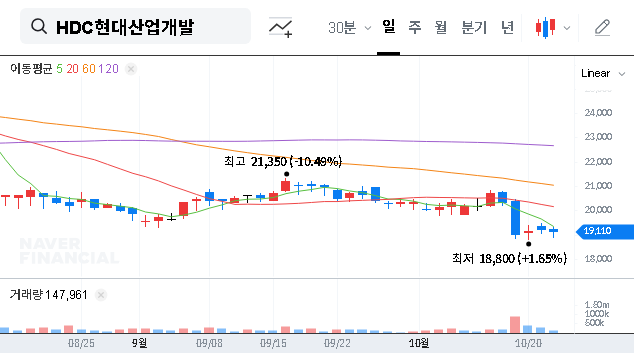
    In a significant development for the South Korean construction sector, HYUNDAI DEVELOPMENT COMPANY (HDC) has officially secured a major contract that has captured the attention of investors. The company announced a landmark ₩419.6 billion construction agreement for the Gwang-an 4 Redevelopment Project, a deal that represents a substantial 9.9% of its recent annual revenue. This news raises a crucial question: is this the catalyst for a new growth chapter for HDC, or do underlying risks warrant caution? This comprehensive analysis will delve into the contract’s implications, a balanced view of the opportunities and challenges, and provide a strategic roadmap for potential investors.

    This contract is more than just a number on a balance sheet; it’s a strategic win that reinforces HDC’s market position and signals a potential turning point in investor confidence after a challenging period.

    The Gwang-an 4 Redevelopment Project: A Closer Look

    On October 22, 2025, HYUNDAI DEVELOPMENT COMPANY formally announced the signing of the construction contract with the Gwang-an 4 Redevelopment Project Association. The project, valued at ₩419.6 billion, is set to transform the Gwang-an-dong area within Suyeong-gu, Busan, a prime coastal location known for its potential. According to the Official Disclosure (DART), this large-scale venture underscores the company’s robust capabilities in securing high-value urban renewal projects.

    This isn’t just another project; it’s a strategic foothold in one of South Korea’s most dynamic real estate markets. The successful execution of the Gwang-an 4 Redevelopment Project will not only reshape a key part of Busan but also significantly influence HDC’s financial performance and industry reputation for years to come.

    Why This Contract is a Game-Changer for HDC

    The immediate financial injection is clear, but the strategic implications of this win are far more profound. For investors conducting an HDC stock analysis, understanding these multifaceted benefits is crucial.

    1. Bolstered Revenue and Proven Bidding Prowess

    A ₩419.6 billion contract provides a direct and substantial boost to HDC’s revenue pipeline, offering greater earnings visibility. More importantly, winning such a competitive bid reaffirms the company’s market strength and expertise in project estimation and proposal development, which can create a positive feedback loop for securing future high-margin contracts.

    2. Enhanced Reputation in the Redevelopment Sector

    Successfully delivering on a high-profile project like the Gwang-an 4 Redevelopment Project will cement HDC’s reputation as a leader in the lucrative urban renewal space. This strengthens their portfolio and builds immense trust with future project associations and municipalities, making them a preferred partner for similar large-scale developments.

    3. Restoring Investor Confidence and Corporate Image

    HYUNDAI DEVELOPMENT COMPANY has previously faced market scrutiny over incidents at other sites. This significant, well-publicized win serves as a powerful counter-narrative, demonstrating operational competence and a forward-looking strategy. It’s a critical step in rebuilding its corporate image and mitigating perceived risks among the investment community.

    HDC Stock Analysis: A Balanced View of Potential Risks

    While the news is overwhelmingly positive, a prudent HDC investor analysis must also weigh the potential hurdles and risks associated with a project of this magnitude.

    • Profitability Uncertainty: The headline contract value is impressive, but the final profit margin is not guaranteed. Unforeseen rises in material costs, supply chain disruptions, or labor shortages could compress profitability over the project’s lifecycle.
    • Operational & Financial Risks: Executing a multi-year, large-scale project requires impeccable operational management and stable funding. Investors should closely examine HDC’s current debt-to-equity ratio, cash flow statements, and overall financial health. For more on this, see our guide on Analyzing Construction Company Financials.
    • Execution and Market Risks: The construction industry is fraught with execution risks, including potential safety issues, civil complaints from local residents, and unexpected design changes. Furthermore, the broader real estate market’s health could impact the project’s ultimate success upon completion.
    • Legacy Reputational Impact: While this contract is a positive step, the shadow of past issues may still linger. The market will be watching HDC’s execution of this project with intense scrutiny, and any misstep could be amplified.

    Investor Action Plan & Final Thoughts

    The Gwang-an 4 Redevelopment Project contract is undeniably a major short-term catalyst for HYUNDAI DEVELOPMENT COMPANY. However, long-term investment success requires a strategy grounded in diligent analysis rather than speculative excitement.

    Investors should focus on continuous monitoring of the company’s quarterly financial reports, paying close attention to profit margins and cash flow. Stay updated with industry news from authoritative sources like Bloomberg’s Real Estate sector coverage and analyze how HDC is navigating the competitive landscape. While this contract marks a significant opportunity for growth and reputational recovery, prudent investment decisions must be based on a comprehensive and ongoing evaluation of both the promise and the peril.

    (294870) HYUNDAI DEVELOPMENT COMPANY (HDC) Wins ₩419.6B Gwang-an 4 Redevelopment Contract: Investor Analysis & Stock Outlook 관련 이미지