Tag: Rare Disease

  • (068270) Celltrion’s $1B Gambit: A Deep Dive into the Rare Autoimmune Disease Drug Deal

    (068270) Celltrion’s $1B Gambit: A Deep Dive into the Rare Autoimmune Disease Drug Deal

    In a landmark move signaling a strategic pivot, global biopharmaceutical giant Celltrion, Inc. has made a significant investment into the future of innovative medicine. The company recently announced a major licensing agreement for a promising new rare autoimmune disease drug, solidifying its commitment to evolving beyond its biosimilar stronghold. This deal, valued at up to $744 million, involves novel drug candidates from Kaigene Inc. and is poised to become a new growth engine, capturing the attention of investors and the pharmaceutical industry alike.

    This comprehensive analysis will dissect the agreement, explore the science behind the technology, weigh the potential rewards against the inherent risks, and provide a clear roadmap for stakeholders monitoring Celltrion’s ambitious journey.

    Dissecting the Landmark Agreement

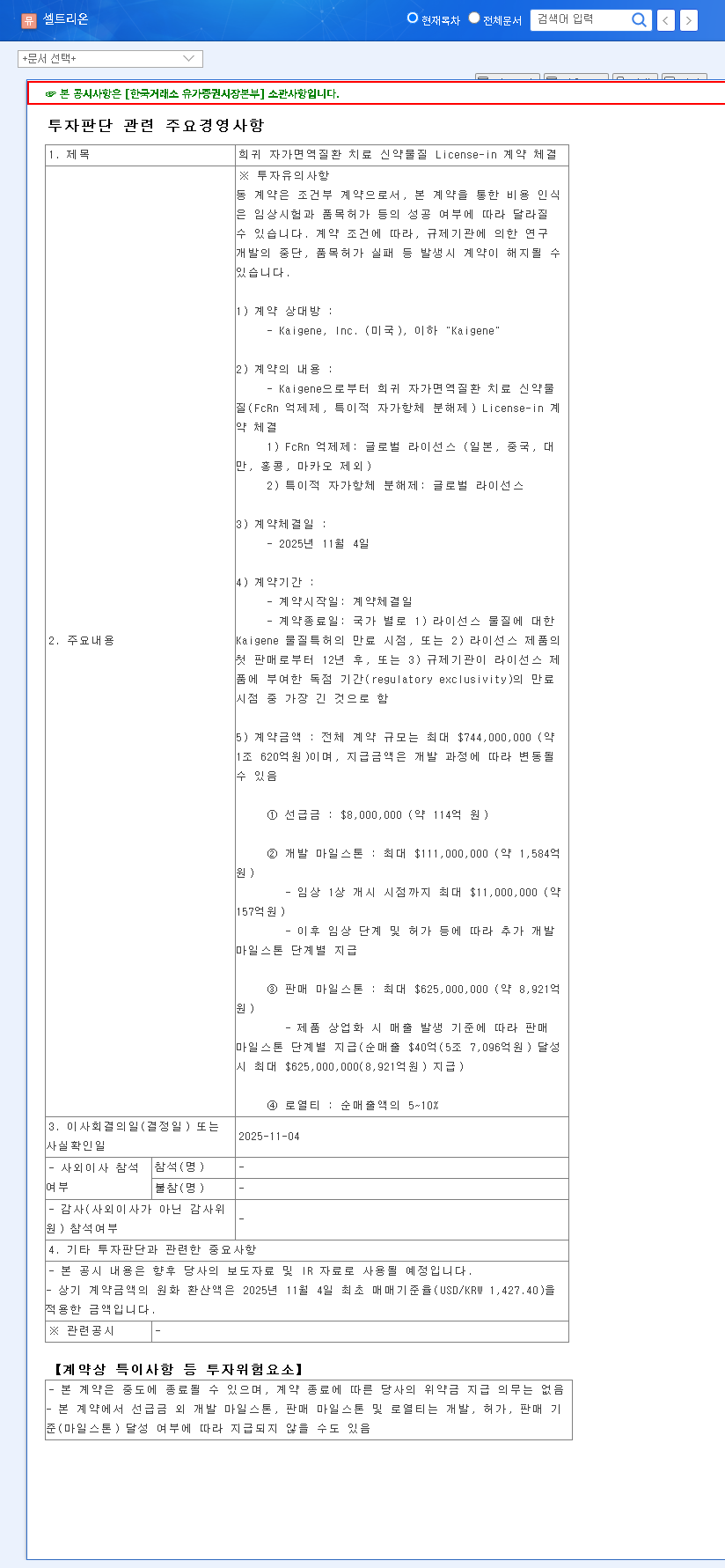
    On November 4, 2025, Celltrion formalized a global license-in agreement with Kaigene Inc., securing the rights to two pioneering drug candidates targeting rare autoimmune diseases. As detailed in the Official Disclosure, this strategic acquisition focuses on an FcRn inhibitor and a specific autoantibody degrader. This move is a cornerstone of Celltrion’s ‘Vision 2030’, aiming to generate 40% of its sales from innovative new drugs.

    The Financial Framework

    • Total Deal Value: Up to $744 million (approximately KRW 1.062 trillion).
    • Upfront Payment: An initial investment of $8 million to secure the license.
    • Milestone Payments: Up to $111 million tied to specific development and regulatory achievements.
    • Royalties & Sales Milestones: A tiered royalty structure of 5-10% on net sales, plus additional payments based on commercial success.

    The Strategic Rationale: Targeting the High-Value Rare Disease Market

    Celltrion’s decision to acquire this rare autoimmune disease drug candidate is a calculated move to diversify away from its highly successful, yet increasingly competitive, biosimilar portfolio. The rare disease market, often referred to as the orphan drug market, offers unique advantages, including higher pricing power, extended market exclusivity, and often a more streamlined regulatory pathway. For more context, you can explore our guide on Understanding Biosimilars vs. Innovative Drugs.

    “This is more than just a pipeline expansion; it’s a statement of intent. Celltrion is leveraging its robust cash flow from biosimilars to become a fully-integrated, innovative pharmaceutical powerhouse. The FcRn inhibitor space is hot, and this deal places them squarely in the game.”

    What is an FcRn Inhibitor?

    FcRn inhibitors represent a cutting-edge class of drugs. In many autoimmune diseases, the body mistakenly produces antibodies (IgG) that attack its own tissues. The neonatal Fc receptor (FcRn) is a protein that normally protects these antibodies from being broken down, extending their lifespan. An FcRn inhibitor works by blocking this receptor, which causes the harmful autoantibodies to be cleared from the body more rapidly. This mechanism has shown significant promise in treating conditions like myasthenia gravis, chronic inflammatory demyelinating polyneuropathy (CIDP), and others. For a deeper scientific perspective, the National Institutes of Health (NIH) provides extensive research on this topic.

    Weighing the Opportunity Against the Risk

    While the long-term potential is immense, this venture into innovative new drug development comes with a distinct set of challenges that investors must carefully consider.

    Positive Catalysts for Growth

    • Enhanced Corporate Value: Successful development would transition Celltrion’s valuation model from a stable biosimilar manufacturer to a high-growth innovative pharma company.
    • Portfolio Diversification: Reduces reliance on any single market segment and opens up substantial new revenue streams.
    • Strengthened R&D Credibility: A successful clinical program would significantly boost market confidence in Celltrion’s R&D capabilities.

    Potential Risks and Headwinds

    • Clinical Trial Uncertainty: The path from pre-clinical to commercialization is long and fraught with risk. The majority of drug candidates fail during Phase II or Phase III trials.
    • Fierce Competition: The FcRn inhibitor market is competitive, with established players like argenx (Vyvgart) and UCB. Celltrion must demonstrate a clear clinical or commercial advantage.
    • Financial Burden: The upfront and milestone payments are just the beginning. The costs of running global clinical trials are substantial and could impact short-term profitability.
    • Macroeconomic Factors: As a USD-denominated deal, fluctuations in the KRW/USD exchange rate could significantly alter the final cost.

    Investor Action Plan: What to Monitor

    For investors, this high-stakes venture requires careful and continuous monitoring. Key inflection points will determine the success of this Celltrion rare autoimmune disease drug project.

    • Clinical Trial Data Readouts: Pay close attention to announcements regarding the outcomes of Phase I (safety), Phase II (efficacy), and Phase III (pivotal) trials. Positive data will be a major stock catalyst.
    • Regulatory Filings and Approvals: Monitor filings with major regulatory bodies like the FDA and EMA. Approval in these key markets is critical for commercial success.
    • Quarterly Financials: Track the company’s R&D spend and cash flow to ensure the development costs are being managed effectively without unduly straining the core business.
    • Competitive Landscape: Keep an eye on the progress of competitors in the FcRn inhibitor and broader autoimmune disease space.

    In conclusion, Celltrion’s deal with Kaigene Inc. is a bold and potentially transformative step. While it introduces new risks, it also unlocks a new frontier of growth that could redefine the company’s future for decades to come.
    (068270) Celltrion's $1B Gambit: A Deep Dive into the Rare Autoimmune Disease Drug Deal 관련 이미지
  • ISU Abxis IR Analysis: Potential for Second Half 2025 Leap and Investment Strategy


    ISU Abxis IR Analysis: Potential for Second Half 2025 Leap and Investment Strategy 대표 차트 이미지


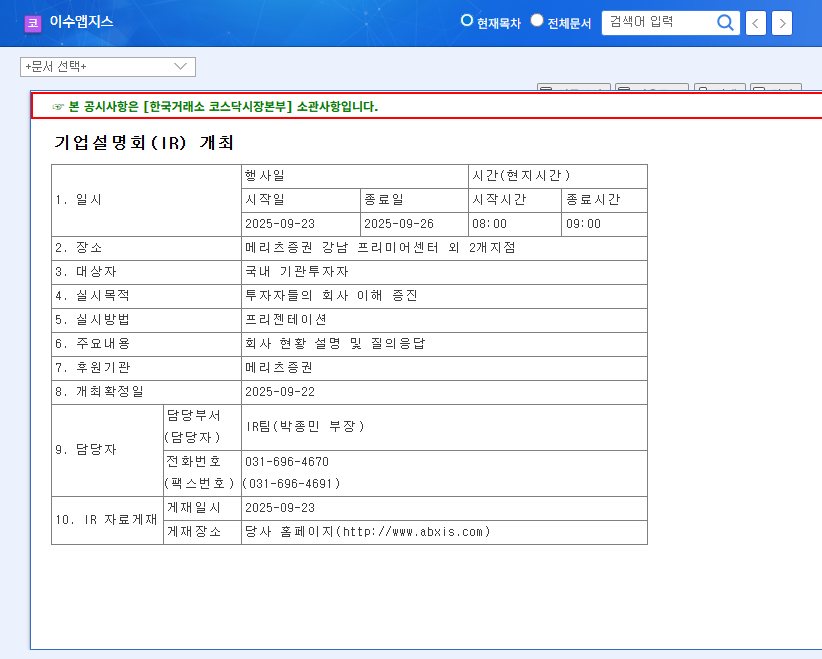
    What Happened? ISU Abxis Holds IR Meeting!

    ISU Abxis held an investor relations (IR) meeting on September 23, 2025, presenting the company’s current status and future strategies. This IR served as a crucial platform to communicate the company’s growth potential and investment value to investors.

    Key Takeaways: Growth Potential and Financial Risks

    ISU Abxis has established a solid presence in the rare disease treatment market, and the surge in Abcertin exports to Africa is particularly noteworthy. The potential ISU104 licensing deal is also expected to positively impact future financial performance. However, investors should carefully consider the short-term decline in profitability and financial risks related to convertible bonds and derivatives.

    What to Do: Investment Strategies

    • Positive Aspects: Continued growth in Abcertin exports, successful ISU104 licensing deal, performance of new business ventures
    • Risk Management: Improvement in short-term profitability, securing financial soundness, managing derivative risks

    Investor Action Plan

    Investors considering ISU Abxis should continuously monitor positive aspects such as the sustained growth of Abcertin exports, the successful conclusion of the ISU104 licensing agreement, and the performance of new businesses. At the same time, it’s crucial to carefully examine management’s strategies for addressing potential risk factors, including improving short-term profitability, ensuring financial soundness, and managing risks related to derivatives.


    FAQ

    What is ISU Abxis’s main business?

    ISU Abxis’s core business is the development and sale of treatments for rare diseases. Key products include the hemophilia treatment ‘Clotinab’, the Gaucher disease treatment ‘Abcertin’, and the Fabry disease treatment ‘Fabagal’.

    What is the reason for the increase in Abcertin exports to Africa?

    The increase is a result of the growing demand for rare disease treatments in Africa, combined with ISU Abxis’s proactive market penetration strategy. The company is expanding its market share based on competitive pricing and product quality.

    What is ISU104?

    ISU104 is an anti-cancer drug candidate being developed by ISU Abxis. It is currently in clinical trials and has the potential for commercialization through a licensing agreement.

    What are the financial risks for ISU Abxis?

    The issuance of convertible bonds and increasing debt related to derivatives are contributing to financial burdens. Investors should pay close attention to how these financial risks are being managed.


    ISU Abxis IR Analysis: Potential for Second Half 2025 Leap and Investment Strategy 관련 이미지
    ISU Abxis IR Analysis: Potential for Second Half 2025 Leap and Investment Strategy 관련 이미지


  • ISU Abxis IR Analysis: Investment Opportunity or Risk?


    ISU Abxis IR Analysis: Investment Opportunity or Risk? 대표 차트 이미지


    1. ISU Abxis IR: What Was Discussed?

    ISU Abxis held an investor relations (IR) session on September 9, 2025, presenting the company’s current status and future strategies. Key topics included the stable growth of its existing pharmaceutical business, updates on its new drug pipeline development, and diversification strategy through new business ventures.

    2. Why It Matters: Investment Opportunities vs. Risk Factors

    • Opportunities: High growth potential of the rare disease treatment market, commercialization potential of the new drug pipeline, securing growth engines through business diversification.
    • Risks: Uncertainties surrounding new business ventures, potential failure in new drug development, and potential equity dilution due to convertible bond issuance.

    3. What’s Next?: Future Stock Price Outlook

    Considering the information released during the IR and the current market conditions, ISU Abxis’s stock price is expected to experience increased volatility. The stock price is likely to react sensitively, particularly to news related to new drug development and new business ventures. The possibility of stock dilution due to convertible bond issuance is also a factor that investors should closely monitor.

    4. Investor Action Plan: What Should You Do?

    Investors should thoroughly analyze the IR materials and make investment decisions based on a comprehensive assessment of the company’s long-term growth potential and risk factors. Continuous monitoring of the progress of the new drug pipeline, concrete results of new businesses, and resolution of uncertainties related to convertible bonds are particularly crucial.


    Frequently Asked Questions (FAQ)

    What are ISU Abxis’s main businesses?

    ISU Abxis focuses on rare disease treatments and antibody therapeutics, while pursuing diversification through new ventures in health foods, real estate, and investment businesses.

    What is the current status of ISU Abxis’s new drug development?

    ISU Abxis possesses multiple drug pipelines and is actively engaged in research and development activities. Notably, they have confirmed the potential for monetization through technology transfer of ISU104.

    How does the issuance of convertible bonds affect the stock price?

    The issuance of convertible bonds carries the potential for equity dilution, which can put downward pressure on the stock price.


    ISU Abxis IR Analysis: Investment Opportunity or Risk? 관련 이미지
    ISU Abxis IR Analysis: Investment Opportunity or Risk? 관련 이미지


  • 3Billion IR: Q2 2025 Earnings and the Path to Profitability

    3Billion IR: Q2 2025 Earnings and the Path to Profitability 대표 차트 이미지

    1. 3Billion’s IR: What Was Discussed?

    3Billion’s IR meeting focused on the company’s Q2 2025 financial results and its strategy for future growth. The key takeaways centered around their recent performance and plans for achieving profitability.

    2. Why It Matters: Balancing Growth and Losses

    3Billion has demonstrated remarkable revenue growth, capitalizing on the expanding rare disease diagnostics market and achieving significant international expansion. However, high R&D and fixed costs have resulted in continued losses. The IR meeting’s focus on profitability strategies is therefore crucial for investors. Addressing the company’s increasing debt is also essential.

    3. The Potential Outcomes: IR Impact Scenarios

    A clear and achievable profitability plan presented during the IR meeting could alleviate market concerns and drive stock prices upward. Conversely, disappointing results or a vague profitability strategy could negatively impact investor confidence and lead to a decline in share value.

    4. Investor Action Plan: Key Checkpoints

    • Review Q2 2025 earnings and profitability trends.
    • Assess the specific plans and timelines for achieving profitability.
    • Evaluate the scalability and revenue generation plan for the SaaS business.
    • Gather information on AI technology advancements and new pipelines.
    • Analyze debt management and capital raising plans.
    • Review strategies for managing foreign exchange volatility.

    Frequently Asked Questions

    What is 3Billion’s core business?

    3Billion provides rare disease diagnostic services using its AI-powered genomic analysis technology, ‘GEBRA’, covering over 8,000 rare diseases.

    What are 3Billion’s competitive advantages?

    3Billion boasts AI-driven automated interpretation technology, a global network spanning over 70 countries, 43 patents, 131 publications, and awards from AI competitions, demonstrating strong R&D capabilities.

    What is 3Billion’s current financial situation?

    While revenue is growing rapidly, the company is currently operating at a loss due to high R&D and fixed costs. The increasing debt-to-equity ratio should also be monitored closely.

    3Billion IR: Q2 2025 Earnings and the Path to Profitability 관련 이미지
    3Billion IR: Q2 2025 Earnings and the Path to Profitability 관련 이미지
  • ISU Abxis Returns to Profit: What Investors Should Look for in the Upcoming IR (August 2025 Analysis)

    1. What’s Happening with ISU Abxis?

    ISU Abxis reported a return to operating profit in its H1 2025 report. While increased exports of Fabagal contributed positively, declining sales of Abcertin and the absence of technology sales remain challenges.

    2. Behind the Profitability and Future Outlook

    The return to profit is attributed to improved cost of goods sold, streamlined SG&A expenses, and reduced R&D costs. However, despite the growth potential of the rare disease market and diversification efforts, high R&D investment burdens, financial risks associated with convertible bonds, and exchange rate volatility require continuous monitoring.

    3. The Importance of the August 25th IR

    This IR is a critical opportunity to assess ISU Abxis’s future growth strategy. Detailed information on the clinical progress of new pipelines, overseas market expansion strategies, and new business plans are expected to be revealed. Investors should carefully evaluate management’s vision and execution capabilities.

    4. Action Plan for Investors

    • Carefully analyze the IR materials to accurately assess the company’s growth potential and risks.
    • Actively utilize the Q&A session to address any questions and assess management’s transparency.
    • Continuously monitor disclosed materials and the company’s performance after the IR to adjust investment strategies.
    Q: What is ISU Abxis’s main business?

    A: ISU Abxis primarily develops and sells rare disease treatments. Key products include Fabagal, Clotinab, and Abcertin.

    Q: How has ISU Abxis performed recently?

    A: ISU Abxis returned to operating profit in the first half of 2025. However, sales slightly decreased compared to the same period last year.

    Q: What are the key investment risks for ISU Abxis?

    A: Key risks include high R&D investment costs, financial risks related to convertible bonds, and exchange rate volatility.

  • ISU Abxis IR: A Turning Point for the Struggling Stock? Key Analysis and Investment Strategies

    ISU Abxis IR Key Analysis

    What Happened?

    ISU Abxis recently recorded an operating loss and a net loss, turning to a deficit. The main causes are financial expenses and valuation losses related to convertible bonds and derivatives. Sales also decreased compared to the same period last year.

    Why is it important?

    ISU Abxis belongs to the high-growth rare disease treatment market and shows low PER and PBR indicators, suggesting an undervalued appeal. However, financial instability acts as an investment risk. This IR is an important opportunity to confirm the company’s future strategies and financial restructuring plans.

    What can we expect from the IR?

    • • Current business status and future strategies
    • • Progress of new drug pipeline
    • • Financial restructuring plan
    • • Addressing investor concerns through Q&A

    Investors are particularly anticipating answers regarding financial soundness securing measures and specific progress on the new drug development pipeline.

    What should investors do?

    Investors should carefully review the IR announcements and comprehensively assess the company’s growth potential and risks. In particular, it is essential to evaluate the feasibility of the financial restructuring plan and the likelihood of success in new drug development. As this IR is expected to provide critical information for investment decisions, active participation and analysis are crucial.

    Frequently Asked Questions

    What is ISU Abxis’s main business?

    ISU Abxis’s main business is the development and sale of treatments for rare diseases and antibody therapies.

    When is this IR being held?

    The date of the IR is not specified in the provided text.

    What are the key points to consider when investing in ISU Abxis?

    Investors should consider risk factors such as high financial costs and debt burden, short-term profitability deterioration, and macroeconomic uncertainties.