Tag: Pulmuone

  • (017810) Pulmuone Value Enhancement Plan: In-Depth Stock Analysis (017810)

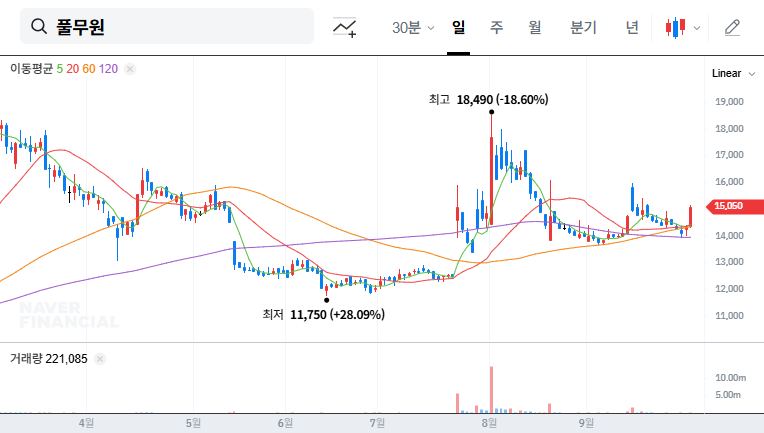
    (017810) Pulmuone Value Enhancement Plan: In-Depth Stock Analysis (017810) 대표 차트 이미지

    Pulmuone (017810) has recently unveiled its ambitious ‘2025 Corporate Value Enhancement Plan,’ a strategic initiative designed to catalyze significant growth and boost shareholder returns. This announcement has captured the market’s attention, prompting investors to ask a critical question: Is this the dawn of a new era for Pulmuone’s stock? This comprehensive Pulmuone stock analysis will dissect the plan, evaluate the company’s current financial health, and outline the potential opportunities and risks for investors.

    We will delve into the official disclosure, breaking down the aggressive growth targets, the roadmap for shareholder returns, and the underlying challenges Pulmuone must overcome. For those considering an investment, understanding the nuances of this plan is paramount.

    The Catalyst: Understanding the Pulmuone Value Enhancement Plan

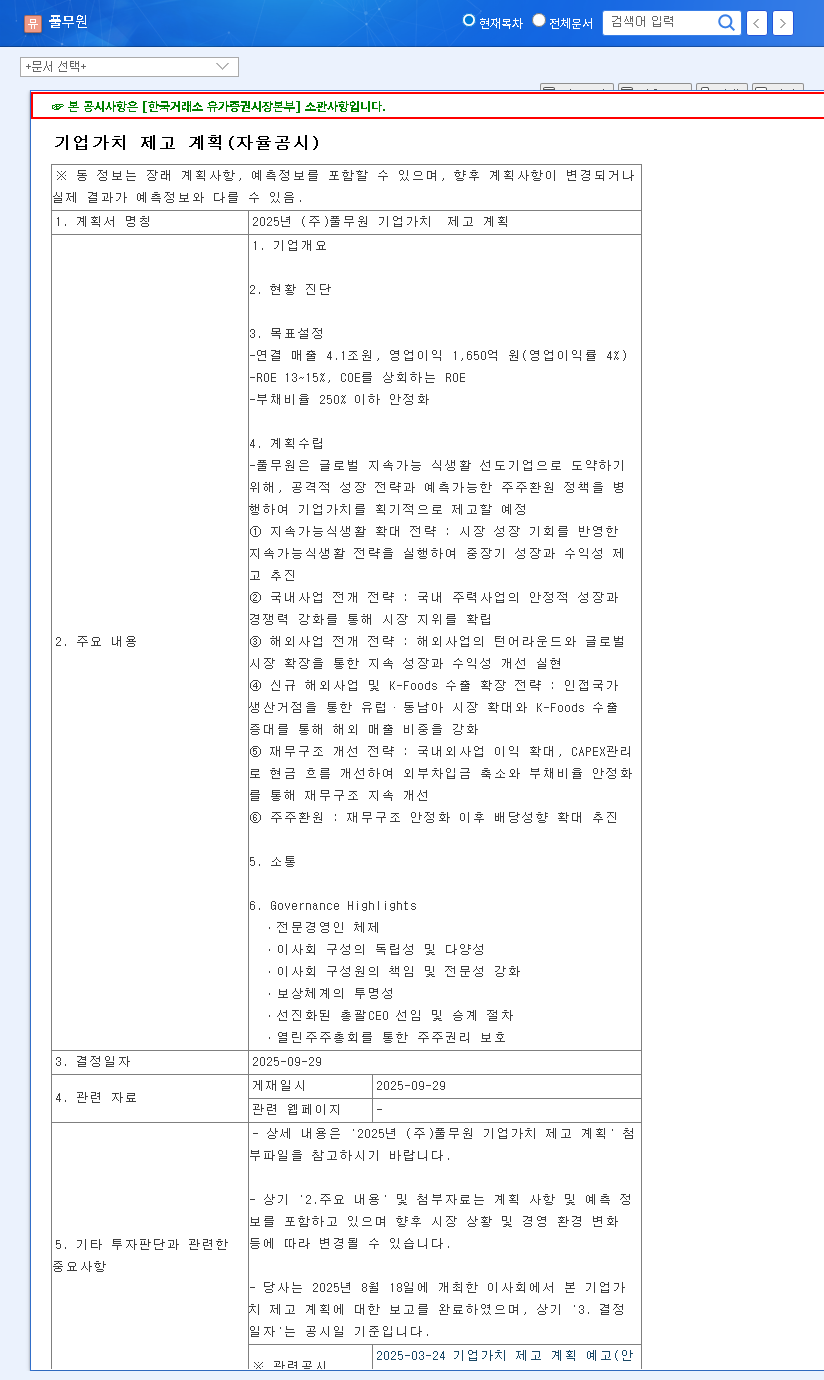
    On September 29, 2025, Pulmuone released its forward-looking strategy, which you can view in the Official Disclosure on DART. The plan’s core mission is to elevate corporate value enhancement by intertwining aggressive growth with a more predictable and rewarding policy for shareholder return. This isn’t just about sales figures; it’s a holistic commitment to strengthening the company’s financial foundation and investor appeal.

    The plan sets highly ambitious targets for 2025: Consolidated Revenue of KRW 4.1 trillion, an Operating Profit of KRW 165 billion, a Return on Equity (ROE) of 13-15%, and stabilizing the debt-to-equity ratio below 250%.

    Current Financial Snapshot: Why Now?

    Pulmuone’s decision is a direct response to its recent performance and the broader market environment. A look at H1 2025 reveals a mixed picture. While revenue grew a modest 4.2% YoY to KRW 1,632.6 billion, operating profit declined by 5.2%, and the company posted a net loss. This highlights a critical need to address profitability and financial efficiency.

    Strengths and Growth Drivers

    • Strong Domestic Position: The ‘Earth Plate’ brand and its plant-forward food lineup are capitalizing on global health trends, providing a stable revenue base.
    • Overseas Potential: Double-digit growth in the US, popular tofu products in Japan, and a turnaround in China signal significant untapped potential in international markets.
    • ESG Leadership: A strong commitment to sustainability enhances brand reputation and long-term corporate value. For more on ESG investing, see our guide on How Environmental, Social, and Governance Factors Impact Stocks.

    Headwinds and Risk Factors

    • Profitability Squeeze: Rising costs, financial expenses, and foreign exchange volatility are eroding profit margins.
    • Financial Health: A high debt-to-equity ratio and vulnerability to interest rate hikes pose financial risks.
    • Macroeconomic Pressures: Global inflation and supply chain issues, as tracked by sources like Reuters, continue to impact production and logistics costs.

    Strategic Pillars for Growth and Shareholder Return

    The Pulmuone Value Enhancement Plan is built on several core strategies designed to address these challenges and seize opportunities:

    • Global K-Food Expansion: Aggressively expand overseas ventures and increase exports of K-Foods to drive top-line growth.
    • Profit-Centric Operations: Achieve a turnaround in overseas business profitability and enhance the competitiveness of the core domestic business.
    • Financial Discipline: Improve the financial structure through careful CAPEX management and debt reduction to stabilize the balance sheet.
    • Enhanced Shareholder Return: After stabilizing finances, the company plans to expand its dividend payout ratio, directly rewarding investors.

    Investor Action Plan & Final Verdict

    Pulmuone’s corporate value enhancement plan presents a compelling vision. It’s a clear acknowledgment of current weaknesses and a bold roadmap for the future. However, ambition must be tempered with realistic expectations.

    Key Monitoring Points for Investors:

    • Execution is Everything: Monitor quarterly reports for progress against the stated revenue and profitability targets. The gap between a plan and its execution is where risk resides.
    • Overseas Performance: Pay close attention to the profitability of international segments. This is a primary driver for achieving the ambitious operating profit margin goal.
    • Debt Reduction: Track the debt-to-equity ratio. Successful deleveraging will de-risk the stock and is a prerequisite for higher dividend payouts.

    In conclusion, the Pulmuone Value Enhancement Plan is a significant positive catalyst that could unlock substantial value if executed successfully. For now, it provides a clear framework for measuring management’s performance. Prudent investors should adopt a ‘watch and verify’ approach, keeping a close eye on the company’s progress in turning these ambitious goals into tangible financial results.

    Disclaimer: This article is for informational purposes only and is based on publicly available information. It should not be construed as financial advice. The final responsibility for investment decisions rests with the individual investor.
    (017810) Pulmuone Value Enhancement Plan: In-Depth Stock Analysis (017810) 관련 이미지
  • Pulmuone Q2 2025 Earnings Analysis: Below Expectations, What’s the Investment Strategy?

    1. Q2 Earnings: A Disappointing Performance Below Expectations

    Pulmuone’s Q2 2025 earnings missed market expectations. Revenue came in at ₩839.1 billion, 2% below estimates, while operating profit reached ₩19.5 billion, a 7% shortfall. Most notably, the company reported a net loss of ₩8.2 billion, a significant deviation from the anticipated profit.

    Category Q2 2025 (Actual) Q2 2025 (Estimated) Change (%)
    Revenue ₩839.1B ₩856.8B -2.0%
    Operating Profit ₩19.5B ₩20.9B -7.0%
    Net Income -₩8.2B ₩2.8B -393.0%

    2. Analyzing the Causes of the Downturn: Rising Costs and Financial Expenses

    Increased cost of goods sold, logistics expenses, and sales and administrative expenses contributed to the decline in operating profit. The net loss was primarily driven by increased financial expenses, derivative valuation losses, and higher corporate taxes. Declining domestic market share and a challenging macroeconomic environment (rising exchange rates and fluctuating raw material prices) also played a role.

    3. Future Outlook and Investment Strategy: Focusing on Long-Term Positives

    While short-term downward pressure on the stock price is expected, there are positive factors, such as growth in overseas business and a strengthened health-focused product lineup. Investors should monitor the company’s strategies for improving profitability, strengthening financial health, and enhancing market competitiveness, considering investments from a long-term perspective.

    4. Investing in Pulmuone: Points to Consider

    Before making any investment decisions, carefully evaluate Pulmuone’s future earnings trends, management improvement efforts, and changes in the macroeconomic environment. It’s crucial to analyze the company’s fundamentals and long-term growth potential rather than reacting solely to short-term stock price fluctuations.

    What was Pulmuone’s net income for Q2 2025?

    Pulmuone reported a net loss of ₩8.2 billion.

    What are the main reasons for the decline in earnings?

    The main factors contributing to the decline are increased cost of goods sold, logistics and sales/administrative expenses, higher financial expenses, and derivative valuation losses.

    What should Pulmuone’s future investment strategy be?

    Pulmuone should focus on improving profitability, strengthening its financial health, and enhancing market competitiveness. It’s important to analyze the company’s fundamentals and long-term growth potential.

  • Pulmuone CEO Increases Stake: A Positive Sign or More?

    Pulmuone CEO’s Stake Increase: What’s the Context?

    CEO Nam Seung-woo increased his stake in Pulmuone by 0.01%p through an open market purchase, bringing his total ownership to 67.64%. The official purpose is stated as ‘management influence.’ But what does this small increase mean, considering he already holds a majority stake?

    Stake Increase: Positive or Negative?

    On the positive side, it can be interpreted as a sign of the management’s commitment to responsible leadership. However, given the already high ownership percentage, the direct impact on stock prices is expected to be limited. The timing of this move, amidst a Q1 earnings slump, warrants caution. The purchase of 1,707 shares itself is not significant enough to substantially alter the company’s fundamentals or financial status.

    Key Takeaways for Investors: Action Plan

    • Short-term Investors: Focus on earnings recovery, overseas business growth potential, and profitability improvement in the domestic market. Actual performance, rather than stake changes, will be key.
    • Long-term Investors: Continuously monitor risk factors such as high debt ratio and cost burdens. The success of ESG management and overseas expansion strategies will determine long-term investment value. The stake increase can be seen as an indicator of management’s commitment.

    Frequently Asked Questions

    Will this stake increase positively impact Pulmuone’s stock price?

    The short-term impact is expected to be limited. Given the already high ownership percentage, this increase alone is unlikely to act as a significant catalyst. Other factors, such as the Q1 earnings slump, are likely to have a greater impact on the stock price.

    What is the outlook for Pulmuone?

    Key factors determining Pulmuone’s future outlook include earnings recovery, overseas business growth, and debt reduction. While positive factors exist, such as strengthening ESG management and growth in the plant-based food market, there are also risks like increased competition and rising costs.