Tag: PBR

  • (055550) Shinhan Financial Group H1 2025 Earnings: In-Depth Analysis & ₩64,000 Stock Target

    (055550) Shinhan Financial Group H1 2025 Earnings: In-Depth Analysis & ₩64,000 Stock Target

    In a volatile global market, SHINHAN FINANCIAL GROUP CO.,LTD (055550) has emerged as a beacon of stability and growth. The recent release of their H1 2025 report not only surpassed market expectations but also highlighted a robust turnaround and a strengthened commitment to shareholders. This in-depth analysis of the Shinhan Financial Group earnings for the first half of 2025 will unpack the core financial metrics, explore the key growth drivers, and provide a clear investment thesis for investors looking to capitalize on its future potential.

    We’ll break down complex data into actionable insights, helping you understand the forces shaping the Shinhan Financial stock trajectory and make well-informed decisions. Let’s explore the compelling value proposition that Shinhan Financial Group presents today.

    Key Highlights from the H1 2025 Earnings Report

    Shinhan Financial Group announced a formidable performance for the first half of 2025, signaling a powerful recovery and operational excellence. The official numbers, available in the Official Disclosure (DART), reveal a company firing on all cylinders. Here are the most significant takeaways:

    • Impressive Net Income Growth: The group posted a net income of 3.0374 trillion KRW (attributable to controlling shareholders), a remarkable 10.6% increase year-over-year. This represents a significant turnaround from previous net losses, showcasing a return to strong profitability.
    • Surging Profitability Metrics: The net profit margin skyrocketed to an incredible 99.99%, while the annualized Return on Equity (ROE) reached a healthy 9.12%. These figures demonstrate a highly efficient and profitable operational structure.
    • Enhanced Shareholder Value: A strong commitment to shareholder returns was evident. The announcement of a Q2 dividend of 570 KRW per share, coupled with a massive 800 billion KRW share buyback and cancellation program, signals confidence from management and directly rewards investors.
    • Maintained Financial Stability: Despite a slight increase, the debt-to-equity ratio remains at a manageable and stable level. The group’s balance sheet health is solid, providing a strong foundation for future growth and resilience against market shocks.

    What’s Driving the Growth? Unpacking the Catalysts

    This stellar performance wasn’t a matter of luck; it was the result of a multi-faceted strategy and favorable conditions. Understanding these drivers is key to evaluating the sustainability of Shinhan’s growth.

    Diversified and Balanced Business Portfolio

    A core strength lies in the group’s diversified revenue streams. Solid, balanced growth was achieved across all primary segments—including banking, securities, and insurance. This portfolio approach reduces reliance on any single market segment and provides a stable earnings base even in fluctuating economic climates.

    Resolution of One-Off Costs

    The previous year’s financial results were weighed down by one-time costs associated with Equity-Linked Securities (ELS). The expiration of these costs in H1 2025 provided a significant, direct boost to the bottom line, allowing the group’s underlying profitability to shine through.

    Proactive Risk and Cost Management

    Management’s focus on efficient cost control and proactive risk management has been crucial. By maintaining a conservative stance on provisioning for potential loan losses and optimizing operational expenditures, Shinhan has fortified its fundamentals and protected its margins.

    Market Context & Investment Thesis

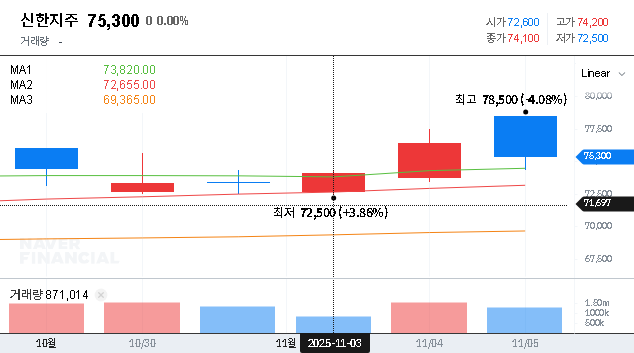
    The Shinhan Financial stock performance is influenced by macroeconomic trends. The stock surged past ₩50,000 following the earnings announcement but has since consolidated. A stable interest rate environment in both Korea and the U.S. could be beneficial for the bank’s Net Interest Margin (NIM), a key profitability driver. For a deeper understanding of this metric, you can read our guide on Understanding Net Interest Margin in Banking Stocks. However, investors must monitor factors like the US 10-Year Treasury Yield, as covered by sources like Bloomberg, which can signal shifts in global rate expectations.

    Based on our comprehensive analysis of the latest Shinhan Financial Group earnings, we are issuing a ‘BUY’ recommendation with a target price of ₩64,000. The company’s robust fundamentals, aggressive shareholder return policy, and undervalued status present a compelling investment opportunity.

    Recommended Investment Strategy

    • Adopt a Long-Term Perspective: Focus on the company’s stable fundamentals and strategic initiatives like digital transformation, which are poised to deliver value over the long haul.
    • Utilize Dollar-Cost Averaging: In a fluctuating market, making staggered investments can help manage your average purchase price and mitigate volatility risk.
    • Focus on Dividend Yield: The consistent and growing dividend provides a stable income stream and can add a defensive cushion to your portfolio.
    • Monitor Key Risks: Stay informed about macroeconomic headwinds, potential real estate financing (PF) risks in the Korean market, and the competitive landscape with emerging fintech players.

    Conclusion: A Compelling Buy

    The Shinhan Financial Group H1 2025 earnings report paints a picture of a resilient and strategically adept institution. With strong fundamentals, a clear path to growth, and a shareholder-friendly capital return policy, the stock appears undervalued at its current levels. For investors with a long-term horizon, Shinhan Financial Group represents a high-quality entry point into the Korean financial sector.

    Disclaimer: This analysis is for informational purposes only. The ultimate responsibility for investment decisions rests with the individual investor. Please conduct your own due diligence.

    Frequently Asked Questions (FAQ)

    Q1: How did Shinhan Financial Group perform in H1 2025?

    Shinhan Financial Group had an excellent H1 2025, with net income rising 10.6% year-over-year to 3.0374 trillion KRW. Key metrics like ROE (9.12%) and net profit margin also showed significant improvement, indicating a strong financial turnaround.

    Q2: What is the current target price for Shinhan Financial stock?

    Based on this analysis, a ‘BUY’ opinion is maintained with a target price of 64,000 KRW. This is supported by its strong fundamentals, shareholder return initiatives, and current undervaluation.

    Q3: What are the primary risks for investors?

    The main risks include macroeconomic uncertainty (e.g., prolonged high interest rates), potential exposure to real estate project financing (PF) defaults, intensifying competition from fintech companies, and changes in financial regulations.

    Q4: What makes Shinhan a good long-term investment?

    Its diversified business model across banking, securities, and insurance provides stability. Furthermore, its commitment to digital transformation, strong risk management, and a generous shareholder return program make it an attractive option for long-term investors.
    (055550) Shinhan Financial Group H1 2025 Earnings: In-Depth Analysis & ₩64,000 Stock Target 관련 이미지
  • (001430) SeAH Besteel Holdings: A Deep Dive into the 2025 Corporate Value Enhancement Plan

    (001430) SeAH Besteel Holdings: A Deep Dive into the 2025 Corporate Value Enhancement Plan

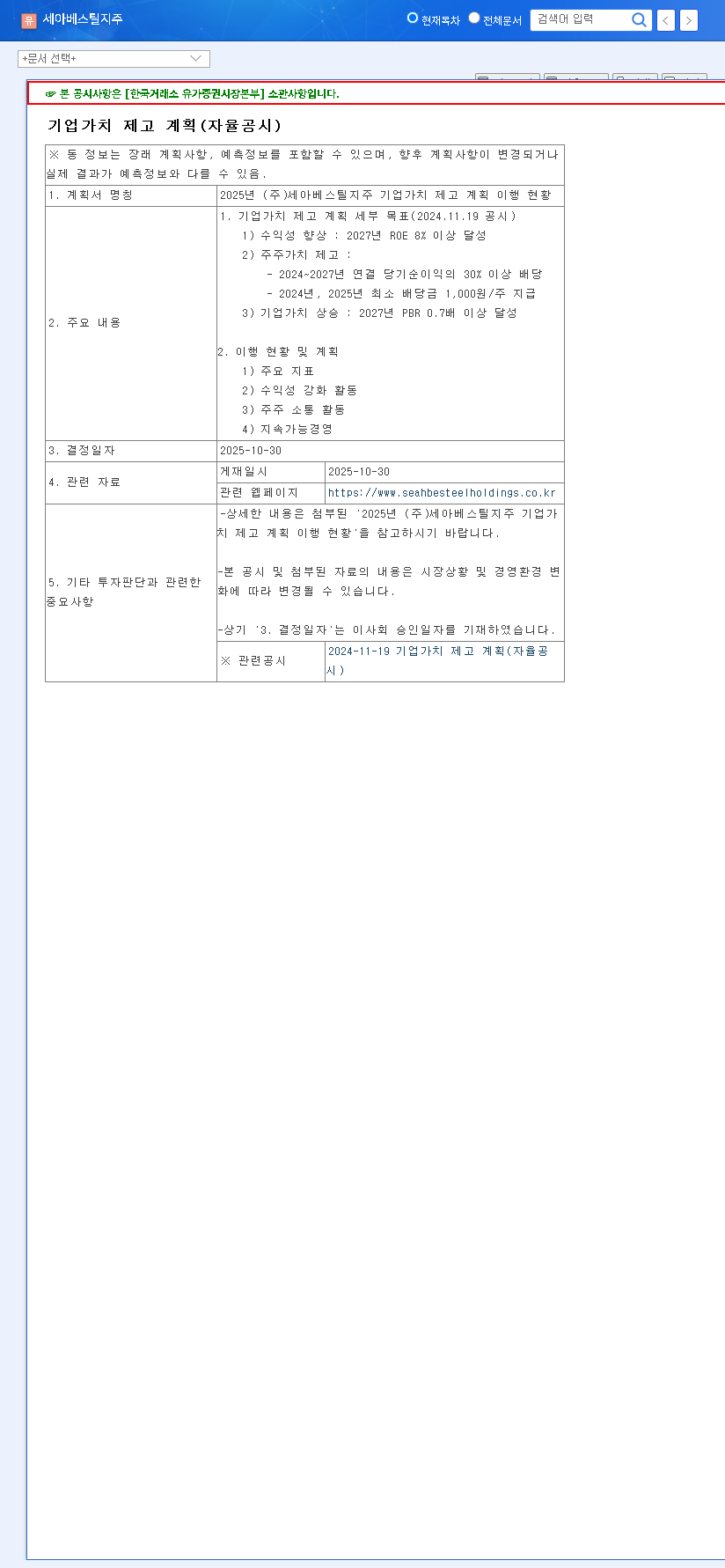
    SeAH Besteel Holdings Corporation has captured the market’s attention with the recent progress report on its ambitious 2025 Corporate Value Enhancement Plan. This isn’t just a routine corporate update; it’s a strategic roadmap designed to bolster profitability, significantly increase shareholder returns, and elevate the company’s overall market valuation. For investors, this plan presents both a compelling opportunity and a series of critical questions.

    This comprehensive investor analysis will dissect the core components of the plan, evaluate the fundamental strengths and weaknesses of SeAH Besteel Holdings, and provide a clear, strategic outlook. We will explore whether this roadmap is a guaranteed path to growth or if a more cautious approach is warranted in the current economic climate.

    Core Pillars of the Value Enhancement Plan

    The 2025 Corporate Value Enhancement Plan is built on three specific, measurable objectives that signal a profound commitment to sustainable growth and shareholder-friendly policies. Understanding these goals is the first step in a thorough investor analysis.

    • Enhanced Profitability: The primary financial target is to achieve a Return on Equity (ROE) of 8% or higher by the year 2027. This represents a significant leap from current levels, indicating a focus on operational efficiency and margin improvement.
    • Superior Shareholder Value: A commitment to distribute over 30% of consolidated net profit as dividends between 2024 and 2027. Crucially, the plan guarantees a minimum dividend of KRW 1,000 per share for 2024-2025, providing a reliable income floor for investors.
    • Corporate Value Growth: The goal is to reach a Price-to-Book Ratio (PBR) of 0.7x or more by 2027. This metric is key to addressing the ‘Korea discount’ and bringing the company’s market valuation more in line with its intrinsic asset value.

    Fundamental Diagnosis of SeAH Besteel Holdings

    As a pure holding company, the financial health of SeAH Besteel Holdings is intrinsically linked to the performance of its subsidiaries. A balanced view requires examining both its foundational strengths and the potential risks on the horizon.

    Positive Fundamental Factors

    • Reliable Dividend Stream: With over 91% of its operating revenue coming from subsidiary dividends (notably from SeAH Besteel and SeAH Changwon Specialty Steel), the company has a stable income base.
    • Strong Creditworthiness: An A+ (Stable) corporate bond rating and A2+ commercial paper rating underscore its financial stability and access to capital markets, reducing financing risks.
    • Commitment to Innovation: Ongoing R&D investments by its subsidiaries in new materials and technologies are crucial for maintaining a competitive edge and long-term value creation.

    Negative and Cautionary Factors

    • Subsidiary Performance Volatility: The specialty steel and aluminum industries are highly cyclical. A global economic slowdown or a downturn in key sectors like construction and automotive could directly impact profitability.
    • Rising Debt Levels: An increased consolidated debt-to-equity ratio heightens the company’s sensitivity to fluctuations in interest rates and foreign exchange, potentially pressuring margins.
    • Macroeconomic Headwinds: External risks, including volatile raw material prices, currency fluctuations, and rising protectionist trade policies, remain significant threats to business stability. For more on this, see analysis from leading financial experts at authoritative sources like Bloomberg.

    By transparently outlining its mid-to-long-term growth objectives, SeAH Besteel Holdings is making a clear promise to investors. The key will be translating these ambitious targets into tangible financial results.

    Impact Analysis and Investor Strategy

    The announcement of the plan is a positive signal, but savvy investors must look beyond the headlines. The successful execution of this plan is contingent on both internal discipline and favorable market conditions. The company’s own projections, as detailed in its Official Disclosure (Source), show a path to improvement but highlight the significant effort required.

    Achieving an ROE of 8% from its current low base will demand substantial operational improvements. While the enhanced dividend policy provides a strong incentive, its sustainability hinges on generating consistent net profit. For those unfamiliar with these metrics, our guide on understanding key financial ratios can provide more context.

    Recommended Investment Approach

    Given the current ‘initial phase’ of the plan, a ‘wait and see’ strategy followed by a cautious approach is prudent.

    • Short-Term (3-6 Months): The announcement may create some positive price momentum. However, this is likely to be speculative. Substantial appreciation in the SeAH Besteel stock price will require concrete proof of execution in upcoming quarterly reports.
    • Mid-to-Long-Term (1-3 Years): The key is to monitor the execution. Investors should closely track quarterly earnings, management commentary on profitability initiatives, and shareholder communication. The interim review scheduled for the end of 2025 will be a pivotal moment to reassess the plan’s viability and the company’s commitment.

    In conclusion, while the Corporate Value Enhancement Plan from SeAH Besteel Holdings is a commendable and positive step, it is a statement of intent, not a guarantee of results. The path forward involves navigating significant industry and macroeconomic challenges. Diligent monitoring of the plan’s progress is essential before committing significant capital.

    (001430) SeAH Besteel Holdings: A Deep Dive into the 2025 Corporate Value Enhancement Plan 관련 이미지
  • Youngone Holdings Announces Value Enhancement Plan: Should Investors Be Optimistic?

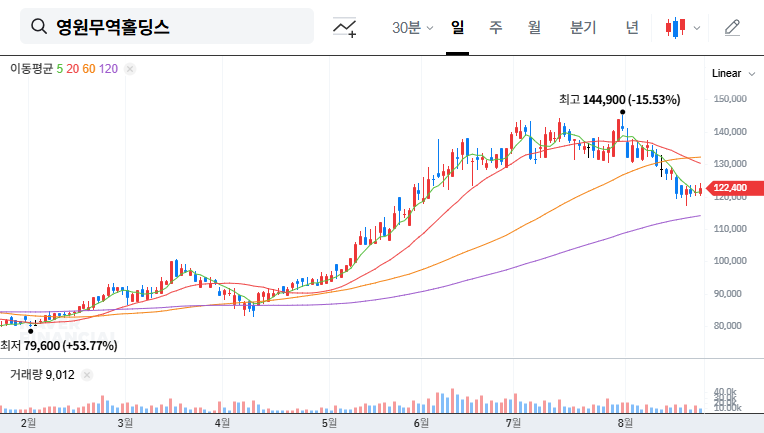
    Youngone Holdings Announces Value Enhancement Plan: Should Investors Be Optimistic? 대표 차트 이미지

    1. What is Youngone Holdings’ Plan?

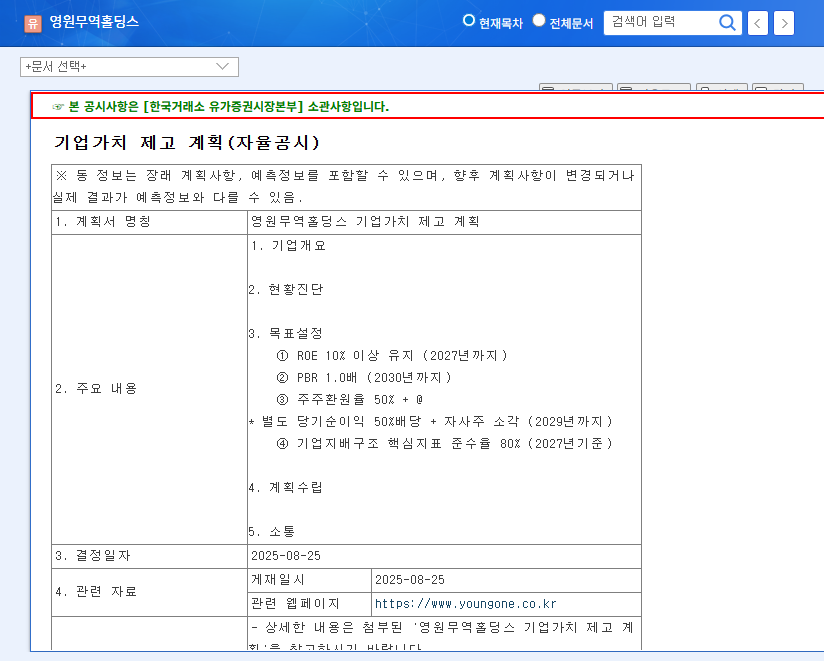
    Youngone Holdings aims to achieve ROE of 10%, PBR of 1.0x, a 50% shareholder return ratio, and 80% compliance with key corporate governance indicators. The plan includes increased dividends and share buybacks. However, with a trailing ROE of 4.35%, achieving these targets will be challenging.

    2. Why This Plan Now?

    Recent underperformance and external headwinds have pressured Youngone’s stock price. This plan aims to restore investor confidence and boost corporate value by emphasizing long-term growth and shareholder value creation.

    3. Market Impact and Outlook

    The increased shareholder return may provide a short-term boost to the stock price. However, the long-term outlook depends on the successful execution of the plan and tangible results. Investors should consider external risks and the uncertainty surrounding the achievement of the stated targets.

    4. What Should Investors Do?

    • Wait and See: Monitor the implementation of the plan and initial results before making investment decisions.
    • Monitor Key Metrics: Track ROE, operating profit margin, net income, and share buybacks.
    • Analyze Business Segments: Carefully examine manufacturing OEM orders, SCOTT inventory management, and the growth potential of IT services.

    Frequently Asked Questions (FAQ)

    What are Youngone Holdings’ main businesses?

    Youngone Holdings’ core businesses include manufacturing OEM, SCOTT (bicycle), and domestic retail (Youngone Outdoor).

    What is Youngone Holdings’ shareholder return policy?

    The company plans to distribute approximately 50% of its standalone net income as dividends and repurchase 1% of its outstanding shares annually from 2025 to 2029, totaling 5%.

    What are the key risks for investors in Youngone Holdings?

    Investors should consider the global economic slowdown, risks within specific business segments, and the uncertainty of achieving the stated targets. It’s advisable to monitor the plan’s execution and initial results before investing.

    Youngone Holdings Announces Value Enhancement Plan: Should Investors Be Optimistic? 관련 이미지
    Youngone Holdings Announces Value Enhancement Plan: Should Investors Be Optimistic? 관련 이미지
  • Dongsuh (026960) H1 2025 Earnings Analysis: Stable Food Business, But Is It a Buy?

    1. Dongsuh H1 2025 Earnings Analysis: Key Highlights

    Dongsuh reported revenue of KRW 136.8 billion, operating profit of KRW 11.7 billion, and net profit of KRW 41 billion in the first half of 2025. While revenue slightly increased compared to the previous quarter, both operating and net profits decreased. This is attributed to external factors such as the global economic slowdown and fluctuating raw material prices.

    2. Segment Analysis: Stable Food Business vs. Struggling Manufacturing/Export

    Dongsuh’s core food business, contributing 55.3% of total revenue, maintains stable competitiveness. However, the manufacturing/export segment is facing declining sales due to the global economic downturn. The company’s strategy to strengthen this segment’s competitiveness will be a key factor in its future growth.

    3. Financial Stability and Risk Management: Strong Foundation, But External Factors Require Caution

    Dongsuh boasts excellent financial stability with a very low debt-to-equity ratio of 4%. The company also actively manages risks through derivative transactions for currency fluctuations. However, continuous monitoring of external factors like raw material prices and interest rate volatility is necessary.

    4. Investment Metrics and Conclusion: Attractive Investment, But Further Analysis Needed

    With a P/E ratio of 29.13 and a P/B ratio of 2.85, further analysis is required. However, its stable business model and strong financial structure make Dongsuh an attractive investment. Investors should carefully monitor the company’s ability to strengthen its manufacturing/export segment and adapt to external changes when making investment decisions.

    5. Investor Action Plan: Continuous Monitoring, Long-Term Perspective

    Dongsuh is expected to achieve steady growth based on its stable food business and solid financial position. However, continuous monitoring of the performance improvement of its manufacturing/export segment and its ability to respond to external environmental changes is crucial. A long-term investment perspective is recommended.

    What are Dongsuh’s main businesses?

    Dongsuh’s primary businesses are food (coffee, tea, beverages) and manufacturing/export. The food business accounts for a significant portion of its total revenue.

    How did Dongsuh perform in H1 2025?

    Dongsuh reported revenue of KRW 136.8 billion, operating profit of KRW 11.7 billion, and net profit of KRW 41 billion.

    What are the key investment considerations for Dongsuh?

    Investors should carefully consider the potential weakening of the manufacturing/export segment and the company’s sensitivity to external factors such as exchange rates and raw material prices.

  • Youngone Corporation Unveils Value Enhancement Plan: A Bullish Signal for Investors?

    1. What is Youngone Corporation’s Plan?

    Youngone Corporation announced its ‘Corporate Value Enhancement Plan’ on August 11, 2025. Key highlights include:

    • • Maintaining ROE above 10% by 2027
    • • Achieving a PBR of 1.0 by 2030
    • • Gradually increasing consolidated dividend payout ratio to 25%
    • • Achieving 80% compliance with key corporate governance indicators by 2027

    2. Why Does This Plan Matter?

    This plan is a crucial strategy to boost Youngone Corporation’s currently undervalued stock price and secure long-term growth momentum. The target PBR of 1.0 suggests significant upside potential, while the increased dividend payout is expected to enhance investment appeal.

    3. What Does This Mean for the Stock Price?

    Analysts predict a positive impact on Youngone Corporation’s stock price following this announcement. The company’s solid fundamentals and concrete shareholder return policy are expected to attract investors and drive a re-evaluation of corporate value. However, external factors like global economic slowdown and exchange rate volatility pose risks that could increase stock price volatility.

    4. What Should Investors Do?

    Investors considering Youngone Corporation should closely monitor the following: Track the progress towards achieving ROE, dividend payout ratio targets through quarterly earnings releases, and monitor the recovery speed of the SCOTT business segment and its performance in new markets. Investors should also be mindful of global economic conditions and exchange rate fluctuations.

    Frequently Asked Questions

    What are Youngone Corporation’s main businesses?

    Youngone Corporation’s core businesses are OEM (Original Equipment Manufacturing) of outdoor apparel and the SCOTT brand bicycle business.

    What are the key objectives of the Corporate Value Enhancement Plan?

    Key objectives include achieving a 10% ROE, a 1.0 PBR, and increasing the dividend payout ratio to 25%.

    What should investors be aware of?

    Investors should be mindful of external factors such as a global economic slowdown and exchange rate volatility, and continuously monitor the achievement of the stated objectives.

  • LG Uplus Announces KRW 100 Billion Share Buyback: Impact on Stock Price?

    1. KRW 100 Billion Share Buyback: What Happened?

    On July 21, 2025, LG Uplus announced its decision to buy back 6,783,006 of its own shares (1.53% of the market capitalization, approximately KRW 100 billion). The cancellation date is scheduled for August 5th. This decision aims to enhance shareholder value, anticipating an increase in earnings per share (EPS) and a rise in stock price due to the reduction in the number of outstanding shares.

    2. Why the Share Buyback?

    While LG Uplus’s Q1 2025 earnings showed growth, challenges remain, such as slowing growth in the smart home business and declining revenue in the telephone business. In this context, the share buyback aims to alleviate shareholder concerns and demonstrate confidence in the company’s future growth.

    3. Share Buyback: What’s the Impact on Stock Price?

    Share buybacks generally have a positive impact on stock prices due to the anticipated improvement in EPS and PBR. However, these effects can be short-lived, and long-term stock price increases depend on fundamental improvements.

    • Positive Effects: Increased EPS, stock price increase, improved PBR
    • Potential Risks: Potential for short-term effects without fundamental improvements, impact of external economic variables (US/Europe interest rate hikes, raw material price/exchange rate fluctuations)

    4. What Should Investors Do?

    While the share buyback can be a positive factor in the short term, long-term investors should carefully consider LG Uplus’s fundamental improvements. It’s advisable to review the Q2 earnings announcement to assess the growth of each business segment and the company’s strategies for addressing changes in the external economic environment before making investment decisions.

    What is a share buyback?

    A share buyback is when a company buys back its own shares from the market and cancels them. This reduces the number of outstanding shares, increasing earnings per share (EPS).

    Why do companies buy back their shares?

    It’s a common way to enhance shareholder value. It can boost stock prices and signal confidence in the company’s future growth.

    Will the LG Uplus share buyback only have positive effects on the stock price?

    While it may positively impact stock price in the short term, long-term performance depends on the company’s earnings and fundamental improvements.