Tag: Oil Price

  • (010950) S-Oil Corporation Earnings (Q3 2025): In-Depth Stock Analysis & Forecast

    (010950) S-Oil Corporation Earnings (Q3 2025): In-Depth Stock Analysis & Forecast

    This comprehensive analysis of the S-Oil Corporation earnings for the third quarter of 2025 unpacks a complex financial story. While the South Korean refining giant surpassed revenue expectations, its bottom-line profitability came under significant pressure, falling short of market consensus. This raises critical questions for investors: Is this a temporary setback or a sign of deeper structural issues? We will explore the macroeconomic headwinds, segment-specific performance, and long-term strategic projects to provide a clear outlook and an actionable S-Oil investment thesis.

    S-Oil Q3 2025 Results: The Official Numbers

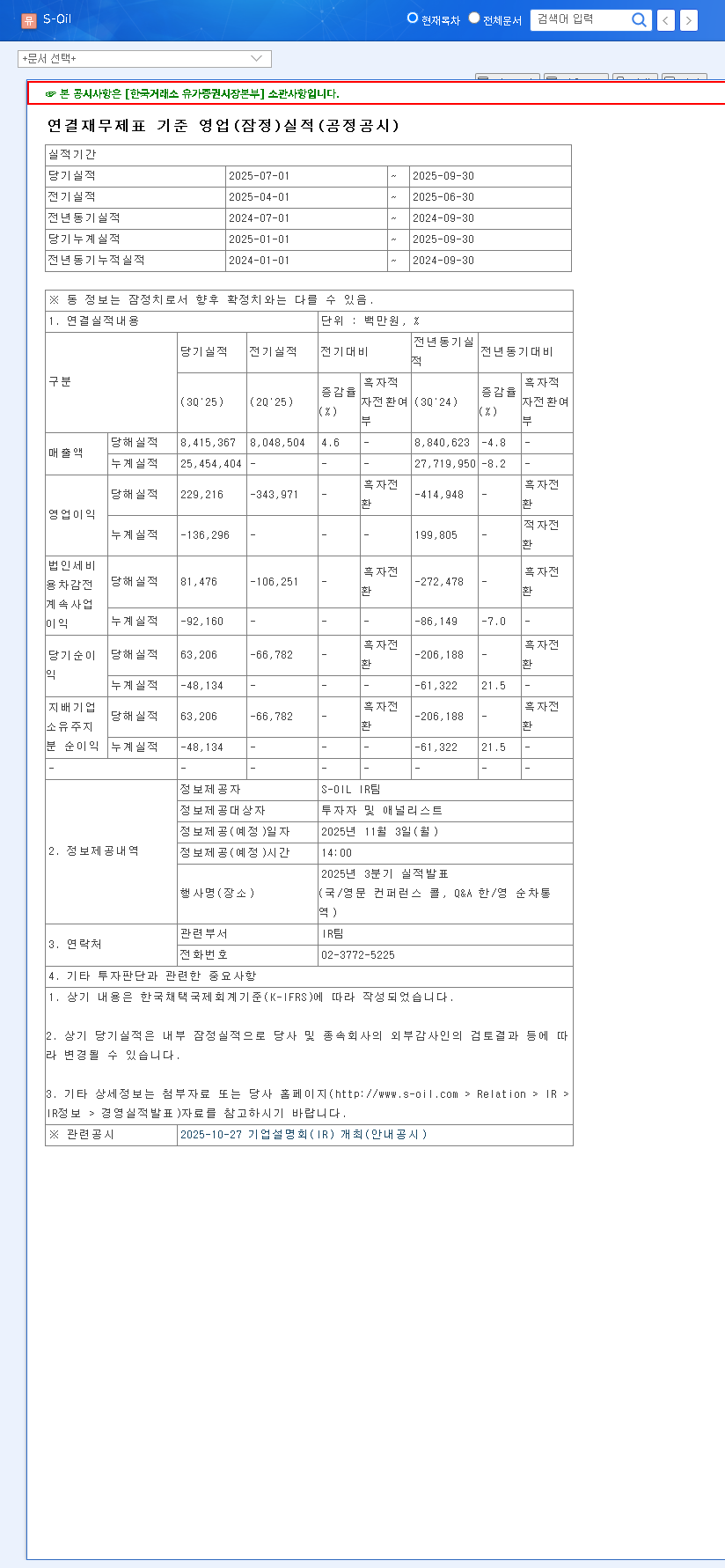
    On November 3, 2025, S-Oil Corporation released its provisional Q3 earnings, painting a mixed picture. The company successfully swung back to profitability after a substantial loss in the second quarter, but key metrics reveal ongoing challenges in the operating environment. The full details can be verified in the Official Disclosure (DART).

    Here is a summary of the key performance indicators from the S-Oil Corporation earnings report:

    • Revenue: KRW 8.4154 trillion, which was 3% above the market estimate of KRW 8.1879 trillion.
    • Operating Profit: KRW 229.2 billion, falling 2% below the market estimate of KRW 233.7 billion.
    • Net Profit: KRW 63.2 billion, a significant 10% miss compared to the market estimate of KRW 70.2 billion.

    The revenue beat suggests resilient demand, but the disappointing profit figures highlight the severe impact of external market forces on the company’s margins and overall S-Oil profitability.

    Why the Disconnect? Analyzing the Headwinds

    S-Oil’s Q3 performance was shaped by a confluence of challenging macroeconomic conditions and mixed results across its core business units. Understanding these factors is crucial for any accurate S-Oil stock analysis.

    Macroeconomic Volatility: A Perfect Storm

    The global economic environment in Q3 2025 was far from stable. Fluctuations in oil prices, currency exchange rates, and interest rates created significant headwinds. International oil prices, a primary driver of S-Oil’s costs and revenue, exhibited high volatility, making profitability forecasts difficult. As tracked by agencies like the U.S. Energy Information Administration (EIA), such price swings directly impact refining margins. Furthermore, the Korean Won’s depreciation against the US Dollar (from 1,354.00 to 1,439.70 KRW/USD) inflated the cost of importing crude oil, directly squeezing profit margins. Rising shipping costs, indicated by the Baltic Dry Index, further compounded these cost-side pressures.

    A Segment-by-Segment Performance Breakdown

    • Refining: This core segment faced a mixed reality. While demand for light petroleum products remained strong, a global economic slowdown weakened demand for diesel, and overseas market margins were poor.
    • Lubricants: Despite solid demand for high-grade lube base oils, margins were compressed due to industrial slowdowns and an oversupply situation. A slight rebound in Group III products was not enough to offset the broader weakness.
    • Petrochemicals: This segment continues to be a weak point. The startup of new facilities in China has created intense competition and a supply glut for key products like polypropylene (PP) and propylene oxide (PO), severely impacting profitability.

    Future Outlook: The Shaheen Project and Long-Term Strategy

    Despite the short-term struggles, S-Oil is making massive long-term investments designed to transform its business. The Shaheen Project and the Gas to Gas (GTG) project are central to this strategy. These initiatives will significantly increase the company’s production of high-value petrochemicals, reducing its reliance on the volatile and cyclical refining market. However, these large-scale investments come with increased debt and financial costs, which are expected to weigh on net profit and depreciation expenses in the near term until they become operational in 2026-2027.

    While S-Oil’s short-term profitability is under pressure from macroeconomic factors, its long-term strategic investments in petrochemicals aim to create a more resilient and profitable business model for the future.

    S-Oil Investment Action Plan

    Given the latest S-Oil Q3 2025 results, investors must weigh the immediate challenges against the potential long-term rewards. The stock’s current valuation and deteriorating profitability metrics suggest a cautious approach. The estimated 2025 Price-to-Earnings (PER) ratio of 64.67x is historically high, and the Return on Equity (ROE) is forecast at a very low 1.23%. For context, you can compare these metrics with others in our complete guide to investing in the energy sector.

    Positive Factors (Long-Term Upside)

    • Revenue resilience indicates continued strong end-market demand.
    • Successful return to operating profit after a significant Q2 loss.
    • Strategic investments (Shaheen, GTG) provide a clear path to long-term growth.

    Negative Factors (Short-Term Risks)

    • Operating and net profits missed estimates, signaling deep margin pressure.
    • Persistent external pressures from oil prices and currency exchange rates.
    • High valuation (PER) and low profitability (ROE) diminish short-term appeal.

    The most prudent approach for a potential S-Oil investment at this time appears to be a ‘wait-and-see’ strategy. Investors should closely monitor macroeconomic indicators and the progress of its major projects before committing capital.

    Disclaimer: This report is based on publicly available information and is for informational purposes only. All investment decisions are the sole responsibility of the investor.
    (010950) S-Oil Corporation Earnings (Q3 2025): In-Depth Stock Analysis & Forecast 관련 이미지
  • (010950) S-Oil Q3 2025 Earnings & Stock Analysis: A Deep Dive for Investors

    (010950) S-Oil Q3 2025 Earnings & Stock Analysis: A Deep Dive for Investors

    For investors tracking the energy and petrochemical sectors, the upcoming S-Oil Q3 2025 earnings announcement and subsequent Investor Relations (IR) conference on November 3, 2025, is a pivotal event. This is more than a routine financial update; it’s a comprehensive look into the company’s operational health, strategic direction, and resilience amidst a complex global economic landscape. The details revealed will heavily influence S-Oil stock analysis for the months to come. This deep dive will explore the key factors at play, from refining margins to the monumental Shaheen Project, providing a roadmap for what to watch. You can view the Official Disclosure from DART for preliminary details.

    Decoding the S-Oil Q3 2025 Earnings Outlook

    The third-quarter results are expected to be a mixed bag, reflecting both the strengths of S-Oil’s core business and the volatility of the wider market. A comprehensive S-Oil stock analysis requires a nuanced understanding of each business segment.

    The Core Engine: Refining Segment Performance

    The refining division remains S-Oil’s primary revenue driver. Positive signals from Q2, such as improved refining margins, are anticipated to continue into Q3. This is largely due to stable global demand for transportation fuels and disciplined production quotas from major oil-producing nations. Investors should listen for management’s commentary on crack spreads and how S-Oil’s long-term crude oil contracts have helped insulate it from spot price volatility, a key topic for any S-Oil investor relations call.

    Navigating Volatility: Petrochemicals and Lube Base Oil

    This area presents more uncertainty. The lube base oil segment, while benefiting from stable underlying demand, may still feel the aftershocks of an oversupplied market from earlier in the year. The petrochemical segment, particularly products like paraxylene (PX), faces headwinds from a sluggish Asian market and the lingering effects of US-China trade tensions, which can disrupt supply chains and depress prices. The key question is whether efficiency improvements can offset these external pressures.

    S-Oil stands at a strategic crossroads: leveraging its robust refining cash flow to fund a transformative shift into high-value petrochemicals via the Shaheen Project, while navigating short-term macroeconomic storms.

    The Shaheen Project: S-Oil’s Blueprint for the Future

    Arguably the most critical topic for long-term investors is the progress of the Shaheen Project. This multi-billion dollar investment is S-Oil’s strategic pivot away from traditional fuels and towards a future dominated by advanced chemicals. It’s designed to be one of the world’s largest refinery-integrated steam crackers, dramatically increasing the company’s production of high-value polymers used in everything from automotive parts to plastics.

    Updates from the S-Oil Q3 2025 IR will be scrutinized for any changes to the timeline (mechanical completion in H1 2026) or budget. Confirmation of smooth progress will bolster confidence in S-Oil’s long-term growth narrative and its ability to execute complex, large-scale projects.

    S-Oil Stock Analysis: Potential Price Catalysts from the IR Call

    The IR call is a stage where market sentiment can be reshaped. The stock’s direction will hinge on whether bullish or bearish signals dominate the narrative emerging from the S-Oil Q3 2025 earnings report.

    Bullish Signals to Watch For:

    • Earnings Beat: Operating profit and revenue that surpass consensus analyst expectations would be a strong positive catalyst.
    • Shaheen Project Confidence: Clear confirmation that the project is on schedule and on budget, perhaps with new milestones announced.
    • Strong Shareholder Returns: Any positive guidance on dividend policies or potential share buybacks would be very well-received by the market.

    Bearish Risks on the Horizon:

    • Earnings Miss: Performance falling short of expectations, especially if driven by weakness in the core refining segment.
    • Project Delays: Any hint of delays or cost overruns with the Shaheen Project could spook long-term investors.
    • Weak Forward Guidance: A pessimistic outlook for Q4 or 2026, citing macroeconomic factors like falling oil prices (see the latest trends on Bloomberg) or a global slowdown.

    Investor Action Plan & Key Questions

    To make an informed decision, investors should go into the S-Oil investor relations event with a clear checklist. Analyze the numbers, but also listen carefully to the tone and substance of management’s answers. For more context, you might also read our guide on investing in the Korean energy sector.

    Key Questions to Ask:

    • How are you managing the impact of the KRW/USD exchange rate volatility on raw material costs and export profits?
    • What is your updated forecast for petrochemical spreads in Asia for the next two quarters?
    • Can you provide specific progress metrics for the Shaheen Project beyond the top-line completion date?
    • What is the company’s strategy for managing its debt load, especially with interest rates remaining elevated?

    Frequently Asked Questions (FAQ)

    Q1: When is the S-Oil Corporation Q3 2025 IR scheduled?

    A1: S-Oil Corporation will hold its Q3 2025 provisional earnings and industry outlook Investor Relations (IR) conference on November 3, 2025.

    Q2: What is the primary focus of the Shaheen Project?

    A2: The Shaheen Project is a massive investment to expand S-Oil’s petrochemical business. It aims to build one of the world’s largest steam crackers to convert crude oil directly into high-value chemicals and polymers, securing future growth.

    Q3: What are the main external risks for S-Oil’s performance?

    A3: The key external risks include volatility in global oil prices and currency exchange rates (KRW/USD), a potential global economic slowdown impacting demand, and geopolitical instability affecting energy markets.

    Disclaimer: This analysis is based on publicly available information and is not intended as financial advice. All investment decisions are the sole responsibility of the individual investor.

    (010950) S-Oil Q3 2025 Earnings & Stock Analysis: A Deep Dive for Investors 관련 이미지
  • BMT (086670) Q2 2025 Earnings Analysis: Back to Black? Investment Strategies

    1. BMT Q2 Earnings: What Happened?

    BMT reported sales of KRW 39.3 billion, operating profit of KRW 3.4 billion, and net income of KRW 1.1 billion for Q2 2025. Year-over-year, sales increased by 7.4%, and operating profit turned positive. However, net income decreased by 74.4%, raising concerns.

    2. Profitability and Net Income Decline: Why?

    The positive operating profit is attributed to growth in the overseas market for the fitting/valve business and rising oil prices. Notably, technical certifications and vendor approvals from overseas national energy companies suggest strong future growth potential. The decline in net income may be due to one-off factors such as exchange rate fluctuations or financial instrument valuation losses. Further disclosures will be needed to determine the precise cause.

    3. Investing in BMT: What Should You Do?

    We propose the following action plan for investing in BMT:

    • Monitor Performance: Closely observe whether the positive trends from Q2 will continue.
    • Manage Risk: Prepare for exchange rate volatility. Examine the company’s currency hedging strategy.
    • Identify Growth Drivers: Pay attention to the company’s efforts in developing new businesses and investing in R&D for future growth.

    4. Future Outlook: Opportunities and Threats

    BMT faces both opportunities, such as overseas market expansion and rising oil prices, and threats, including a global economic slowdown and geopolitical risks. These factors should be considered when making investment decisions.

    Q: What are the key takeaways from BMT’s Q2 earnings?

    A: The return to operating profit and the decline in net income. While overseas growth in the fitting/valve business is positive, understanding the reasons behind the net income decrease is crucial.

    Q: What should investors consider when investing in BMT?

    A: Investors should pay close attention to future performance trends, exchange rate volatility, and the company’s ability to secure new growth drivers.

    Q: What is the outlook for BMT?

    A: BMT has potential for growth through overseas expansion and potential benefits from rising oil prices, but it also faces risks related to a potential global economic slowdown.

  • NH Investment & Securities Q1 2025 Earnings: Strong Performance, But What Lies Ahead?

    1. NH Investment & Securities Q1 2025 Earnings Analysis

    NH Investment & Securities reported a net operating revenue of KRW 556.7 billion and net income of KRW 208.2 billion in Q1 2025, both up year-over-year. While the IB division shined, Sales & Trading underperformed due to decreased market trading volume. A key positive is their robust financial health, with a net capital ratio of 1,652.3%.

    2. Key Focus Points for the Upcoming IR

    The August 4th IR will provide a detailed analysis of Q1 results and unveil mid- to long-term growth strategies. Key areas of interest include the sustainability of IB growth, plans to address the Sales & Trading slump, and strategies to navigate market uncertainties such as Fintech competition and interest rate hikes. Management’s approach to market expectation management will also be closely watched.

    3. Market Conditions and the Future of NH Investment & Securities

    Various market indicators, including US interest rate hikes, fluctuations in the KRW/USD exchange rate, and international oil prices, can impact NH Investment & Securities’ fundamentals. Pay close attention to factors that can directly affect overseas business profitability, operational strategies, and trading revenue. The possibility of a global economic slowdown should also be considered.

    4. Action Plan for Investors

    Potential investors in NH Investment & Securities should carefully evaluate the concreteness and feasibility of the mid- to long-term growth strategies presented at the IR. Assess the effectiveness of their revenue diversification and risk management plans and their ability to adapt to changing market conditions. Make informed investment decisions considering market volatility, and manage risk through continuous information gathering and analysis.

    What are the key highlights of NH Investment & Securities’ Q1 2025 earnings?

    Revenue and profit increased due to strong performance in the Investment Banking division, but Sales & Trading underperformed. Financial soundness remains very strong.

    What will be announced at the August IR?

    The IR will cover Q1 earnings analysis, mid- to long-term growth strategies, and market expectation management.

    What should investors be aware of when considering investing in NH Investment & Securities?

    Investors should consider factors such as increasing market competition, macroeconomic uncertainties, and fluctuations in interest rates and exchange rates. It’s crucial to make investment decisions based on a comprehensive analysis of information presented at the IR and prevailing market conditions.

  • E1’s ₩678.2B LPG Deal with Lotte Chemical: Impact on Stock Price?

    E1 and Lotte Chemical Sign ₩678.2B LPG Deal: What Happened?

    On July 31, 2025, E1 announced a ₩678.2 billion LPG supply contract with Lotte Chemical. The contract period is 1 year and 8 months, from June 1, 2026, to January 31, 2028. This represents 6.06% of E1’s recent annual revenue and is expected to significantly impact E1’s future performance.

    How Will the Deal Impact E1’s Stock Price?

    Positive Factors:

    • • Increased Revenue and Profitability: Stable sales are expected to improve profitability.
    • • Enhanced Financial Stability: The large-scale contract will improve cash flow and strengthen the financial structure.
    • • Future Growth Momentum: The partnership with Lotte Chemical opens up future business expansion possibilities.

    Negative Factors:

    • • LPG Price Volatility: Actual profits may differ from projections depending on LPG price fluctuations.
    • • Cost Management: E1’s cost management capabilities will significantly influence profitability.

    Investment Strategy: Consider Key Variables

    Macroeconomic indicators such as oil prices, exchange rates, and interest rates significantly influence E1’s stock price. Rising oil prices tend to have a positive impact, while a strong Korean Won can have a negative impact. Therefore, carefully analyze these variables before making investment decisions.

    Action Plan for Investors

    Develop a long-term investment strategy rather than reacting to short-term stock price fluctuations. It’s crucial to carefully review the actual contract implementation and profit status through future quarterly reports and continuously monitor changes in macroeconomic indicators.

    What are the key details of the E1-Lotte Chemical LPG deal?

    It’s a contract to supply a total of ₩678.2 billion worth of LPG to Lotte Chemical for 1 year and 8 months, starting from June 2026 to January 2028.

    How will this contract affect E1’s stock price?

    It’s expected to positively impact sales growth and financial stability, but actual profits may vary depending on LPG price fluctuations and macroeconomic indicators.

    What precautions should investors take?

    Investors should continuously monitor changes in macroeconomic indicators such as oil prices, exchange rates, and interest rates, as well as E1’s cost management capabilities. Reviewing future quarterly reports to check contract implementation and profit status is also essential.

  • S-Oil Q2 Earnings: Rebound Potential and Investment Strategies

    1. What’s Happening with S-Oil’s Q2 Earnings?

    S-Oil announced its Q2 2025 earnings release and investor relations (IR) meeting on July 18, 2025. The Q1 net loss (-445.58 billion KRW) was primarily due to rising crude oil prices, a weak refined product market, and increased initial investment costs for the Shaheen project.

    2. Why the Poor Performance?

    The refining division struggled due to the domestic economic downturn and unfavorable market conditions. The petrochemical division also experienced a decline in sales due to seasonal factors and scheduled maintenance. While the Shaheen project offers long-term growth potential, it poses a short-term financial burden.

    3. What’s the Outlook?

    Market expectations for Q2 earnings are low, considering the disappointing Q1 results. Improvements in refining margins and recovery in the petrochemical sector will significantly impact stock prices. S-Oil’s IR presentation will likely focus on highlighting Q2 improvements and the long-term value of the Shaheen project to boost investor confidence. Volatility in external factors like crude oil prices, exchange rates, and interest rates remains a key variable impacting S-Oil’s performance. Fluctuations in global market indicators, such as the rising Baltic Dirty Tanker Index and the falling China Containerized Freight Index, can also affect shipping costs and product sales.

    4. Investor Action Plan

    • Carefully review the Q2 earnings announcement and management’s future outlook during the IR meeting.
    • Continuously monitor the volatility of external factors such as oil prices, exchange rates, and interest rates, as well as the progress of the Shaheen project.
    • Make investment decisions by comprehensively considering the long-term growth potential of the Shaheen project and short-term financial risks.
    What is the outlook for S-Oil’s Q2 earnings?

    Market expectations are somewhat low following a disappointing Q1. Improvement in refining margins and recovery in the petrochemical sector are key.

    How will the Shaheen project impact S-Oil?

    It offers long-term diversification and growth potential but poses a financial burden in the short term.

    What should investors consider when investing in S-Oil?

    Investors should monitor the volatility of external factors like oil prices, exchange rates, and interest rates, and the progress of the Shaheen project.