Tag: Nuclear

  • Orbit Tech Wins $185M Nuclear Contract: Investment Opportunity?


    Orbit Tech Wins $185M Nuclear Contract: Investment Opportunity? 대표 차트 이미지


    1. The $185M Contract: What Does it Mean for Orbit Tech?

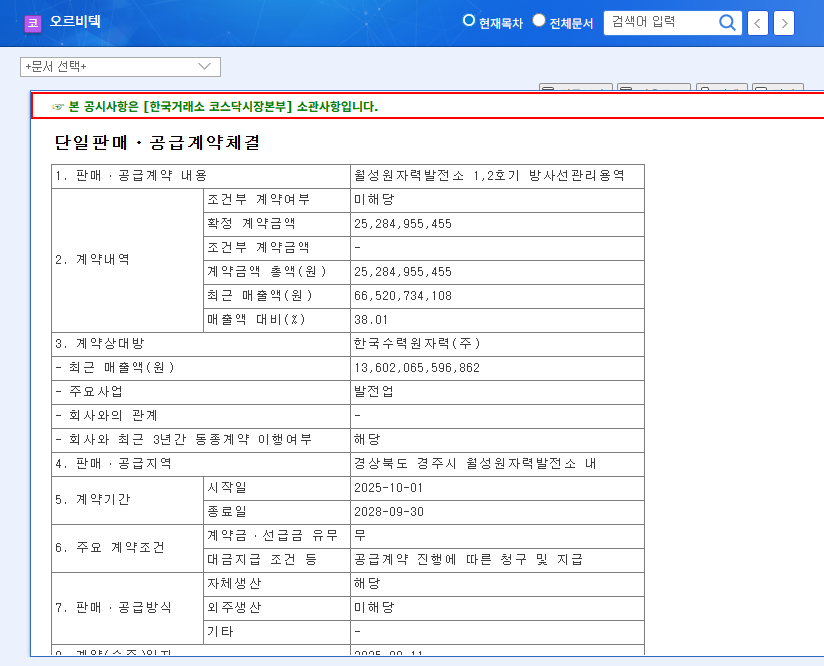
    Orbit Tech has secured a $185 million contract with KHNP for radiation management services at the Wolsong Nuclear Power Plant Units 1 & 2. Spanning three years, this contract represents 38.01% of Orbit Tech’s annual revenue and is expected to significantly contribute to the stable growth of its nuclear business. The long-term nature of the contract offers positive prospects for securing stable revenue and increasing the likelihood of further contract wins.

    2. Orbit Tech’s Fundamentals: Are They Solid?

    Orbit Tech operates in nuclear, ISI, and aviation businesses. While the nuclear business shows stable revenue, its high cost of sales ratio of 84.82% indicates the need for improved profitability. The ISI business, with a critical cost of sales ratio of 132.94%, poses a major challenge to profitability. The aviation business also faces pressure from its high 124.38% cost of sales ratio. Financially, a debt ratio of 73.41% and a negative interest coverage ratio (-5.97x) suggest an urgent need to improve financial soundness. The accumulated deficit of $159 million also presents a long-term challenge.

    3. Market Conditions: Favorable for Orbit Tech?

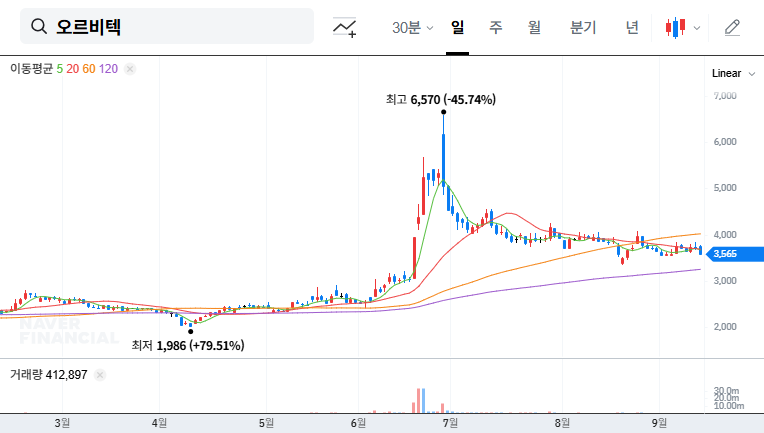
    The recent rise in the USD/KRW exchange rate could be positive for the aviation business’s export sales but might increase the cost burden due to rising import material prices. While the interest rate freeze is favorable for borrowing costs, managing interest expenses is crucial given the high debt level. The stock price has shown a gradual recovery with increased trading volume after the rights offering.

    4. Action Plan for Investors

    While this contract is a positive sign for Orbit Tech’s growth potential, the company must also address the challenge of improving profitability. Investors should consider the following:

    • Trends in the improvement of cost of sales ratio for the ISI and Aviation businesses.
    • Performance of new business investments and securing future growth engines.
    • Efforts to strengthen financial soundness and their actual results.

    It is crucial to thoroughly analyze the company’s fundamental improvements and profitability potential rather than making investment decisions solely based on the contract signing.


    Frequently Asked Questions (FAQ)

    Will this contract have a positive impact on Orbit Tech’s stock price?

    Generally, large-scale contracts positively influence investor sentiment and can lead to stock price increases. However, the long-term stock price trend depends on the company’s earnings improvement. Therefore, continuous monitoring of profitability trends is necessary.

    What is Orbit Tech’s biggest risk?

    The high cost of sales ratio in the ISI business segment is the biggest risk. Failure to improve this ratio could offset the positive effects of increased revenue from this contract.

    What should investors be cautious of when investing in Orbit Tech?

    Investors should carefully examine trends in cost of sales ratio improvement, the performance of new business investments, and efforts to strengthen financial soundness. Investment decisions should be made cautiously.


    Orbit Tech Wins $185M Nuclear Contract: Investment Opportunity? 관련 이미지
    Orbit Tech Wins $185M Nuclear Contract: Investment Opportunity? 관련 이미지


  • Woojin BHI (105840) H1 2025 Earnings Analysis: Hidden Opportunities Amidst Headwinds?

    1. What Happened? Analyzing the Earnings Decline

    Woojin BHI reported consolidated revenue of KRW 62 billion, operating profit of KRW 3.1 billion, and net income of KRW 0.9 billion for H1 2025. This represents a year-on-year decrease of 17.5%, 62.0%, and 92.2%, respectively. All major business segments, including nuclear, plant, and temperature sensors, experienced declining sales, largely attributed to external factors like the global economic slowdown, reduced client investments, and sluggish construction and manufacturing sectors.

    2. Why These Results? External Factors and Internal Strategies

    The nuclear business segment was impacted by completed deliveries and delays in new orders, while the plant segment suffered from the downturn in the steel industry. In addition to declining sales, increased costs also contributed to the profit squeeze. However, there are positive developments. Woojin is pursuing a new smart factory software business in response to the fourth industrial revolution and continues to invest in R&D for future growth.

    3. What’s Next? Future Outlook and Growth Potential

    While a short-term recovery seems challenging, there are positive long-term factors. The successful establishment of the smart factory business, a recovery in the nuclear and plant sectors, and securing overseas nuclear power plant orders are key to Woojin’s turnaround. Notably, its robust financial health will be a strength in the face of economic uncertainty.

    4. What Should Investors Do? Investment Strategies and Considerations

    • Monitor Nuclear Order Trends: Stay updated on news and developments related to overseas nuclear power plant orders.
    • Check Smart Factory Business Growth: Pay close attention to the sales and profitability trends of the new software business.
    • Monitor Macroeconomic Indicators: Understand the impact of global economic conditions, exchange rates, and interest rate fluctuations on Woojin’s performance.
    Q: What are Woojin BHI’s main businesses?

    A: Woojin BHI’s core businesses are nuclear power plant instrumentation, industrial plant instrumentation, and temperature sensors and measuring instruments. They have recently ventured into smart factory software solutions.

    Q: Why did Woojin BHI’s H1 2025 earnings decline?

    A: The decline is attributed to a combination of external factors, such as the global economic slowdown, reduced client investments, and a sluggish construction and manufacturing sector, as well as internal factors like delays in new orders for the nuclear segment and a downturn in the plant business.

    Q: What are Woojin BHI’s future growth drivers?

    A: Woojin BHI’s future growth is expected to be driven by its smart factory software business, securing overseas nuclear power plant orders, and technological developments related to i-SMR (Innovative Small Modular Reactor).

  • KPS Q2 Earnings: Revenue Beats Expectations, Investment Opportunity?

    1. KPS Q2 Earnings: 6% Revenue Growth, Beating Market Expectations

    KPS reported consolidated revenue of KRW 454 billion in Q2 2025, surpassing the market consensus of KRW 426.8 billion by 6%, demonstrating robust growth. While operating profit and net profit slightly missed expectations at KRW 65.6 billion and KRW 50.9 billion respectively, the revenue growth is interpreted as a positive signal.

    2. Drivers of Robust Growth: Core Business Strength and Nuclear Power Expansion

    This growth is attributed to KPS’s strong position in the power plant maintenance market and its benefit from the nuclear power expansion policy. Revenue growth in the nuclear/pumped storage segment was particularly notable, and the steady growth of overseas business also contributed positively.

    3. Investment Opportunities and Risks: Growth Potential and Profitability Improvement Challenges

    • Opportunities: Nuclear power expansion policy, overseas business growth potential, robust revenue growth
    • Risks: Operating and net profit below expectations, exchange rate volatility, regulatory and policy changes, ongoing litigation

    4. Investment Strategy: Positive Long-Term Outlook, Consider Short-Term Volatility

    KPS is viewed positively from a long-term investment perspective, underpinned by stable fundamentals and growth potential. However, careful investment decisions are needed, considering short-term stock price volatility and profitability improvement challenges.

    Frequently Asked Questions (FAQ)

    What are the key takeaways from KPS’s Q2 earnings?

    KPS achieved revenue growth that exceeded market expectations in Q2. Revenue increased by 6% year-on-year to KRW 454 billion, driven by the company’s strong core business competitiveness and the positive impact of the nuclear power expansion policy.

    What should investors be aware of?

    While KPS holds long-term growth potential, investors should consider risk factors such as operating profit margin improvement and exchange rate volatility. Thorough analysis of the company’s financial position and market environment changes is crucial before investing.

    What is the outlook for KPS’s stock price?

    While short-term stock price fluctuations are possible, the long-term growth outlook is positive. Growth momentum from nuclear power expansion and overseas market entry remains valid, and continued earnings improvement is expected.

  • Doosan Enerbility Q2 Earnings: Below Expectations, But Future Growth Drivers Remain Strong

    1. Q2 Earnings: A Story of Contrasts

    Doosan Enerbility reported Q2 revenue of KRW 45.69 trillion, exceeding the previous year’s figures. However, operating profit and net income, at KRW 2.71 trillion and KRW 1.31 trillion respectively, missed market projections. Increased orders for large-scale EPC projects in the Middle East and strong performance by Doosan Bobcat contributed to revenue growth, but were offset by rising raw material prices and unfavorable exchange rate fluctuations.

    2. Analyzing the Earnings Miss

    Beyond raw material prices and exchange rates, rising Baltic Clean Tanker Index, indicating increased sea transportation costs, also contributed to the decline in profitability. Despite Doosan Bobcat’s positive performance, the underperformance of Doosan Enerbility’s core business had a more significant impact on overall results.

    3. Future Growth Drivers: Nuclear, Gas Turbines, and Offshore Wind

    Despite the short-term setback, Doosan Enerbility’s mid-to-long-term growth strategy remains promising. The company’s expansion into nuclear power, gas turbines, and offshore wind power, as well as its entry into the SMR market, are key growth drivers. However, the rising cost of investment capital due to interest rate hikes poses a potential challenge to profitability.

    4. Action Plan for Investors

    While there’s short-term downward pressure on the stock price, investors should consider the company’s long-term growth potential. Careful monitoring of raw material prices, exchange rate volatility, geopolitical risks, and debt-to-equity ratio is crucial for developing a sound investment strategy.

    Why did Doosan Enerbility’s Q2 earnings fall short of expectations?

    Rising raw material prices, exchange rate fluctuations, and increased sea transportation costs were identified as the primary factors. Despite growth in the Doosan Bobcat segment, the underperformance of Doosan Enerbility’s core business impacted the overall results.

    What are Doosan Enerbility’s future growth drivers?

    Expansion into nuclear power, gas turbines, and offshore wind power, along with entry into the SMR market, are considered key growth drivers.

    What should investors keep in mind?

    Investors should be mindful of short-term stock price volatility and monitor raw material prices, exchange rate fluctuations, geopolitical risks, and the debt-to-equity ratio while maintaining a long-term investment perspective.