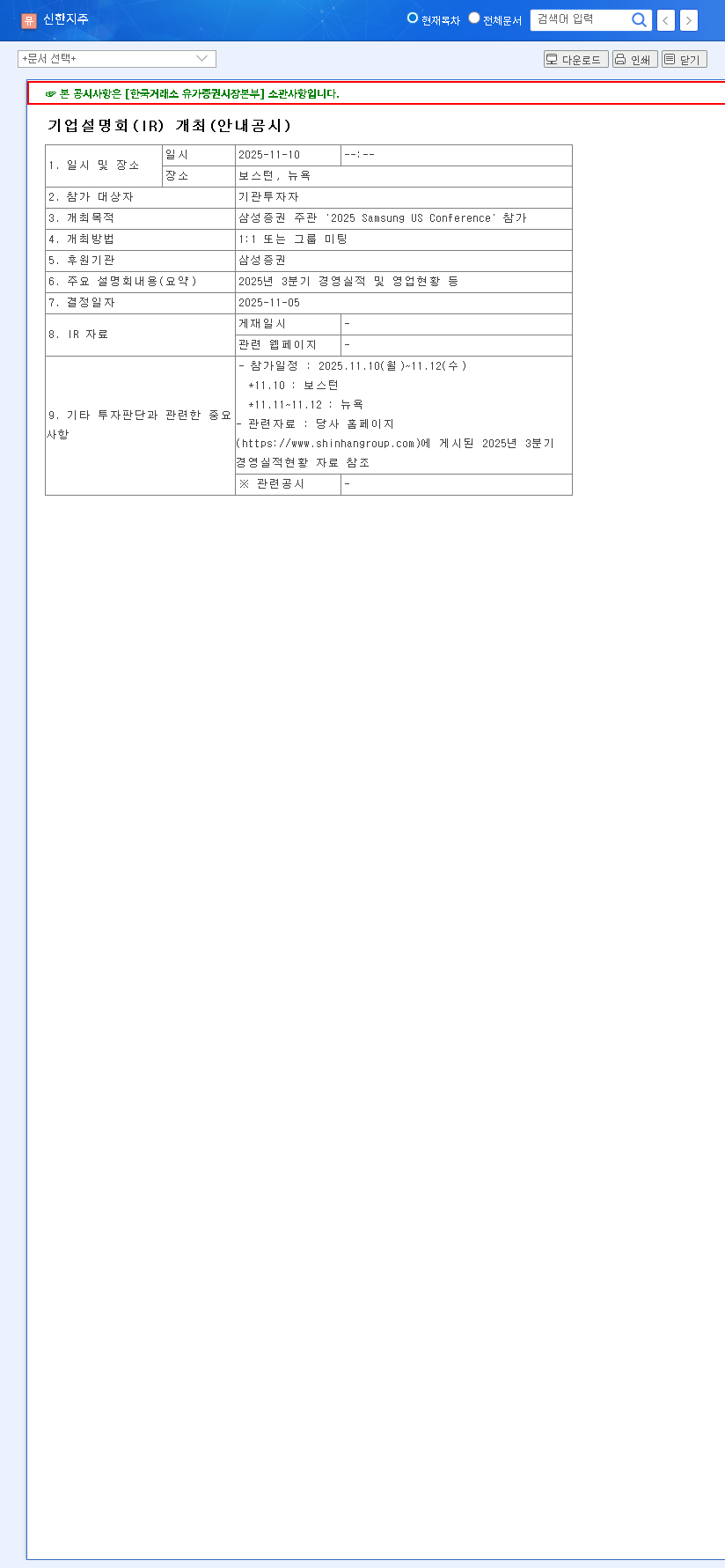
Investors are keenly awaiting the upcoming SHINHAN FINANCIAL GROUP Q3 2025 IR presentation, a pivotal event scheduled for November 10, 2025, at the ‘2025 Samsung US Conference’. As one of South Korea’s premier financial institutions, Shinhan’s performance and strategic outlook provide a crucial barometer for the health of the market. This detailed analysis unpacks the group’s recent performance, identifies key challenges, and offers a comprehensive investment strategy based on the anticipated disclosures from this event. This information is based on the official disclosure filed with DART (Source).
This report will explore Shinhan’s achievements, its navigation of macroeconomic headwinds, and the strategies it will deploy to maintain market leadership. For investors, understanding these dynamics is essential for making informed decisions in a complex financial landscape.
Reviewing H1 2025: A Foundation of Strength
Before looking ahead to the Q3 2025 results, it’s vital to analyze the solid foundation Shinhan built in the first half of the year. The group demonstrated considerable resilience and strategic acumen, which sets the stage for the upcoming IR.
Key Strengths and Positive Indicators
- •Robust Net Income Growth: Consolidated net income surged to KRW 3.0374 trillion, a significant 10.6% year-on-year increase. This wasn’t just a single-source gain; it was driven by balanced growth across both traditional interest income and dynamic non-interest income from capital markets and securities.
- •Impressive Capital Adequacy: The CET1 ratio stood firm at 13.59%, a figure well above regulatory requirements. This indicates a strong capital buffer, providing stability against market shocks. For more context, you can learn more about banking capital ratios here.
- •Commitment to Shareholder Returns: The declaration of a KRW 570 dividend per share for Q2 and a bold KRW 800 billion treasury share buyback-and-cancel program signals strong confidence from management in the company’s intrinsic value.
- •Digital Dominance: With 27.5 million Monthly Active Users (MAUs) across its digital platforms, Shinhan is successfully executing its digital transformation strategy, capturing a new generation of customers.
Identified Challenges and Headwinds
Despite the positive momentum, Shinhan is not immune to broader market pressures. The IR presentation will need to address these challenges head-on to maintain investor confidence.
- •Non-Banking Sector Slowdown: Shinhan Card’s net income fell 35.0% due to a trifecta of rising funding costs, higher delinquency rates, and increased investment spending. Similarly, Shinhan Capital’s profits declined from increased provisions for high-risk Project Financing (PF) and bridge loans.
- •Macroeconomic Uncertainty: The global economic climate, as detailed by leading institutions like the World Bank, presents ongoing risks. Interest rate volatility and geopolitical tensions remain significant external threats to profitability and stability.
- •Real Estate Market Risks: The domestic real estate market shows signs of cooling, which could amplify risks associated with the group’s PF loan portfolio and impact subsidiaries like Shinhan Asset Trust.
Analyzing the Potential Stock Impact of the Q3 IR
The SHINHAN FINANCIAL GROUP Q3 2025 IR will likely act as a major catalyst for its stock price. Here are the potential positive and negative scenarios investors should consider.
The core question for investors is whether Shinhan’s robust core banking operations and digital growth can outweigh the headwinds in its non-banking segments and the broader macroeconomic uncertainty. The Q3 IR should provide the answer.
Potential Positive Drivers (Bull Case)
- •Stronger-Than-Expected Q3 Results: If Q3 performance continues the strong trajectory of H1 and shows signs of recovery in the non-banking sectors, it will reinforce the positive fundamental narrative.
- •Clear Future Growth Vision: A detailed and credible roadmap for growth engines like AI integration, fintech partnerships, and global expansion could significantly boost long-term investor confidence.
- •Enhanced Shareholder Return Plans: Any announcement of an increased dividend or additional share buybacks would be a powerful signal and directly benefit shareholders.
Potential Negative Drags (Bear Case)
- •Persistent Non-Banking Weakness: If subsidiaries like Shinhan Card and Shinhan Capital report further declines or fail to show a clear path to recovery, it could raise concerns about the group’s diversified model.
- •Vague Strategy on Macro Risks: A generic or unclear response to managing interest rate risks and potential credit defaults could be interpreted as a lack of preparedness, dampening sentiment.
- •Negative Surprises in Asset Quality: Any unexpected increase in the non-performing loan (NPL) ratio, particularly related to real estate PF, would be a significant red flag for the market.
Actionable Investment Strategy and Recommendations
Based on this analysis, a prudent Shinhan investment strategy requires careful attention to the details of the IR call. The focus should be on management’s ability to address weaknesses while capitalizing on strengths.
Key Points to Watch During the IR
- •Guidance on Net Interest Margin (NIM): Listen for management’s outlook on NIM for Q4 and 2026. This is a primary driver of bank profitability.
- •Specifics on Non-Banking Turnaround: Vague promises won’t suffice. Look for concrete steps being taken to stabilize Shinhan Card and de-risk Shinhan Capital’s loan book.
- •Risk Management Commentary: Analyze the depth of their discussion on managing credit risk, especially in the real estate sector. Are their loan loss provisions adequate?
Ultimately, while stock price volatility may increase around the event, a long-term investment decision should be based on the fundamental strength and strategic clarity demonstrated in the Shinhan Financial Group performance report. It is recommended to make prudent decisions after fully digesting the IR presentation content.
Disclaimer: This report is an analysis based on publicly available information and does not constitute financial advice. All investment decisions must be made at the investor’s own discretion and responsibility.