Tag: New Facility Investment

  • (038870) EcoBio Holdings Hydrogen Investment: A Deep Dive into the KRW 6.5B Bet

    (038870) EcoBio Holdings Hydrogen Investment: A Deep Dive into the KRW 6.5B Bet

    EcoBio Holdings Co., Ltd. stands at a critical crossroads. The company recently unveiled a significant EcoBio Holdings hydrogen investment, committing a substantial 6.5 billion KRW to expand its footprint in the green energy sector. This bold strategic pivot aims to capture a share of the burgeoning hydrogen economy, promising a new era of growth. However, this ambitious move comes as the company grapples with deteriorating financial health, creating a classic high-risk, high-reward scenario for investors. Is this a visionary leap into the future or a financial gamble that could strain the company to its breaking point? This in-depth analysis will dissect the investment, evaluate the underlying financials, and provide a clear roadmap for stakeholders.

    The Landmark Investment: What is the KRW 6.5 Billion For?

    On November 11, 2025, EcoBio Holdings formally announced its plan to inject 6.5 billion KRW into new hydrogen business facilities. This figure, representing over 8% of the company’s total equity, is a clear signal of intent. The investment, detailed in the company’s Official Disclosure on DART, is scheduled over approximately 1.1 years. The capital is expected to fund the development of advanced hydrogen production and storage infrastructure, positioning the company to meet future demand. While the specifics of the technology are proprietary, the goal is to establish a competitive advantage in a market that is rapidly gaining global momentum.

    A Company Under Pressure: The Financial Reality

    The timing of this major capital expenditure is what raises significant concerns. A close look at the EcoBio financial health reveals a company facing considerable headwinds. The decision to invest heavily now, while potentially strategic, adds a layer of risk that cannot be ignored.

    Alarming Liquidity and Debt Metrics

    The company’s ability to meet its short-term obligations is under scrutiny. Key indicators paint a worrying picture:

    • Plummeting Current Ratio: A dramatic fall from a healthy 153.78% in 2023 to a precarious 35.64% in 2024 suggests a severe weakening of short-term liquidity. This means the company has far fewer current assets to cover its current liabilities.
    • Rising Debt-to-Equity: This ratio climbed from 27.24% to 46.00% over the last year. While the longer-term trend shows a slight decrease, the current level remains high, indicating a reliance on debt financing that this new investment will only exacerbate.

    Plummeting Profitability and Asset Quality

    It’s not just the balance sheet that’s flashing warning signs. Profitability has also been on a steady decline. The operating profit margin shrank from 16.21% in 2022 to just 4.87% in 2024, while Return on Equity (ROE) collapsed from 16.03% to 3.37% in the same period. Compounding these issues, both consolidated and separate financial statements reported a net loss in 2024, eroding total equity. An increase in the allowance for doubtful accounts also hints at potential issues with asset quality and loan collections.

    For EcoBio Holdings, this hydrogen investment is the ultimate double-edged sword: it represents a potential lifeline to future relevance and profitability, but its immediate financial burden could sink the ship before it reaches the promised land.

    The Two Sides of the Coin: Pros vs. Cons

    The Bull Case: Future Growth and Diversification

    Despite the financial risks, the strategic rationale for the hydrogen business investment is compelling. Globally, governments are promoting hydrogen as a key component of decarbonization, creating powerful tailwinds. According to reports from institutions like the International Energy Agency, the hydrogen market is poised for exponential growth. By investing now, EcoBio could secure a crucial first-mover advantage. This move also serves to diversify its business portfolio, reducing dependence on its currently struggling core operations and creating new, potentially more stable revenue streams for the long term.

    The Bear Case: Financial Burden and Execution Risk

    The primary risk is clear: the company is making a large, speculative bet from a position of financial weakness. The KRW 6.5 billion investment will place immense pressure on short-term cash flow and further strain the balance sheet. Furthermore, the hydrogen industry is capital-intensive and fraught with technological hurdles and intense competition. There is no guarantee of success, and a return on investment could be many years away. If the core business continues to underperform, it may lack the financial stability to see this ambitious project through to completion. Investors should also review our guide to analyzing high-risk growth stocks for more context.

    Investor’s Strategic Checklist

    For those conducting an EcoBio Holdings stock analysis, a cautious and vigilant approach is paramount. The long-term stock price will hinge on the successful execution of this hydrogen strategy. Key areas to monitor include:

    • Funding Transparency: How will the 6.5 billion KRW be financed? Will it be through debt, equity, or a mix? Analyze the impact of the chosen method on financial health.
    • Project Milestones: Track the progress of the hydrogen facility construction and operations. Are they hitting their targets on time and on budget?
    • Core Business Performance: Look for signs of a turnaround in the existing business. A stabilization here would provide a much-needed financial cushion for the new venture.
    • Industry & Policy Landscape: Keep an eye on government policies, subsidies for the hydrogen sector, and the competitive environment.

    In conclusion, the EcoBio Holdings hydrogen investment is a defining moment for the company. While the short-term market reaction may be negative due to the clear financial risks, the long-term potential could be transformative if management executes flawlessly. Prudent financial risk management must be the top priority to ensure this growth engine doesn’t become a financial anchor.
    (038870) EcoBio Holdings Hydrogen Investment: A Deep Dive into the KRW 6.5B Bet 관련 이미지
  • (072990) HCT Nuclear Power Investment: Analyzing the ₩12.2 Billion Growth Strategy

    (072990) HCT Nuclear Power Investment: Analyzing the ₩12.2 Billion Growth Strategy

    The recent announcement of the HCT nuclear power investment has sent ripples through the market. HCT CO., LTD. has committed a substantial ₩12.2 billion to a new facility focused on ‘nuclear power performance verification’—a critical service that ensures the safety, reliability, and compliance of components used in nuclear reactors. This strategic pivot into a high-stakes, high-reward sector signals a bold new chapter for the company. But does this move guarantee a path to sustainable growth, or does it introduce undue risk? This comprehensive analysis will dissect the investment, evaluate HCT’s fundamentals, and provide actionable insights for investors monitoring HCT CO., LTD. stock.

    The ₩12.2 Billion Announcement: What Happened?

    HCT CO., LTD. formally declared a significant new facility investment totaling ₩12.2 billion, a figure representing 12.91% of the company’s capital. The funds are earmarked for establishing state-of-the-art facilities and testing sites dedicated to nuclear power performance verification. According to the Official Disclosure, this ambitious project has a defined timeline and purpose.

    • Investment Purpose: To build and equip facilities for nuclear power equipment testing and performance verification.
    • Total Investment: ₩12.2 billion (12.91% of total capital).
    • Investment Period: A projected 1.1-year timeline, from November 11, 2025, to December 31, 2026.

    Why Now? HCT’s Strong Fundamentals and Strategic Rationale

    This significant capital expenditure is not a speculative whim but a calculated move grounded in HCT’s robust financial health and a clear diversification strategy. The company’s H1 2025 semi-annual report paints a picture of stability and growth, providing the foundation needed for such a forward-looking investment. For the first half of 2025, consolidated revenue climbed an impressive 24.8% to ₩54.86 billion, while operating profit surged by 66.6% to ₩6.41 billion. With a stable debt-to-equity ratio of 66.04%, HCT is in a strong position to absorb the short-term costs of this expansion.

    This HCT nuclear power investment aligns perfectly with a broader strategy of diversifying into high-barrier, high-growth industries like 5G, autonomous driving, and now, nuclear energy. It’s a classic case of leveraging a strong core business to finance the next engine of growth.

    The timing is also opportune. With renewed global interest in nuclear energy as a stable, carbon-free power source and supportive government policies, HCT is positioning itself to capture a vital niche in the expanding nuclear supply chain. This move is a crucial step in evolving from a general testing and certification provider to a highly specialized and indispensable industrial partner.

    Impact Analysis: A Double-Edged Sword

    An investment of this magnitude carries both immense potential and significant risks. A balanced HCT investment analysis requires a careful look at both sides of the coin.

    The Upside: Potential for Long-Term Value Creation

    • New Growth Engine: Entry into the nuclear sector provides a powerful new revenue stream, diversifying the company away from its traditional markets and tapping into a long-term, high-growth industry.
    • Strengthened Competitive Moat: Nuclear verification requires immense technical expertise and certifications that adhere to global standards set by the IAEA. Successfully establishing this capability creates a high barrier to entry for competitors.
    • Enhanced Corporate Value: Securing a foothold in a critical future industry can significantly enhance HCT’s long-term corporate valuation and appeal to institutional investors.

    The Downsides: Potential Risks and Headwinds

    • Short-Term Financial Burden: The ₩12.2 billion outlay will likely require increased borrowing, leading to higher interest expenses that could temporarily depress profitability until the new division generates revenue.
    • Industry-Specific Uncertainties: The nuclear industry is subject to stringent regulations, complex licensing, and political shifts. Any of these factors could introduce delays or unforeseen costs. This contrasts with the faster cycles seen when evaluating growth stocks in the tech sector.
    • Execution and Competitive Risk: HCT will be competing against established players. Their success hinges on their ability to execute the facility build-out on time and on budget, and then effectively win contracts in a competitive landscape.

    Investor’s Guide: A Neutral Stance with a Bullish Outlook

    Given the balance of factors, the overall investment opinion remains Neutral for the short term. The long-term potential of the HCT nuclear power investment is undeniable, but the path to profitability will take time. Investors should not expect an immediate surge in stock price. Instead, a patient, mid-to-long-term approach is recommended, with close attention paid to key performance milestones.

    Key Monitoring Points for Investors:

    • Project Execution: Is the new facility construction proceeding on schedule and within budget?
    • Early Contract Wins: Are there announcements of new orders or partnerships in the nuclear performance verification business?
    • Financial Metrics: How are debt levels and interest expenses impacting quarterly earnings reports?
    • Macro Environment: How are interest rate trends and currency fluctuations affecting the project’s financing and equipment costs?

    If HCT can navigate the initial challenges and establish a profitable revenue stream from its nuclear division, this investment will be viewed as a masterstroke. For now, prudent investors will watch and wait for tangible results to emerge from this bold strategic venture.

    (072990) HCT Nuclear Power Investment: Analyzing the ₩12.2 Billion Growth Strategy 관련 이미지
  • (107640) HanJungNCS ESS Investment: A 19B KRW Gamble on Future Growth? | In-Depth Analysis

    (107640) HanJungNCS ESS Investment: A 19B KRW Gamble on Future Growth? | In-Depth Analysis

    In a bold move to capture a larger share of the booming green energy sector, HanJungNCS.Co.,Ltd has announced a landmark 19 billion KRW facility investment. This significant capital injection is aimed squarely at expanding its Energy Storage System (ESS) component production. The HanJungNCS ESS investment represents a pivotal moment for the company, positioning it to capitalize on explosive market demand. However, this aggressive growth strategy is not without substantial risks, especially given the company’s current financial pressures and the volatile macroeconomic climate. This analysis will explore both the promising opportunities and the potential pitfalls of this high-stakes venture.

    Dissecting the 19 Billion KRW Investment

    On November 10, 2025, HanJungNCS officially disclosed its plan for a ‘New Facility Investment.’ The core objective is to significantly scale up its manufacturing capacity for critical ESS components. The 19 billion KRW investment, which constitutes a substantial 23.62% of the company’s equity capital, is scheduled to unfold over a one-year period, concluding on October 31, 2026. This move is a clear strategic pivot, designed to reinforce the company’s position within the high-growth ESS market. For complete transparency, you can view the Official Disclosure (DART) on the matter.

    The Bull Case: Fueling Future Growth in the ESS Market

    From a strategic standpoint, the timing of this investment appears impeccable. The global demand for energy storage solutions is surging, driven by the global transition to renewable energy sources like solar and wind, which require robust storage to ensure grid stability.

    Tapping into Explosive Market Growth

    Expanding production capacity allows HanJungNCS to directly address the soaring demand within the global Energy Storage System (ESS) market. This proactive expansion is expected to drive significant top-line growth for the company’s ESS division, positioning it to capture increased market share from competitors who may be slower to scale.

    This investment isn’t just about producing more; it’s about cementing a leadership position in a market that will define the future of energy for decades to come.

    Sharpening the Technological Edge

    The investment will also fund advancements in HanJungNCS’s core technologies, such as its sophisticated liquid cooling systems for ESS units. Enhancing these capabilities creates a competitive moat, enabling the company to produce higher-value, more efficient products. This technological differentiation is crucial for attracting premium clients and diversifying its customer base beyond its current portfolio.

    The Bear Case: A Cautious Financial Analysis

    Despite the clear growth opportunities, the HanJungNCS ESS investment places immense pressure on an already strained financial structure. A closer look at the company’s recent performance reveals several red flags that investors cannot ignore.

    Deteriorating Profitability and Cash Flow

    The company’s H1 2025 report painted a concerning picture, with operating profit declining and the company slipping into a net loss. This was attributed to rising costs and administrative expenses. Furthermore, the operating profit margin saw a dramatic fall from 16.21% in 2022 to just 4.87% in 2024. With a debt-to-equity ratio already over 100% and negative operating cash flow, taking on this new investment could severely test the company’s financial resilience. For those wanting to learn more, here is our guide to analyzing corporate financials.

    The Uncertainty of Investment Recovery

    There is a significant time lag between capital expenditure and revenue generation. It may take several quarters, or even years, for this new facility to translate into meaningful profit. During this period, HanJungNCS remains vulnerable to external shocks such as fluctuations in raw material prices (like Resin), rising global interest rates that increase borrowing costs, and intensified market competition. The method of funding this 19 billion KRW—be it through debt, equity, or internal reserves—will be critical in determining the immediate impact on its balance sheet.

    A Prudent Strategy for Investors

    The HanJungNCS ESS investment is a classic high-risk, high-reward scenario. The long-term potential is undeniable, but the short-term financial hurdles are significant. Investors should adopt a cautious and diligent approach, focusing on the following key areas:

    • Financial Health Monitoring: Scrutinize the investment’s funding plan. Keep a close watch on the company’s efforts to manage its debt and improve operating cash flow as the project progresses.
    • Path to Profitability: Look for concrete evidence that the investment is leading to enhanced productivity and economies of scale. Are cost-management strategies effectively offsetting rising expenses?
    • Competitive Landscape: Continuously assess HanJungNCS’s position within the competitive ESS market. Is its technology maintaining a competitive edge, and are its new products gaining traction?
    • Market Volatility: Be prepared for short-term stock price volatility. The combination of positive growth news and negative financial reports could lead to significant price swings.

    In conclusion, while HanJungNCS is making a necessary and forward-looking investment, the immediate financial risks warrant a cautious ‘wait-and-see’ approach. The success of this venture will depend entirely on disciplined execution, prudent financial management, and a favorable market environment.

    (107640) HanJungNCS ESS Investment: A 19B KRW Gamble on Future Growth? | In-Depth Analysis 관련 이미지
  • (441270) Fine M-Tec Investment: A KRW 16B Bet on UV Laser Tech to Dominate the Foldable Market

    (441270) Fine M-Tec Investment: A KRW 16B Bet on UV Laser Tech to Dominate the Foldable Market

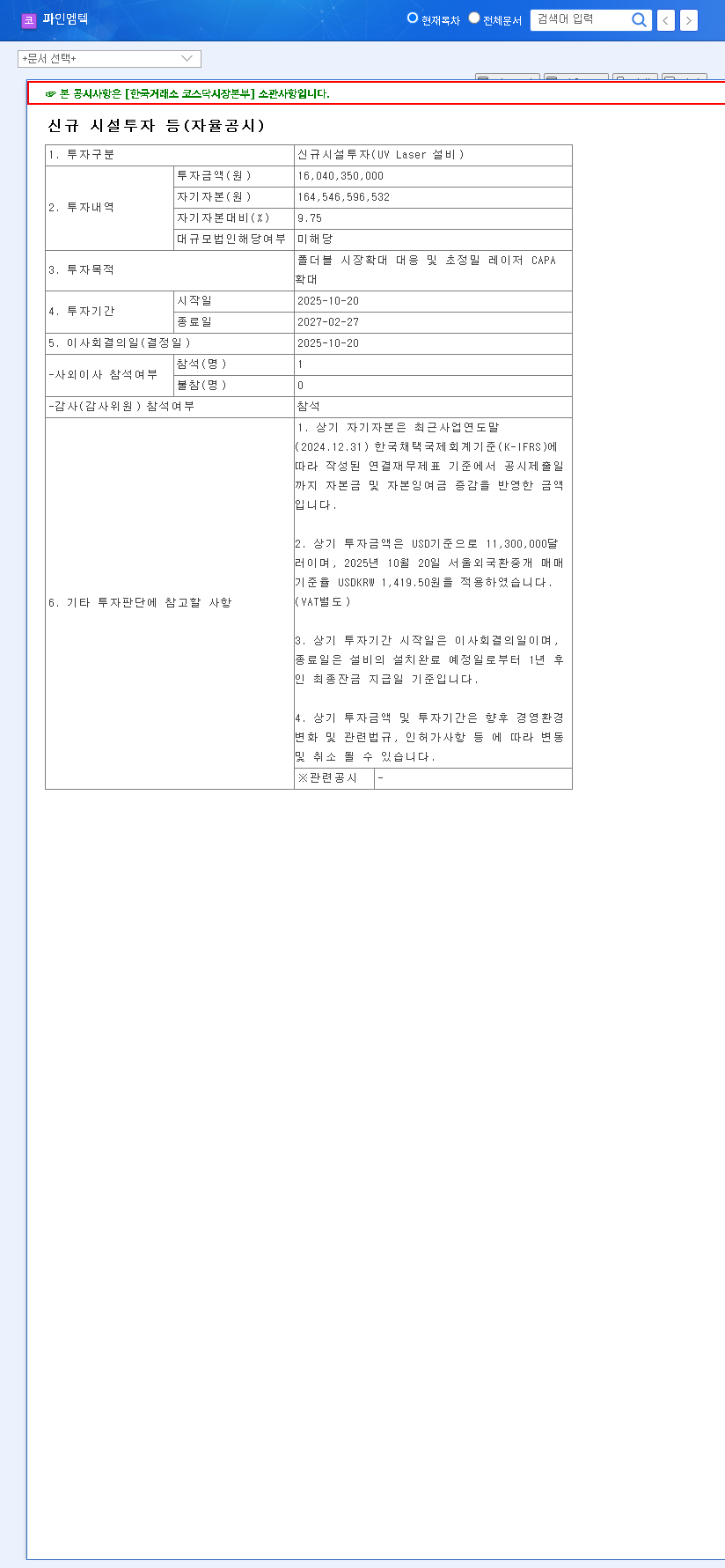
    On October 20, 2025, Fine M-Tec Co., Ltd. (stock code: 441270) made a significant announcement that captured the market’s attention: a strategic Fine M-Tec investment of KRW 16 billion into new UV laser facilities. This move, detailed in an Official Disclosure (Source: DART), represents a substantial 9.75% of the company’s capital. This article provides a comprehensive analysis of what this investment means for the company, its investors, and its position within the rapidly expanding foldable market.

    Deconstructing the KRW 16 Billion Investment

    The core of the announcement is a KRW 16 billion commitment to acquire and implement state-of-the-art UV laser equipment. This project is scheduled over approximately 1.4 years, with a completion date of February 27, 2027. The stated objectives are twofold and crystal clear: to aggressively respond to the growth of the foldable market and to significantly enhance the company’s ultra-precision laser processing capacity (CAPA). For a company with a market capitalization of KRW 352.3 billion, this is not a minor expenditure but a decisive strategic maneuver to secure future growth engines.

    This proactive Fine M-Tec investment is a clear signal of the company’s ambition to transition from a market participant to a market leader in the high-value foldable component sector.

    The Strategic Rationale: Why Now?

    Capitalizing on Explosive Foldable Market Growth

    The market for foldable devices is no longer a niche curiosity; it’s a mainstream growth driver. According to market analysts like Gartner, the sector is projected to see double-digit annual growth as the technology expands from smartphones to tablets, laptops, and beyond. This investment positions Fine M-Tec to directly capture this surging demand. By increasing production capacity, the company can secure larger contracts with major global electronics manufacturers who are desperately seeking reliable suppliers for their next-generation devices.

    Achieving Technological Supremacy with UV Laser Equipment

    Foldable displays and their components require processing with microscopic precision. UV laser equipment is critical here because it performs ‘cold’ ablation—it removes material with minimal thermal damage to surrounding areas. This is essential for delicate polymer films and multi-layer structures found in foldable screens. By investing in the latest UV laser technology, Fine M-Tec builds a significant technological moat. This allows them to produce higher-quality, more reliable components with better yields, which in turn enhances profitability and builds a reputation for excellence that is hard for competitors to replicate.

    Impact on Corporate Value: A Balanced View

    A Fine M-Tec investment of this magnitude carries both immense potential and inherent risks. A careful analysis is crucial for investors.

    Potential Upsides:

    • Enhanced Growth Trajectory: Directly aligns the company with one of the fastest-growing segments in consumer electronics, creating a clear path for revenue and profit growth.
    • Strengthened Competitive Edge: Advanced technology secures a stronger market position and creates higher barriers to entry for competitors.
    • Long-Term Value Creation: This move prioritizes sustainable, long-term growth over short-term gains, building a foundation for future corporate value appreciation.

    Potential Risks to Monitor:

    • Financial Burden: A KRW 16 billion outlay can strain cash flow. The financing method (debt vs. equity) will be critical to its impact on the balance sheet.
    • Market Volatility: The investment’s success is pegged to the continued growth of the foldable market. Any unforeseen slowdown or shift in consumer preference could impact the return on investment.
    • Execution Risk: The timeline to 2027 involves significant operational challenges. Delays in implementation or a failure to achieve expected efficiency gains could temper results.

    Investor Action Plan: Key Factors to Watch

    While this news is promising, prudent investors should conduct thorough due diligence. For more background, consider reading our guide on analyzing tech manufacturing investments. Key areas to monitor moving forward include:

    • Financing Details: Watch for subsequent disclosures on how the KRW 16 billion will be funded. A capital increase could dilute shares, while significant debt could increase financial risk.
    • Quarterly Earnings Calls: Listen for management’s commentary on the project’s progress, initial operational results, and any new client acquisitions related to this expanded capacity.
    • Competitor Movements: Keep an eye on how rival companies respond. Do they announce similar investments? This will provide context for Fine M-Tec’s competitive standing.
    • Industry Reports: Follow broader industry analysis on the foldable market to ensure growth forecasts remain robust.

    In conclusion, the Fine M-Tec investment is a bold and strategic commitment to the future. It solidifies the company’s role as a key enabler of the foldable technology revolution. While risks are present, the potential rewards for establishing a dominant position in this high-growth market are substantial. Investors should view this as a powerful long-term catalyst, contingent on diligent monitoring of the company’s execution and market dynamics.

    (441270) Fine M-Tec Investment: A KRW 16B Bet on UV Laser Tech to Dominate the Foldable Market 관련 이미지
  • (459510) NAUROBOTICS Facility Investment: A KRW 5 Billion Analysis of Growth vs. Risk

    (459510) NAUROBOTICS Facility Investment: A KRW 5 Billion Analysis of Growth vs. Risk

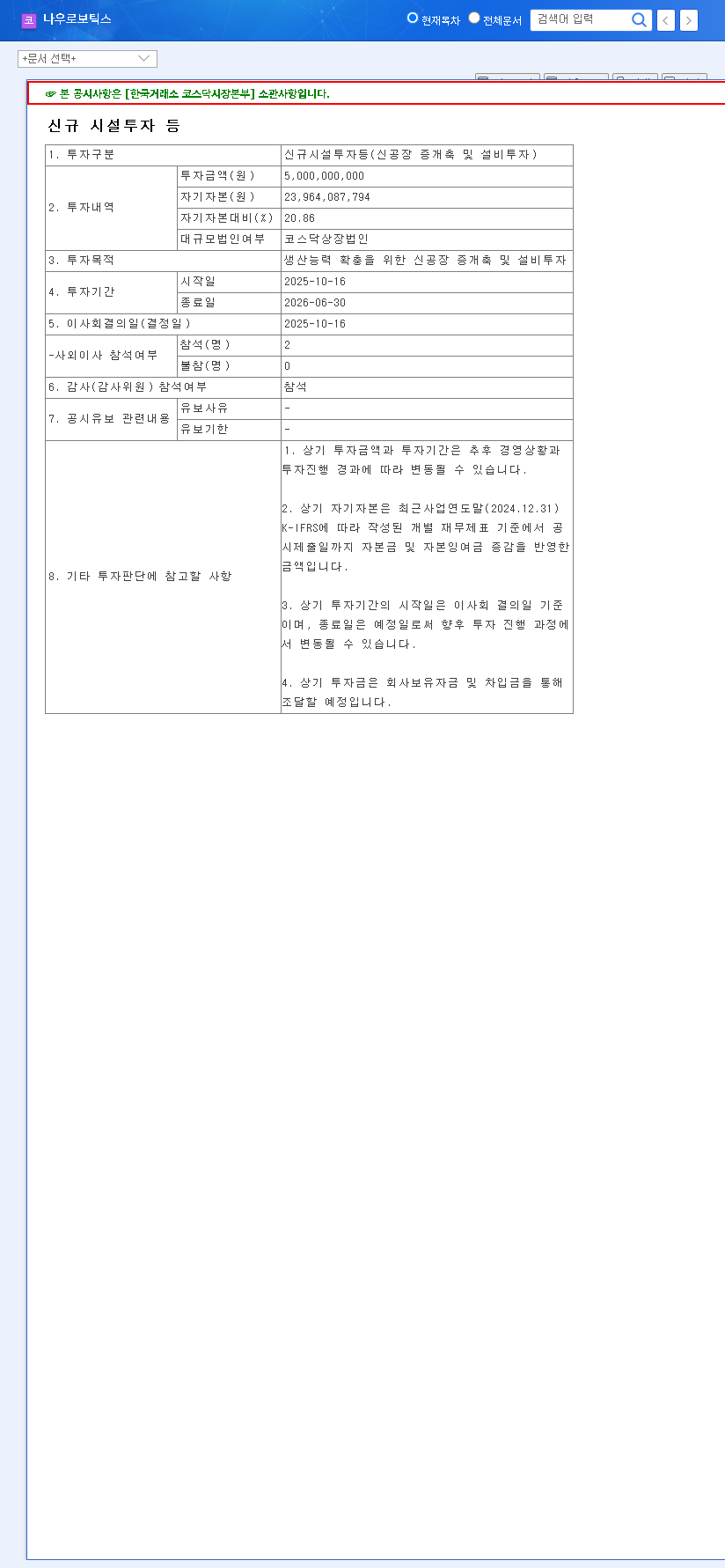
    The recent announcement of the NAUROBOTICS facility investment, a monumental KRW 5 billion commitment to expand production capacity, has captured the market’s full attention. This strategic move, representing a significant 20.86% of the company’s capital, is a clear signal of ambition. But does it position NAUROBOTICS for market dominance in the booming robotics sector, or does it introduce significant financial risks? This comprehensive analysis explores the strategic rationale, potential rewards, and inherent challenges of this pivotal investment.

    Deconstructing the KRW 5 Billion Announcement

    On October 16, 2025, NAUROBOTICS Co., Ltd. formally disclosed its plan for a major capital expenditure. The core objective is to fuel growth through the production capacity expansion via the renovation and expansion of a new factory, complete with state-of-the-art equipment. This move is designed to meet escalating demand and solidify its market position.

    • Investment Amount: KRW 5 Billion
    • Investment as % of Capital: 20.86%
    • Primary Goal: Production Capacity Expansion & Modernization
    • Project Timeline: October 16, 2025 – June 30, 2026

    The Strategic Rationale: Why Invest Now?

    This substantial investment is not a reactive measure but a proactive strategy rooted in a clear vision of the future. The decision is underpinned by powerful trends in the robotics industry growth. According to leading sources like the International Federation of Robotics, demand for automation and robotic solutions is surging across sectors like manufacturing, logistics, and healthcare. NAUROBOTICS aims to capitalize on this wave rather than be left behind.

    This investment is a forward-looking move to transform existing production bottlenecks into a competitive advantage, ensuring NAUROBOTICS can meet and exceed future market demand.

    By expanding now, the company seeks to overcome current capacity limitations that could stifle growth. It’s a strategic play to not only satisfy existing order books but also to aggressively pursue larger contracts and strengthen its market share against competitors who may be slower to scale.

    In-Depth Impact Analysis: Positives and Negatives

    The Upside: A Catalyst for Exponential Growth

    The potential benefits of this NAUROBOTICS facility investment are significant:

    • Revenue Acceleration: The most direct outcome is the ability to produce and sell more. This expanded capacity is the foundation for substantial revenue growth and securing long-term momentum.
    • Enhanced Profitability: New, advanced equipment will drive operational efficiency, reduce waste, and lower per-unit production costs. These improvements are expected to flow directly to the bottom line, boosting profit margins.
    • Strengthened Market Position: With the ability to fulfill larger orders more quickly, NAUROBOTICS can become a more attractive partner for major clients, thereby increasing its market share and competitive standing.

    The Risks: Navigating Financial and Market Headwinds

    However, an investment of this magnitude is not without its challenges. Prudent investors must consider the potential downsides:

    • Short-Term Financial Strain: Committing KRW 5 billion can put pressure on the company’s cash flow and balance sheet. How this is financed—through debt, equity, or cash reserves—will significantly impact its financial health.
    • Return on Investment (ROI) Uncertainty: There’s no guarantee that market demand will perfectly align with the new capacity. If demand falters or competition intensifies, the payback period for the investment could lengthen, impacting profitability.
    • Execution Risk: Large-scale construction and equipment installation projects are susceptible to delays and cost overruns. Effective project management is critical to ensure the facility comes online on time and within budget.

    Investor Action Plan: Key Factors to Monitor

    For those holding or considering NAUROBOTICS stock, this is a critical period. A thorough NAUROBOTICS investment analysis requires monitoring several key areas. Understanding the sector is a great first step, which you can read about in our guide to investing in robotics technology. Specifically for this investment, investors should focus on:

    • Funding Source: Scrutinize company disclosures for details on how the KRW 5 billion will be financed. High levels of debt could increase financial risk.
    • Project Milestones: Track quarterly reports for updates on the construction progress. Any significant delays should be a red flag.
    • Market & Analyst Sentiment: Follow analyst reports and market commentary to gauge how financial experts are viewing the investment’s progress and potential.
    • Official Filings: The most reliable source for information remains the company’s direct filings. You can review the Official Disclosure on the DART system for complete details.

    In conclusion, the NAUROBOTICS facility investment is a defining moment for the company. It’s a calculated, high-stakes bet on future growth. While the potential rewards are immense, success will ultimately hinge on flawless execution, robust market demand, and prudent financial management. For investors, this calls for diligent monitoring and careful analysis.

    (459510) NAUROBOTICS Facility Investment: A KRW 5 Billion Analysis of Growth vs. Risk 관련 이미지
  • ISU Specialty Chemicals Announces New Facility Investment: A Promising Opportunity?

    1. What Happened? New Facility Investment Announcement

    ISU Specialty Chemicals announced its future growth plans through a ‘new facility investment’ disclosure on August 5, 2025. While specific details are yet to be revealed, the market anticipates this investment will bolster the company’s growth engine.

    2. Why Is It Important? Expanding Growth Potential

    This investment is expected to support ISU Specialty Chemicals’ long-term growth by expanding production capacity, developing new products, and enhancing technological capabilities. The investment in the lithium sulfide (Li2S) business, a key material for solid-state batteries, presents a significant opportunity to capture the future market.

    • Positive Aspects: Enhanced growth, technological advancement, increased market confidence
    • Potential Risks: Investment cost burden, uncertainty of success, short-term earnings volatility

    3. ISU Specialty Chemicals: Current Status? Successful Q1 Turnaround!

    In Q1 2025, ISU Specialty Chemicals achieved remarkable results with an 89.5% increase in sales and a return to profitability. This is attributed to the synergy effects from the merger with ISU Exachem and strong sales of key products. The stable growth of the fine chemical business and the growth potential of the Li2S business support a positive outlook.

    4. What Should Investors Do? 3 Key Checkpoints

    Before making an investment decision, be sure to check the following three points:

    • Thorough Analysis of the Announcement: Verify the investment size, funding methods, and expected effects.
    • Monitor Li2S Business Progress: Continuously track technological developments, production capacity, and sales contract signings.
    • Consider Macroeconomic Variables: Analyze and prepare for the impact of exchange rate and interest rate fluctuations.

    Frequently Asked Questions

    What are ISU Specialty Chemicals’ main businesses?

    ISU Specialty Chemicals produces fine chemicals and lithium sulfide (Li2S), a key material for solid-state batteries. Fine chemicals account for a significant portion of their total sales, holding a high market share in Asia.

    How will the new facility investment affect the stock price?

    Generally, new facility investments are interpreted as a positive sign of a company’s growth potential, which can positively impact the stock price. However, depending on the investment’s details, size, and funding methods, there is also a possibility of a negative impact, requiring careful analysis.

    What are the key points to consider when investing?

    Before investing, thoroughly review the announcement details, monitor the progress of the Li2S business, and keep track of macroeconomic variables. Remember that investments always carry risk, so careful judgment is essential.

  • Finemtek’s $17.5 Billion Investment: A Signal for Foldable Phone Market Expansion and Future Growth

    Finemtek’s New Leap: An Analysis of its $17.5 Billion New Facility Investment

    Finemtek has decided to make a substantial new facility investment of 17.5 billion won to respond to the expansion of the foldable phone market and enhance its ultra-precision laser production capacity. This investment, equivalent to 10.64% of its capital, is scheduled to proceed for approximately 1.5 years from July 17, 2025, to January 20, 2027. This move is considered a core element of Finemtek’s long-term growth strategy.

    1. Why is Finemtek Making a Large-Scale Investment Now?

    This investment is the result of deep consideration regarding several situations Finemtek faces and its future prospects.

    • Current Status and Outlook of Existing Business (IT Components):

      • Reasons for Q1 Performance Slump: In Q1 2025, Finemtek experienced a revenue decline due to a combination of factors including the global economic slowdown, a temporary stagnation in the foldable phone market, and the deceleration of the electric vehicle market. Furthermore, the upward trend in international oil prices and uncertainty in the shipping market likely negatively impacted profitability by increasing raw material costs and logistics expenses. (Related Chart: stock_chart_441270.md)
      • Future Market Recovery Prospects and Variables: While the foldable phone market is expected to rebound from 2026 onwards, and the EV market is projected for long-term growth, this will heavily depend on the pace of global interest rate hikes and economic recovery. In particular, the trends in US, Korean, and European benchmark interest rates (US_benchmark_rate.md, Europe_benchmark_rate.md, Korea_benchmark_rate.md) and long-term government bond yields (US_10yr_treasury.md, Korea_10yr_treasury.md) will be crucial determinants of the timing and strength of the market recovery.
      • Importance of FX and Interest Rate Risk Management: The ongoing volatility in the KRW/USD and KRW/EUR exchange rates (EUR_KRW_exchange_rate.md, USD_KRW_exchange_rate.md) can directly impact Finemtek’s profitability, given its reliance on imported raw materials. Notably, the recent upward trend in the KRW/USD exchange rate could exacerbate raw material price increases, further highlighting the importance of FX and interest rate risk management, as mentioned in the Q1 report.
    • Potential and Challenges of New Business (Medical Devices):

      • Entry into the US Low-Cost Disposable Medical Device Market: Finemtek aims to secure new growth drivers by entering the US low-cost disposable medical device market. However, this market is expected to have high entry barriers and intense competition. Additionally, macroeconomic uncertainties such as changes in US trade policies and gold price fluctuations related to safe-haven demand (refer to gold_price.md) must be considered.
      • Investment Plans and Synergistic Effects: The lack of detailed investment plans and funding strategies for the medical device business introduces uncertainty regarding its success. While revenue is expected from 2026, the scale of investment and potential funding difficulties could negatively impact enterprise value. However, Finemtek’s precision convergence manufacturing technology holds potential for synergistic effects with the medical device business.

    2. How Will Finemtek’s $17.5 Billion Investment Impact its Future?

    This new facility investment is expected to have a positive impact on Finemtek’s future.

    • Responding to Foldable Phone Market Expansion and Enhancing Competitiveness: The 17.5 billion won investment will help Finemtek proactively respond to the growth of the foldable phone market and strengthen its competitive edge by expanding its ultra-precision laser production capacity (CAPA). This is anticipated to drive sales growth and improve profitability in the long run.
    • Securing Growth Drivers through New Business: The entry into the medical device business is a strategy to overcome the limitations of its existing business and capture new growth opportunities. If successful in market penetration, it will significantly contribute to diversifying Finemtek’s portfolio and increasing its enterprise value.

    3. Key Points for Investors to Watch

    The success of Finemtek’s investment is contingent upon various external factors. Investors should closely monitor the following:

    • Timing and Speed of Global Economic Recovery: Especially if interest rate hikes continue, consumer sentiment may weaken, and investment may decrease, leading to a slower market recovery.
    • Volatility of Raw Material Prices and Exchange Rates: Continued increases in raw material prices and exchange rate fluctuations could burden Finemtek’s profitability.
    • Success of US Medical Device Market Entry: Competitive landscape, regulatory changes, and Finemtek’s execution capabilities will be critical for success.
    • Correlation Analysis with Stock Price: Analyzing the correlation between past stock price movements (stock_chart_441270.md) and the announcement of this investment is crucial for predicting market reactions.

    In conclusion, Finemtek’s 17.5 billion won new facility investment signals a positive move to secure future growth drivers and enhance competitiveness, despite short-term performance headwinds. However, the success of this investment hinges on thorough responses to external environmental changes, strengthening existing business competitiveness, and successfully establishing its new business ventures. We recommend careful investment decisions while closely monitoring Finemtek’s future endeavors.

    Q1: What is the purpose of Finemtek’s 17.5 billion won investment?

    Finemtek has decided to make a new facility investment of 17.5 billion won to respond to the expansion of the foldable phone market and enhance its ultra-precision laser production capacity (CAPA).

    Q2: Is Finemtek’s performance expected to improve due to this investment?

    The new investment is expected to contribute to sales growth and improved profitability in the long term. However, external factors such as the timing of global economic recovery, raw material prices, and exchange rate fluctuations may affect performance.

    Q3: What is the outlook for Finemtek’s new medical device business?

    The US low-cost disposable medical device market is expected to have high entry barriers and intense competition, but it holds growth potential through synergies with Finemtek’s precision manufacturing technology. However, the success of the business depends on the concretization of investment plans and market penetration.

    Q4: What should investors be cautious about when investing in Finemtek?

    Investors should carefully monitor the speed of global economic recovery, the volatility of raw material prices and exchange rates, the success of entry into the US medical device market, and changes in the investment environment due to interest rate fluctuations.

    Q5: What were the reasons for Finemtek’s Q1 performance slump?

    The Q1 performance slump was attributed to a combination of factors, including the global economic slowdown, temporary stagnation in the foldable phone market, deceleration of the EV market, and increases in raw material prices and shipping market uncertainties.