The recent news surrounding the SK Securities subsidiary divestment strategy has captured significant attention from the investment community. On September 25, 2025, reports surfaced detailing the company’s plan to rebalance its portfolio, including the potential sale of its subsidiary, NBH Capital. This strategic move, coming on the heels of a successful profit turnaround in the first half of the year, raises crucial questions for current and prospective shareholders. What does this rebalancing mean for the company’s future, and how should investors navigate the potential volatility? This comprehensive guide provides a deep analysis of the situation.
The NBH Capital Divestment Plan: Background and Official Status
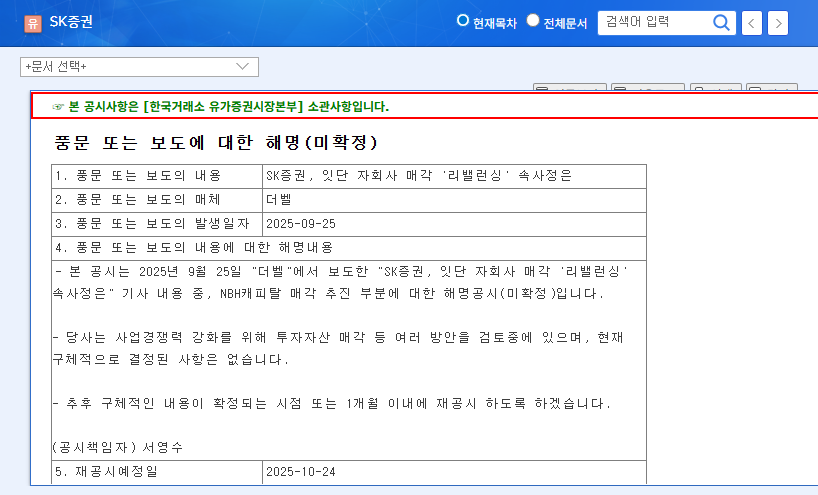
The core of SK Securities’ rebalancing initiative is the potential sale of non-core assets to sharpen its focus and bolster its financial structure. The primary asset under consideration is NBH Capital. In response to market inquiries, SK Securities confirmed that it is reviewing various strategic options to enhance business competitiveness, which includes the sale of investment assets. However, the company has clarified that no concrete decisions have been finalized. According to the Official Disclosure on DART, further updates are expected within the next three months. This period of review is critical for investors to monitor closely.
Analyzing SK Securities’ H1 2025 Financial Health
To understand the context of this strategic shift, it’s essential to look at the company’s recent performance. SK Securities demonstrated a significant turnaround in the first half of 2025, returning to profitability with a net profit of KRW 15.5 billion. This success was largely fueled by strong performance in proprietary trading and investment banking (IB) segments.
Key Financial Indicators to Watch
- •Net Capital Ratio (NCR): At 211.79%, the NCR is stable but has decreased year-on-year. This ratio is a key measure of a securities firm’s financial soundness, indicating its ability to absorb potential losses.
- •Leverage Ratio: This ratio has increased to 904.10%, suggesting higher debt relative to equity. While leverage can amplify returns, it also increases risk, making this a critical metric to monitor. For more on this, you can read our guide on Understanding Financial Ratios for Stock Analysis.
Potential Impacts of the Subsidiary Divestment
The SK Securities subsidiary divestment carries both significant opportunities and potential risks that investors must weigh carefully.
The Upside: Strategic Focus and Financial Fortification
- •Improved Financial Structure: Selling NBH Capital would inject cash into the company, which could be used to pay down debt (lowering the leverage ratio) or reinvest in core, high-growth business areas.
- •Enhanced Business Efficiency: Divesting non-core assets allows management to dedicate more time, resources, and capital to its primary operations like IB and trading, potentially driving stronger long-term profitability.
- •Renewed Investor Confidence: A successful and transparent restructuring process can signal strong, proactive leadership, which often helps restore investor trust and can positively influence the stock price.
The Downside: Uncertainty and Execution Risk
The path of divestment is fraught with uncertainty. The macroeconomic environment, as reported by sources like Reuters, presents challenges with rising exchange rates and oil prices that could dampen investor sentiment and complicate the sale process. A failed or delayed sale could be interpreted as a sign of weakness, negatively impacting the stock. Furthermore, if the sale price is lower than anticipated, it may not provide the expected financial benefits, potentially worsening capital soundness ratios.
Investor Outlook & Strategic Recommendation
The SK Securities rebalancing strategy is a logical and potentially positive move for its long-term health. However, the current stage is defined by uncertainty. The “unconfirmed” nature of the NBH Capital sale, combined with broader market volatility, calls for a prudent and cautious investment approach.
Investment Recommendation: Maintain a “Hold” Stance.
Given the significant execution risks and lack of confirmed details, a wait-and-see approach is advisable. Aggressive accumulation is not recommended until there is more clarity on the sale’s progress, terms, and the planned use of proceeds.
Key Monitoring Points for Investors
- •Official announcements regarding the progress and final terms of the NBH Capital divestment.
- •Management’s detailed plans for utilizing the proceeds from the sale.
- •Quarterly changes in key financial health indicators (NCR, Leverage Ratio).
- •Shifts in the macroeconomic landscape, particularly interest rate policies and currency exchange rates.
In conclusion, while SK Securities is making promising strides towards a more efficient and focused business model, the immediate future contains notable uncertainties tied to its divestment strategy. A watchful and informed approach will be the key to navigating this transitional period successfully.
Disclaimer: This analysis is for informational purposes only and is based on publicly available information. It should not be considered as financial advice. The ultimate responsibility for investment decisions rests with the individual investor.