Tag: Lotte Chemical

  • LOTTE Fine Chemical Invests 127 Billion Won: Strengthening Green Materials Business with Hesellos Acquisition


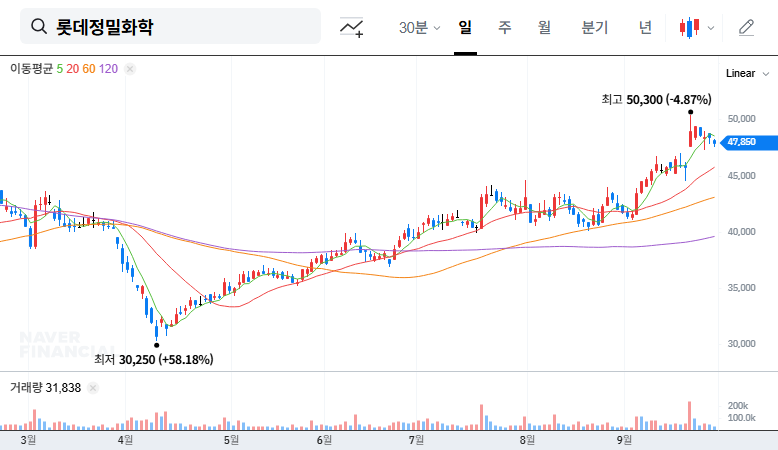
    LOTTE Fine Chemical Invests 127 Billion Won: Strengthening Green Materials Business with Hesellos Acquisition 대표 차트 이미지


    1. LOTTE Fine Chemical’s Hesellos Acquisition: What’s Happening?

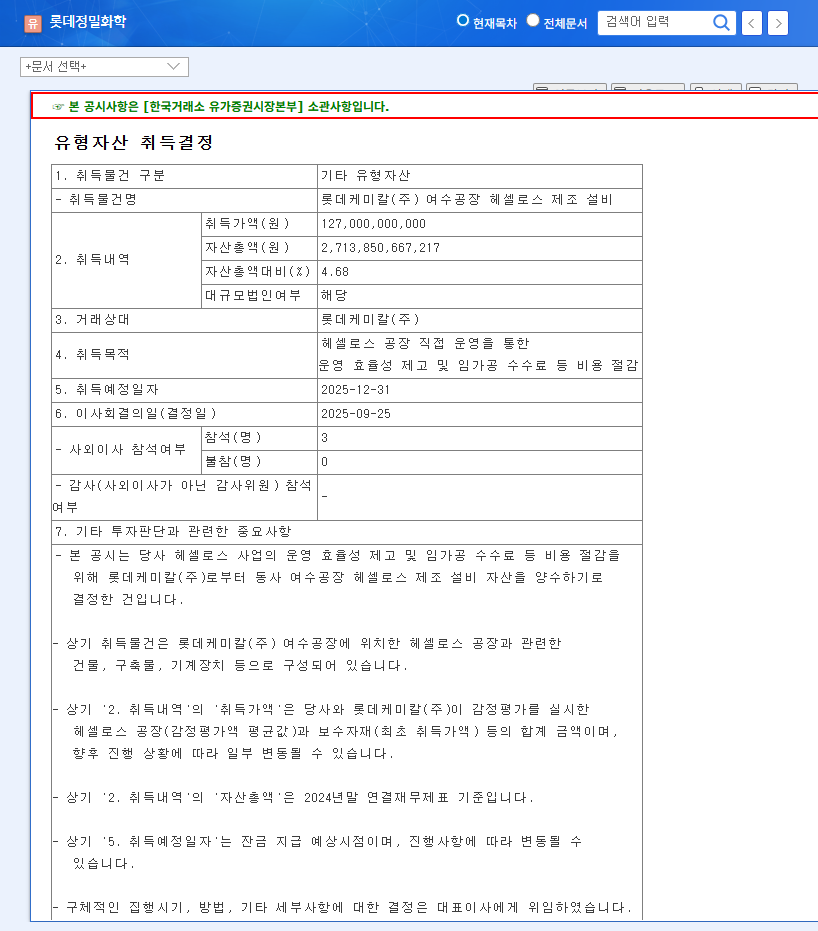
    LOTTE Fine Chemical will acquire LOTTE Chemical’s Yeosu plant Hesellos manufacturing facilities for 127 billion won by December 31, 2025. This represents 4.68% of LOTTE Fine Chemical’s assets and is a strategic investment to improve efficiency and reduce processing costs by directly operating the Hesellos plant.

    2. Why the Hesellos Acquisition?

    LOTTE Fine Chemical focuses on chemical and green materials businesses, and Hesellos is one of the key products in the green materials business. This acquisition aims to enhance production efficiency and cost competitiveness through vertical integration of the Hesellos business. LOTTE Fine Chemical’s operating profit slightly decreased in the first half of 2025 compared to the same period last year, and this investment is expected to improve profitability.

    3. Impact of the Acquisition on LOTTE Fine Chemical

    • Positive Impacts: Increased operating efficiency, cost reduction, strengthened competitiveness in the green materials business, synergy with LOTTE Chemical
    • Negative Impacts: Short-term liquidity burden, facility operation risks
    • Neutral Impacts: Macroeconomic variables such as exchange rates, interest rates, and raw material prices

    Overall, positive impacts are expected to outweigh negative ones in the long term. However, continuous monitoring of facility operation and market conditions after the acquisition is necessary.

    4. Investor Action Plan

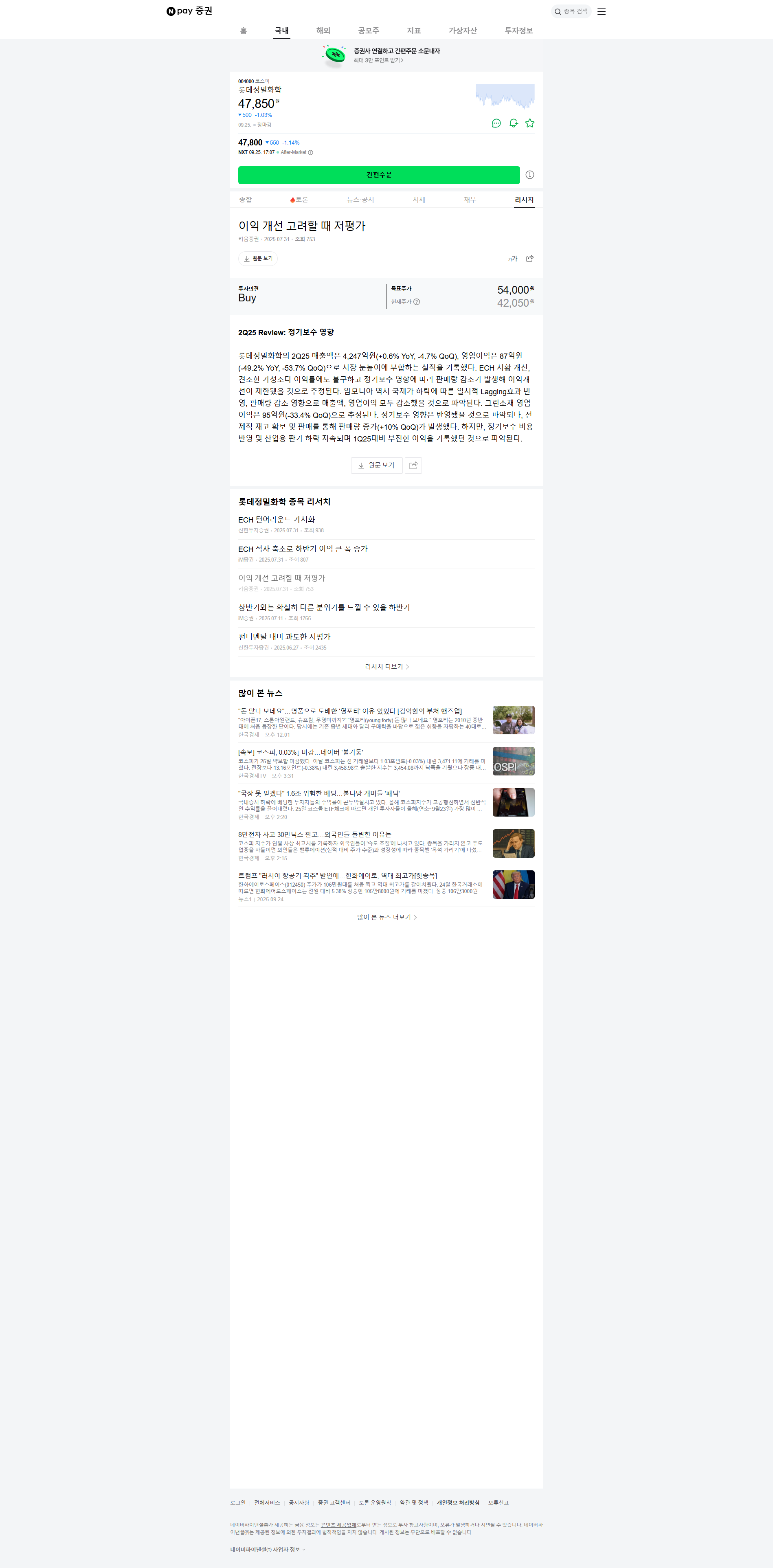
    Currently, no specific market expectations for this acquisition have been released. However, experts interpret it as a positive signal in the long term and recommend a ‘buy’ opinion. Investors should closely monitor the actual cost reduction effect, Hesellos business growth rate, and additional investment plans after the acquisition.


    Frequently Asked Questions

    What is Hesellos?

    Hesselos is one of the core products of LOTTE Fine Chemical’s green materials business.

    How will this investment affect LOTTE Fine Chemical’s stock price?

    It may not have a significant impact in the short term, but it is expected to have a positive impact in the long term.

    What are the key points to consider when investing?

    Investors should continuously monitor post-acquisition facility operating efficiency, Hesellos business growth rate, and macroeconomic variables.


    LOTTE Fine Chemical Invests 127 Billion Won: Strengthening Green Materials Business with Hesellos Acquisition 관련 이미지
    LOTTE Fine Chemical Invests 127 Billion Won: Strengthening Green Materials Business with Hesellos Acquisition 관련 이미지


  • Synoptics IR: Taking Off with Lotte Chemical’s Water Treatment Business Acquisition?

    1. Synoptics IR: What’s it about?

    Synoptics is holding an IR on August 19, 2025, to present its current business status and future growth strategies. The key focus is on strengthening its AMFS division and entering the medical device business through the Lotte Chemical water treatment business acquisition.

    2. Why is it important?

    This IR will be a crucial indicator of Synoptics’ future growth potential. Investor attention is expected to be particularly focused on whether a concrete roadmap for new business ventures will be presented. The growth potential of the AMFS division, coupled with the steady growth of the SE division, could be a catalyst for reevaluating Synoptics’ corporate value.

    3. Key IR Highlights and Investor Action Plan

    • Effects of Lotte Chemical Water Treatment Business Acquisition: Synergies, expected earnings contribution, future business expansion plans.
    • Global Market Entry Strategy for Medical Device Business: Certification preparation status, market entry roadmap.
    • SE Division Competitiveness Reinforcement Plan: Strategies for maintaining a competitive edge in the global market.
    • Financial Soundness Plan: Debt ratio management and profitability improvement measures.

    Carefully analyze the IR information. If you are confident in the management’s vision and strategy, consider active investment. However, it’s crucial to make prudent investment decisions based on a comprehensive assessment of market conditions and the company’s fundamentals.

    Frequently Asked Questions

    What are Synoptics’ main businesses?

    Synoptics’ business is primarily divided into the SE division (FPCB modules, etc.) and the AMFS division (filter products, etc.). The SE division has a high export ratio, while the AMFS division is domestically focused.

    How will the acquisition of Lotte Chemical’s water treatment business impact Synoptics?

    It is expected to contribute to strengthening the competitiveness of the AMFS division, internalizing filter technology, expanding global patents, and enhancing ESG management.

    What is the status of Synoptics’ medical device business entry?

    Synoptics is preparing for FDA, CE MDR, and US FDA certifications for hemodialyzers, CRRT devices, etc., and is exploring entry into the global market.

  • Lotte Holdings Q2 2025 Earnings Analysis: Below Expectations, but Future Growth Potential?

    1. Lotte Holdings Q2 2025 Performance: What Happened?

    Lotte Holdings reported consolidated revenue of KRW 40.43 trillion, operating profit of KRW 1.42 trillion, and a net loss of KRW 685 billion for Q2 2025. Revenue decreased by 5% compared to market expectations, operating profit fell by 16%, and the company swung to a net loss.

    2. Analyzing the Underperformance: Why These Results?

    • Lotte Shopping’s Struggles: Weak consumer sentiment and intensifying competition impacted Lotte Shopping’s department store and electronics retail segments, leading to a decline in operating profit.
    • Lotte Chemical’s Volatility: Fluctuations in international oil prices and concerns about a global economic slowdown increased the volatility of chemical product prices, affecting Lotte Chemical’s earnings.
    • Lotte Healthcare Termination: The failed investment in Lotte Healthcare resulted in a financial setback and created uncertainty regarding future strategic direction.
    • Overseas Market Risks and Legal Issues: Volatility in overseas store operations and costs related to legal issues, including the humidifier disinfectant case, further burdened the company.

    3. Positive & Negative Factors: What’s Next?

    Positive Factors

    • Stable Revenue Streams: Lotte Holdings benefits from stable revenue sources, including dividends from subsidiaries, trademark royalties, and rental income.
    • Diversified Portfolio: Its diversified business portfolio can help offset the negative impact of underperformance in specific industries.
    • Investments in Future Growth: R&D investments in future megatrends, such as hydrogen energy and battery materials, contribute to the company’s long-term growth potential.

    Negative Factors

    • High Debt Ratio: Rising interest rates could increase interest expenses and put pressure on financial performance.
    • New Business Investment Risk: The Lotte Healthcare case highlights the inherent risks associated with investments in new businesses.
    • Macroeconomic Uncertainty: The global economic slowdown, coupled with interest rate and exchange rate volatility, adds to the uncertain business environment.

    4. Action Plan for Investors: What to Do?

    • Monitor Lotte Shopping’s Turnaround Strategy: Closely watch the results of Lotte Shopping’s efforts to strengthen competitiveness and create synergies with online channels.
    • Observe Lotte Chemical’s Portfolio Shift: Pay attention to the progress of Lotte Chemical’s strategy to strengthen its high-value specialty business.
    • Assess Financial Health and Risk Management: Analyze Lotte Holdings’ debt management and its strategies to address interest rate and exchange rate risks.
    • Review New Business Investment Strategies: In light of the Lotte Healthcare termination, carefully scrutinize the company’s new business investment strategies and future investment direction.

    FAQ

    Q: What are the reasons for Lotte Holdings’ underperformance in Q2 2025?

    A: The poor performance was due to a combination of factors, including Lotte Shopping’s struggles, increased volatility in Lotte Chemical’s earnings, the termination of the Lotte Healthcare business, and overseas market risks and legal issues.

    Q: What are Lotte Holdings’ future growth drivers?

    A: The company is investing in R&D for future megatrends, such as hydrogen energy and battery materials, to secure long-term growth potential. Its diversified business portfolio and stable revenue streams are also positive factors.

    Q: What should investors consider when evaluating Lotte Holdings?

    A: Investors should consider the company’s high debt ratio, new business investment risks, and macroeconomic uncertainties. It’s also essential to monitor Lotte Shopping’s turnaround strategy, Lotte Chemical’s portfolio shift, and Lotte Holdings’ overall financial health and risk management approach.

  • Lotte Chemical H1 2025 Earnings Report Analysis: Key Insights for Investors

    1. Lotte Chemical’s H1 2025 Performance: What Happened?

    Lotte Chemical reported consolidated revenue of KRW 41.97 trillion in Q2 2025, a decrease year-over-year, with operating and net losses of KRW -2.448 trillion and KRW -4.712 trillion, respectively. These figures fell significantly short of market consensus.

    2. Reasons for the Weak Performance: Why Did This Happen?

    • Petrochemical Industry Downturn: The overall industry is facing challenges due to the global economic slowdown, weak demand from China, and declining prices for major products.
    • Volatility in Raw Material Prices: Despite falling crude oil prices, the volatility of naphtha and other key raw material prices continues to pressure profitability.
    • Slowing Downstream Demand: Weakening demand from downstream industries such as home appliances, IT, and automobiles has led to a decrease in demand for Lotte Chemical’s products.

    3. Lotte Chemical’s Future: What’s Next?

    • Positive Factors: Investments in new growth engines like hydrogen energy and battery materials, along with strengthened ESG management, are expected to be long-term growth drivers.
    • Negative Factors: Potential for further short-term earnings deterioration, high fixed costs, rising interest rates, and exchange rate fluctuations pose risks.

    4. Action Plan for Investors: How to Invest?

    Lotte Chemical is currently facing a challenging market environment. Investors should proceed with caution and closely monitor future earnings performance, progress in new growth businesses, stabilization of raw material prices and exchange rates. It’s crucial to invest with a long-term perspective, focusing on the company’s growth potential rather than short-term fluctuations.

    Frequently Asked Questions

    How did Lotte Chemical perform in the first half of 2025?

    Lotte Chemical reported weak performance in H1 2025 with consolidated revenue of KRW 41.97 trillion, operating loss of KRW -2.448 trillion, and net loss of KRW -4.712 trillion.

    What are the main reasons for the weak performance?

    The main reasons are attributed to the global economic slowdown, petrochemical industry downturn, declining product prices, raw material price volatility, and slowing downstream demand.

    What is the outlook for Lotte Chemical?

    While investments in new growth engines like hydrogen energy and battery materials, along with strengthened ESG management, are positive, short-term earnings uncertainty and macroeconomic volatility pose risks. A cautious investment approach is recommended.

  • Lotte Holdings Q2 2025 Earnings: A Surprise, But with Caveats

    1. Lotte Holdings Q2 2025 Performance: What Happened?

    Lotte Holdings reported consolidated revenue of KRW 40.43 trillion and operating profit of KRW 1.42 trillion, exceeding market forecasts. Operating profit soared by an impressive 689% year-on-year, fueled by Lotte Chemical’s battery materials business and solid performance from Lotte Chilsung and Lotte Wellfood. However, losses related to the termination of the Lotte Healthcare business led to a net loss of KRW 685 billion.

    2. Drivers of Growth and Underlying Risks: Why?

    The growth of Lotte Chemical’s battery materials division and a partial recovery in its basic materials business, combined with steady growth from Lotte Chilsung and Lotte Wellfood, were key drivers of the positive results. However, the continued struggles of Lotte Shopping’s discount store division and ongoing losses in e-commerce remain a drag on performance. The high debt-to-equity ratio of 111.24% is also a financial burden. Furthermore, volatility in raw material prices and the potential for a global economic slowdown represent key risks.

    • Positive Factors: Lotte Chemical’s new growth engines, stable growth of Lotte Chilsung/Wellfood
    • Negative Factors: Lotte Shopping’s struggles, high debt levels, macroeconomic uncertainty

    3. Outlook and Investment Strategy: What Now?

    Lotte Holdings’ future stock performance hinges on the success of Lotte Chemical’s new businesses, Lotte Shopping’s turnaround efforts, and the company’s ability to navigate macroeconomic challenges. Our current investment recommendation is ‘Neutral’. Given the mix of positive and negative factors, a cautious approach is warranted. Careful monitoring of key factors will be crucial for making informed investment decisions.

    4. Action Plan for Investors

    Investors should closely monitor the following:

    • Performance and market share gains of Lotte Chemical’s new businesses
    • Restructuring and earnings improvement at Lotte Shopping
    • Improvements in financial health and risk management capabilities
    • ESG performance and transparency
    • Response to macroeconomic factors (exchange rates, interest rates, oil prices)
    • Consistency of shareholder return policies and impact on shareholder value

    FAQ

    What were the key takeaways from Lotte Holdings’ Q2 2025 earnings?

    Lotte Holdings delivered a positive earnings surprise thanks to strong performance in Lotte Chemical’s battery materials business. However, the ongoing challenges at Lotte Shopping and high debt levels are still concerns.

    Should I invest in Lotte Holdings?

    Our current recommendation is ‘Neutral’. A balanced perspective is crucial, as both positive and negative factors are at play. Closely monitor Lotte Chemical’s new businesses, Lotte Shopping’s turnaround, and macroeconomic developments.

    What is the outlook for Lotte Holdings’ stock price?

    The stock’s trajectory will likely depend on the success of Lotte Chemical’s new investments, Lotte Shopping’s restructuring, and the company’s ability to manage macroeconomic headwinds.

  • Lotte Chemical H1 2025 Earnings Analysis: Deepening Crisis and Investment Strategy

    1. What Happened at Lotte Chemical?

    Lotte Chemical’s H1 2025 performance was poor across the board. Sales declined significantly year-over-year, and both operating and net income plunged into the red. The operating loss, in particular, deepened compared to the previous year and fell far short of market expectations. This continues the trend of losses that began in Q2 2024.

    2. Why is Lotte Chemical Struggling?

    The reasons behind this poor performance are multifaceted.

    • External Factors: Declining oil prices, a global economic slowdown, and escalating geopolitical risks have led to weaker petrochemical prices and shrinking demand.
    • Internal Factors: Struggles in the advanced materials business, increasing burdens from new business investments, and volatile raw material prices have exacerbated the decline in profitability. Large-scale investments in future growth engines, such as battery materials and hydrogen energy, have weighed on short-term profitability.

    3. What’s the Outlook for Lotte Chemical?

    If current conditions persist, Lotte Chemical’s recovery appears challenging. Continued operating losses and a widening net loss could further deteriorate its financial health. Rising debt-to-equity ratios and declining current ratios raise concerns about financial stability.

    4. What Should Investors Do?

    Investors should approach Lotte Chemical with extreme caution. A short-term recovery seems unlikely, and further deterioration in performance is possible. Investors should closely monitor upcoming earnings releases and any changes in management strategy. They should also pay close attention to external factors such as global economic recovery, easing of geopolitical risks, and stabilization of raw material prices.

    FAQ

    Q: What are the main reasons for Lotte Chemical’s poor H1 2025 performance?

    A: A combination of external factors like declining oil prices, global economic slowdown, and geopolitical risks, along with internal factors such as struggles in the advanced materials business and the burden of new investments.

    Q: What is the outlook for Lotte Chemical?

    A: Recovery seems challenging under current conditions, with the possibility of further losses and increased financial risks. A cautious investment approach is advised.

    Q: What should investors watch out for?

    A: Investors should monitor upcoming earnings, changes in management strategy, global economic recovery, geopolitical risks, and raw material price stabilization.

  • E1’s ₩678.2B LPG Deal with Lotte Chemical: Impact on Stock Price?

    E1 and Lotte Chemical Sign ₩678.2B LPG Deal: What Happened?

    On July 31, 2025, E1 announced a ₩678.2 billion LPG supply contract with Lotte Chemical. The contract period is 1 year and 8 months, from June 1, 2026, to January 31, 2028. This represents 6.06% of E1’s recent annual revenue and is expected to significantly impact E1’s future performance.

    How Will the Deal Impact E1’s Stock Price?

    Positive Factors:

    • • Increased Revenue and Profitability: Stable sales are expected to improve profitability.
    • • Enhanced Financial Stability: The large-scale contract will improve cash flow and strengthen the financial structure.
    • • Future Growth Momentum: The partnership with Lotte Chemical opens up future business expansion possibilities.

    Negative Factors:

    • • LPG Price Volatility: Actual profits may differ from projections depending on LPG price fluctuations.
    • • Cost Management: E1’s cost management capabilities will significantly influence profitability.

    Investment Strategy: Consider Key Variables

    Macroeconomic indicators such as oil prices, exchange rates, and interest rates significantly influence E1’s stock price. Rising oil prices tend to have a positive impact, while a strong Korean Won can have a negative impact. Therefore, carefully analyze these variables before making investment decisions.

    Action Plan for Investors

    Develop a long-term investment strategy rather than reacting to short-term stock price fluctuations. It’s crucial to carefully review the actual contract implementation and profit status through future quarterly reports and continuously monitor changes in macroeconomic indicators.

    What are the key details of the E1-Lotte Chemical LPG deal?

    It’s a contract to supply a total of ₩678.2 billion worth of LPG to Lotte Chemical for 1 year and 8 months, starting from June 2026 to January 2028.

    How will this contract affect E1’s stock price?

    It’s expected to positively impact sales growth and financial stability, but actual profits may vary depending on LPG price fluctuations and macroeconomic indicators.

    What precautions should investors take?

    Investors should continuously monitor changes in macroeconomic indicators such as oil prices, exchange rates, and interest rates, as well as E1’s cost management capabilities. Reviewing future quarterly reports to check contract implementation and profit status is also essential.

  • Lotte Chemical’s Critical August IR: A Rebound After Q1 Shock? (A Must-Read for Investors)

    What’s Happening? Lotte Chemical to Hold IR on August 12

    Lotte Chemical has officially announced it will hold a corporate briefing (IR) for investors at 9:00 AM on August 12, 2025. The session is expected to cover a general company overview, a review of Q1 performance, and an unveiling of future business strategies.

    Why Is It Important? A Dismal Q1, A Light at the End of the Tunnel?

    The significance of this IR is amplified by Lotte Chemical’s current predicament. The company posted a staggering ₩126.6 billion operating loss in Q1 2025, a sharp turn into the red. The primary causes were:

    • – Soaring Costs: Volatility in oil prices, exacerbated by the Russia-Ukraine war and US-China trade tensions, led to instability in the price of naphtha, a key raw material, increasing cost pressures.
    • – Weak Demand: Sustained high-interest rates and a delayed economic recovery in China significantly dampened demand from key downstream industries like home appliances, IT, and automotive.
    • – Geopolitical Risks: Persistent global supply chain disruptions and fears of a global recession have heightened uncertainty in the business environment.

    This IR will be the company’s first major test to dispel market concerns and rebuild trust after its worst quarterly performance in recent memory.

    So What? Two Scenarios That Will Dictate the Stock’s Trajectory

    The stock’s reaction will likely be starkly divided based on the IR’s content. Investors should prepare for the following two scenarios:

    The Bull Case: A Signal for a Rebound

    Positive investor sentiment and a potential stock rally could be triggered if the company presents:

    • ✅ A Concrete Recovery Strategy: A detailed roadmap and evidence showing how they will improve performance from Q2 onwards, through cost-cutting measures and a shift towards high-value-added products.
    • ✅ Visible Future Growth Engines: Clear progress updates and a compelling vision for new businesses like the Indonesia cracker project, hydrogen energy, and battery materials, reinforcing long-term growth potential.
    • ✅ Restored Trust Through Transparency: A frank admission of current difficulties, coupled with a demonstration of strong management commitment and a clear plan to overcome them.

    The Bear Case: Continued Uncertainty

    Conversely, a sell-off could ensue, increasing downward pressure on the stock if the following occurs:

    • ❌ Persistent Q2 Slump: An announcement that Q2 performance shows little to no improvement from Q1, or a bleak outlook for the coming months.
    • ❌ Vague, Generic Strategies: A presentation that relies on boilerplate statements without concrete action plans, or news of delays and scale-backs in new business initiatives.
    • ❌ Blaming External Factors: An attitude that attributes poor performance solely to external factors like geopolitics and the global economy, suggesting a lack of internal drive for innovation and reform.

    Investor Action Plan: What to Check Before and After the IR

    Successful investing requires more than just listening to the presentation. A comprehensive judgment should be based on checking the following:

    1. Confirm Q2 Earnings: The Q2 results, likely to be released before the IR, are the most critical barometer. Check whether it’s an earnings surprise or an earnings shock compared to the market consensus.
    2. Analyze Brokerage Reports: Compare reports from various securities firms to get an objective view of market expectations and concerns regarding Lotte Chemical.
    3. Track Competitors: Assess Lotte Chemical’s relative competitiveness by comparing its performance and strategy with domestic and international peers like LG Chem and Kumho Petrochemical.
    4. Monitor Macro Indicators: Continuously track key macroeconomic indicators that directly impact earnings, such as naphtha prices, crude oil prices, and currency exchange rates.

    In conclusion, Lotte Chemical’s August IR is a pivotal event that will shape its future corporate value and stock direction. Investors should critically evaluate the company’s strategy and crisis-management capabilities presented at the IR and cross-verify the information with relevant data to make informed investment decisions.

    Q1. When and why is Lotte Chemical holding this IR?

    A. It will be held at 9:00 AM on August 12, 2025. Following a significant Q1 operating loss, the event aims to explain the company’s current situation, share future strategies, and thereby alleviate investor concerns and rebuild trust.

    Q2. What were the main reasons for Lotte Chemical’s poor Q1 performance?

    A. There were three main factors. First, volatile oil prices increased the burden of raw material costs. Second, a global economic slowdown reduced demand for its products from key downstream industries like automotive and electronics. Third, geopolitical risks like the US-China trade conflict disrupted supply chains.

    Q3. What needs to be announced at the IR for Lotte Chemical’s stock to rise?

    A. The company needs to present concrete evidence of improved Q2 results or a clear and credible plan for a significant earnings recovery. Additionally, providing a clear vision and progress update on new growth engines—such as the Indonesia cracker, hydrogen energy, and battery materials—is crucial to boost long-term growth expectations.

    Q4. What are Lotte Chemical’s key new business ventures?

    A. Lotte Chemical is diversifying its portfolio towards eco-friendly and specialty materials. Key initiatives include the large-scale cracker project in Indonesia (LINE Project), PET recycling, battery materials for EVs, and hydrogen energy, a future clean energy source.