Tag: Loss

  • (046070) Kodaco Delisting (046070): A Complete Guide for Shareholders

    (046070) Kodaco Delisting (046070): A Complete Guide for Shareholders

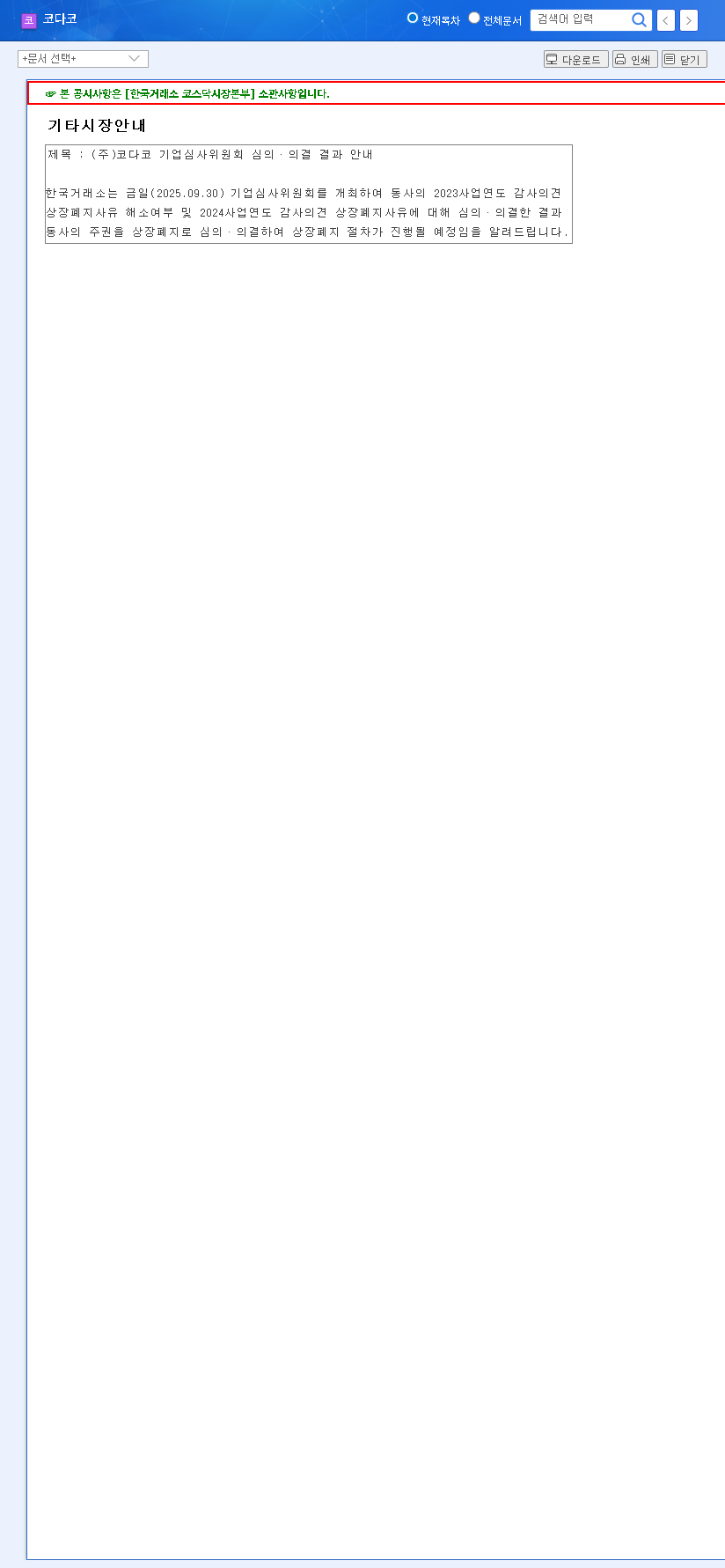
    The news investors feared is now official: the Kodaco delisting has been formally confirmed. On September 30, 2025, the Korea Exchange announced its final resolution to delist all shares of Kodaco (046070), a decision that has sent shockwaves through its shareholder community. For anyone holding this stock, this event represents a critical moment that could potentially lead to a significant or total loss of investment capital. This comprehensive guide will break down the entire situation, from the underlying causes to the actionable steps you must consider to protect your assets.

    This situation underscores the inherent risks in equity markets, particularly with companies facing financial distress. We will explore the timeline, the financial red flags that led to this point, and provide a clear framework for shareholder response strategies.

    The Official Announcement: Kodaco’s Delisting Confirmed

    The final decision was made public on September 30, 2025, when the Korea Exchange’s Corporate Review Committee concluded its review of Kodaco (046070). The committee determined that the company had not only failed to resolve the delisting grounds from its 2023 audit but had also incurred new grounds for delisting based on its 2024 audit. The official filing can be viewed directly on the DART system (Official Disclosure). Trading of Kodaco stock had already been suspended since March 21, 2025, following a disclaimer of audit opinion and the ongoing rehabilitation procedures, but this final decision seals its fate on the public exchange.

    A ‘disclaimer of opinion’ from an auditor is one of the most severe red flags for a publicly traded company. It means the auditor could not obtain sufficient evidence to form an opinion on the financial statements, indicating fundamental issues with the company’s financial records or viability.

    Core Reasons Behind the Kodaco Delisting

    The delisting wasn’t a sudden event but the culmination of prolonged financial and operational struggles. Understanding these root causes is crucial for any investor.

    1. Catastrophic Financial Instability

    At the heart of the Kodaco delisting was its precarious financial health. Despite entering a rehabilitation plan, the company failed to meet its obligations. Key indicators included:

    • Massive Debt Burden: The company’s consolidated debt-to-equity ratio reached an astronomical 1,643.46%. This signifies that its debts were over 16 times greater than its shareholder equity, a completely unsustainable level.
    • Failed Rehabilitation: Delays in repaying rehabilitation claims created severe doubts about its ability to continue as a ‘going concern’—a foundational accounting principle. You can learn more about this concept from authoritative sources like Investopedia.
    • Unsuccessful Fundraising: Efforts to raise capital through subsidiary sales and debt refinancing ultimately failed, leaving the company without the necessary cash flow to survive.

    2. Business Limitations & Market Headwinds

    While Kodaco’s core business in aluminum die-casting for automotive parts had stable sales, it wasn’t enough to overcome its financial woes. Attempts to pivot to higher-growth areas like EV and hybrid vehicle components did not gain traction. This was compounded by a harsh external environment, including a rising USD/KRW exchange rate, high interest rates, and soaring raw material costs, which further squeezed its already thin margins.

    Impact on Shareholders & What to Do Now

    For investors, a stock delisting is often the worst-case scenario. The termination of exchange trading means a complete loss of liquidity, making it nearly impossible to sell shares. The value of the stock will likely fall to zero. Given this irreversible decision, shareholders must act decisively.

    • Assess the Delisting Trading Period: The exchange typically provides a brief period for 정리매매 (delisting trading) before the stock is fully removed. This is a highly volatile, last-chance window to sell shares, often at a steep loss. Evaluate if cutting losses here is the best path.
    • Monitor for Liquidation Value: After delisting, if the company is liquidated, shareholders are last in line to receive any remaining assets after all creditors are paid. In cases of such high debt, the chance of recovering any residual value is extremely slim, but it’s a possibility to monitor.
    • Learn and Adapt Your Strategy: Use the painful lesson from the Kodaco delisting to improve your investment process. For more information, read our internal guide on how to analyze a company’s financial health before investing.

    Frequently Asked Questions

    Q1: Is the Kodaco delisting decision final?

    A1: Yes, the decision made on September 30, 2025, by the Korea Exchange’s Corporate Review Committee is the final resolution to delist the shares from the public market.

    Q2: What was the single biggest reason for the delisting?

    A2: The primary trigger was the ‘disclaimer of opinion’ from auditors for consecutive years, stemming from the company’s severe financial distress, failed rehabilitation, and inability to prove its viability as a going concern.

    Q3: Do my delisted Kodaco shares have any value?

    A3: Once delisted, the shares lose their market liquidity and, in most cases, their investment value converges to zero. There is a very remote chance of recovering a small fraction of value if the company is liquidated and has assets remaining after paying all debts, but this is highly unlikely.

    Q4: What’s the key lesson for investors from this case?

    A4: This case is a stark reminder to always conduct thorough due diligence. Pay close attention to audit reports, debt-to-equity ratios, and any mention of ‘going concern’ doubts. These are not minor details; they are critical indicators of a company’s survival risk.
    (046070) Kodaco Delisting (046070): A Complete Guide for Shareholders 관련 이미지
  • SYSWOK Delisting Confirmed: Impact on Investors and Response Strategies


    SYSWOK Delisting Confirmed: Impact on Investors and Response Strategies 대표 차트 이미지


    SYSWOK Delisting: What Happened?

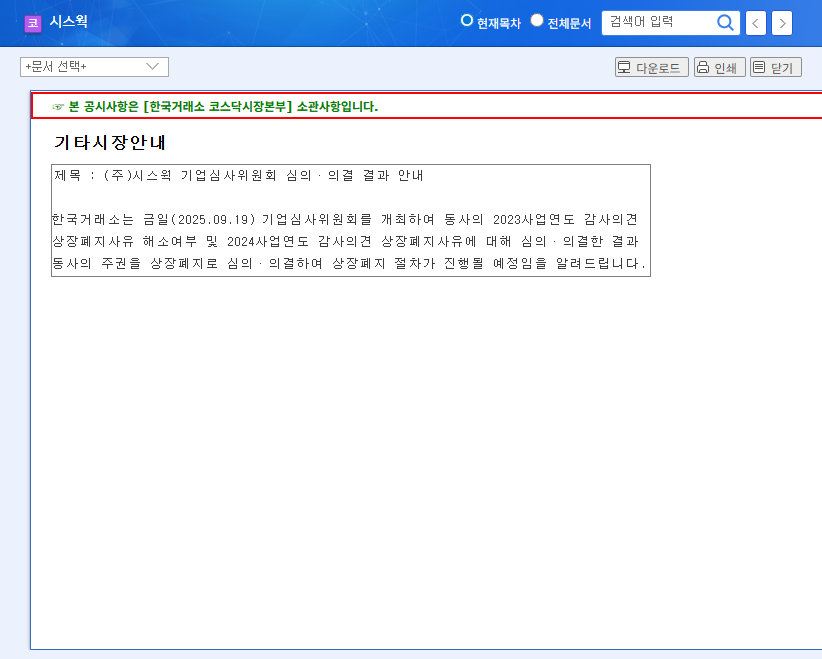
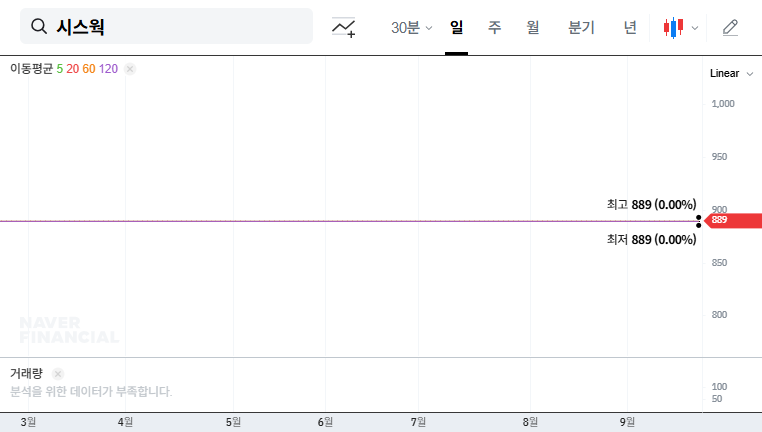
    The Korea Exchange made the final decision to delist SYSWOK on September 19, 2025, after a meeting of the Corporate Review Committee. The disclaimer of opinion on the 2023 and 2024 financial statements was the decisive factor.

    Underlying Causes of Delisting

    • Deteriorating Financial Status: SYSWOK is in a state of complete capital impairment (-20.587 billion KRW) and the disclaimer of opinion since 2021 has eroded market confidence in its financial soundness.
    • Failed Rehabilitation Proceedings: Since the commencement of rehabilitation proceedings in 2024, SYSWOK has experienced instability including failed M&A attempts, cancellation and re-application of the rehabilitation process.
    • Weakening Business Competitiveness: A sharp decline in sales (52% year-on-year decrease) due to a slowdown in semiconductor and display industry investments and sluggish performance in core businesses exacerbated the situation.

    Market Impact

    • Increased Investor Losses: Trading of SYSWOK shares has been completely halted, making it difficult for investors to recover their funds. While already suspended, the delisting confirms significant losses for investors.
    • Negative Impact on Similar Companies: SYSWOK’s case is expected to further dampen investor sentiment towards other financially troubled companies, particularly those undergoing rehabilitation proceedings or facing disclaimers of opinion.

    Action Plan for Investors

    Investment in SYSWOK offers minimal chance of recovery, so further investment should be avoided. Existing investors should seek legal advice to explore options for minimizing losses.


    Frequently Asked Questions

    Are SYSWOK shares now worthless?

    With the delisting confirmed, trading on the regular market is impossible. While there might be a chance for partial recovery through a liquidation process, significant losses are inevitable.

    Is there any possibility of SYSWOK being relisted?

    Given SYSWOK’s current situation, relisting is highly unlikely. The company’s fundamentals are severely damaged, making recovery and normalization improbable.

    Is there any way to recover my investment?

    Investors can attempt to sell their shares during the liquidation period or pursue legal action for damages. However, the recoverable amount is expected to be very limited.


    SYSWOK Delisting Confirmed: Impact on Investors and Response Strategies 관련 이미지


  • Shinseong Tongsang Delisting: Urgent Action Plan for Investors

    Shinseong Tongsang Delisting: Urgent Action Plan for Investors 대표 차트 이미지

    What Happened? Delisting Application Explained

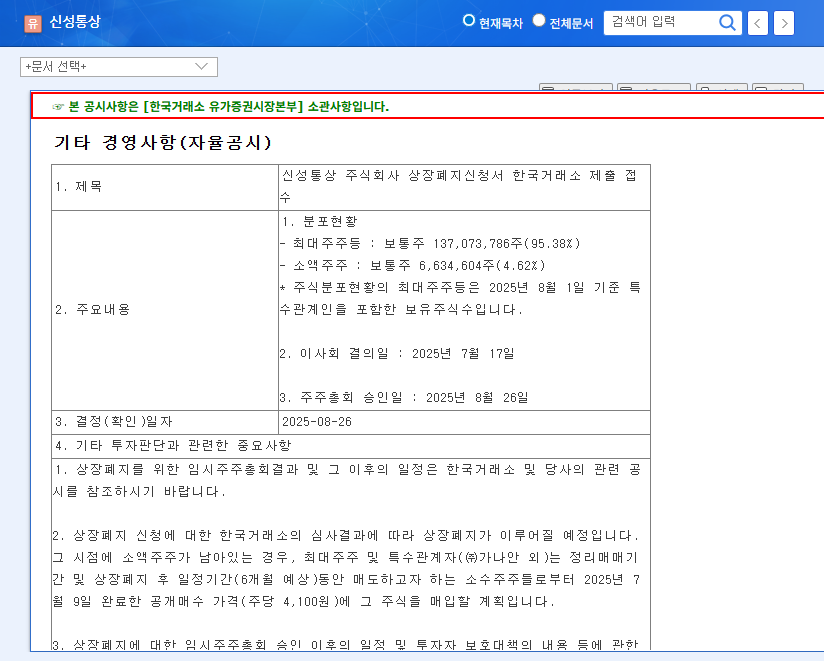
    Shinseong Tongsang submitted a delisting application via a voluntary disclosure. The application has been approved by the board of directors and a temporary shareholders’ meeting. The final decision rests with the Korea Exchange.

    Why the Delisting? Analyzing the Reasons

    While official reasons are yet to be disclosed, the company’s poor performance in Q1 2025 likely played a significant role. Despite a slight increase in revenue, operating profit and net income declined substantially due to increased SG&A and financial expenses. Cost savings from delisting and consolidating management control are also speculated motives.

    What’s Next? Investor Impact and Outlook

    Delisting will halt trading, significantly reduce liquidity, and inevitably lead to a decline in investment value. The tender offer price of 4,100 won per share may result in losses for minority shareholders. Concerns regarding management transparency and further decline in corporate value also exist. Current macroeconomic conditions, such as the weakening Korean Won, high interest rates, and fluctuating raw material prices, further exacerbate the negative outlook.

    What Should Investors Do? Action Plan

    Current shareholders should consider selling their shares immediately to mitigate potential losses. Closely monitor announcements from the Korea Exchange regarding the review process and minority shareholder protection measures. New investments in Shinseong Tongsang are strongly discouraged.

    When will the delisting be finalized?

    The Korea Exchange will review the application. The exact date will be announced through official disclosures.

    Is the tender offer price of 4,100 won fair?

    Compared to historical stock prices, the offer price seems low and may result in losses for minority shareholders.

    What happens to my shares after delisting?

    Trading will halt, making selling on the exchange impossible. Shareholders can participate in the tender offer or seek over-the-counter transactions.

    Shinseong Tongsang Delisting: Urgent Action Plan for Investors 관련 이미지
    Shinseong Tongsang Delisting: Urgent Action Plan for Investors 관련 이미지
  • Hanse MK Forecasts 216 Billion Won Loss: Investor Alert – 2024 Earnings Analysis and Outlook

    1. What Happened? : Hanse MK’s 216 Billion Won Loss Forecast

    Hanse MK announced a projected operating loss of 216 billion won for 2024, with projected revenue of 256.3 billion won. This comes as a significant blow to the market, especially after the company already recorded a 15.3 billion won operating loss in the first half of 2025, indicating a further widening of the loss.

    2. Why is this Happening? : Analyzing the Root Causes of the Decline

    Hanse MK’s declining performance is attributed to a combination of factors, including discontinued brands, a deteriorating market environment, inventory valuation losses, and increased marketing and administrative expenses. In particular, the decline in inventory management efficiency and continuous net losses raise serious concerns about capital erosion. The increasing debt burden from issuing private placement bonds and convertible bonds is also worsening the company’s financial health.

    3. What’s Next? : Market Impact and Future Outlook

    This announcement is likely to put downward pressure on the stock price in the short term. In addition to dampened investor sentiment, indirect impacts such as a decline in corporate credibility, difficulties in raising capital, and intensified competition are also concerns. In the medium to long term, the success of the brand portfolio restructuring and overseas market entry strategies will be key. However, considering the current financial state and poor performance, the possibility of a turnaround remains uncertain. Fluctuations in exchange rates and raw material prices could also pose challenges.

    4. What Should Investors Do? : Action Plan

    Investing in Hanse MK currently carries a high level of risk. Investors should closely monitor the specifics and outcomes of the company’s turnaround strategy, efforts to improve its financial status, and changes in the market environment. It is crucial to make cautious investment decisions from a long-term perspective, without being swayed by short-term stock price fluctuations.

    Q: What is Hanse MK’s 2024 earnings forecast?

    A: Hanse MK projects a loss of 216 billion won for 2024, with revenue estimated at 256.3 billion won.

    Q: What is the outlook for Hanse MK’s stock price?

    A: The recent announcement of the projected loss is expected to put downward pressure on the stock price in the short term. The medium to long-term outlook remains uncertain, depending on the success of the turnaround strategy.

    Q: Is it advisable to invest in Hanse MK?

    A: Investing in Hanse MK currently carries significant risk. Investors considering Hanse MK should carefully monitor the company’s turnaround strategy, financial improvement efforts, and market conditions.

  • KC Cottrell Q2 2025 Earnings Analysis: Deepening Losses Under Workouts, What Should Investors Do?

    1. KC Cottrell’s Q2 2025 Performance: What Happened?

    KC Cottrell reported revenue of ₩53 billion, an operating loss of ₩400 million, and a net loss of ₩8.6 billion in Q2 2025. While revenue saw a marginal increase year-over-year, profitability deteriorated significantly.

    2. Why These Results?

    The company’s struggles are primarily attributed to ongoing workout procedures, a deteriorating financial structure, and a disclaimer of opinion from its auditor. Despite implementing a corporate restructuring plan, high debt levels and potential capital impairment remain significant concerns. The auditor’s disclaimer further casts doubt on the reliability of the company’s financial reporting.

    3. What’s Next? – Short-Term and Long-Term Outlook

    • Short-term outlook: The progress of the workout procedures and corporate restructuring plan will be crucial. Resolving the auditor’s concerns and recovering outstanding receivables are key to any potential short-term improvement.
    • Long-term outlook: Success in overseas markets and new business ventures will be essential for long-term growth. However, addressing the underlying financial issues is paramount for sustainable recovery.

    4. Investor Action Plan

    Investing in KC Cottrell carries significant risk. Investors should carefully monitor the company’s financial health, the progress of the workout procedures, and the auditor’s opinion before making any investment decisions. A long-term perspective focused on fundamental value is crucial, avoiding impulsive reactions to short-term market fluctuations.

    Frequently Asked Questions

    Why did KC Cottrell file for workout procedures?

    KC Cottrell filed for workout procedures in September 2024 due to continuous operating losses and a deteriorating financial structure.

    Is KC Cottrell stock a good investment now?

    Investing in KC Cottrell carries substantial risk. Thorough due diligence on the company’s financials and workout progress is essential before considering any investment.

    Does KC Cottrell have a chance of recovery?

    The success of the workout procedures and the implementation of the corporate restructuring plan are critical factors in determining KC Cottrell’s chances of recovery. The current outlook remains highly uncertain.

  • Ecobio Holdings (038870) H1 2025 Earnings Report Analysis: Profitability, Risks, and Investment Strategies

    1. Ecobio Holdings H1 2025 Performance: What Happened?

    Ecobio Holdings recorded KRW 4.6 billion in revenue and KRW 200 million in operating profit for H1 2025, marking a turnaround from the previous year. However, the company reported a net loss of KRW 600 million.

    2. Profitability and Persistent Losses: Understanding the Paradox

    The positive operating profit stems from growth in the renewable energy sector. However, losses from investments in affiliates and increased operating expenses contributed to the net loss. Rising debt and interest expenses also pose challenges.

    3. Ecobio Holdings’ Future: Opportunities and Threats

    3.1. Positive Factors

    • Growth potential in renewable energy and hydrogen businesses
    • Expansion possibilities in the bio-sulfur sector
    • Synergy expected from AI integration

    3.2. Negative Factors

    • Continued net loss
    • Financial burden due to increasing debt
    • Risks associated with early-stage new businesses

    4. Action Plan for Investors

    Consider the following points when evaluating Ecobio Holdings as an investment:

    • Focus on long-term growth strategies rather than short-term results
    • Assess the company’s efforts to improve financial health and the performance of new businesses
    • Analyze the potential impact of macroeconomic factors (interest rates, exchange rates, oil prices)

    Continuous monitoring is crucial to minimize investment risks and make informed investment decisions.

    Frequently Asked Questions

    What are Ecobio Holdings’ main businesses?

    Ecobio Holdings operates in biogas-based renewable energy, bio-sulfur, and AI-driven businesses.

    What are the key takeaways from the H1 2025 earnings report?

    While the company achieved a turnaround with KRW 4.6 billion in revenue and KRW 200 million in operating profit, it reported a net loss of KRW 600 million.

    What should investors consider when evaluating Ecobio Holdings?

    Investors should carefully analyze the company’s financial health, the performance of its new ventures, and the potential impact of macroeconomic changes.

  • iCure’s H1 2025 Earnings Shock: Investor Alert! 📉

    1. What Happened at iCure?

    iCure achieved sales of 25.2 billion KRW in H1 2025 but reported an operating loss of 4.4 billion KRW and a net loss of 9.8 billion KRW, failing to escape the red. Although sales exceeded market expectations of 0 KRW, the deteriorating profitability is a serious concern.

    2. Why These Results?

    iCure’s poor performance is primarily attributed to increased costs due to R&D investment in the pharmaceutical business and intensified competition in the cosmetics market. The high-interest rate environment is also adding to the financial burden. Despite a temporary return to profitability in Q3 2024, the company has consistently recorded losses, highlighting the urgent need for profitability improvement.

    3. What’s Next for iCure?

    iCure’s future stock price hinges on its ability to improve profitability. The company must enhance R&D investment efficiency, achieve success with new pipelines, and strengthen its competitiveness in the cosmetics business to restore its profit-generating capacity. Improving financial structure and regaining investor trust are also crucial tasks.

    4. What Should Investors Do?

    Investors should closely monitor iCure’s future IR activities and earnings announcements, carefully assessing the possibility of a real turnaround. Currently, the investment risk is very high, requiring a cautious approach.

    What were iCure’s sales in H1 2025?

    25.2 billion KRW.

    What was iCure’s operating income in H1 2025?

    -4.4 billion KRW.

    What are iCure’s main businesses?

    Pharmaceuticals and cosmetics based on TDDS (Transdermal Drug Delivery System) technology.

    What are the reasons for iCure’s poor performance?

    Increased costs due to R&D investment and intensified competition in the cosmetics market, as well as the high-interest rate environment.

  • Jasco Holdings (023440) Q2 2025 Earnings Analysis: Revenue Growth Overshadowed by Continuing Losses

    1. What Happened at Jasco Holdings?

    Jasco Holdings reported KRW 10.6 billion in revenue for Q2 2025, surpassing the expected KRW 0. However, the company recorded an operating loss of KRW 3 billion and a net loss of KRW 7 billion.

    2. Why Did This Happen?

    Despite the revenue increase, profitability suffered due to rising costs. Increased raw material prices, selling, general and administrative expenses, and financial costs offset the revenue gains. This suggests internal cost management challenges amidst a difficult operating environment. High interest rates, unfavorable exchange rates, and a weak steel industry also negatively impacted the company’s bottom line.

    3. What are the Implications?

    Continued losses could worsen the company’s financial structure and deepen capital erosion. This increases the need for external funding, which may be challenging given the current weak financial position. With ongoing ‘going concern’ uncertainties, this earnings report could negatively impact investor sentiment and put downward pressure on the stock price.

    4. What Should Investors Do?

    • Monitor Profitability: Closely watch for signs of cost reduction and improvements in profitability.
    • Analyze Funding Plans: Carefully evaluate the feasibility of any funding plans and their potential impact on shareholder value.
    • Assess Industry Environment: Analyze the company’s competitive position and survival strategy in the challenging steel industry.
    • Evaluate Management Transparency: Continuously monitor management’s transparency and accountability.

    Frequently Asked Questions

    What was Jasco Holdings’ revenue for Q2 2025?

    Jasco Holdings reported KRW 10.6 billion in revenue, surpassing the expected KRW 0.

    What about the operating and net income?

    The company reported an operating loss of KRW 3 billion and a net loss of KRW 7 billion.

    What are the reasons for the losses?

    Despite revenue growth, increased raw material prices, SG&A expenses, and financial costs led to declining profitability. High interest rates, unfavorable exchange rates, and a weak steel industry also contributed.

    What should investors consider?

    Investors should consider profitability improvements, funding plans, industry environment, and management transparency. The ‘going concern’ uncertainty is also a significant risk factor.

  • Daelim Trading (006570) Crisis: Continuous Losses in H1 2025, What Should Investors Do?

    1. What Happened?: Daelim Trading’s H1 2025 Performance Analysis

    Daelim Trading recorded sales of KRW 30.5 billion, an operating loss of KRW 2.6 billion, and a net loss of KRW 4.3 billion in the first half of 2025. Compared to the same period last year, sales decreased, operating losses expanded, and net losses deepened, indicating serious management difficulties. In particular, the sharp decline in sales and substantial losses in the ‘Other’ segment suggest the possibility of business restructuring.

    2. Why Did This Happen?: Analysis of the Causes of the Decline in Performance

    Daelim Trading’s deteriorating performance is the result of a combination of internal and external factors. Internally, the decline in faucet prices in the building materials business, the continued burden of raw material costs and labor costs in the tableware segment, and poor performance in other businesses are the main causes. Externally, unfavorable market conditions such as the global economic slowdown, weakened consumer sentiment, high interest rates, and rising raw material prices negatively impacted performance.

    3. So What Happens Next?: Future Outlook and Investment Strategy

    The short-term outlook for Daelim Trading’s performance improvement is not bright. Continued losses, liquidity shortages, and increasing financial burdens could threaten the company’s survival. However, there is a possibility of overcoming the crisis through aggressive cost reduction, efforts to improve profitability, and the development of new growth engines. Investors should closely monitor the company’s self-rescue efforts and market conditions and make prudent investment decisions.

    4. Investor Action Plan

    • Short-term investors: A cautious approach is necessary. Lack of rebound momentum and high risk. Confirmation of financial restructuring and performance improvement is essential.
    • Long-term investors: Monitor the company’s business restructuring and the securing of new growth engines. Consider the possibility of recovery from a long-term perspective.
    • All investors: Continuous monitoring of public disclosures and market conditions is essential. Investment should be made at your own discretion and responsibility.

    Frequently Asked Questions

    What are Daelim Trading’s main businesses?

    Daelim Trading is engaged in the manufacturing and sales of building materials (such as faucets) and tableware. As of H1 2025, the building materials business accounts for approximately 80% of sales.

    Why did Daelim Trading’s H1 2025 performance decline?

    A combination of external factors such as the economic slowdown, weakened consumer sentiment, rising raw material prices, and high interest rates, along with internal factors such as declining faucet prices and increased cost burdens, contributed to the decline.

    Should I invest in Daelim Trading?

    Daelim Trading is currently facing difficulties. Investment decisions should be made at the investor’s own discretion and responsibility, and it is important to carefully analyze the company’s financial situation and market environment before investing.

  • NEWON (123840) H1 2025 Earnings Analysis: Soaring Sales Mask Underlying Risks

    1. What Happened?: NEWON’s H1 2025 Performance Breakdown

    NEWON reported revenue of KRW 23.27 billion in H1 2025, a significant increase year-over-year. However, operating income swung to a loss of KRW -9.22 billion, with a net loss of KRW -10.16 billion. Despite strong sales growth in the health functional food and household goods segments, weak performance in the specialized machinery business and high selling, general, and administrative expenses (SG&A) eroded profitability.

    2. Why is this Happening?: Six Years of Losses and a Precarious Financial Position

    NEWON has recorded operating losses for six consecutive years and faces serious financial challenges, including excess current liabilities exceeding KRW 180 billion and accumulated losses of over KRW 130 billion. The high SG&A ratio (104.7%) further complicates profitability improvements. Concerns about the company’s ability to continue as a going concern are mounting.

    3. What to Do Now?: Action Plan for Investors

    In the short term, investors should exercise extreme caution with NEWON. Without improvements in the operating loss structure, financial difficulties are likely to persist. In the medium to long term, close monitoring of performance improvements in the machinery business, profitability in the health food/household goods segment, and normalization of the financial structure is crucial. Pay close attention to the Q3 earnings release and the execution of specific business plans. Currently, the investment risk is very high, requiring careful consideration before making any investment decisions.

    Frequently Asked Questions (FAQ)

    What are NEWON’s main businesses?

    NEWON operates in specialized machinery (vacuum deposition equipment), health functional foods, and household goods.

    How did NEWON perform in H1 2025?

    While revenue increased significantly year-over-year, operating income turned negative, and the financial situation deteriorated.

    Should I invest in NEWON?

    Currently, the investment risk is very high. Careful consideration is advised before making any investment decisions.