Tag: Lead-Acid Battery

  • (004490) SEBANG GLOBAL BATTERY IR (2025): A Deep Dive for Investors | EV Strategy & Analysis

    (004490) SEBANG GLOBAL BATTERY IR (2025): A Deep Dive for Investors | EV Strategy & Analysis

    SEBANG GLOBAL BATTERY IR Event: A Pivotal Moment for Investors

    The upcoming SEBANG GLOBAL BATTERY IR event, scheduled for November 6, 2025, represents a critical juncture for the company and its investors. As a dominant force in the lead-acid battery market, Sebang is navigating a complex transition towards the high-growth electric vehicle (EV) sector. This investor relations event is more than a simple earnings call; it’s a window into the company’s future, offering crucial insights into its Q3 performance, strategic direction, and readiness to tackle macroeconomic headwinds. For those conducting a thorough Sebang investment analysis, this event will be the ultimate test of the company’s long-term vision and execution capability.

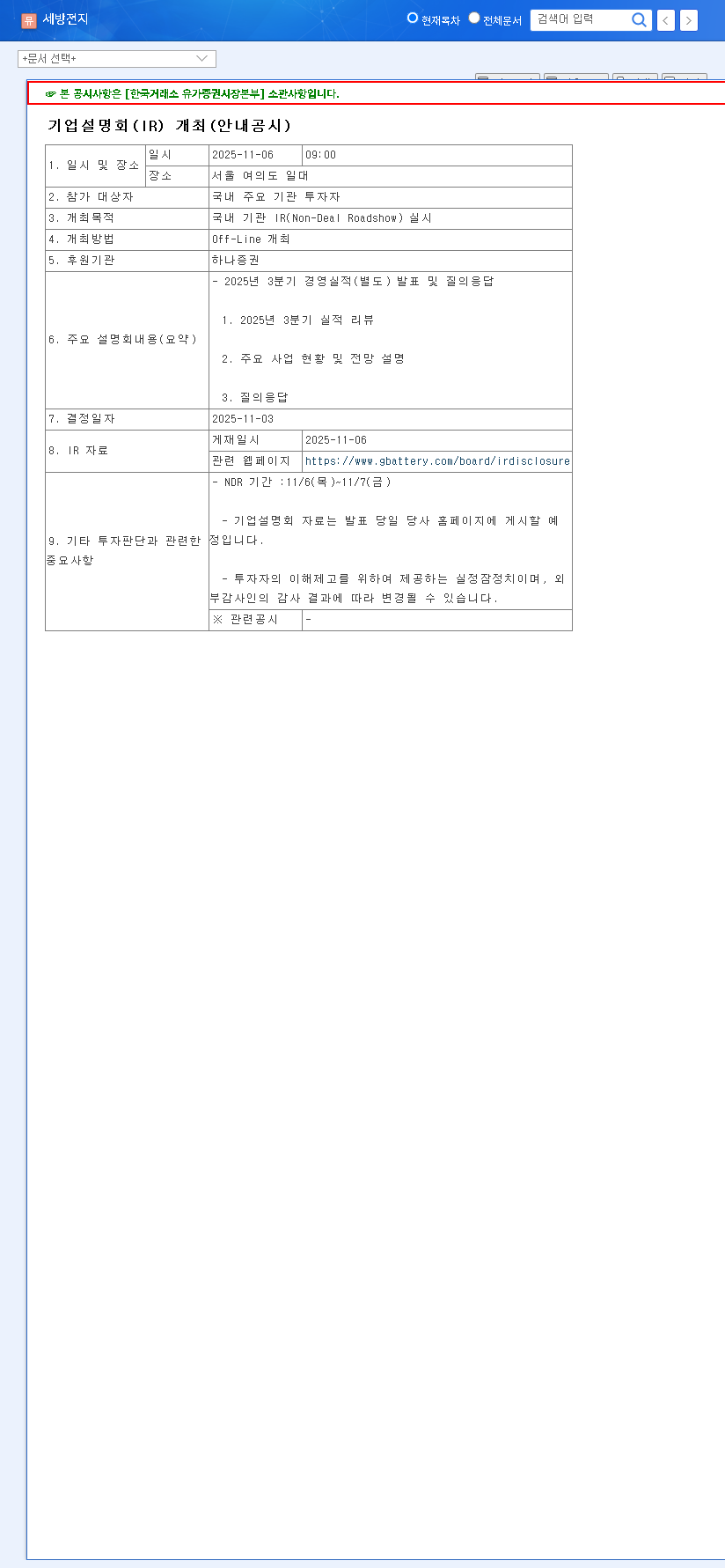
    The event, targeting domestic institutional investors, will commence at 9:00 AM and cover Q3 2025 performance, a comprehensive business outlook, and an interactive Q&A session. Key details have been outlined in their Official Disclosure filed with DART.

    Current Financial Health: A Tale of Growth and Pressure

    A review of Sebang’s H1 2025 performance reveals a classic dilemma: impressive top-line growth coupled with shrinking profitability. While sales surged by 9.4% to KRW 1.078 trillion, driven by strong demand for both conventional and new battery products, operating profit fell by 17.4%. This highlights the intense pressure from external factors that investors must scrutinize during the SEBANG GLOBAL BATTERY IR.

    Key Strengths to Consider

    • Robust Sales Momentum: Continued growth in core vehicle lead-acid batteries and emerging power auxiliary packs signals strong market demand.
    • Market Leadership: Unwavering dominance in the domestic lead-acid battery market provides a stable revenue foundation.
    • Future-Forward Investment: Ongoing R&D and facility investments demonstrate a commitment to innovation and scaling the Sebang EV battery strategy.

    Significant Challenges and Risks

    • Profitability Squeeze: The decline in operating profit, attributed to US tariffs and currency fluctuations, is a primary concern.
    • High Dependency on Legacy Products: With lead-acid batteries still forming 85% of sales, the pressure is on the EV segment to accelerate growth.
    • Financial Leverage: A relatively high debt-to-equity ratio (230.13%) could limit financial flexibility in a volatile market. For more on this, read our guide to analyzing corporate debt.

    The core question for investors is whether Sebang can successfully leverage its established manufacturing prowess to build a profitable, large-scale EV battery business that can offset the margin pressures in its legacy operations.

    Navigating External Economic Volatility

    As a major exporter, Sebang’s performance is intrinsically linked to global macroeconomic trends. The company’s strategy for mitigating these risks will be a focal point of the IR presentation.

    • Currency Headwinds: The rising USD/KRW exchange rate directly inflates costs and creates potential foreign exchange losses. Investors will look for details on hedging strategies.
    • Raw Material Costs: While lead (Pb) prices have moderated, volatility in other commodities and rising global inflation could still pressure margins. Supply chain resilience is key.
    • Logistics Stabilization: A silver lining appears in logistics, with major freight indices trending downwards, which could provide some cost relief. For broader market context, see the latest reports from authoritative sources like Reuters.

    Potential Stock Impact Post-IR Event

    This SEBANG GLOBAL BATTERY IR event could serve as a major catalyst for the stock price, with outcomes hinging on the clarity and credibility of the management’s presentation.

    The Bull Case (Positive Scenario)

    A positive re-rating could occur if management delivers a detailed and convincing roadmap for its Sebang EV battery strategy, demonstrates tangible progress in improving profit margins despite headwinds, and provides transparent, confidence-boosting forward guidance. This could enhance investor sentiment and attract new capital.

    The Bear Case (Negative Scenario)

    Conversely, the stock could face downward pressure if the Sebang Q3 earnings fall significantly below expectations, if the EV strategy lacks specifics, or if the company fails to present a robust plan to counter external risks. Highlighting increased competition or R&D burdens without a clear path to profitability could also trigger a negative reaction.

    Actionable Investor Checklist for the IR

    To make an informed decision, investors should approach the SEBANG GLOBAL BATTERY IR with a clear checklist of questions to be answered:

    • Profitability Plan: What specific, measurable steps is management taking to improve operating margins?
    • EV Business Vision: How does Sebang plan to compete in the crowded EV battery market? What is their technological edge and timeline for scaling?
    • Risk Mitigation: What are the company’s concrete strategies for managing currency, raw material, and geopolitical risks?
    • Capital Allocation: How will future cash flows be allocated between debt reduction, R&D, and shareholder returns?

    By closely monitoring the company’s answers to these points and observing the subsequent market reaction, you can position yourself to make a well-reasoned investment decision. This event offers a rare opportunity for a comprehensive Sebang investment analysis based on the latest company data and forward-looking statements.
    (004490) SEBANG GLOBAL BATTERY IR (2025): A Deep Dive for Investors | EV Strategy & Analysis 관련 이미지
  • Sebang Global Battery H1 2025 Earnings: Revenue Growth, but Profitability Declines – Investment Strategy?

    1. Sebang Global Battery H1 2025 Performance: What Happened?

    Sebang Global Battery recorded KRW 1.0787 trillion in revenue in the first half of 2025, maintaining growth compared to the same period last year. However, operating profit fell to KRW 86.7 billion and net income to KRW 71.9 billion, both showing significant declines. Notably, Q2 operating profit decreased by 28.7% quarter-over-quarter to KRW 36.1 billion.

    2. Reasons for the Decline in Profitability

    External factors such as US tariffs, exchange rate fluctuations, and temporary cost increases negatively impacted Q2 earnings. Despite falling raw material prices and a weaker USD/KRW exchange rate, these factors were not enough to offset the negative impact. High interest rates likely added to the burden on profitability through increased borrowing costs.

    3. Sebang’s Future and Investment Strategy

    Sebang’s future hinges on the growth of its EV battery segment and maintaining its dominance in the lead-acid battery market. A conservative approach is necessary in the short term due to concerns about declining profitability. However, in the medium to long term, positive investment opportunities may arise if profitability improves and external factors ease. Investors should closely monitor profitability improvement efforts, growth in the EV battery segment, and changes in the macroeconomic environment.

    4. Key Action Plan for Investors

    • Short-term Investors: Be aware of potential short-term stock price volatility following the Q2 earnings announcement. Maintain a conservative investment strategy.
    • Mid- to Long-term Investors: Focus on the growth potential of Sebang’s EV battery segment and its dominant position in the lead-acid battery market. Continuously monitor profitability improvements and changes in external factors.
    What was Sebang’s operating profit in Q2 2025?

    KRW 36.1 billion.

    What is Sebang’s main business?

    Manufacturing and selling lead-acid batteries and EV batteries.

    What was Sebang’s revenue for the first half of 2025?

    KRW 1.0787 trillion.

  • Sebang Global Battery Q2 2025 Earnings Shock: Analyzing the Causes and Future Investment Strategies

    1. Sebang’s Q2 Earnings Shock: What Happened?

    Sebang Global Battery reported sales of ₩425.4 billion, operating profit of ₩30 billion, and net income of ₩19.1 billion in Q2 2025. These figures represent a significant decline compared to the same period last year (-18%, -48%, and -66% respectively) and the previous quarter (-20%, -40%, and -60% respectively). The projected economic slowdown from the Q1 report materialized, impacting performance significantly.

    2. Key Factors Driving the Decline

    • Slowing Lead-Acid Battery Growth: Sluggish recovery in the domestic automotive market and decreased industrial/household demand due to the economic downturn hampered growth in the lead-acid battery segment.
    • Decreased Foreign Exchange Benefits: Positive forex effects from Q1, related to the KRW/USD and KRW/EUR exchange rates, dissipated in Q2, contributing to lower profitability.
    • Continued Losses in the EV Battery Division: Despite growth in the EV market, the EV battery division continues to struggle with profitability due to intensified competition and technological challenges.
    • Raw Material Price Fluctuations and Global Economic Slowdown: While lead prices decreased, fluctuations in other raw material prices and the global economic slowdown contributed to cost pressures and reduced demand.

    3. Sebang’s Future Investment Strategy

    Despite the short-term setback, Sebang’s long-term growth potential remains. The following strategic responses are necessary:

    • Strengthening EV Battery Competitiveness: Increased R&D investment and strategic partnerships are crucial for achieving profitability.
    • Adapting to Market Changes in the Lead-Acid Battery Segment: Market diversification and cost competitiveness are essential for navigating the economic slowdown.
    • Reinforcing Risk Management: Implementing hedging strategies for foreign exchange and raw material price fluctuations is vital.

    4. Action Plan for Investors

    Investors should focus on Sebang’s long-term growth potential and risk management capabilities rather than short-term fluctuations. Closely monitoring management’s future strategy announcements, the performance of the EV battery division, and conducting further market data analysis are crucial for informed investment decisions.

    Frequently Asked Questions

    What are the main reasons for Sebang’s Q2 earnings decline?

    Slowing growth in the lead-acid battery segment, decreased foreign exchange benefits, continued losses in the EV battery division, fluctuating raw material prices, and the global economic downturn are the primary factors.

    What is the outlook for Sebang Global Battery?

    While short-term performance is weak, the long-term outlook remains positive considering the growth potential of the EV battery segment. Strategies focused on enhancing competitiveness and managing risk are crucial.

    What should investors pay attention to?

    Investors should monitor management’s future strategy announcements, the performance of the EV battery segment, and analyze further market data to inform their investment decisions.

  • Sebang Global Battery: H1 2025 Earnings and Investment Strategies

    Sebang Global Battery’s IR Meeting: What to Expect

    The IR meeting, scheduled for 1 PM on July 31, 2025, will cover the company’s H1 2025 earnings, current business status, and future outlook. Key areas of focus include the growth and profitability of the EV battery segment, strategies for maintaining market share in the lead-acid battery segment, responses to raw material price and exchange rate fluctuations, and plans for new businesses.

    Sebang’s Fundamentals: A Closer Look

    Sebang reported positive results in Q1 2025, with sales and operating profit increasing by 13.0% and 9.8% year-on-year, respectively. While the lead-acid battery business remains its core, there are high expectations for the growth potential of the EV battery segment. However, macroeconomic uncertainties and intensifying competition require continuous monitoring.

    • Strengths: High market share in lead-acid batteries, growth potential in EV batteries
    • Weaknesses: Slowing growth in the lead-acid battery market, increasing competition in EV batteries
    • Opportunities: Expanding EV battery market, new business ventures
    • Threats: Macroeconomic uncertainties (exchange rates, interest rates, raw material prices), intensifying competition

    Action Plan for Investors

    Carefully analyze the information presented at the IR meeting and consider the following factors when making investment decisions:

    • H1 2025 earnings and future outlook
    • Growth strategy for the EV battery segment and response to changes in the lead-acid battery market
    • Effectiveness of hedging strategies against raw material price and exchange rate fluctuations
    • Market entry strategy and profitability outlook for new businesses
    • Potential impact of macroeconomic indicator changes on fundamentals

    Frequently Asked Questions

    What are Sebang Global Battery’s main businesses?

    Sebang Global Battery’s primary businesses are lead-acid batteries and EV batteries. Currently, the lead-acid battery business accounts for most of its revenue, but the company is fostering the EV battery business as a future growth engine.

    What are the key takeaways from this IR meeting?

    The key takeaways are the H1 2025 earnings announcement, the current business status and future outlook, and the Q&A session. Information on the growth and profitability of the EV battery segment is expected to be particularly important.

    What should investors be aware of when investing in Sebang?

    Investors should consider macroeconomic uncertainties and intensifying competition in the EV battery market. It is crucial to make investment decisions based on a comprehensive analysis of the information presented at the IR meeting and changes in the external environment.