Tag: Lawsuit

  • (036180) GW Vitek Analysis: KRW 3.8B Lawsuit Threatens Rehabilitation & Investor Confidence

    (036180) GW Vitek Analysis: KRW 3.8B Lawsuit Threatens Rehabilitation & Investor Confidence

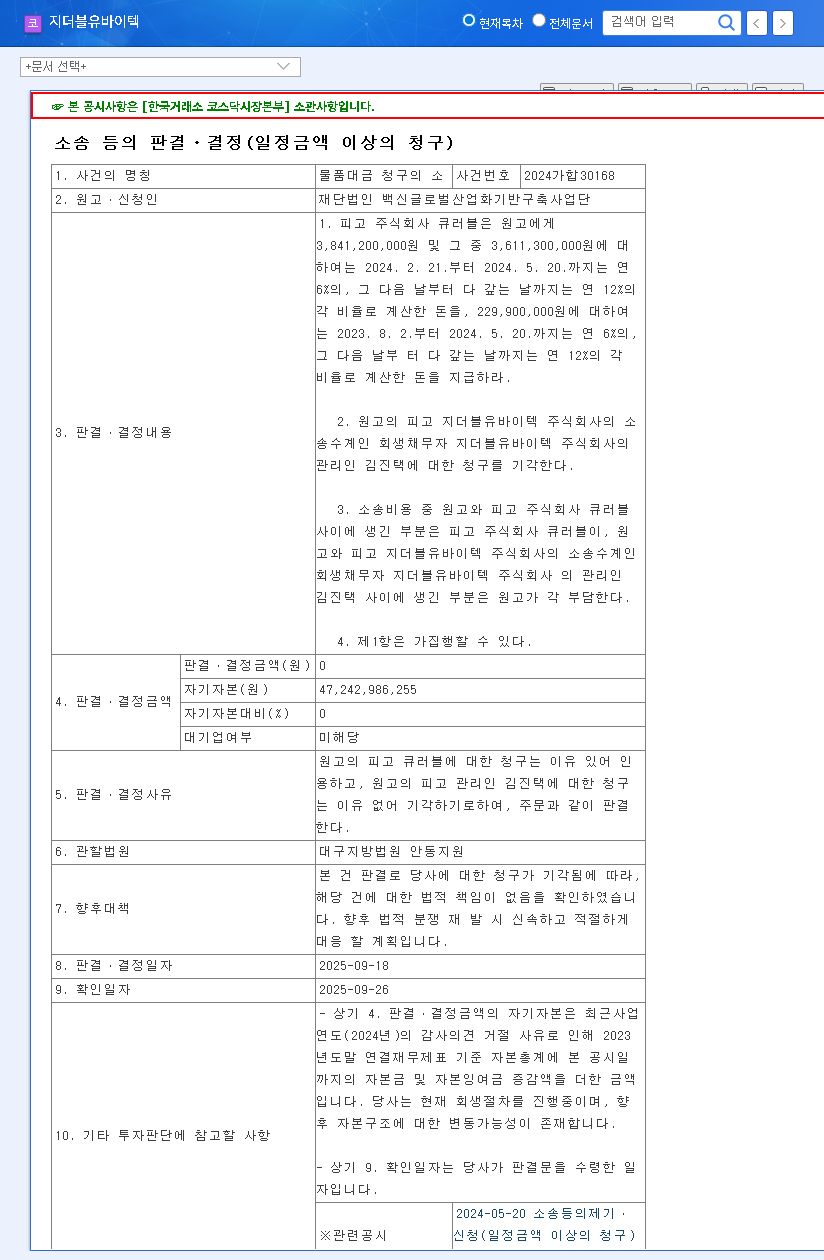
    The precarious situation for GW Vitek CO.,LTD., a company already navigating treacherous corporate rehabilitation proceedings, has intensified significantly. A newly emerged appeal for a KRW 3.841 billion goods payment lawsuit casts a dark, ominous shadow over its prospects for recovery. This development introduces a critical layer of uncertainty that investors and stakeholders cannot afford to ignore. This comprehensive analysis will dissect the lawsuit’s implications for GW Vitek, its fragile financial state, and the viability of its entire rehabilitation process.

    The New Legal Hurdle: A KRW 3.8 Billion Lawsuit

    Already burdened by severe management challenges and suspended stock trading, GW Vitek now confronts another significant legal battle. The Vaccine Global Industrialization Foundation has filed an appeal for a ‘claim for goods payment’ lawsuit valued at KRW 3.841 billion. This amount represents a substantial 7.62% of the company’s total assets, making it a material event with potentially devastating consequences.

    The appeal, which will be heard at the Andong Branch of the Daegu District Court, seeks to overturn a first-instance ruling where the plaintiff was unsuccessful. If the appeal succeeds, this KRW 3.841 billion will be confirmed as a rehabilitation claim, adding a massive financial weight to a company already on the brink. The specifics of this legal challenge were disclosed in an official regulatory filing. You can view the Official Disclosure (Source) for detailed information.

    Understanding the Gravity: GW Vitek’s Deep-Rooted Crisis

    To fully appreciate the impact of this lawsuit, it’s essential to understand the dire state of GW Vitek’s fundamentals. The company is operating under extreme ‘going concern uncertainty,’ a term auditors use when a business is at high risk of failure. This isn’t a new development but a culmination of persistent financial decay.

    With liabilities soaring and equity diminishing, the addition of a multi-billion KRW claim from this GW Vitek lawsuit could be the final straw that breaks the company’s chances of a successful turnaround.

    Catastrophic Financial Performance

    The company’s financial reports paint a grim picture. In Q3 2025, accumulated sales plummeted to KRW 3.25 billion, an 85% decrease year-over-year, while the operating loss ballooned to KRW 3.27 billion. More alarmingly, total liabilities stand at a staggering KRW 136.4 billion against a dwindling total equity of just KRW 15.048 billion, signaling severe capital impairment and a desperate need for restructuring. These are not just numbers; they represent a fundamental collapse of the business’s operational viability.

    Compounding Internal and External Pressures

    The problems extend beyond poor sales. GW Vitek is also dealing with the fallout from alleged embezzlement and breach of trust, resulting in outstanding illegal activity receivables of KRW 18.33 billion. This, combined with numerous other ongoing lawsuits and the loss of control over subsidiaries, has created a perfect storm. The auditor’s ‘disclaimer of opinion’ underscores the chaos, making it nearly impossible for investors to trust the financial statements. Furthermore, the harsh macroeconomic climate of high interest rates and inflation makes sourcing capital or finding operational efficiencies incredibly challenging. For more information on navigating such situations, investors can review resources on analyzing distressed companies.

    How the Lawsuit Derails the Rehabilitation Process

    The success of corporate rehabilitation proceedings hinges on creating a clear and viable path forward. This new lawsuit threatens to shatter that clarity in several ways:

    • Exacerbated Financial Burden: If the court rules against GW Vitek, its already overwhelming debt load will increase, making financial restructuring nearly impossible and potentially triggering liquidation.
    • Deterrent to M&A and Investment: Potential buyers or investors seek stability. A large, unresolved legal claim is a major red flag, significantly reducing the chances of a successful M&A deal that could save the company.
    • Damaged Corporate Trust: Continuous legal disputes destroy a company’s reputation. Even if GW Vitek somehow survives, rebuilding trust with customers, suppliers, and the market will be a monumental task.
    • Complicated Rehabilitation Plan: The entire rehabilitation plan submitted to the court is now thrown into question. Creditors will be less likely to approve a plan when a massive, uncertain liability is looming.

    Conclusion: An Extremely High-Risk Scenario for Investors

    The emergence of this KRW 3.841 billion ‘claim for goods payment’ lawsuit is a profoundly negative event for GW Vitek. It compounds an existing crisis defined by rehabilitation proceedings, suspended trading, embezzlement-related debts, and a damning auditor’s report. The path to normalization now appears more obscured than ever.

    Therefore, any investment consideration in GW Vitek at this juncture carries an exceptionally high level of risk. Investors must exercise extreme caution and diligently monitor all developments. A prudent approach is not just recommended; it is essential for capital preservation. Focus on the outcome of this lawsuit and the progress of the rehabilitation plan, as these will be the ultimate determinants of the company’s fate.
    (036180) GW Vitek Analysis: KRW 3.8B Lawsuit Threatens Rehabilitation & Investor Confidence 관련 이미지
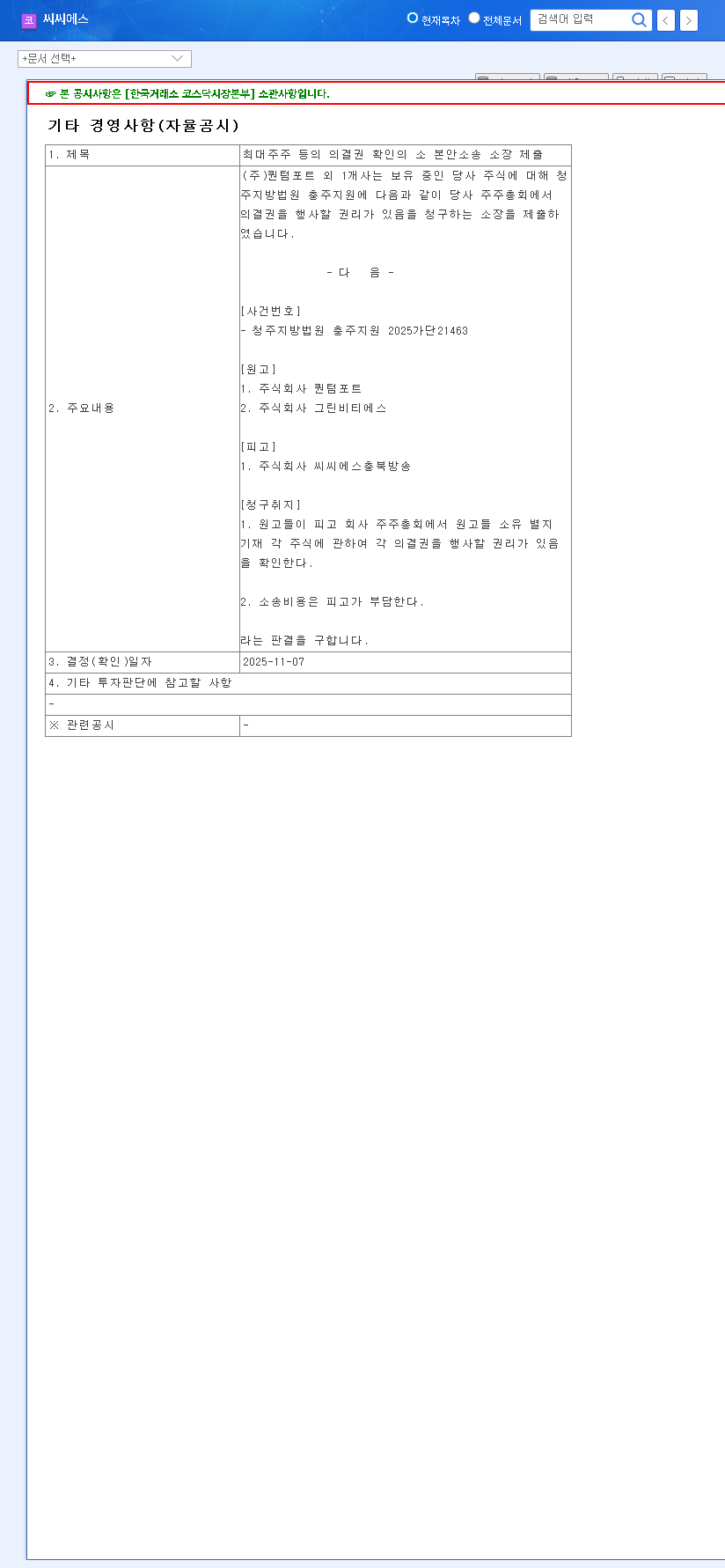
  • (066790) CCS 066790 Management Dispute: In-Depth Analysis of Delisting Risk & Financial Crisis

    (066790) CCS 066790 Management Dispute: In-Depth Analysis of Delisting Risk & Financial Crisis

    The ongoing CCS 066790 management dispute has taken a critical turn, placing investors on high alert. A recent public disclosure reveals a shareholder has initiated legal action to compel access to the company’s books, a move that signals deepening distrust and intensifies the already severe turmoil surrounding Korea Cable T.V Chung-Buk System Co., Ltd. (CCS, 066790). This development is not merely a legal footnote; it is a significant catalyst that could accelerate the company’s path toward a potential delisting, compounding its grave financial and operational challenges.

    For any stakeholder, understanding the implications of this shareholder lawsuit is paramount. This article provides a comprehensive CCS 066790 financial analysis, dissecting the latest disclosure, its impact on the company’s fundamentals, and the escalating CCS delisting risk.

    Decoding the Shareholder Lawsuit: A Public Vote of No Confidence

    On November 12, 2025, CCS disclosed a filing titled “Application for Indirect Compulsory Enforcement of Provisional Disposition to Permit Inspection and Copying of Books, etc.” According to the Official Disclosure on DART, a shareholder, Mr. Choi, has requested court intervention to force management to provide access to critical financial and operational documents. This legal maneuver, known as indirect compulsory enforcement, is a powerful tool used when a party believes management is obscuring information or mismanaging company assets.

    This legal action is not just a procedural matter; it is a public declaration of profound distrust in the current leadership. It transforms a private CCS 066790 management dispute into a formal, public crisis with severe financial penalties attached.

    A Company in Crisis: In-depth CCS 066790 Financial Analysis

    This lawsuit doesn’t exist in a vacuum. It is a symptom of a deeply troubled company. The fundamentals of Korea Cable T.V Chung-Buk System have been deteriorating for years, creating a perfect storm of risk.

    Irrecoverable Financial Condition

    • Persistent Revenue Decline: The company’s core business in the hyper-competitive cable TV industry is shrinking, with no clear strategy for a turnaround.
    • Widening Losses: Both operating and net losses are expanding, indicating a fundamental inability to generate profit from its primary operations.
    • Severe Liquidity Pressure: A high provision for doubtful accounts suggests the company is struggling to collect what it’s owed, further straining its cash flow.

    Endless Management Disputes and Litigation

    The company’s leadership has been in a state of constant flux, paralyzing strategic decision-making. The instability is characterized by frequent changes in major shareholders, delays in regulatory approval, and a litany of legal battles. This environment makes it nearly impossible to execute a coherent business plan. Investors looking to protect themselves may want to review our guide on how to analyze at-risk stocks.

    The Domino Effect: How This Lawsuit Amplifies CCS Delisting Risk

    This latest CCS shareholder lawsuit acts as a powerful accelerant to the company’s existing problems, pushing it closer to the brink.

    • Intensified Management Paralysis: Management must now divert precious time and capital to fighting a legal battle instead of fixing the business. This further prolongs any hope of normalization.
    • Accelerated Cash Burn: If the court sides with the shareholder and CCS fails to comply, it faces a penalty of 20 million KRW per day. For a company already in financial distress, this is a potentially fatal blow to its liquidity.
    • Shattered Investor Confidence: With the company already designated an ‘Administrative Issue Stock’ and trading suspended, this public dispute solidifies its toxic reputation. This makes attracting new capital virtually impossible and severely amplifies the CCS delisting risk.

    Conclusion: Extreme Caution Required for CCS 066790

    The situation at Korea Cable T.V Chung-Buk System Co., Ltd. is dire. The shareholder lawsuit is a clear indicator that internal conflicts have reached a boiling point, further threatening the company’s survival. With a paralyzed management, deteriorating financials, and a mounting pile of legal and regulatory issues, the prospect of business normalization appears distant. Investors must exercise extreme caution, as the underlying risks, including the potential for a complete delisting, are substantial and growing daily.

    Disclaimer: This analysis is for informational purposes only and is based on publicly available information. It does not constitute investment advice. All investment decisions should be made based on your own judgment and research.

    (066790) CCS 066790 Management Dispute: In-Depth Analysis of Delisting Risk & Financial Crisis 관련 이미지
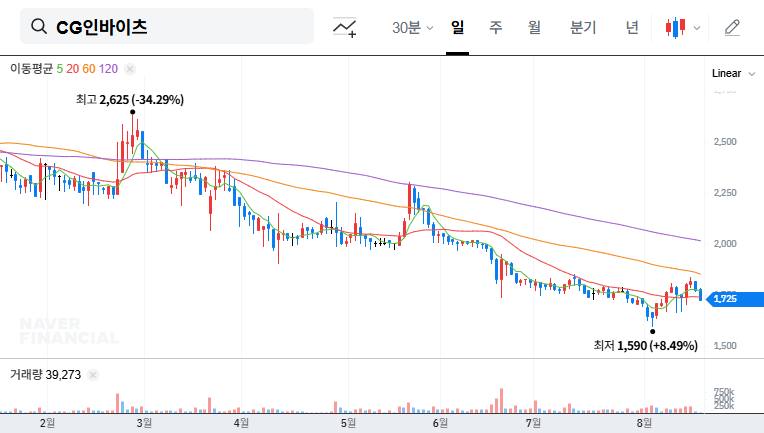
  • (083790) CG Invites Lawsuit: ₩5.5B Claim Threatens Stock & Digital Health Plans

    (083790) CG Invites Lawsuit: ₩5.5B Claim Threatens Stock & Digital Health Plans

    The CG Invites lawsuit has cast a significant shadow over the company’s ambitious plans. As a key player in the biotech and pharmaceutical space, CG Invites Co., Ltd. has been aggressively pivoting towards high-growth sectors like digital healthcare and innovative drug development. However, a looming ₩5.54 billion lawsuit threatens to derail this progress, raising serious concerns for investors about the company’s financial stability and future. This comprehensive analysis unpacks the full implications of the legal challenge, from its direct financial impact to the potential disruption of its long-term strategic goals.

    The ₩5.5 Billion Lawsuit: A Closer Look

    The legal challenge stems from a claim for contractual payments filed by an individual, Park, at the Seongnam Branch of Suwon District Court. The claim, totaling a substantial ₩5.54 billion, is scheduled for a hearing on November 11, 2025. This figure is not trivial; it represents approximately 4.58% of CG Invites’ entire asset base. For a company already navigating financial headwinds, this lawsuit is more than just a legal nuisance—it’s a material threat. This development was confirmed in an Official Disclosure filed with the Financial Supervisory Service, adding a layer of certainty to the market’s concerns.

    Assessing the Financial Damage to CG Invites

    To understand the gravity of the CG Invites lawsuit, one must first examine the company’s current financial standing. The picture, even before this legal challenge, was complex and pointed towards significant vulnerabilities.

    Current Financial Health: A Company Under Pressure

    In the first half of 2025, CG Invites reported consolidated sales growth, reaching ₩9.26 billion. However, this top-line growth was overshadowed by an operating loss of ₩13.1 billion and a net loss of ₩17.1 billion. This deficit is a result of aggressive investments in new ventures, rising R&D costs, and other financial expenses. Key metrics paint a concerning picture:

    • Deteriorating Liquidity: With current assets of ₩55.9 billion dwarfed by current liabilities of ₩125.6 billion, the company’s ability to meet its short-term obligations is under strain.
    • High Leverage: The company’s debt-to-equity ratio stands at a high 143.05%. This financial metric, often analyzed by investors to gauge leverage, indicates that the company is heavily reliant on debt to finance its assets. You can learn more about what a debt-to-equity ratio means from authoritative financial resources.

    Given the existing liquidity crunch and high debt, a sudden cash outflow of ₩5.54 billion would not just strain resources—it could trigger a severe financial crisis, forcing asset sales or dilutive capital increases at an inopportune time.

    Direct Impact of a Negative Verdict

    Should the court rule against CG Invites, the consequences would be immediate and severe. A direct cash outflow of ₩5.54 billion, plus any accrued interest, would intensify the already critical liquidity pressure. Furthermore, the company would likely need to set aside provisions on its financial statements, which would directly reduce its reported net income and further erode shareholder equity. This makes the CG Invites stock particularly vulnerable to negative sentiment and sell-offs.

    A Cloud Over Ambitious Growth Plans

    The timing of this lawsuit is particularly damaging as it coincides with CG Invites’ strategic pivot. The company has been investing heavily to establish itself as a leader in next-generation healthcare, a move critical for its long-term survival and growth. This legal battle threatens to pull focus and resources away from these crucial initiatives.

    Digital Healthcare Ambitions at Risk?

    The company’s foray into digital healthcare includes ICT-based health management services, digital therapeutics, and hospital information systems. These are capital-intensive fields that require sustained investment. The lawsuit not only threatens the availability of capital for R&D and market expansion but also damages the company’s reputation, making it harder to attract partners and talent in this competitive sector.

    New Drug Development and Manufacturing

    Alongside digital health, CG Invites is advancing its drug pipeline with candidates like Ibaltinostat and Camrelizumab. Clinical trials are notoriously expensive, and any diversion of funds to cover legal fees or settlements could delay these programs. The company’s revenue-generating PCB and hotpack manufacturing arm, while steady, is unlikely to be sufficient to cover both a massive legal penalty and the aggressive R&D spending required for success in the biotech sector.

    Investor Outlook: Navigating the Uncertainty

    For current and prospective investors, the CG Invites lawsuit introduces a high degree of risk and uncertainty. While the company has pledged an active legal defense, a prudent approach requires careful monitoring of several key factors.

    Key Risks to Monitor

    • Stock Price Volatility: Negative news flow surrounding the lawsuit is likely to pressure the CG Invites stock price in the short to medium term.
    • Financial Restructuring: Watch for announcements of asset sales, capital increases, or additional debt, which may be necessary to shore up the balance sheet.
    • Operational Delays: Any sign of delays in the clinical trial pipeline or digital health rollouts could indicate that the lawsuit’s financial impact is affecting operations.

    Recommendations for Investors

    A cautious stance is advised. Investors should prioritize monitoring the company’s transparency regarding the lawsuit. Clear communication, coupled with a tangible plan to improve financial health, will be critical to restoring confidence. Ultimately, the ability of CG Invites to generate tangible results from its new ventures will determine if it can overcome this crisis and unlock new growth.

    Disclaimer: This article is for informational purposes only and is based on publicly available data. It does not constitute investment advice. Investment decisions should be made based on your own research and judgment after consulting with a qualified financial professional.

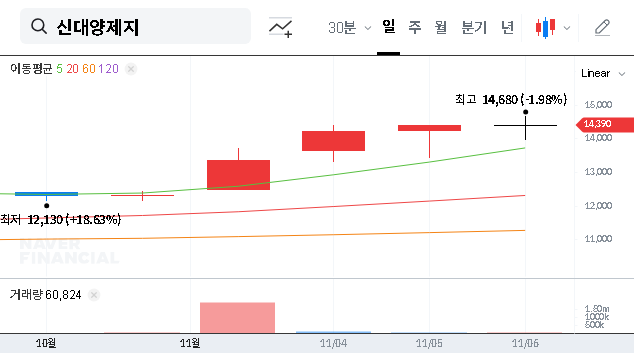
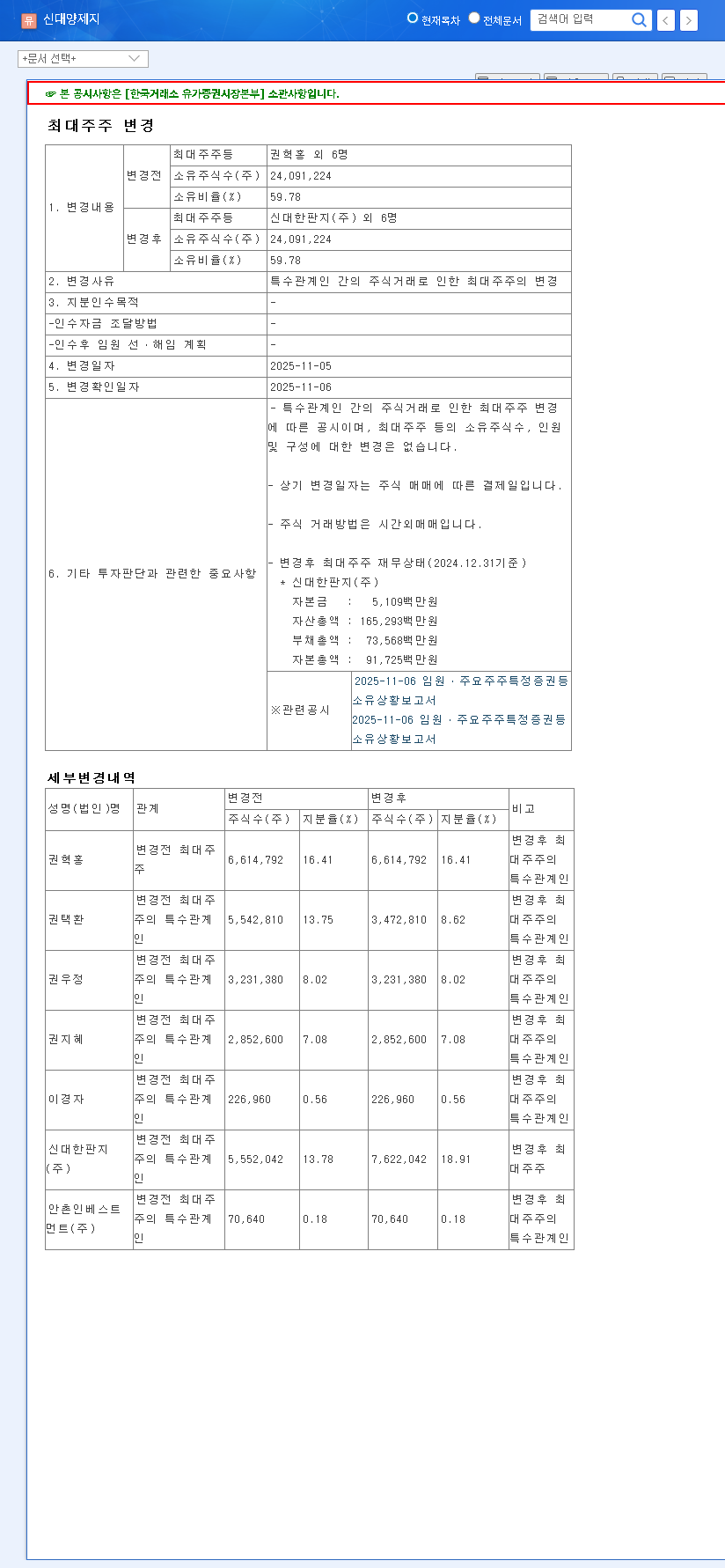
  • (016590) SHINDAEYANG PAPER Management Dispute Looms: A Deep Dive for Investors

    (016590) SHINDAEYANG PAPER Management Dispute Looms: A Deep Dive for Investors

    The recent legal filings against SHINDAEYANG PAPER CO.,LTD suggest a potential SHINDAEYANG PAPER management dispute is on the horizon, capturing the attention of investors. A lawsuit filed on November 6, 2025, seeking to inspect and copy the company’s shareholder register, is far more than a routine legal matter. It is often a strategic precursor to a broader challenge against existing management, raising critical questions about the company’s future governance, stock performance, and overall corporate value.

    This comprehensive analysis will delve into the specifics of the SHINDAEYANG PAPER lawsuit, evaluate the company’s fundamental strengths and weaknesses, explore the potential impacts on its stock price, and provide a clear, actionable strategy for current and prospective investors navigating this period of uncertainty.

    Decoding the Shareholder Register Injunction Lawsuit

    On November 6, 2025, SHINDAEYANG PAPER disclosed that a group of 12 individuals, led by Kim ○○, filed a lawsuit for a ‘Shareholder Register Inspection and Copying Injunction’ at the Ansan Branch of Suwon District Court. The plaintiffs are demanding complete access to the shareholder list as of October 22, 2025, with a steep penalty of KRW 20 million per day for non-compliance. This information is verifiable via the Official Disclosure. While the company has pledged a robust legal defense, the implications of this action are significant.

    A request to inspect the shareholder register is often the first strategic move in a larger campaign aimed at influencing corporate direction, gathering support for a proxy fight, or challenging the current management’s control.

    By identifying other shareholders, the plaintiffs can build alliances, solicit proxies, and prepare for shareholder meetings. This is a classic tactic in activist investing and a clear signal that the status quo is being challenged. The core issue for investors is the uncertainty this introduces into the company’s corporate governance framework.

    Evaluating SHINDAEYANG PAPER’s Financial Fortitude

    To understand how this legal battle might play out, we must first assess the company’s underlying financial health. A strong company can better weather internal storms, while a weak one may be more vulnerable.

    Core Strengths

    • Stable Market Position: As a key manufacturer of corrugated base paper and boxes, the company has a stable production capacity and a reliable market share, which generates consistent cash flow.
    • Exceptional Financial Health: The company boasts a ‘negative net debt’ position, meaning its cash and cash equivalents exceed its total borrowings. This indicates extremely low liquidity risk and a strong balance sheet.
    • Shareholder-Friendly Policies: Historically, SHINDAEYANG PAPER has engaged in treasury stock buybacks and maintained a dividend policy, showing commitment to shareholder value.

    Inherent Risks

    • Commodity Price Volatility: Profitability is sensitive to fluctuations in the prices of recycled paper and pulp, as well as foreign exchange rates.
    • Operational Headwinds: A recent fire at its subsidiary’s plant has suspended some production, creating short-term performance pressure and future restoration costs.

    Investment Impact: A Two-Fold Analysis

    The looming SHINDAEYANG PAPER management dispute creates distinct short-term and long-term risks for investors.

    Short-Term: Volatility and Uncertainty

    In the immediate future, the primary impact will be heightened stock price volatility. Uncertainty is poison to investor sentiment, and headlines about legal battles often trigger reactive selling. Traders may try to capitalize on the swings, but long-term investors may feel uneasy. Legal defense costs, while likely minor, will also be a small drag on short-term earnings.

    Mid-to-Long-Term: Governance and Value Erosion

    Should this injunction escalate into a full-blown proxy fight, the long-term consequences could be severe. Management’s focus could shift from running the business to defending their positions, leading to a decline in operational efficiency. A prolonged dispute can tarnish the company’s reputation, making it harder to attract talent and capital, potentially leading to a sustained decrease in corporate value. To learn more, it’s helpful to understand the principles of effective corporate governance from high-authority sources.

    Investor Action Plan: A Prudent Approach

    Given the circumstances surrounding the SHINDAEYANG PAPER stock, a cautious and informed strategy is paramount.

    • Monitor Diligently: Stay updated on all court decisions and company announcements related to the lawsuit. Understanding the plaintiffs’ ultimate goals is key.
    • Evaluate Communication: Assess how transparently SHINDAEYANG PAPER’s management communicates with the market. Proactive and clear communication is a sign of good governance.
    • Focus on Fundamentals: Do not make rash decisions based on short-term price movements. Re-evaluate the company’s intrinsic value against the new governance risk. For a deeper understanding, review our guide on how to analyze company financials.
    • Assess Management’s Response: The true test will be how effectively the current leadership navigates this challenge. Their ability to manage this risk will be a critical indicator for future investment decisions.

    Frequently Asked Questions

    Q1: What is the ‘shareholder register inspection’ injunction against SHINDAEYANG PAPER?

    This injunction is a legal procedure where shareholders ask a court to force a company to let them view and copy the shareholder list. It is often seen as a preparatory step for engaging with other shareholders to influence or take control of management.

    Q2: How might this lawsuit affect SHINDAEYANG PAPER’s stock price?

    A management dispute increases uncertainty, which typically leads to higher stock price volatility in the short term. Over the long term, if the dispute distracts management or harms the company’s image, it could put downward pressure on the stock’s value.

    Q3: What are SHINDAEYANG PAPER’s current fundamentals?

    SHINDAEYANG PAPER has a stable position in the corrugated cardboard market and a very strong financial structure, with more cash than debt. However, it faces risks from raw material price changes and a recent fire at a subsidiary’s plant.

    Q4: What should investors consider in this situation?

    Investors should monitor legal proceedings and company communications closely. It is wise to avoid emotional reactions to short-term price swings and instead focus on the company’s long-term value and management’s ability to handle this governance challenge effectively.

    (016590) SHINDAEYANG PAPER Management Dispute Looms: A Deep Dive for Investors 관련 이미지
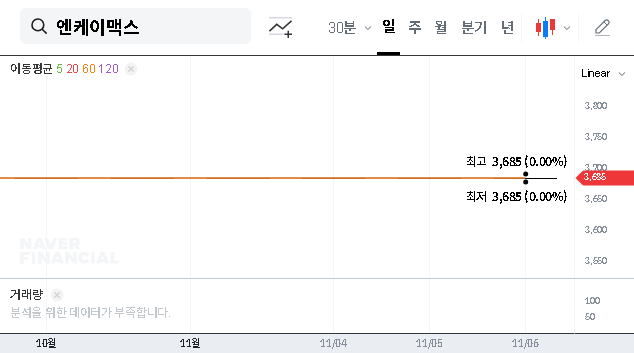
  • (182400) NKMAX Rehabilitation Claim: In-Depth Analysis of the 2 Billion Won Ruling (182400)

    (182400) NKMAX Rehabilitation Claim: In-Depth Analysis of the 2 Billion Won Ruling (182400)

    The recent confirmation of a 2 billion won NKMAX rehabilitation claim has sent ripples through the investment community, raising critical questions about the future of NKMAX Co., Ltd. (182400). This development, sanctioned by the Seoul Rehabilitation Court, marks a pivotal moment in the biotech company’s strenuous corporate restructuring journey. While it quantifies a significant liability, it also removes a layer of uncertainty. For investors, the key question remains: does this ruling pave the way for a stable recovery, or does it add an insurmountable burden to an already strained financial state?

    This comprehensive analysis will delve into the multifaceted implications of the court’s decision, evaluate NKMAX’s fundamental health, and provide a strategic outlook for those monitoring this volatile biotech stock.

    Deconstructing the 2 Billion Won Court Ruling

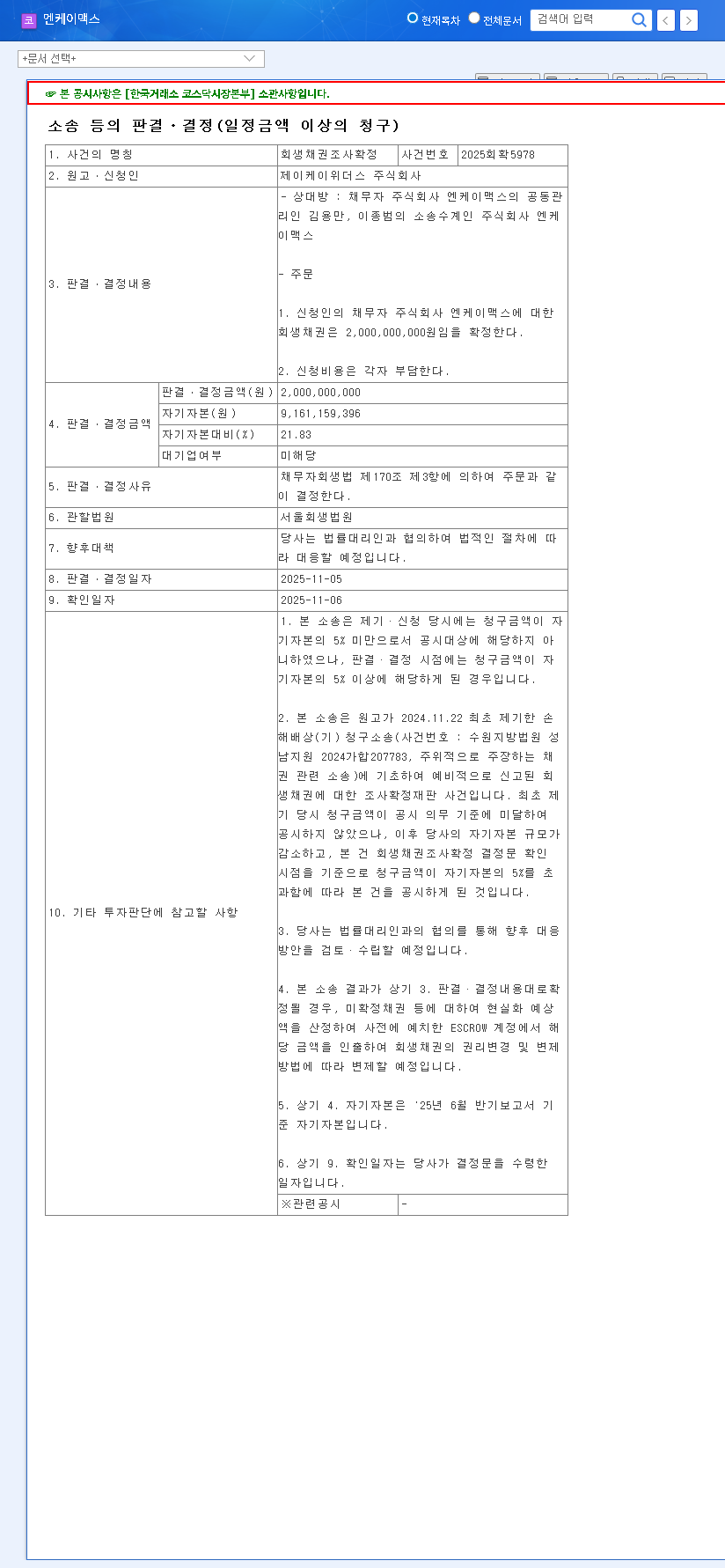
    On June 18, 2025, the Seoul Rehabilitation Court officially recognized a 2 billion won claim filed by JK Witheus Co., Ltd. against NKMAX. Initially, this lawsuit was below the threshold for public disclosure. However, a significant decrease in NKMAX’s equity meant the claim amount subsequently exceeded 5% of its equity, triggering a mandatory disclosure. This information comes directly from the company’s Official Disclosure filed with DART.

    The confirmation of this claim is a double-edged sword. It provides a concrete financial figure for debt adjustment within the rehabilitation plan, but it also formalizes a substantial financial obligation for a company already in a precarious position.

    Implications for the Corporate Restructuring Process

    The primary impact of this ruling is on the clarity and execution of NKMAX’s ongoing rehabilitation. By defining this 2 billion won liability, the company’s administrators and its new largest shareholder can now incorporate this exact figure into their financial models and debt repayment schedules. A key detail is the expectation that this claim will be settled via an ESCROW account established as part of the rehabilitation, which may mitigate immediate cash flow pressures.

    Current Financial Health: A Deep Dive into NKMAX’s Fundamentals

    To understand the weight of the NKMAX rehabilitation claim, we must assess the company’s underlying financial condition. As of the first half of 2025, the picture is one of significant distress, even as the company attempts to normalize operations.

    • Deteriorating Revenue: H1 2025 revenue stood at 3.446 billion KRW, an 18.27% drop year-over-year. The decline in sales of its flagship immune diagnostic product, NK Vue® KIT, is a major contributor to this trend.
    • Expanding Losses: The operating loss for the same period ballooned to 12.267 billion KRW. This indicates that core operational costs, likely driven by R&D for its Super NK cell therapy pipeline, are far outpacing its revenue.
    • Severe Capital Impairment: NKMAX remains in a state of severe capital impairment, a critical condition where total liabilities exceed total assets. This is a primary risk factor for potential delisting and underscores the urgent need for successful capital injections.

    Market Environment and Competitive Landscape

    NKMAX operates in highly competitive and capital-intensive sectors. The global cell therapy market, while growing, is crowded with major pharmaceutical players and agile biotechs. Success for its Super NK therapy hinges not just on clinical outcomes but on securing a competitive niche. Similarly, the in-vitro diagnostics market requires constant innovation and effective commercial strategy. The broader macroeconomic environment, characterized by high interest rates as noted by sources like Bloomberg, increases the cost of capital, making fundraising a significant challenge for companies undergoing corporate restructuring.

    Investor Outlook: A Cautious Path Forward

    The confirmation of the 2 billion won claim introduces both risks and a degree of clarity. For investors, a highly cautious and analytical approach is paramount.

    Potential Risks to Monitor

    • Financial Burden: Despite the ESCROW arrangement, 2 billion won is a material sum that depletes resources which could otherwise be used for R&D or operations.
    • Investor Sentiment: With a grace period for improvement granted on June 20, 2024, to avoid delisting, this news could sour investor confidence and make attracting new capital more difficult.
    • Execution Risk: The company’s survival hinges on the flawless execution of its rehabilitation plan. Any deviation or unforeseen expense could exacerbate its capital impairment. For more context, you can read our guide on evaluating biotech stocks during restructuring.

    Conclusion: What Investors Should Watch

    NKMAX Co., Ltd. is at a critical juncture. The resolution of the 2 billion won claim is a necessary step in its rehabilitation, but it simultaneously highlights the deep-seated financial issues the company must overcome. The path forward depends entirely on the successful implementation of its turnaround strategy, the clinical and commercial success of its product pipeline, and its ability to secure vital new funding. Investors should closely monitor progress reports on the rehabilitation, quarterly financial statements, and any news regarding its R&D pipeline before making any investment decisions. The risk of delisting remains a significant and tangible threat until the company can demonstrate a sustainable path to profitability.

    (182400) NKMAX Rehabilitation Claim: In-Depth Analysis of the 2 Billion Won Ruling (182400) 관련 이미지
  • (123890) KOREA ASSET IN TRUST Lawsuit (123890): Full Analysis of the ₩192.1B Claim & Stock Impact

    (123890) KOREA ASSET IN TRUST Lawsuit (123890): Full Analysis of the ₩192.1B Claim & Stock Impact

    A significant legal challenge has cast a shadow over KOREA ASSET IN TRUST Co., Ltd (123890), a key player in the real estate trust sector. The unfolding KOREA ASSET IN TRUST lawsuit involves a staggering claim of ₩192.1 billion, representing nearly 20% of the company’s total assets. This development has sent ripples through the investment community, raising critical questions about the company’s financial stability, future profitability, and the trajectory of its stock price. For investors, navigating this period of uncertainty requires a clear and comprehensive understanding of the situation. This detailed analysis will dissect the lawsuit, evaluate the company’s fundamental health, and provide a strategic outlook for both the short and long term.

    The ₩192.1 Billion Lawsuit: A Closer Look

    On October 27, 2025, a large-scale lawsuit was filed against KOREA ASSET IN TRUST in the Seoul Central District Court. The plaintiffs, a group of 465 individuals led by Mr. Noh, are seeking ‘cancellation, termination, and restitution of sales contracts,’ with the claim amount recently increasing to ₩192.1 billion. This figure is significant not just for its absolute size but for its scale relative to the company’s financial base—it equals 19.48% of its assets. The official disclosure of this event can be found in the company’s public filing. (Source: Official DART Report).

    The core of the company’s defense rests on the argument that its liability is confined to the specific trust assets associated with the project in question. However, the plaintiffs are challenging this limitation, creating a high-stakes legal battle with profound implications.

    The critical question for investors is whether this massive liability will be firewalled within the trust’s assets or if it will breach the corporate shield, directly impacting KOREA ASSET IN TRUST’s proprietary funds and overall financial health.

    Company Under Pressure: KOREA ASSET IN TRUST Analysis

    To understand the potential impact of the KOREA ASSET IN TRUST lawsuit, we must first assess the company’s underlying financial condition based on its H1 2025 report.

    Strong Financial Soundness (Pre-Lawsuit)

    The company entered this legal battle from a position of apparent financial strength. Key indicators point to robust health:

    • High Capital Ratio: Its Operating Net Capital Ratio stands at 280%, well above the regulatory minimum of 150%, suggesting a solid capital buffer.
    • Exceptional Liquidity: A KRW Liquidity Ratio of 5,071% indicates a very strong ability to meet short-term obligations without stress.
    • Stable Capital Structure: Capital accounts for approximately 56% of the balance sheet, reflecting stability.

    Warning Signs: Declining Profitability

    Despite its sound balance sheet, profitability has been on a downward trend. A challenging real estate market, exacerbated by sustained high interest rates, has squeezed margins. Consolidated operating revenue, operating profit, and net income have all seen year-over-year decreases. The primary driver of this decline is a reduction in commission income, particularly from its core land trust business. For more information on navigating market downturns, check out our guide to investing in real estate during high-interest periods.

    Emerging Financial Risks

    Even before this lawsuit, certain risks were becoming more prominent. The company’s debt levels have been increasing, which could raise its financial burden in a tough economic climate. More concerning is the sharp rise in the non-performing loan (NPL) ratio to 52%. While this may relate to specific trust assets, it signals a need for diligent monitoring of overall asset quality.

    Navigating the Uncertainty: Investor Outlook & Strategy

    The lawsuit introduces a major variable into the valuation of KOREA ASSET IN TRUST stock. Investors must adopt a cautious and informed approach, considering both short-term volatility and the long-term fundamental picture.

    • Monitor the Lawsuit’s Progress: The single most important factor is the court’s interpretation of the company’s liability. Any news regarding the acceptance or rejection of their limited liability defense will be a major catalyst for the stock.
    • Assess Risk Management: Observe how the company communicates its contingency plans. Transparent disclosure and proactive risk management can help restore investor confidence.
    • Evaluate Core Business Health: Look beyond the lawsuit. Is the company adapting to the new real estate market reality? Are there efforts to diversify revenue streams away from the struggling land trust segment?

    In the short term, the uncertainty will likely weigh heavily on the stock price. A negative ruling could cause severe damage to the company’s equity and long-term reputation, as trust is the bedrock of its industry. Conversely, a decisive win would remove this overhang and allow the stock to be re-evaluated based on its fundamentals in the current market.

    Frequently Asked Questions (FAQ)

    What is the core claim of the lawsuit against KOREA ASSET IN TRUST?

    The plaintiffs are demanding the ‘cancellation, termination, and restitution of sales contracts,’ with a total claim of ₩192.1 billion, which is nearly 20% of the company’s total assets.

    What is the worst-case financial impact of this lawsuit?

    If the court rules that the company is liable with its own proprietary assets (not just the trust assets), a loss of ₩192.1 billion would directly reduce net income and total equity, severely damaging key financial metrics like ROE and PER.

    How might this lawsuit affect the KOREA ASSET IN TRUST stock price?

    The ongoing uncertainty is a significant negative catalyst, likely causing downward pressure and increased volatility. The final outcome will be a major determinant of the stock’s long-term direction; a loss could be devastating, while a win could remove a major obstacle.

    (123890) KOREA ASSET IN TRUST Lawsuit (123890): Full Analysis of the ₩192.1B Claim & Stock Impact 관련 이미지
  • (108230) TOPTEC Lawsuit: Full Analysis of the ₩11.6B Penalty & Impact on TOPTEC Stock

    (108230) TOPTEC Lawsuit: Full Analysis of the ₩11.6B Penalty & Impact on TOPTEC Stock

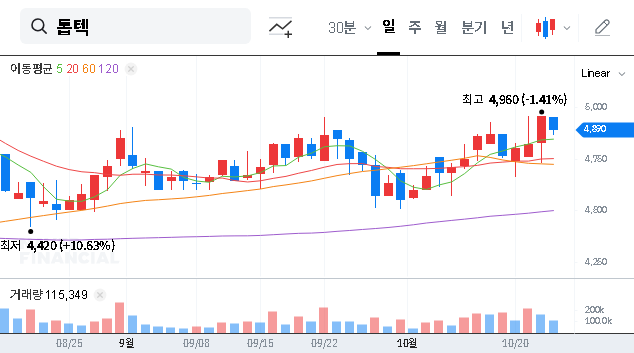
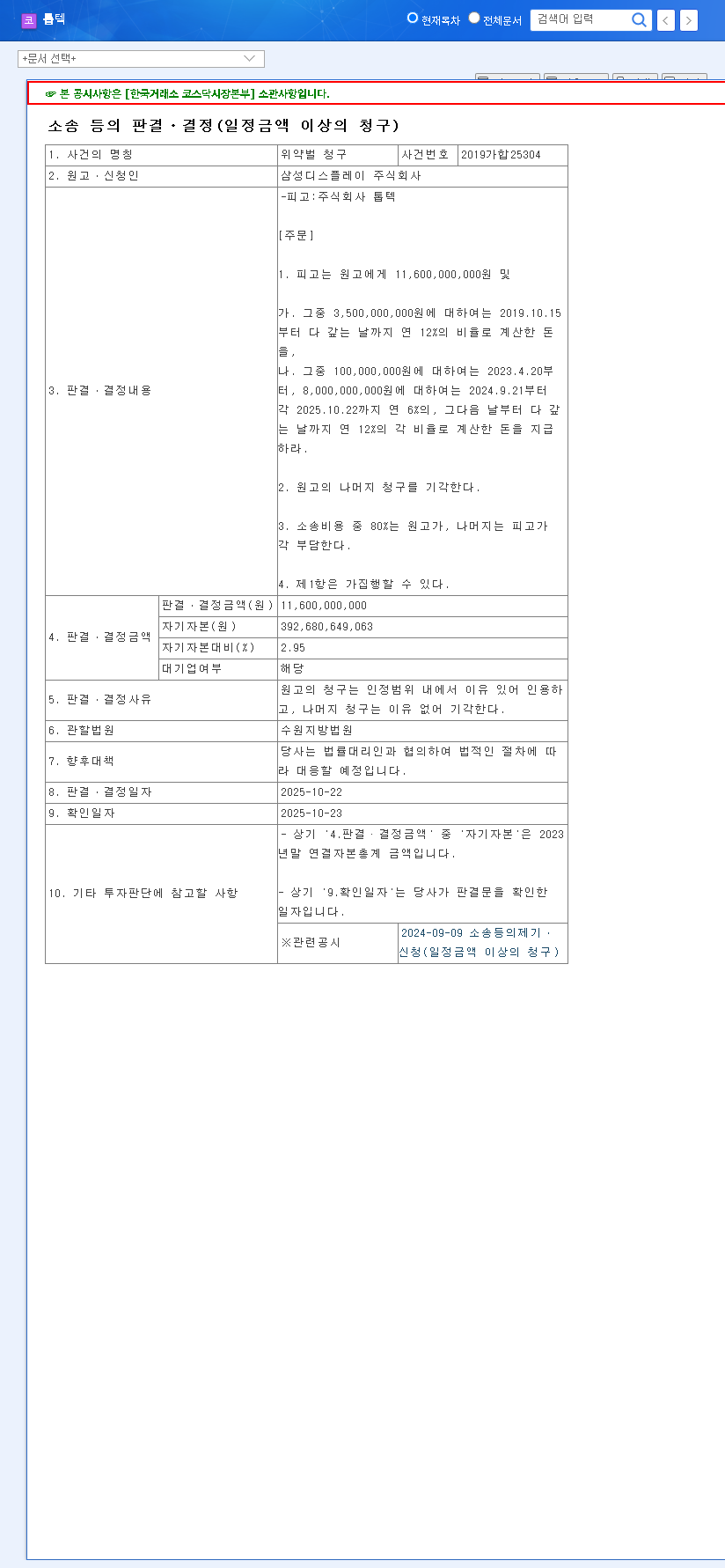
    In a significant development for TOPTEC investors, the company has been dealt a major blow in its legal battle with Samsung Display. The recent verdict in the TOPTEC lawsuit mandates a staggering ₩11.6 billion (approx. $8.5 million USD) penalty for punitive damages. This ruling represents a critical inflection point, raising serious questions about the company’s financial stability, operational future, and stock performance.

    This comprehensive analysis dissects the court’s decision, explores the far-reaching consequences of the penalty, and provides actionable insights for current and prospective investors. We will delve into the financial strain, potential reputational damage, and the key risk factors to monitor as the situation unfolds.

    The Verdict: A Deep Dive into the TOPTEC Lawsuit

    On October 23, 2025, the Suwon District Court delivered an unfavorable judgment against TOPTEC COMPANY,LIMITED in the punitive damages claim (Case No. 2019gahap25304) initiated by Samsung Display Co., Ltd. The court ordered TOPTEC to pay the substantial sum of ₩11.6 billion. The official filing confirms the core details of this ruling. You can view the Official Disclosure (DART) for primary source verification.

    Key Details of the Judgment

    • Principal Amount: A penalty of ₩11.6 billion payable to Samsung Display.
    • Interest Accrual: Additional interest payments at rates of 6% or 12% per annum on different portions of the amount, compounding the financial burden from dates in 2019, 2023, and 2024.
    • Litigation Costs: TOPTEC is also liable for 20% of the total litigation costs, adding another layer of expense.

    The ₩11.6 billion penalty isn’t just a line item on a balance sheet; it’s a direct challenge to TOPTEC’s liquidity and a significant test of investor confidence in the company’s governance and risk management.

    Financial & Operational Fallout of the ₩11.6 Billion Penalty

    The consequences of this verdict extend beyond the immediate cash outlay. The TOPTEC ₩11.6 billion penalty will create ripples across its entire financial structure and business reputation.

    Gauging the Financial Strain

    Numerically, the ₩11.6 billion fine represents 2.95% of TOPTEC’s total assets (as of year-end 2023) and a more significant 6.2% of its market capitalization. This creates an immediate and pressing liquidity challenge. The company must now devise a strategy to fund this payment, which could involve depleting cash reserves, selling assets, or taking on new debt. Each of these options carries its own risks, from hindering future R&D investment to increasing leverage. For more on how companies manage such obligations, you can read about corporate liquidity strategies on authoritative financial sites like Investopedia.

    Reputation and Business Continuity Risks

    While the verdict may not halt daily operations, the reputational damage could be long-lasting. Losing a high-profile TOPTEC lawsuit to a global giant like Samsung Display can erode trust with other clients and partners. Potential customers may become wary of entering into complex contracts, fearing similar disputes. This tarnished credibility could put TOPTEC at a competitive disadvantage when bidding for new projects, impacting its long-term growth pipeline.

    Outlook for TOPTEC Stock and Investor Strategy

    For TOPTEC investors, the path forward requires careful navigation. The market’s reaction is likely to be swift, but a considered, long-term approach is essential.

    Short-Term Volatility vs. Long-Term Fundamentals

    In the short term, the TOPTEC stock price is expected to face significant downward pressure as the market digests the news of the ₩11.6 billion liability. Investor sentiment will likely turn negative. However, the long-term outlook depends entirely on management’s response. If the company can transparently address the payment plan and demonstrate the continued strength of its core automation business, it may be able to rebuild confidence over time. Investors should review our guide on Analyzing Tech Sector Stocks Under Duress for more context.

    Key Risk Factors to Monitor

    • Appeal Strategy: A decision to appeal could delay the payment but prolong market uncertainty. A decision not to appeal signals acceptance and a move towards resolution.
    • Funding Plan: Watch for official announcements on how TOPTEC will finance the ₩11.6 billion payment. This will be a key indicator of its financial health.
    • Future Disclosures: Upcoming quarterly and annual reports must be scrutinized for writedowns, updated guidance, and management’s commentary on the lawsuit’s impact.

    Frequently Asked Questions (FAQ)

    What is the exact amount TOPTEC must pay Samsung Display?

    TOPTEC must pay ₩11.6 billion in punitive damages, plus accumulating interest and a portion of the legal fees.

    How will this ruling affect TOPTEC’s finances?

    The penalty, which is 2.95% of total assets, will significantly strain short-term liquidity. The company will likely need to arrange special financing or use a large portion of its cash reserves, which could impact its operational flexibility.

    What is the expected impact on TOPTEC’s stock price?

    A negative short-term impact on the stock price is highly probable due to increased financial risk and negative investor sentiment. The long-term performance hinges on the company’s strategic response.

    What should TOPTEC investors do now?

    Investors should avoid panic-selling and instead focus on monitoring official company communications regarding its funding plan and appeal strategy. Re-evaluating the company’s fundamental business strength against this new financial risk is a prudent next step.

    (108230) TOPTEC Lawsuit: Full Analysis of the ₩11.6B Penalty & Impact on TOPTEC Stock 관련 이미지
  • (071850) CASTEC KOREA Appeal: A Deep Dive for Investors on Stock Risks & Governance

    (071850) CASTEC KOREA Appeal: A Deep Dive for Investors on Stock Risks & Governance

    The recent CASTEC KOREA appeal has sent ripples through the investment community. After a lower court nullified key resolutions from its extraordinary general meeting, CASTEC KOREA CO.,LTD is fighting back, escalating a legal battle that brings significant uncertainty. For investors, this situation is more than just a news headline; it’s a critical event that could impact stock performance, question the company’s corporate governance, and dictate future investment strategy. This comprehensive analysis will break down the core issues, explore the potential market impact, and provide clear recommendations for navigating the volatility ahead.

    The Heart of the Matter: Deconstructing the CASTEC KOREA Appeal

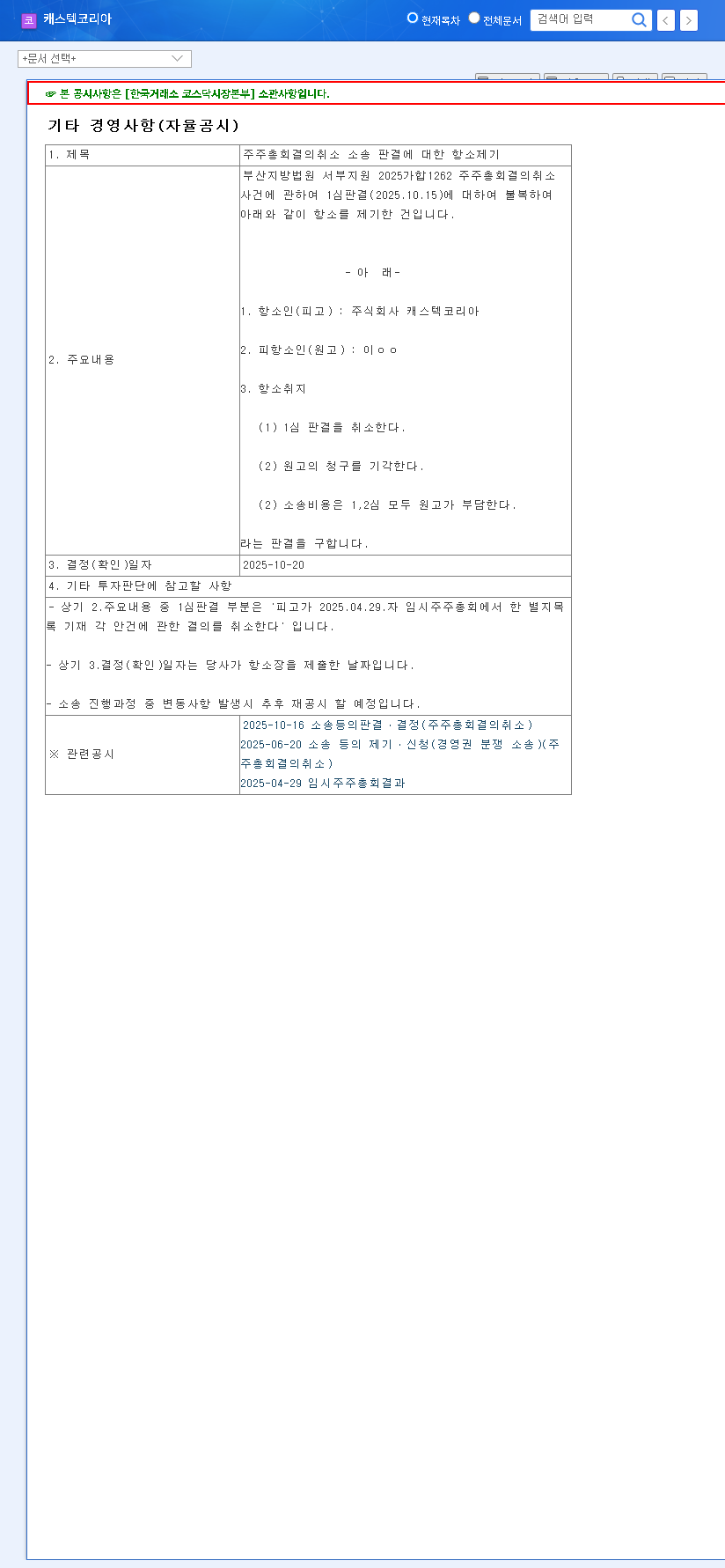
    On October 20, 2025, CASTEC KOREA officially challenged a first-instance ruling from the Busan District Court. This initial judgment, delivered on October 15, 2025, invalidated resolutions made during the company’s extraordinary general meeting (EGM) on April 29, 2025. The lawsuit, centered on the ‘Cancellation of Resolutions of the General Meeting of Shareholders’, represents a fundamental conflict over corporate procedure and authority. CASTEC KOREA’s legal objective is clear: to have the higher court overturn the initial judgment, dismiss the plaintiff’s original claims entirely, and place the burden of all litigation costs on the plaintiff. The full details were disclosed via an Official Disclosure (DART report).

    Key Chronological Details

    • EGM Held: April 29, 2025 – The meeting where the disputed resolutions were passed.
    • First-Instance Ruling: October 15, 2025 – The Busan District Court rules against CASTEC KOREA, nullifying the resolutions.
    • Appeal Filed: October 20, 2025 – CASTEC KOREA officially files its appeal to challenge the court’s decision.

    Market Impact Analysis: Volatility and Investor Sentiment

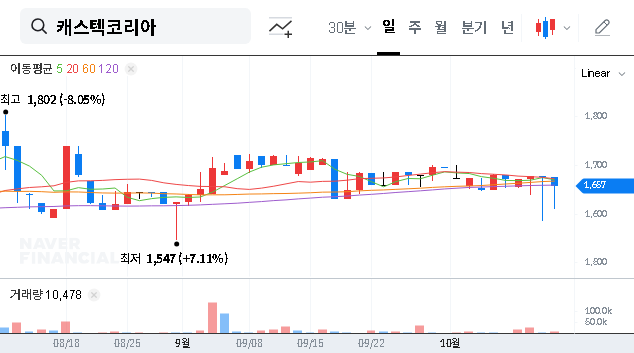
    Legal disputes of this nature are a major catalyst for market uncertainty. The appeal prolongs the period of ambiguity, directly affecting management focus and investor confidence, which can lead to significant fluctuations in the CASTEC KOREA stock price.

    Immediate Effects: Management Distraction and Legal Costs

    The most direct impact is the diversion of resources. Management’s time, attention, and capital must now be allocated to a potentially lengthy and expensive legal fight. This can detract from core business operations, innovation, and strategic growth initiatives. For investors, this ‘management burden’ is a red flag, as it introduces an operational risk that is difficult to quantify but can negatively affect performance.

    Long-Term Concerns: Corporate Governance and Credibility

    Beyond the immediate financial and operational strain, a lawsuit concerning shareholder resolution cancellation strikes at the heart of corporate integrity. It raises fundamental questions about the company’s internal controls, its respect for shareholder rights, and the overall state of its corporate governance. A protracted legal battle can erode trust and damage the company’s reputation, making it harder to attract future investment and potentially souring relationships with existing major shareholders. Strong corporate governance is a cornerstone of sustainable value, and any perceived weakness can have lasting consequences. To understand its importance, investors can learn more about corporate governance principles from authoritative sources.

    While a successful appeal could restore stability, the current environment is defined by uncertainty. The market will react to every development, making a well-informed, long-term perspective more critical than ever.

    Investor Advisory: Navigating the Path Forward

    Given the heightened risk profile, both the company and its investors must adopt clear, strategic approaches. Proactive measures can help mitigate anxiety and ground decisions in fact rather than speculation.

    What Investors Should Monitor

    A prudent investor advisory in this situation involves diligent monitoring. Rather than reacting to short-term price swings, focus on the following key developments:

    • Official Communications: Pay close attention to any official statements from CASTEC KOREA regarding the appeal’s progress. Transparency is key to rebuilding trust.
    • Court Filings and Decisions: Keep track of key dates and outcomes from the appellate court. These will be the most significant catalysts for market reaction.
    • Underlying Business Performance: Look beyond the lawsuit. Are the company’s core fundamentals (revenue, profit margins, market share) remaining strong? A healthy business can better withstand legal turmoil. For more information, you can read our guide on analyzing company legal risks.

    Frequently Asked Questions (FAQ)

    Q1: What exactly is the CASTEC KOREA appeal about?
    A1: CASTEC KOREA is appealing a court decision that invalidated resolutions passed at its shareholder meeting on April 29, 2025. The company is trying to reverse this lower court ruling to reaffirm the legitimacy of those resolutions and avoid the negative implications of the cancellation.

    Q2: How could this appeal directly impact the CASTEC KOREA stock?
    A2: The appeal creates a period of legal uncertainty, which often leads to increased stock price volatility. A negative outcome could further depress the stock, while a successful appeal could restore investor confidence and lead to a price recovery. Investors should be prepared for potential price swings based on news related to the case.

    Q3: What is the wisest approach for an investor right now?
    A3: The wisest approach is cautious and research-driven. Avoid making rash decisions based on speculation. Instead, focus on the company’s long-term financial health, monitor official news about the appeal, and assess your own risk tolerance. Diversification and a long-term investment horizon are crucial when dealing with company-specific risks like this.

    (071850) CASTEC KOREA Appeal: A Deep Dive for Investors on Stock Risks & Governance 관련 이미지
  • (140410) Mezzion Pharma Lawsuit: KRW 4.7B Claim Rocks Stock – In-Depth Investor Analysis

    (140410) Mezzion Pharma Lawsuit: KRW 4.7B Claim Rocks Stock – In-Depth Investor Analysis

    A significant development has sent ripples through the biotech investment community: a major Mezzion Pharma lawsuit has been filed, creating a new layer of uncertainty for the company and its shareholders. Mezzion Pharma Co., Ltd., already navigating the turbulent waters of new drug development and financial pressures, now faces a ‘Claim for Damages’ lawsuit totaling approximately KRW 4.7 billion. This event could have substantial repercussions for the Mezzion stock price and overall investor confidence.

    This in-depth analysis will explore the specifics of the lawsuit, dissect its potential impact on Mezzion’s precarious financial situation, and offer strategic considerations for those following this critical story in biotech investing. For any investor with a stake in Mezzion Pharma Co., Ltd., understanding the full scope of this challenge is paramount.

    Deconstructing the KRW 4.7 Billion Lawsuit

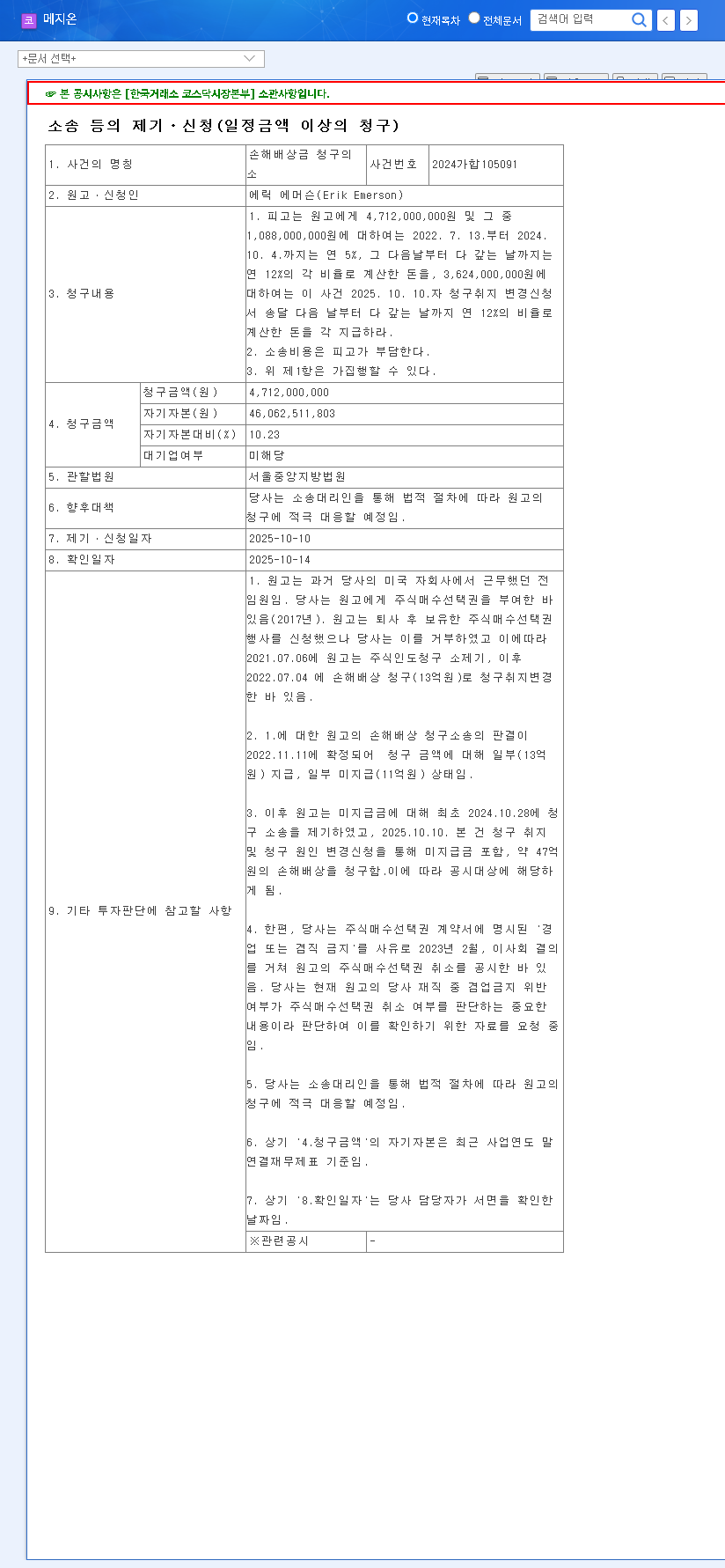
    The legal challenge facing Mezzion is not a minor dispute. It represents a significant financial threat that demands close scrutiny. Here are the core details of the claim filed against Mezzion Pharma Co., Ltd.:

    • Case Name: Claim for Damages
    • Plaintiff: Erik Emerson
    • Jurisdiction: Seoul Central District Court
    • Claim Amount: KRW 4,712,000,000
    • Impact on Assets: This amount represents a staggering 10.23% of Mezzion’s total assets, highlighting the material nature of the claim.
    • Company Response: Mezzion has publicly stated its intention to mount an active legal defense through its representatives. For more details, see the Official Disclosure.

    For a company already facing significant headwinds, a lawsuit of this magnitude is the last thing investors wanted to see. It’s not just the potential financial payout; it’s the diversion of resources and the damage to market sentiment that pose the real threats.

    A Perfect Storm: Compounding Financial and Operational Pressures

    The timing of this Mezzion Pharma lawsuit could not be worse. It arrives when the company’s fundamentals are already under immense strain. To fully grasp the potential fallout, one must consider the broader context of Mezzion’s current state.

    Persistent Drug Development Hurdles

    Mezzion’s primary focus is the development of a treatment for single ventricle heart disease (SVHD) in Fontan surgery patients. This noble pursuit has been fraught with challenges. A key setback occurred when the US FDA recommended additional clinical trials, forcing Mezzion to withdraw its new drug application. This has led to extended development timelines, ballooning R&D costs (reaching KRW 34.2 billion in H1 2025), and a cloud of uncertainty over its most critical asset.

    Deteriorating Financial Health

    The company’s financial statements paint a concerning picture. With high current liabilities (KRW 47 billion) and derivative liabilities (KRW 15.8 billion), Mezzion exhibits a high debt ratio and significant liquidity risk. The recent issuance of KRW 23 billion in convertible bonds adds to this burden. Compounding the issue, revenue from its once-stable BNF business unit has been in decline, removing a crucial financial cushion. This fragile state makes the prospect of a KRW 4.7 billion payout from the lawsuit particularly alarming.

    Analyzing the Mezzion Pharma Lawsuit’s Impact on Stock & Strategy

    Given the context, the repercussions of this lawsuit are likely to be multi-faceted, affecting investor sentiment, financial stability, and long-term business operations.

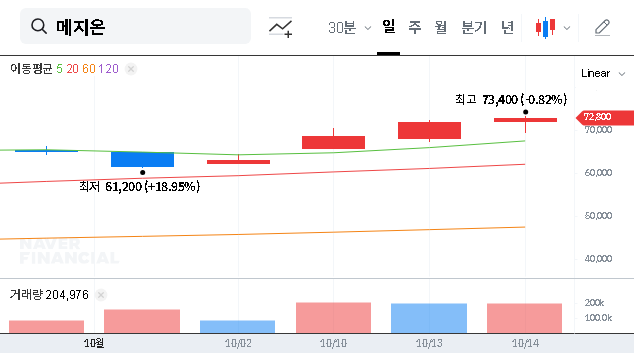
    • Stock Price Volatility: The news is a clear negative catalyst for Mezzion stock. Expect heightened short-term downward pressure as the market digests the risk. The 10.23% of assets figure will likely fuel sell-offs from risk-averse investors.
    • Deteriorating Cash Flow: An unfavorable verdict would directly impact Mezzion’s cash reserves, further straining its ability to fund ongoing R&D and meet its debt obligations. This could trigger a vicious cycle of financial distress.
    • Resource Diversion: Legal battles are costly and time-consuming. Management’s focus may be diverted from critical business operations and drug development to litigation strategy, potentially delaying key milestones.

    Strategic Considerations for Mezzion Investors

    For those considering a Mezzion investment or holding a current position, a cautious and informed approach is essential. The market for developmental-stage companies is already volatile, a fact underscored by broader trends in biotech sector analysis from sources like Reuters. Here are key areas to monitor:

    • Transparency and Communication: Watch for how Mezzion communicates the lawsuit’s progress. Prompt, transparent updates can help mitigate market uncertainty.
    • Legal Defense Milestones: Keep an eye on any public statements or filings from Mezzion’s legal team that might indicate the strength of their defense.
    • Financial Contingency Plans: It is critical to see if management outlines a plan to mitigate the financial impact of a potential loss. This could involve asset sales, strategic partnerships, or other forms of financing.
    • Core Business Progress: Ultimately, Mezzion’s long-term value is tied to its drug pipeline. Any positive news on the R&D front could help offset the negative sentiment from the lawsuit. Learn more about how to analyze biotech stocks for a deeper perspective.

    In conclusion, the Mezzion Pharma lawsuit is a material event that significantly elevates the risk profile of the company. Investors must weigh the potential of its drug development pipeline against a backdrop of severe financial strain and now, a costly legal battle. Diligent monitoring and a comprehensive risk assessment are more crucial than ever.

    (140410) Mezzion Pharma Lawsuit: KRW 4.7B Claim Rocks Stock – In-Depth Investor Analysis 관련 이미지
  • Kolmar BNH’s Lawsuit Withdrawal: A Sign of Management Stability and Investment Opportunity?

    Investment Analysis

    Kolmar BNH Lawsuit Withdrawal: 3 Key Insights for Investors

    The recent **withdrawal of Kolmar BNH’s application for a temporary shareholders’ meeting** has sent a strong signal to the market, suggesting a potential end to the prolonged management dispute. For investors, this development is a critical turning point. But what does it truly mean for the company’s future and your portfolio? This article breaks down the situation, analyzes the core fundamentals, and provides a clear action plan for what to watch next.

    Kolmar BNH stock chart showing positive movement after lawsuit withdrawal news
    The lawsuit withdrawal marks a pivotal moment for Kolmar BNH’s corporate governance.

    1. The Lawsuit Withdrawal: A Sudden Turn of Events

    On September 25, 2025, **Kolmar BNH formally withdrew its application** for a temporary shareholders’ meeting. The lawsuit (case number 2025Bihap50052), filed in the Daejeon District Court by Yoon Dong-han and another party, was officially concluded when their legal representative submitted a withdrawal notice. This move is widely interpreted as a step toward de-escalation, allowing the company’s management to sidestep a public confrontation and focus on core business operations.

    2. The Impact: Why This Matters for Corporate Value

    Management disputes are a significant drain on corporate resources and a major red flag for investors. They create a cloud of uncertainty that can depress stock prices, stall strategic initiatives, and damage morale. The withdrawal of this lawsuit is crucial because it:

    • Reduces Uncertainty: It removes the immediate threat of a disruptive shareholders’ meeting and signals a potential reconciliation behind the scenes.
    • Improves Investor Sentiment: A stable management team is key to long-term value creation. This news provides a much-needed boost to investor confidence.
    • Allows Focus on Business: Management can now redirect its energy and resources from legal battles to tackling fundamental business challenges.

    3. Investor Outlook: Analyzing Fundamentals & Strategy

    While the management situation appears to be stabilizing, savvy investors must look beyond the headlines. The core health of the business remains the ultimate driver of long-term stock performance.

    Fundamental Health Check

    Strengths to Build On

    • Solid business foundation
    • Consistent R&D investment
    • Ongoing global market expansion
    • Stable dividend policy

    Weaknesses to Address

    • Declining sales and profits
    • Increasing inventory levels
    • Dependence on major customers
    • Rising corporate debt

    “The key takeaway for investors is that while the withdrawal is a significant short-term positive, the mid-to-long-term success of Kolmar BNH hinges on its ability to address these fundamental challenges.”

    Your Action Plan: Key Metrics to Monitor

    Prudent investment requires ongoing vigilance. While the lawsuit withdrawal is a positive signal, focus on the following key performance indicators (KPIs) in the upcoming quarters:

    1. 1
      Performance Recovery: Is there a visible turnaround in sales and profit growth? Look for signs of stabilizing revenue streams.
    2. 2
      Balance Sheet Health: Are inventory and debt levels being managed effectively? Check the debt-to-equity ratio and inventory turnover.
    3. 3
      Innovation & R&D: Are new business ventures and R&D efforts yielding tangible results or new product pipelines?
    4. 4
      Customer Diversification: Are there concrete steps being taken to reduce dependency on a small number of major customers?

    Final Takeaway

    The end of the management dispute is a welcome development that clears the air for Kolmar BNH. For investors, this translates to reduced risk and a renewed focus on business fundamentals. While the short-term outlook is positive, long-term success will be determined by the company’s ability to execute its growth strategy and improve its financial health. Continue to monitor the key metrics outlined above to make an informed investment decision.

    Frequently Asked Questions

    Why was a temporary shareholders’ meeting requested?
    +

    It was likely requested as a strategic move during the management dispute to give shareholders a formal platform to make decisions on company direction and leadership.

    Will this news positively affect the stock price?
    +

    In the short term, reduced uncertainty often leads to improved investor sentiment, which can positively impact the stock price. However, long-term growth will depend on fundamental business improvements.

    What is the overall outlook for Kolmar BNH now?
    +

    The outlook is cautiously optimistic. With the management dispute seemingly resolved, the company can focus on its strategic goals. The key tasks ahead are reversing the decline in sales and improving overall profitability.