Tag: Kwangmu Co.

  • (029480) Kwangmu Management Dispute (029480): Injunction Dismissed, But Is the Stock a Buy? In-Depth Analysis

    (029480) Kwangmu Management Dispute (029480): Injunction Dismissed, But Is the Stock a Buy? In-Depth Analysis

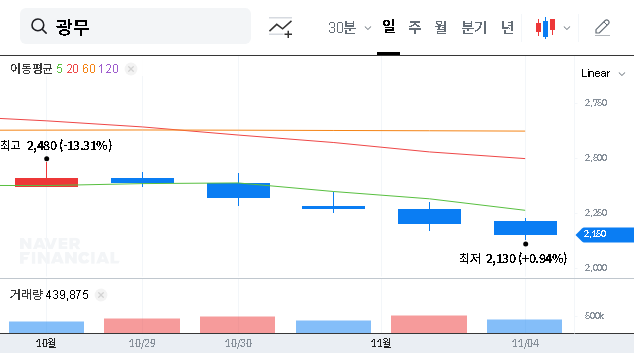
    The ongoing Kwangmu management dispute has been a source of significant uncertainty for investors. While a recent court decision provided a moment of relief, a deeper look into the company’s fundamentals reveals a far more complex picture. On November 12, 2025, the Seoul Central District Court’s dismissal of a provisional injunction against an extraordinary general meeting has seemingly stabilized the leadership situation, but this legal victory may only be a temporary reprieve from much more significant underlying challenges facing Kwangmu Co.,Ltd. (029480).

    This in-depth analysis unpacks the court’s decision, scrutinizes Kwangmu’s alarming H1 2025 financial report, and provides a strategic outlook for current and potential investors. Is this a turning point for the Kwangmu Co.,Ltd. stock, or just a pause before further turbulence?

    The Provisional Injunction Dismissal: A Short-Term Win

    The core of the recent news revolves around the dismissal of a provisional injunction application. Filed by previous major shareholders, the injunction sought to block an extraordinary general meeting, a common tactic in management rights disputes. According to the Official Disclosure (DART), the court dismissed all applications, effectively siding with the current management. In the short term, this is a positive development. It removes immediate legal uncertainty, which often weighs heavily on stock prices, and allows the current leadership to operate without the imminent threat of being ousted. This can restore a degree of investor confidence and provide a stable environment for management to focus on operational strategy.

    While the legal battle has paused, the war for Kwangmu’s financial survival is just beginning. The court’s decision clears the air, but the company’s balance sheet is clouded by severe underperformance.

    Beyond the Courtroom: Kwangmu’s Fundamental Crisis

    The relief from the Kwangmu management dispute is quickly overshadowed by the grim reality presented in the company’s H1 2025 report. The financial data paints a picture of a company in distress, facing challenges far greater than boardroom politics.

    Alarming Financial Health and Profitability Collapse

    While the company’s debt ratio improved significantly, this is a minor point in the face of a catastrophic decline in core operations. Key indicators reveal deep-seated problems:

    • Revenue Plunge: Revenue plummeted by 40.3% year-on-year to just KRW 3.9 billion. This is a clear sign of failing business segments.
    • Widening Losses: The company swung to an operating loss of KRW 2.2 billion, and the net loss ballooned to a staggering KRW 27.4 billion.
    • Cash Burn: Operating cash flow was a negative KRW 14.7 billion, indicating the company is burning through cash just to sustain its operations.

    The Failed Promise of the Kwangmu Secondary Battery Business

    Perhaps the most concerning data point is that the Kwangmu secondary battery material business—once touted as a key future growth engine—recorded zero revenue in the first half of 2025. This suggests a complete stall in progress, raising serious questions about the viability of the venture and management’s ability to execute on its strategic pivots. For investors who bought into the growth story, this is a major red flag. To learn more about the sector’s challenges, investors can read about current secondary battery market trends.

    Investor Outlook: Navigating Uncertainty for Stock 029480

    Given this complex backdrop, investors must weigh the short-term legal stability against the long-term fundamental weaknesses. The change in the largest shareholder to Hyupjin Co., Ltd. adds another layer of uncertainty. Will the new major shareholder inject capital and a viable turnaround strategy, or will this lead to further instability?

    The downward trend of the stock price, coupled with macroeconomic headwinds like interest rate hikes and volatile raw material prices as reported by sources like Bloomberg, creates a high-risk environment. The positive impact of the injunction dismissal is likely to be fleeting unless management can deliver a concrete and convincing plan for a fundamental turnaround.

    Key Factors for Investors to Monitor:

    • Q3 & Q4 Performance: Any sign of revenue recovery or loss mitigation in upcoming quarterly reports will be critical.
    • New Shareholder Strategy: Announcements from Hyupjin Co., Ltd. regarding their plans for Kwangmu.
    • Secondary Battery Business Updates: Any news, partnerships, or developments related to reviving this stalled business segment.
    • Potential for Future Disputes: While this injunction was dismissed, the underlying conflicts of the Kwangmu management dispute could resurface.

    In conclusion, the dismissal of the provisional injunction is a minor positive event in a sea of fundamental concerns. The direct impact on Kwangmu’s long-term corporate value is expected to be minimal. Prudent investors should view the Kwangmu Co.,Ltd. stock (029480) with extreme caution, demanding tangible evidence of a business turnaround before considering it a viable investment.
    (029480) Kwangmu Management Dispute (029480): Injunction Dismissed, But Is the Stock a Buy? In-Depth Analysis 관련 이미지
  • (029480) Kwangmu Management Dispute: In-Depth Analysis of Stock Outlook & Fundamental Crisis (029480)

    (029480) Kwangmu Management Dispute: In-Depth Analysis of Stock Outlook & Fundamental Crisis (029480)

    The ongoing Kwangmu management dispute has sent shockwaves through the investor community, casting a dark shadow over the company’s future. For investors holding or considering stock in Kwangmu Co.,Ltd. (029480), the situation has evolved from concerning to critical. This isn’t just a boardroom squabble; it’s a battle for control happening on the shaky ground of a severe Kwangmu fundamental crisis. This comprehensive analysis will dissect the lawsuit, evaluate the company’s deteriorating financial health, and provide a clear-eyed Kwangmu stock outlook to guide your investment decisions.

    When a legal battle for control collides with a pre-existing financial meltdown, the result is a perfect storm of uncertainty. For Kwangmu, the path forward is fraught with unprecedented risk.

    The Lawsuit Igniting the Fire: A Management Dispute Unfolds

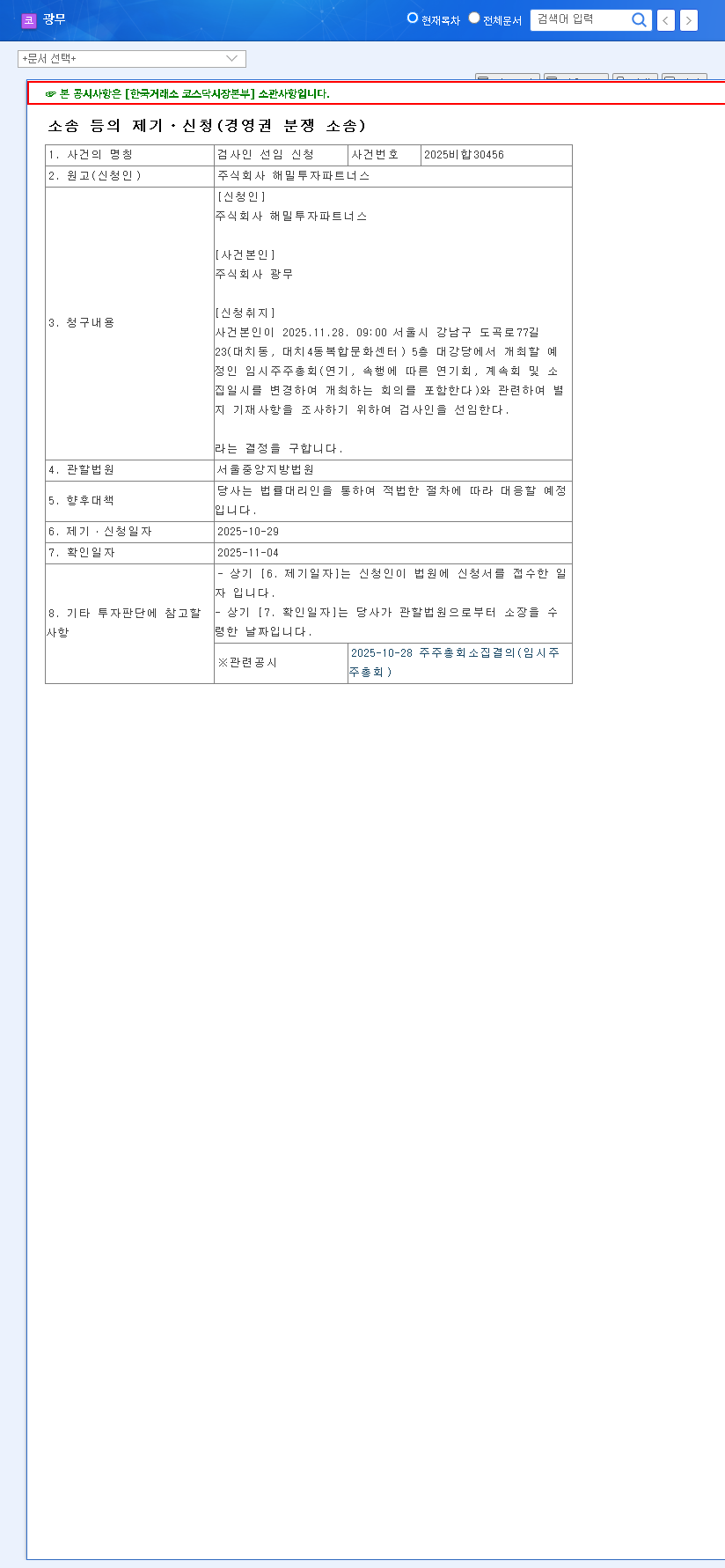
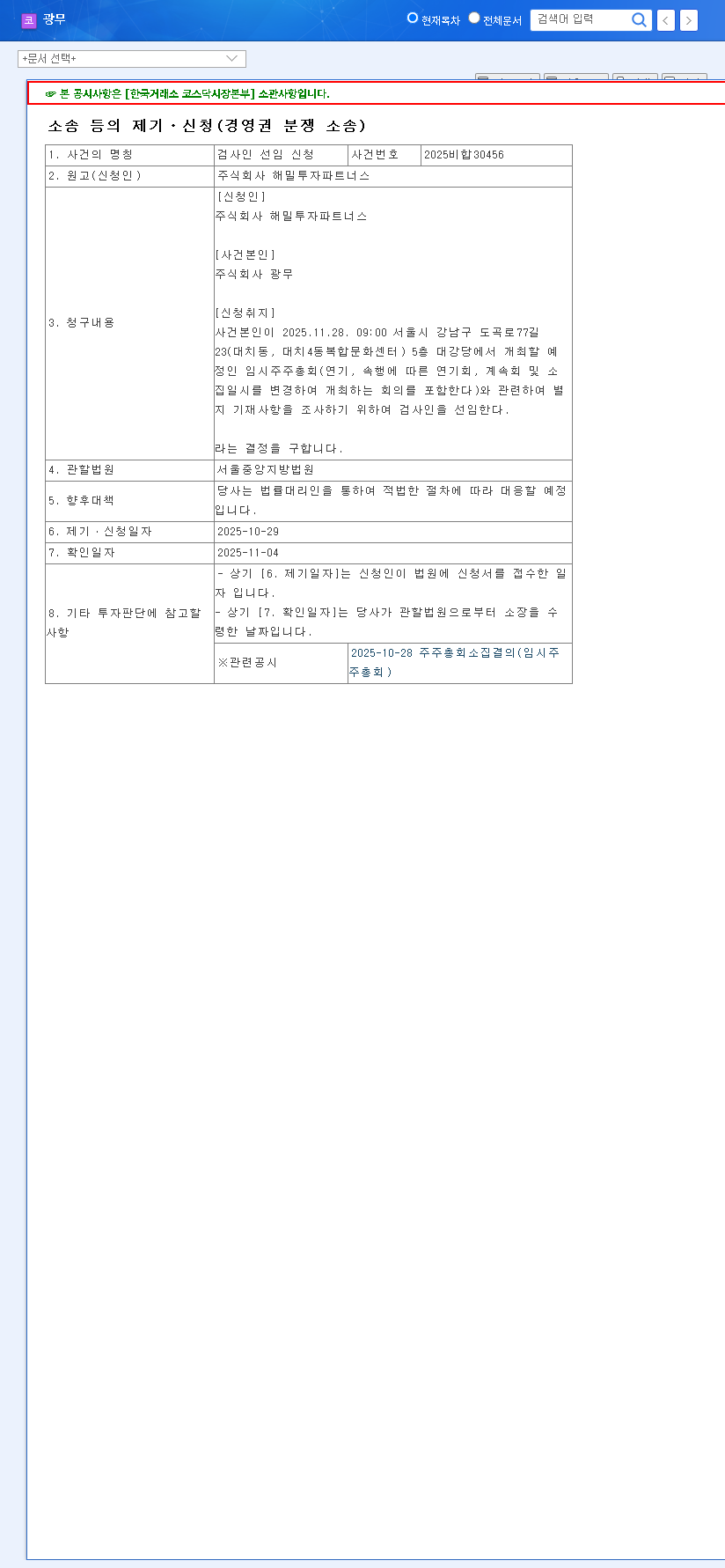
    The official start of the Kwangmu management dispute was marked by a significant legal filing: an ‘application for the appointment of an auditor’ submitted by Haemil Investment Partners Co., Ltd. This move signals a deep-seated distrust in the current management’s ability to operate transparently and effectively. An auditor appointment is a tool used by shareholders to force an independent investigation into a company’s financial records and operational conduct. You can view the filing directly via the Official Disclosure (DART). This action is the first public shot in what is expected to be a prolonged battle for the company’s direction.

    Analyzing the Kwangmu Fundamental Crisis

    Long before the management dispute came to light, Kwangmu was already navigating a severe internal crisis. A detailed 029480 analysis of its recent semi-annual report reveals a company in financial distress. The key issues are alarming:

    • Catastrophic Revenue Decline: Revenue plummeted by a staggering 40.3% year-over-year. This isn’t a minor dip; it’s a sign of a core business in retreat.
    • Failed New Ventures: The much-hyped secondary battery material business, once a beacon of future growth, recorded zero product sales. This failure has not only wasted capital but also shattered confidence in management’s strategic vision.
    • Deepening Profitability Woes: The company remains deep in the red with its operating profit, while net income has worsened significantly due to derivative-related losses.
    • Precarious Financial Health: The debt-to-equity ratio has surged to a dangerous 230.13%. This indicates that the company is heavily reliant on debt to finance its assets, posing a significant risk to shareholders in a downturn. For more on this, read our guide on Understanding Financial Ratios for Stock Analysis.

    The Compounding Effect of Market Headwinds

    External macroeconomic factors are exacerbating Kwangmu’s internal problems. Persistently high interest rates make servicing its large debt burden more expensive. According to market analysis from authoritative sources like Bloomberg, currency volatility and fluctuating raw material costs further squeeze margins, leaving no room for error in an already fragile operation.

    Kwangmu Stock Outlook: Navigating Extreme Volatility

    The confluence of the Kwangmu management dispute and its fundamental crisis creates a ‘Very High Risk’ environment for investors. The potential impacts on the stock price are severe:

    • Paralyzed Decision-Making: Management’s focus will be diverted to legal battles instead of fixing the core business, potentially worsening operational performance.
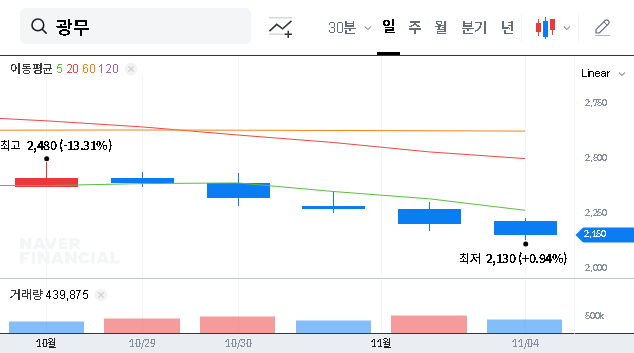
    • Heightened Stock Volatility: The lawsuit will fuel speculation and anxiety, leading to erratic price swings. As the dispute drags on, sustained downward pressure is highly likely.
    • Eroded Investor Confidence: Public disputes destroy trust. This makes it harder to attract new capital, which is desperately needed to address the company’s high debt load and fund any potential turnaround.

    Investor Action Plan: A Strong Recommendation to Defer

    At this juncture, any investment in Kwangmu (029480) carries an exceptional level of risk. A positive outcome is difficult to envision without a clear and credible plan for a complete operational overhaul. We strongly advise investors to defer any new investment and for current shareholders to re-evaluate their position. Monitor the situation for any concrete recovery plans from either the current management or Haemil Investment Partners, but remain on the sidelines until tangible signs of improvement emerge.

    Frequently Asked Questions

    What are the biggest risk factors for Kwangmu Co.,Ltd. currently?

    Kwangmu faces a dual threat: a severe fundamental crisis (plummeting revenue, high debt, failed ventures) and the escalating Kwangmu management dispute. These two issues are feeding off each other, creating maximum uncertainty and risk.

    How is Kwangmu’s secondary battery material business performing?

    The business is in a state of complete stagnation. The latest financial reports show that product sales from this division have dropped to zero, raising serious doubts about its viability and the company’s ability to execute on new growth initiatives.

    Is it safe to invest in Kwangmu (029480) right now?

    No. Our analysis concludes that the company is in a ‘Very High Risk’ category. We strongly recommend deferring any investment decision until the management dispute is resolved and there is clear, verifiable evidence of a fundamental business turnaround.

    (029480) Kwangmu Management Dispute: In-Depth Analysis of Stock Outlook & Fundamental Crisis (029480) 관련 이미지
  • (029480) Kwangmu Convertible Bond Conversion: Stock Price Impact & Investor Guide (029480)

    (029480) Kwangmu Convertible Bond Conversion: Stock Price Impact & Investor Guide (029480)

    A pivotal financial event is unfolding for Kwangmu Co.,Ltd. (029480) that demands investor attention. The recent exercise of its 42nd Kwangmu convertible bond conversion rights is set to introduce a significant number of new shares into the market. This raises critical questions about potential share dilution and its effect on the Kwangmu stock price. This guide provides a comprehensive analysis to help you navigate this event and make informed decisions leading up to the new share listing date of November 11, 2025.

    Event Overview: Unpacking the Kwangmu Convertible Bond Conversion

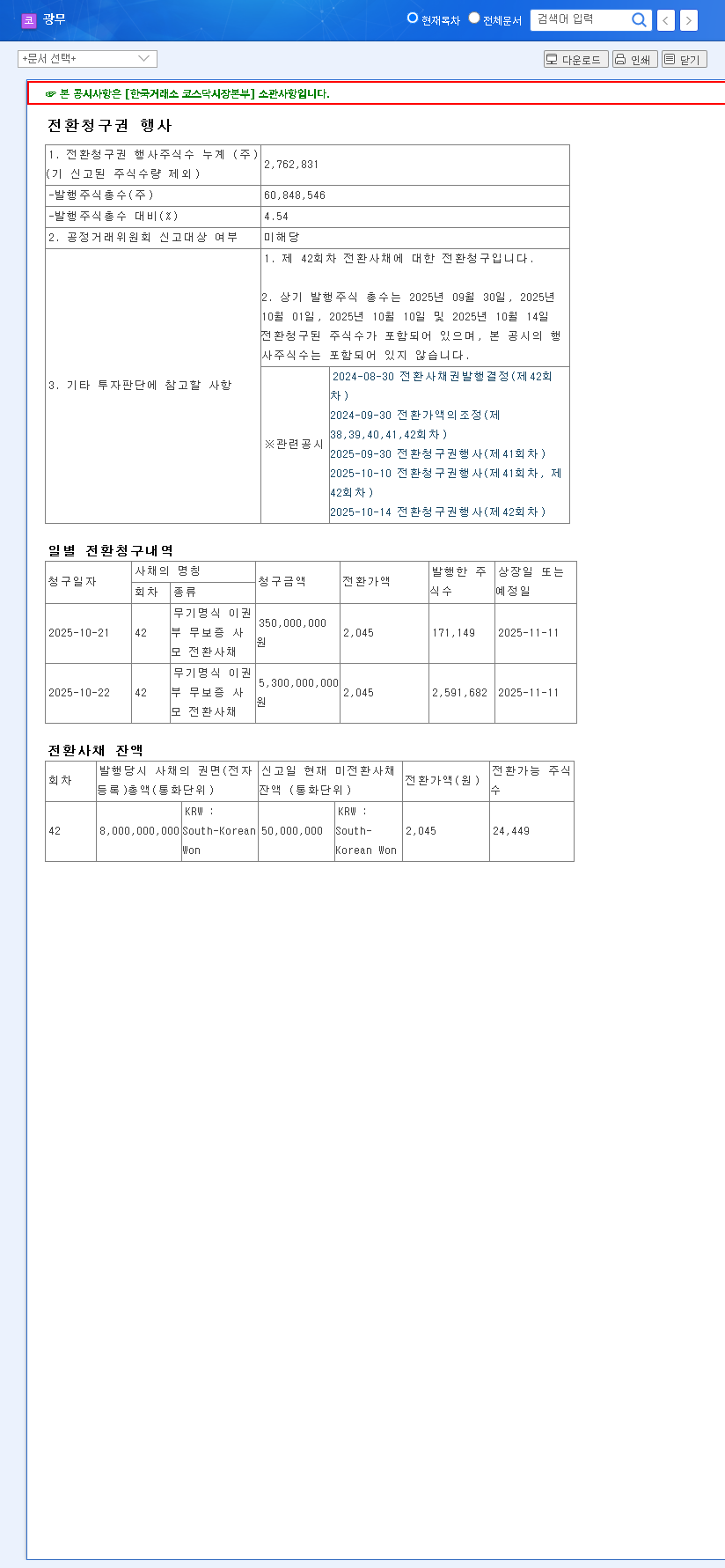
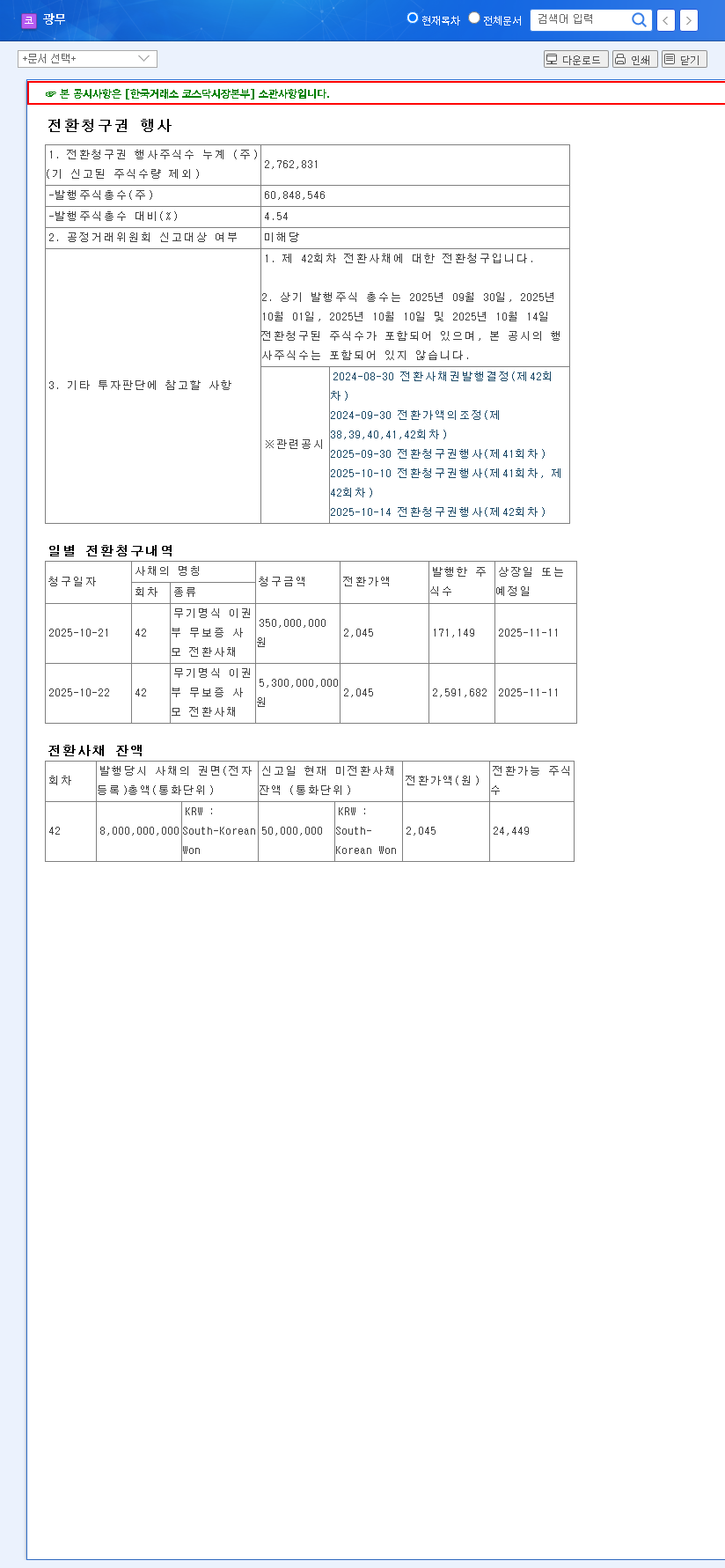
    Kwangmu Co.,Ltd. has officially announced that holders of its 42nd series of convertible bonds have chosen to exercise their conversion rights. In simple terms, these investors are trading their debt holdings (bonds) for equity (common shares) in the company. This is a common financial instrument, but the scale and terms of this specific conversion are what make it noteworthy. Here are the crucial details from the Official Disclosure (Source):

    • Company: Kwangmu Co.,Ltd. (029480)
    • Event: 42nd Convertible Bond Conversion Rights Exercise
    • New Shares to be Issued: 2,762,831
    • Ratio to Market Cap: 4.54%
    • Conversion Price: KRW 2,045 per share
    • Expected Listing Date: November 11, 2025

    Core Analysis: Why This Conversion Matters to You

    The introduction of nearly 2.8 million new shares is not a trivial event. It creates ripple effects that every current and prospective investor must understand. The two primary forces at play are share dilution and selling pressure.

    The Inevitable Share Dilution Impact

    The most direct consequence is the share dilution impact. Think of the company as a pizza. Before the conversion, it was cut into a certain number of slices (shares). Now, the company is adding 2,762,831 new slices. The pizza itself hasn’t grown, so each slice now represents a smaller portion of the whole pie. This increase in the number of outstanding shares can decrease key metrics like Earnings Per Share (EPS), potentially reducing the perceived value of each individual share.

    Arbitrage Opportunity and Selling Pressure

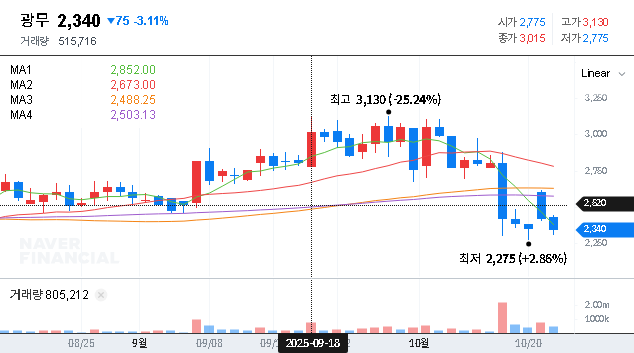
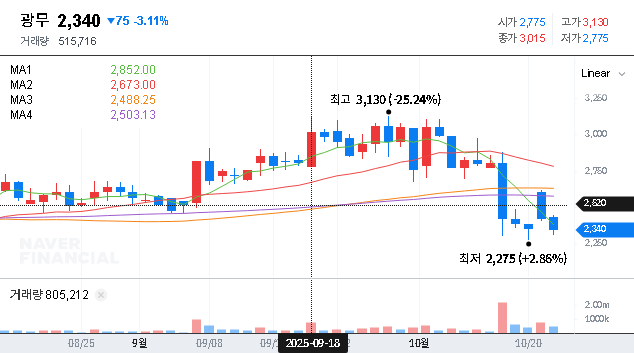
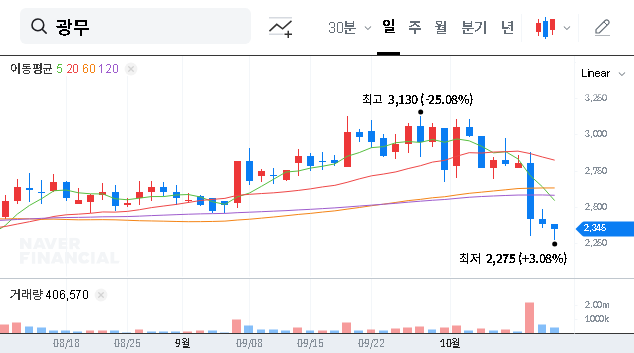
    The second critical factor is the price difference. The bondholders are converting their debt into shares at a price of KRW 2,045. With the current market price significantly higher (e.g., KRW 2,340 at the time of announcement), this creates a powerful incentive for these new shareholders to sell immediately upon listing to lock in a substantial, low-risk profit. This is a classic arbitrage opportunity.

    This anticipated wave of selling, especially concentrated around the November 11, 2025 listing date, could create significant downward pressure on the Kwangmu stock price as supply temporarily outstrips demand.

    Navigating the Uncertainty: What to Watch For

    A major challenge for investors is the current lack of public information on Kwangmu’s strategic outlook and underlying financial health. Without guidance from brokerage reports or clear company statements, predicting the long-term impact is difficult. The key question remains: how will the capital from this conversion be used? Will it fuel growth and innovation, or simply service existing debt? This uncertainty increases market volatility.

    For a deeper understanding of these financial instruments, you can read more about how convertible bonds work on Investopedia, a highly authoritative financial education resource.

    Investor Action Plan & Strategic Response

    Given the high probability of short-term price pressure, a measured and informed approach is essential. Your strategy should be twofold, addressing both the immediate volatility and the long-term potential.

    Short-Term Defensive Strategy (Pre-Listing)

    • Acknowledge Risk: Be prepared for potential price declines and increased volatility around the November 11, 2025 listing date.
    • Monitor Volume: Pay close attention to trading volumes. A spike in selling volume on or after the listing date will confirm the profit-taking trend.
    • Consider Hedging: Advanced investors might consider strategies to hedge their positions against a potential short-term drop.

    Long-Term Strategic Outlook (Post-Listing)

    The long-term story depends entirely on Kwangmu’s fundamentals. For further reading, you can check our internal guide on analyzing a company’s financial health.

    • Seek Information: Diligently search for company disclosures (IR reports, press releases) that clarify how the raised capital will be deployed.
    • Analyze Fundamentals: Look beyond this single event. Assess Kwangmu’s revenue growth, profit margins, and competitive position in its industry.
    • Evaluate Past Performance: Research how the Kwangmu stock price has reacted to past financing events. Historical patterns can sometimes provide valuable clues.

    Frequently Asked Questions (FAQ)

    What does this Kwangmu convertible bond conversion mean for an average shareholder?

    It means the total number of company shares is increasing, which dilutes your percentage of ownership. In the short term, it could also lead to a temporary drop in the stock price due to heavy selling from the bond converters.

    Why would bondholders convert if it pushes the stock price down?

    Their decision is based on individual profit. They acquire shares at a fixed price of KRW 2,045. If the market price is KRW 2,340, they can sell immediately for a guaranteed profit, regardless of the broader market impact.

    Is this event a definite negative for Kwangmu’s long-term value?

    Not necessarily. While the short-term mechanics suggest price pressure, the long-term impact depends on how effectively Kwangmu uses this capital. If it funds a highly profitable project or strengthens the balance sheet, it could be very positive for the company’s future value.

    (029480) Kwangmu Convertible Bond Conversion: Stock Price Impact & Investor Guide (029480) 관련 이미지
  • (029480) Kwangmu Management Dispute: EGM Injunction & Stock Analysis for Investors

    (029480) Kwangmu Management Dispute: EGM Injunction & Stock Analysis for Investors

    The ongoing Kwangmu management dispute has escalated significantly, capturing the attention of the investment community. A recent court filing to block a critical Extraordinary General Meeting (EGM) has cast a pall of uncertainty over the company’s future leadership and strategic direction. For current and prospective investors, this is a pivotal moment that demands careful analysis and a clear understanding of the potential risks and outcomes. This comprehensive guide breaks down the situation, explores the underlying causes, and provides actionable insights for navigating the turbulence ahead.

    The Catalyst: An Injunction to Halt the EGM

    On October 22, 2025, Kwangmu Co., Ltd. formally disclosed that a lawsuit had been filed seeking an injunction to prohibit its upcoming EGM, which was scheduled for November 28, 2025. The filing, lodged in the Seoul Central District Court by ‘Lee OOO and one other,’ names Kwangmu and another party as defendants. This legal maneuver is a direct challenge to the company’s current leadership and signals a deep-seated conflict over control. The official disclosure for this event can be viewed directly from the source: Official DART Report. The company has stated its intention to respond proactively through its legal representatives, but the battle lines have been drawn.

    Decoding the Kwangmu Management Dispute

    While the public filing is the tip of the iceberg, the root causes of the Kwangmu management dispute are likely complex. Based on the nature of the legal action, we can infer several potential scenarios that investors should consider:

    Possibility 1: Hostile Takeover Attempt

    An EGM is a classic battleground for hostile M&A activity. An external entity or a rival shareholder faction may be attempting to seize control by calling a meeting to replace board members or pass resolutions favorable to their agenda. The injunction, in this case, would be a defensive move by the incumbent management or their allies to stall the takeover attempt and buy time to rally support.

    Possibility 2: Internal Power Struggle

    The conflict may not be external but rather an internal schism. Disagreements among major shareholders or within the management team over corporate strategy, succession planning, or capital allocation can boil over into a public power struggle. One faction might have called the EGM to force a change, prompting the opposing side to resort to legal measures to block it. This scenario points to a severe breakdown in corporate governance.

    Possibility 3: Shareholder Activism

    Another angle is a dispute involving minority shareholder rights. Activist investors, feeling that their interests are being ignored or that management is underperforming, might have initiated the EGM to address specific grievances. The current leadership may view this as a disruptive action and are using the courts to quash it. Understanding the rights of shareholders is crucial in these situations, a topic covered extensively by authorities like the U.S. Securities and Exchange Commission.

    Regardless of the cause, a public management dispute creates significant operational and financial headwinds. The primary risk for investors is prolonged uncertainty, which can paralyze decision-making and erode shareholder value.

    Impact Analysis: What This Means for Kwangmu Stock

    The fallout from the Kwangmu EGM injunction will likely be felt in both the short and long term.

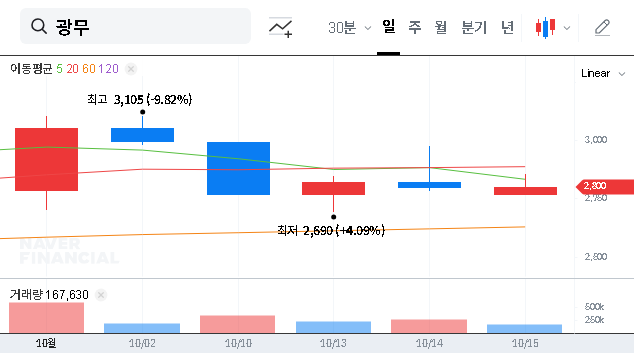
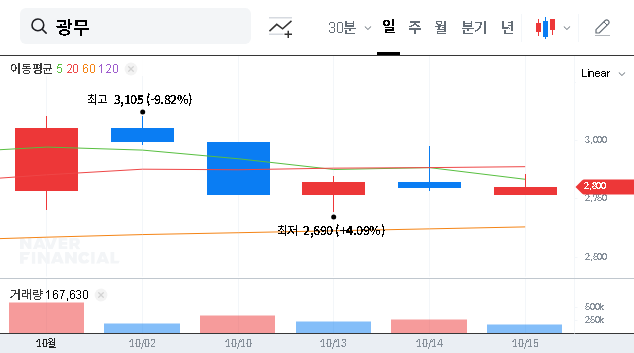
    • Short-Term Impact: Expect heightened stock price volatility. News of a management dispute often triggers fear, leading to sell-offs and downward pressure on the stock. Trading volumes may spike as speculators enter the fray, but the overall investor sentiment is likely to be negative until clarity emerges.
    • Long-Term Impact: A protracted legal battle could lead to management paralysis. Critical business decisions, new investments, and strategic partnerships may be put on hold. This stagnation can cause Kwangmu to lose its competitive edge. Furthermore, the company will incur significant legal fees, impacting its bottom line.

    Investor Guidance: A Prudent Action Plan

    Navigating the Kwangmu management dispute requires a cautious and informed approach. Rash decisions can be costly. Consider the following steps:

    • Monitor Official Channels: Keep a close watch on court decisions and official disclosures from Kwangmu. Avoid reacting to market rumors and focus on verified information.
    • Review Your Portfolio: Assess your exposure to Kwangmu stock. If it represents an oversized portion of your portfolio, consider rebalancing to mitigate risk through diversification.
    • Understand the Stakes: Analyze the potential outcomes. If the incumbent management wins, will it lead to stability or continued friction? If the challengers win, what is their vision for the company? For more on this, see our guide on How to Analyze Corporate Governance Risks.

    Ultimately, the resolution of this dispute will determine the company’s trajectory. Until then, caution is the most valuable asset for any investor involved with Kwangmu Co., Ltd.

    Disclaimer: This analysis is based on publicly available information and should not be considered direct investment advice. All investment decisions should be made after conducting personal due diligence.

    (029480) Kwangmu Management Dispute: EGM Injunction & Stock Analysis for Investors 관련 이미지
  • (029480) Kwangmu Management Dispute: A Deep Dive for Investors on Stock Impact & Future Outlook

    (029480) Kwangmu Management Dispute: A Deep Dive for Investors on Stock Impact & Future Outlook

    The Kwangmu management dispute has thrust Kwangmu Co.,Ltd. (광무) into the spotlight, creating significant uncertainty for investors. A recent lawsuit seeking to overhaul the company’s leadership has initiated a full-fledged battle for control, with profound implications for the Kwangmu stock price and its long-term strategic direction. This comprehensive analysis will unpack the core issues of this corporate governance challenge, evaluate its market impact, and provide a clear action plan for shareholders navigating this turbulent period.

    The Catalyst: A Lawsuit to Seize Control

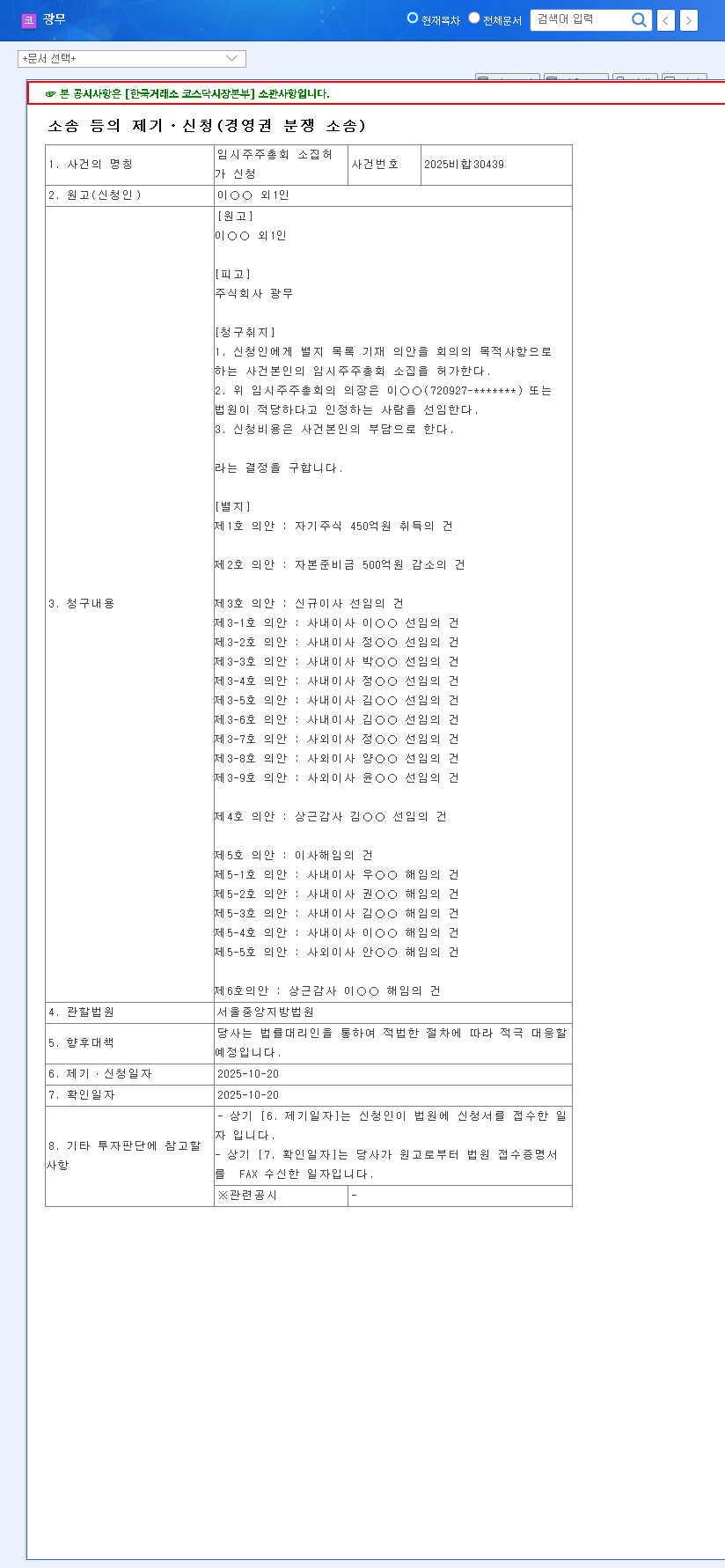
    The conflict officially began on October 20, 2025, when Mr. Lee ○○ and another party filed an application with the Seoul Central District Court. Their objective is to force a provisional shareholders’ meeting, an extraordinary measure used to address urgent matters outside the regular annual meeting schedule. This legal maneuver is a direct challenge to the current board and signals a serious attempt to reshape the company’s future. The complete details of this filing can be reviewed in the company’s official disclosure. (Source: Click to view DART report).

    The Applicants’ Strategic Agenda

    The application lays out a bold, multi-pronged strategy aimed at wrestling control from the incumbent management team. Each proposal is a calculated move in this corporate chess match:

    • Acquisition of 45 Billion KRW in Treasury Shares: This could serve a dual purpose—shoring up the stock price to win shareholder favor or creating a block of friendly shares to defend against counter-moves.
    • Reduction of Capital Reserve by 50 Billion KRW: While officially for securing dividend resources, this could be a tactic to unlock cash and distribute it to shareholders, essentially buying their support for the applicants’ agenda.
    • Appointment of 12 New Directors & 1 Auditor: This is the core of the takeover attempt. By proposing a slate of 9 internal and 3 external directors, the applicants aim to install a board loyal to their vision and gain majority control over all strategic decisions.
    • Dismissal of 6 Existing Directors & 1 Auditor: The final, unequivocal step is to completely oust the current leadership, leaving no room for opposition from the old guard.

    Kwangmu Co.,Ltd. has publicly stated its intention to mount a vigorous legal defense. The outcome will now be determined by the Seoul Central District Court, and subsequently, by the company’s shareholders.

    Market Impact and Future Outlook

    A management dispute of this magnitude invariably sends shockwaves through the market. The effects can be divided into immediate, short-term volatility and potential long-term shifts in the company’s fundamental value.

    This isn’t merely an internal power struggle; it is a pivotal event that directly impacts every shareholder’s investment. The central question is whether the proposed changes will ultimately unlock or destroy long-term value.

    Short-Term: Heightened Volatility is a Certainty

    The market abhors uncertainty, and the Kwangmu management dispute creates it in abundance. Investors should brace for a period of extreme fluctuations in the Kwangmu stock price. Trading volume is expected to surge as speculators and arbitrageurs enter the fray, attempting to profit from the chaos. Both sides will be vying for shares on the open market to bolster their voting power, which can lead to artificial price spikes. Conversely, the risk of short-sellers betting against the company amidst the instability also increases, potentially driving sharp downturns.

    Long-Term: A Fundamental Reshaping of Corporate Value

    Beyond the immediate market noise, the resolution of this dispute will have lasting consequences. A prolonged legal battle can drain company resources through significant legal fees and divert management’s focus from core business operations. If the challengers succeed, the company’s entire corporate governance framework and strategic direction could change overnight. This could be positive if the new team brings superior vision and execution, or disastrous if it leads to instability and poor decision-making. The future of existing projects, investment plans, and even dividend policies will hang in the balance until a clear winner emerges.

    Investor Action Plan: A Guide to Wise Decision-Making

    In this high-stakes environment, a proactive and informed approach is critical. Here are key strategies for investors:

    • Monitor Information Flow: Stay glued to official company disclosures, court ruling announcements, and reputable financial news. Information is your greatest asset in a volatile market.
    • Analyze Shareholder Structure: Understand the holdings of major institutional investors and which side they might favor. The balance of power will be critical in any shareholder vote. You can learn more with our guide to analyzing shareholder reports.
    • Assess Hostile M&A Potential: Recognize that this management dispute could be the first step toward a full hostile takeover. Understanding the mechanics of such events can provide crucial context.
    • Adopt a Cautious Stance: Given the current lack of fundamental corporate disclosures and the high level of uncertainty, speculative trading is extremely risky. A prudent, observant approach is recommended until the situation stabilizes.

    Conclusion: A Time for Prudence and Patience

    The Kwangmu management dispute is a defining moment for the company. While it creates opportunities for significant gains, the risks are equally substantial. Short-term price action will be unpredictable, and the long-term outlook depends entirely on which faction prevails and how effectively they can lead. For the average investor, the wisest course of action is to remain on the sidelines, gather information diligently, and wait for the dust to settle before making any major investment decisions. This is a time for caution, not conjecture.

    (029480) Kwangmu Management Dispute: A Deep Dive for Investors on Stock Impact & Future Outlook 관련 이미지
  • (029480) Kwangmu Co.,Ltd. Investment Analysis: Golden Value Fund’s 8.99% Stake and What It Means for Investors

    (029480) Kwangmu Co.,Ltd. Investment Analysis: Golden Value Fund’s 8.99% Stake and What It Means for Investors

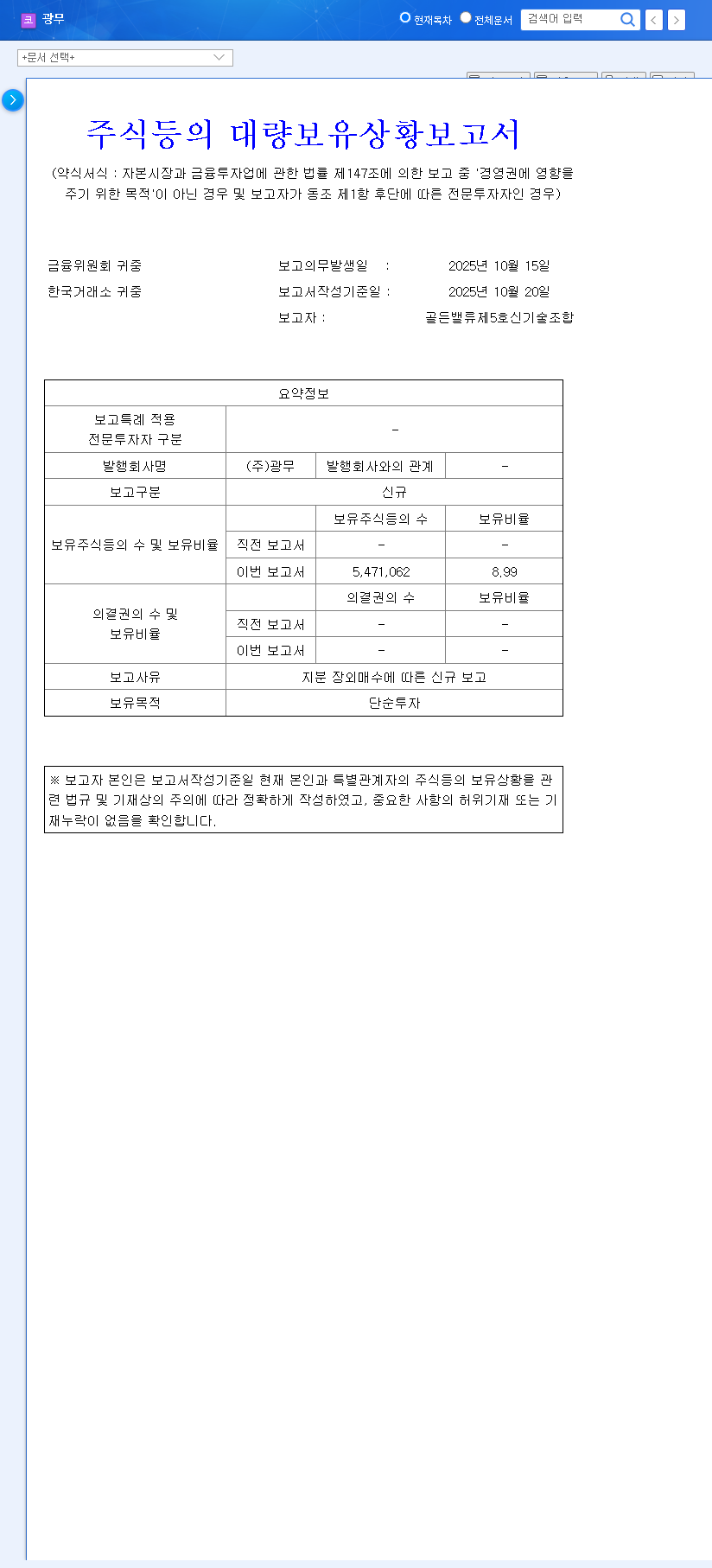
    A significant development in the landscape of Kwangmu Co.,Ltd. investment has captured the market’s attention. The recent disclosure that Golden Value No. 5 New Technology Fund has acquired a substantial 8.99% stake in the company (Ticker: 029480) has sent ripples through the investment community. While the stated purpose is a “simple investment,” any major shift in shareholding warrants a deeper analysis. This report unpacks the details of the acquisition, explores the potential motivations behind it, and provides a strategic action plan for current and prospective investors evaluating their position in Kwangmu Co.,Ltd. stock.

    The Landmark Acquisition: What Exactly Happened?

    On October 20, 2023, public records were updated to reflect a major transaction. Golden Value No. 5 New Technology Fund secured 5,471,062 shares, amounting to an 8.99% stake in Kwangmu Co., Ltd. The shares were acquired in an over-the-counter (OTC) purchase from Atlas8000 Co., Ltd. The transaction was formally reported, and you can view the Official Disclosure on the DART system for verification. This move instantly establishes the fund as a significant shareholder, capable of influencing investor sentiment and, potentially, future corporate direction.

    Decoding the ‘Simple Investment’ Motive

    The term “simple investment” is often used in disclosures to indicate that the acquiring party does not currently intend to participate in management or exert control. However, seasoned investors know this label can mask a range of strategic possibilities.

    The Bull Case: A Vote of Confidence

    The most optimistic interpretation is that a fund specializing in new technology sees deep, untapped value in Kwangmu’s business model and growth prospects. This Kwangmu Co.,Ltd. investment could be a purely financial play, betting on significant stock price appreciation. The “New Technology Fund” moniker suggests a potential synergy with Kwangmu’s existing or future projects, implying the fund’s analysis has identified a catalyst for growth that the broader market may have overlooked.

    The Strategic View: A Foot in the Door

    Alternatively, a “simple investment” can be the first step in a more ambitious plan. Acquiring a sub-10% stake allows the fund to establish a significant position without triggering more stringent disclosure or control-related regulations. From here, Golden Value No. 5 New Technology Fund can observe the company’s operations more closely, engage with management, and decide whether to increase its stake, push for strategic changes, or divest at a profit. This passive-aggressive approach is common in activist investing, a possibility that cannot be entirely ruled out.

    The emergence of a major, tech-focused shareholder is a pivotal event. It forces the market to reassess Kwangmu’s intrinsic value and future trajectory, creating both opportunities and risks for investors.

    Market Impact and Investor Action Plan

    News of this magnitude will inevitably affect Kwangmu Co.,Ltd. stock. We can anticipate increased short-term volatility as algorithms and retail investors react to the headline. However, a prudent long-term investor must look beyond the noise and formulate a strategy based on diligent research.

    Your Due Diligence Checklist

    Given the limited information, a cautious yet proactive approach is necessary. Before making any decisions, focus on gathering more intelligence:

    • Analyze Kwangmu’s Fundamentals: Go back to the basics. Scrutinize the company’s balance sheet, income statements, revenue growth, profit margins, and debt levels. Is the core business healthy enough to justify this new investment? A thorough guide to fundamental analysis can be an essential resource here.
    • Investigate the Investor: Research Golden Value No. 5 New Technology Fund. What is their investment track record? Do they typically take passive stakes, or do they have a history of activism? Understanding the fund’s modus operandi provides crucial context for their 029480 stock analysis and purchase.
    • Monitor Management’s Response: Pay close attention to any official statements, press releases, or investor calls from Kwangmu’s management. Their reaction—or lack thereof—to their new major shareholder will be very telling.
    • Review Market Consensus: See what professional analysts and institutional reports are saying. While not infallible, expert opinions from sources like Bloomberg or Reuters can help gauge the broader market sentiment.

    Conclusion: A Catalyst for Re-evaluation

    The acquisition of an 8.99% stake in Kwangmu by Golden Value No. 5 New Technology Fund is more than just a large transaction; it’s a significant catalyst. It validates the company to some, while introducing uncertainty for others. For the diligent investor, this is an opportunity. Rather than reacting to short-term price swings, use this event as a prompt to conduct a deep, comprehensive review of your Kwangmu Co.,Ltd. investment thesis. A clear-headed, long-term perspective, backed by solid research, will be your greatest asset in navigating what comes next.

    (029480) Kwangmu Co.,Ltd. Investment Analysis: Golden Value Fund's 8.99% Stake and What It Means for Investors 관련 이미지
  • (029480) Kwangmu Major Shareholder Sale (029480): An In-Depth Investor Analysis

    (029480) Kwangmu Major Shareholder Sale (029480): An In-Depth Investor Analysis

    A seismic shift is underway at Kwangmu Co., Ltd. (029480), triggering significant concerns for current and potential investors. The complete divestment by its largest shareholder, Atlaspalcheun Co., Ltd., is more than a routine transaction; it’s a critical event that casts a long shadow over the company’s management stability and future strategy. This Kwangmu major shareholder sale has sent ripples through the market, leaving many to wonder if this is a precursor to a necessary corporate overhaul or a sign of deeper troubles ahead. This comprehensive investor analysis will dissect the event, evaluate the potential stock price impact, and provide a clear action plan for navigating the heightened management uncertainty.

    For anyone holding Kwangmu stock or considering an investment, understanding the nuances of this situation is paramount for making informed decisions in a volatile environment.

    The Catalyst: A Complete Divestment by the Largest Shareholder

    What Exactly Happened?

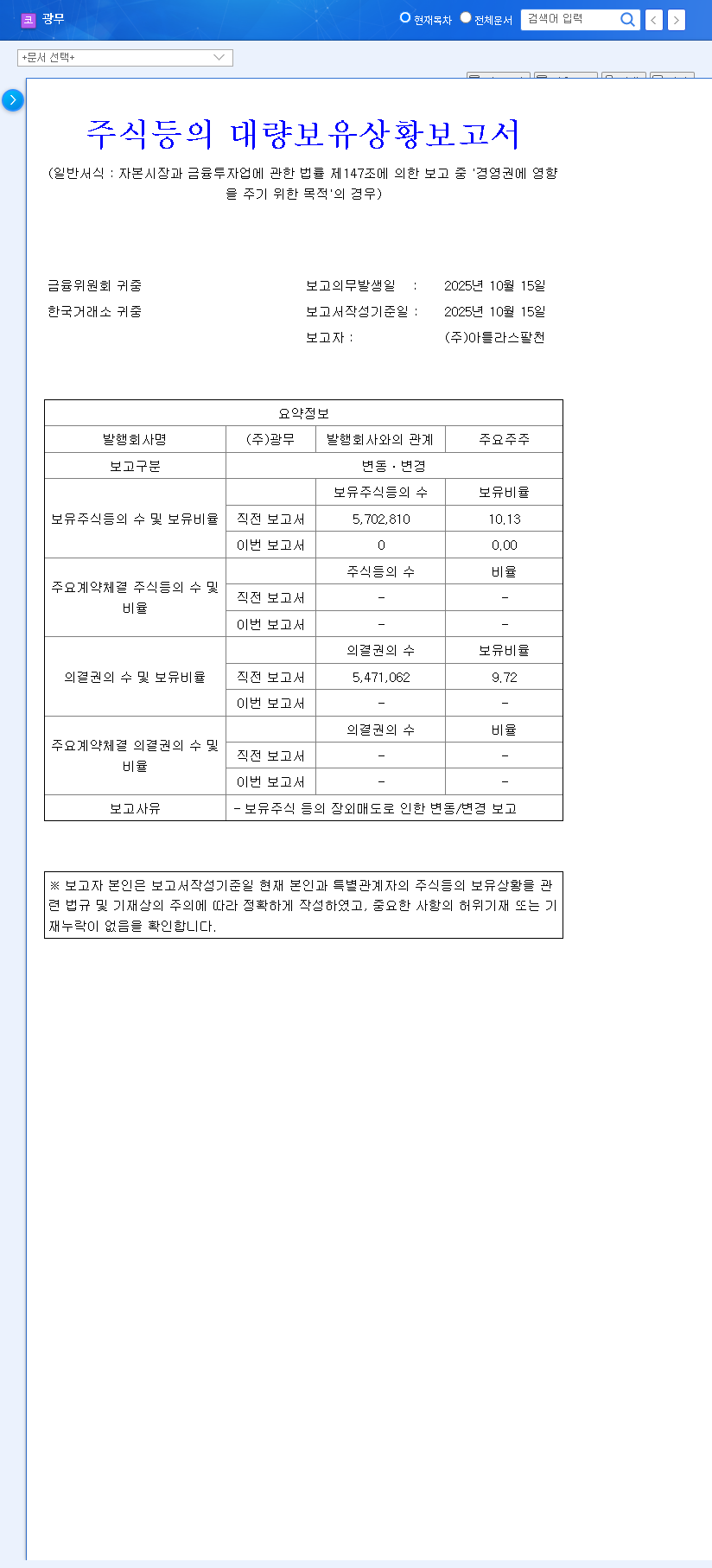
    On October 15, 2025, Kwangmu’s ownership structure was fundamentally altered. Atlaspalcheun Co., Ltd., formerly the largest shareholder with a 10.13% stake, executed an off-market sale of its entire position. This move was detailed in an Official Disclosure (Source). The significance of this sale is amplified by the fact that Atlaspalcheun’s stated purpose for holding the shares was ‘management influence.’ Their complete exit signals a definitive withdrawal from any strategic involvement, creating a power vacuum and fueling market anxiety about the company’s future direction and control.

    When a major shareholder with a stated goal of ‘management influence’ sells every single share, the market interprets it as a vote of no confidence. This creates immediate and severe management uncertainty that can paralyze strategic decision-making.

    Impact Analysis: A Two-Fold Crisis for Kwangmu (029480)

    Short-Term Shockwaves: Financial Strain and Market Jitters

    The immediate fallout from the Kwangmu major shareholder sale is likely to be negative. The leadership void directly impacts investor sentiment and operational stability. Compounding this issue is Kwangmu’s precarious financial health. The 2025 semi-annual report revealed alarming figures: over 16 billion KRW in outstanding convertible bonds and 18.7 billion KRW in current liabilities, against a mere 1.83 billion KRW in cash. This ownership change could exacerbate liquidity pressure, making it harder to manage debt and fund operations. Furthermore, with a 40% drop in semi-annual revenue and zero income from its secondary battery materials venture, the company’s fundamentals are already weak. The absence of a clear leader will only hinder recovery efforts.

    Mid-to-Long-Term Outlook: All Eyes on the New Leadership

    Kwangmu’s future now hinges entirely on the identity and intentions of the new controlling entity. The long-term trajectory will be determined by several factors: Will the new shareholder be a strategic partner with a vision for growth, or a financial player seeking short-term gains? A new, competent management team could aggressively restructure the failing business portfolio, potentially salvaging the secondary battery business or pivoting to new growth areas. However, if the new ownership fails to present a credible turnaround plan, the company’s existing NI/SI businesses, already facing stiff competition, will likely continue their decline. For a deeper understanding of corporate turnarounds, investors can review case studies from authoritative business journals.

    Investor Action Plan: Navigating the Uncertainty

    Given the high level of risk, a cautious and vigilant approach is essential. The negative signals from weak fundamentals and the shareholder exodus are likely to create significant downward stock price impact in the near term. Investors should postpone any major decisions until there is clarity on the following critical points:

    • Identity and Vision of the New Major Shareholder: Who acquired the shares? What is their track record, management philosophy, and strategic plan for Kwangmu?
    • Tangible Business Restructuring Plans: Are there concrete proposals to revitalize the secondary battery business or develop new, viable revenue streams?
    • Commitment to Financial Health: How will the new leadership address the looming debt from convertible bonds and secure the necessary liquidity to ensure operational stability? For more on this, read our guide on evaluating corporate financial statements.

    Frequently Asked Questions (FAQ)

    Why is the Kwangmu major shareholder sale so significant?

    It is significant because the departing shareholder, Atlaspalcheun Co., Ltd., held its stake with the explicit purpose of ‘management influence.’ Their complete exit is not just a sale; it’s a withdrawal of strategic participation, which creates a critical leadership vacuum and deepens management uncertainty.

    How will this event affect Kwangmu’s stock price?

    In the short term, the stock price impact is expected to be negative. The combination of poor financial fundamentals and high-profile ownership uncertainty is a powerful deterrent for investors, likely leading to increased selling pressure and a decline in share value.

    What is the recommended approach for Kwangmu investors now?

    Extreme caution is advised. Investors should closely monitor all company disclosures and market news for information about the new major shareholder and their plans. Until a credible and transparent path forward is announced, making new investments or increasing positions carries a very high degree of risk.

    (029480) Kwangmu Major Shareholder Sale (029480): An In-Depth Investor Analysis 관련 이미지
  • (029480) Kwangmu Co.,Ltd. Stake Increase: A Deep Dive into Hyupjin’s Strategy & What It Means for Investors (122330021888)

    (029480) Kwangmu Co.,Ltd. Stake Increase: A Deep Dive into Hyupjin’s Strategy & What It Means for Investors (122330021888)

    In a significant development capturing market attention, Hyupjin Co., Ltd., the largest shareholder of Kwangmu Co., Ltd., has executed a substantial Kwangmu Co.,Ltd. stake increase, cementing its position and signaling a clear intent to fortify its management control. This move has ignited widespread speculation about Kwangmu’s future, particularly concerning its struggling secondary battery materials division and overall corporate direction. Will this be the catalyst that finally propels Kwangmu out of its business stagnation, or is it a prelude to more internal restructuring? This analysis provides a comprehensive look at Hyupjin’s strategic motives, Kwangmu’s financial health, and the critical factors investors must now consider.

    The Details: A Breakdown of the Stake Increase

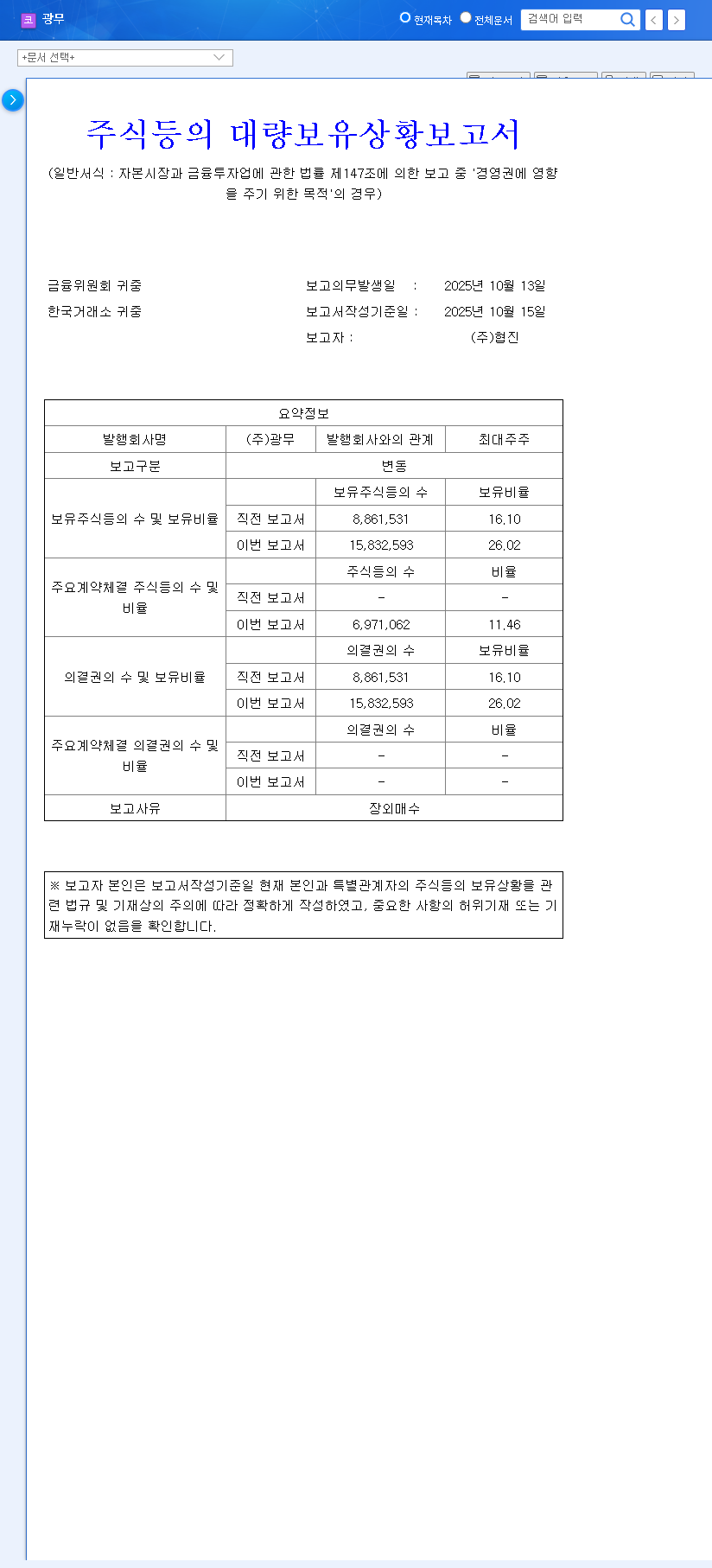
    On October 15, 2025, Kwangmu Co.,Ltd. filed a ‘Report on the Status of Large Shareholding,’ confirming the transaction. The official disclosure, available on Korea’s DART system, provides the raw data behind this strategic maneuver. You can review the Official Disclosure (Source) for complete details. Hyupjin’s actions were decisive and well-orchestrated through a series of off-market purchases.

    Key Transaction Highlights

    • Reporting Entity: Hyupjin Co., Ltd.
    • Stated Purpose: Influence over management.
    • Ownership Before Change: 16.10%
    • Ownership After Change: 26.02% (a 9.92 percentage point increase)
    • Method of Acquisition: Off-market purchases from various entities, including Hansluce Co., Ltd. and Golden Value No. 5 New Technology Investment Partnership.

    By raising its total stake to over 26%, Hyupjin has significantly tightened its grip on Kwangmu. This level of ownership provides substantial power to influence board decisions, guide strategic initiatives, and implement a more hands-on approach to management, moving far beyond the role of a passive investor.

    Analyzing Hyupjin’s Motives and Kwangmu’s Challenges

    This Kwangmu Co.,Ltd. stake increase is not an impulsive act but a calculated move rooted in Kwangmu’s current business realities and Hyupjin’s long-term vision. To understand why, we must examine Kwangmu’s fundamental weaknesses and the potential synergies Hyupjin aims to unlock.

    Kwangmu’s Precarious Position

    Kwangmu has been struggling. Its traditional business segments (NI/SI and ITO) are in decline, dragging down overall sales. More alarmingly, the secondary battery materials business—once touted as the company’s future—posted zero sales in the first half of 2025 after a modest KRW 13.21 billion in 2024. This suggests significant operational hurdles or delays in supply contracts. While its finances have seen some improvement from debt reduction, a net loss has eroded total equity. This backdrop of declining core revenue and a faltering growth engine made Kwangmu ripe for a strategic intervention.

    “Hyupjin isn’t just buying shares; it’s buying control. This is a clear signal that the era of passive oversight is over. They are moving in to directly steer the ship, likely targeting a major overhaul of the secondary battery business and a push for operational efficiency,” notes a market analyst from a leading financial publication.

    Hyupjin’s Strategic Play for Synergy and Growth

    With a firm grip on Kwangmu management control, Hyupjin can now execute its strategy more forcefully. Key objectives likely include:

    • Accountable Leadership: Installing a management team that can drive consistent strategy and be held directly responsible for performance metrics.
    • Revitalizing the Battery Business: Leveraging its own network and resources, potentially in conjunction with the acquisition of Central Advanced Materials Co., Ltd., to finally activate Kwangmu’s potential in the high-growth secondary battery materials market.
    • Aggressive Restructuring: Undertaking bold moves, such as capital increases, divestment of non-core assets, or business reorganizations, to streamline operations and focus on profitable ventures.

    Investor Outlook: Opportunities and Risks

    For investors, this event presents a double-edged sword. A proactive majority shareholder can be a powerful force for positive change, but the path to recovery is fraught with risks. A sound Kwangmu investment strategy requires weighing these factors carefully.

    The Bull Case: A Path to Turnaround

    The upside is clear: stabilized management, accelerated strategic execution, and the potential for new capital injections to fund growth. The synergy between Kwangmu and Hyupjin’s other interests could unlock value that has long been dormant, especially in high-tech materials.

    The Bear Case: Execution and Governance Risks

    However, significant risks remain. The news may cause short-term stock price volatility. More importantly, Hyupjin’s success depends entirely on its ability to execute its plan. A strong vision is meaningless without competent operational management. Investors must also watch for potential governance issues, such as conflicts with minority shareholders or the overhang from convertible bonds that could dilute equity.

    Actionable Plan for Investors

    Instead of reacting to market noise, investors should focus on monitoring tangible progress:

    • Monitor all official announcements from Hyupjin regarding its specific plans for Kwangmu.
    • Scrutinize the upcoming Q3 earnings report for any signs of revenue in the secondary battery segment.
    • Track changes in financial health and be aware of any new convertible bond issuances or conversions.

    Ultimately, the Kwangmu Co.,Ltd. stake increase is a pivotal moment. The long-term value will be determined not by this transaction alone, but by the strategic clarity, operational excellence, and disciplined execution that follows.

    (029480) Kwangmu Co.,Ltd. Stake Increase: A Deep Dive into Hyupjin's Strategy & What It Means for Investors (122330021888) 관련 이미지
  • (029480) Kwangmu Convertible Bond Conversion: A Deep Dive for Investors

    (029480) Kwangmu Convertible Bond Conversion: A Deep Dive for Investors

    The recent announcement regarding the Kwangmu convertible bond conversion has sent ripples through the investment community. With nearly a million new shares set to enter the market, existing and potential investors are asking critical questions: What does this mean for the company’s future, and how will it impact the stock price? While the conversion helps clean up the balance sheet by reducing debt, the looming threat of share dilution and the company’s shaky fundamentals present a complex picture. This in-depth analysis will dissect the event, evaluate Kwangmu’s financial health, and provide a clear investment strategy.

    Event Overview: The 42nd CB Conversion Details

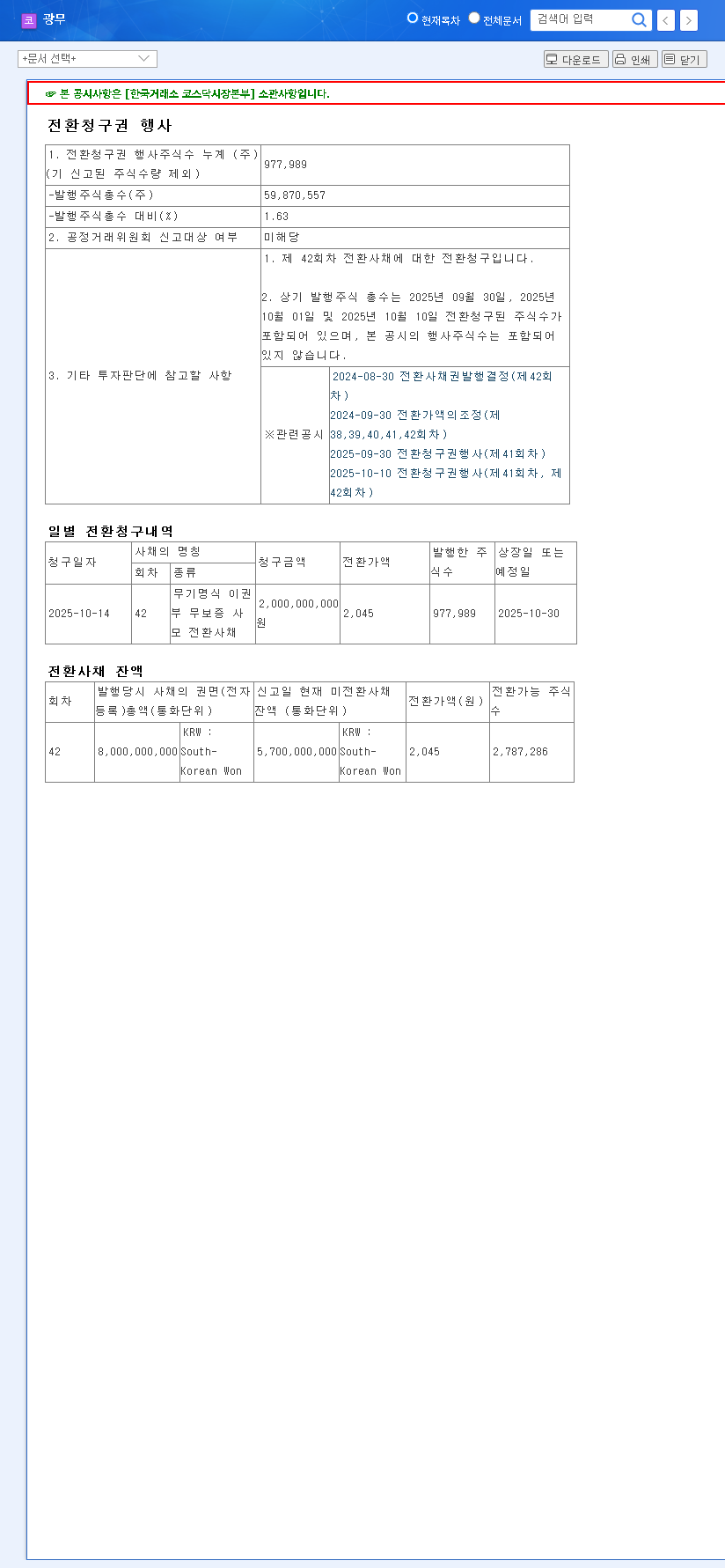
    On October 14, 2025, Kwangmu Co., Ltd. confirmed the exercise of conversion rights for its 42nd convertible bond tranche. This action will result in the issuance of 977,989 new shares, which are scheduled to be listed on October 30, 2025. This represents approximately 1.63% of the company’s market capitalization on the day of the announcement.

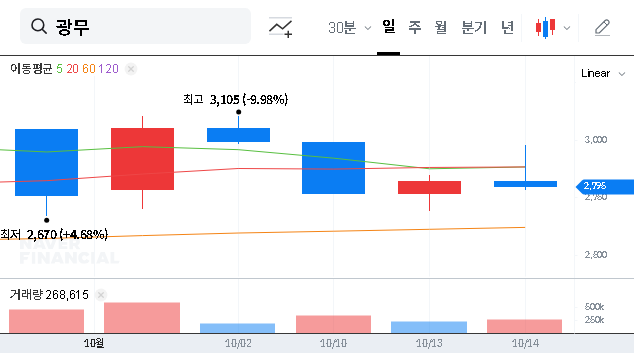
    A key point of concern is the conversion price of KRW 2,045 per share. With the stock trading significantly higher at KRW 2,795 at the time, this creates a substantial arbitrage opportunity for bondholders. They can immediately sell their newly acquired shares for a quick profit, creating significant selling pressure that could drive the stock price down. The official details of this event can be found in the company’s public disclosure (Source: Official Disclosure).

    Essentially, a convertible bond is a hybrid security that starts as a loan (bond) but includes an option for the holder to convert it into a set number of common stock shares. For a more detailed explanation, you can refer to authoritative sources like Investopedia.

    Kwangmu’s Unstable Financial Foundation

    The context of this Kwangmu convertible bond conversion is critical, and unfortunately, the company’s financial health is far from robust. An analysis of its latest semi-annual report reveals deep-seated issues that magnify the risks associated with this new share issuance.

    Core Business Underperformance

    • Legacy Business Decline: Revenue from core ITO and NI/SI segments is shrinking due to a stagnant telecom market and fierce competition.
    • New Venture Failure: The highly anticipated secondary battery material business has recorded zero sales, hampered by market slowdowns and project delays.

    Severe Financial Instability

    The financial statements paint a grim picture:

    • Equity Erosion: Consolidated total equity fell by approximately KRW 30 billion year-over-year.
    • Cash Burn: Cash reserves have plummeted from KRW 56.4 billion to a mere KRW 1.8 billion.
    • Deep Losses: The company recorded a staggering net loss of KRW 27.4 billion, highlighting severe profitability issues.

    Frequent management changes, including a new major shareholder in April 2025, only add to the operational uncertainty. This backdrop makes the CB conversion look less like a strategic move and more like a desperate measure for liquidity. For more insights on how to interpret such data, consider reading our guide on how to analyze a company’s financial health.

    Investment Strategy: Navigating the Kwangmu Stock Outlook

    Given the significant share dilution effect and the company’s weak fundamentals, a highly cautious and conservative investment stance is advised. This CB conversion is unlikely to be a catalyst for a long-term turnaround.

    Recommendations for Investors

    • Short-Term Traders: Brace for volatility. The overhang from the new shares creates a high probability of a short-term price decline. The risk currently outweighs the potential reward.
    • Long-Term Investors: Stay on the sidelines. Before considering an investment, look for concrete evidence of a fundamental turnaround. This includes successful business restructuring, tangible results from new ventures, and a sustainable improvement in financial stability. Without these, the stock’s long-term prospects remain poor.

    Frequently Asked Questions

    What exactly is the Kwangmu convertible bond conversion?

    It is the process where holders of Kwangmu’s convertible bonds (a form of debt) choose to exchange that debt for company stock. In this case, it results in nearly one million new shares being created and issued to these bondholders.

    How does this CB conversion impact the stock price?

    The short-term impact is likely negative. The increase in the number of shares dilutes the ownership stake of existing shareholders. Furthermore, since the conversion price is low, bondholders are incentivized to sell their new shares immediately, which increases supply and can push the stock price down.

    What is Kwangmu’s current financial situation?

    Kwangmu’s financial status is precarious. The company is facing declining revenues in its main businesses, has failed to generate income from new ventures, and is experiencing significant cash burn and net losses, leading to a highly unstable financial structure.

    What is the final investment opinion on Kwangmu stock?

    A ‘conservative’ or ‘avoid’ stance is recommended. The risks tied to the Kwangmu convertible bond conversion, combined with deep-rooted business and financial problems, make it a high-risk investment at this time. Investors should wait for clear signs of a fundamental business recovery before committing capital.

    (029480) Kwangmu Convertible Bond Conversion: A Deep Dive for Investors 관련 이미지
  • (029480) Kwangmu Stock Forecast: A Deep Dive into the Conversion Rights Exercise

    (029480) Kwangmu Stock Forecast: A Deep Dive into the Conversion Rights Exercise

    This comprehensive Kwangmu stock forecast delves into the company’s recent announcement regarding a significant exercise of conversion rights, an event that has captured the full attention of the investment community. As Kwangmu navigates a pivotal transition towards its secondary battery business, we analyze whether this financial maneuver signals a long-term growth opportunity or introduces short-term market threats. Join us as we explore the fundamentals, market dynamics, and strategic implications for investors.

    Understanding the Kwangmu Conversion Rights Exercise

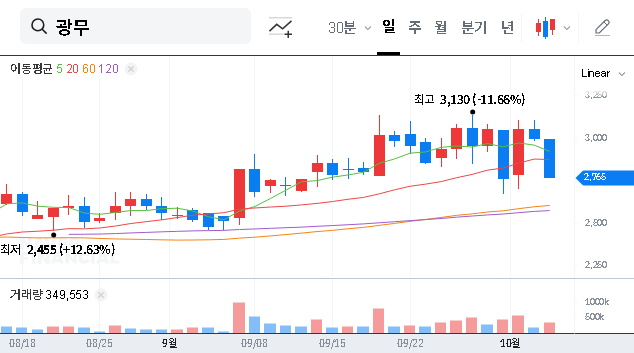
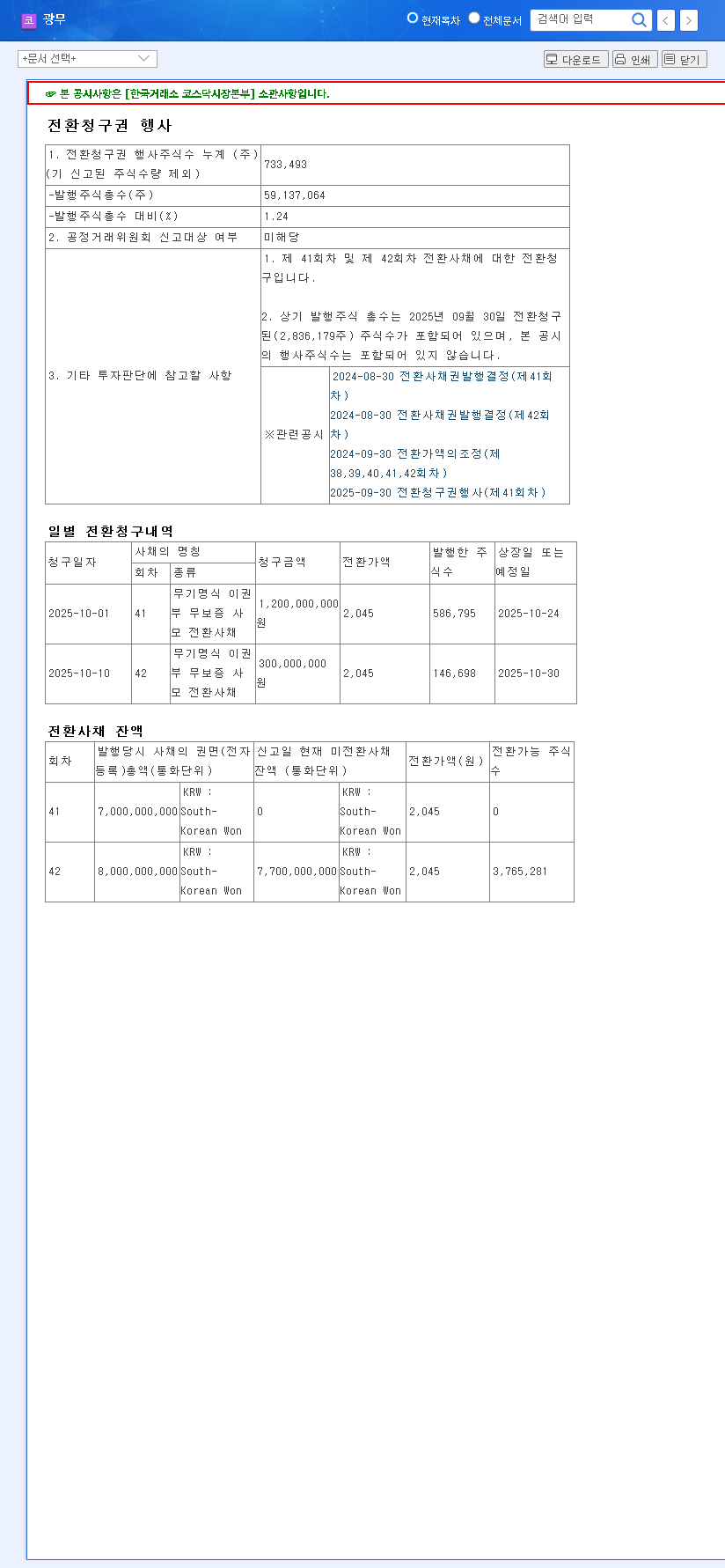
    Kwangmu Co., Ltd. has officially disclosed the exercise of conversion rights linked to its 41st and 42nd series convertible bonds. According to the Official Disclosure on DART, this will result in the issuance of 733,493 new shares. This figure represents approximately 1.24% of the company’s current market capitalization, a notable injection of equity into the market. The shares are set to be listed in two tranches: 586,795 shares on October 24, 2025, and the remaining 146,698 on October 30, 2025. A critical detail for any Kwangmu stock forecast is the conversion price of KRW 2,045, which sits roughly 35% below the recent stock price of KRW 2,765.

    The core tension for investors lies in balancing the short-term dilution from new shares against the long-term potential of a strengthened balance sheet and a funded pivot to high-growth sectors.

    Company Background: A Pivot to Future Technologies

    Kwangmu’s strategic direction is one of ambitious transformation. While its traditional ITO/NI/SI business segments have faced headwinds, the company is aggressively channeling capital into the high-growth secondary battery material business. This pivot, however, is still in its nascent stages, with significant revenue yet to materialize. The company’s financials reflect this transition; a decrease in liabilities from convertible bond redemptions is a positive sign, yet overall profitability remains a challenge. Recent corporate actions, including a change in the largest shareholder to Hyupjin Co., Ltd., and increased investment in Joongang Advanced Materials, underscore this strategic shift. The Kwangmu conversion rights exercise should be viewed as a key component of this broader capital strategy to fund future growth.

    Analyzing the Impact on Kwangmu’s Stock Price

    The exercise of conversion rights introduces several factors that could influence the Kwangmu stock price. Investors must consider both the immediate and long-term consequences.

    The Bear Case: Short-Term Headwinds

    • Share Dilution: The most direct impact is the increase in the number of outstanding shares. This dilution can put downward pressure on earnings per share (EPS) and the stock price.
    • Selling Pressure: With a conversion price significantly lower than the market price, bondholders have a built-in incentive to convert and sell their shares to realize a profit, potentially creating selling pressure around the listing dates.
    • Macroeconomic Risks: A strong USD and high global interest rates, as seen in the US and Europe, increase funding costs and can dampen investor sentiment for growth-oriented, pre-profitability companies like Kwangmu.

    The Bull Case: Long-Term Tailwinds

    • Improved Financial Health: Converting debt to equity cleans up the balance sheet. Lower liabilities and higher capital reduce financial risk and can make the company more attractive to long-term investors.
    • Growth Fuel: This event is a consequence of prior funding efforts for the new secondary battery business. A stronger financial position enables continued investment in this promising sector, which is expected to grow exponentially, according to a report from BloombergNEF.
    • Vote of Confidence: The willingness of bondholders to convert to equity can be interpreted as a positive signal, suggesting they believe in the future upside of Kwangmu’s stock.

    Investor Strategy & Key Factors to Watch

    A prudent investment decision requires a balanced view. While the improvement in Kwangmu’s financial structure is a clear positive, the immediate market dynamics cannot be ignored. The success of this transition hinges entirely on the execution of its new business strategy. Investors should closely monitor the following key points.

    The ultimate driver of the long-term Kwangmu stock forecast will be the performance of the secondary battery division. Investors should look for tangible progress, such as signed contracts, production milestones, and a clear path to profitability. For more background, you can review our guide on evaluating emerging technology stocks. The strategy of the new major shareholder, Hyupjin Co., Ltd., will be paramount in steering the company through this critical phase.

    Frequently Asked Questions (FAQ)

    What is the primary short-term risk for Kwangmu’s stock?

    The primary short-term risk is increased stock price volatility and potential downward pressure caused by the 733,493 new shares entering the market, which could lead to a share dilution effect.

    What is the main long-term opportunity for Kwangmu?

    The main long-term opportunity lies in the successful execution of its pivot to the secondary battery material business. If this division generates significant revenue and profit, it could dramatically increase the company’s valuation.

    How does the new major shareholder affect the investment thesis?

    The change to Hyupjin Co., Ltd. as the largest shareholder is a major factor. Their management strategy, capital allocation decisions, and vision for the secondary battery business will be crucial in determining Kwangmu’s future success.

    (029480) Kwangmu Stock Forecast: A Deep Dive into the Conversion Rights Exercise 관련 이미지