Tag: KB Financial

  • (323410) KakaoBank Q3 2025 Earnings: A Deep Dive Analysis & Stock Forecast

    (323410) KakaoBank Q3 2025 Earnings: A Deep Dive Analysis & Stock Forecast

    The initial report on the KakaoBank Q3 2025 earnings sent a wave of concern through the market. With key profitability metrics falling short of analyst consensus, investors are questioning whether this is a minor hiccup or a sign of more significant headwinds for the digital banking giant. This comprehensive KakaoBank stock analysis examines the performance drivers, underlying risks, and long-term growth prospects to provide a clear roadmap for what’s next.

    KakaoBank Q3 2025 Earnings Report: The Numbers

    According to its preliminary earnings announcement, KakaoBank Corp. posted a Q3 2025 revenue of KRW 764.7 billion. However, the figures that caught investors’ attention were the operating profit of KRW 151.1 billion and a net profit of KRW 111.4 billion. These results were both approximately 7% below market expectations, signaling a continued downward trend in profitability from previous quarters. The slight quarter-on-quarter revenue decrease further fuels concerns about the bank’s near-term growth trajectory. For a detailed breakdown, investors can consult the Official Disclosure filed with DART.

    Why the Miss? Analyzing the Headwinds

    The disappointing results weren’t caused by a single issue but rather a combination of internal fundamental pressures and a challenging macroeconomic landscape.

    Fundamental and Risk Factors

    • Declining Profitability Metrics: A key area of concern is the compression of the Net Interest Margin (NIM), which measures the difference between interest income and interest paid out. This downward trend, a crucial indicator of a bank’s core profitability, suggests increasing pressure on margins. You can learn more about how to analyze banking metrics in our guide to financial stock analysis.
    • Rising Corporate Loan Delinquency: The year-on-year increase in the delinquency rate for corporate loans is a red flag. It highlights the growing need for stringent risk management to maintain the health of KakaoBank’s expanding corporate loan portfolio.
    • Decreasing Capital Adequacy: While attributable to business expansion, the year-on-year drop in the BIS Total Capital Ratio requires close monitoring. Future capital injection plans will be critical to support growth without compromising financial stability.

    Macroeconomic and Market Pressures

    External factors have created a difficult operating environment for the entire banking sector:

    • Interest Rate Volatility: Rising global benchmark rates and unpredictable government bond yields are directly squeezing bank margins like KakaoBank’s NIM.
    • Household Debt & Consumption: Growing concerns over high levels of household debt in Korea and a corresponding slowdown in consumer spending could negatively impact loan quality and growth across the industry.

    While the Q3 2025 earnings report presents short-term challenges, it’s crucial for investors to look beyond the immediate numbers and evaluate the long-term strategic initiatives that could redefine KakaoBank’s future.

    The Bull Case: KakaoBank’s Long-Term Growth Engines

    Despite the current headwinds, KakaoBank Corp. holds several powerful strategic advantages that form a strong foundation for future growth and improved KakaoBank profitability.

    • AI-Powered Innovation: The company’s focus on leveraging AI for everything from credit scoring to personalized financial products is a key differentiator that can enhance efficiency and customer experience.
    • Platform Expansion: Diversifying its service portfolio with offerings like the MMF Box investment service strengthens the app’s ecosystem, increasing customer engagement and creating a powerful lock-in effect.
    • Robust Financial Health: Despite recent decreases, the bank’s overall BIS capital ratio and Liquidity Coverage Ratio (LCR) remain stable, providing a solid buffer against potential market shocks.
    • Global Expansion: Securing a virtual bank license in Thailand is a significant first step into overseas markets, opening up new, high-growth revenue streams beyond Korea. For more information on market trends, see the latest from authoritative financial news sources.

    Investment Outlook & Action Plan

    The KakaoBank Q3 2025 earnings miss has understandably created short-term negative sentiment. The current investment recommendation is to maintain a ‘Neutral’ stance. The key is to avoid overreacting to one quarter’s results and instead focus on monitoring key performance indicators that will shape the company’s long-term value.

    Key Factors for Investors to Monitor:

    • Profitability Initiatives: Watch for tangible results from efforts to improve NIM, manage the corporate loan portfolio, and successfully monetize new AI-driven services.
    • Macroeconomic Shifts: Keep an eye on central bank policies regarding interest rates, inflation trends, and the overall pace of economic recovery.
    • Competitive Landscape: Observe KakaoBank’s strategic responses to intensifying competition, including from potential new digital banking entrants.
    • Overseas Performance: Track the progress and success of the new venture in Thailand, as this will be a major indicator of its global scalability.

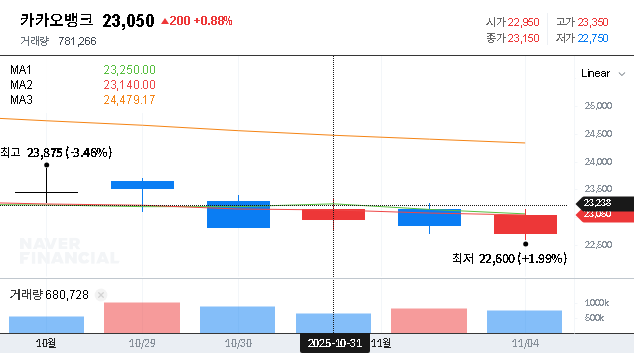
    (323410) KakaoBank Q3 2025 Earnings: A Deep Dive Analysis & Stock Forecast 관련 이미지
  • (105560) KB Financial Group Inc. Analysis: Inside Capital Group’s Major 8.27% Stake

    (105560) KB Financial Group Inc. Analysis: Inside Capital Group’s Major 8.27% Stake

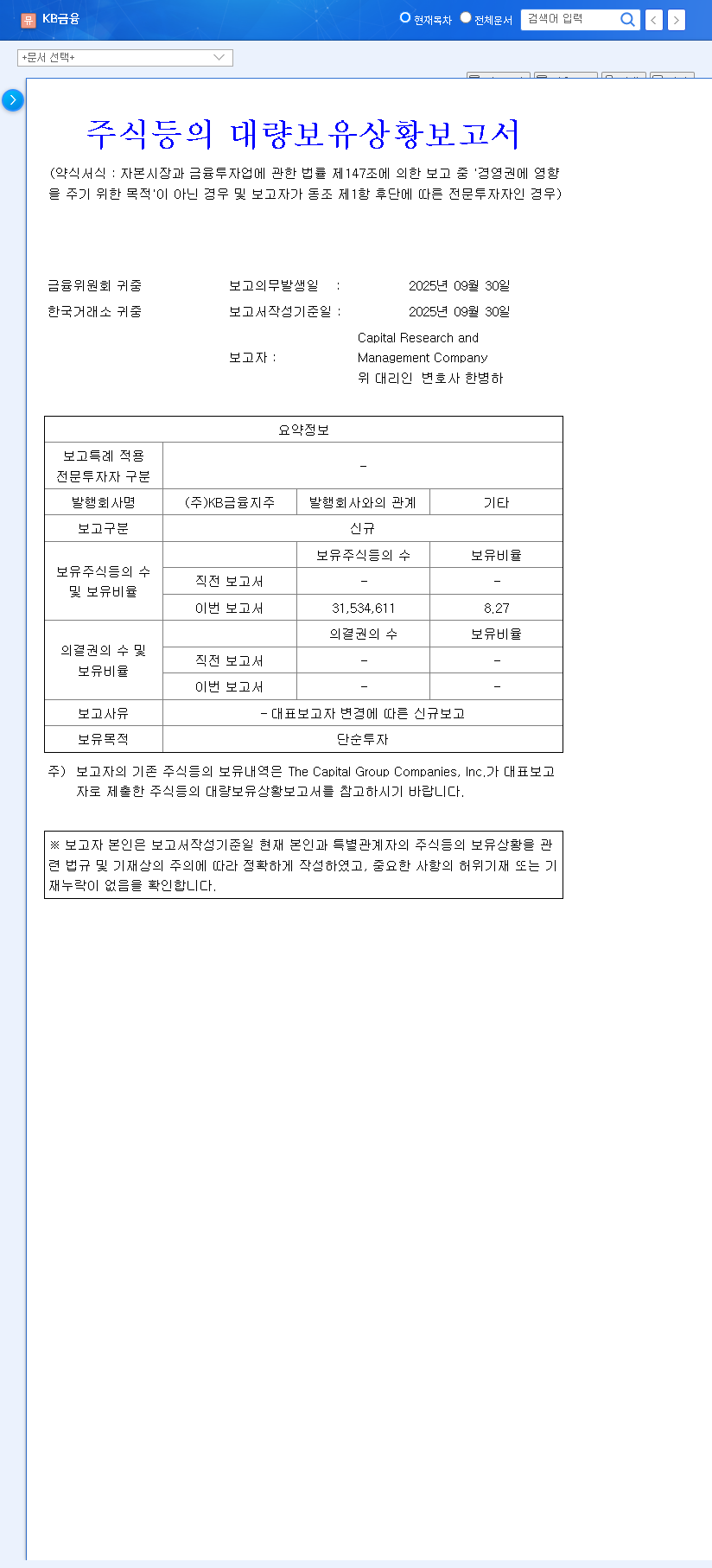
    When a global investment titan like Capital Group makes a multi-billion dollar move, the market pays close attention. Their recent acquisition of a substantial 8.27% stake in KB Financial Group Inc. has sent a powerful signal to investors worldwide. While the stated purpose is a ‘simple investment,’ this move signifies deep confidence in the South Korean financial giant’s future.

    This article provides an in-depth analysis of the deal, dissects the underlying fundamentals of KB Financial Group Inc., and explores what this major vote of confidence could mean for the company’s stock price and your investment strategy.

    The Landmark Deal: Capital Group’s Stake in KB Financial Group Inc.

    On October 14, 2025, Capital Group, through its affiliates, formally disclosed its acquisition of an 8.27% holding in KB Financial Group Inc., a cornerstone of South Korea’s financial sector. This is not a minor adjustment but a significant new position, making Capital Group one of the largest foreign shareholders. The transaction details were made public via an Official Disclosure on the DART system.

    Capital Group is known for its long-term, value-oriented investment philosophy. Their decision to invest heavily in KB Financial Group Inc. suggests a strong belief in the company’s intrinsic value and its capacity for sustained growth, looking beyond short-term market fluctuations.

    Deep Dive: A Fundamental Analysis of KB Financial Group Inc.

    To understand Capital Group’s rationale, we must examine the core strengths and potential risks associated with KB Financial Group Inc. The company’s 2025 half-year report reveals a picture of robust health, albeit with some challenges on the horizon.

    Core Strengths and Positive Factors

    • Diversified Profit Streams: Beyond traditional banking, KB has successfully expanded its non-banking portfolio, including securities, insurance, and credit cards. This diversification creates a more resilient profit structure that can weather economic cycles.
    • Robust Capitalization: The group maintains an industry-leading capital ratio, providing a strong buffer against unexpected losses and the financial firepower to pursue new growth opportunities.
    • Digital Transformation: Through strategic investments in AI, big data, and fintech partnerships, KB is positioning itself as a leader in digital finance, securing a long-term competitive edge.
    • Global Footprint: Steady growth in emerging markets is strengthening KB’s global competitiveness and diversifying its revenue base away from reliance on the domestic South Korean market.

    Potential Risks and Headwinds

    Despite the positive outlook, prudent investors must consider the potential challenges.

    • Macroeconomic Volatility: Fluctuations in interest rates and currency exchange rates present an ongoing challenge to profitability and require careful management.
    • Real Estate PF Exposure: The South Korean real estate market has shown signs of cooling. KB’s exposure to project financing (PF) loans requires diligent risk management to prevent potential defaults from impacting the bottom line.
    • Intense Competition: The rise of agile fintech startups and internet-only banks continues to intensify competition within the domestic financial industry.

    Stock Price Outlook: How Will This Investment Impact KB Financial?

    The acquisition by a prestigious investor like Capital Group is a significant catalyst that is likely to positively influence the KB Financial stock analysis. This move boosts market confidence and could attract a wave of follow-on investments from other foreign institutions, creating sustained buying pressure. You can explore further analysis in our guide to investing in South Korean financial stocks.

    While the controversial 2024 financial estimates (showing a projected net loss) might cause short-term concern, Capital Group’s investment horizon extends far beyond a single year’s performance. Their focus is likely on the improving debt-to-equity ratio and the long-term earnings power of the franchise. This endorsement signals that the company’s strong fundamentals are expected to overcome temporary setbacks. For more context on global investment trends, see the latest reports from authoritative sources like Bloomberg.

    Overall Assessment & Investor Guidance

    Our overall assessment of KB Financial Group Inc. is Positive. The substantial investment from Capital Group validates the company’s strong fundamental position and provides a powerful upward catalyst for its stock price. It underscores a belief that the company is well-positioned to navigate macroeconomic uncertainties and capitalize on its diversified business model.

    Investors should adopt a long-term perspective, focusing on the company’s core operational performance. Key metrics to monitor in upcoming earnings reports include Net Interest Margin (NIM) trends, growth in non-banking segments, and the status of the real estate loan portfolio. While risks exist, the endorsement from one of the world’s most respected investors provides a compelling reason for optimism.

    Frequently Asked Questions (FAQ)

    What does Capital Group’s investment in KB Financial Group Inc. signify?

    It signals a strong vote of confidence in KB Financial’s long-term growth potential and fundamental value. It enhances market credibility and suggests that a sophisticated global investor sees the company as undervalued relative to its future prospects.

    Is KB Financial Group Inc. a good investment despite the 2024 loss estimates?

    From a long-term perspective, yes. Major institutional investors like Capital Group often look past short-term volatility. The investment implies a belief that core strengths—such as a strong balance sheet and diversified income—will outweigh a temporary dip in profitability.

    What are the key risks when investing in KB Financial Group Inc.?

    The primary risks include exposure to the domestic real estate market (PF loans), macroeconomic headwinds like interest and exchange rate fluctuations, and intensifying competition from fintech companies. Continuous monitoring of these factors is crucial.

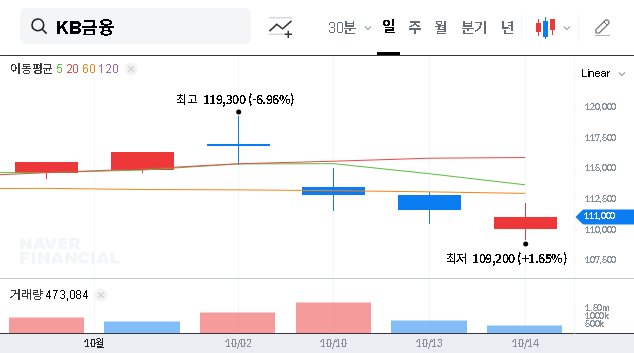
    (105560) KB Financial Group Inc. Analysis: Inside Capital Group's Major 8.27% Stake 관련 이미지
  • (105560) KB Financial Group Inc. Analysis (2025): Performance, Risks & Stock Outlook

    (105560) KB Financial Group Inc. Analysis (2025): Performance, Risks & Stock Outlook

    This comprehensive KB Financial Group Inc. analysis for the first half of 2025 unpacks a compelling story of contradiction. While the financial giant’s H1 report highlights impressive fundamentals and clear growth trajectories, the sudden and complete exit of a major shareholder, The Capital Group, casts a shadow of uncertainty. For investors, this creates a critical question: Do the group’s intrinsic strengths outweigh the risks signaled by this significant divestment? This report offers the deep insights necessary to navigate your KB Financial Group investment strategy.

    We will dissect the group’s financial health, explore the implications of the shareholder shake-up, and evaluate the potential risks and rewards that lie ahead. By understanding both the stable foundation and the emerging cracks, you can make a more informed decision about the future of KB Financial stock in your portfolio.

    The Capital Group’s Divestment: A Major Market Signal

    The most significant event impacting KB Financial Group Inc. was the strategic pivot by The Capital Group Companies, Inc., a globally recognized investment firm. According to an Official Disclosure, the firm fully divested its entire 8.07% stake between September 17 and September 30, 2025. This move, changing their holding purpose from ‘simple investment,’ is a critical development that demands investor attention.

    The exit of a sophisticated institutional investor like The Capital Group can trigger short-term stock price volatility and negatively influence market sentiment. The key for long-term investors is to determine whether this was a routine portfolio rebalancing or a reaction to perceived underlying weaknesses in the company’s future outlook.

    The mid-to-long-term impact on the KB Financial stock price will depend heavily on the market’s interpretation of this sale and the company’s subsequent performance and strategic responses.

    Analyzing KB Financial Group’s Core Strengths

    Despite the shareholder news, the fundamentals of KB Financial Group Inc. remain robust, built on a foundation of diversification, financial prudence, and forward-looking innovation.

    1. Diversified and Stable Business Portfolio

    A key strength is the group’s balanced revenue structure, which mitigates risk by not over-relying on a single sector. This diversification ensures a stable and predictable revenue base.

    • Core Banking Operations: The traditional banking arm remains a consistent profit generator.
    • Strong Non-Banking Growth: Subsidiaries like KB Securities, KB Insurance, and KB Kookmin Card are increasingly significant contributors to the bottom line.
    • Future Growth Engines: Strategic moves, such as KB Life Insurance’s expansion into the high-growth nursing care business, signal proactive market positioning.

    2. Outstanding Financial Health and Stability

    The group’s balance sheet is a testament to its conservative and effective risk management. Key capital adequacy ratios, including the BIS ratio and Net Capital Ratio, comfortably exceed regulatory minimums. This high capitalization provides a substantial buffer to absorb unexpected market shocks and demonstrates exceptional financial stability, reassuring investors about its long-term viability.

    Potential Risks and Headwinds to Consider

    A thorough KB Financial Group analysis requires a clear-eyed view of the potential challenges that could pressure fundamentals and impact investor returns.

    • Macroeconomic Uncertainty: Persistent high-interest rates and the risk of a global economic slowdown could lead to increased credit defaults and weakened profitability across the financial sector. Investors should monitor these trends from authoritative sources like Reuters.
    • Intensified Competition: The financial landscape is being reshaped by agile Fintech and Big Tech competitors. KB Financial Group must continue its digital transformation to maintain its market-leading position.
    • Real Estate PF Risk: The high non-performing loan (NPL) ratio at KB Real Estate Trust is a specific point of concern. A prolonged downturn in the real estate market could negatively affect the group’s overall asset quality.

    Investment Outlook and Strategic Recommendations

    KB Financial Group Inc. presents a classic case of weighing solid fundamentals against market sentiment and external risks. The company’s stable business model, strong capitalization, and digital initiatives suggest significant long-term growth potential. Historically, the group has demonstrated resilience during economic downturns.

    However, the divestment by The Capital Group cannot be ignored. Prudent investors should closely monitor stock price movements and market reactions in the coming months. It is crucial to evaluate management’s response to the identified risks, particularly in real estate PF and the competitive landscape. For a broader perspective on the market, see our Guide to Investing in Korean Financial Stocks. A comprehensive analysis of all risk factors alongside continuous monitoring is essential before making any KB Financial Group investment decisions.

    Frequently Asked Questions (FAQ)

    What is the current financial status of KB Financial Group Inc.?

    As of its H1 2025 report, KB Financial Group Inc. exhibits strong financial health, characterized by industry-leading capital adequacy ratios, sound liquidity, and a robust, diversified profit structure with notable growth in non-banking sectors.

    What does The Capital Group’s divestment signify?

    The complete sale of an 8.07% stake by a major institutional investor like The Capital Group can signal a lack of confidence or be a simple portfolio adjustment. It is likely to cause short-term downward pressure on the stock and has created uncertainty that requires careful monitoring by current and potential investors.

    What are the key risks for a KB Financial Group investment?

    The primary risks include macroeconomic headwinds like high interest rates, fierce competition from Fintech/Big Tech, potential asset quality deterioration from its real estate project financing (PF) exposure, and lingering reputational risk from past legal or regulatory issues.

    What are KB Financial Group Inc.’s main long-term growth drivers?

    Long-term growth is expected to be driven by its stable, diversified business portfolio, ongoing digital transformation using AI and other technologies, and strategic expansion into new, high-growth areas within its non-banking divisions, such as the nursing care industry.

    (105560) KB Financial Group Inc. Analysis (2025): Performance, Risks & Stock Outlook 관련 이미지
  • KB Financial Group: Strong H1 2025 Earnings – A Buy?


    KB Financial Group: Strong H1 2025 Earnings - A Buy? 대표 차트 이미지


    KB Financial Group H1 2025 Earnings Analysis

    KB Financial Group achieved a consolidated net income of KRW 3.436 trillion in the first half of 2025, marking an impressive 23.8% year-on-year growth. This result was driven by the combined growth of both interest and non-interest income.

    Key Fundamentals

    • Strong Financial Health: Maintaining an industry-leading BIS capital adequacy ratio of 16.36%, KB demonstrates a stable management foundation.
    • Excellent Liquidity: A liquidity ratio of 366.19% indicates ample short-term payment capacity and the ability to navigate market volatility.
    • Sound Asset Quality: Low NPL and NPL ratios demonstrate effective risk management capabilities.

    Future Growth Drivers

    KB Financial Group is expanding its growth engines in the non-banking sector, building on the stable growth of its banking division. Key drivers include strengthening the IB competitiveness of KB Securities, maximizing CSM strategy at KB Insurance, and expanding the senior life platform business at KB Life Insurance. Overseas expansion and fintech investments by KB Capital, as well as digital transformation efforts at KB Kookmin Card, are also expected to drive future growth.

    Investment Considerations

    Potential risks to consider include the possibility of global and domestic economic slowdown, interest rate fluctuations, exchange rate volatility, and real estate PF risks. The risks related to KB Real Estate Trust require ongoing monitoring.

    Action Plan for Investors

    • Monitor KB Financial Group’s IR activities and earnings announcements to stay informed about changes in fundamentals.
    • Analyze the impact of macroeconomic indicator changes on KB Financial Group and adjust your investment strategy accordingly.
    • Conduct competitor analysis to understand KB Financial Group’s relative strengths and weaknesses to inform your investment decisions.


    FAQ

    What are KB Financial Group’s key H1 2025 financial results?

    KB Financial Group achieved a consolidated net income of KRW 3.436 trillion in H1 2025, a 23.8% increase year-on-year.

    What are the main growth drivers for KB Financial Group?

    Key growth drivers include the stable growth of the banking division, growth in non-banking sectors like KB Securities, KB Insurance, and KB Life Insurance, as well as digital transformation and fintech investments.

    What should investors be aware of when considering KB Financial Group?

    Investors should consider macroeconomic uncertainties, increased competition in the financial market, and real estate PF risks.


    KB Financial Group: Strong H1 2025 Earnings - A Buy? 관련 이미지


  • KB Financial Group Q2 2025 Earnings Analysis: Investment Strategies & Outlook

    KB Financial Group Q2 2025 Earnings Analysis: Investment Strategies & Outlook 대표 차트 이미지

    1. KB Financial Group Q2 2025 Earnings: Key Highlights

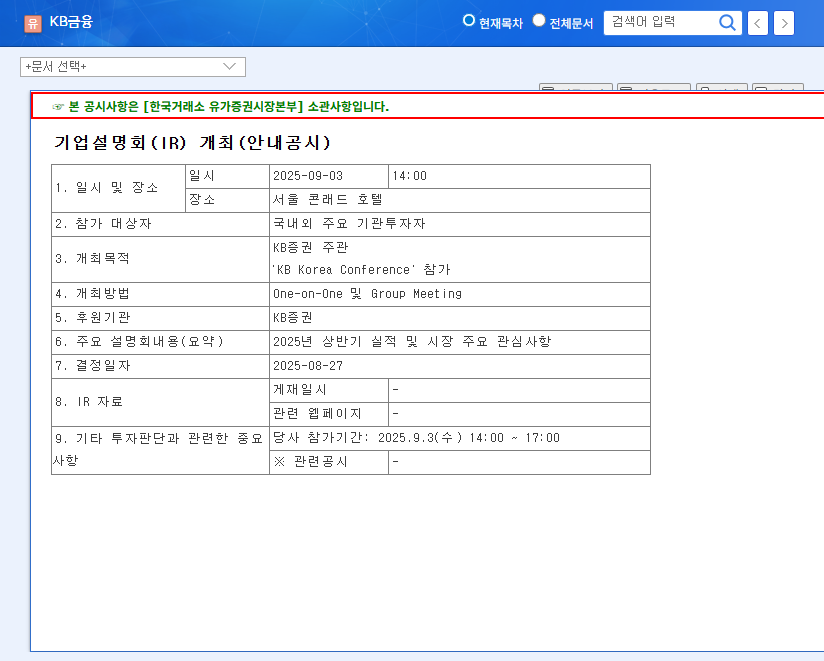
    KB Financial Group held its Q2 2025 earnings release and investor relations meeting on September 3rd at 2 PM KST. The presentation reviewed the financial performance for the first half of the year and addressed key market concerns.

    2. Key Performance & Market Expectations

    Market expectations were generally positive, anticipating KB’s strong fundamentals and stable performance. Investors were particularly interested in the group’s strategies and achievements regarding key issues like the changing interest rate environment, increased competition, and digital transformation.

    3. KB Financial Group’s Fundamentals: Strengths & Weaknesses

    a. Positive Factors

    • Stable revenue base and diversified business portfolio (increased profit contribution from non-banking sectors like securities, insurance, and credit cards)
    • Solid financial health (industry-leading BIS capital adequacy ratio, low NPL ratio, ample liquidity)
    • Future growth drivers (strengthening digital and AI capabilities, platform partnerships, ESG management, overseas business expansion)
    • Proactive shareholder return policy (demonstration of commitment to enhancing shareholder value)

    b. Negative Factors and Considerations

    • Continued macroeconomic uncertainty (global economic slowdown, geopolitical risks, interest rate and exchange rate volatility)
    • Intensifying competition (expansion of fintech companies, mature credit card market)
    • Potential litigation risks (possible financial burden due to the outcome of lawsuits involving some subsidiaries)
    • Changes in the regulatory environment (introduction of IFRS17 in the insurance industry, strengthening of insurance soundness supervision)

    4. Market Price & Future Outlook

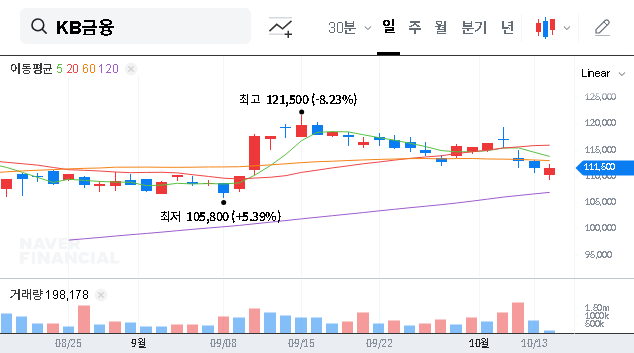
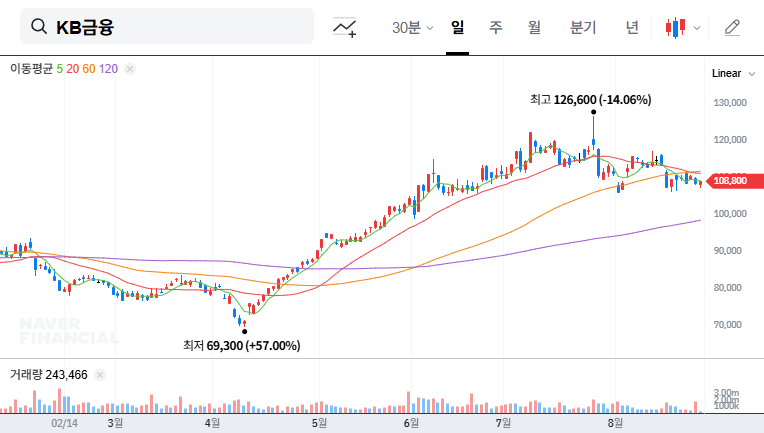
    KB Financial Group’s stock price fluctuated between a high of KRW 112,300 and a low of KRW 100,000 in June 2025 and traded at approximately KRW 108,700 at the end of July. The September 3rd IR event is expected to strengthen investor confidence and generate positive momentum through detailed earnings disclosures and communication on market concerns.

    5. Action Plan for Investors

    Investors should consider various factors when making investment decisions, including KB’s business diversification, digital innovation performance, risk management, and shareholder return policy. It is advisable to monitor macroeconomic conditions and changes in the competitive landscape and invest with a long-term perspective.

    Frequently Asked Questions

    What are KB Financial Group’s main businesses?

    KB Financial Group is a comprehensive financial group offering a wide range of financial services, including banking, securities, insurance, and credit cards.

    What is KB Financial Group’s dividend policy?

    KB Financial Group implements a consistent dividend and share buyback/cancellation policy to enhance shareholder value. Refer to investor relations materials for more details.

    What should investors consider when investing in KB Financial Group’s stock?

    It’s crucial to make investment decisions based on a comprehensive consideration of financial market conditions, the competitive landscape, and regulatory changes. Consulting with financial professionals and diversifying investments to manage risk is recommended.

    KB Financial Group Q2 2025 Earnings Analysis: Investment Strategies & Outlook 관련 이미지
  • KB Financial Group H1 2025 Report Analysis: Strong Growth and Future Outlook

    1. What Happened in KB Financial Group’s H1 2025?

    KB Financial Group reported remarkable earnings, achieving KRW 3.44 trillion in accumulated net income for H1 2025 and KRW 1.75 trillion in standalone net income for Q2 2025. This represents a significant increase of 23.8% YoY and 69.7% QoQ, exceeding market expectations.

    2. The Secret to This Impressive Growth?

    This remarkable growth is attributed to increased non-interest income and a diversified business portfolio through efficient capital allocation.

    • Solid net income growth
    • Stable capital ratios (BIS ratio 16.36%, Tier 1 capital ratio 15.36%, CET1 ratio 13.74%)
    • Total asset growth (KRW 780.6 trillion, a 3.0% increase compared to the end of the previous year)
    • Balanced business portfolio (Banking sector 64%, increasing contribution from securities, insurance, and credit card sectors)
    • Securing future growth engines (Digital/AI, Big Tech/Platform partnerships, ESG and non-financial investments)

    3. KB Financial Group’s Future Outlook

    KB Financial Group anticipates a positive future based on its stable financial soundness and diversified business portfolio. The company is actively pursuing future growth drivers, including digital transformation, global market expansion, and new business investments. However, potential risks include macroeconomic volatility, such as interest rate fluctuations, exchange rate fluctuations, and the possibility of a global economic slowdown, as well as increased competition from fintech companies.

    4. Action Plan for Investors

    KB Financial Group is currently considered an attractive investment opportunity with both solid fundamentals and future growth potential. However, investors should continuously monitor macroeconomic conditions and changes in the competitive landscape before making investment decisions.

    Frequently Asked Questions

    What are KB Financial Group’s key financial results for H1 2025?

    KB Financial Group achieved KRW 3.44 trillion in accumulated net income for H1 2025 and KRW 1.75 trillion in standalone net income for Q2 2025.

    What are KB Financial Group’s main business segments?

    KB Financial Group operates various financial business segments, including banking, securities, insurance, and credit cards.

    What is KB Financial Group’s future growth strategy?

    KB Financial Group is securing future growth engines through digital/AI, partnerships with big tech/platform companies, and investments in ESG and non-financial businesses.