Tag: KakaoBank

  • (323410) KakaoBank Q3 2025 Earnings: A Deep Dive for Investors | AI & Global Growth Analysis

    (323410) KakaoBank Q3 2025 Earnings: A Deep Dive for Investors | AI & Global Growth Analysis

    The upcoming KakaoBank Q3 2025 earnings announcement, scheduled for November 5, 2025, is more than just a financial report; it’s a critical inflection point for investors. This event will provide a crucial glimpse into the company’s trajectory as it navigates a dynamic financial landscape, doubling down on its identity as an ‘AI Native Bank’ and accelerating its global expansion. This comprehensive KakaoBank investment analysis will dissect the fundamentals, explore potential outcomes, and offer a clear action plan for investors looking to make informed decisions.

    Understanding the Stakes: Why This Earnings Call Matters

    Following a robust performance in the first half of 2025, the market is keenly watching to see if KakaoBank can sustain its growth momentum. The KakaoBank Q3 2025 earnings call is pivotal for two key reasons: it will be the first major progress report on its ambitious AI strategy, and it will offer concrete details on its foray into international markets. The results will not only impact KakaoBank stock but also set the tone for the competitive South Korean neobank sector, where rivals like Toss Bank and K-Bank are also vying for market share.

    Will KakaoBank’s investments in technology and global reach translate into sustainable, long-term shareholder value? This Q3 report will provide the first substantial clues.

    A Look Under the Hood: KakaoBank’s Core Fundamentals

    Before looking ahead, it’s essential to understand the solid foundation KakaoBank has built. As of its H1 2025 report, the company’s strength lies in several key areas:

    Unmatched Platform Power & AI Innovation

    KakaoBank’s primary advantage is its massive user base, with nearly 20 million Monthly Active Users (MAU). This is not just a number; it represents a deep moat built on the network effects of the Kakao ecosystem. The company is now leveraging this advantage to execute its KakaoBank AI Native Bank transformation, aiming to integrate artificial intelligence into every facet of its operations—from AI-powered financial calculators and smishing detection to hyper-personalized loan offers and predictive wealth management advice. This strategy is central to its future competitiveness.

    Robust Financial Health & Profitability

    Financial stability is paramount. KakaoBank maintains an exceptionally high level of financial health, evidenced by a BIS total capital ratio of 25.45% and a Liquidity Coverage Ratio (LCR) of 806.66%. These figures, which significantly exceed regulatory requirements, showcase prudent management and a strong capacity to absorb economic shocks. For detailed figures, investors can refer to the Official Disclosure (DART). Despite slight pressure on its Net Interest Margin (NIM), which stands at a competitive 2.00%, the bank continues to deliver solid profitability.

    Analyzing the Q3 Impact: Bull vs. Bear Scenarios

    The KakaoBank Q3 2025 earnings report will likely push the stock in one of two directions based on the following potential catalysts and headwinds.

    The Bull Case: Positive Catalysts

    • Exceeding Earnings Expectations: If Q3 profits beat analyst consensus, driven by strong loan growth and successful NIM management, it will reaffirm the bank’s core earning power and boost investor confidence significantly.
    • Clear Global Strategy Roadmap: Concrete details on market entry into regions like Southeast Asia, including partnerships or license acquisitions, would validate the KakaoBank growth strategy and provide a tangible long-term growth narrative.
    • Enhanced Shareholder Returns: Any announcement of an increased dividend or share buyback program would be a strong signal of management’s confidence and could make the stock more attractive to value-oriented investors.

    The Bear Case: Potential Headwinds

    • Growth Slowdown or Margin Compression: An unexpected miss on earnings or signs of a significant slowdown could trigger concerns about market saturation. Greater-than-expected NIM pressure due to macroeconomic factors, as often reported by sources like Reuters, would also be a major concern.
    • Uncertainty in New Ventures: If the monetization of AI services appears slow or if global expansion faces unforeseen hurdles, doubts could arise about the long-term growth engines, potentially leading to a re-evaluation of the company’s premium valuation.
    • Regulatory Changes: Increased scrutiny from financial authorities or the introduction of new regulations targeting fintech platforms could create operational uncertainty and weigh on investor sentiment.

    Investor Action Plan & Final Take

    For those conducting a KakaoBank investment analysis, the key is to look beyond the headline numbers. During the earnings call, focus on management’s commentary on key performance indicators. To dive deeper, consider our guide on how to evaluate modern fintech stocks.

    Ultimately, KakaoBank’s powerful brand, massive user base, and innovative spirit position it well for the future. The KakaoBank Q3 2025 earnings will be a crucial test of its ability to execute on its ambitious vision. While we maintain a long-term positive outlook, investors should carefully scrutinize the report for confirmation that the growth story remains firmly on track before making any new investment decisions.

    Disclaimer: This analysis is based on publicly available information, and investment decisions should be made at the investor’s own discretion and responsibility. The content is for informational purposes only and does not constitute financial advice.

    (323410) KakaoBank Q3 2025 Earnings: A Deep Dive for Investors | AI & Global Growth Analysis 관련 이미지
  • KakaoBank Targets Global Investors: An Analysis of its Recent IR and Future Prospects


    KakaoBank Targets Global Investors: An Analysis of its Recent IR and Future Prospects 대표 차트 이미지


    KakaoBank’s IR: What was discussed?

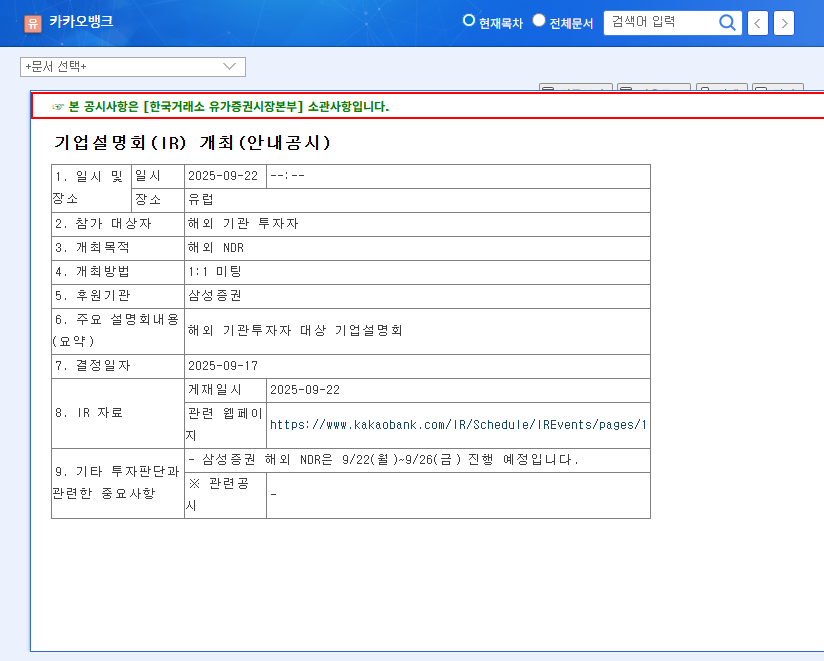
    KakaoBank conducted a Non-Deal Roadshow (NDR) on September 22, 2025, targeting international institutional investors. The primary goal was to showcase the company’s vision, growth potential, and attract investment.

    Strengths and Opportunities for KakaoBank

    • Strong Fundamentals: KakaoBank boasts a robust financial structure with an AA+ credit rating, high capital adequacy ratio, and consistent profitability (ROA 0.78%, ROE 8.09%).
    • Continuous Growth: With 25.86 million customers, KRW 63.7 trillion in deposits, and KRW 44.8 trillion in loans, KakaoBank continues its impressive growth trajectory. The expansion of its platform business also deserves attention.
    • AI-Driven Innovation: Its ‘AI Native Bank’ strategy focuses on expanding AI-powered services to enhance customer experience and lead the future of finance.
    • Competitive Edge: Superior UX/UI, customer-centric product development, and effective IT utilization provide KakaoBank with a distinct competitive advantage.

    Investment Considerations

    • Interest Rate and Economic Volatility: Potential interest rate fluctuations and economic slowdown pose risks to the banking sector as a whole.
    • Intensifying Competition: The internet banking market is becoming increasingly competitive, necessitating continuous innovation.
    • Market Reaction to IR: The stock price may experience volatility if the IR outcomes fail to meet market expectations.

    Action Plan for Investors

    • Carefully analyze the IR presentation and Q&A session.
    • Monitor stock price and trading volume trends following the IR.
    • Consider KakaoBank’s long-term growth potential and potential risks comprehensively.


    Frequently Asked Questions

    What was the purpose of KakaoBank’s IR?

    The IR aimed to present KakaoBank’s current business status and growth strategies to international institutional investors and explore investment opportunities.

    What are KakaoBank’s key competitive advantages?

    KakaoBank’s key strengths include its user-friendly UX/UI, innovative financial products, and AI-powered services.

    What factors should investors consider when evaluating KakaoBank?

    Investors should consider potential interest rate volatility, increasing competition, and the possibility of an economic slowdown.


    KakaoBank Targets Global Investors: An Analysis of its Recent IR and Future Prospects 관련 이미지


  • KakaoBank’s $450 Billion Real Estate Investment: Opportunity or Risk? (Pangyo Tech One Analysis)

    KakaoBank's $450 Billion Real Estate Investment: Opportunity or Risk? (Pangyo Tech One Analysis) 대표 차트 이미지

    1. Why is KakaoBank Investing in Real Estate?

    KakaoBank has decided to invest $450 billion in a real estate fund to acquire the Pangyo Tech One building, aiming to diversify its portfolio and enhance operational returns. This investment represents 6.88% of its equity capital and 0.72% of its total assets.

    2. Opportunity Analysis: Stable Income and Portfolio Diversification

    Pangyo Tech One, located in a prime business district, is expected to generate stable rental income. This investment will also diversify KakaoBank’s asset portfolio, reducing its dependence on specific assets and mitigating risks. In the long term, securing its own office building could enhance operational stability.

    3. Risk Analysis: Market Volatility and Investment Size

    The substantial investment size of $450 billion carries the risk of principal loss if the real estate market declines. Current market uncertainties, high interest rates, and the possibility of an economic slowdown could negatively impact the investment. The large capital outlay might also affect short-term liquidity, and the investment’s classification as non-core business raises questions about resource allocation efficiency.

    4. Market Context and KakaoBank’s Track Record

    Considering the current interest rate environment and real estate market outlook, the Pangyo Tech One investment is expected to have relatively stable demand, but a general market correction cannot be ruled out. Examining KakaoBank’s past asset management performance and declining BIS capital adequacy ratio suggests the need for ongoing monitoring of its capital soundness.

    5. Action Plan for Investors

    While this investment is a strategic decision for long-term portfolio diversification and return enhancement, it requires a cautious approach given the investment size and market conditions. Investors should carefully monitor the fund’s performance, real estate market trends, KakaoBank’s capital adequacy indicators, and its efforts to strengthen its core business competitiveness before making investment decisions.

    What is the purpose of KakaoBank’s investment in Pangyo Tech One?

    To diversify its portfolio and enhance operational returns.

    What is the investment amount and its proportion to equity capital?

    $450 billion, representing approximately 6.88% of its equity capital.

    What are the main risks associated with this investment?

    Real estate market volatility, significant investment size, liquidity impact, and non-core business investment.

    KakaoBank's $450 Billion Real Estate Investment: Opportunity or Risk? (Pangyo Tech One Analysis) 관련 이미지
  • KakaoBank Q2 2025 Earnings & UBS Korea Summit IR: Key Takeaways for Investors

    KakaoBank Q2 Earnings: Key Highlights

    Here are the key takeaways from KakaoBank’s Q2 2025 earnings presentation at the UBS Korea Summit:

    • Sustained Growth: Key metrics like monthly active users (19.64 million) and total customers (25.86 million) continued to grow.
    • AI-Driven Services: KakaoBank emphasized its focus on improving customer experience through AI-powered services like ‘AI Search’ and ‘AI Financial Calculator.’ The performance and future roadmap of these services are key areas of interest.
    • International Expansion: Following its virtual bank license approval in Thailand, details on the bank’s expansion strategy are anticipated. Success in international markets will be crucial for future growth.
    • Capital Adequacy: With concerns around the recent decline in its BIS ratio, KakaoBank’s explanation of its capital management strategy will be critical for investor confidence.
    • Competitive Landscape: The bank’s strategy for navigating the increasingly competitive landscape with other internet banks and fintech companies will be closely watched.

    Investor Action Plan

    Based on the information presented, investors should reassess their investment strategy, focusing on these key aspects:

    • Capital Management: Evaluate the bank’s plans for managing its BIS ratio and capital adequacy for long-term stability.
    • International Expansion: Analyze the progress and future plans for expansion into Thailand and assess the potential for new growth drivers.
    • Competitive Strategy: Determine if KakaoBank has a differentiated offering and a viable strategy to maintain market share in a competitive environment.
    • Macroeconomic Factors: Consider the impact of interest rate fluctuations and economic slowdown on KakaoBank’s performance and manage investment risks accordingly.

    Frequently Asked Questions (FAQ)

    When did KakaoBank announce its Q2 2025 earnings?

    KakaoBank announced its Q2 2025 earnings on August 25th at the UBS Korea Summit.

    What are the key growth drivers for KakaoBank?

    Key growth drivers include a strong customer base, expansion of AI-driven services, and international market entry.

    What are the key risks associated with investing in KakaoBank?

    Key risks include a declining BIS ratio, increasing competition, and macroeconomic factors such as interest rate fluctuations and economic slowdown.

  • KakaoBank IR Analysis: 2025 Growth Strategies and Investment Opportunities

    1. KakaoBank IR: What was discussed?

    On August 19, 2025, KakaoBank held an Investor Relations (IR) meeting for domestic institutional investors. Following the announcement of strong Q1 results, KakaoBank focused on its platform business expansion strategy and its response to intensifying fintech competition.

    2. Why is it important?

    KakaoBank is Korea’s leading internet-only bank, boasting 25.45 million customers, KRW 60.4 trillion in deposits, and KRW 44.3 trillion in loans. This IR provided important indicators for gauging KakaoBank’s future growth potential and is expected to significantly influence its stock price.

    3. Key Takeaways and Investor Action Plan

    a. Platform Business: The Core Growth Driver

    • KakaoBank highlighted the success of its platform business, including surpassing 6.99 million securities accounts opened.
    • The company presented its strategy to target younger demographics through KakaoBank mini and its vision to become a financial super app.
    • Investors should carefully analyze the sustainability of platform business growth and potential for profit improvement.

    b. Macroeconomic Uncertainty: Risk Management Strategy

    • KakaoBank explained its strategies to address high interest rates and economic slowdown.
    • It emphasized its robust financial health, with a BIS ratio of 26.08% and a non-performing loan ratio of 0.51%, appealing to investors with its stability.
    • Investors should monitor changes in asset quality due to macroeconomic shifts.

    c. Intensifying Competition: Differentiation Strategy

    • KakaoBank presented its differentiation strategy to maintain a competitive edge against fintech and big tech companies.
    • It highlighted its strengths, including AI-powered service innovation and user-friendly UX/UI.
    • Investors should continuously monitor whether KakaoBank can maintain its competitive advantages.

    FAQ

    What were the key takeaways from KakaoBank’s IR?

    KakaoBank’s August 19, 2025 IR presentation focused on platform business expansion, addressing macroeconomic uncertainty, and its differentiation strategy in the face of intensifying competition.

    How is KakaoBank’s platform business growing?

    KakaoBank is seeing success with its platform business expansion, particularly with its securities account opening service, having secured 6.99 million accounts, and is pursuing a ‘financial super app’ strategy.

    What is the state of KakaoBank’s financial health?

    KakaoBank maintains a stable financial position with a BIS ratio of 26.08% and a non-performing loan ratio of 0.51%.

  • KakaoBank Q2 2025 Earnings: Slowing Growth or Long-Term Opportunity?

    1. KakaoBank Q2 2025 Earnings: Key Highlights

    KakaoBank reported revenue of ₩778 billion, operating profit of ₩170.1 billion, and net income of ₩126.3 billion for Q2 2025. These figures missed market expectations and represent a slowdown in growth compared to the previous quarter.

    • Q2 2025 Summary: Revenue ₩778B (QoQ decrease), Operating Profit ₩170.1B (QoQ decrease), Net Income ₩126.3B (QoQ decrease)

    2. Analyzing the Earnings Miss

    Several factors contributed to the weaker-than-expected Q2 results, including slower growth compared to Q1, increased market competition, and macroeconomic uncertainties. The decline in operating and net income is a key concern for investors.

    3. Assessing KakaoBank’s Fundamentals

    Despite the disappointing Q2 results, KakaoBank’s underlying fundamentals remain strong. As of Q1 2025, the bank demonstrated robust growth, maintained healthy asset quality, and continued its innovative platform business expansion. Its mobile-first UX, KakaoTalk synergy, and platform business expansion remain key competitive advantages.

    4. Key Considerations for Investors

    Investors should closely monitor interest rate movements, loan asset quality management, the impact of new service launches, and the competitive landscape. How KakaoBank navigates these challenges will be crucial for investment decisions.

    5. Investment Strategy: Maintaining a Long-Term Perspective

    Rather than reacting to short-term market fluctuations, investors should focus on KakaoBank’s long-term growth potential. The bank is well-positioned to regain growth momentum through continued innovation and strengthening its platform competitiveness.

    Why did KakaoBank’s Q2 2025 earnings fall short of expectations?

    Slower growth compared to Q1, increased market competition, and macroeconomic uncertainties contributed to the weaker results.

    Are KakaoBank’s fundamentals still strong?

    Yes, the bank maintains strong fundamentals, including robust growth, healthy asset quality, and innovative platform expansion.

    What should investors consider when evaluating KakaoBank?

    Investors should monitor interest rates, loan asset quality, new service launches, competition, and macroeconomic conditions.