Tag: ITC-6146RO

  • (287840) IntoCell’s ITC-6146RO: A Deep Dive into the FDA IND Submission and ADC Technology

    (287840) IntoCell’s ITC-6146RO: A Deep Dive into the FDA IND Submission and ADC Technology

    The world of biotech investment is closely watching IntoCell, Inc., a pioneering company in Antibody-Drug Conjugate (ADC) platform technology. The firm recently announced a major milestone: the successful submission of its Investigational New Drug (IND) application to the U.S. Food and Drug Administration (FDA) for its proprietary anti-cancer drug candidate, ITC-6146RO. This critical step prepares the ground for Phase 1 clinical trials and signals a significant move towards global market entry for IntoCell’s innovative oncology treatment.

    This FDA IND submission is far more than a regulatory formality; it is a powerful validation of IntoCell’s advanced ADC technology by one of the world’s most rigorous regulatory agencies. This analysis delves into the specifics of ITC-6146RO, the implications of this achievement for IntoCell’s business outlook, and the potential risks and rewards for investors.

    Understanding ITC-6146RO and the FDA IND Submission

    On October 31, 2025, IntoCell officially completed its IND application for ITC-6146RO, marking the achievement of a key corporate goal. An IND application is the first crucial step required to administer a new drug candidate to humans, representing the culmination of extensive non-clinical safety and efficacy studies. For a biotech company, securing an FDA IND clearance is a monumental achievement that opens the door to the largest biopharmaceutical market in the world.

    Details of the Phase 1 Clinical Trial

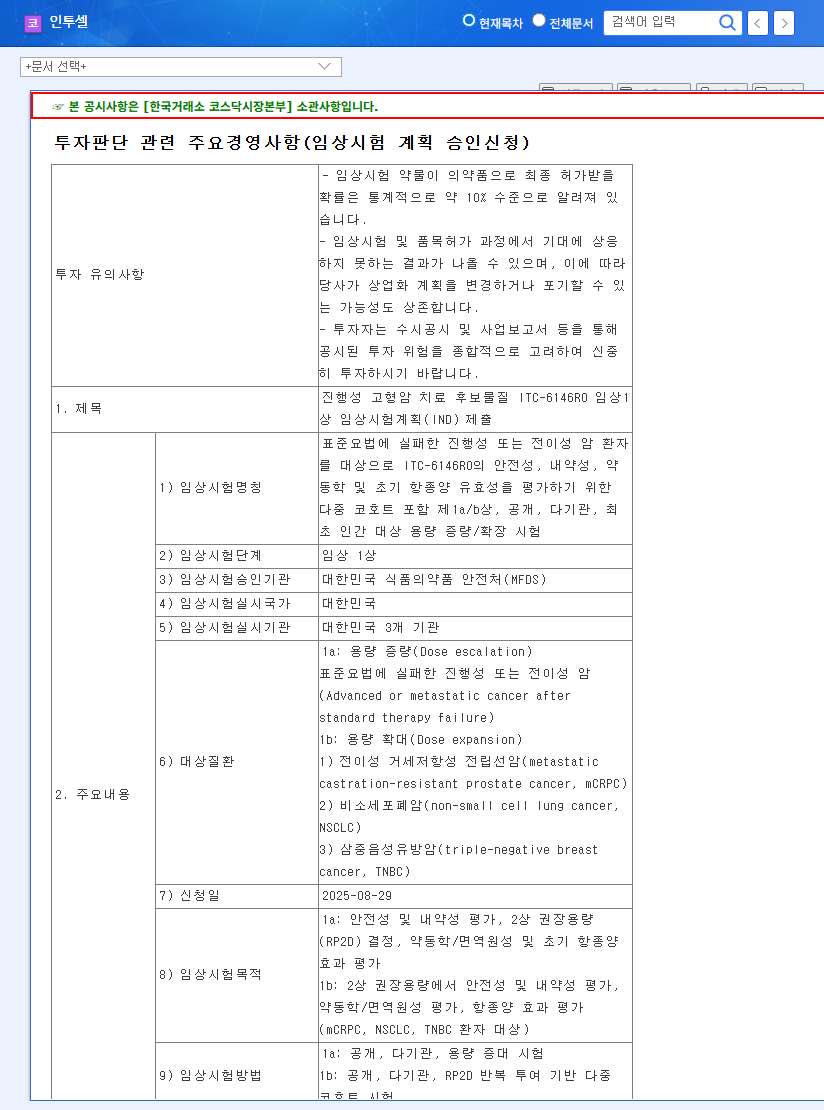
    The upcoming Phase 1a/b clinical trial for ITC-6146RO is an open-label, multi-center, first-in-human dose escalation and expansion study. Its primary objectives are:

    • To evaluate the safety and tolerability of the drug in patients with advanced or metastatic cancer who have exhausted standard therapies.
    • To study its pharmacokinetics (how the drug moves through the body).
    • To assess preliminary anti-tumor efficacy.

    The Phase 1b expansion will specifically target challenging cancers, including Metastatic Castration-Resistant Prostate Cancer (mCRPC), Non-Small Cell Lung Cancer (NSCLC), and Triple-Negative Breast Cancer (TNBC).

    IntoCell’s Core Competency: Advanced ADC Technology

    At the heart of IntoCell’s innovation is its proprietary Antibody-Drug Conjugate platform. ADCs are a powerful class of drugs designed to act like guided missiles, delivering potent chemotherapy agents directly to cancer cells while sparing healthy tissue. You can learn more about the fundamentals of ADC technology on our blog. IntoCell’s key technological advantages include:

    • OHPAS™ Linker Platform: This technology enhances the stability of the ADC in the bloodstream, preventing the premature release of the toxic payload. It ensures the drug is selectively cleaved and activated only inside the target cancer cells.
    • PMT™ Platform: This platform minimizes the non-selective uptake of the drug by normal, healthy cells. This precision targeting is crucial for reducing side effects and improving the therapeutic window.

    This differentiated technology suite forms the basis of IntoCell’s business model, which is focused on generating revenue through early-stage clinical pipeline out-licensing and strategic partnerships with global pharmaceutical companies.

    Investment Analysis: Opportunities and Risks

    Positive Catalysts from the FDA IND Submission

    The IND submission for ITC-6146RO is a significant de-risking event that enhances investor confidence. The progression of a key pipeline into the clinical stage validates the company’s scientific approach and business model. It also accelerates opportunities for technology out-licensing discussions with major pharmaceutical players, which could dramatically improve IntoCell’s financial structure. As is common in the biotech sector, this news is expected to provide positive stock price momentum, driven by heightened expectations for future growth.

    Overall, the U.S. FDA IND submission for ITC-6146RO is a profoundly positive event for IntoCell, signaling a crucial turning point in its medium-to-long-term growth trajectory. Combined with substantial cash assets from its IPO and the robust growth of the global ADC market, IntoCell’s future outlook is bright.

    Potential Risks and Considerations for Investors

    Despite the optimism, investing in biotech carries inherent risks. The FDA IND submission is only the beginning of a long and expensive journey. Clinical trial success is never guaranteed; data from Phase 1 trials, which primarily focus on safety, can lead to success, delays, or outright failure. According to the National Cancer Institute, the path through clinical development is fraught with uncertainty.

    Furthermore, clinical trials require substantial capital, and R&D expenditures are expected to rise, increasing the short-term financial burden. This is compounded by the recent termination of a license agreement with ABL Bio, which affects short-term profitability and makes securing new partnerships even more critical. Finally, the ADC technology market is intensely competitive, and ITC-6146RO must demonstrate a clear competitive advantage in its clinical results to succeed.

    Investors should carefully monitor the progress and results of the Phase 1 clinical trial for ITC-6146RO and watch for new technology out-licensing agreements. While the IND submission is a major step forward, long-term value will be determined by clinical data and commercial execution. For full transparency, refer to the company’s Official Disclosure filed with regulatory authorities.

    (287840) IntoCell's ITC-6146RO: A Deep Dive into the FDA IND Submission and ADC Technology 관련 이미지
  • Intocell Applies for Phase 1 IND for Anticancer Drug: Investment Opportunity Analysis

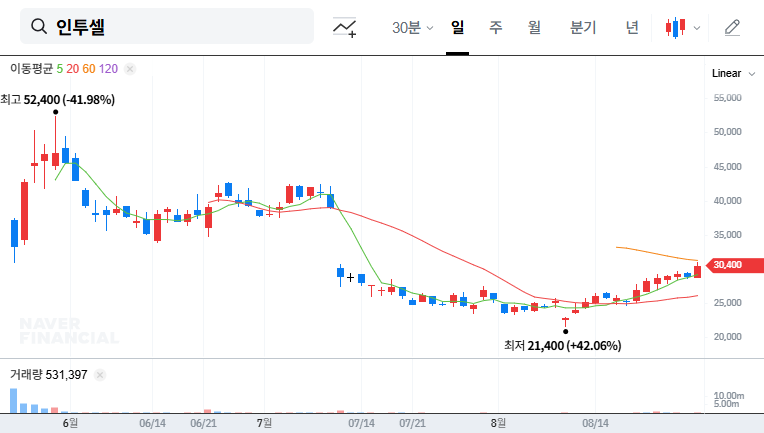
    Intocell Applies for Phase 1 IND for Anticancer Drug: Investment Opportunity Analysis 대표 차트 이미지

    What Happened?

    Intocell announced on August 29, 2025, that it had completed the application for Investigational New Drug (IND) approval for a Phase 1 clinical trial of its anti-B7-H3 antibody-drug conjugate (ADC), ITC-6146RO, in Korea. ITC-6146RO is Intocell’s core pipeline, and this IND application is a significant milestone marking the entry into the clinical stage.

    Why is it Important?

    This IND application is a significant event showcasing Intocell’s differentiated ADC platform technology and growth potential. ITC-6146RO, developed based on OHPAS linker and PMT technology, is expected to demonstrate high efficacy and safety compared to existing anticancer treatments and contribute to securing a competitive edge in the global ADC market.

    What’s Next?

    Once the IND is approved and the Phase 1 clinical trial verifies safety and efficacy, the possibility of technology transfer and partnership agreements is expected to increase, positively impacting Intocell’s future revenue generation. Furthermore, successful clinical results are likely to enhance market confidence and act as a momentum for stock price increases.

    What Should Investors Do?

    • Monitor Clinical Progress: After IND approval, investors should closely watch the results of Phase 1 clinical trials and the progress towards subsequent clinical phases.
    • Check for Technology Transfer and Partnership Opportunities: Successful clinical results can lead to technology transfer and partnerships, so pay attention to related news.
    • Analyze Competitors: Analyze the competitive landscape of the ADC market and evaluate Intocell’s relative competitiveness.
    • Check Financial Soundness: It is crucial to confirm funding plans for continued R&D and the company’s financial stability.
    • Consider Risk Factors: Make informed investment decisions by considering potential risks such as the possibility of clinical trial failure, regulatory approval uncertainty, and intensifying competition.
    What are Intocell’s core technologies?

    Intocell’s core competencies are its OHPAS linker platform and PMT technology. The OHPAS linker has advantages in drug applicability, blood stability, and drug release rate, while PMT technology aims to improve the therapeutic index (TI) by minimizing normal cell entry.

    What is ITC-6146RO?

    ITC-6146RO is Intocell’s core pipeline anti-B7-H3 ADC. B7-H3 is a protein expressed in various cancer cells, and ITC-6146RO targets it for anticancer effects.

    When will the IND be approved?

    The timing of IND approval depends on the MFDS’s review schedule and is difficult to predict accurately.

    Intocell Applies for Phase 1 IND for Anticancer Drug: Investment Opportunity Analysis 관련 이미지
    Intocell Applies for Phase 1 IND for Anticancer Drug: Investment Opportunity Analysis 관련 이미지
  • Intocell (287840) Investment Analysis: ADC Technology vs. Lack of Profitability, What’s the Future?

    1. What Happened? Analysis of Intocell’s 2025 Semi-Annual Results

    Intocell recorded zero sales, an operating loss of 3.7 billion won, and a net loss of 3.8 billion won in its 2025 semi-annual report. Even considering that it is a research and development-focused company, the results are disappointing. In particular, the issue of contract termination with a specific partner has increased market concerns.

    2. Why These Results? Fundamental Analysis

    • Strengths: Excellent ADC platform technology (OHPAS, PMT), diverse pipeline (ITC-6146RO, etc.), collaboration with major pharmaceutical companies, secured patents, government support
    • Weaknesses: Chronic deficit, high R&D expenses, declining sales, contract termination issue

    Intocell’s core competitiveness lies in its innovative ADC platform technology. However, the difficulty in generating profits and high R&D expenditures continue to be a burden.

    3. What’s Next? Market Conditions and Outlook

    The ADC market is expected to have high growth. If Intocell’s technology is recognized in the market, it can achieve significant growth. However, key events such as clinical trial results, new partnership agreements, and technology transfer must be successful. Macroeconomic conditions, interest rates, and exchange rate fluctuations can also affect Intocell’s growth.

    4. What Should Investors Do? Action Plan

    In the short term, investors should be wary of stock price volatility. From a long-term perspective, it is necessary to closely monitor the progress of clinical trials, the status of partnership agreements, and the success of technology transfer. Investors should keep in mind that investment decisions are their own responsibility.

    What is Intocell’s core technology?

    Intocell possesses antibody-drug conjugate (ADC) platform technologies, OHPAS and PMT. These technologies offer high versatility, stability, and efficacy, providing differentiated competitiveness.

    What is Intocell’s main pipeline?

    Intocell’s main pipeline is ITC-6146RO, a B7-H3 targeted ADC candidate. It is currently preparing to enter Phase 1 clinical trials, and additional pipelines such as HER3 and PSMA are also under development.

    What should I be aware of when investing in Intocell?

    Intocell has high growth potential, but it has not yet generated profits and continues to record losses. In addition, stock price volatility can be high depending on clinical trial results and partnership agreements, so caution is advised when investing.