Tag: Investment

  • Hanmi Pharmaceutical IR: Unveiling R&D Pipeline and Investment Strategies


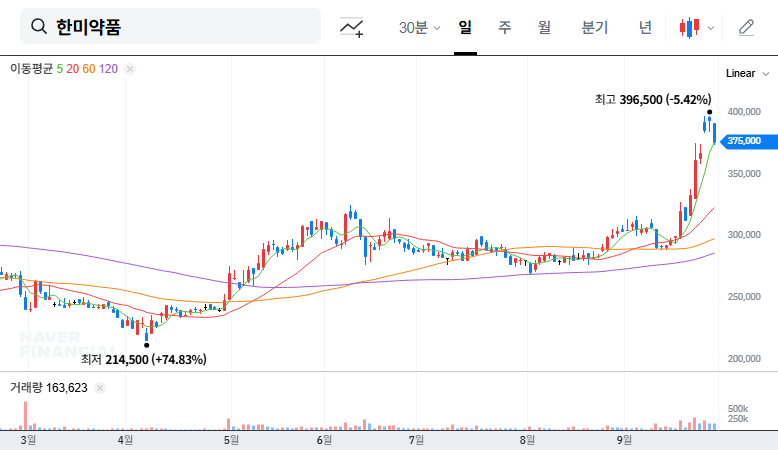
    Hanmi Pharmaceutical IR: Unveiling R&D Pipeline and Investment Strategies 대표 차트 이미지


    1. Hanmi Pharmaceutical IR: What Happened?

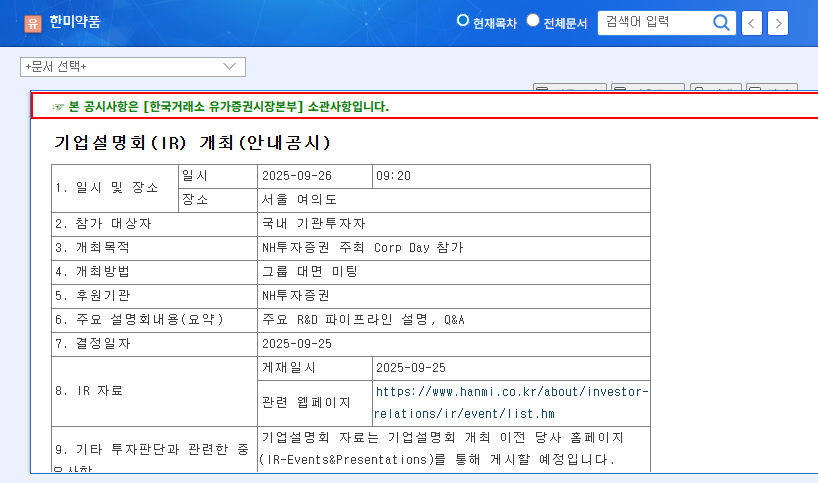
    Hanmi Pharmaceutical held its IR on September 26, 2025, during NH Investment & Securities’ Corp Day. The focus was on sharing updates on major R&D pipelines and addressing investor questions. While there was a recent correction disclosure regarding the semiannual report, its impact on the company’s fundamentals is deemed minimal.

    2. Key Takeaways and Market Impact: Why Does it Matter?

    This IR provided a crucial opportunity to assess Hanmi’s future growth potential by examining the current status of its R&D pipelines. Positive clinical trial results or the unveiling of new pipelines could boost investor sentiment, while delays or negative results could negatively impact the stock price.

    • Positive Factors: Unveiling of innovative new drug pipelines, positive clinical trial results, potential for strategic partnerships.
    • Negative Factors: Disappointing clinical trial results, development delays or discontinuations, negative market outlook for pipelines, low R&D investment efficiency.

    3. Key Information for Investors: What Should You Do?

    Investors should carefully analyze the information presented at the IR, including management’s responses, to formulate their investment strategies. A comprehensive evaluation of the specific development stages of the pipelines, commercialization potential, and market competition is crucial. Macroeconomic factors such as interest rates and exchange rates can also influence investment decisions and require ongoing monitoring.

    4. Investor Action Plan

    • Thoroughly review IR materials and related news.
    • Consult expert analysis reports.
    • Develop a long-term investment strategy.
    • Continuously monitor macroeconomic changes.


    FAQ

    What were the key takeaways from the Hanmi Pharmaceutical IR?

    The main focus was sharing updates on major R&D pipelines and a Q&A session.

    Why was this IR important?

    It provided valuable insights into Hanmi’s R&D pipelines, which are key drivers of its future growth.

    What should investors consider when making investment decisions?

    Investors should consider the IR announcements, market conditions, and macroeconomic indicators.


    Hanmi Pharmaceutical IR: Unveiling R&D Pipeline and Investment Strategies 관련 이미지
    Hanmi Pharmaceutical IR: Unveiling R&D Pipeline and Investment Strategies 관련 이미지


  • Hankook Tire & Technology Announces Value Enhancement Plan: Investment Strategy Analysis

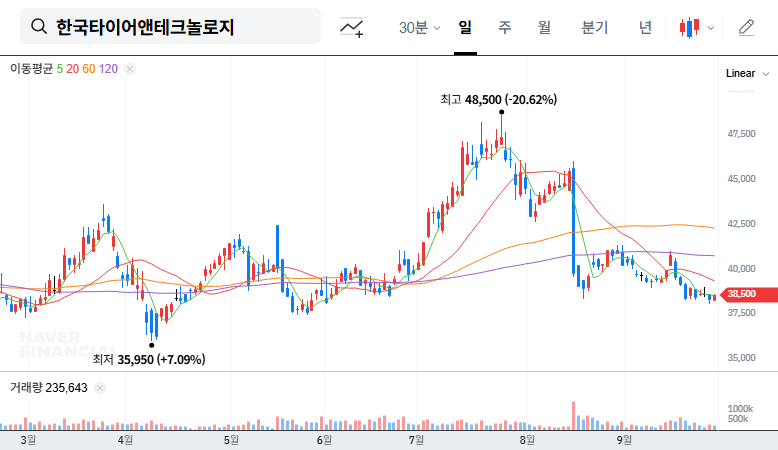
    Hankook Tire & Technology Announces Value Enhancement Plan: Investment Strategy Analysis 대표 차트 이미지

    1. What Happened?

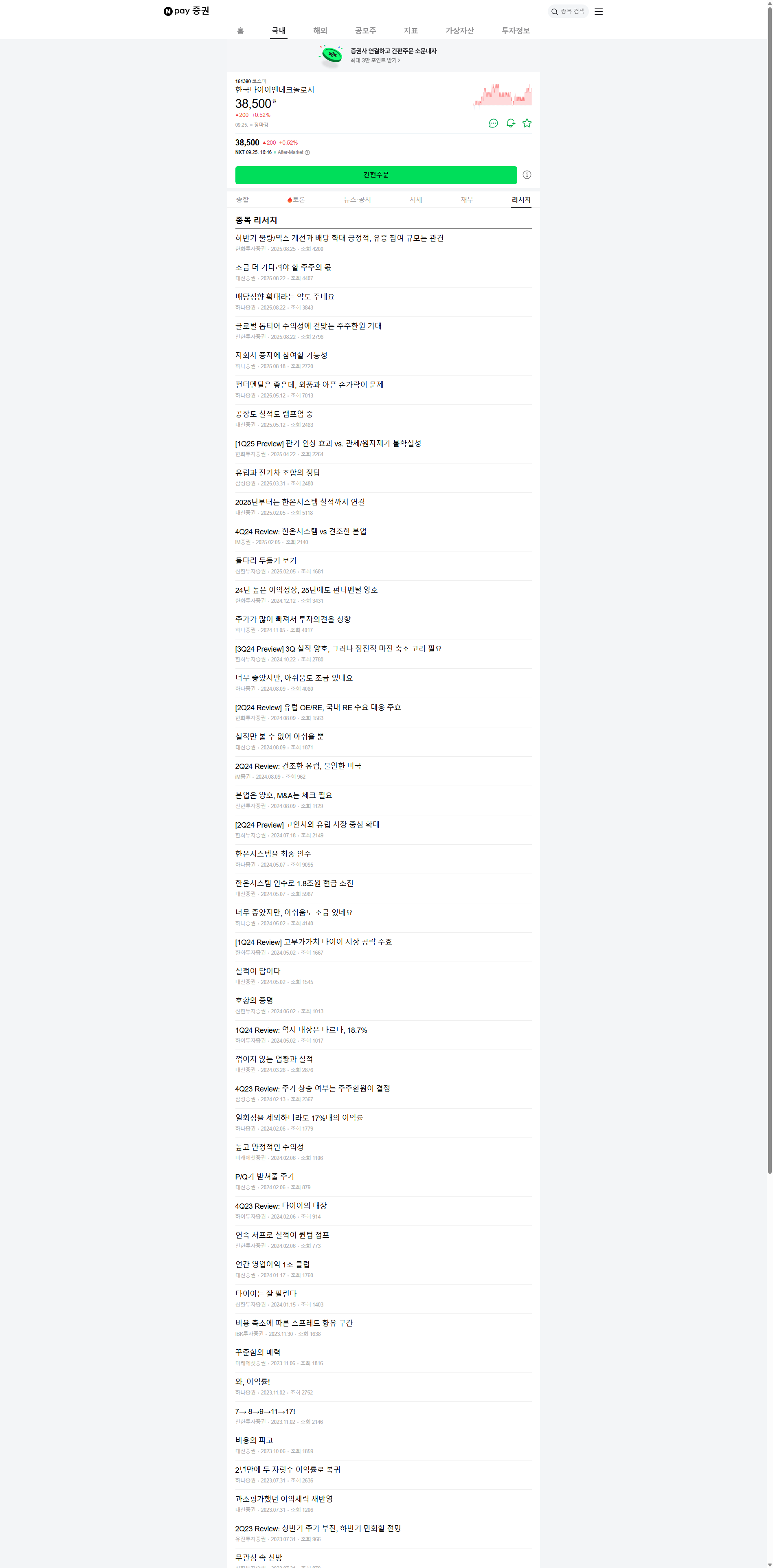
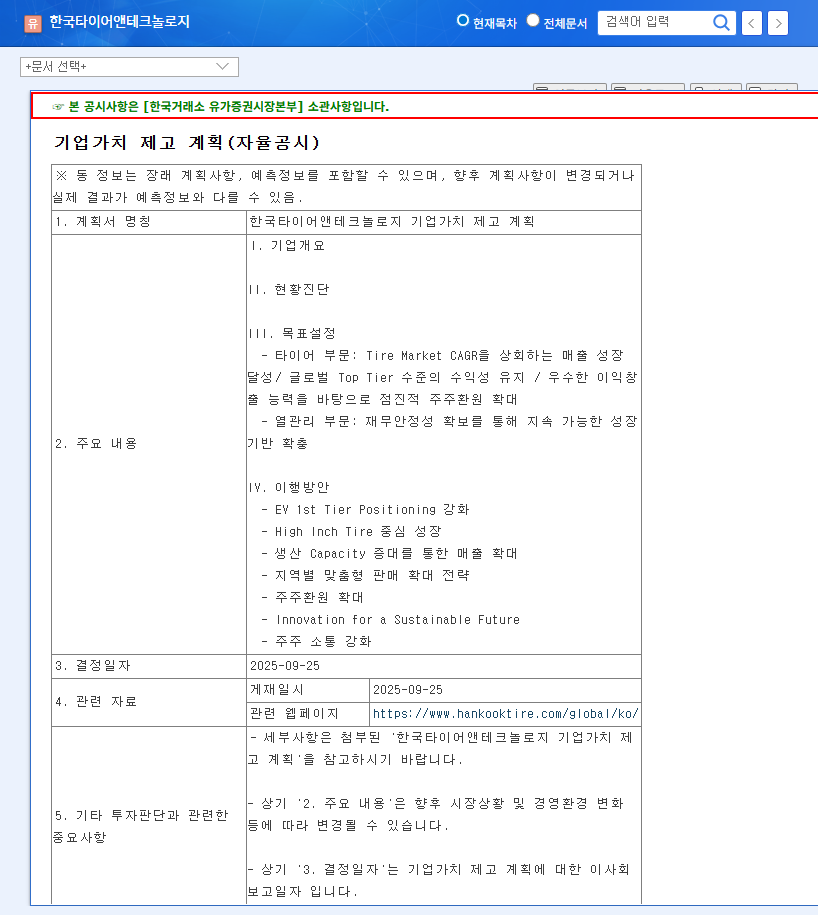
    On September 25, 2025, Hankook Tire & Technology announced its ‘Value Enhancement Plan’ through a voluntary disclosure. This plan focuses on securing future growth drivers based on two main pillars: the continuous growth of the tire business and financial stability of Hanon Systems.

    2. Why Does It Matter?

    This plan is a crucial indicator of Hankook Tire & Technology’s future growth strategy. Capturing the expanding EV tire market, focusing on high-inch tires, and expanding shareholder returns offer important investment points for investors.

    • Tire Business: Strengthening the ‘iON’ EV tire lineup and expanding high-inch tire sales to secure market competitiveness.
    • Thermal Management Business: Establishing a sustainable growth foundation through securing the financial stability of Hanon Systems.
    • Shareholder Return Expansion: Gradual expansion of shareholder returns to enhance shareholder value.

    3. What’s the Expected Outcome?

    With successful implementation of the plan, Hankook Tire & Technology is expected to secure a leading position in the EV tire market and strengthen the growth and profitability of its tire business. However, external factors such as global economic slowdown, raw material price volatility, and interest rate hikes could pose potential risks.

    4. What Should Investors Do?

    While positive momentum is expected in the short term, investors should carefully monitor the plan’s execution and market conditions from a mid-to-long-term perspective. Pay close attention to Hanon Systems’ performance improvement, risk management related to exchange rate and interest rate fluctuations, and efforts to strengthen ESG management.

    Frequently Asked Questions

    What are the key points of Hankook Tire’s value enhancement plan?

    The key aspects are the growth and profitability enhancement of the tire business and securing the financial stability of Hanon Systems. Focusing on the EV tire market and expanding shareholder returns are key elements.

    What should investors be aware of?

    Investors should consider external factors like global economic slowdown, raw material price fluctuations, interest rate hikes, and the performance volatility of Hanon Systems.

    What is Hankook Tire’s EV tire strategy?

    Hankook Tire aims to establish a leading position in the EV tire market by strengthening its ‘iON’ EV tire lineup and investing in technology development.

    Hankook Tire & Technology Announces Value Enhancement Plan: Investment Strategy Analysis 관련 이미지
    Hankook Tire & Technology Announces Value Enhancement Plan: Investment Strategy Analysis 관련 이미지
  • DASCO Acquires SolEco: Investment Opportunity or Risk? Key Analysis and Investment Strategy

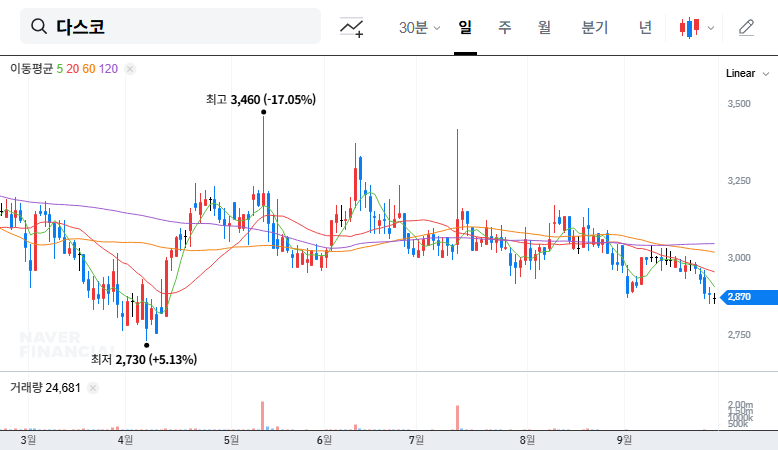
    DASCO Acquires SolEco: Investment Opportunity or Risk? Key Analysis and Investment Strategy 대표 차트 이미지

    1. DASCO-SolEco Merger: What’s Happening?

    DASCO announced on September 24, 2025, its plan to acquire its subsidiary, SolEco. SolEco, a manufacturer of floating structures and supplier of construction materials, will be fully absorbed by DASCO. The primary goal of this merger is to strengthen DASCO’s renewable energy business, specifically in the floating solar power sector. The merger date is set for November 29, 2025, and DASCO’s stock is currently halted from trading.

    2. Why Merge? Analyzing Synergies and Risks

    DASCO aims to secure SolEco’s floating solar buoy technology and create synergies within its renewable energy business segment to secure future growth engines. The merger is also expected to increase operational efficiency by eliminating overlapping functions and reducing costs. However, SolEco’s weak performance (sales of 3.7 billion KRW and a net loss of 2.4 billion KRW in the first half of 2024) could burden DASCO’s financial health post-merger. The uncertainties surrounding the merger process and the actual realization of synergy effects also require careful consideration.

    3. DASCO’s Business Status and Future Prospects

    DASCO operates in SOC, energy, building materials, and steel businesses. While the SOC business has returned to profitability, the energy and building materials sectors are recording losses. The steel business remains profitable but faces challenges due to intensified competition. DASCO is seeking diversification through new business ventures, but its R&D investment ratio is relatively low.

    4. Action Plan for Investors

    While this merger can be viewed positively in the long term, short-term risks exist. Investors should consider various factors before making investment decisions, including SolEco’s post-merger profitability, the performance improvement of DASCO’s existing businesses, changes in financial structure after the merger, and the macroeconomic and market conditions. The potential for short-term stock price volatility should also be noted.

    What is the purpose of the merger between DASCO and SolEco?

    DASCO is acquiring SolEco to enhance its competitiveness and create synergies within its renewable energy business, particularly in the floating solar power sector.

    What are the risks associated with the merger?

    Key risk factors include SolEco’s poor financial performance, uncertainties surrounding the merger process, and the potential failure to achieve synergy effects.

    What precautions should investors take?

    Investors should consider various factors, including SolEco’s profitability after the merger, the performance of DASCO’s existing business, and changes in financial structure post-merger. They should also be aware of potential short-term stock price volatility.

    DASCO Acquires SolEco: Investment Opportunity or Risk? Key Analysis and Investment Strategy 관련 이미지
    DASCO Acquires SolEco: Investment Opportunity or Risk? Key Analysis and Investment Strategy 관련 이미지
  • STX Engine Stock Forecast: Opportunity or Crisis after UAMCO’s Stake Sale? (September 2025 Analysis)


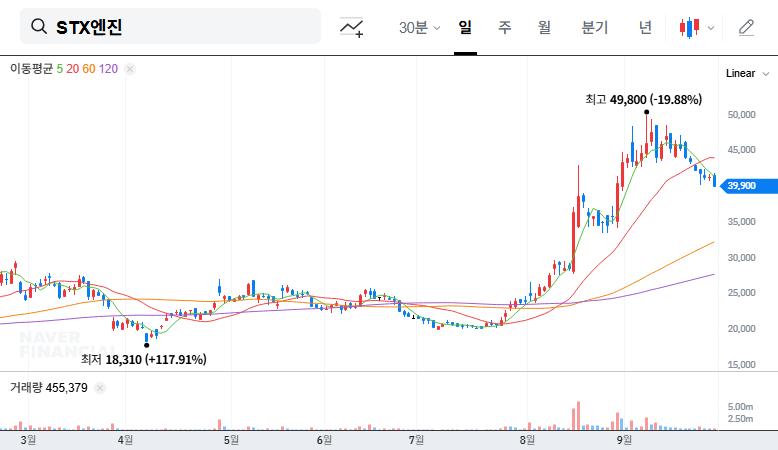
    STX Engine Stock Forecast: Opportunity or Crisis after UAMCO's Stake Sale? (September 2025 Analysis) 대표 차트 이미지


    1. What Happened? UAMCO Sells 2.49% Stake in STX Engine

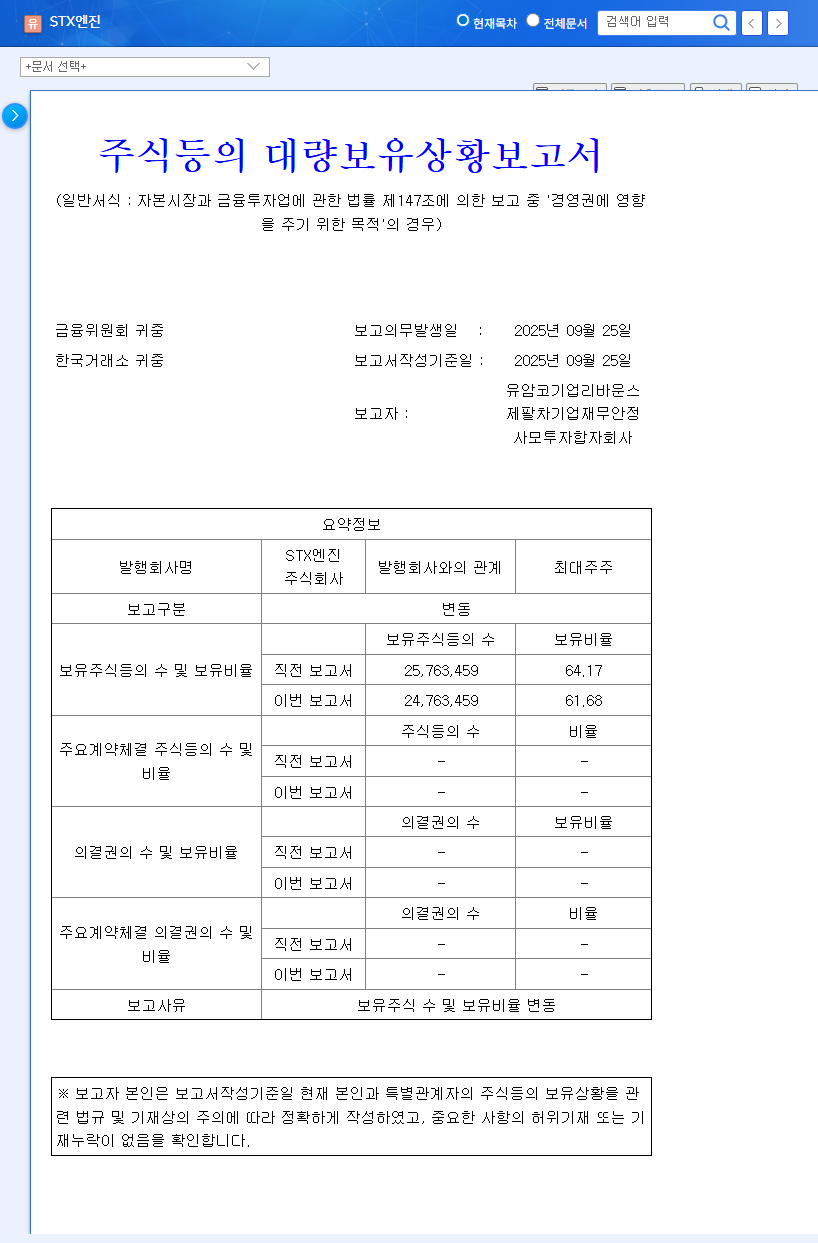
    On September 25, 2025, a public announcement revealed that UAMCO Corporate Rebound No. 8 Private Equity Fund, the largest shareholder of STX Engine, sold a 2.49% stake through after-hours trading. This reduced UAMCO’s stake in STX Engine from 64.17% to 61.68%.

    2. Why the Sale? Background Analysis and Investor Sentiment

    According to the announcement, the reason for the stake sale was ‘change in the number of shares held and ownership ratio,’ and the purpose of holding the shares is still stated as ‘influence on management rights.’ While portfolio adjustments are possible, investors are understandably sensitive to stake sales by major shareholders. The uncertainty surrounding potential further stake sales and the background of the sale can dampen investor sentiment.

    3. STX Engine’s Current Status: Fundamental Analysis

    Interestingly, STX Engine’s first-half 2025 earnings were quite positive. Sales increased by 12.76% year-on-year, and operating profit also improved significantly. The robust growth of the defense sector and investment in eco-friendly technologies stand out. However, the low operating rate in the commercial sector and exchange rate volatility remain risk factors.

    4. So, What Should We Do? Investment Strategy Suggestions

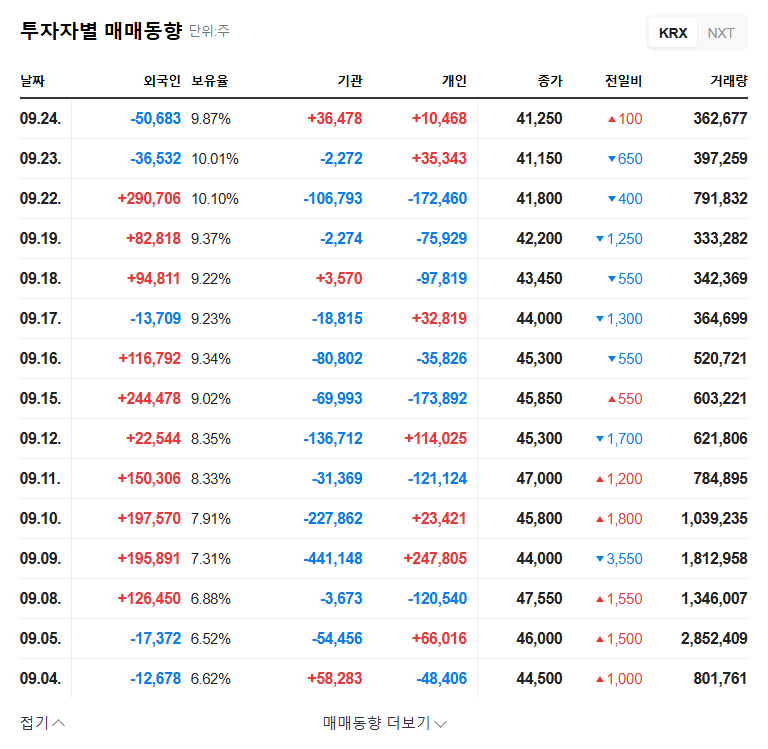
    In the short term, investors should be wary of increased stock price volatility. The sale of shares by a major shareholder can put downward pressure on the stock price. However, in the medium to long term, it’s necessary to pay attention to STX Engine’s growth potential. The commercialization of eco-friendly engine technology and the performance of the defense sector could be momentum for future stock price increases.

    Investor Action Plan

    • Short-term investors: Be cautious of increased volatility and prepare for potential short-term price drops.
    • Mid- to long-term investors: Focus on growth momentum and fundamental improvements, and look for additional buying opportunities.
    • All investors: Continuously monitor UAMCO’s potential further stake sales, exchange rate and interest rate fluctuations, and the recovery of the commercial sector.


    FAQ

    Why did UAMCO sell its stake in STX Engine?

    The official reason is ‘change in the number of shares held and ownership ratio’. It could be a simple portfolio adjustment, but further information is needed to understand the exact background.

    What is the future stock price outlook for STX Engine?

    In the short term, volatility may increase due to the stake sale issue, but in the medium to long term, it is important to pay attention to positive fundamentals and growth momentum.

    What should investors be aware of?

    Investors should continuously monitor the possibility of further stake sales by UAMCO, exchange rate and interest rate fluctuations, and the recovery of the commercial sector.


    STX Engine Stock Forecast: Opportunity or Crisis after UAMCO's Stake Sale? (September 2025 Analysis) 관련 이미지
    STX Engine Stock Forecast: Opportunity or Crisis after UAMCO's Stake Sale? (September 2025 Analysis) 관련 이미지


  • LS ELECTRIC Announces Treasury Stock Disposal: Impact on Stock Price?


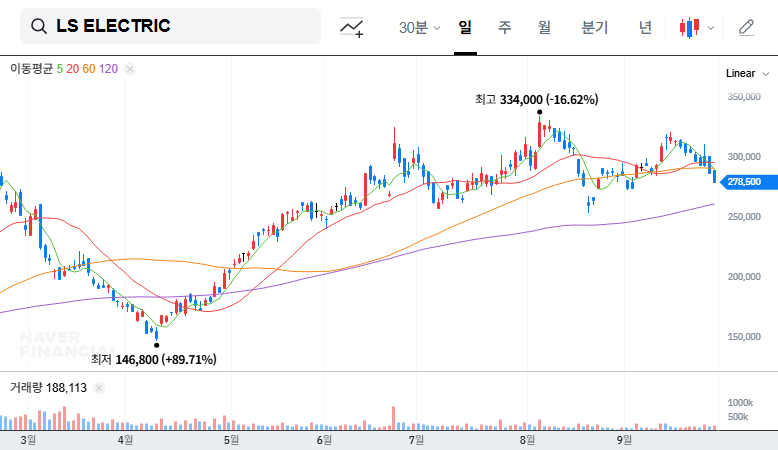
    LS ELECTRIC Announces Treasury Stock Disposal: Impact on Stock Price? 대표 차트 이미지


    1. LS ELECTRIC’s Treasury Stock Disposal: What’s Happening?

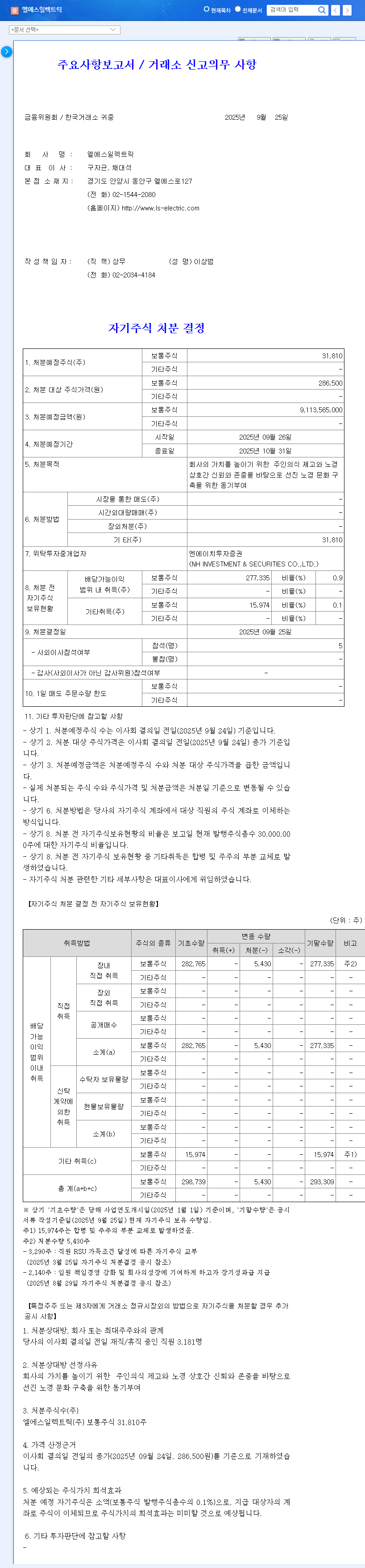
    On September 25, 2025, LS ELECTRIC announced its decision to dispose of 31,810 common shares, equivalent to about 9.1 billion won. This process will be handled through NH Investment & Securities, and the stated purpose is to foster a sense of ownership among employees and build an advanced labor-management culture based on trust and respect.

    2. Why Dispose of Treasury Stock?

    LS ELECTRIC aims to boost employee ownership and improve labor-management relations by distributing these shares. The ultimate goal is to enhance trust among shareholders and stakeholders by sharing the company’s growth and profits in the long run.

    3. Impact on Stock Price?

    • Positive Effects:
      • Signals management’s commitment to enhancing shareholder value.
      • Potential for long-term corporate culture improvement and productivity enhancement.
      • Limited impact on supply and demand due to the small disposal size relative to the total market capitalization.
    • Neutral/Potential Negative Effects:
      • Limited direct impact on stock price in the short term.
      • Potential for positive or negative perception depending on whether the disposal objectives are achieved.

    4. Investor Action Plan

    LS ELECTRIC possesses stable business portfolios and robust financial soundness, securing growth momentum. While this treasury stock disposal can be a positive factor in the long term, investment decisions should be made while monitoring macroeconomic conditions such as exchange rates, interest rates, and raw material prices.

    It is crucial to verify additional information like the actual disposal price, timing, and method, as well as to monitor whether the disposal objectives are achieved.


    FAQ

    Will LS ELECTRIC’s treasury stock disposal positively impact the stock price?

    While the short-term impact is expected to be minimal, it could positively affect the stock price in the long run by contributing to corporate culture improvement and increased productivity.

    What is the size of the treasury stock disposal?

    31,810 common shares, equivalent to approximately 9.1 billion won.

    What is the purpose of the treasury stock disposal?

    To foster employee ownership and build an advanced labor-management culture based on trust and respect.


    LS ELECTRIC Announces Treasury Stock Disposal: Impact on Stock Price? 관련 이미지
    LS ELECTRIC Announces Treasury Stock Disposal: Impact on Stock Price? 관련 이미지


  • MAUM.AI Stock Forecast: CEO Taejun Yoo’s Stake Change – What Investors Need to Know (September 2025 Analysis)


    MAUM.AI Stock Forecast: CEO Taejun Yoo's Stake Change - What Investors Need to Know (September 2025 Analysis) 대표 차트 이미지


    1. What Happened? : CEO Taejun Yoo’s Stake Change Announcement

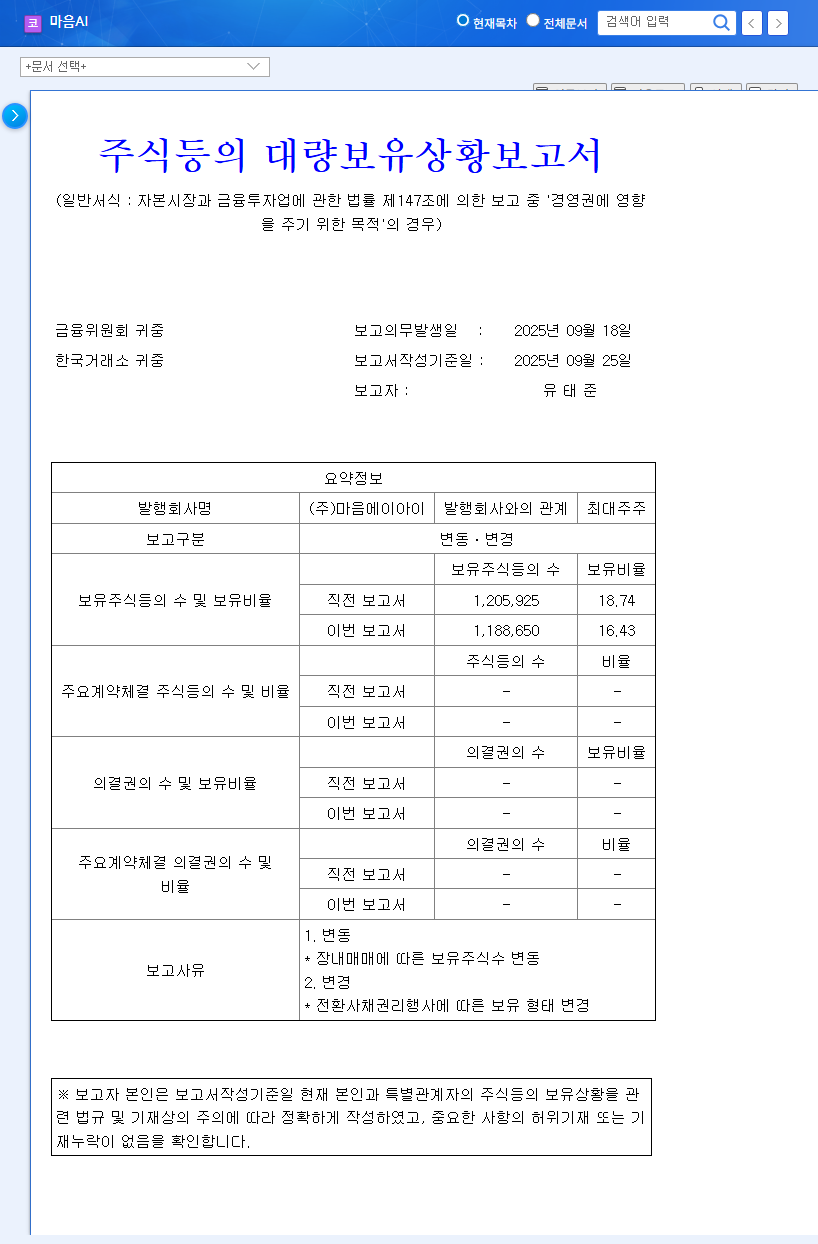
    On September 25, 2025, a public announcement revealed that MAUM.AI CEO Taejun Yoo’s stake decreased from 18.74% to 16.43%. This change is attributed to over-the-counter trading and the exercise of convertible bond rights, potentially impacting management control.

    2. Why the Change? : Background Analysis

    Over-the-counter selling by Mr. Byeonghee Son and the exercise of convertible bond rights are the main reasons for the stake change. The specific amount of shares sold directly by CEO Yoo has not been disclosed. The convertible bonds pose a potential for further stake dilution upon conversion to shares in the future.

    3. What’s the Impact? : Stock Price and Business Impact Analysis

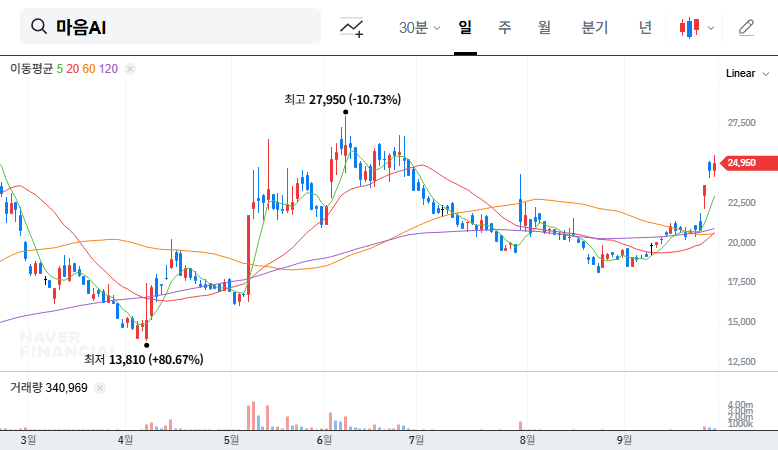
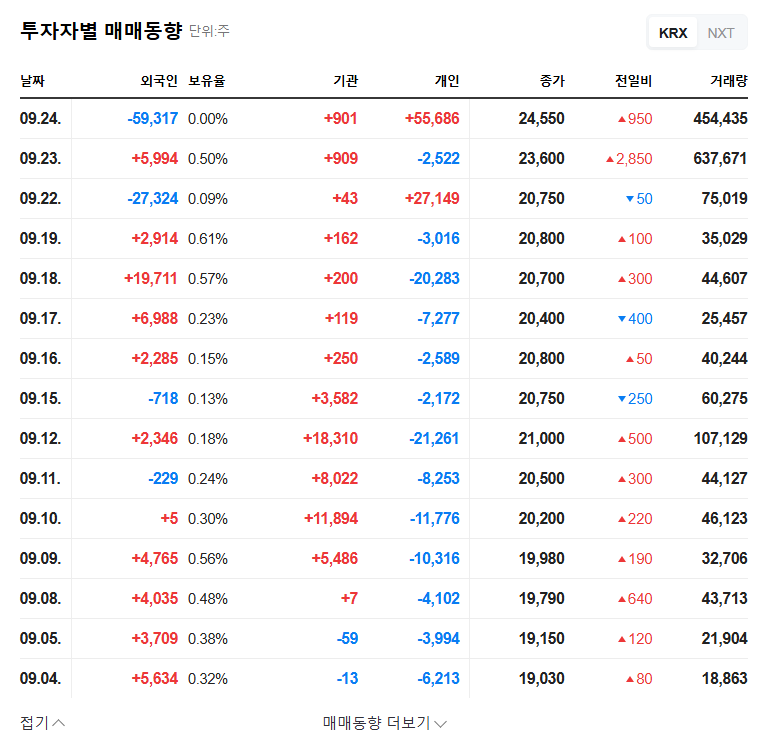
    • Stock Price Impact: A decrease in major shareholder stake can put downward pressure on the stock price in the short term. Selling by a shareholder with management influence can negatively impact investor sentiment.
    • Business Impact: While this stake change is unlikely to directly affect business strategy, caution is advised for investment decisions.
    • Financial Impact: Although financial soundness improved as of the first half of 2025, the potential dilution from convertible bonds warrants continuous monitoring.

    4. What Should Investors Do? : Action Plan

    • Short-term Investors: Selling or waiting is recommended in preparation for the risk of a stock price decline. Closely monitor further stake changes by CEO Yoo and any related announcements.
    • Long-term Investors: Re-evaluate MAUM.AI’s growth potential in the AI market, technological competitiveness, financial soundness, profitability improvement trends, impact of convertible bonds, and macroeconomic variables to establish an investment strategy.


    FAQ

    What is the reason for CEO Taejun Yoo’s stake change?

    The stake change is due to over-the-counter trading and the exercise of convertible bond rights. The exact reason for the sale was not disclosed.

    How will this stake change affect MAUM.AI’s stock price?

    It is likely to put downward pressure on the stock price in the short term. The long-term impact will depend on the company’s fundamentals and business outlook.

    How should investors respond?

    Short-term investors should consider selling or waiting, while long-term investors should re-evaluate the company’s fundamentals and business outlook to formulate an investment strategy.


    MAUM.AI Stock Forecast: CEO Taejun Yoo's Stake Change - What Investors Need to Know (September 2025 Analysis) 관련 이미지
    MAUM.AI Stock Forecast: CEO Taejun Yoo's Stake Change - What Investors Need to Know (September 2025 Analysis) 관련 이미지


  • TLB Stock Forecast: Mirae Asset’s Stake Change and Investment Strategies


    TLB Stock Forecast: Mirae Asset's Stake Change and Investment Strategies 대표 차트 이미지


    What Happened?

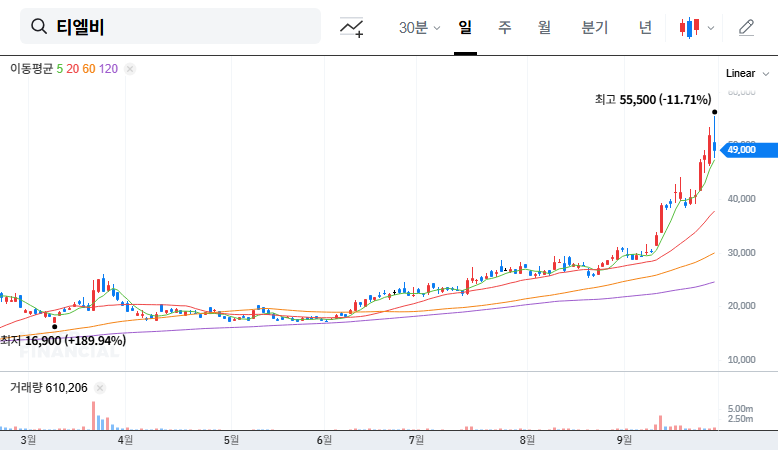
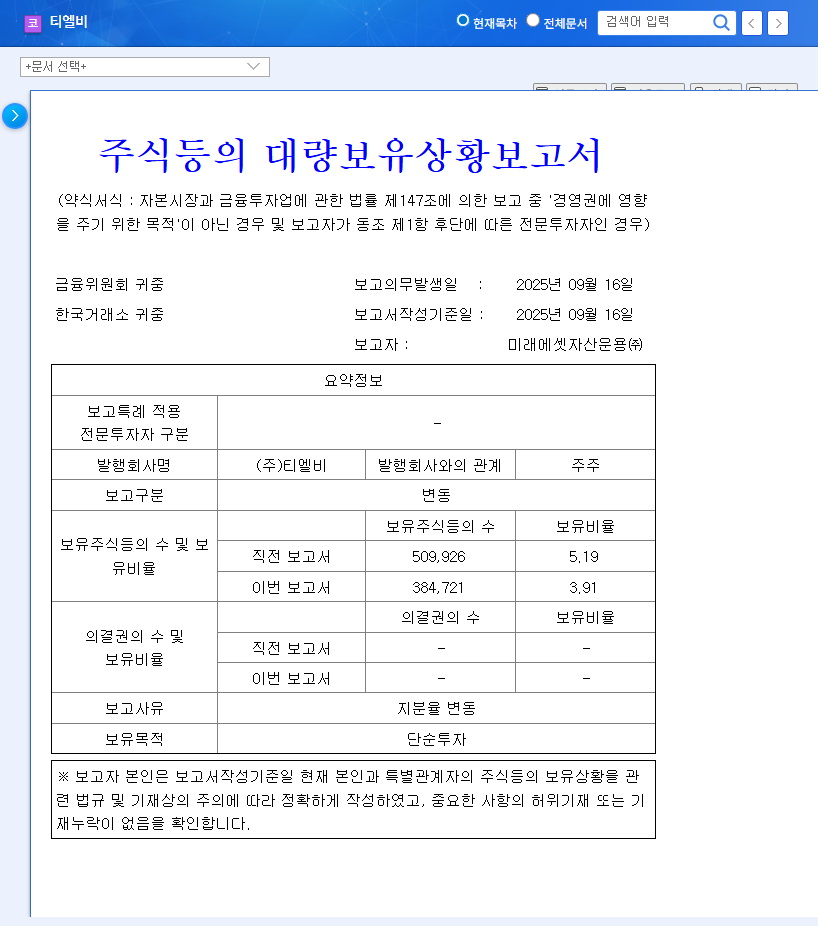
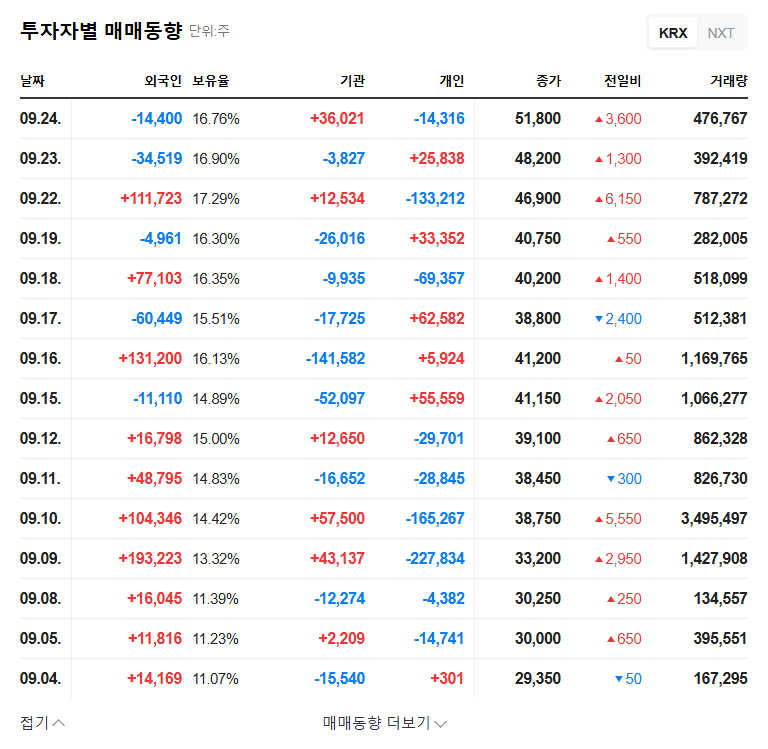
    On September 25, 2025, Mirae Asset Management reduced its stake in TLB to 3.91% by selling shares on the open market. While they stated the adjustment was for simple investment purposes, the possibility of profit-taking after the recent stock price surge cannot be ruled out.

    Why Pay Attention to TLB?

    TLB is considered a beneficiary of the growing AI and data center market. Specializing in manufacturing PCBs for memory semiconductors, the company is pursuing global competitiveness by investing in new technologies like CXL and SOCAMM, and expanding its production base in Vietnam. Its strong performance in the first half of 2025 demonstrates its growth momentum.

    • Strong Performance: Achieved KRW 117 billion in sales and KRW 8.73 billion in operating profit in Q2 2025 (significant improvement YoY)
    • Solid Financial Structure: Stable debt ratio of 76.30%, healthy current and quick ratios
    • Future Growth Drivers: Expected to benefit from AI and data center market expansion, enhanced global competitiveness through Vietnam production base

    Impact of Mirae Asset’s Stake Change

    Mirae Asset’s stake reduction could put downward pressure on TLB’s stock price in the short term. However, considering TLB’s solid fundamentals and growth potential, the impact is expected to be minimal in the mid to long term.

    What Should Investors Do?

    • Stay Engaged: Continuously monitor TLB’s earnings announcements, new technology developments, and business progress
    • Consider Dollar-Cost Averaging: DCA can mitigate short-term volatility risks
    • Risk Management: Check the company’s strategies for managing financial risks such as increasing debt and exchange rate fluctuations

    [Disclaimer] This content is not investment advice, and investment decisions are the sole responsibility of the investor.


    FAQ

    What is TLB’s main business?

    TLB’s main business is manufacturing PCBs for memory semiconductors. They are also investing in new technologies like CXL and SOCAMM, and expanding their overseas production to address the growth in the AI and data center markets.

    What was the reason for Mirae Asset Management’s stake change?

    Mirae Asset Management announced that the stake change was for simple investment purposes. Through on-market buying and selling, their stake decreased from 5.19% to 3.91%.

    What are some investment strategies for TLB?

    Investors should continuously monitor TLB’s earnings announcements, new technology developments, and business progress. Dollar-cost averaging can be considered to reduce short-term volatility risks. It’s also crucial to check the company’s strategies for managing financial risks, including increasing debt and exchange rate fluctuations.


    TLB Stock Forecast: Mirae Asset's Stake Change and Investment Strategies 관련 이미지
    TLB Stock Forecast: Mirae Asset's Stake Change and Investment Strategies 관련 이미지


  • TF Holdings Stock Outlook: Mirae Asset’s Increased Stake, A Sign of Stronger Fundamentals?


    TF Holdings Stock Outlook: Mirae Asset's Increased Stake, A Sign of Stronger Fundamentals? 대표 차트 이미지


    Mirae Asset Management Acquires 5.27% Stake in TF Holdings

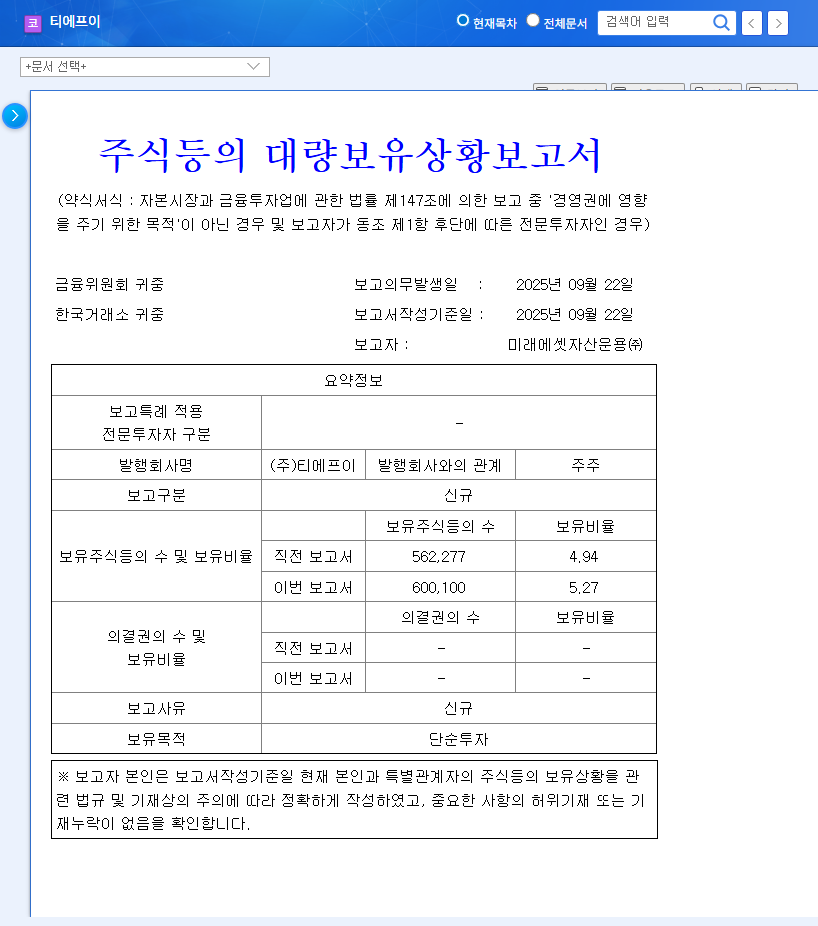
    Mirae Asset Management announced on September 25, 2025, that it had increased its stake in TF Holdings from 4.94% to 5.27%, a 0.33%p increase. This resulted from the acquisition of an additional 37,823 shares on September 22nd through on-market purchases. Mirae Asset stated that the stake increase was for simple investment purposes.

    TF Holdings on a Growth Trajectory with Robust Fundamentals

    TF Holdings demonstrated strong growth in the first half of 2025, recording sales of KRW 47,073 million (a 32% YoY increase), operating profit of KRW 6,896 million (a significant YoY improvement), and an operating profit margin of 14.65%. Domestic sales growth was particularly notable, driven by the recovery of the domestic semiconductor market and increased demand from key client ‘A’. Financial soundness is also healthy, with a significant improvement in operating cash flow.

    Mirae Asset’s Stake Increase: A Positive Signal for TF Holdings Stock?

    Mirae Asset’s increased stake is interpreted as reflecting positive market expectations for TF Holdings’ growth potential. Increased institutional investor interest could lead to further buying, creating upward momentum for the stock price. Investment from a large institution like Mirae Asset can send a strong positive signal to the market.

    Investment Considerations

    • Customer Concentration Risk: High reliance on client ‘A’ makes TF Holdings susceptible to demand fluctuations from this client.
    • Exchange Rate Volatility: Performance can be affected by fluctuations in USD and JPY exchange rates.
    • Convertible Bonds: Potential for future stock dilution exists.

    Action Plan for Investors

    • Continuously monitor Mirae Asset Management for any further stake changes.
    • Analyze client ‘A’s’ investment plans and strategic changes within the semiconductor market.
    • Observe TF Holdings’ efforts to expand exports and manage exchange rate volatility.
    • Assess the likelihood of convertible bond conversion and its potential stock dilution effect.


    FAQ

    What does TF Holdings do?

    TF Holdings manufactures COK, Test Board, and Test Socket, which are essential components for the semiconductor testing process. They are the only company in Korea supplying all three of these key testing resources.

    Why did Mirae Asset Management invest in TF Holdings?

    Officially, the investment was stated as being for ‘simple investment’ purposes. It’s likely they have a positive outlook on TF Holdings’ growth potential.

    What are the key investment considerations for TF Holdings?

    Investors should consider the high revenue dependence on a single client, exchange rate volatility, and the potential for stock dilution from convertible bonds.


    TF Holdings Stock Outlook: Mirae Asset's Increased Stake, A Sign of Stronger Fundamentals? 관련 이미지
    TF Holdings Stock Outlook: Mirae Asset's Increased Stake, A Sign of Stronger Fundamentals? 관련 이미지


  • Hanon Systems Rights Offering: Investment Opportunity or Risk?

    Hanon Systems Rights Offering: Investment Opportunity or Risk? 대표 차트 이미지

    1. What Happened?: Hanon Systems Rights Offering IR Session

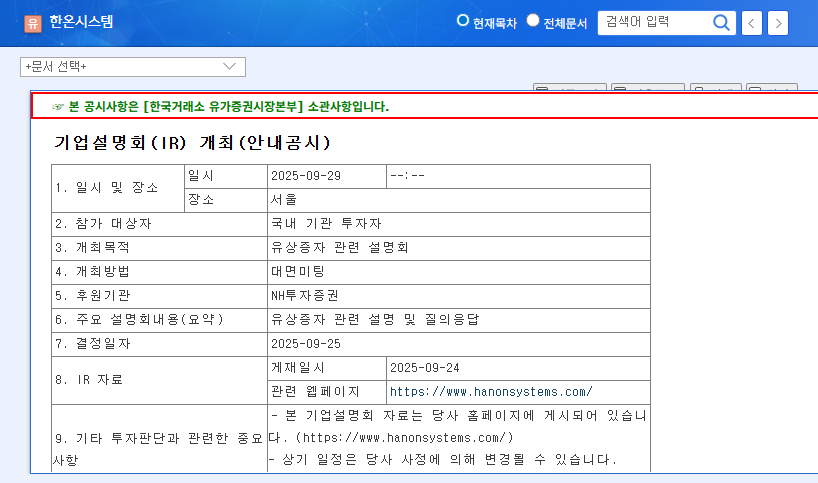
    Hanon Systems held an IR session on September 29, 2025, to discuss the details of its planned rights offering. The session provided information on the purpose and scale of the offering, the intended use of funds, and addressed investor questions.

    2. Why?: The Rationale Behind the Rights Offering

    Despite revenue growth in the first half of 2025, Hanon Systems faced declining profitability and a high debt-to-equity ratio (257.2%). The rights offering aims to raise capital for financial restructuring and future growth initiatives. The market is closely watching how the raised capital will contribute to enhancing the company’s value.

    3. So What?: Potential Impact of the Rights Offering

    • Positive Impacts: Improved financial structure, increased future investment, stabilized credit rating, enhanced corporate image.
    • Negative Impacts: Share dilution, fundraising costs, potential inefficiency in fund utilization.

    Given the rights offering follows a change in majority shareholder (Hankook Tire & Technology), expectations are high for synergy between the two companies. Investments in R&D to address the growing electric vehicle market are also a key area of focus.

    4. Investor Action Plan: Key Takeaways from the IR Session

    • Size and offer price of the rights offering
    • Planned use of funds (R&D investment, facility investment, etc.)
    • Synergy with Hankook Tire & Technology
    • Future earnings outlook
    • Impact of exchange rate and interest rate trends

    Careful analysis of the IR session content and consideration of the above key points are crucial for making informed investment decisions. Focus on long-term growth potential rather than short-term stock price fluctuations.

    What is the purpose of Hanon Systems’ rights offering?

    To raise capital for financial restructuring and future growth initiatives.

    How will the funds from the rights offering be used?

    The funds will be used for R&D investment, facility investment, debt repayment, etc. Refer to the IR materials for detailed information.

    How will the rights offering affect the stock price?

    There is a possibility of short-term share dilution, but it could contribute to enhancing corporate value in the long term.

    Hanon Systems Rights Offering: Investment Opportunity or Risk? 관련 이미지
    Hanon Systems Rights Offering: Investment Opportunity or Risk? 관련 이미지
    Hanon Systems Rights Offering: Investment Opportunity or Risk? 관련 이미지
  • SM Veccell’s Response to Inquiry: “No Material Information to Disclose” – What’s Next for the Stock?


    SM Veccell's Response to Inquiry:


    What Happened? Analyzing SM Veccell’s Inquiry Response

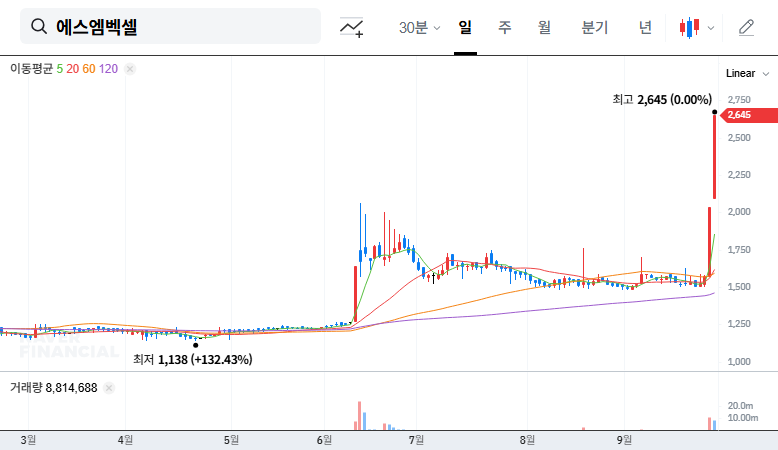
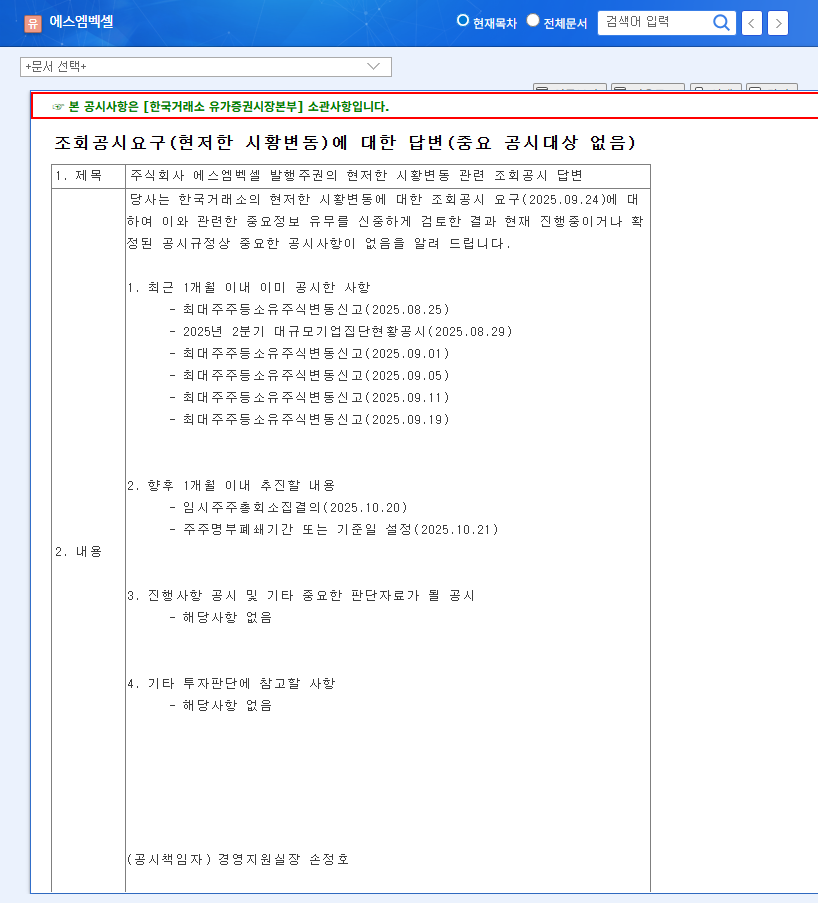
    On September 25, 2025, SM Veccell responded to the Korea Exchange’s inquiry regarding unusual stock fluctuations, stating that there are “no significant disclosures pending or confirmed.”

    How are SM Veccell’s Fundamentals?

    According to the 2025 semi-annual report, SM Veccell is showing positive fundamental changes. Operating profit increased by more than 130% year-over-year, and the debt ratio improved, indicating enhanced financial health. Both the auto parts and battery sectors recorded solid performance.

    So, What’s Next for the Stock Price? Short-Term and Long-Term Outlook

    This inquiry response is expected to resolve market uncertainty in the short term. It can reaffirm the already known positive fundamental improvement trend. In the long term, the stock price is expected to be influenced by future earnings announcements, R&D investment, and new business development. The declining trend in R&D investment warrants close monitoring.

    What Should Investors Do? Key Investment Points

    • Short-term investors: Should be aware of increased stock volatility and observe short-term trends.
    • Long-term investors: Should continuously monitor future earnings announcements and R&D investment trends, and evaluate the company’s growth potential. Improving customer dependence and securing new business drivers are key investment points.


    Frequently Asked Questions (FAQ)

    What are SM Veccell’s main businesses?

    SM Veccell’s main businesses are auto parts and batteries.

    Will this inquiry response positively affect the stock price?

    In the short term, it can contribute to resolving uncertainty, but the long-term impact depends on future earnings and management performance.

    What should investors be aware of when investing in SM Veccell?

    Investors should pay close attention to the declining trend in R&D investment and customer dependence.


    SM Veccell's Response to Inquiry:
    SM Veccell's Response to Inquiry: