Tag: Investment Risk

  • CSA Cosmic (083660) Stock Forecast: Major Shareholder Change and Poor Performance Signal Investment Risk

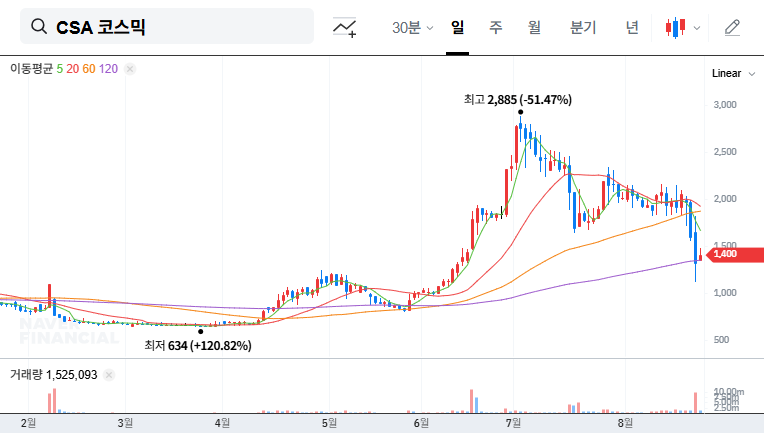
    CSA Cosmic (083660) Stock Forecast: Major Shareholder Change and Poor Performance Signal Investment Risk 대표 차트 이미지

    1. What Happened? : Major Shareholder Change and Stake Sell-off

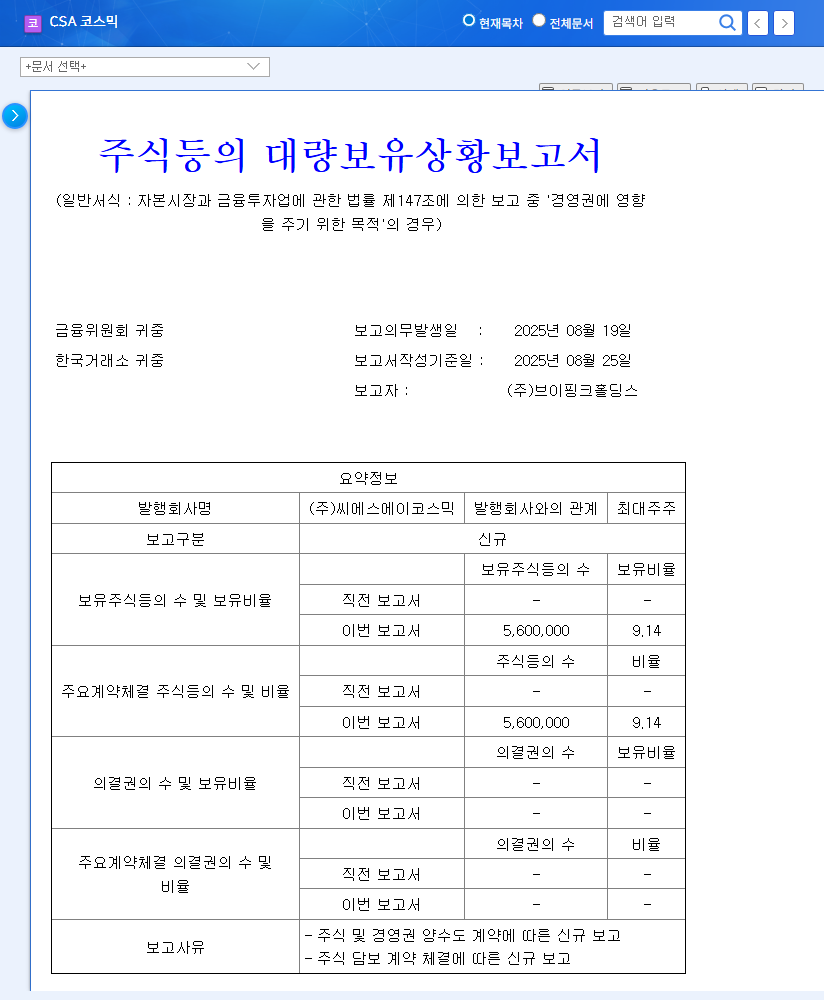
    Homecast significantly reduced its stake in CSA Cosmic from 55.45% to 10.76%. This represents a transfer of management control, with Sweet K expected to become the new major shareholder. The issue is that this change occurs amidst a backdrop of declining performance.

    2. Why Does it Matter? : Increased Uncertainty and Weakened Investor Sentiment

    Frequent changes in major shareholders raise concerns about management instability and potential strategic shifts. CSA Cosmic’s 2025 half-year results show a significant decline, with sales down 60.5% year-on-year and both operating and net income turning negative. This change in ownership amplifies uncertainty about the company’s future, further dampening investor sentiment.

    3. What’s the Impact? : Downward Pressure on Stock Price and Potential Fundamental Deterioration

    The large-scale sell-off of shares is likely to put downward pressure on the stock price in the short term. Furthermore, investing in CSA Cosmic is risky given the uncertainty surrounding the new major shareholder’s management capabilities and business strategies. The issuance of KRW 8 billion in convertible bonds and a KRW 100 billion rights offering will help secure short-term funding, but the potential for long-term stock dilution must be considered.

    4. What Should Investors Do? : Careful Observation and Risk Management

    • Monitor the new major shareholder’s business plans: Carefully review Sweet K’s plans for business normalization and growth strategies.
    • Check for a turnaround in the cosmetics business: Focus on tangible performance improvement efforts, such as new product launches and changes in marketing strategy.
    • Monitor financial structure improvement trends: Continuously review changes in financial soundness following the rights offering and convertible bond issuance.

    Investment in CSA Cosmic requires extreme caution at this time. Maintaining a speculative sell position or remaining on the sidelines and responding flexibly to changes in the situation is recommended.

    Q. How will the change in CSA Cosmic’s major shareholder affect the stock price?

    A. It is likely to put downward pressure on the stock price in the short term. Uncertainty increases and investor sentiment may weaken due to the unproven management capabilities and business strategy of the new major shareholder.

    Q. Why is CSA Cosmic’s poor performance a serious concern?

    A. The company’s 2025 half-year sales decreased by 60.5% year-on-year, and both operating and net income turned negative. The slump in the cosmetics business is the main cause, signaling a deterioration in the company’s fundamentals.

    Q. Should I invest in CSA Cosmic?

    A. A speculative sell or hold position is currently recommended. It is advisable to make investment decisions after confirming the new management’s business plans and performance improvements. Investments should always be made at your own discretion and responsibility.
    CSA Cosmic (083660) Stock Forecast: Major Shareholder Change and Poor Performance Signal Investment Risk 관련 이미지
    CSA Cosmic (083660) Stock Forecast: Major Shareholder Change and Poor Performance Signal Investment Risk 관련 이미지
  • CCS (066790): Shareholder Registry Inspection Granted – What Investors Need to Know

    1. What Happened at CCS?

    CCS, a provider of cable television, high-speed internet, and other services, is facing escalating management disputes following the court’s decision to grant access to its shareholder registry. This ruling could empower stakeholders to actively participate in management decisions, potentially influencing future shareholder meetings and voting processes.

    2. Why Did This Happen?

    CCS is already grappling with weak fundamentals, frequent changes in majority shareholders, and violations of broadcasting regulations, contributing to high management uncertainty. Declining revenue, worsening operating profit, and deepening net losses have fueled concerns about the company’s financial health. The court’s decision regarding shareholder registry access could further exacerbate the existing management conflict.

    3. What Should Investors Do?

    CCS is currently facing dual challenges: deteriorating fundamentals and heightened management uncertainty. The granted access to the shareholder registry amplifies these uncertainties, posing significant risks for investors. Extreme caution is advised for any investment in CCS, and close monitoring of the situation is crucial.

    4. Investor Action Plan

    • Gather Information: Continuously monitor CCS-related news, public disclosures, and analyst reports to stay informed about the latest developments.
    • Manage Risk: Before making any investment decisions, thoroughly understand the risks associated with investing in CCS and assess your risk tolerance.
    • Consult Experts: If you are unsure about your investment strategy, consider consulting with a financial advisor to review your options.

    FAQ

    What are CCS’s main businesses?

    CCS primarily provides cable television, high-speed internet, VoIP phone services, and broadcasting advertising.

    What does the shareholder registry inspection decision mean?

    It means that a specific shareholder has been granted the right by the court to inspect and copy CCS’s shareholder registry, which could influence future management disputes.

    Is it safe to invest in CCS now?

    CCS currently faces high investment risks due to deteriorating fundamentals and escalating management disputes. Extreme caution is advised for any investment decisions.

  • OpenEdge Technology’s H1 2025 Report: Navigating the Gap Between AI Chip Dreams and Reality

    1. What Happened?: OpenEdge Technology’s H1 2025 Report Reveals Financial Difficulties

    OpenEdge Technology’s H1 2025 report paints a concerning picture. Revenue decreased by 41.6% year-over-year to ₩73.98 billion, while operating losses increased by 167.7% to -₩153.68 billion. Net losses also widened significantly, raising concerns about the company’s financial health.

    2. Why Did This Happen?: Analyzing the Factors Behind the Decline

    The decline can be attributed to a combination of factors, including the global economic slowdown, delays in client development schedules, and high R&D expenses, which reached 250% of revenue. The company’s designation as a potential delisting candidate further adds to investor anxieties.

    3. What’s Next?: Future Outlook and Investment Considerations

    While the short-term outlook appears challenging, the growth potential of the AI chip market and OpenEdge Technology’s partnerships with Tier-1 clients offer a glimmer of hope. Future stock performance will depend heavily on the market success of new IPs, the effectiveness of turnaround strategies, cash flow management, and the overall global economic and semiconductor market conditions.

    • Key Investment Points:
    • – Success of New IP Market Entry
    • – Potential for Financial Restructuring and Profitability
    • – Global Economic and Semiconductor Market Conditions

    4. What Should Investors Do?: Careful Consideration and Continuous Monitoring Are Essential

    OpenEdge Technology currently carries significant investment risk. Investors should avoid being swayed by short-term stock fluctuations and instead carefully evaluate the company’s long-term growth potential and inherent risks. Continuous monitoring of earnings releases and major business contracts is crucial for making informed investment decisions.

    How did OpenEdge Technology perform in H1 2025?

    The company reported revenue of ₩73.98 billion (down 41.6% YoY), an operating loss of -₩153.68 billion (up 167.7%), and a significant increase in net loss.

    What are the main reasons for the decline?

    The decline is attributed to the global economic slowdown, client development delays, and high R&D expenses.

    What is the investment outlook for OpenEdge Technology?

    While the AI chip market offers growth potential, the company’s financials are weak. Closely monitor new IP success and turnaround strategies.

    What should investors be aware of?

    Consider the risks associated with high R&D spending and potential delisting. Careful investment decisions are crucial.

  • Setopia Designated as Investment Caution Stock: Delisting Risk Intensifies

    What Happened to Setopia?

    On August 14, 2025, Setopia was designated as an investment caution stock due to a ‘disqualified half-year review (audit) opinion’ and a capital impairment ratio exceeding 50% for the first half of the 2025 fiscal year. This follows a previous delisting decision by the Corporate Review Committee on June 12, 2025. Although the delisting process is currently suspended due to an injunction, the risk of delisting remains high depending on the lawsuit’s outcome.

    Why is Capital Impairment Dangerous?

    Capital impairment signifies a severe deterioration of a company’s financial health. In Setopia’s case, its total capital fell below 1 billion KRW at the end of 2023, and its capital impairment ratio surpassed 50% by the end of 2024. This raises serious doubts about the company’s ability to continue operating.

    What Should Investors Do?

    Investors in Setopia should immediately consider divesting. If the delisting is finalized, the stock’s value is likely to plummet to near zero. The current situation makes Setopia an unsuitable investment, and swift action is crucial to mitigate further losses.

    Action Plan for Investors

    • Step 1: Closely monitor news and announcements related to Setopia.
    • Step 2: Consult with a financial advisor to reassess your investment strategy.
    • Step 3: Consider selling your shares immediately if the situation worsens.

    Frequently Asked Questions

    Why was Setopia designated as an investment caution stock?

    Setopia was designated as an investment caution stock because its capital impairment ratio exceeded 50% in the first half of 2025.

    What is the likelihood of delisting?

    The likelihood of delisting is very high, given the existing delisting decision and the worsening capital impairment.

    What actions should investors take?

    Investors should closely monitor the situation, consult a financial advisor, and consider divesting their holdings.

  • Celumed (049180) Receives Disclaimer of Opinion: Investor Alert!

    What Happened? Celumed’s Disclaimer of Opinion

    Despite increased sales, Celumed’s 2025 semi-annual report revealed widening operating and net losses, culminating in a disclaimer of opinion. This casts significant doubt on the reliability of the company’s financial statements and raises concerns about its ability to continue as a going concern.

    Why Did This Happen? The Root of Celumed’s Crisis

    Celumed’s crisis stems from a severe deterioration in its financial health. High debt ratios, capital impairment, and continuous operating losses are significant obstacles to the company’s recovery. The lack of tangible results from new business ventures further adds to the uncertainty.

    • Financial Status: Capital impairment, high debt ratio (779.99%), lack of liquidity
    • Profitability: Widening operating and net losses
    • New Businesses: Uncertainty surrounding performance

    What Should Investors Do? Action Plan

    Investing in Celumed at this time carries substantial risk. Investors should carefully consider the following before making any decisions:

    • Resolution of the disclaimer of opinion and obtaining a qualified opinion
    • Concrete plans and execution for improving the financial structure
    • Tangible results and future prospects of new businesses

    Caution and careful observation are advised until these issues are addressed.

    What does Celumed’s disclaimer of opinion mean?

    A disclaimer of opinion means the auditor cannot express an opinion on the reliability of the company’s financial statements. This is a serious issue for investors, as it indicates potential problems with the company’s financial health.

    Should I buy Celumed stock now?

    Investing in Celumed currently carries significant risk due to the disclaimer of opinion and its weakened financial position. Caution is advised.

    What is the future outlook for Celumed?

    The future of Celumed is uncertain and depends on several factors, including resolving the audit issues, improving its financial structure, and achieving success with its new businesses.

  • Seowon E&C Q2 2025: Massive Loss and ‘Disclaimer of Opinion’ – A Red Flag for Investors

    1. What Happened at Seowon E&C?

    Seowon E&C reported a significant loss in Q2 2025, with revenue of KRW 14.6B, an operating loss of KRW 2.1B, and a net loss of KRW 14.2B. This represents a sharp decline compared to the same period last year and reverses the brief return to profitability in Q1 2025. Adding to the concerns, the company received a ‘disclaimer of opinion’ from its external auditor, raising doubts about its ability to continue as a going concern and increasing the risk of delisting.

    2. What Caused the Decline?

    Several factors contributed to Seowon E&C’s poor performance. Delayed payments on some contracts, construction halts related to the Petrofac HQC IJV LLC project, and challenging macroeconomic conditions, including high interest rates, volatile oil prices, and fluctuating shipping costs, all played a role.

    3. What Should Investors Do?

    Investing in Seowon E&C carries significant risk. Investors should exercise extreme caution and consider the potential for delisting. Careful monitoring of the following factors is crucial:

    • Financial recovery: Revenue growth, return to profitability, and debt reduction
    • Management normalization: Resolution of audit issues and improved transparency
    • New business development: Concrete plans and potential for success
    • Macroeconomic indicators: Interest rates, exchange rates, and commodity prices

    4. Investor Action Plan

    Investment decisions regarding Seowon E&C should be made with extreme caution and thorough due diligence. Consider the company’s fundamentals, management situation, and the outcome of any delisting-related lawsuits before making any investment decisions. Imprudent investments could lead to substantial losses.

    Frequently Asked Questions

    Is Seowon E&C likely to be delisted?

    Yes, the disclaimer of opinion and going concern uncertainty significantly increase the risk of delisting. The final decision will depend on the outcome of related legal proceedings.

    Should I invest in Seowon E&C?

    Investing in Seowon E&C is currently very risky. Given the potential for delisting and the company’s poor financial performance, extreme caution is advised.

    What is the outlook for Seowon E&C?

    The outlook for Seowon E&C is highly uncertain. It will depend on factors such as financial restructuring, management normalization, and the success of new business ventures.

  • STX Stock Faces Delisting: A Critical Analysis for Investors

    1. What’s Happening with STX?

    STX’s 2025 semi-annual report revealed net losses on both a consolidated and individual basis, plunging the company into capital impairment. A deficit of ₩179.5 billion raises serious doubts about the company’s ability to continue operations. Furthermore, trading of STX stock has been suspended due to violations of accounting standards, triggering a delisting review. The Korea Exchange will decide on the delisting on August 22nd.

    2. Why This Crisis?

    STX has a history of struggling with financial restructuring. Continuous operating losses and poor investment management have culminated in the current crisis. While the company launched the ‘TrollyGo’ platform as a new growth engine, the lack of concrete plans and uncertain profitability cast doubt on its ability to improve fundamentals. The situation is exacerbated by external factors such as a weak Korean Won and volatile raw material prices. High interest rates also hinder the company’s ability to raise capital.

    3. What’s Next for STX?

    The future of STX is highly uncertain. Delisting would result in substantial losses for investors. Even if delisting is avoided, it will take significant time and effort for the company to resolve its capital impairment and restore profitability.

    4. What Should Investors Do?

    Investing in STX is currently extremely risky. Investors should seriously consider the possibility of delisting and review their investment positions to minimize potential losses. A ‘strong sell’ recommendation is issued, and new investments should be absolutely avoided.

    Why is STX facing delisting?

    STX is facing delisting due to severe capital impairment and violations of accounting standards. The 2025 semi-annual report shows net losses on both a consolidated and individual basis, with total equity in the negative.

    What about STX’s ‘TrollyGo’ platform?

    While STX hopes ‘TrollyGo’ will drive new growth, uncertainties surrounding its business plan and profitability make it unlikely to significantly improve fundamentals in the short term.

    Should I sell my STX stock now?

    Analysts have issued a ‘strong sell’ recommendation for STX. The high probability of delisting and the lengthy recovery process, even if delisting is avoided, make investment in STX extremely risky. Current investors should strongly consider liquidating their positions.

  • Terascience Receives Disclaimer of Opinion: Investor Alert, Risk of Stock Plunge Analyzed

    1. Terascience’s Disclaimer of Opinion: What Does it Mean?

    Terascience received a ‘disclaimer of opinion’ on its 2025 semi-annual report. This signifies that the company’s financial statements are potentially materially misstated or that the auditor could not obtain sufficient evidence to verify their accuracy. The foundation of trust has been shaken.

    2. Why This Situation? Deteriorating Fundamentals

    • Sharp Decline in Sales and Profitability: An economic slowdown and increased competition led to a sharp drop in sales, while high cost ratios exacerbated deteriorating profitability.
    • Massive Loss Expansion: Operating and net losses have significantly increased, further fueled by uncertainties surrounding investments in new businesses.
    • Deteriorating Financial Health: The debt ratio has surged, and liquidity risk has heightened.
    • Worsening Operating Cash Flow: The ability to generate cash from operations has severely diminished.

    3. Disclaimer of Opinion: What are the Impacts?

    In the short term, there’s a risk of a stock plunge, an investment warning designation, and potential trading suspension. In the long term, the possibility of recovery decreases, new business ventures face difficulties, and even delisting from the stock exchange must be considered.

    4. Investor Action Plan

    • Limited Information Access: Access to information is restricted for companies with a disclaimer of opinion, requiring extreme caution in investment decisions.
    • Monitor Further Disclosures: Closely monitor future disclosures and announcements.
    • Consult with Experts: Consult with financial professionals before making any investment decisions.

    Investment Opinion: Currently, investing in Terascience is extremely risky. Consider reducing your investment or complete withdrawal.

    What is a disclaimer of opinion?

    A disclaimer of opinion is a statement by an external auditor that they cannot vouch for the reliability of a company’s financial statements. This could be due to significant errors in the statements or limitations in the scope of the audit.

    What should investors do if a company receives a disclaimer of opinion?

    Investors should seek additional information and consult with professionals to reassess their investment strategy. Careful consideration is essential, as recovering invested capital may be challenging.

    What is the outlook for Terascience?

    The disclaimer of opinion creates substantial uncertainty. Investors should closely monitor the company’s recovery efforts and future announcements.

  • KH Construction Faces Delisting Crisis: Q1 2025 Earnings Analysis and Investor Warning

    1. What Happened at KH Construction?

    KH Construction reported a net loss of ₩50.9 billion on revenue of ₩4.9 billion in Q1 2025. These figures significantly missed market expectations, raising serious concerns among investors following consecutive quarters of poor performance.

    2. Why the Decline?

    The decline in revenue is primarily attributed to weakness in the construction and manufacturing sectors. The surge in non-operating losses stems from investment losses in related companies. Three consecutive auditor disagreements, along with legal risks including bid rigging and illegal remittance allegations, further compound the company’s woes.

    3. What’s Next for KH Construction?

    The short-term outlook for KH Construction is bleak. The significant earnings miss, delisting risks, and legal challenges will negatively impact investor sentiment. Delisting remains a real possibility, and investors must consider worst-case scenarios.

    4. Investor Action Plan

    Investors in KH Construction need to proceed with extreme caution. Closely monitor legal proceedings related to delisting, future project acquisitions, construction market recovery, and the company’s restructuring plans. Prepare for potential investment reduction or even total loss of capital.

    What were KH Construction’s Q1 2025 earnings?

    KH Construction reported a net loss of ₩50.9 billion on revenue of ₩4.9 billion and an operating loss of ₩1.3 billion in Q1 2025.

    Is KH Construction facing delisting?

    Three consecutive auditor disagreements have triggered delisting procedures, which are currently on hold pending an injunction. The risk of delisting is substantial.

    Should I invest in KH Construction?

    KH Construction is facing a severe management crisis, and investment should be approached with extreme caution. Investors must consider the possibility of significant losses, including total loss of capital.

  • SEWON E&C (091090) Earnings Shock: Delisting Risk Intensifies? Urgent Investor Check!

    What Happened to SEWON E&C?

    SEWON E&C announced its preliminary Q2 2025 earnings on August 14, 2025. With sales of KRW 14.6 billion (-37%), operating profit of KRW -2.1 billion (-134%), and net profit of KRW -14.2 billion (-282%), the company received a poor report card, falling far short of market expectations. In particular, net profit decreased sharply year-on-year, suggesting serious management difficulties.

    What are the Causes of the Earnings Shock?

    The main causes of this earnings shock are a sharp drop in sales and worsening profitability. Sales, which reached KRW 69 billion in Q3 2024, plummeted to KRW 14.6 billion in less than a year. This is analyzed as a result of the combined effect of sluggish performance in major business areas and uncertainty related to contracts. In addition, the worsening macroeconomic environment, such as rising raw material prices and interest rate hikes, acted as factors that further deteriorated profitability.

    So What Happens? Impact on Investors

    This earnings shock is highly likely to cause a sharp drop in SEWON E&C’s stock price. In a situation already at risk of delisting, this earnings deterioration is expected to further dampen investor sentiment and cause difficulties in raising funds. Doubts about its ability to continue as a going concern will also grow.

    • Sharp drop in stock price and dampened investor sentiment
    • Further deterioration of financial soundness
    • Uncertain future earnings outlook

    Investor Action Plan

    At this point, investments in SEWON E&C should be approached with extreme caution. Considering the possibility of delisting, deteriorating earnings, and uncertain business outlook, the investment risk is very high. Investors should carefully review the company’s specific business improvement plan and financial structure improvement plan, and monitor the progress of legal procedures related to delisting. Investing without further information 확인 could be very risky.

    What are SEWON E&C’s Q2 2025 earnings?

    The company recorded an earnings shock with sales of KRW 14.6 billion, operating profit of KRW -2.1 billion, and net profit of KRW -14.2 billion, falling far short of market expectations.

    What are the main business risks for SEWON E&C?

    The main risks include a serious deterioration of financial status, an auditor’s opinion disclaimer and delisting risk, and uncertainty regarding contract fulfillment and payment collection.

    Should I invest in SEWON E&C?

    Extreme caution is advised for investment in the current situation. Considering the possibility of delisting and the trend of deteriorating earnings, the investment risk is very high.