Tag: Interest Rates

  • (001500) HYUNDAI MOTOR SECURITIES Q3 2025 Earnings: Full Analysis & Stock Outlook

    (001500) HYUNDAI MOTOR SECURITIES Q3 2025 Earnings: Full Analysis & Stock Outlook

    The latest HYUNDAI MOTOR SECURITIES Q3 2025 earnings report presents a complex picture for investors. While preliminary results show a noticeable dip from the previous quarter, a year-over-year recovery suggests underlying resilience. Navigating this mixed financial data requires a deeper understanding of the company’s strategic position, recent governance changes driven by shareholder activism, and the broader macroeconomic landscape. Is this a temporary hurdle or the beginning of a sustainable turnaround for Hyundai Motor Securities? This comprehensive analysis will dissect the key figures, explore the catalysts and risks, and provide an actionable outlook for potential investors.

    Deep Dive: HYUNDAI MOTOR SECURITIES Q3 2025 Earnings Breakdown

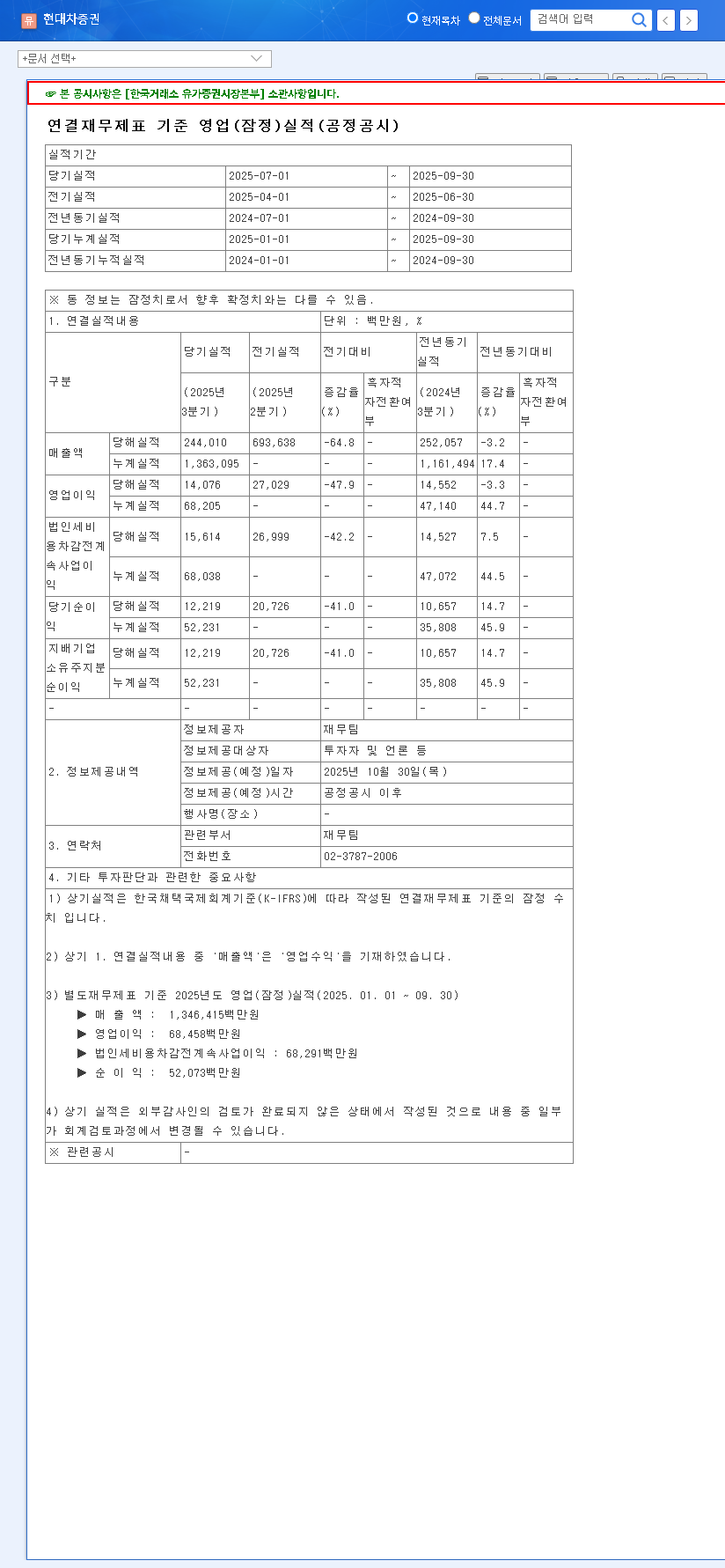
    On October 30, 2025, HYUNDAI MOTOR SECURITIES CO.,LTD. released its preliminary consolidated financial statements for the third quarter. The headline numbers, detailed in the Official Disclosure (DART), are as follows:

    • Revenue: 244.0 billion KRW
    • Operating Profit: 14.1 billion KRW
    • Net Income: 12.2 billion KRW

    The Story Behind the Numbers: QoQ vs. YoY

    The quarter-over-quarter (QoQ) decline is stark, with revenue falling from 694.6 billion KRW and operating profit from 27.0 billion KRW in Q2 2025. This downturn can be attributed to cyclical market slowdowns and decreased trading volumes typical of the period. However, the year-over-year (YoY) comparison tells a story of recovery. Compared to Q4 2024, where the company posted an operating loss, Q3 2025’s profitable results signal a significant operational improvement and a strengthening of the company’s core business lines against a challenging backdrop.

    Shareholder Activism as a Catalyst for Change

    A pivotal development for Hyundai Motor Securities has been the recent rise in minority shareholder activism. At the 71st Annual General Meeting, shareholders proposed a cash dividend increase and a reduction in the director compensation limit. While the dividend proposal was rejected in favor of reinvestment, the successful approval of the compensation limit reduction is a landmark win for corporate governance. This signals that management is becoming more responsive to shareholder concerns, a positive indicator for long-term Hyundai Motor Securities shareholder value. For more on this topic, see our guide on evaluating corporate governance in your investments.

    The approval to reduce director compensation is a clear sign that shareholder voices are being heard, potentially leading to improved transparency and a stronger alignment between management and investor interests.

    Macroeconomic Winds: Headwinds and Tailwinds

    No financial firm operates in a vacuum. The performance of Hyundai Motor Securities is intrinsically linked to global and domestic economic trends. Investors must monitor these key factors:

    • Interest Rate Environment: A potential shift towards lower benchmark interest rates by central banks in the US and Korea is a major tailwind. Lower rates typically stimulate loan demand, boost asset valuations, and improve investor sentiment, creating a favorable environment for securities firms.
    • Currency Volatility: High volatility in the Won/Dollar exchange rate poses a risk, particularly for the company’s overseas asset management and Investment Banking (IB) divisions. A stable currency is crucial for predictable returns on foreign investments.
    • Commodity and Freight Markets: As reported by high-authority sources like Reuters, instability in oil prices and shipping freight indices are barometers of global economic health and can directly impact the profitability of IB deals tied to these sectors.

    Future Outlook and Investor Action Plan

    Looking ahead, the investment thesis for the Hyundai Motor Securities stock hinges on balancing short-term challenges with long-term opportunities. The YoY recovery and governance improvements are positive signals. However, macroeconomic uncertainty remains a persistent risk.

    Key Points for Investors to Monitor:

    • Sustained Profitability: Scrutinize upcoming earnings reports for consistent profitability and margin improvement to confirm a genuine turnaround.
    • Shareholder Return Policies: Watch for any future announcements regarding dividend policies or share buyback programs as a sign of management’s commitment to shareholder value.
    • Macroeconomic Response: Analyze how effectively the company hedges against currency risks and adapts its IB strategy to the changing global economic climate.

    Frequently Asked Questions (FAQ)

    Q1: What were the key takeaways from HYUNDAI MOTOR SECURITIES’ Q3 2025 performance?

    The key takeaway is the dual narrative: a short-term, quarter-over-quarter decline in revenue and profit, contrasted with a positive year-over-year turnaround to profitability. This suggests the company is recovering from previous lows but is still susceptible to market volatility.

    Q2: How is shareholder activism impacting the company?

    Shareholder activism is acting as a positive force for governance. The approval of a reduced director compensation limit demonstrates that management is beginning to respond to shareholder demands for greater accountability and transparency, which can boost investor confidence.

    Q3: What is the most significant economic factor for Hyundai Motor Securities’ future?

    The direction of global interest rates is arguably the most significant factor. A trend towards lower rates would create a highly favorable operating environment by stimulating investment activity and increasing the value of assets under management.
    (001500) HYUNDAI MOTOR SECURITIES Q3 2025 Earnings: Full Analysis & Stock Outlook 관련 이미지
  • (294870) NPS Sells HDC Hyundai Development Stock: A 2025 Investor’s Deep Dive

    (294870) NPS Sells HDC Hyundai Development Stock: A 2025 Investor’s Deep Dive

    The recent news that South Korea’s National Pension Service (NPS) has significantly reduced its holding in HDC Hyundai Development stock has sent ripples through the investment community. As the country’s largest institutional investor, any major portfolio change by the NPS is scrutinized as a critical market signal. This move prompts an essential question for current and prospective investors: Is this a routine rebalancing, or does it signal a deeper concern about the company’s fundamentals and future prospects?

    In a challenging macroeconomic environment defined by high interest rates, volatile exchange rates, and soaring material costs, this analysis provides an in-depth look at the implications of the NPS stake sale. We will explore the internal risks facing the company, the external economic pressures, and what this all means for the valuation of HDC Hyundai Development stock.

    The Catalyst: NPS Announces Major Stake Reduction

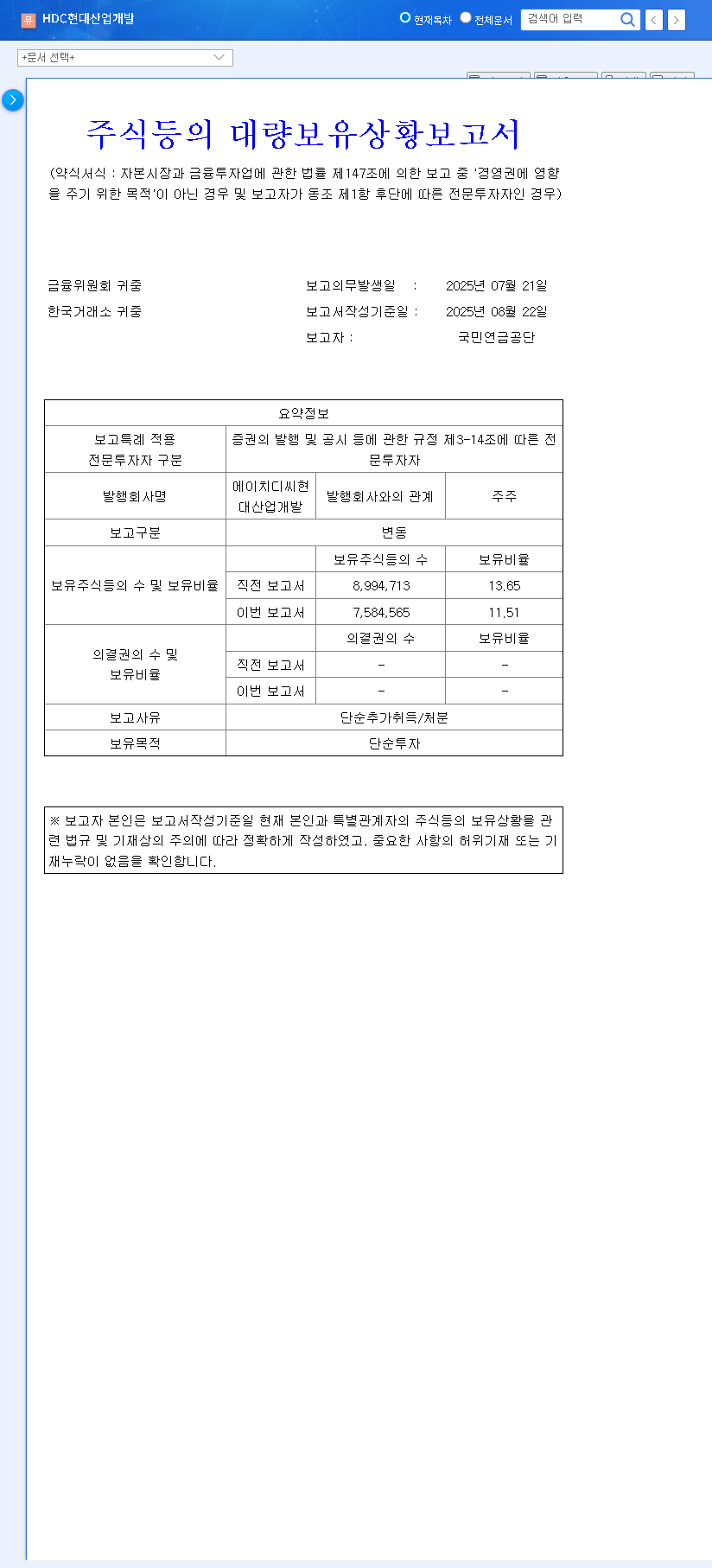
    On October 1, 2025, the National Pension Service filed a mandatory public disclosure detailing a significant change in its holdings. The report confirmed that the NPS reduced its stake in HDC Hyundai Development Co., Ltd. from 13.65% down to 11.51%, a substantial decrease of 2.14 percentage points. While the stated purpose of holding is ‘simple investment,’ such a large sale by a key institutional player warrants a closer look. You can view the report directly via the Official Disclosure from the Financial Supervisory Service.

    When an institutional giant like the NPS trims its position, the market pays attention. It can trigger a chain reaction, influencing investor sentiment and applying short-term downward pressure on the stock price, regardless of the company’s underlying fundamentals.

    Internal Headwinds: Company-Specific Risks

    Beyond the NPS sale, HDC Hyundai Development has faced its own internal challenges, which may have contributed to the pension fund’s decision. Recent amendments to its business reports have highlighted several areas of operational uncertainty that could impact financial stability.

    Project Delays and Cash Flow Concerns

    For a development company, consistent project execution is paramount. Any disruption can have significant financial consequences. Key risks include:

    • Liquidity Strain: A high probability of project delays and outstanding payments from clients can put a severe strain on short-term cash flow and liquidity management.
    • Revenue Uncertainty: Potential changes to contract timelines, unfulfilled agreements, and shifting project costs create uncertainty around future revenue and profitability.
    • Deteriorating Profit Margins: The company’s recent performance has already shown a concerning decline in both operating profit margin and net profit margin, indicating pressure on its core business.

    External Pressures: The Macroeconomic Storm

    HDC Hyundai Development is not operating in a vacuum. A difficult global and domestic economic climate is creating significant headwinds for the entire construction sector. For a deeper look at global economic trends, authoritative sources like Bloomberg’s economic analysis provide valuable context.

    High Interest Rates and Currency Volatility

    Elevated interest rates in both the US and South Korea increase financing costs for large-scale development projects and simultaneously dampen consumer demand for real estate. Furthermore, a strong USD against the KRW (hovering around 1,400 won) increases the cost of imported raw materials, directly squeezing profit margins.

    Rising Material and Logistics Costs

    The cost of construction is rising sharply. Volatility in international crude oil prices affects everything from transportation to petroleum-based materials. Instability in global shipping, reflected in freight indices, adds another layer of cost and complexity to procuring necessary materials, further pressuring the company’s bottom line.

    Investor Action Plan & Final Outlook

    Given the combination of the NPS stake reduction, internal business uncertainties, and a harsh macroeconomic environment, a cautious approach to HDC Hyundai Development stock is warranted. The sale by the NPS is likely to amplify market skepticism and could signal a negative fundamental outlook from one of the market’s most informed players.

    While the company has made efforts to improve its financial health (e.g., reducing its debt-to-equity ratio), the headwinds are significant. Our overall assessment is ‘Neutral with significant downward pressure.’ Investors should closely monitor the following factors before making any decisions:

    • Further NPS Moves: Any additional sales could indicate a complete loss of confidence.
    • Quarterly Earnings Reports: Pay close attention to profit margins, cash flow statements, and updates on project timelines.
    • Macroeconomic Shifts: Monitor changes in interest rate policy, currency exchange rates, and commodity prices.

    Making informed decisions requires a solid understanding of sector-specific analysis. You can learn more about how to analyze construction sector stocks in our related guide.

    Frequently Asked Questions

    Why did the National Pension Service sell its HDC Hyundai Development stock?

    The NPS officially stated the sale was for ‘simple investment’ purposes, which can mean portfolio rebalancing. However, given the company’s challenges and the size of the sale, it could also reflect a negative assessment of the stock’s future growth prospects.

    How will this sale affect the stock price?

    In the short term, a major stake sale like this typically dampens investor sentiment and can lead to downward pressure on the stock price as the market digests the negative signal.

    What is the fundamental outlook for HDC Hyundai Development?

    The outlook is mixed but leaning negative. While the company is working to improve its financial health, it faces significant headwinds from business uncertainties, declining profitability, and a challenging macroeconomic environment that are putting continuous pressure on its fundamentals.

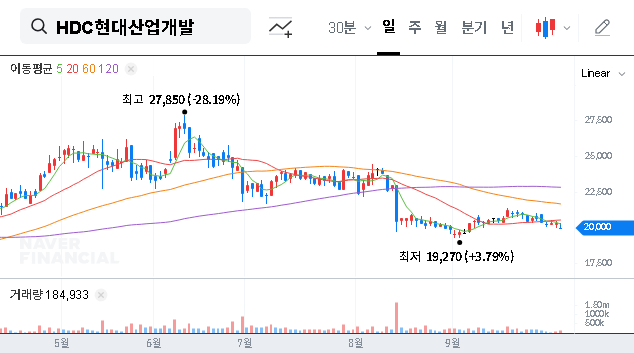
    (294870) NPS Sells HDC Hyundai Development Stock: A 2025 Investor's Deep Dive 관련 이미지
  • (003030) SeAH Steel Holdings: Fueling Offshore Wind Growth with Exchangeable Bonds

    (003030) SeAH Steel Holdings: Fueling Offshore Wind Growth with Exchangeable Bonds

    The recent strategic financial maneuver by SeAH Steel Holdings has captured the attention of the investment community. The company’s decision to dispose of treasury stock to facilitate an Exchangeable Bond (EB) issuance is a clear signal of its ambition to secure future growth drivers. This move, aimed at bolstering its financial health and aggressively pursuing new ventures like offshore wind power, requires a thorough analysis for any serious investor.

    This comprehensive guide will deconstruct the intricacies of SeAH Steel Holdings’ strategy, exploring its impact on financial stability, stock valuation, and long-term corporate value. We will delve into the opportunities and risks, providing you with the critical insights needed to navigate this pivotal moment in the company’s trajectory.

    The Strategic Move: Treasury Stock and Exchangeable Bonds

    A Landmark Announcement

    On October 1, 2025, SeAH Steel Holdings announced a pivotal strategic decision in an Official Disclosure: the disposition of 101,196 treasury shares. This transaction, valued at approximately KRW 19.3 billion, is not a simple sale of assets. Instead, it serves as the underlying collateral for a sophisticated capital-raising instrument: Exchangeable Bonds (EB).

    An Exchangeable Bond is a hybrid debt instrument that gives the bondholder the right to exchange the bond for shares of a company other than the issuer—in this case, treasury shares of SeAH Steel Holdings itself. This makes it an attractive, flexible tool for corporate financing.

    Why Choose Exchangeable Bonds?

    The choice of EBs over traditional bonds or a direct stock sale is a calculated one. This strategy allows SeAH Steel Holdings to achieve several key objectives simultaneously:

    • Lower Cost of Capital: EBs typically carry a lower interest rate (coupon) than conventional bonds because the conversion option offers investors potential upside in the stock’s value.
    • Minimized Share Dilution: Unlike issuing new shares, using existing treasury stock for the EBs avoids immediate dilution of earnings per share (EPS) for current stockholders.
    • Funding for Growth: Most importantly, it unlocks KRW 19.3 billion in capital earmarked for strategic investments, particularly in high-potential sectors.

    Powering the Future: SeAH Steel and Offshore Wind

    The capital raised is directly linked to SeAH Steel Holdings’ ambition to become a dominant force in the offshore wind power industry. This sector represents a monumental growth opportunity for steel manufacturers capable of producing the massive, high-specification components required. The investment will likely target:

    • Expansion of production facilities for monopiles and jacket foundations, which are the critical substructures for offshore wind turbines.
    • Research and development into next-generation steel grades that can withstand harsh marine environments.
    • Strengthening the structural pipe business to support the entire energy infrastructure supply chain.

    According to the International Energy Agency, the global offshore wind market is set for exponential growth, making this a timely and strategic pivot for SeAH Steel Holdings. Success in this area could redefine the company’s long-term revenue streams and market valuation.

    Investor’s Guide: Financial and Market Impact

    Analyzing the Financial Health of SeAH Steel Holdings

    The infusion of KRW 19.3 billion provides a welcome boost to short-term liquidity. However, investors must consider the multi-faceted impact on the balance sheet. While the EBs are initially recorded as debt (potentially increasing the debt-to-equity ratio), their future conversion into equity could improve the capital structure. The key is to monitor the progress of the investments funded by this capital. For further context, you can read our Deep Dive into Global Steel Market Trends.

    Stock Price and Market Expectations

    The market’s reaction will likely be two-phased:

    • Short-Term Volatility: The news of a treasury stock disposition can sometimes create downward pressure on the stock price. The market may exhibit caution until the terms of the EB and the specifics of the investment plan are fully digested.
    • Long-Term Potential: The long-term trajectory will depend entirely on execution. If the investment in offshore wind yields tangible contracts and profitable returns, it will act as a powerful catalyst for stock price appreciation. If results fall short, the initial debt burden could weigh on valuation.

    Macroeconomic Headwinds to Monitor

    No analysis of a steel company is complete without considering the broader economic climate. Key variables for SeAH Steel Holdings include:

    • Interest Rates: With a trend of rising rates globally, the company’s borrowing costs could increase, impacting profitability.
    • Exchange Rates: As a major exporter, fluctuations in the KRW against the USD and EUR directly affect revenue and margins.
    • Commodity Prices: The cost of raw materials like iron ore and coking coal, as well as energy prices, remain a critical factor for operational efficiency.

    The Bottom Line for Investors

    SeAH Steel Holdings’ issuance of Exchangeable Bonds is a bold, forward-looking strategy. It demonstrates a clear commitment to securing a leadership position in the high-growth offshore wind sector while intelligently managing its capital structure.

    Investors should adopt a long-term perspective. While short-term price swings are possible, the ultimate success of this initiative hinges on the company’s ability to translate this fresh capital into profitable, sustainable growth. Continuous monitoring of project milestones in the offshore wind business, alongside a keen awareness of macroeconomic shifts, will be essential for making informed investment decisions regarding SeAH Steel Holdings.

    Disclaimer: This analysis is for informational purposes only and does not constitute investment advice. All investment decisions should be made with the consultation of a qualified financial professional.

    (003030) SeAH Steel Holdings: Fueling Offshore Wind Growth with Exchangeable Bonds 관련 이미지
  • KB Financial Group H1 2025 Earnings Analysis: Solid Growth, but Risks Remain

    1. KB Financial Group H1 2025 Earnings: What Happened?

    KB Financial Group recorded KRW 3.436 trillion in net income for the first half of 2025, a significant 23.8% increase year-over-year. Stable interest income from the banking division and growth in the non-banking sector drove this strong performance. Notably, KB Kookmin Bank’s maintained market share, KB Securities’ steady earnings, and KB Insurance’s CSM maximization strategy contributed positively.

    2. Drivers of Growth and Fundamental Analysis: Why?

    KB Financial Group’s solid fundamentals are the key driver of this strong performance. Their focus on efficient management and innovative growth strategies, including digital transformation, AI technology adoption, and strengthened ESG management, has paid off. The diversified business portfolio reduces reliance on any single sector and enables stable revenue generation.

    3. Potential Risks and Future Outlook: What’s Next?

    However, global economic slowdown, increasing interest rate volatility, and real estate PF risks remain potential threats to KB Financial Group. In particular, a potential downturn in the real estate market could put pressure on the group’s asset quality. Increased competition also poses a challenge to maintaining profitability.

    4. Action Plan for Investors: What Should You Do?

    While KB Financial Group is expected to continue its stable growth based on its robust fundamentals, investors should closely monitor potential risk factors. Continuous observation of KB’s strategies to address interest rate volatility, real estate PF risks, and intensifying competition should inform investment decisions.

    What was KB Financial Group’s net income for H1 2025?

    KB Financial Group reported a net income of KRW 3.436 trillion for the first half of 2025, a 23.8% increase year-over-year.

    What are the key growth drivers for KB Financial Group?

    The key growth drivers are stable interest income from the banking division, increased contributions from the non-banking sector, and strategic focus on digital transformation, AI technology adoption, and ESG management.

    What are the main risks facing KB Financial Group?

    The main risks include global economic slowdown, increasing interest rate volatility, potential real estate project financing (PF) risks, and intensifying competition from fintech and big tech companies.

  • NH Allone REIT July Monthly Report: Key Takeaways and Investor Considerations

    NH Allone REIT July Report: What’s Inside?

    NH Allone REIT published its July 2025 monthly report on August 6, 2025. This report offers investors updated information on asset management, leasing status, and financial performance.

    Why is this Report Important?

    Monthly reports enhance corporate transparency and help investors understand the company’s current operational status. This particular report holds significant weight, released amidst mixed signals of improved Q1 earnings and high debt-to-equity ratio. Both positive and negative information within the report can influence short-term stock price fluctuations.

    How Will the Report Impact Stock Price?

    While the report itself doesn’t directly alter fundamentals, market reactions can vary based on its content. If the report reveals a continuing trend of increasing debt from Q1 or raises concerns about the deteriorating real estate market, investor sentiment could weaken. Conversely, positive news like improved rental income or increased asset value could boost investor confidence.

    • Positive Scenario: Increased rental income, rising asset value → Improved investor sentiment
    • Negative Scenario: Further debt increase, real estate market concerns → Weakened investor sentiment

    What Should Investors Do?

    Investors should carefully analyze the report’s details and compare them with existing fundamental analysis to identify additional risks or opportunities. Pay close attention to debt management, profitability, and plans to address accumulated deficit, especially in a rising interest rate environment. Continuous monitoring of external factors like interest rates, the real estate market, and the macroeconomic landscape is also crucial.

    Frequently Asked Questions (FAQ)

    Does the release of the monthly report directly affect the stock price?

    The release itself is a neutral event. However, the report’s content can influence investor sentiment, which can lead to stock price fluctuations.

    What’s the most important factor to consider when investing in NH Allone REIT?

    Pay close attention to the high debt-to-equity ratio and accumulated deficit, as well as the impact of interest rate changes. The stability of rental income and the efficiency of asset management are also key considerations.

    What is the outlook for NH Allone REIT?

    While the improved Q1 earnings are positive, the high debt-to-equity ratio remains a risk factor. It’s essential to consider the upcoming interest rate and real estate market conditions, as well as the specific business performance revealed through monthly reports, to make informed investment decisions.

  • TKG Huchems Earnings Surprise: Short-Term Gain or Long-Term Growth?

    1. Analyzing the Surprise: What’s Behind the 12.2% Beat?

    Despite a decline in Q1 2025 revenue, TKG Huchems achieved impressive operating profit through cost management and strategic operations. However, determining the sustainability of this performance requires careful analysis of external factors like raw material prices, exchange rates, interest rate hikes, and the company’s performance since the new plant launch in 2024.

    2. Key Variables: Factors Shaping TKG Huchems’ Future

    • Raw Material Prices: Volatility in prices of crude oil, benzene, toluene, and ammonia directly impacts TKG Huchems’ profitability. Assessing the effectiveness of hedging strategies and future price projections is crucial.
    • Exchange Rates and Interest Rates: Fluctuations in the KRW/USD and KRW/EUR exchange rates can significantly affect TKG Huchems, given its export-oriented business. The potential for increased financial burden due to interest rate hikes also warrants consideration.
    • Global Economic Slowdown: A potential slowdown in the Chinese economy and weakening demand in downstream industries could negatively impact TKG Huchems’ growth.

    3. Investment Strategy: Navigating the Post-Surprise Landscape

    Avoid being swayed by short-term gains and focus on long-term investment prospects. Consider future quarterly earnings forecasts, raw material price predictions, and exchange rate fluctuations when formulating your investment strategy. Critically evaluate whether the earnings surprise is a temporary phenomenon or signals a sustained improvement in performance, especially considering the decline in operating profit in 2024.

    Q: What are the main drivers behind TKG Huchems’ earnings surprise?

    A: Cost management and strategic operations led to higher-than-expected operating profit. However, the sustainability of Q1 performance needs careful scrutiny.

    Q: What should investors consider when evaluating TKG Huchems?

    A: Investors should analyze factors like raw material prices, exchange rate fluctuations, interest rate hikes, and the potential for a global economic slowdown, adopting a long-term investment perspective.

    Q: What is the outlook for TKG Huchems?

    A: The short-term outlook appears positive, but the long-term view depends on various factors such as raw material prices, exchange rates, and the global economic climate. Continuous monitoring of future quarterly earnings and relevant variables is essential.

  • Kumho Petrochemical Q2 Earnings Shock: A Deep Dive into the Underperformance

    1. Kumho Petrochemical’s Q2 Performance: A Closer Look

    Kumho Petrochemical reported Q2 2025 revenue of KRW 1.77 trillion, operating profit of KRW 65.2 billion, and net income of KRW 57.7 billion. These figures represent a 1%, 15%, and 34% miss, respectively, compared to market consensus. Following strong growth in Q1, this sharp decline has raised concerns.

    2. Unpacking the Underperformance: Key Factors at Play

    Several key factors contributed to this disappointing performance:

    • Global Economic Slowdown: Weakening demand in downstream industries, particularly a continued slump in the Chinese market, directly impacted Kumho Petrochemical’s results.
    • Rising Raw Material Prices: The company struggled to fully pass on increased costs of crude oil and other key raw materials to product pricing, squeezing profit margins.
    • Currency Fluctuations: A strengthening Korean Won negatively affected the export-oriented Kumho Petrochemical.
    • Interest Rate Hikes: Rising interest rates led to increased financing costs, putting pressure on the highly leveraged company.

    3. Looking Ahead: What’s Next for Kumho Petrochemical?

    The outlook for Kumho Petrochemical hinges on several factors, including global economic recovery, stabilization of raw material prices, and the trajectory of currency and interest rate movements. The recovery of demand in the Chinese market and the success of Kumho Petrochemical’s strategy to develop high-value-added products and diversify its markets will be crucial.

    4. Investor Action Plan: Navigating the Uncertainty

    Investors should avoid overreacting to the short-term earnings decline and focus on analyzing the company’s long-term fundamentals and growth potential. A careful review of the upcoming Q3 earnings report, which will provide more detailed analysis and future strategies, is recommended before making any investment decisions.

    Frequently Asked Questions

    Q: What were the main reasons for Kumho Petrochemical’s Q2 earnings miss?

    A: A combination of factors, including the global economic slowdown, rising raw material prices, currency fluctuations, and interest rate hikes, contributed to the underperformance.

    Q: What is the outlook for Kumho Petrochemical?

    A: The outlook depends on various factors such as global economic recovery, stabilization of raw material prices, currency and interest rate movements, and the recovery of demand in the Chinese market.

    Q: What should investors do?

    A: Investors should avoid overreacting to the short-term results and focus on the company’s long-term fundamentals. Reviewing the Q3 report for more details before making investment decisions is advised.

  • Handok Q2 2025 Earnings: Continued Losses Raise Concerns for Investors

    1. What Happened? Handok’s Q2 2025 Earnings Breakdown

    Handok reported revenue of KRW 125.3 billion, an operating loss of KRW 600 million, and net income of KRW 1.9 billion for Q2 2025. While the operating loss narrowed slightly compared to Q1, the company remains unprofitable. Net income turned positive, but this could be attributed to non-recurring items. Furthermore, a restatement of the Q1 2025 report, while not impacting figures, raises questions about transparency.

    2. Why These Results? Understanding the Factors at Play

    Pinpointing the exact causes based on the preliminary earnings release is challenging. However, a confluence of factors likely contributed, including a deteriorating macroeconomic environment, rising raw material costs, and increasing interest rates. The recent appreciation of the USD/KRW exchange rate over the past six months likely pressured Handok, given its reliance on imported raw materials. The company’s high debt-to-equity ratio also exacerbates the impact of rising interest rates on profitability.

    3. What’s Next? Action Plan for Investors

    Caution is advised for investors at this juncture. A thorough review of the detailed earnings release, when available, will be crucial for understanding the specific drivers of declining sales and persistent operating losses. Avoid reacting impulsively to short-term market fluctuations and focus instead on assessing the company’s long-term growth potential and fundamental improvements. Closely monitor upcoming disclosures and market reactions to inform investment decisions.

    Q: What was Handok’s operating income in Q2 2025?

    A: Handok reported an operating loss of KRW 600 million in Q2 2025.

    Q: What contributed to Handok’s poor Q2 performance?

    A: While further analysis is needed, potential factors include a challenging macroeconomic environment, rising raw material costs, and increasing interest rates.

    Q: Should I invest in Handok?

    A: Investors should proceed with caution. Await further disclosures and monitor market reactions before making investment decisions.

  • Korea Zinc Q2 2025 Earnings: Key IR Insights and Stock Forecast

    What Happened?: Korea Zinc’s Q2 IR Announcement

    Korea Zinc announced its Q2 2025 earnings release and Investor Relations (IR) presentation on July 31, 2025.

    Why It Matters: Mixed Q3 Results Raise Investor Questions

    While Q3 saw increased revenue due to rising zinc, gold, and silver prices, net profit declined due to falling lead prices and weakness in some business segments. Investors are eager to understand Q2 performance and the outlook for the future, particularly regarding zinc prices and management’s strategic direction.

    What’s Next?: Key IR Focus Points & Stock Forecast

    • Zinc Price: Decreasing LME inventories are positive, but the global economic slowdown could dampen demand.
    • Gold & Silver Prices: Safe-haven demand may drive prices higher, but volatility is expected.
    • Lead Price: Continued downward pressure is anticipated due to China’s economic slowdown and oversupply.
    • Macroeconomic Impact: Fluctuations in exchange rates, interest rates, and commodity prices directly affect Korea Zinc’s profitability. Pay close attention to management’s risk management strategies.

    Depending on the IR outcome, the stock price could experience significant short-term volatility. Positive earnings and a favorable zinc price outlook could drive the stock higher, while negative factors could lead to a decline. Long-term, the success of the company’s investment plans will be a key driver of stock performance.

    Investor Action Plan:

    Carefully review the IR presentation and pay close attention to management’s Q&A to address uncertainties. Monitor market reactions and adjust your investment strategy based on new information.

    FAQ

    When will the Q2 earnings be released?

    Korea Zinc’s Q2 2025 earnings will be released during the IR presentation on July 31st.

    What is the outlook for zinc prices?

    Declining LME inventories suggest a potential supply shortage, but the global economic slowdown could reduce demand. The IR presentation should offer a more detailed outlook.

    What is the outlook for Korea Zinc’s stock price?

    Short-term volatility is expected depending on the IR outcome and market conditions. Long-term stock performance will depend on the success of the company’s investment plans.

  • UNID Earnings Call Analysis: Q2 2025 Results and Future Stock Outlook

    1. UNID Earnings Call: What Happened?

    UNID held its earnings call on July 31, 2025, announcing its Q2 2025 financial results and future business strategies. Key areas of focus included the company’s performance in relation to the challenges faced in Q1, such as rising raw material costs and weak overseas operations.

    2. What Caused the Q1 Slump?

    In Q1 2025, UNID reported consolidated revenue of KRW 322.5 billion and operating profit of KRW 28.6 billion. While revenue increased compared to the previous quarter, operating profit saw a slight decline. This was primarily attributed to rising raw material prices and sluggish overseas operations, particularly within the USH division, despite growth in the chemical business unit.

    3. Key Takeaways from the Earnings Call

    The earnings call provided details on Q2 performance, along with insights into the performance and outlook of the China business divisions (UJC, OJC, UHC, USH). Furthermore, UNID addressed its cost management strategy, exchange rate risk management, investment plans, and strategies to combat increasing competition.

    • Q2 Earnings: Impact of raw material prices, exchange rates, overseas performance, and logistics costs.
    • China Business: Impact of China’s economic slowdown and geopolitical risks.
    • Cost Management: Strategies to address rising raw material costs and cost reduction efforts.
    • Exchange Rate Risk: Management strategies for profitability fluctuations due to exchange rate volatility.

    4. Actionable Insights for Investors

    Careful analysis of the earnings call is crucial for understanding UNID’s Q2 performance and future prospects. Investors should pay close attention to the impact of China business performance, cost and exchange rate risk management strategies, and the company’s approach to increasing competition on its stock price. A long-term investment strategy focused on UNID’s fundamental improvement potential is recommended, rather than reacting to short-term price fluctuations.

    Frequently Asked Questions

    How did UNID perform in Q2?

    Detailed information was released during the earnings call. Investors should focus on improvements compared to Q1.

    What are UNID’s main business segments?

    UNID primarily focuses on the chemical business, with a significant emphasis on the Chinese market.

    What are the key investment considerations for UNID?

    Investors should monitor macroeconomic indicators like raw material price fluctuations, exchange rate volatility, and China’s economic conditions, as well as the competitive landscape.