Tag: Inspection Equipment

  • Nexteen Secures KRW 6 Billion Wafer Inspection System Supply Contract, Accelerating China Market Penetration


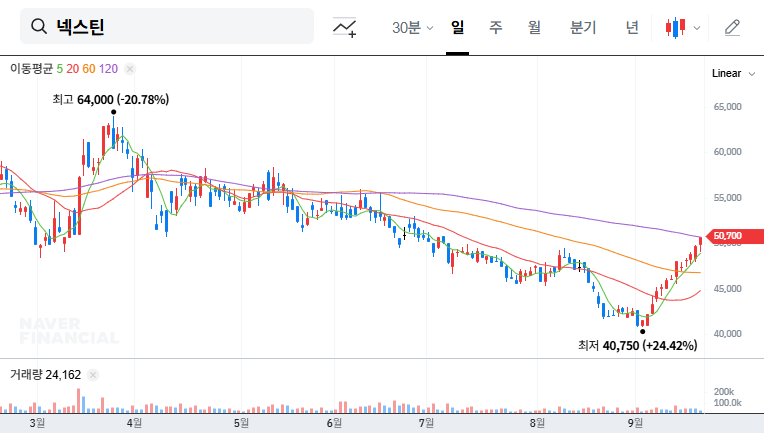
    Nexteen Secures KRW 6 Billion Wafer Inspection System Supply Contract, Accelerating China Market Penetration 대표 차트 이미지


    1. Nexteen’s KRW 6 Billion Contract: What Happened?

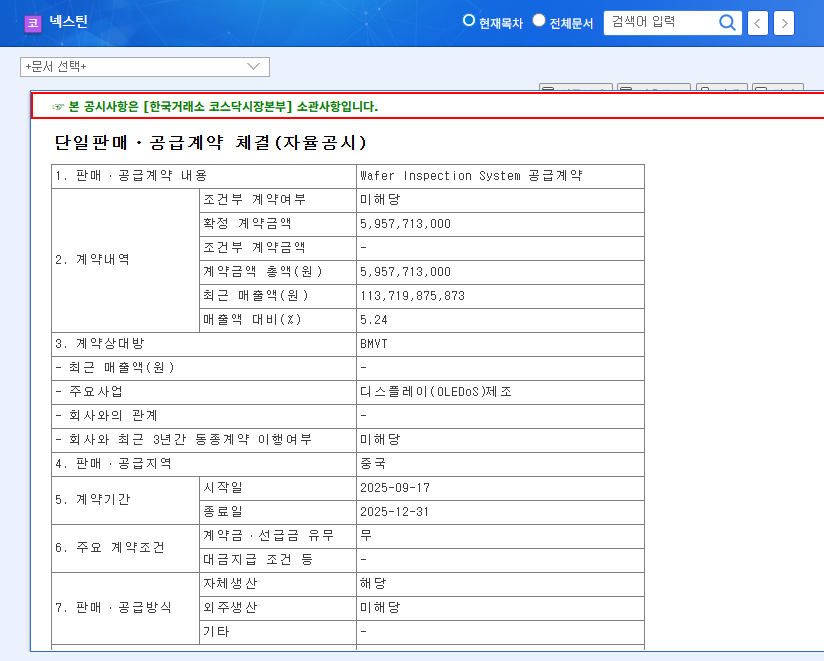
    On September 18, 2025, Nexteen announced a KRW 6 billion supply contract for its Wafer Inspection System with BMVT. The contract period is approximately three months, from September 17 to December 31, 2025, and represents 5.24% of Nexteen’s 2024 revenue.

    2. The Significance of the Contract: Why Does It Matter?

    This contract signifies more than just increased sales; it validates Nexteen’s growth potential. The increased orders from the Chinese market demonstrate Nexteen’s global competitiveness and raise expectations for future contracts. Securing a new client also positively contributes to the diversification of Nexteen’s customer portfolio.

    3. Market Impact and Investment Strategy: What Should Investors Do?

    This contract is expected to positively impact Nexteen’s Q4 2025 earnings. However, as profitability details haven’t been disclosed, investors should pay close attention to future announcements. Continuously monitoring overall semiconductor market trends and competitive landscape changes is also crucial.

    4. Key Checklist for Investors

    • Nexteen’s Future Earnings Announcements: Verify the profitability of this contract through Q4 earnings reports.
    • Potential for Additional Contracts: Monitor the possibility of further contracts, particularly in the Chinese market.
    • Semiconductor Market Trends: Continuously analyze Nexteen’s growth prospects in light of changes in the semiconductor industry.


    Frequently Asked Questions (FAQ)

    Will this contract positively impact Nexteen’s stock price?

    A positive short-term impact can be anticipated, but investment decisions should be made carefully, considering various factors.

    What is Nexteen’s main business?

    Nexteen manufactures and sells Wafer Inspection Systems, which are used in the front-end process of semiconductor manufacturing.

    Who are Nexteen’s competitors?

    While not specified in the original text, research companies competing in the semiconductor inspection equipment market.
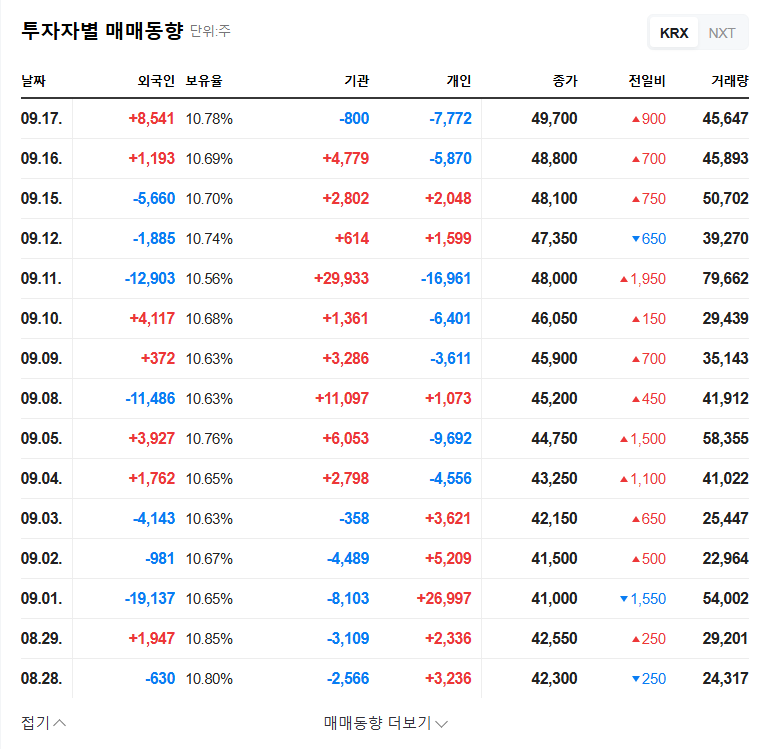




    Nexteen Secures KRW 6 Billion Wafer Inspection System Supply Contract, Accelerating China Market Penetration 관련 이미지
    Nexteen Secures KRW 6 Billion Wafer Inspection System Supply Contract, Accelerating China Market Penetration 관련 이미지


  • Mirae Industry Secures KRW 5 Billion Semiconductor Inspection Equipment Supply Contract: Impact on Stock Price?


    Mirae Industry Secures KRW 5 Billion Semiconductor Inspection Equipment Supply Contract: Impact on Stock Price? 대표 차트 이미지


    1. What Happened?

    Mirae Industry has signed a KRW 5 billion semiconductor inspection equipment supply contract with YILING TRADING. This represents 18.46% of Mirae Industry’s sales, and the contract period is from September 8, 2025, to October 30, 2025.

    2. Why Is It Important?

    This contract reaffirms the growth of Mirae Industry’s core ATE (Test Handler, etc.) business unit. It is particularly significant as it can be an opportunity to expand into the Chinese market. The ATE business unit accounts for 79.36% of Mirae Industry’s total sales and 97.92% of its operating profit. On the other hand, the impact on the struggling MAI business unit (Chip Mounter, etc.) may be limited.

    3. So, What About the Stock Price?

    A positive impact on the stock price is expected in the short term. The KRW 5 billion contract will directly contribute to sales growth and demonstrates the potential for expansion into the Chinese market. However, the short contract period (1 month), the sluggish performance of the MAI business unit, and exchange rate fluctuations are factors to consider when investing. The mid-to-long-term stock price trend will depend on securing additional orders and improving the performance of the MAI business unit.

    4. What Should Investors Do?

    • Short-term investors: Can take advantage of short-term stock price momentum, but should approach cautiously considering the short contract period.
    • Mid-to-long-term investors: Should carefully analyze Mirae Industry’s future performance and growth potential, and continuously monitor factors such as additional order contracts, MAI business unit performance improvement, and semiconductor industry conditions.


    Frequently Asked Questions

    How much will this contract impact Mirae Industry’s performance?

    The KRW 5 billion contract represents a significant 18.46% of Mirae Industry’s sales and is expected to contribute significantly to short-term sales growth.

    What will happen to Mirae Industry’s stock price in the future?

    A positive impact is expected in the short-term, but the mid-to-long-term stock price trend will depend on securing additional orders and the performance improvement of the MAI business unit.

    What are the investment precautions?

    Factors such as the short contract period, sluggish performance of the MAI business unit, and exchange rate fluctuations should be considered. Continuous attention should also be paid to changes in the semiconductor industry.


    Mirae Industry Secures KRW 5 Billion Semiconductor Inspection Equipment Supply Contract: Impact on Stock Price? 관련 이미지
    Mirae Industry Secures KRW 5 Billion Semiconductor Inspection Equipment Supply Contract: Impact on Stock Price? 관련 이미지


  • Inomet IR: Riding the Wave of the Growing 2nd Battery Inspection Equipment Market?

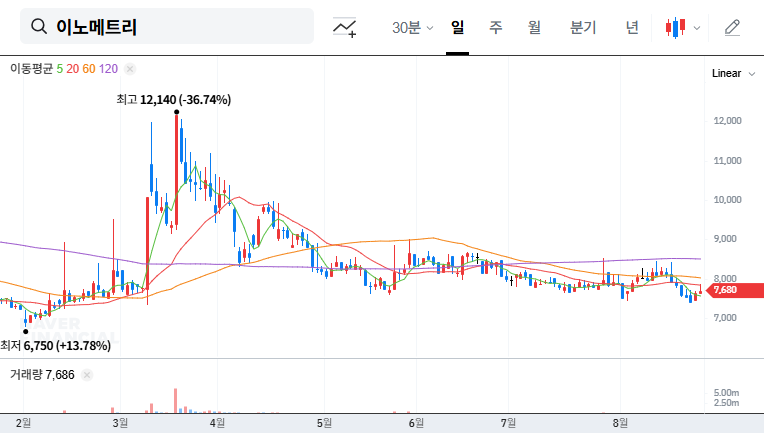
    Inomet IR: Riding the Wave of the Growing 2nd Battery Inspection Equipment Market? 대표 차트 이미지

    1. Inomet IR: What was discussed?

    Inomet presented its current business status and future growth strategies at the Bukook Securities Corporate Day. The primary focus was explaining the background of the recently revised Q2 order backlog surge (approximately 87%) and strategies for securing competitiveness in the 2nd battery inspection equipment market.

    2. Why is it important? – 2nd Battery Market Growth and Order Backlog Surge

    Inomet directly benefits from the growth of the 2nd battery inspection equipment market. The explosive growth of the global EV and ESS markets leads to increased demand for Inomet’s core product: X-ray inspection equipment. The revised Q2 order backlog surge further fuels expectations for future sales growth.

    3. So what? – Potential Impact on Investors

    • Positive Impact: If the IR presentation successfully conveys a positive business outlook and addresses investor concerns, it could trigger upward momentum in the stock price. Specifically, a detailed explanation of the increased order backlog and future sales forecasts will likely improve investor sentiment.
    • Negative Impact: Failure to provide a clear explanation and improvement plan for the recent decline in short-term performance, or a presentation that falls short of market expectations, could negatively impact the stock price.

    4. Investor Action Plan

    Investors should carefully analyze the IR materials and make investment decisions based on a comprehensive assessment of the future growth prospects of the 2nd battery market and Inomet’s competitiveness. Comparing and analyzing Inomet’s technological capabilities, profitability, and growth potential against its competitors is crucial. It’s advisable to develop an investment strategy from a long-term perspective, rather than being swayed by short-term stock price fluctuations.

    Frequently Asked Questions

    What is Inomet’s main business?

    Inomet primarily manufactures X-ray inspection equipment for 2nd batteries. They are currently expanding their business into the areas of recycled batteries and AI software.

    Why is the increase in order backlog important?

    An increase in order backlog is a key indicator of a company’s growth potential as it often translates into increased future sales.

    What should investors be aware of when investing in Inomet?

    Investors should consider factors such as short-term performance volatility, increasing competition in the 2nd battery market, and macroeconomic variables when making investment decisions.

    Inomet IR: Riding the Wave of the Growing 2nd Battery Inspection Equipment Market? 관련 이미지
    Inomet IR: Riding the Wave of the Growing 2nd Battery Inspection Equipment Market? 관련 이미지
  • MOT (413390) Semi-Annual Report Analysis: Poor Performance, What’s the Investment Strategy?

    1. MOT (413390) 2025 Semi-Annual Performance Analysis

    MOT recorded sales of 9.9 billion won in the first half of 2025. This figure far exceeded the market expectation of 0 won announced at the time of the preliminary second-quarter earnings release, but it represents a decrease of approximately 49% compared to the same period last year (51.596 billion won). Operating profit shifted to a loss of 1 billion won, and net profit also recorded a loss of 0.9 billion won.

    2. Causes of Poor Performance: Dependence on Company S and Market Conditions

    The main cause of the decline in sales is the decrease in sales contribution from major customer ‘Company S’ (86.01% → 77.94%) due to delays in investment and changes in production plans. External factors such as the slowdown in the global electric vehicle market, IRA uncertainty, and intensified competition from China also negatively impacted performance.

    3. MOT’s Future: Growth Potential and Risks

    MOT is striving to secure future growth engines by expanding its secondary battery inspection equipment and software business. However, the high dependence on ‘Company S’ still acts as a risk factor. The emergence of a new customer, ‘Major Customer B,’ is positive, but diversification of sales channels is an urgent task. Financially, both operating and investing cash flows recorded negative figures, increasing the importance of liquidity management.

    4. Investment Strategy: Cautious Approach and Continuous Monitoring

    Currently, MOT carries a high short-term investment risk. Investors should continuously monitor performance improvements, customer relationships, and new customer acquisition. New investments should be made cautiously after confirming turnaround signals, financial soundness, and a trend of improved profitability.

    Q: What were MOT’s sales in the first half of 2025?

    A: 9.9 billion won. While exceeding the market expectation of 0, this represents a 49% decrease compared to the same period last year.

    Q: What are the main reasons for MOT’s poor performance?

    A: The main reasons are delays in investment and changes in production plans by major customer ‘Company S,’ and the slowdown in the global electric vehicle market.

    Q: Should I invest in MOT?

    A: Currently, MOT carries a high short-term investment risk. Investments should be made cautiously after confirming turnaround signals, improved financials, and profitability.

  • Pemtron (168360) H1 2025 Earnings Analysis: Navigating Risks and Opportunities

    1. What Happened? H1 2025 Earnings Breakdown

    Pemtron’s H1 2025 revenue plummeted by 50.5% year-over-year to 27.8 billion KRW, with both operating and net income swinging into losses. Alarmingly, the debt-to-equity ratio surged to 408.08%, raising red flags about the company’s financial health.

    2. Why the Decline? Analyzing the Factors

    This downturn is attributed to a confluence of factors, including intensified competition in the SMT inspection equipment sector, delayed customer investments, sluggish performance in the semiconductor and secondary battery inspection equipment segments, and a challenging macroeconomic environment marked by high interest rates and rising raw material costs.

    3. What’s Next? Outlook and Investment Strategies

    In the short term, Pemtron’s stock price is likely to face downward pressure. Unless concrete efforts to improve its financial structure materialize, the outlook remains negative. However, investments in AI-powered inspection technology and new business ventures offer potential long-term growth opportunities. Investors should closely monitor Pemtron’s future earnings announcements, financial restructuring plans, and progress in new technology development.

    4. Investor Action Plan

    • Short-term investors: Proceed with caution, closely monitor financial restructuring efforts.
    • Long-term investors: Track progress in new technology development and commercialization.
    • All investors: Stay informed about company disclosures, news, and market trends.

    Frequently Asked Questions

    What are Pemtron’s main businesses?

    Pemtron manufactures inspection equipment for SMT, semiconductors, and secondary batteries.

    Why did Pemtron’s H1 2025 earnings decline?

    The decline is due to increased competition in SMT inspection equipment, delayed customer investments, poor performance in semiconductor and secondary battery inspection equipment, and a challenging macroeconomic environment.

    What is the outlook for Pemtron?

    The short-term outlook is uncertain, but successful development and commercialization of AI-powered inspection technology and new business ventures could drive future growth.