Tag: Import Car

  • Kolon Mobility Group Stock Outlook: Majority Shareholder Increases Stake to 93% – Opportunity or Threat?

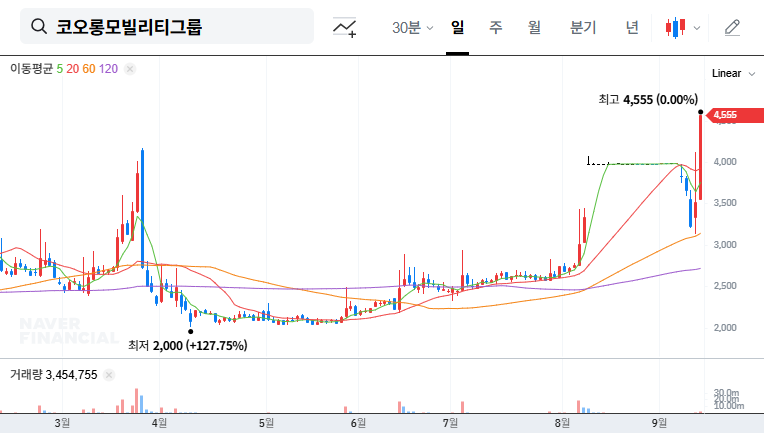
    Kolon Mobility Group Stock Outlook: Majority Shareholder Increases Stake to 93% - Opportunity or Threat? 대표 차트 이미지

    1. What Happened?

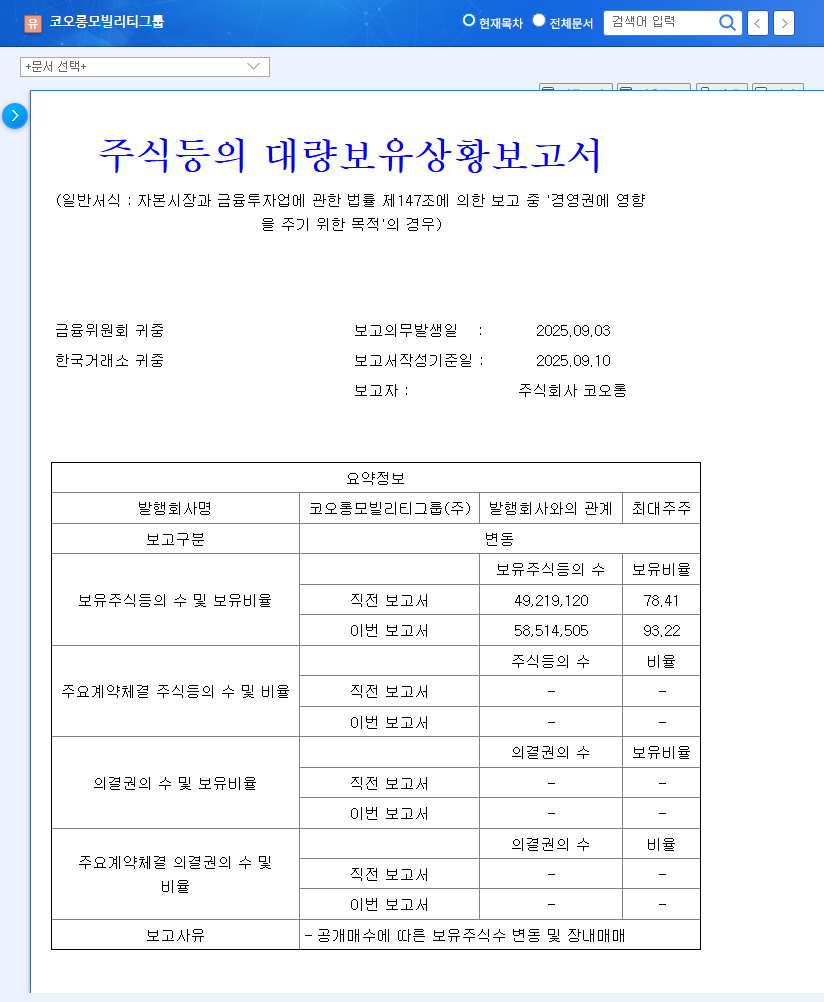
    Kolon increased its stake in Kolon Mobility Group from 78.41% to 93.22% through a tender offer and on-market purchases. The stated purpose of this acquisition is to influence management.

    2. Why This Decision?

    This move solidifies Kolon’s control over Kolon Mobility Group. It signals their intent to strengthen management control, enabling them to pursue long-term business strategies and efficiently implement shareholder value enhancement policies like treasury stock cancellation and share swaps with Kolon Corp.

    3. What’s Next?

    • Positive Impacts:
      • Management stabilization and faster decision-making
      • Expected implementation of shareholder value enhancement policies
      • Increased market confidence
    • Negative Impacts/Potential Risks:
      • Potential weakening of minority shareholder rights
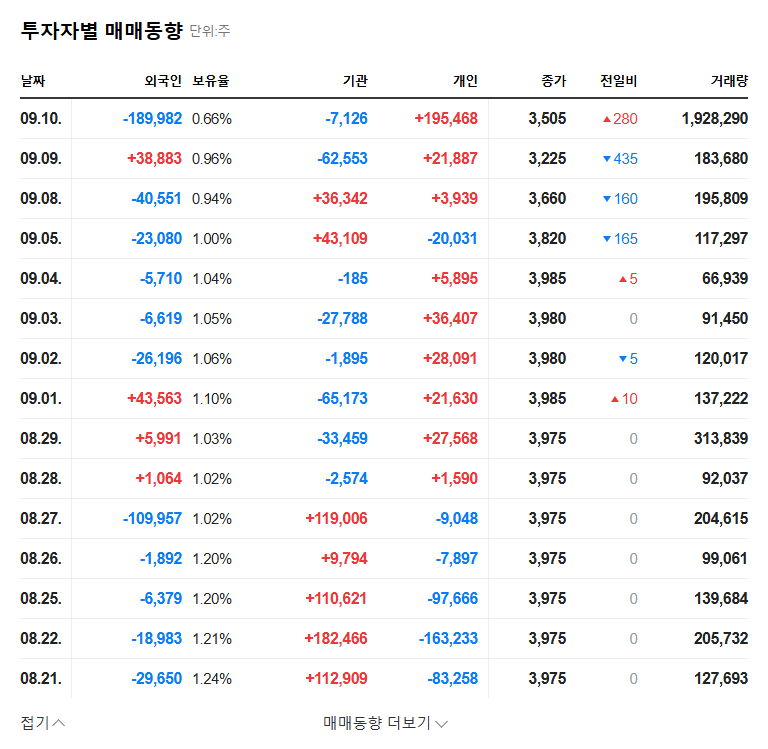
      • Concerns about short-term liquidity decrease
      • Fundamental risks like high debt ratio and intensified market competition

    While a short-term price increase is anticipated due to this ‘management defense’ event, long-term stock performance hinges on fundamental improvements.

    4. What Should Investors Do?

    Instead of reacting to short-term price fluctuations, investors should carefully analyze Kolon Mobility Group’s fundamentals, financial health, and market competitiveness, making investment decisions with a long-term perspective. Continuous monitoring of macroeconomic conditions and trends in the import car market is crucial.

    Does an increase in majority shareholder stake always positively impact the stock price?

    Not necessarily. While short-term price increases can occur due to expectations of management stability, sustained price growth requires underlying improvements in the company’s performance.

    What are the key investment points for Kolon Mobility Group?

    Consider factors like market share in the import car market, improvements in financial structure, new business ventures and their performance.

    What are the key risks to consider before investing?

    Be aware of risks like high debt-to-equity ratio, increasing competition in the import car market, and macroeconomic uncertainties.
    Kolon Mobility Group Stock Outlook: Majority Shareholder Increases Stake to 93% - Opportunity or Threat? 관련 이미지
    Kolon Mobility Group Stock Outlook: Majority Shareholder Increases Stake to 93% - Opportunity or Threat? 관련 이미지
  • Deutsch Motors Q2 2025 Earnings: Recovery Amidst Underlying Concerns?

    1. Deutsch Motors Q2 Performance: What Happened?

    Deutsch Motors reported KRW 654.8 billion in revenue, KRW 13.7 billion in operating profit, and KRW 2.8 billion in net profit for Q2 2025. While revenue increased compared to Q4 2024, both operating and net profit decreased. Compared to Q1 2025, revenue increased, but operating and net profit decreased.

    2. Analyzing the Drivers: Why These Results?

    Positive Factors:

    • Strong domestic market presence of BMW and MINI brands
    • Steady growth in auto financing business
    • Sales recovery compared to Q4 2024
    • Return to profitability on a consolidated net income basis

    Negative Factors:

    • Overall downturn in the import car market
    • Increased financing costs due to rising interest rates
    • High debt-to-equity ratio (329.17%)
    • Increased volatility in foreign exchange rates

    3. Deutsch Motors’ Future: What Lies Ahead?

    Deutsch Motors holds growth potential, grounded in its core BMW and MINI sales and its financing business. However, the high debt ratio and market uncertainties pose persistent risks. Future improvements hinge on increasing operating profit margin, improving financial structure, and strengthening new car sales strategies.

    4. Action Plan for Investors: What Should You Do?

    Investors should closely monitor Deutsch Motors’ future earnings trends, new car sales strategies, financial health of its financing arm, and its strategies for managing foreign exchange and interest rate fluctuations. A cautious, long-term investment approach is advised.

    Frequently Asked Questions

    What are Deutsch Motors’ main businesses?

    Deutsch Motors primarily sells and services new BMW and MINI vehicles and certified pre-owned cars. Through subsidiaries, they are also involved in real estate development, auto financing and leasing, and financial brokerage.

    What are the key takeaways from Deutsch Motors’ Q2 earnings?

    While revenue increased compared to the previous quarter, operating and net profit declined. High debt levels and market uncertainty remain key risks.

    What should investors consider when evaluating Deutsch Motors?

    Investors should carefully monitor future earnings trends, new car sales strategies, the financial health of the financing division, and the company’s strategies for managing foreign exchange and interest rate fluctuations. A cautious, long-term perspective is recommended.

  • Kolon Mobility Group Q1 2025 Earnings: Analysis and Investment Strategy

    1. Kolon Mobility Group Q1 2025 Performance: Strong BMW Sales, But…

    Kolon Mobility Group’s Q1 2025 results presented a mixed picture. Positive aspects included robust BMW sales and growth in the after-sales service segment. However, the overall decline in the import car market and the sluggish performance of the Audi brand raised concerns.

    1.1 Key Performance Indicators

    • BMW New Car Sales: KRW 325.9 billion (Strong)
    • After-Sales Service Revenue Share: 17.2% (Steady Growth)
    • Overall Import Car Market: Declining Trend
    • Audi Brand Sales: Continued Slump

    2. Understanding the Results: Market Environment and Macroeconomic Analysis

    The decline in the import car market is primarily attributed to macroeconomic factors such as high interest rates, unfavorable exchange rates, and an economic slowdown. These factors have weakened consumer purchasing power, negatively impacting import car sales.

    2.1 Key Macroeconomic Variables

    • Exchange Rates: Continued Volatility (KRW/USD, KRW/EUR)
    • Interest Rates: Maintained Hold Stance, Continued Financing Cost Burden

    3. Looking Ahead: Key Events and Future Outlook

    Kolon Mobility Group has initiated a capital reduction to improve its financial structure. However, the high debt-to-equity ratio remains a risk factor. While the change in management led to a short-term surge in stock price, its sustainability depends on fundamental improvements.

    4. Investor Action Plan: Investment Strategy Insights

    In the short term, investors should capitalize on the stock’s momentum while closely monitoring fundamental improvements. The long-term strategy should focus on adapting to market changes, strengthening financial soundness, managing risks, and diversifying the business portfolio.

    4.1 Key Investment Strategies

    • Short-Term: Leverage Momentum, Monitor Fundamental Improvements
    • Long-Term: Adapt to Market Changes, Improve Financial Health, Manage Risks, Diversify Business

    Frequently Asked Questions (FAQ)

    What are Kolon Mobility Group’s main businesses?

    Kolon Mobility Group primarily focuses on the sales and after-sales service of imported cars such as BMW, Audi, and Volvo. Recently, they have been diversifying into other areas such as Bang & Olufsen audio sales.

    What are the key takeaways from the Q1 2025 earnings?

    Strong BMW sales and growth in the after-sales service business were positive, while the declining import car market and the weak performance of the Audi brand posed challenges.

    What are the main risks for Kolon Mobility Group?

    Key risks include the declining import car market, high interest rates, exchange rate volatility, and a high debt-to-equity ratio.