Tag: HLB Group

  • (046210) HLB PANAGENE PEF Investment: A Deep Dive Analysis for Investors

    (046210) HLB PANAGENE PEF Investment: A Deep Dive Analysis for Investors

    HLB PANAGENE Co., LTD. (HLB파나진) has captured the market’s attention with its recent decision to make an 8.5 billion KRW HLB PANAGENE PEF investment. As a leader in PNA-based molecular diagnostics, this strategic move raises a critical question for investors: Is this a catalyst for future growth or a gamble that could increase financial uncertainty? This comprehensive analysis will dissect the investment’s rationale, evaluate the company’s financial health, and provide actionable insights for potential and current shareholders.

    Unpacking the 8.5 Billion KRW PEF Investment

    On November 14, 2025, HLB PANAGENE formally announced its commitment to acquire shares in the Cactus Westview Special Situation Private Equity Fund. This significant investment, representing 10.67% of the company’s equity, is positioned as a strategic effort to secure future growth drivers by participating as a limited partner. The scheduled acquisition date is set for December 31, 2025. The company’s official filing provides the complete details of this transaction. Official Disclosure (DART). A Private Equity Fund (PEF) like this often targets companies with unique opportunities or challenges, aiming to unlock value through financial and operational restructuring.

    A Financial Health Check: Strengths and Weaknesses

    Understanding HLB PANAGENE’s current financial standing is crucial to contextualize the PEF investment. The picture is mixed, revealing both robust liquidity and profitability challenges.

    Key Financial Metrics (Q3 2025)

    • Revenue & Profit Decline: Cumulative revenue stood at 10.815 billion KRW, down 18.0% year-over-year. The operating loss widened to -1.76 billion KRW, primarily due to underperformance in the biomaterial and immunodiagnostics sectors.
    • Molecular Diagnostics Resilience: This core segment, accounting for 75.31% of revenue, helped mitigate the overall decline, though concerns about intensifying market competition are growing.
    • Improved Financial Soundness: Cash reserves increased significantly to 41.31 billion KRW. The debt-to-equity ratio improved to a healthy 31.90%, largely due to recent capital-raising activities like convertible bond issuances.
    • Lingering Concerns: High research and development (R&D) expenses and the financial obligations from convertible bonds remain significant hurdles to achieving sustainable profitability.

    Market Position and Competitive Landscape

    HLB PANAGENE operates within the rapidly expanding global molecular diagnostics market, a sector projected to reach nearly $18 billion by 2025. The company’s proprietary PNA (Peptide Nucleic Acid) technology provides a distinct competitive advantage, especially in the high-value area of companion diagnostics for targeted cancer therapies. However, recent performance suggests that this advantage is being tested by fierce competition and potential challenges in scaling its distribution channels effectively.

    This HLB PANAGENE PEF investment can be seen as a strategic pivot—using a strong cash position to acquire external growth engines while working to resolve profitability issues in its core business.

    Potential Impacts: The Bull vs. The Bear Case

    The Bull Case (Potential Upsides)

    • Fuel for Growth: The 8.5 billion KRW provides significant capital for new technology development, strategic acquisitions, or market expansion.
    • Enhanced Management: PEFs often bring valuable operational expertise and strategic oversight, which could drive efficiency improvements within HLB PANAGENE.
    • Financial Fortification: The capital injection further strengthens the balance sheet, reducing financial risk and improving investor confidence.

    The Bear Case (Potential Downsides)

    • Profitability Drag: If the core business continues to post operating losses, this investment won’t be a short-term fix and could be seen as a distraction from fundamental issues.
    • Investment Uncertainty: The success of the PEF’s own investments is not guaranteed. Poor performance by the fund could negatively impact HLB PANAGENE’s financials.
    • Short-Term Volatility: The news can create significant short-term stock price fluctuations as the market digests the long-term implications.

    Actionable Strategy for HLB PANAGENE Investors

    The HLB PANAGENE PEF investment is a complex event with both promise and risk. The short-term impact is likely neutral to slightly positive, reflecting the balance between enhanced financial stability and ongoing operational questions. Investors should tailor their approach based on their time horizon.

    For Short-Term Traders: Caution is advised. Monitor market reactions closely and be prepared for volatility. Avoid making impulsive decisions based on initial price swings.

    For Long-Term Investors: Focus on the fundamentals. Key areas to monitor include the company’s progress toward operating profitability, the commercial success of new diagnostic products, and any clear synergies that emerge from the PEF investment. For more information on this sector, you might review our guide on how to analyze biotech stocks.

    Ultimately, the success of this move hinges on whether HLB PANAGENE can translate this financial maneuver into tangible improvements in its core molecular diagnostics business and generate a strong return from the fund itself.
    (046210) HLB PANAGENE PEF Investment: A Deep Dive Analysis for Investors 관련 이미지
  • (115450) HLB Therapeutics’ ₩6.5B Vaccine Contract: A Comprehensive Investment Analysis

    (115450) HLB Therapeutics’ ₩6.5B Vaccine Contract: A Comprehensive Investment Analysis

    HLB Therapeutics Co.,Ltd. recently announced a significant ₩6.5 billion (approx. $4.7 million USD) single-source supply contract for a meningococcal vaccine, a development that has captured the attention of the market. This deal, representing a notable portion of its recent revenue, prompts a critical question for stakeholders: Is this a genuine turning point for HLB Therapeutics, offering a solution to its financial hurdles, or is it merely a temporary boost? This in-depth analysis will explore the contract details, dissect the company’s fundamentals across its core business segments, and offer a nuanced investment perspective for 2025 and beyond.

    While the vaccine deal provides a welcome revenue stream, the long-term valuation of HLB Therapeutics remains fundamentally tethered to the success of its high-stakes biopharmaceutical pipeline.

    Deconstructing the ₩6.5 Billion Vaccine Supply Contract

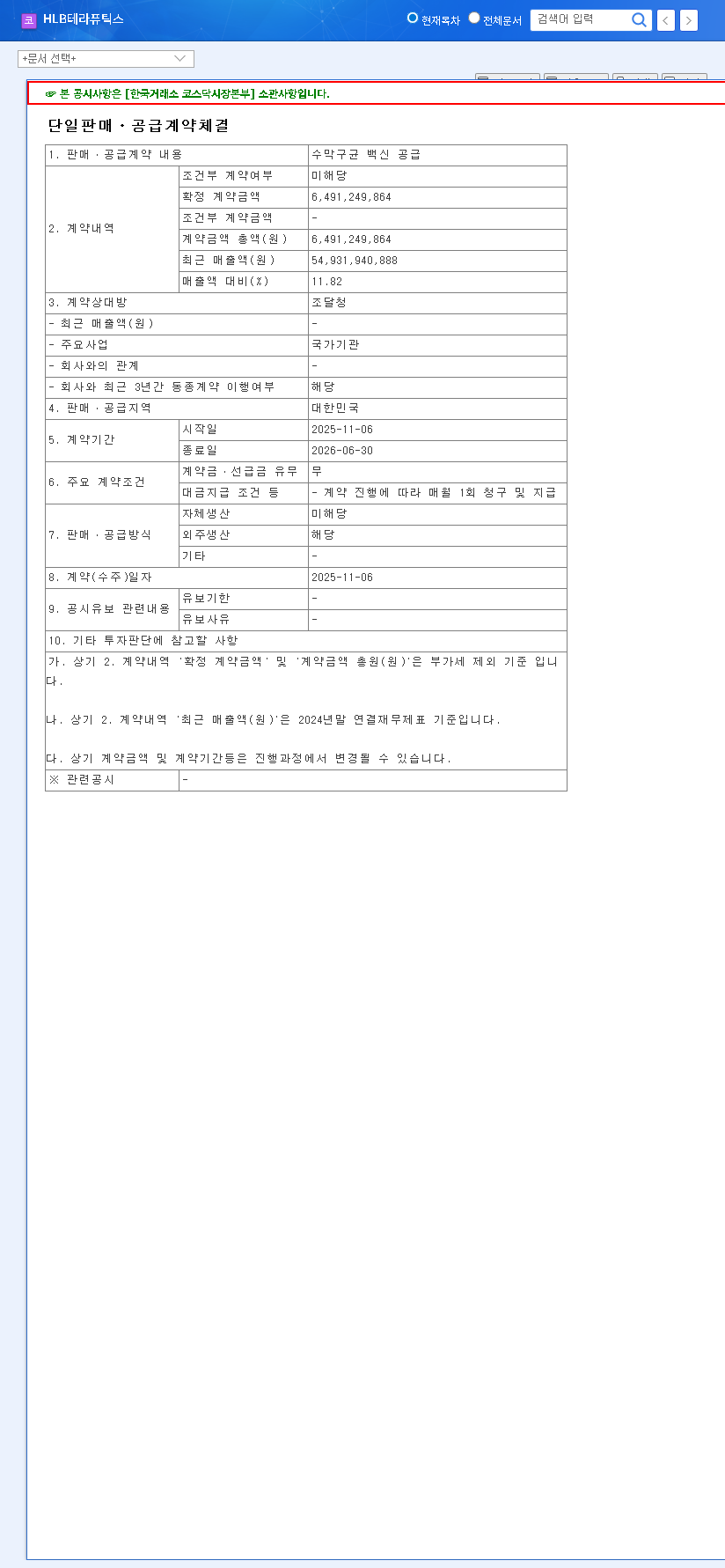
    On November 7, 2025, HLB Therapeutics officially disclosed a ₩6.5 billion supply contract with the Public Procurement Service for a meningococcal vaccine. You can view the Official Disclosure for complete details. The contract is set to run for approximately seven months, from November 2025 to June 2026. This agreement accounts for 11.82% of the company’s 2024 revenue and 14.16% of its cold chain division’s revenue. Meningococcal disease is a serious bacterial infection, and vaccines are a critical public health tool for prevention, as highlighted by health authorities like the World Health Organization. Securing such a government contract signals operational competency and reliability.

    Immediate Positives for HLB Therapeutics

    • Revenue Diversification: The contract provides a stable, predictable revenue stream, bolstering the cold chain business and diversifying the company’s income beyond its more volatile bio-pharma pursuits.
    • Enhanced Credibility: Winning a government contract enhances market trust and validates the company’s logistical and cold chain capabilities, which were honed during the COVID-19 vaccine distribution era.
    • Investor Sentiment: In the short term, this news can ease investor concerns about declining revenues and operating losses, providing a positive catalyst for the stock.

    Underlying Concerns and Limitations

    Despite the positive headlines, it’s crucial to contextualize the deal’s impact. The ₩6.5 billion figure, while significant, is not a silver bullet for the company’s deeper financial challenges, such as persistent operating losses and capital impairment risks. Furthermore, this contract primarily benefits the logistics side of the business and has very limited direct synergy with the core biopharmaceutical research and development efforts, which remain the ultimate driver of long-term company value.

    A Tale of Two Businesses: Bio-Pharma vs. Cold Chain

    To make an informed HLB Therapeutics investment decision, one must understand its two distinct operational pillars.

    The High-Risk, High-Reward Bio Business

    The company’s future value is heavily staked on its drug development pipelines. Key assets include:

    • RGN-259: A therapeutic agent for ophthalmic diseases like dry eye syndrome. The success of its clinical trials could unlock a massive market.
    • OKN-007: A treatment for glioblastoma, an aggressive form of brain cancer with limited treatment options. Positive data here would be a game-changer.

    However, this segment is fraught with uncertainty, long development timelines, and high R&D costs. The company relies on financing mechanisms like convertible bonds, which pose a risk of share dilution for existing investors.

    The Steady Cold Chain Business

    Acquired through the merger with SJ Pharm, the cold chain division provides a stable revenue foundation (₩45.9 billion in 2024). This new vaccine contract is a direct win for this unit, which is continuously upgrading its systems for automated delivery and temperature control. While less glamorous than drug discovery, this business provides essential cash flow and operational stability.

    Investor Action Plan & Strategic Outlook

    Given the dual nature of HLB Therapeutics, investors should adopt a cautious and long-term perspective. The vaccine supply contract is a positive data point for the cold chain segment but does not alter the fundamental risk/reward profile of the bio-pharma pipeline. For a broader understanding of market dynamics, consider reading about How to Analyze Biotech Sector Investments.

    Key factors to monitor closely include:

    • Clinical Trial Milestones: Any news, positive or negative, regarding RGN-259 and OKN-007 will have a far greater impact on the stock price than logistics contracts.
    • Financial Health: Keep an eye on quarterly reports for improvements in operating cash flow, debt levels, and any new convertible bond issuances.
    • Cold Chain Growth: Look for evidence that the company can secure more high-value contracts and improve the profitability of this division.

    Frequently Asked Questions (FAQ)

    Q1: What is the main benefit of the vaccine contract for HLB Therapeutics?

    A1: The primary benefit is the strengthening of its cold chain business through a stable ₩6.5 billion revenue stream. It also diversifies the company’s operations and enhances its market credibility as a reliable logistics partner for sensitive medical supplies.

    Q2: Can this contract fix the company’s financial problems?

    A2: No, it is unlikely to be a fundamental fix. While helpful, the contract’s value is insufficient to resolve underlying issues like ongoing operating losses and capital impairment concerns. A significant breakthrough in the biopharmaceutical business is needed for a true financial turnaround.

    Q3: Where does the real long-term value of HLB Therapeutics lie?

    A3: The core long-term investment thesis for HLB Therapeutics remains its bio business. The ultimate enterprise value will be determined by the clinical success and eventual commercialization of its drug pipelines, particularly RGN-259 and OKN-007.

    (115450) HLB Therapeutics' ₩6.5B Vaccine Contract: A Comprehensive Investment Analysis 관련 이미지