Tag: H1 Earnings

  • (055550) Shinhan Financial Group H1 2025 Earnings: In-Depth Analysis & ₩64,000 Stock Target

    (055550) Shinhan Financial Group H1 2025 Earnings: In-Depth Analysis & ₩64,000 Stock Target

    In a volatile global market, SHINHAN FINANCIAL GROUP CO.,LTD (055550) has emerged as a beacon of stability and growth. The recent release of their H1 2025 report not only surpassed market expectations but also highlighted a robust turnaround and a strengthened commitment to shareholders. This in-depth analysis of the Shinhan Financial Group earnings for the first half of 2025 will unpack the core financial metrics, explore the key growth drivers, and provide a clear investment thesis for investors looking to capitalize on its future potential.

    We’ll break down complex data into actionable insights, helping you understand the forces shaping the Shinhan Financial stock trajectory and make well-informed decisions. Let’s explore the compelling value proposition that Shinhan Financial Group presents today.

    Key Highlights from the H1 2025 Earnings Report

    Shinhan Financial Group announced a formidable performance for the first half of 2025, signaling a powerful recovery and operational excellence. The official numbers, available in the Official Disclosure (DART), reveal a company firing on all cylinders. Here are the most significant takeaways:

    • Impressive Net Income Growth: The group posted a net income of 3.0374 trillion KRW (attributable to controlling shareholders), a remarkable 10.6% increase year-over-year. This represents a significant turnaround from previous net losses, showcasing a return to strong profitability.
    • Surging Profitability Metrics: The net profit margin skyrocketed to an incredible 99.99%, while the annualized Return on Equity (ROE) reached a healthy 9.12%. These figures demonstrate a highly efficient and profitable operational structure.
    • Enhanced Shareholder Value: A strong commitment to shareholder returns was evident. The announcement of a Q2 dividend of 570 KRW per share, coupled with a massive 800 billion KRW share buyback and cancellation program, signals confidence from management and directly rewards investors.
    • Maintained Financial Stability: Despite a slight increase, the debt-to-equity ratio remains at a manageable and stable level. The group’s balance sheet health is solid, providing a strong foundation for future growth and resilience against market shocks.

    What’s Driving the Growth? Unpacking the Catalysts

    This stellar performance wasn’t a matter of luck; it was the result of a multi-faceted strategy and favorable conditions. Understanding these drivers is key to evaluating the sustainability of Shinhan’s growth.

    Diversified and Balanced Business Portfolio

    A core strength lies in the group’s diversified revenue streams. Solid, balanced growth was achieved across all primary segments—including banking, securities, and insurance. This portfolio approach reduces reliance on any single market segment and provides a stable earnings base even in fluctuating economic climates.

    Resolution of One-Off Costs

    The previous year’s financial results were weighed down by one-time costs associated with Equity-Linked Securities (ELS). The expiration of these costs in H1 2025 provided a significant, direct boost to the bottom line, allowing the group’s underlying profitability to shine through.

    Proactive Risk and Cost Management

    Management’s focus on efficient cost control and proactive risk management has been crucial. By maintaining a conservative stance on provisioning for potential loan losses and optimizing operational expenditures, Shinhan has fortified its fundamentals and protected its margins.

    Market Context & Investment Thesis

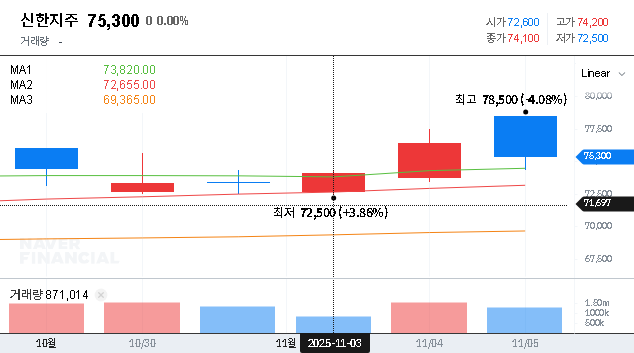
    The Shinhan Financial stock performance is influenced by macroeconomic trends. The stock surged past ₩50,000 following the earnings announcement but has since consolidated. A stable interest rate environment in both Korea and the U.S. could be beneficial for the bank’s Net Interest Margin (NIM), a key profitability driver. For a deeper understanding of this metric, you can read our guide on Understanding Net Interest Margin in Banking Stocks. However, investors must monitor factors like the US 10-Year Treasury Yield, as covered by sources like Bloomberg, which can signal shifts in global rate expectations.

    Based on our comprehensive analysis of the latest Shinhan Financial Group earnings, we are issuing a ‘BUY’ recommendation with a target price of ₩64,000. The company’s robust fundamentals, aggressive shareholder return policy, and undervalued status present a compelling investment opportunity.

    Recommended Investment Strategy

    • Adopt a Long-Term Perspective: Focus on the company’s stable fundamentals and strategic initiatives like digital transformation, which are poised to deliver value over the long haul.
    • Utilize Dollar-Cost Averaging: In a fluctuating market, making staggered investments can help manage your average purchase price and mitigate volatility risk.
    • Focus on Dividend Yield: The consistent and growing dividend provides a stable income stream and can add a defensive cushion to your portfolio.
    • Monitor Key Risks: Stay informed about macroeconomic headwinds, potential real estate financing (PF) risks in the Korean market, and the competitive landscape with emerging fintech players.

    Conclusion: A Compelling Buy

    The Shinhan Financial Group H1 2025 earnings report paints a picture of a resilient and strategically adept institution. With strong fundamentals, a clear path to growth, and a shareholder-friendly capital return policy, the stock appears undervalued at its current levels. For investors with a long-term horizon, Shinhan Financial Group represents a high-quality entry point into the Korean financial sector.

    Disclaimer: This analysis is for informational purposes only. The ultimate responsibility for investment decisions rests with the individual investor. Please conduct your own due diligence.

    Frequently Asked Questions (FAQ)

    Q1: How did Shinhan Financial Group perform in H1 2025?

    Shinhan Financial Group had an excellent H1 2025, with net income rising 10.6% year-over-year to 3.0374 trillion KRW. Key metrics like ROE (9.12%) and net profit margin also showed significant improvement, indicating a strong financial turnaround.

    Q2: What is the current target price for Shinhan Financial stock?

    Based on this analysis, a ‘BUY’ opinion is maintained with a target price of 64,000 KRW. This is supported by its strong fundamentals, shareholder return initiatives, and current undervaluation.

    Q3: What are the primary risks for investors?

    The main risks include macroeconomic uncertainty (e.g., prolonged high interest rates), potential exposure to real estate project financing (PF) defaults, intensifying competition from fintech companies, and changes in financial regulations.

    Q4: What makes Shinhan a good long-term investment?

    Its diversified business model across banking, securities, and insurance provides stability. Furthermore, its commitment to digital transformation, strong risk management, and a generous shareholder return program make it an attractive option for long-term investors.
    (055550) Shinhan Financial Group H1 2025 Earnings: In-Depth Analysis & ₩64,000 Stock Target 관련 이미지
  • Shinhan Financial Group H1 2025 Earnings Analysis: Solid Fundamentals, Future Growth Drivers, and Investment Strategies

    Shinhan Financial Group H1 2025 Earnings Analysis: Solid Fundamentals, Future Growth Drivers, and Investment Strategies 대표 차트 이미지

    1. Shinhan’s H1 2025 Performance: What Happened?

    Shinhan maintained steady growth despite the challenging macroeconomic environment. Improved performance in banking and securities, strategic restructuring at Shinhan Card, and stable performance at Shinhan Life demonstrate the strength of its diversified business portfolio. The high CET1 ratio of 13.59% and the KRW 800 billion share buyback signal a strong commitment to shareholder value.

    2. Reasons for Strong Performance: Why?

    • Solid Fundamentals: Steady profit growth in banking and securities underpins the group’s stability.
    • Financial Soundness: The high CET1 ratio demonstrates strong risk management capabilities and provides a foundation for long-term growth.
    • Shareholder Return Policy: The share buyback demonstrates a commitment to enhancing shareholder value.
    • Future Growth Drivers: Digital transformation, AI integration, and strengthened ESG management are crucial for securing future competitiveness.

    3. Future Outlook and Investment Strategies: What’s Next?

    Despite the positives, potential slowdown in Shinhan Card’s profitability, real estate PF risks, and intensifying competition require ongoing management. Shinhan is expected to strengthen its fundamentals through proactive responses to these challenges. The current investment recommendation is ‘Hold’ with a target price of KRW 64,000.

    4. Key Action Plan for Investors

    • Continuous Monitoring: Investors should monitor macroeconomic indicators, regulatory changes, and the group’s risk management and growth strategies.
    • Balanced Investment: Diversifying investment portfolios is crucial for risk mitigation.
    • Seek Expert Advice: Consulting with investment professionals can be beneficial for developing investment strategies.
    Q: What is Shinhan Financial Group’s CET1 ratio for H1 2025?

    A: Shinhan Financial Group’s CET1 ratio for H1 2025 is 13.59%.

    Q: Does Shinhan Financial Group have any plans for share buybacks?

    A: Yes, Shinhan Financial Group has announced a share buyback program amounting to KRW 800 billion.

    Q: What are Shinhan Financial Group’s future growth strategies?

    A: Shinhan Financial Group is focusing on accelerating digital transformation, integrating AI technology, and strengthening ESG management to secure future growth drivers.

    Shinhan Financial Group H1 2025 Earnings Analysis: Solid Fundamentals, Future Growth Drivers, and Investment Strategies 관련 이미지
  • Kukbo Design H1 2025 Earnings Analysis: Revenue Growth vs. Profit Decline – What’s Next?

    1. Kukbo Design H1 2025 Performance: What Happened?

    Kukbo Design reported revenue of KRW 119.2 billion, operating profit of KRW 11.2 billion, and net income of KRW 9.7 billion for the first half of 2025. While revenue grew compared to the same period last year, operating profit decreased.

    2. Why These Results?

    • Revenue Growth: Seasonal factors and strong project execution contributed to the revenue increase.
    • Operating Profit Decline: Potential factors include increased cost of goods sold and higher selling, general, and administrative expenses.

    3. What’s Next? Investment Strategy Analysis

    Kukbo Design maintains a strong financial position and growth potential, but reversing the declining operating profit trend is crucial. Closely monitor future order intake, new project progress, and overseas market penetration.

    4. Investor Action Plan

    • Short-Term Investors: Await further information regarding the reasons for the operating profit decline before making investment decisions. Maintain a ‘hold’ or ‘neutral’ stance.
    • Long-Term Investors: Consider Kukbo Design’s growth potential for a long-term investment strategy. However, continuously monitor the impact of macroeconomic variables.

    Frequently Asked Questions

    Q: Why did Kukbo Design’s Q2 operating profit decline?

    A: Potential factors include increased cost of goods sold and higher SG&A expenses. The company’s official explanation is pending.

    Q: Should I invest in Kukbo Design?

    A: Currently, the recommendation is ‘hold’ or ‘neutral’. Further analysis of the operating profit decline and the company’s ability to improve profitability is needed.

    Q: What is the outlook for Kukbo Design?

    A: The company has positive factors such as a strong financial position and potential for overseas expansion. However, reversing the declining operating profit trend is key.

  • LG Electronics H1 2025 Earnings: A Mixed Bag for Investors

    What Happened? H1 2025 Performance Overview

    LG Electronics reported a 1.6% year-on-year increase in revenue to KRW 434.75 trillion in H1 2025. However, operating profit declined by 25% to KRW 18.985 trillion, falling short of market expectations. The Q2 2025 preliminary earnings further highlighted this challenging trend.

    Why These Results? Key Drivers of Performance

    The decline in operating profit is primarily attributed to the weak performance of the Media entertainment Solution (MS) division and increased investments in the Vehicle Solution (VS) division. External factors such as the global economic slowdown, rising raw material prices, and volatile exchange rates also played a significant role.

    • MS Division: Increased competition in the OLED TV market impacted profitability.
    • VS Division: Investments in future growth initiatives weighed on short-term earnings.
    • External Factors: Rising raw material prices and exchange rate fluctuations added pressure on margins.

    What’s Next? Outlook and Investment Strategy

    LG Electronics continues to invest in future growth drivers like robotics, automotive components, and smart home solutions. However, short-term profitability improvements are expected to be challenging. Investors should consider the following:

    • Short-term perspective: Monitor the MS division’s performance, the return on VS investments, and the overall macroeconomic environment.
    • Long-term perspective: The success of these future growth investments and the company’s ability to regain competitiveness in core businesses will determine long-term value.

    Investor Action Plan

    A cautious approach is recommended in the short term, with careful monitoring of market conditions and prudent investment decisions. For a long-term perspective, investment strategies should consider the growth potential of LG’s future-oriented businesses.

    Frequently Asked Questions

    What are the main reasons for LG Electronics’ weaker H1 2025 earnings?

    The primary factors include the underperformance of the MS division, increased investment in the VS division, rising raw material costs, and exchange rate volatility.

    What are LG Electronics’ future growth drivers?

    Robotics, vehicle components, and smart home solutions are identified as key future growth areas.

    What should investors consider when evaluating LG Electronics?

    In the short term, monitor the MS division’s performance, VS investment returns, and macroeconomic conditions. For the long term, focus on the growth potential of future-oriented businesses.

  • Seegene Matrix H1 2025 Earnings: Strong Potential vs. Profitability Challenges – Investment Strategies

    What Happened?

    Seegene Matrix reported revenue of KRW 5.19 billion in H1 2025, exceeding market projections. However, both operating and net income remained negative at KRW -379 million and KRW -1.177 billion, respectively.

    Why These Results?

    Despite revenue growth, high R&D investment and a pipeline yet to be commercialized have hampered profitability. However, proprietary molecular diagnostic technologies like C-Tag and Encleap, and a diverse pipeline including Hepatitis A and COVID-19 vaccines, demonstrate strong future growth potential.

    What’s Next?

    Seegene Matrix’s future hinges on the successful commercialization of its technology. Aggressive business strategies, including expansion into overseas markets and the launch of new diagnostic products, are crucial for achieving revenue growth and improved profitability.

    Investor Action Plan

    While short-term stock volatility is expected due to sluggish earnings, investors should focus on the company’s technology and pipeline value from a mid- to long-term perspective. Closely monitoring clinical trial results for new drug pipelines and the progress of overseas expansion is crucial for making informed investment decisions.

    What was Seegene Matrix’s revenue in H1 2025?

    Seegene Matrix reported KRW 5.19 billion in revenue for H1 2025, exceeding market expectations.

    Why is Seegene Matrix still not profitable?

    High R&D investment and a pipeline yet to be commercialized are hindering profitability.

    What is the future growth potential of Seegene Matrix?

    Seegene Matrix possesses strong growth potential due to its proprietary molecular diagnostic technologies and diverse pipeline.

    What should investors be aware of?

    Investors should be mindful of short-term stock volatility and closely monitor the success of technology commercialization and overseas expansion.

  • Ubiquitous Holdings Soars with Record Profits in H1 2025!

    1. Ubiquitous Holdings H1 2025 Financial Performance

    Ubiquitous Holdings announced a successful return to profitability, reporting KRW 43.5 billion in revenue, KRW 7.8 billion in operating profit, and KRW 7.9 billion in net income for the first half of 2025. While revenue decreased compared to the same period last year, operating and net income surged by 64.5% and 113.5%, respectively. The company demonstrated explosive growth compared to Q1 2025, generating positive market sentiment.

    2. Core Business Growth and Future Drivers

    The growth of the network business segment, specifically a 73.46% increase in switch/FTTH product sales, was the primary driver of this strong performance. The industrial board manufacturing business also maintained steady performance, providing a stable revenue base. Continued investments in next-generation communication equipment development further enhance the company’s future growth potential.

    3. External Factors to Consider for Investment

    Despite the positive performance, investors should consider external factors. High exchange rate volatility poses risks of increased raw material import costs and foreign exchange losses. Global macroeconomic uncertainty could also lead to a contraction in demand. Furthermore, the intensifying competition in the communications equipment market requires ongoing monitoring.

    4. Action Plan for Investors

    Ubiquitous Holdings’ H1 2025 results signal a solid improvement in fundamentals. However, before making investment decisions, it’s crucial to carefully examine future order forecasts, the impact of exchange rate fluctuations, and competitor analysis. The current stock price may not fully reflect the growth momentum, making it essential for investors to consider both short-term price appreciation and long-term growth potential.

    Frequently Asked Questions

    What are Ubiquitous Holdings’ main businesses?

    Ubiquitous Holdings’ core businesses are network solutions (switches, FTTH products, etc.) and industrial board manufacturing. They are also diversifying into holding company operations and new technology finance.

    What are the key factors contributing to this improved performance?

    The primary factor is the increased sales of switch/FTTH products in the network business segment. Efficient cost management also played a role in improving profitability.

    What precautions should investors take?

    Investors should consider external factors such as exchange rate volatility, macroeconomic uncertainty, and intensifying competition. Thoroughly reviewing the company’s order book and new technology development progress is also crucial.

  • Shinyoung Wacoal H1 2025 Earnings Analysis: Profitability Concerns and Uncertain Future

    1. Shinyoung Wacoal H1 2025 Performance: Mixed Results and Warning Signs

    Shinyoung Wacoal reported consolidated revenue of KRW 57.8 billion, an operating loss of KRW 100 million, and a net profit of KRW 3 billion for H1 2025. While maintaining net profitability, the shift to an operating loss raises concerns. Sales declined slightly year-over-year, highlighting ongoing challenges in the core business.

    2. Core Business Struggles and New Business Uncertainty

    Intensified competition in the women’s innerwear market and weakened consumer sentiment contributed to the continued decline in Shinyoung Wacoal’s core business, led by its ‘Venus’ brand. Despite efforts to diversify sales channels through online and live commerce platforms, the company has struggled to reverse the declining sales trend. The discontinuation of the medical product business and the uncertain outlook for the museum/memorial hall operation further add to the uncertainty surrounding new growth drivers.

    3. Change in Majority Shareholder: A Catalyst for Change?

    The change in majority shareholder on July 31, 2025, is expected to significantly impact Shinyoung Wacoal’s future management strategy. Close monitoring of the new shareholder’s management philosophy and business direction is crucial.

    4. Investor Action Plan: Proceed with Caution

    While Shinyoung Wacoal possesses a stable brand reputation and sound financial health, the company faces challenges in addressing declining profitability and identifying new growth engines. Investors should closely monitor the company’s future earnings performance, new business developments, and management changes following the change in majority shareholder before making investment decisions.

    Q: What are the key highlights of Shinyoung Wacoal’s H1 2025 earnings?

    A: The company reported a net profit of KRW 3 billion, an operating loss of KRW 100 million, and a slight year-over-year decline in revenue to KRW 57.8 billion.

    Q: What is Shinyoung Wacoal’s main business?

    A: The company’s core business is women’s innerwear, primarily under the ‘Venus’ brand, with sales through various channels including online and live commerce.

    Q: What are the key risks for investors in Shinyoung Wacoal?

    A: Key risks include declining profitability in the core business, uncertainty surrounding new business ventures, and potential management changes following the change in majority shareholder.

  • Company K Partners Announces Soaring H1 2025 Earnings: Investment Opportunity Analysis

    1. About Company K Partners

    Company K Partners is a venture capital firm specializing in the formation and management of venture capital funds. With total assets under management (AUM) of KRW 1.0674 trillion and 19 operating funds, the company demonstrates consistent growth, focusing its investments in promising sectors like AI and biotech.

    2. H1 2025 Performance Highlights

    Company K Partners achieved remarkable results in H1 2025, reporting KRW 8.34 billion in revenue, KRW 4.2 billion in operating profit, and KRW 3.54 billion in net income. This represents a substantial year-on-year growth of 25.7% and 71.5%, respectively. The increase in equity method income, driven by the rising valuation of their investment portfolio, was a key contributor to this success.

    • Q2 2025: Revenue KRW 4.4B, Operating Profit KRW 2.5B, Net Income KRW 2.1B
    • Q1 2025: Revenue KRW 3.9B, Operating Profit KRW 1.7B, Net Income KRW 1.4B

    3. Drivers of Growth

    Company K Partners’ rapid growth is attributed to a combination of successful investment portfolio management, consistent fund-raising capabilities, and a favorable market environment supported by government policies promoting venture capital investment. Their proactive investments in high-growth sectors like AI and biotech have been particularly impactful.

    4. Future Outlook

    Experts predict that Company K Partners will maintain its leading position in the venture capital market, driven by its strong fundamentals and consistent growth trajectory. However, potential risk factors such as exchange rate volatility and increasing market competition require ongoing monitoring.

    5. Investor Action Plan

    Investors interested in Company K Partners’ growth potential should carefully analyze the company’s exit strategies, competitive landscape, and macroeconomic indicators before making investment decisions.

    Frequently Asked Questions

    What is Company K Partners’ main business?

    Company K Partners is a venture capital firm that forms and manages venture capital funds, investing in promising ventures to generate returns.

    What were Company K Partners’ H1 2025 financial results?

    Company K Partners reported KRW 8.34 billion in revenue, KRW 4.2 billion in operating profit, and KRW 3.54 billion in net income in H1 2025.

    What is Company K Partners’ investment strategy?

    Company K Partners focuses its investments on high-growth sectors such as AI and biotech.

  • Hana Micron IR Analysis: H1 2025 Earnings and Future Outlook

    1. Hana Micron H1 2025 Earnings Analysis: A Mixed Bag

    Hana Micron achieved consolidated revenue of KRW 311.7 billion (+15.9% YoY) in H1 2025. Robust growth in the semiconductor manufacturing and materials segments drove revenue growth, but operating profit declined to KRW 11.7 billion (-29% YoY), indicating weakened profitability. Net income reached KRW 570 million, marking a return to profitability, albeit on a limited scale. The debt-to-equity ratio rose slightly to 229.38% compared to the end of the previous year, while operating cash flow improved significantly to KRW 42 billion.

    2. Segment-wise Growth Drivers and Risk Analysis

    • Semiconductor Manufacturing: Despite revenue growth, declining profitability poses a challenge. The company aims to improve profitability by expanding its high-value-added memory and non-memory businesses.
    • Semiconductor Materials: Sustained robust growth is driven by a unique competitive edge in silicon components for etching processes.
    • R&D: The company focuses on developing next-generation packaging and SiC components, maintaining an R&D ratio of 2.75% to 3.17%.

    3. Market Environment Analysis and Investment Strategies

    The growing demand for AI and automotive semiconductors is a positive factor, but the global economic slowdown and geopolitical risks are downside pressures. The continued weakness of the Korean Won against the US dollar negatively impacts exporting companies. A potential decrease in US and European interest rates is expected to alleviate financial burdens. Volatility in international oil prices can affect raw material and logistics costs.

    Investors should carefully analyze the IR presentation, assessing the feasibility of the presented strategies and overall semiconductor industry sentiment. Close attention should be paid to the company’s profitability improvement plan and its strategy for navigating the macroeconomic environment.

    Frequently Asked Questions

    What were Hana Micron’s H1 2025 financial results?

    Hana Micron reported revenue of KRW 311.7 billion (+15.9% YoY), operating profit of KRW 11.7 billion (-29% YoY), and net income of KRW 570 million (return to profitability) in H1 2025.

    What are Hana Micron’s main business segments?

    Hana Micron’s main business segments are semiconductor manufacturing and semiconductor materials.

    What is Hana Micron’s future growth strategy?

    Hana Micron plans to focus on expanding its high-value-added memory and non-memory businesses and developing next-generation packaging and SiC components.

  • Dongwoon Anatech’s H1 2025 Earnings: A Surprise Preliminary Announcement, But What’s the Catch?

    1. What Happened?

    Dongwoon Anatech announced preliminary earnings of KRW 30.1 billion in revenue, KRW 3.1 billion in operating profit, and KRW 0 billion in net income in its semi-annual report on August 12, 2025. These figures significantly exceeded market expectations. However, the “Preliminary Earnings: N” notation indicates that these figures are not finalized, and the identical figures to Q2 results are causing confusion.

    2. Why These Results?

    The decline in sales of smartphone components, especially AF/OIS Driver ICs, continues. Increased competition in the smartphone market and customer inventory adjustments are analyzed as the main causes. On the other hand, OIS Driver ICs maintain relatively stable sales due to the increasing demand for high-performance cameras. The digital healthcare business is still in the research and development stage, with mass production targeted for 2026.

    3. What’s Next?

    The preliminary earnings announcement could have a positive impact on stock prices in the short term, but if the difference with the final earnings is significant, there is a possibility of disappointed selling. The success of the digital healthcare business will be the key to securing mid- to long-term growth momentum. Efforts to restore competitiveness in the smartphone component business are also crucial.

    4. What Should Investors Do?

    The current investment recommendation is ‘Hold’. In the short term, it is advisable to wait for further confirmation of the preliminary earnings announcement and the final earnings announcement. In the mid- to long-term, it is necessary to closely monitor the progress of the digital healthcare business and the recovery of competitiveness in the smartphone component market.

    Q: What were Dongwoon Anatech’s H1 2025 earnings?

    A: The company announced preliminary earnings of KRW 30.1 billion in revenue, KRW 3.1 billion in operating profit, and KRW 0 billion in net income. While exceeding market expectations, it’s important to note that these figures are ‘preliminary’.

    Q: What are Dongwoon Anatech’s main business segments?

    A: Smartphone components (AF/OIS Driver IC, OIS Driver IC, etc.) and digital healthcare (saliva-based glucose measurement system).

    Q: What is the outlook for Dongwoon Anatech?

    A: The success of the digital healthcare business is expected to be a key determinant of mid- to long-term growth. Recovery of competitiveness in the smartphone component business is also a critical challenge.