Tag: Financial Holding Group

  • (175330) JB Financial Group Stock: Why a Major Investor Sold Out & What It Means for You

    (175330) JB Financial Group Stock: Why a Major Investor Sold Out & What It Means for You

    Unpacking the Major Stake Sale in JB Financial Group

    News of a significant investor exit can send ripples of uncertainty through the market, and the recent development concerning JB FINANCIAL GROUP CO.,LTD is no exception. The Capital Group Companies, a major institutional investor, has completely divested its 6.64% stake, a move that naturally raises questions for current and potential shareholders. Is this a red flag signaling underlying issues, or is it merely a strategic portfolio adjustment? This comprehensive analysis delves into the official report, assesses the fundamental impact, and provides a clear-eyed view to help you navigate the short-term noise and make informed investment decisions.

    The Event: A Complete Divestment by a Key Investor

    On October 14, 2025, a mandatory disclosure was filed, revealing a significant shift in the ownership structure of JB FINANCIAL GROUP CO.,LTD. The filing, categorized as a ‘Report on Large Shareholding Status,’ confirmed that The Capital Group Companies, Inc. liquidated its entire position in the company. The sale involved multiple funds managed by the investment giant, reducing their holding from 6.64% to zero.

    For full transparency, the details of this transaction are publicly available. You can view the Official Disclosure on the DART system, South Korea’s primary electronic disclosure platform.

    Key Details of the Transaction:

    • Issuer: JB FINANCIAL GROUP CO.,LTD
    • Selling Entity: The Capital Group Companies, Inc. and its related funds.
    • Stake Sold: Complete divestment of a 6.64% stake.
    • Reason Cited: Termination report due to a change in the representative reporter.

    Decoding the ‘Why’: Is This Cause for Alarm?

    The crucial detail lies in the officially stated reason: ‘termination due to a change in the representative reporter.’ This is not a vote of no confidence in the company’s management or future prospects. Instead, it typically points to internal restructuring, fund consolidation, or portfolio rebalancing within the investment firm. Such moves are common for large asset managers juggling numerous global funds.

    This event does not signal a direct change in the fundamental value of JB Financial Group. Its assets, profitability, and capital structure remain unaffected by this ownership change. The core business is intact.

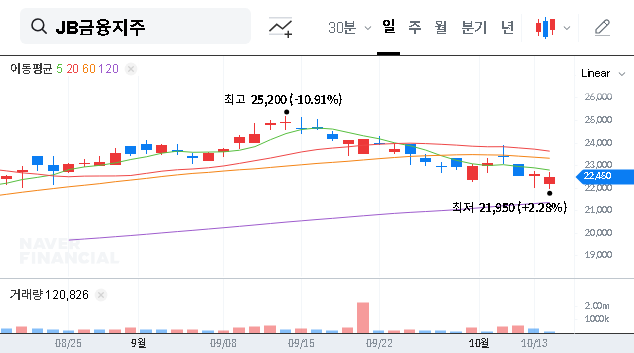
    However, while fundamentals are unchanged, market perception can be powerful. The exit of a well-known investor can create short-term headwinds, primarily affecting investor sentiment and creating supply-demand pressure as a large block of shares is absorbed by the market.

    Market Context: A Look at the Bigger Picture

    No stock operates in a vacuum. The recent price action of JB Financial Group stock has been influenced by broader global macroeconomic trends. Persistent high-interest rates and shifting expectations for rate cuts have created volatility across the financial sector. The declining foreign ownership rate, from nearly 41% in 2020 to around 37% recently, reflects a wider trend of capital flow adjustments in emerging markets. This large-scale sale will contribute to that decline, potentially impacting supply and demand dynamics in the near term.

    An Investor’s Playbook: What to Do Now

    A prudent investor must weigh the short-term market sentiment against the long-term fundamental value of the company. Based on its recent semi-annual reports, JB FINANCIAL GROUP CO.,LTD continues to demonstrate robust fundamentals and stable profitability.

    Key Considerations for Your Strategy:

    • Focus on Fundamentals: Look past the headline. The company’s intrinsic value, profitability, and net interest margin (NIM) have not changed. For more on this, see our guide on How to Analyze Bank Stocks.
    • Monitor for Opportunity: Short-term downward pressure caused by supply/demand imbalance can create attractive entry points for long-term investors who believe in the company’s core business.
    • Assess Your Timeline: Short-term traders may be wary of the volatility, but long-term, value-oriented investors may see this as an opportunity to accumulate shares at a better price.
    • Watch for Future Catalysts: Keep an eye on upcoming earnings announcements and strategic business plans from JB Financial Group’s management. Their response and performance will ultimately drive the stock’s future.

    Conclusion: A Test of Sentiment, Not Fundamentals

    In summary, the divestment by The Capital Group is a significant event that is likely to cause short-term price volatility for JB FINANCIAL GROUP CO.,LTD stock. However, the evidence suggests this is driven by the investor’s internal strategy rather than a fundamental flaw in the company. For investors with a long-term horizon, any resulting price weakness could represent a strategic buying opportunity, provided their own due diligence aligns with the company’s continued stable performance and robust fundamentals.

    (175330) JB Financial Group Stock: Why a Major Investor Sold Out & What It Means for You 관련 이미지
  • (138930) BNK Financial Group H1 2025 Earnings: A Deep Dive for Investors

    (138930) BNK Financial Group H1 2025 Earnings: A Deep Dive for Investors

    The latest BNK Financial Group H1 2025 earnings report offers a critical snapshot for investors navigating the dynamic financial markets. As a pillar of its regional economy, the group’s performance provides valuable insights into both its internal health and the broader economic climate. While the report reveals commendable asset growth, it also highlights significant challenges in profitability and the need for strategic adaptation.

    This comprehensive BNK Financial Group analysis will dissect the key figures, explore the underlying causes of the mixed results, and outline a forward-looking investment strategy. We will delve into how factors like interest rate fluctuations and intense market competition are shaping the company’s trajectory and what it means for potential and current shareholders.

    H1 2025 Financial Snapshot: Key Performance Indicators

    The H1 2025 report for BNK Financial Group paints a picture of a company in transition, balancing external growth with internal profitability pressures. Let’s break down the headline numbers.

    Stable Asset Growth vs. Net Profit Decline

    On the surface, the group continues to expand its footprint, a positive sign of market presence and customer trust.

    • Total Assets Expanded: The group’s total assets grew by 2.7% from the end of the previous year, reaching an impressive KRW 181.5 trillion. This growth was well-balanced across deposits, loans, and securities.
    • Net Profit Contracted: Despite asset growth, consolidated net profit fell by 3.4% year-over-year to KRW 475.8 billion. The primary drivers were a 2.3% drop in net interest income and a significant 25.7% decrease in net fee and commission income.

    While asset growth provides a stable foundation, the decline in net profit underscores an urgent need for strategic recalibration in key subsidiaries and income streams.

    A Divergent Story Across Subsidiaries

    The group’s overall performance masks a varied landscape at the subsidiary level. The banking segment showed mixed results, while non-banking units offered a silver lining.

    • Busan Bank: Remained a pillar of stability, with net profit inching up to KRW 251.7 billion.
    • Gyeongnam Bank & BNK Capital: Faced significant headwinds. Gyeongnam Bank’s profit dropped by KRW 45.8 billion, and BNK Capital’s fell by KRW 7.3 billion, highlighting them as key areas for strategic intervention.
    • Non-Banking Bright Spots: BNK Securities and BNK Asset Management demonstrated strong growth, with net profits increasing by KRW 15.3 billion and KRW 6.1 billion, respectively. This signals successful diversification efforts.

    Decoding the Numbers: Factors Influencing Performance

    Understanding the ‘why’ behind the numbers is crucial. A combination of macroeconomic pressures and internal strategic imperatives shaped the BNK Financial Group H1 2025 earnings.

    Macroeconomic Headwinds and Competitive Pressure

    The global interest rate environment and declining domestic bond yields directly squeezed the banking sector’s Net Interest Margin (NIM), a core profitability metric. This pressure was the primary cause of the drop in net interest income. These trends align with broader market forecasts from high-authority sources like leading financial news agencies, which predict a challenging year for regional banks. Furthermore, fierce competition in the lending and capital markets put additional strain on subsidiaries like Gyeongnam Bank and BNK Capital.

    Financial Health and Risk Management

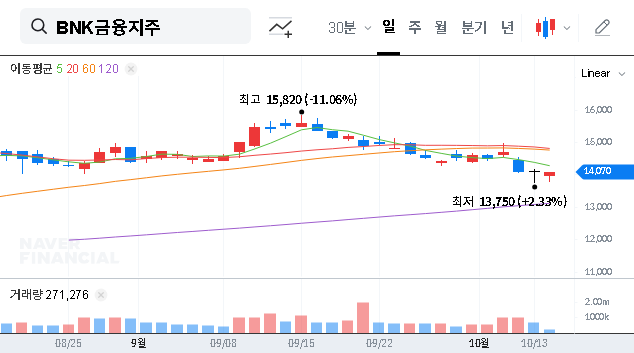
    Despite profitability concerns, the group’s foundational stability remains robust. The BIS total capital ratio of 13.96% is well above regulatory requirements, indicating a healthy capital buffer. However, a slight uptick in the non-performing loan (NPL) ratio to 1.62% and the delinquency ratio to 1.39% serves as a reminder of the importance of proactive risk management in a slowing economy. For those new to financial stock analysis, our guide on how to evaluate bank financial health provides essential background.

    Investor’s Playbook: A Strategic Approach to BNK

    For savvy investors, the current situation presents both risks and opportunities. A successful BNK investment strategy requires a multi-faceted approach that looks beyond the headline numbers.

    1. Focus on Value and Fundamentals

    Analyze whether the current stock price is undervalued relative to the company’s intrinsic worth. Key metrics like the Price-to-Book Ratio (PBR) and Return on Equity (ROE) are essential tools. The strong asset base and robust capital ratio provide a solid foundation for a long-term value play, provided the profitability challenges are addressed.

    2. Monitor Strategic Execution

    Keep a close watch on management’s execution of key initiatives. This includes turnaround efforts at Gyeongnam Bank, competitive repositioning of BNK Capital, and the acceleration of the group’s digital transformation to fend off fintech rivals. The continued growth of the non-banking arms is another critical area to monitor for successful income diversification.

    3. Evaluate Shareholder Returns

    The group’s commitment to shareholder value is a significant positive. The recent decision to cancel treasury shares is a strong signal of management’s confidence and directly benefits existing shareholders by increasing their equity stake. Ongoing evaluation of dividend policies and capital management will be key. For a complete breakdown, investors can review the Official Disclosure filed with DART (Source).

    Frequently Asked Questions (FAQ)

    How did BNK Financial Group’s net profit change in H1 2025?

    BNK Financial Group’s net profit for H1 2025 was KRW 475.8 billion, a decrease of 3.4% compared to the same period last year, primarily due to lower interest and fee income.

    Which BNK subsidiaries are facing challenges?

    Gyeongnam Bank and BNK Capital were the primary underperformers, with both seeing a notable decrease in net profit. They are key focus areas for profitability improvement.

    What is BNK Financial Group’s financial soundness?

    The group maintains strong financial health, with a BIS total capital ratio of 13.96%, which comfortably exceeds regulatory standards and indicates a stable capital structure.

    (138930) BNK Financial Group H1 2025 Earnings: A Deep Dive for Investors 관련 이미지