Tag: FEED

  • Woosung (006980) Insider Sells Stake: What Investors Need to Know

    Woosung (006980) Insider Sells Stake: What Investors Need to Know 대표 차트 이미지

    1. What Happened?

    Park Soon-jung, a key insider at Woosung, sold a total of 3,000 shares (approximately 0.097%) in August and September 2025. This reduced their stake from 38.53% to 38.43%.

    2. Why Did the Insider Sell?

    While the official reason remains undisclosed, the recent decline in Woosung’s stock price suggests profit-taking as a likely motive. However, continuous monitoring is needed to rule out other potential factors.

    3. How Will This Impact the Stock Price?

    In the short term, the sale could exert downward pressure on the stock price and negatively impact investor sentiment. In the long term, while the impact on management control is expected to be minimal, careful observation of further stake changes is crucial.

    • Short-term Impact: Downward pressure on stock price, increased trading volume, potential negative investor sentiment
    • Long-term Impact: Low probability of management change, no direct impact on fundamentals, continued monitoring of stock trends necessary

    4. What Should Investors Do?

    While this event might be considered short-term noise, the recent stock decline and uncertain market conditions warrant caution. Investment decisions should be made after considering various factors such as exchange rates, raw material prices, and earnings forecasts. Avoid impulsive investments and carefully monitor further stake changes and the company’s future business strategies.

    5. Investment Opportunities and Risks for Woosung

    • Risk Factors: Exchange rate fluctuations, rising raw material prices, global economic slowdown, possibility of further insider selling, uncertain earnings outlook
    • Opportunity Factors: Cost reduction and improved management efficiency, new business ventures (e.g., pet food), stabilization of raw material prices, reduced exchange rate volatility

    Frequently Asked Questions

    Who is Park Soon-jung?

    A key insider at Woosung.

    Is this sale a negative sign for Woosung’s future?

    It’s difficult to say definitively. While it could contribute to short-term price declines, it doesn’t directly impact the company’s fundamentals.

    Should I invest in Woosung?

    Careful consideration is advised due to the recent stock decline and uncertain market conditions.

    Woosung (006980) Insider Sells Stake: What Investors Need to Know 관련 이미지
    Woosung (006980) Insider Sells Stake: What Investors Need to Know 관련 이미지
  • Hanil Feed Signs 4-Year Supply Contract with Seoul Milk: Investment Opportunity Analysis

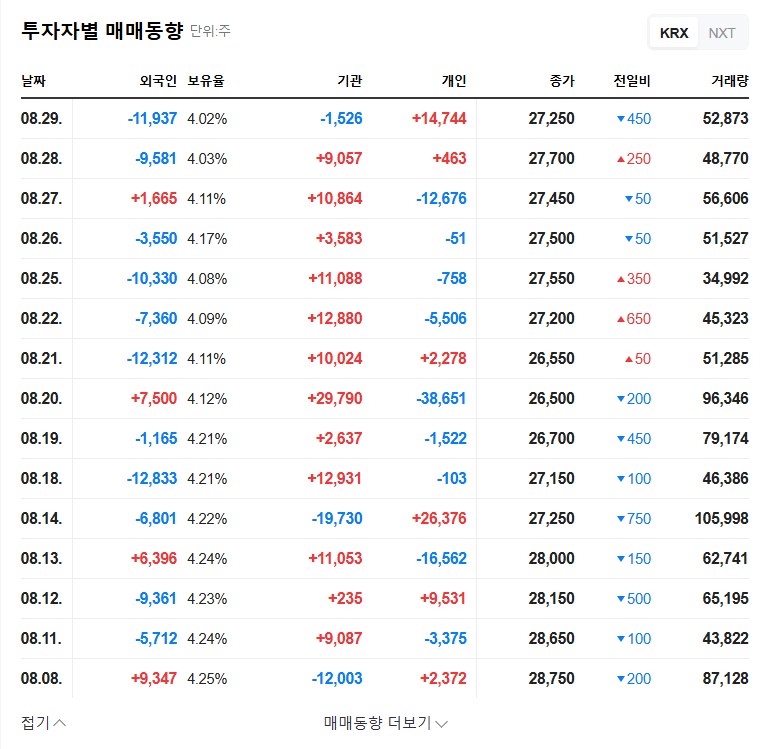
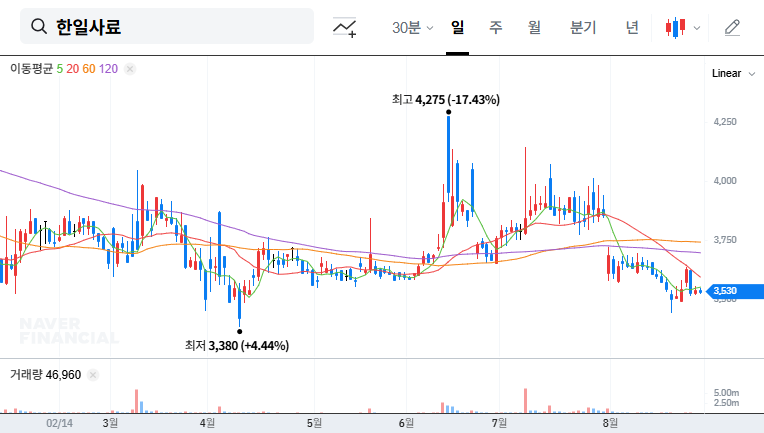
    Hanil Feed Signs 4-Year Supply Contract with Seoul Milk: Investment Opportunity Analysis 대표 차트 이미지

    1. What Happened?

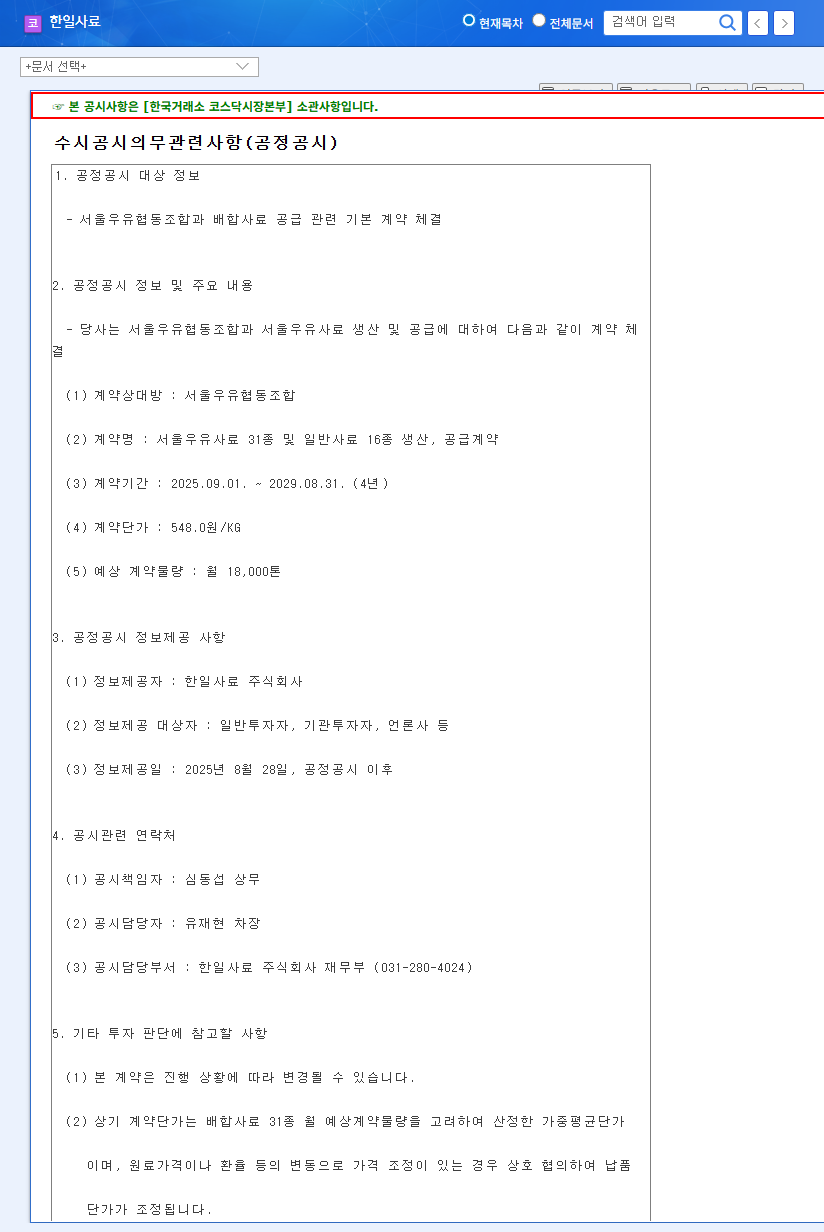
    Hanil Feed Co., Ltd. signed a 4-year feed supply contract with Seoul Milk Cooperative on August 28, 2025. The contract volume is set at 18,000 tons per month, a 35% increase compared to the average of the past four years. This is expected to contribute significantly to the sales stability of Hanil Feed’s feed division.

    2. Why is it Important?

    The feed division accounts for approximately 35% of Hanil Feed’s total sales and has recently faced challenges due to intensifying competition and price declines. This contract offers an opportunity to overcome these difficulties and secure growth momentum by securing a stable sales outlet. In particular, the close cooperative relationship with Seoul Milk Cooperative is expected to positively impact the brand value of ‘Magic Feed’.

    3. So, What’s Next?

    • Positive Effects: Secured sales stability, driving external growth, enhancing brand credibility, potential for profitability improvement
    • Risk Factors: Uncertainty in profitability due to fluctuations in raw material prices and exchange rates, increased transportation and production costs, potential changes in actual supply volume

    The contract price is set at 548.0 KRW/KG but is subject to adjustments based on fluctuations in raw material prices and exchange rates. Therefore, investors should closely monitor raw material market trends and exchange rate fluctuations.

    4. What Should Investors Do?

    While this contract is expected to provide positive momentum for Hanil Feed’s mid-to-long-term growth, potential risk factors also exist. Investors should make prudent investment decisions by comprehensively considering these factors.

    What are the key details of this contract?

    Hanil Feed signed a contract to supply 18,000 tons of feed per month to Seoul Milk Cooperative for four years. This represents a 35% increase compared to the average supply volume over the past four years.

    Will this contract positively impact Hanil Feed?

    Yes, positive effects such as secured sales stability, external growth, and enhanced brand credibility are expected. However, attention should be paid to risk factors such as raw material price fluctuations and exchange rate changes.

    What should investors be aware of?

    Investors should carefully monitor raw material prices, exchange rate volatility, and market competition and make investment decisions by comprehensively considering these factors.

    Hanil Feed Signs 4-Year Supply Contract with Seoul Milk: Investment Opportunity Analysis 관련 이미지
    Hanil Feed Signs 4-Year Supply Contract with Seoul Milk: Investment Opportunity Analysis 관련 이미지
  • Farmstory Invests $32M in Farmsworld: A Strategic Move for Synergistic Growth

    1. Farmstory Acquires Farmsworld: What Happened?

    Farmstory announced on September 9, 2025, its decision to acquire a 90% stake in Farmsworld for $32 million. Farmsworld operates in the livestock (pig farming) business, and this acquisition will complete Farmstory’s vertical integration, encompassing feed production to meat processing.

    2. Why Acquire Farmsworld?

    Farmstory expects the following benefits from this acquisition:

    • Improve Subsidiary’s Financial Structure: Enhance group-wide risk management by securing Farmsworld’s financial stability.
    • Create Business Synergies: Secure cost competitiveness and a stable supply chain through vertical integration from feed production to pig farming and meat processing.
    • Secure Long-term Growth Engine: Expand market dominance through Farmsworld in the growing livestock market.

    3. Impact of the Acquisition on Farmstory

    This acquisition has both positive and negative aspects:

    • Positive Impacts: Business diversification, synergy effects, securing long-term growth potential.
    • Negative Impacts: Financial burden from the $32 million investment, Farmsworld’s business risks, market uncertainty.

    While Farmstory recorded stable performance in the first half of 2025, it remains vulnerable to external factors such as raw material price fluctuations and interest rate hikes. Therefore, the key is how Farmstory manages the financial burden from the Farmsworld acquisition and how quickly it can generate synergistic effects.

    4. Investor Action Plan

    Investors should consider the following factors when making investment decisions:

    • Monitor Farmsworld’s Financial Improvement and Synergy Creation: The success of the investment depends on Farmsworld’s performance improvement.
    • Monitor Changes in the Macroeconomic Environment: Analyze the impact of external factors such as exchange rates, interest rates, and raw material prices on Farmstory.
    • Manage Existing Business Risks: Managing existing business risks such as increased competition in the feed market and the risk of disease outbreaks in the poultry business is also important.

    Frequently Asked Questions

    How will the Farmsworld acquisition affect Farmstory’s stock price?

    In the short term, stock price volatility may increase due to the burden of the investment amount, but in the long term, it may have a positive impact due to expectations of synergy effects. Farmsworld’s performance improvement is expected to have the greatest impact on the stock price.

    How did Farmstory finance the investment?

    The article doesn’t mention the specific financing methods, but investors should continuously monitor information about Farmstory’s future funding plans and financial stability.

    What are Farmstory’s main businesses?

    Farmstory’s main businesses are feed, meat processing, and poultry. With this acquisition of Farmsworld, they’re expanding into the livestock business, aiming to become a comprehensive agricultural and livestock company.

  • Hyundae Saryo Faces Delisting: In-depth Analysis and Future Outlook for Investors

    1. What’s Happening? Hyundae Saryo’s Delisting Crisis

    Hyundae Saryo is currently undergoing delisting procedures from the KOSDAQ market and is preparing an appeal. Delisting poses a significant threat to the company’s continued existence.

    2. Why is This Happening? Analyzing the Root Causes

    • Business Restructuring and Sales Decline: Discontinuation of the bio business has led to a sharp decline in sales, and profitability in the core feed business remains stagnant.
    • Deteriorating Financial Health: Declining capital, low ROE, high PBR, and other financial indicators are worsening, significantly reducing investment attractiveness.
    • Unstable Macroeconomic Environment: A rising exchange rate, interest rate hikes, and increasing logistics costs are further complicating Hyundae Saryo’s business environment.

    3. What’s Next? Future Outlook for Hyundae Saryo

    The outcome of the delisting appeal will determine Hyundae Saryo’s future. The company’s fate will depend heavily on the results. A positive outlook is difficult to foresee at this time.

    4. What Should Investors Do? Investment Strategies and Action Plan

    • Acknowledge the Delisting Risk: Investors must be fully aware of the potential for total loss of investment principal.
    • Analyze Core Business Turnaround Potential: Regardless of the delisting outcome, a realistic assessment of the feed business’s potential for recovery is crucial.
    • Stay Informed: Continuously monitor public disclosures, news, and management comments for the latest information to inform investment decisions.
    Why is Hyundae Saryo facing delisting?

    A combination of factors, including declining sales due to business restructuring, poor financial performance, and an unstable macroeconomic environment, has led to the current crisis. The discontinuation of the bio business has significantly impacted revenue, and the core feed business has struggled to improve profitability.

    Should I invest in Hyundae Saryo?

    Currently, investing in Hyundae Saryo carries extremely high risk. Investors should only consider investment under extremely optimistic scenarios and with full awareness of the potential for total loss of principal.

    What is the future outlook for Hyundae Saryo?

    The outcome of the delisting appeal will be critical for Hyundae Saryo’s future. Careful analysis of the appeal’s chances of success and the potential for business turnaround is necessary. Currently, a positive outlook is challenging to predict. Investors should continuously monitor relevant information.

  • Hanil Feed (005860) H1 2025 Earnings Analysis: Revenue Growth, but Profitability Declines. What’s Next?

    1. Hanil Feed H1 2025 Performance: What Happened?

    Hanil Feed reported KRW 107.8 billion in revenue for H1 2025, showing growth compared to the same period last year. However, operating profit decreased to KRW 1 billion, while net profit, though improved at KRW 1.7 billion, was significantly influenced by non-operating income.

    2. Analyzing the Profitability Decline: Why These Results?

    Despite revenue growth, the decline in profitability is primarily attributed to falling prices in the feed segment and weak demand in the meat distribution segment. The feed segment struggled to pass on increased raw material costs, while the meat distribution segment faced intensified market competition.

    3. Key Insights for Investors: What to Do?

    • Investment Points:
      • Stable revenue from the feed segment
      • Growth potential in the meat distribution segment
      • Improved consolidated financial health
    • Risk Factors:
      • Declining profitability
      • Cost pressures (exchange rate, raw material prices)
      • Market uncertainty
      • Dependence on Seoul Milk Cooperative
      • High debt-to-equity ratio (standalone basis)

    4. Future Outlook and Investment Strategy: What Actions Should Investors Take?

    The current investment recommendation is ‘Neutral’. Investors should closely monitor the company’s ability to improve profitability through price increases in the feed segment, new sales channels in the meat distribution segment, and cost reduction efforts. Furthermore, exchange rate and raw material price volatility, as well as contract renewal with Seoul Milk Cooperative, are crucial factors to consider. A thorough analysis of the company’s future strategies and market conditions is essential before making investment decisions.

    Frequently Asked Questions

    Q: What are Hanil Feed’s main businesses?

    A: Hanil Feed manufactures and sells animal feed and operates a meat distribution business.

    Q: What are the key takeaways from the H1 2025 earnings report?

    A: Revenue increased, but operating profit declined due to falling feed prices and weak demand in the meat distribution segment.

    Q: What should investors consider when investing in Hanil Feed?

    A: Key considerations include declining profitability, cost pressures, market uncertainty, dependence on Seoul Milk Cooperative, and the company’s debt-to-equity ratio (standalone basis).

  • Sunjin Co., Ltd. Announces Surprise Earnings in H1 2025: Investment Analysis and Future Outlook

    1. Sunjin’s H1 2025 Earnings Analysis: Unpacking the Surprise

    Sunjin recorded sales of KRW 463 billion, operating profit of KRW 44.3 billion, and net income of KRW 49.2 billion in the first half of 2025, significantly exceeding market expectations. This “earnings surprise” is attributed to the company’s robust fundamentals and efficient management strategies.

    2. Key Investment Highlights: Strong Fundamentals and Growth Momentum

    2.1 Improved Financial Structure: A substantial decrease in the debt-to-equity ratio signifies a notable improvement in financial health, enhancing resilience against external shocks.
    2.2 Diversified Business Portfolio: Sunjin’s portfolio across the livestock industry value chain provides a stable revenue base. Synergies between the feed, hog farming, and meat processing segments are expected.
    2.3 Future Growth Drivers: Strategic investments in overseas market expansion, online channel reinforcement, and ESG management are driving future growth.

    3. Potential Risks: External Variables and Segment-Specific Analysis

    Despite the positive outlook, external factors such as raw material price volatility and exchange rate fluctuations require continuous monitoring. Further analysis of the discrepancies between consolidated and standalone financial statements is also necessary.

    4. Action Plan for Investors

    Sunjin’s earnings surprise is expected to provide short-term momentum for stock price appreciation. Considering its strong fundamentals and growth strategies, the company holds attractive investment potential in the mid-to-long term. However, investors should carefully evaluate external environmental changes and risk factors before making investment decisions.

    Q. What are Sunjin’s main businesses?

    A. Sunjin operates across the livestock industry value chain, including feed, hog farming, meat processing, and meat distribution.

    Q. What are the main reasons for this earnings surprise?

    A. The main factors are attributed to efficient management strategies, a robust business portfolio, and growth in overseas markets.

    Q. What should investors be aware of when considering investing in Sunjin?

    A. Investors should consider external factors such as raw material price volatility and exchange rate fluctuations, as well as the differences between consolidated and standalone financial results.

  • Samsung E&C Wins Indonesia LNG Project FEED Contract: Investment Strategy Analysis

    1. What Happened? Securing the Indonesian LNG Project FEED Contract

    Samsung E&C, in conjunction with KBR Indonesia and Adhi Karya, has been awarded the FEED contract for the INPEX Abadi Onshore LNG Project in Indonesia. This project encompasses the basic design for an LNG plant with an annual capacity of 9.5 million tons, and Samsung E&C’s contract value is approximately USD 26 million.

    2. Why is it Important? Securing Growth Drivers and Business Diversification

    This contract holds several significant implications for Samsung E&C. Firstly, it presents an opportunity to diversify its business beyond the Middle East and strengthen its competitiveness in the global market. Secondly, winning the FEED contract increases the likelihood of securing the subsequent EPC (Engineering, Procurement, and Construction) contract, contributing to long-term growth. Thirdly, entering the LNG business, a source of eco-friendly energy, aligns with global energy transition trends and is a crucial step towards enhancing future growth potential.

    • Positive Aspects: Securing a new contract, demonstrating competitiveness in the chemical plant sector, aligning with global energy transition trends.
    • Considerations: Small contract size relative to total revenue, EPC contract not yet secured, risks associated with new regional project execution.

    3. So What? Focus on Short-Term Momentum and Long-Term Growth

    While this contract may provide short-term momentum for stock prices, it’s essential to consider the relatively small contract size. Evaluating the growth potential from a long-term perspective, in conjunction with the company’s global plant business capabilities and investment strategy in new businesses related to energy transition, is crucial. Continuous monitoring of external factors such as oil and LNG price volatility and exchange rate fluctuation risks is also necessary.

    4. What Should Investors Do?

    Investors should consider the following:

    • Focus on long-term growth potential rather than short-term stock price fluctuations.
    • Continuously monitor competitor trends and the global energy market situation.
    • Review the company’s exchange rate and interest rate volatility management strategies.

    What is Samsung E&C’s FEED contract for the Indonesian LNG project?

    It’s a Front-End Engineering Design contract for the construction of an LNG plant that will process and liquefy natural gas produced from the Abadi gas field in Indonesia for export. Samsung E&C will carry out this project with KBR Indonesia and Adhi Karya.

    What does this contract win mean for Samsung E&C?

    It has positive implications such as business diversification, strengthening global competitiveness, securing long-term growth drivers, and entering the eco-friendly energy business.

    What precautions should be taken when investing?

    Considerations include the relatively small contract size, uncertainty of securing the main EPC contract, exchange rate volatility, and intensifying competition.