Tag: Exchange Rate Risk

  • (010820) FIRSTEC Treasury Share Disposal: A Deep Dive for Investors (2025 Analysis)

    (010820) FIRSTEC Treasury Share Disposal: A Deep Dive for Investors (2025 Analysis)

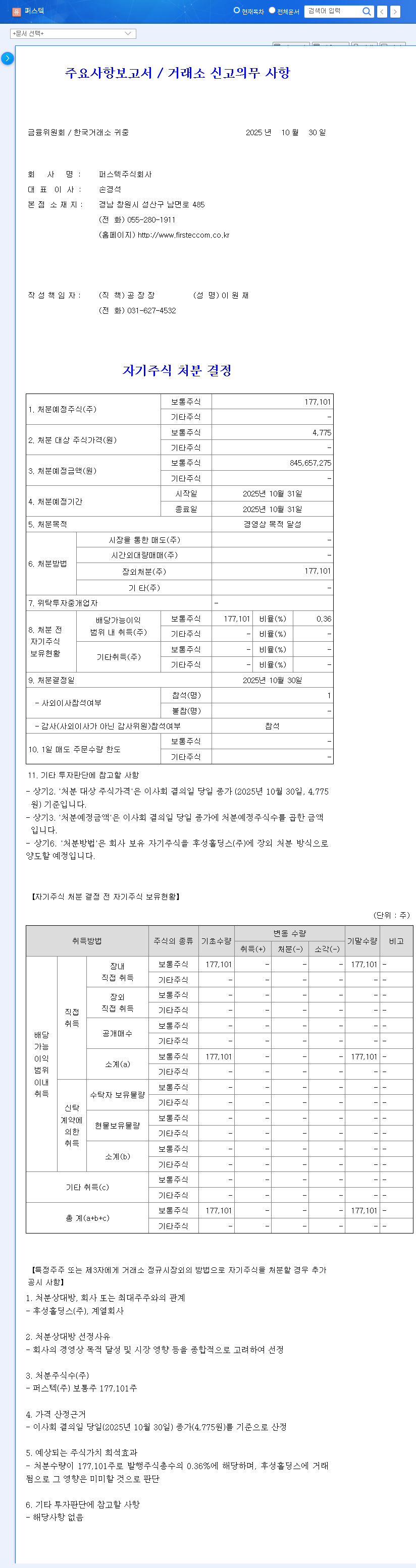
    The recent FIRSTEC treasury share disposal has sent ripples through the investment community. On October 30, 2025, the prominent defense company announced its decision to sell 177,101 treasury shares, valued at approximately ₩800 million, for stated “management objectives.” While the amount seems modest, this move warrants a much deeper look. Is this a strategic maneuver to fuel future growth, or a warning sign of underlying financial strain?

    This comprehensive analysis goes beyond the headlines to dissect the opportunities and risks facing FIRSTEC investors. We will evaluate the company’s robust position in the booming defense sector against a backdrop of concerning financial indicators and volatile macroeconomic conditions. For anyone considering an investment in FIRSTEC stock, this breakdown is essential reading.

    Deconstructing the Treasury Share Disposal Announcement

    According to the Official Disclosure filed with DART, FIRSTEC’s disposal represents approximately 0.36% of its total market capitalization of ₩232.9 billion. In isolation, a sale of this size is unlikely to cause significant short-term stock price dilution. However, seasoned investors know that the true story lies not in the amount, but in the motivation. The vague purpose of “achieving management objectives” requires us to analyze the company’s current financial health to infer the likely use of these funds.

    The Bull Case: Growth Fueled by a Booming Defense Sector

    Record-Breaking Order Backlog

    FIRSTEC’s primary strength is its dominant position within the global defense industry. The company reported a staggering order backlog of ₩1.0346 trillion, providing a clear and positive roadmap for future revenue. With sales in the second quarter of its 51st fiscal year already up 24.2% year-over-year to ₩115.4 billion, the growth trajectory is undeniable. Rising geopolitical tensions globally continue to drive defense spending, creating a favorable tailwind for the entire sector, as reported by leading financial outlets like Reuters.

    Strategic Use of Capital

    From an optimistic perspective, the funds from the treasury share disposal could be a strategic investment in the future. The capital could be allocated towards M&A activities, securing new technologies, or acquiring top-tier talent. If deployed effectively, this ₩800 million could act as a catalyst for securing next-generation growth drivers, ultimately enhancing long-term shareholder value.

    The Bear Case: Unpacking FIRSTEC’s Financial Risks

    Despite the impressive top-line growth, a closer look at FIRSTEC’s financials reveals several potential red flags that could make the FIRSTEC treasury share disposal seem less strategic and more necessary.

    The most alarming metric is the operating cash flow, which registered a negative ₩6.6 billion. This indicates that despite growing sales, the company’s core operations are currently consuming more cash than they generate.

    Key Financial Pressures to Monitor:

    • Deteriorating Cash Flow: As noted, the operating cash flow was -₩6.6 billion in the second quarter, a significant deterioration caused by changes in working capital. This can signal issues with collecting receivables or managing payables effectively.
    • Bloating Inventory: Inventory assets surged from ₩71.5 billion to ₩99.7 billion. While some increase is expected with higher sales, a rapid rise can tie up capital and increase the risk of future write-downs, further straining cash flow.
    • Exchange Rate Sensitivity: With significant international business, FIRSTEC is exposed to currency fluctuations. A 10% change in the KRW/USD exchange rate could impact pre-tax profit by approximately ₩1.53 billion, a material risk in a volatile forex market.
    • Profitability Squeeze: Despite higher sales, operating profit fell year-over-year to ₩2.9 billion. This suggests that rising costs, including a 52% increase in R&D spending, are pressuring profit margins.

    Investor Action Plan: Navigating Your FIRSTEC Strategy

    The FIRSTEC stock analysis presents a duality: a high-growth company in a strong sector facing significant internal financial pressures. The treasury share disposal sits at the crossroads of these two narratives. Prudent investors should take a wait-and-see approach, focusing on the following key areas:

    • Demand Clarity on Fund Usage: Watch for subsequent announcements that specify how the ₩800 million will be used. Transparency is paramount. A clear, strategic plan is a bullish signal; silence or vague justifications are bearish.
    • Monitor Key Financial Metrics: Pay close attention to the next quarterly report. Look for improvements in operating cash flow, a stabilization of inventory levels, and margin recovery.
    • Analyze Broader Sector Trends: Continue to evaluate the health of the global defense market. For more on this, see our complete guide to investing in defense stocks. As long as the sector remains strong, FIRSTEC has a powerful current to swim with.
    • Observe Market Sentiment: Track how institutional investors and analysts react. Their response can provide clues about how the ‘smart money’ is interpreting this disposal.

    Frequently Asked Questions (FAQ)

    Q1: What is the primary reason for the FIRSTEC treasury share disposal?

    A: The company officially stated the reason is to achieve ‘management objectives.’ However, given the negative operating cash flow and rising inventory, it could also be interpreted as a way to bolster its cash position to fund operations and R&D.

    Q2: How will this disposal impact FIRSTEC’s stock price?

    A: The direct impact from dilution should be minimal due to the small size (0.36% of market cap). The long-term impact depends entirely on how effectively the capital is used and whether the company can resolve its underlying financial challenges.

    Q3: What are the biggest financial risks for FIRSTEC right now?

    A: The key risks are the negative operating cash flow (-₩6.6 billion), a sharp increase in inventory assets, pressure on operating profit margins, and sensitivity to foreign exchange rate fluctuations.
    (010820) FIRSTEC Treasury Share Disposal: A Deep Dive for Investors (2025 Analysis) 관련 이미지
  • (241590) Hwaseung Enterprise Stock (241590) Analysis: A Deep Dive Beyond the NPS Stake Change

    (241590) Hwaseung Enterprise Stock (241590) Analysis: A Deep Dive Beyond the NPS Stake Change

    The recent adjustment in the National Pension Service’s (NPS) holding of Hwaseung Enterprise stock has sent ripples through the investment community, prompting a closer look at the company’s trajectory. While institutional moves are noteworthy, a savvy investor knows that the real story lies deeper within the company’s core health. This comprehensive Hwaseung Enterprise analysis moves beyond the headlines to dissect the company’s fundamental strengths and weaknesses, evaluate the pressing macroeconomic challenges, and provide a clear, actionable outlook for anyone considering the 241590 stock.

    We’ll explore whether the NPS’s decision is a minor portfolio tweak or a signal of underlying issues, giving you the insights needed to navigate your investment strategy with confidence.

    The Catalyst: Unpacking the NPS Stake Reduction

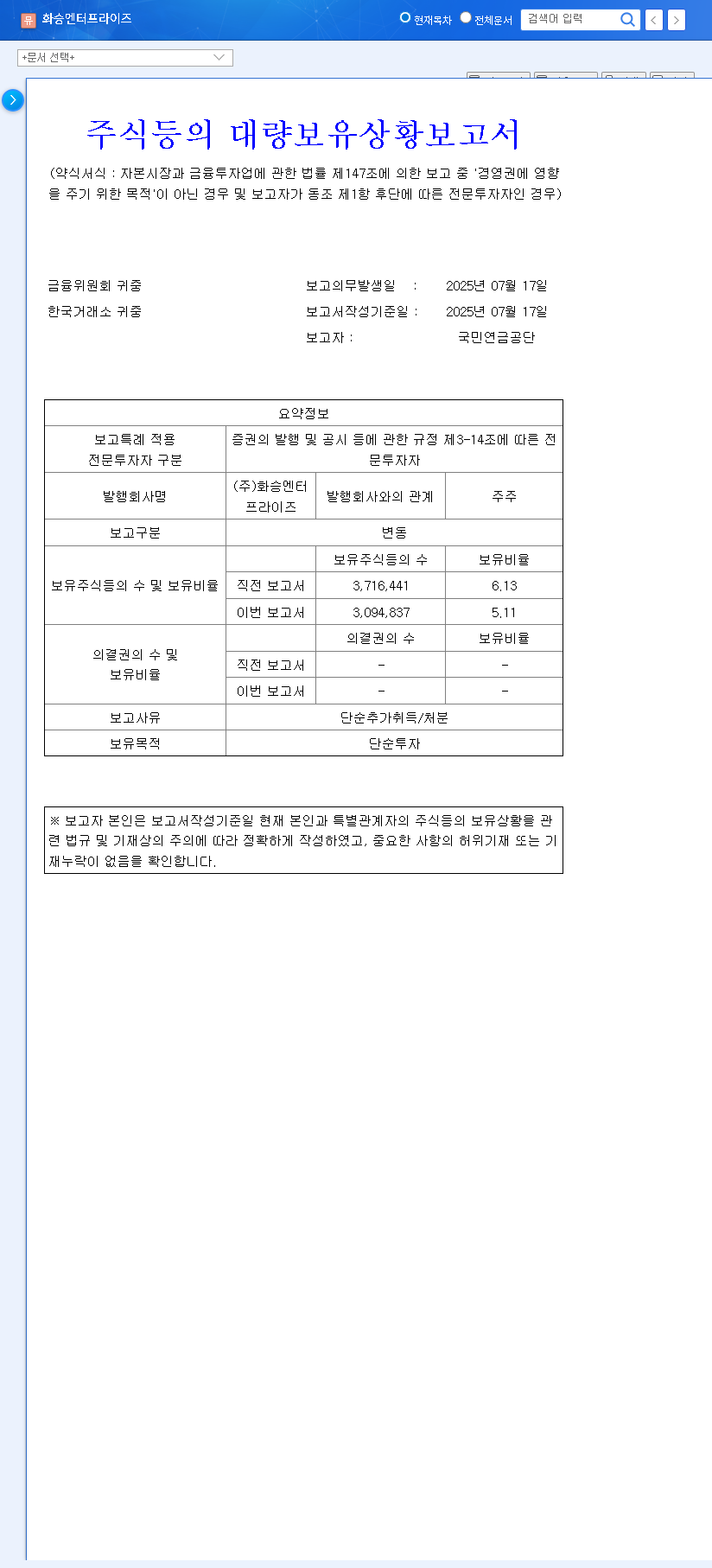
    On October 1, 2025, the National Pension Service officially reported a change in its significant shareholding in Hwaseung Enterprise. The disclosure revealed a decrease in its stake from 6.13% down to 5.11%, a reduction of 1.02 percentage points. You can view the Official Disclosure on DART for complete details.

    Crucially, the NPS maintained its holding purpose as ‘simple investment.’ This classification is significant. It implies the stake is held for capital gains and not for influencing management or exercising shareholder activism. Therefore, this reduction is most likely a strategic portfolio rebalancing or a simple profit-taking maneuver rather than a vote of no confidence in the company’s long-term Hwaseung Enterprise fundamentals.

    Deep Dive: A Fundamental Analysis of Hwaseung Enterprise (241590)

    The true value of any stock is rooted in its fundamentals. Based on the 2025 semi-annual report, Hwaseung Enterprise presents a mixed, but concerning, financial picture.

    ODM Segment Growth vs. Profitability Squeeze

    The company’s core ODM (Original Development Manufacturing) business, which designs and produces goods for other brands, continues to show resilience. Revenue from this segment hit 808 billion KRW, marking a solid year-over-year increase. This growth underscores a stable and robust partnership with its primary client, the Adidas Group.

    However, top-line growth did not translate to bottom-line success. Consolidated net income alarmingly swung to a loss of 9.16 billion KRW. This stark decline was driven by significant translation losses from overseas operations (31 billion KRW) and escalating financial costs, eroding the gains made in revenue.

    Financial Health and Adidas Dependency Risks

    A closer look at the balance sheet reveals areas requiring urgent attention. The financial structure of the Hwaseung Enterprise stock is a key concern for investors.

    • High Debt Ratio: The debt-to-equity ratio stands at a concerning 168.23%. This level of leverage increases financial risk, especially in a high-interest-rate environment.
    • Liquidity Strain: With total borrowings of 616.2 billion KRW vastly outweighing cash and cash equivalents of just 95.7 billion KRW, the company’s liquidity position is tight.
    • Customer Concentration: The deep relationship with Adidas ensures stable orders, but this over-reliance is a double-edged sword. Any shift in Adidas’s performance, strategy, or supplier relationships could directly and severely impact Hwaseung’s revenue stream.

    The Bigger Picture: Macroeconomic Headwinds

    No company operates in a vacuum. For an exporter like Hwaseung Enterprise, global macroeconomic trends are a critical factor. Several external pressures are currently impacting profitability.

    • Exchange Rate Volatility: The volatile KRW/USD exchange rate has been a primary source of pain, leading to substantial foreign exchange translation losses. As revenue is often denominated in USD while some costs are in KRW, a fluctuating rate creates significant accounting and cash flow challenges.
    • Persistent High Interest Rates: Elevated benchmark rates globally directly increase the cost of servicing Hwaseung’s large debt pile. This is a direct drain on profitability that is unlikely to ease in the short term. To learn more, explore this overview of global interest rate policies from authoritative sources like Reuters.

    Future Outlook & Investment Strategy for Hwaseung Enterprise Stock

    Considering all factors, the future of the Hwaseung Enterprise stock price hinges less on the NPS’s minor stake adjustment and more on the company’s ability to navigate its fundamental and macroeconomic challenges. The market has likely priced in the NPS sale; the focus now shifts to operational execution.

    Short-Term & Mid-Term Perspective

    In the short term, investors should prioritize monitoring fundamental improvement indicators over institutional holdings. Watch for the company’s next quarterly report for any signs of cost control, improved profit margins, and effective currency hedging strategies. Any positive news in these areas could provide a much-needed catalyst for the stock.

    Long-Term Investment Thesis

    For a long-term position, the investment case rests on Hwaseung’s ability to enhance its intrinsic value. Key strategic initiatives to watch for include:

    • Efforts to diversify its client base beyond Adidas to mitigate concentration risk.
    • A clear and credible plan to reduce debt and strengthen the financial structure.
    • Continued innovation in its ODM segment to maintain its competitive edge. You can learn more by reading our guide to evaluating company fundamentals.

    In conclusion, while the NPS’s move sparked this conversation, the real focus for any Hwaseung Enterprise stock analysis must be on the company’s profitability and balance sheet. The stable ODM revenue provides a solid foundation, but addressing the financial vulnerabilities is the critical task ahead for unlocking shareholder value.

    Disclaimer: This article is for informational purposes only and does not constitute financial advice. The final responsibility for investment decisions rests with the investor.

    (241590) Hwaseung Enterprise Stock (241590) Analysis: A Deep Dive Beyond the NPS Stake Change 관련 이미지