Tag: Employee Incentives

  • (005930) Samsung Electronics Stock: Analysis of Treasury Stock Disposition & H1 2025 Performance

    (005930) Samsung Electronics Stock: Analysis of Treasury Stock Disposition & H1 2025 Performance

    For investors evaluating Samsung Electronics stock, a recent corporate action—the disposition of treasury stock—offers a valuable lens through which to view the company’s strategy and health. While seemingly a minor event, it provides crucial context when paired with the company’s strong H1 2025 performance and the broader macroeconomic landscape. This analysis will dissect what this move signifies for employee incentives, future growth, and overall investment value.

    We will move beyond a simple news brief to provide an in-depth examination of Samsung’s corporate fundamentals, market position, and the potential impact of global economic trends, empowering you with the insights needed for an informed investment strategy.

    The key for investors is to understand how small corporate actions, like a treasury stock disposition, fit into the larger picture of a company’s financial strength and long-term vision.

    Unpacking the Treasury Stock Disposition

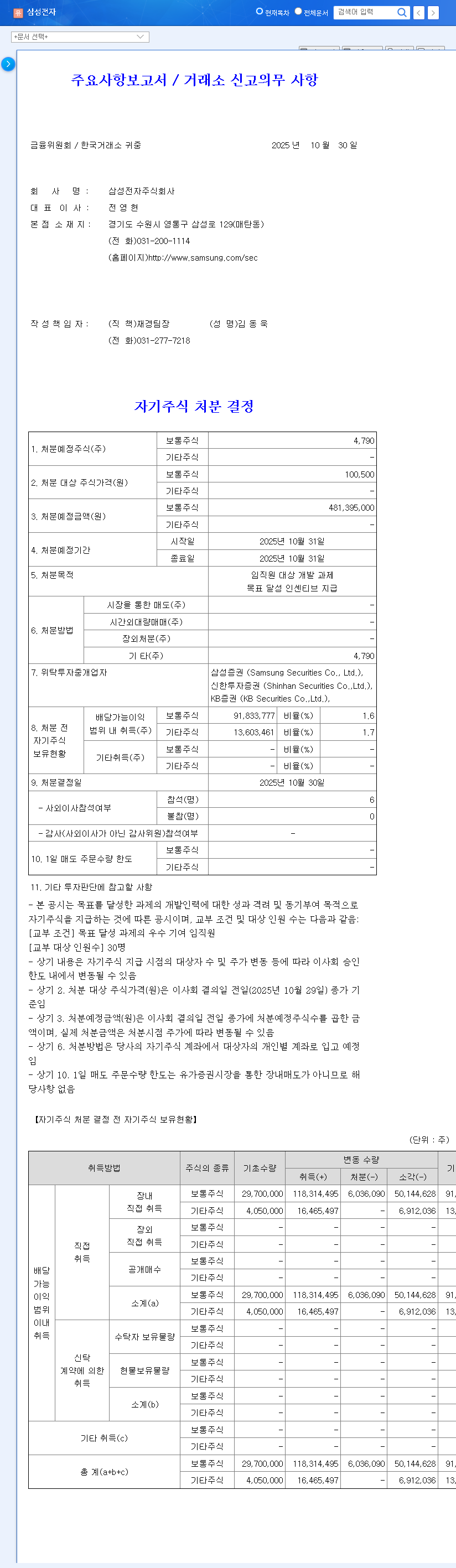
    On October 30, 2025, Samsung Electronics filed a disclosure regarding a Treasury Stock Disposition Decision. This event, while modest in scale, is a deliberate strategic move. The official report can be viewed directly from the source (Source: Official Disclosure).

    Key Details of the Disposition

    • Purpose: To provide performance-based incentives for employees who achieved key development project goals.
    • Shares Disposed: 4,790 common shares.
    • Total Value: Approximately 500 million KRW.
    • Intermediaries: Samsung Securities, Shinhan Investment Corp., KB Securities.

    The primary implication is positive: Samsung is using its own equity to reward and retain top talent, directly aligning employee performance with shareholder interests. Given the minuscule number of shares relative to the total outstanding, concerns about share dilution are negligible. This is less about financial engineering and more about fostering a culture of innovation and excellence.

    Analyzing Samsung Electronics Stock Performance & H1 2025 Fundamentals

    The company’s fundamentals provide a robust backdrop to this corporate action. Samsung Electronics reported impressive financial results for the first half of 2025, showcasing resilience and growth. Sales reached 153.71 trillion KRW, a solid 5.3% increase year-over-year.

    Core Growth Drivers

    • Device eXperience (DX) Division: This consumer-facing segment, including mobiles and electronics, grew by 6.6%, signaling strong brand loyalty and product appeal.
    • Device Solutions (DS) Division: Growing by 2.5%, this division was significantly boosted by the explosive demand for AI-oriented servers. This has led to increased sales of high-performance server DRAM and SSDs, a critical area for future growth. For more on this trend, read our detailed analysis of the semiconductor market.
    • Technological Leadership: Continuous R&D investment is paying off with the mass production of 6th-gen 10nm-class DRAM and the development of GDDR7 DRAM, keeping Samsung at the forefront of the memory market.

    Navigating Macroeconomic Headwinds

    No company operates in a vacuum, and Samsung’s performance is influenced by global economic conditions. As reported by leading financial news outlets, factors like currency fluctuations, interest rates, and commodity prices create a complex operating environment. The volatility of the Korean Won against the US Dollar and Euro directly impacts import costs and export revenues. While stable policy interest rates are a positive, global economic uncertainty and geopolitical risks remain persistent concerns that savvy investors must monitor.

    Investment Outlook: A Mid-to-Long Term Perspective

    The outlook for Samsung Electronics stock remains positive, underpinned by its solid H1 2025 performance and strategic positioning in high-growth markets like AI. The recovery of the semiconductor industry, coupled with aggressive R&D and shareholder-friendly policies, enhances its investment appeal.

    Key Takeaways for Investors

    • Focus on Fundamentals: The treasury stock disposition is a minor event. The real story lies in the company’s strong divisional performance and technological edge.
    • AI is the Catalyst: The DS division’s growth, fueled by AI server demand, is a powerful indicator of Samsung’s alignment with the most significant tech trend of the decade.
    • Adopt a Long-Term View: Short-term market noise from macroeconomic data should be weighed against the company’s long-term growth potential in AI, automotive semiconductors, and its foundry business.

    In conclusion, while the Samsung treasury stock disposition is a positive signal of its corporate culture, investors should anchor their decisions in the company’s robust business fundamentals. With a strong foothold in the burgeoning AI market and a recovering semiconductor industry, Samsung Electronics presents a compelling case for those with a mid-to-long-term investment horizon.
    (005930) Samsung Electronics Stock: Analysis of Treasury Stock Disposition & H1 2025 Performance 관련 이미지
  • Tae Woong Logistics Announces KRW 2.4 Billion Treasury Stock Disposal: What’s Next for the Stock?


    Tae Woong Logistics Announces KRW 2.4 Billion Treasury Stock Disposal: What's Next for the Stock? 대표 차트 이미지


    What Happened? Tae Woong Logistics Announces KRW 2.4 Billion Treasury Stock Disposal!

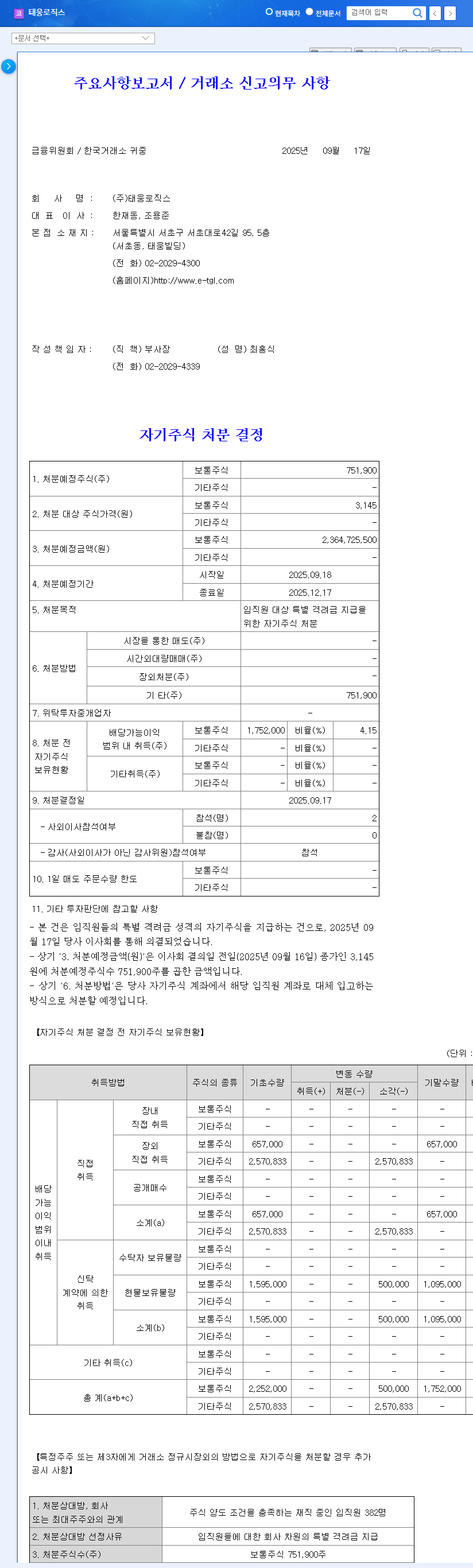
    On September 17, 2025, Tae Woong Logistics announced the disposal of 751,900 treasury shares (worth approximately KRW 2.4 billion) to fund special employee incentives.

    Why the Disposal?

    The company stated that the purpose of the disposal is to boost employee morale and motivation. This is interpreted as a move to reward employees for their hard work in a challenging business environment and encourage long-term performance.

    So, What Happens to the Stock Price?

    The disposal is relatively small compared to the company’s market capitalization, so the direct impact on the stock price is expected to be limited. However, short-term price volatility may occur depending on the disposal price and market conditions.

    • Positive Aspect: Improved long-term productivity is expected through increased employee morale.

    • Potential Negative Aspect: While the KRW 2.4 billion disposal is not expected to significantly impact the company’s liquidity, short-term stock price fluctuations are possible depending on the disposal method and market conditions.

    What Should Investors Do?

    Rather than focusing on the treasury stock disposal itself, investors should pay attention to the company’s fundamentals and future growth potential. Continuous monitoring of efforts to secure new growth engines, such as secondary battery logistics, and earnings improvement is crucial. In particular, the recovery of the global logistics market, improvement in overseas business performance, and management of exchange rate volatility will be key factors determining the future direction of the stock price.


    FAQ

    Does treasury stock disposal negatively affect the stock price?

    Generally, treasury stock disposal has a less negative impact on stock price compared to rights offerings. The scale of this disposal is also small compared to the market capitalization, so a significant impact is not expected.

    What is the outlook for Tae Woong Logistics?

    Despite facing challenges due to uncertainties in the global logistics market and exchange rate fluctuations, Tae Woong Logistics is showing potential for future growth by securing new growth engines such as secondary battery logistics. However, earnings recovery and demonstrating growth potential are important tasks.

    What should investors be aware of?

    Instead of reacting to short-term stock price fluctuations, investors should focus on the company’s fundamentals and long-term growth potential. Continuous monitoring of the global logistics market, exchange rate fluctuations, and new business performance is important.


    Tae Woong Logistics Announces KRW 2.4 Billion Treasury Stock Disposal: What's Next for the Stock? 관련 이미지
    Tae Woong Logistics Announces KRW 2.4 Billion Treasury Stock Disposal: What's Next for the Stock? 관련 이미지


  • Hyundai Movex Announces Treasury Stock Disposal: Impact on Stock Price (August 2025 Analysis)

    1. Hyundai Movex’s Treasury Stock Disposal: What Happened?

    Hyundai Movex decided to dispose of 454,666 common shares (0.41% of total outstanding shares) for approximately KRW 2.3 billion on August 7, 2025. The purpose of the disposal is to provide employee incentives, and the shares will be disposed of through Korea Investment & Securities.

    2. Why Dispose of Treasury Stock?

    The company expects this disposal to boost employee morale and motivation, positively impacting talent acquisition and retention of key personnel. This is expected to lead to improved company performance and enhance shareholder value in the long run.

    3. How Will the Disposal Affect the Stock Price?

    In the short term, increased selling pressure in the market could lead to higher stock price volatility. However, the small volume of shares and the clear purpose of the disposal minimize the likelihood of a significant price drop. Investors should focus on the potential for long-term corporate value enhancement through improved employee performance. It’s important to note that external factors like macroeconomic conditions and changes in the competitive landscape can also influence the stock price.

    4. What Investment Strategies Should Investors Consider?

    • Instead of reacting to short-term stock price fluctuations, it’s crucial to focus on the company’s long-term growth potential.
    • Continuously monitor the growth of the logistics automation and PSD businesses, as well as the company’s performance in overseas markets.
    • Pay attention to competitor activities and manage risks related to changes in the market environment.

    5. What’s the Future of Hyundai Movex?

    Hyundai Movex holds a strong competitive edge in the logistics automation and PSD markets and is securing growth momentum by expanding its IT services business. Continuous technological development and active expansion into overseas markets are expected to enhance future growth prospects.

    What’s the difference between treasury stock disposal and treasury stock retirement?

    Treasury stock disposal refers to selling treasury shares held by a company back into the market. Treasury stock retirement, on the other hand, permanently eliminates those shares. While disposal doesn’t change the number of outstanding shares, retirement reduces the number of shares in circulation, thereby increasing the value per share.

    Will this treasury stock disposal negatively impact the stock price?

    The small volume of shares being disposed of and the clear objective of providing employee incentives suggest that a significant drop in the stock price is unlikely. In the long run, it could even positively impact corporate value.

    What are Hyundai Movex’s main businesses?

    Hyundai Movex’s core businesses are logistics automation systems, platform screen doors (PSD), and IT services. It holds a high market share in logistics automation and PSD in Korea and is actively expanding into overseas markets.