Tag: Economic Indicators

  • (035720) Kakao Corp. Earnings Shock (035720): Q3 2025 Analysis & Investor Guide

    (035720) Kakao Corp. Earnings Shock (035720): Q3 2025 Analysis & Investor Guide

    Analyzing the Q3 2025 Kakao Earnings Shock

    The latest Kakao Corp. earnings report for Q3 2025 has sent a seismic wave through the market, delivering a significant ‘earnings shock’ that fell dramatically short of analyst consensus. For investors holding or watching Kakao Corp. (035720), this moment is pivotal. The results raise critical questions about the company’s current trajectory, the health of its core business segments, and its future growth prospects in an increasingly competitive landscape. This comprehensive analysis will dissect the numbers, explore the underlying causes, and provide a clear, actionable framework for investors navigating what’s next for this South Korean tech giant.

    Understanding the context behind this financial downturn is crucial. We will move beyond the headlines to offer a detailed look at the internal and external factors contributing to the underperformance, from struggling business units to challenging macroeconomic conditions.

    The Q3 2025 Results: A Stark Miss on All Fronts

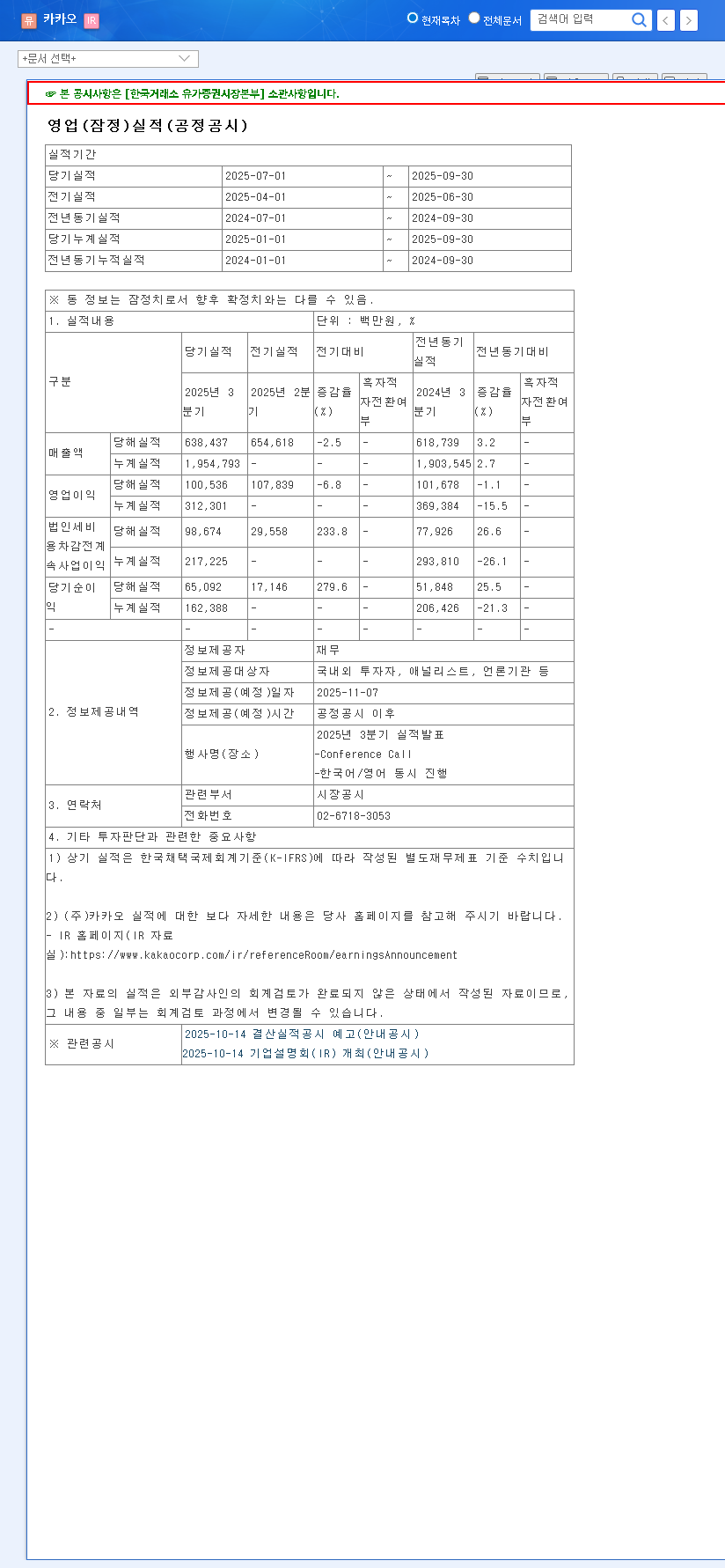
    The term ‘earnings shock’ is not an exaggeration. Kakao Corp.’s preliminary operating results for the third quarter of 2025 revealed a staggering discrepancy from market expectations. The performance wasn’t just a slight miss; it was a fundamental deviation from projected growth, signaling potential systemic issues.

    Key Financial Figures vs. Expectations

    The announced figures painted a grim picture when compared to the consensus forecasts:

    • Revenue: Reported at KRW 638.4 billion, a shocking 69% below the expected KRW 2,031.6 billion.
    • Operating Profit: Came in at KRW 100.5 billion, a 39% miss from the anticipated KRW 164.5 billion.
    • Net Profit: Totaled KRW 65.1 billion, falling 52% short of the KRW 136.9 billion forecast.

    This sharp quarter-over-quarter decline, with revenue plummeting 68.5% from Q2 2025, underscores a rapid deterioration of the company’s financial performance. For a detailed breakdown of the official figures, investors can review the Official Disclosure filed with the Financial Supervisory Service (DART).

    Unpacking the Root Causes of the Underperformance

    A multi-faceted crisis led to this Kakao earnings shock. The issues stem from both internal business unit struggles and external macroeconomic pressures that the company failed to navigate effectively.

    1. Unexpected Headwinds in the Platform Business

    Kakao’s platform businesses, including Talk Biz and Commerce, have long been the bedrock of its growth. However, Q3 saw these reliable engines falter. A slowdown in the digital advertising market, as noted by sources like Reuters, has impacted ad-revenue-dependent services globally. Concurrently, intensified competition from rivals in the e-commerce space has eroded margins and slowed transaction growth, putting unexpected pressure on this core segment.

    2. Intensified Decline in the Content Division

    While the content business showed signs of weakness in the first half of 2025, the slump deepened dramatically in Q3. The massive 69% revenue miss points to critical failures, likely a combination of underperforming new game launches, a weakening competitive edge in its webtoon and media offerings, and challenges in expanding its global footprint against established players.

    The convergence of a global economic slowdown, high interest rates, and unfavorable currency exchange rates created a perfect storm, negatively impacting everything from consumer spending on Kakao’s platforms to the profitability of its overseas ventures.

    Impact on 035720 Stock and Investor Outlook

    The repercussions of this severe earnings miss are likely to be swift and significant. The primary concern for investors is the immediate impact on the 035720 stock price, which is expected to face heavy downward pressure as the market digests this negative surprise. Beyond short-term volatility, there are longer-term implications for the company’s financial health and strategic position.

    Sustained underperformance could trigger a credit rating downgrade by agencies, increasing borrowing costs and further damaging investor confidence. Furthermore, the results highlight a potential loss of market share to more agile competitors, a risk that threatens the company’s long-term fundamental value.

    Action Plan for Kakao Corp. Investors

    In light of this challenging Kakao investor analysis, a measured and strategic approach is required. Actions should be differentiated based on short-term risk management and long-term value assessment.

    Short-Term (Next 1-3 Months)

    • Adopt a Cautious Stance: Given the high probability of a stock price decline, investors may consider reducing exposure or holding off on new purchases until the dust settles.
    • Monitor Management’s Response: Closely watch for official communications from Kakao’s leadership. A clear, credible plan to address the root causes is essential for restoring confidence.

    Mid-to-Long-Term (6+ Months)

    • Evaluate Turnaround Potential: Assess whether the platform business can regain its footing and if the heavy investments in AI and data centers can begin to yield tangible results.
    • Reassess Valuation: After a potential price drop, the stock may present a new valuation. Investors must weigh this against the now-higher perceived risks to determine if it offers an attractive entry point for long-term growth. For more on valuation, you can read our guide on Understanding Kakao’s Core Business Model.

    In conclusion, the Kakao Corp. earnings for Q3 2025 are a clear warning sign. Investors must remain vigilant, balancing the immediate risks with a careful evaluation of the company’s ability to navigate this crisis and execute a successful turnaround strategy.
    (035720) Kakao Corp. Earnings Shock (035720): Q3 2025 Analysis & Investor Guide 관련 이미지
  • (007610) Seondo Electric (007610) Contract: In-Depth Analysis of the ₩3.3B KEPCO Deal

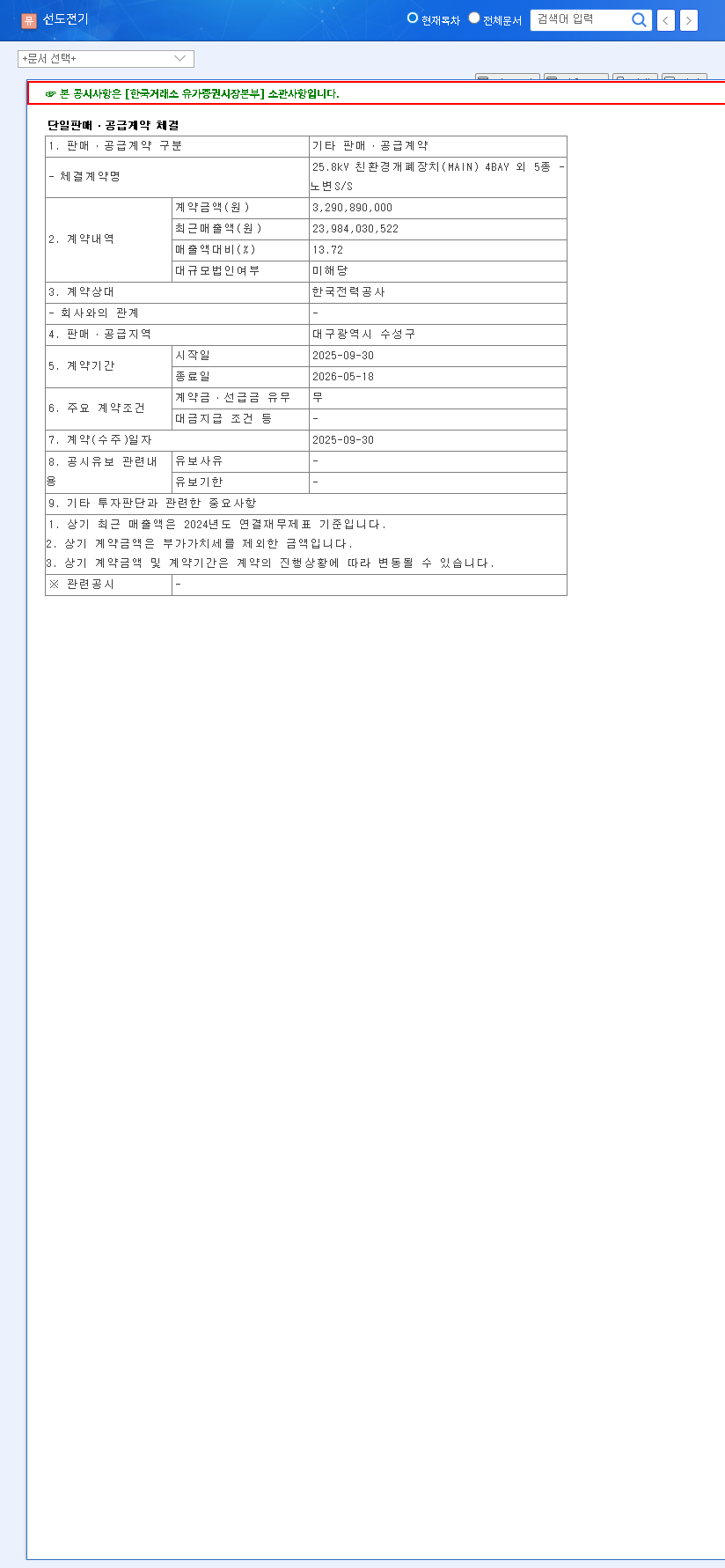
    (007610) Seondo Electric (007610) Contract: In-Depth Analysis of the ₩3.3B KEPCO Deal

    Analyzing the Landmark Seondo Electric Contract with KEPCO

    The recent announcement of the Seondo Electric contract has sent ripples through the market. Seondo Electric (KRX: 007610) officially secured a significant ₩3.3 billion single sales and supply agreement with the Korea Electric Power Corporation (KEPCO), a cornerstone of South Korea’s energy infrastructure. This deal, representing a substantial 13.72% of the company’s 2024 revenue, raises a critical question for investors: is this a genuine turning point for the company or merely a temporary boost? This comprehensive analysis will delve into the contract’s specifics, Seondo Electric’s underlying financial health, and the broader implications for its stock performance.

    Contract Details: A ₩3.3 Billion Eco-Friendly Boost

    On September 30, 2025, Seondo Electric formalized the supply deal with KEPCO. The agreement centers on the provision of 25.8kV eco-friendly switchgear and other related items. This technology is crucial for modernizing power grids, enhancing safety, and reducing environmental impact. The key details of this pivotal agreement are outlined below:

    • Counterparty: Korea Electric Power Corporation (KEPCO)
    • Contract Value: ₩3.3 billion KRW
    • Contract Period: September 30, 2025, to May 18, 2026 (approx. 7.5 months)
    • Revenue Impact: 13.72% of 2024’s revenue (₩23.267 billion KRW)
    • Supply Region: Suseong-gu, Daegu Metropolitan City

    This information is based on the company’s public filing. For complete transparency, investors can review the Official Disclosure (DART Report).

    Financial Health: A Tale of Two Stories

    While this KEPCO contract is undoubtedly a positive development, it’s crucial to place it within the context of Seondo Electric’s broader financial situation. The company faces significant headwinds that this single deal, however large, may not entirely mitigate.

    The Upside: A Much-Needed Lifeline

    The immediate impact is clear. A guaranteed revenue stream of this magnitude will bolster short-term performance and improve the company’s order book. Partnering with a stable, public-sector entity like KEPCO enhances credibility and demonstrates Seondo Electric’s technical capabilities. This revenue injection is expected to flow through to operating profit, assuming costs for raw materials and labor can be managed effectively.

    The Challenge: Deep-Rooted Financial Risks

    Investors performing a Seondo Electric stock analysis must look beyond this single contract. In 2024, the company saw its revenue decline by 44.3% year-over-year, culminating in an operating loss of ₩5.748 billion. This downturn is a result of a wider industry slump and rising material costs. More critically, the company’s current liabilities exceed its current assets, raising concerns about its ability to continue as a going concern. While management is pursuing financial restructuring, the clock is ticking, with an improvement period for its listing eligibility set to expire in April 2025.

    The ₩3.3 billion KEPCO contract provides a crucial revenue boost, but it must be viewed against a backdrop of significant financial challenges and an urgent need to secure long-term stability and profitability.

    Macroeconomic & Strategic Outlook

    No company operates in a vacuum. Seondo Electric’s future will also be shaped by external forces. Volatility in the KRW/USD exchange rate can inflate the cost of imported raw materials, squeezing margins. Furthermore, while the trend towards eco-friendly infrastructure is a major tailwind, as noted by organizations like the International Energy Agency (IEA), the company must navigate fluctuating commodity prices and global interest rate policies that can impact capital investment.

    Strategically, the Seondo Electric contract serves as a powerful proof of concept for its green technology, potentially opening doors to further public and private sector projects focused on grid modernization.

    Action Plan for Investors: A ‘Conservatively Positive’ Stance

    Given the circumstances, a ‘conservatively positive’ outlook is warranted. The contract will likely provide a short-term lift to investor sentiment and the stock price. However, long-term success hinges on the company’s ability to address its fundamental financial weaknesses. Sustainable recovery requires more than one successful deal.

    Key Monitoring Points for Seondo Electric 007610

    • Profitability Tracking: Closely monitor quarterly reports to see if this contract’s revenue translates into actual profit and positive cash flow.
    • New Order Pipeline: Look for announcements of additional contracts to demonstrate sustained business momentum beyond the KEPCO deal.
    • Listing Eligibility Progress: Pay strict attention to any news regarding the resolution of listing eligibility issues before the April 2025 deadline.
    • Financial Health Metrics: For a deeper dive, read our guide on Understanding Financial Health in the Electrical Components Industry.

    (007610) Seondo Electric (007610) Contract: In-Depth Analysis of the ₩3.3B KEPCO Deal 관련 이미지
  • HJ Heavy Industries Returns to Profit, But Proceed With Caution

    1. What Happened? – HJ Heavy Industries’ 2025 Semi-Annual Performance Analysis

    HJ Heavy Industries achieved a turnaround in the first half of 2025. While sales slightly decreased year-on-year to 917.8 billion won, operating profit reached 10.793 billion won, marking a return to profitability. This is attributed to increased sales of special vessels in the shipbuilding sector and improved cost management in the construction sector.

    2. Why the Return to Profit? – Analyzing Positive Factors

    • Return to operating profit: Raises expectations for business normalization.
    • Strong special vessel business: Robust performance in naval vessels and official vessels, coupled with strengthening IMO environmental regulations, are positive factors.
    • Construction sector technological prowess: Securing competitiveness in social infrastructure and plant projects fosters expectations for stable orders.
    • Increased defense budget: Projected to positively impact the naval vessel business.

    3. Nevertheless… – Negative Factors and Risks

    • High debt ratio: The high debt ratio of 564.98% highlights the urgent need to secure financial soundness.
    • Construction sector risks: Uncertainties exist in the construction sector, including rising costs, construction delays, and risks associated with major projects.
    • External environment risks: Susceptible to the influence of external factors such as exchange rate fluctuations and potential slowdown in the construction market.

    4. So, What Should We Do? – Action Plan for Investors

    Investing in HJ Heavy Industries requires caution. While the return to profit is positive, the high debt ratio and risks in the construction sector should not be overlooked. The growth potential of the shipbuilding division and the potential of the special vessel business are attractive, but it’s crucial to monitor volatility stemming from changes in the macroeconomic environment. A prudent approach is to monitor improvements in financial structure and profitability in the construction sector, considering investment from a long-term perspective.

    Frequently Asked Questions (FAQ)

    What was HJ Heavy Industries’ operating profit in the first half of 2025?

    It returned to profit, reaching 10.793 billion won.

    What’s the most important factor to consider when investing in HJ Heavy Industries?

    The high debt ratio and uncertainties surrounding the construction sector.

    What are the future prospects for HJ Heavy Industries?

    Growth is expected in the shipbuilding sector, particularly in the special vessel business. However, investors should be mindful of volatility related to changes in the external environment.

  • Hyundai Elevator Dividend Announcement: Investment Opportunity? (August 2025)

    1. What Happened? Hyundai Elevator’s Dividend Announcement

    Hyundai Elevator has declared a cash dividend of KRW 1,000 per share (quarterly dividend). The record date is September 1st, and the dividend yield is 1.2% based on the current price (KRW 43,232).

    2. Why Does the Dividend Matter?

    This dividend decision demonstrates Hyundai Elevator’s commitment to enhancing shareholder value. It also suggests that the company has secured the capacity to pay dividends based on its stable financial structure. The dividend can positively impact funding for future growth drivers, including elevator technology innovation, digital transformation, and UAM vertiport business.

    3. Investment Strategy Following the Dividend Announcement

    Despite the positives, investors should consider that the dividend yield may be lower than market expectations, the sustainability of future dividend policies, and capital efficiency. Monitoring changes in the macroeconomic environment, such as domestic and international construction markets, exchange rates, interest rates, and raw material prices, is also crucial.

    4. Action Plan for Investors

    • Continuously monitor dividend policy and amount.
    • Check the progress of new technology development and new business initiatives.
    • Analyze the company’s response strategies to changes in macroeconomic variables.
    • Confirm transparent information disclosure and shareholder communication.

    Frequently Asked Questions

    What is the dividend amount for Hyundai Elevator?

    KRW 1,000 per share.

    When is the record date for the dividend?

    September 1, 2025.

    What is the dividend yield?

    1.2% based on the current price.

    How will this dividend decision affect the stock price?

    While positive for shareholder value, the lower-than-expected dividend yield may negatively impact the stock price. However, future growth drivers and macroeconomic conditions can influence stock price fluctuations.

  • E-mart Q1 2025 Earnings Shock: Fundamental Crisis and Investment Strategies

    1. E-mart Q1 2025 Performance: What Happened?

    E-mart reported KRW 70.39 trillion in revenue (down 3% YoY), KRW 21.6 billion in operating profit (down 86.4% YoY), and a net loss of KRW 52.3 billion for Q1 2025. All figures missed market consensus, triggering an “earnings shock.”

    2. What Caused the Underperformance?

    External factors include macroeconomic uncertainties such as the rising USD/KRW exchange rate, increasing international oil prices, and the possibility of interest rate hikes. Internal factors include weakened consumer sentiment, intensified competition in the retail market, and sluggish performance in some business segments.

    3. Impact on Fundamentals?

    This underperformance is expected to negatively impact E-mart’s fundamentals. Continuous sales decline and worsening profitability could lead to weakened investor confidence.

    4. What Should Investors Do?

    Investors should carefully review the upcoming detailed earnings report and the company’s business strategies. It’s crucial to be mindful of short-term stock volatility and make prudent investment decisions with a long-term perspective. Investors should watch E-mart’s strategies to strengthen its core business competitiveness, improve cost efficiency, and identify new growth engines.

    Frequently Asked Questions

    What are the main reasons for E-mart’s poor performance in Q1 2025?

    A combination of factors, including macroeconomic uncertainty (exchange rates, oil prices, interest rates), weakening consumer sentiment, intensified competition, and underperformance in some business segments.

    How will these earnings affect E-mart’s stock price?

    The earnings are likely to negatively impact the stock price in the short term. However, the mid-to-long-term impact will depend on the company’s future strategies and earnings improvements.

    What should investors keep in mind?

    Carefully examine the detailed earnings report and company strategies, be cautious of short-term stock volatility, and make well-informed investment decisions.

  • Hyundai G&F Holdings: Q1 Earnings and August IR Preview

    1. What Happened at Hyundai G&F Holdings?

    Hyundai G&F Holdings experienced declining sales and polarized performance across business segments in Q1 2025. While apparel and furniture performed well, heavy industry, telecommunications, and bio struggled. The divestiture of HYUNDAI BIOLAND JIANGSU CO.,LTD highlights the need to reassess the company’s China strategy.

    2. Why the Disappointing Q1 Results?

    The sales decline is attributed to external factors like a global economic slowdown and weakened consumer sentiment. The uneven performance across business segments suggests increased competition and strategic shortcomings in certain industries. The high proportion of investments in real estate and affiliates, combined with substantial short-term debt, poses risks in a rising interest rate environment.

    3. Key Focus Areas for the August IR

    The August 8th IR is expected to address the Q1 underperformance and outline future business strategies and risk management plans. Key areas of interest include restructuring plans for underperforming sectors, new growth engine strategies, and plans to improve financial soundness. Investors will scrutinize management’s presentations to assess the company’s future growth potential and make informed investment decisions.

    4. Action Plan for Investors

    • Attend the IR and Analyze the Materials: Carefully analyze the information presented and assess the management’s responses to understand the company’s vision and strategy.
    • Analyze Recent Stock Performance and Competitors: Consider recent stock trends and competitor analysis to inform your investment decisions.
    • Monitor External Economic Indicators: Continuously monitor changes in exchange rates, commodity prices, interest rates, and global economic indicators to manage investment risks effectively.

    Frequently Asked Questions

    What are the main businesses of Hyundai G&F Holdings?

    Hyundai G&F Holdings operates a diverse portfolio of businesses, including apparel, furniture, heavy industry, telecommunications, bio, food service, distribution, and food materials.

    What were the main reasons for the poor Q1 performance?

    A combination of factors contributed to the decline, including a global economic slowdown, weakened consumer sentiment, intensified competition in specific sectors, and strategic shortcomings in some business areas.

    What are the key things to watch for in this IR?

    Key points include explanations for the Q1 underperformance, future business strategies, risk management plans, restructuring plans for struggling sectors, new growth engine strategies, and plans to improve financial health.