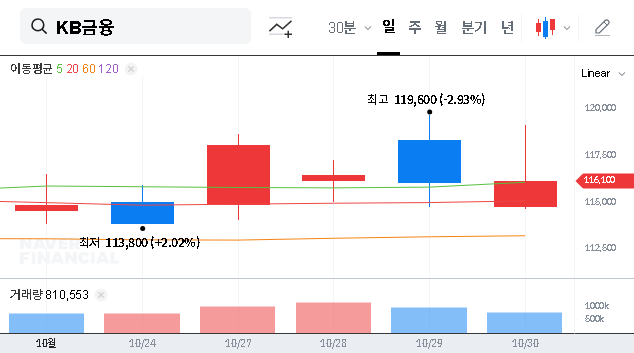
Tag: Earnings Beat

  • (105560) KB Financial Group H1 2025 Earnings: In-Depth Analysis & Stock Outlook

    (105560) KB Financial Group H1 2025 Earnings: In-Depth Analysis & Stock Outlook

    The latest KB Financial Group earnings report for the first half of 2025 has sent ripples through the investment community. Despite facing a landscape of domestic and global economic headwinds, the group delivered a significant ‘earnings surprise,’ outperforming analyst expectations and showcasing remarkable resilience. This comprehensive KB Financial analysis will unpack the key figures, explore the strategic drivers behind this success, and evaluate the potential risks and opportunities for investors considering KB Financial Group stock.

    We will delve into the performance of its core subsidiaries, its advancements in digital finance, and its strategic positioning for future growth. Whether you are a current shareholder or a potential investor, this deep dive provides the critical insights you need to make an informed decision.

    Unpacking the H1 2025 Financial Results

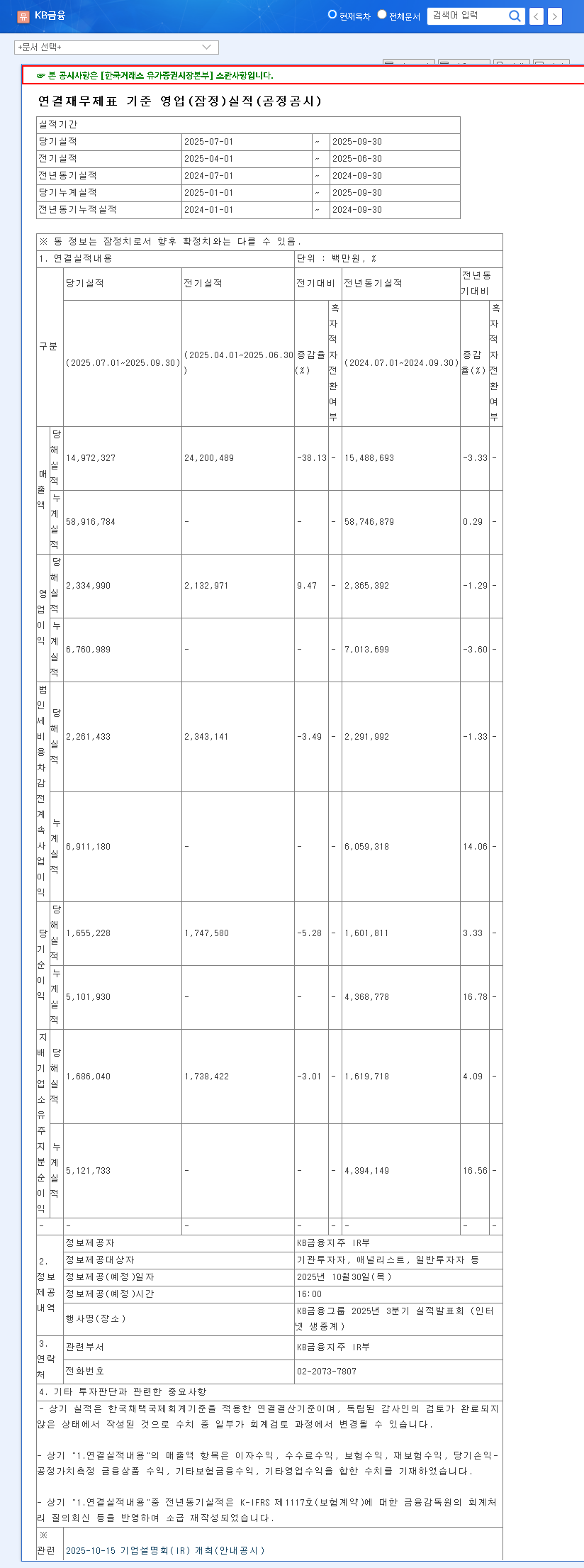
    KB Financial Group Inc. announced its provisional H1 2025 financial results, posting a performance that comfortably surpassed market consensus. The numbers highlight the group’s robust operational strength and effective management. According to the Official Disclosure filed with DART, the key figures are:

    • Revenue: KRW 14,972.3 billion
    • Operating Profit: KRW 2,335.0 billion (Exceeding market expectation of KRW 2,135.5 billion)
    • Net Profit: KRW 1,686.0 billion (Exceeding market expectation of KRW 1,550.8 billion)
    • Year-on-Year Growth: Both operating and net profit increased by a healthy 9%.

    These impressive metrics underscore KB Financial’s capacity for stable and profitable management even amidst significant market uncertainty, reinforcing confidence in the KB Financial Group stock as a solid long-term holding.

    Core Growth Drivers: The Pillars of Success

    The strong KB Financial Group earnings were not a matter of luck but the result of a well-executed strategy built on diversified strengths. The balanced performance across its key subsidiaries was the primary catalyst.

    Synergy Across Key Subsidiaries

    • KB Kookmin Bank: The flagship banking arm generated solid interest income, driven by prudent loan growth and effective management of its Net Interest Margin (NIM).
    • KB Securities: Capitalizing on market dynamics, the securities division maintained stable operating strength through robust brokerage fees and growth in its Wealth Management (WM) business.
    • KB Insurance: Strategic profitability improvements, including an optimized loss ratio and growth in direct premiums, contributed significantly to the group’s bottom line.

    KB Financial’s diversified portfolio has proven to be a powerful shield against market volatility, with non-banking segments increasingly contributing to overall profitability and de-risking the group’s revenue streams.

    Advancements in Digital and AI Capabilities

    A cornerstone of KB Financial’s forward-looking strategy is its aggressive digital transformation. The company is investing heavily to stay ahead of fintech challengers by enhancing user experience and operational efficiency. Key initiatives include the continuous advancement of its flagship mobile app, ‘KB Star Banking,’ and strengthening its cloud/AI business capabilities through KB Data Systems. This focus on technology is crucial for securing future growth and responding to evolving consumer behaviors.

    Navigating Headwinds: Potential Risks and Challenges

    While the H1 2025 performance is commendable, a thorough KB Financial analysis requires acknowledging the potential risks on the horizon. Investors should remain vigilant of these factors.

    • Macroeconomic Uncertainty: Persistent inflation, interest rate volatility, and geopolitical tensions could impact loan demand and credit quality. Investors should monitor global economic outlooks from authoritative sources like leading financial news agencies.
    • Intensified Competition: The rise of agile fintech firms and internet-only banks continues to pressure traditional financial institutions to innovate rapidly.
    • Real Estate PF Risk: The health of the real estate market is a critical factor. Potential downturns could expose the group to risks associated with its Project Financing (PF) loan portfolio, requiring stringent risk management.
    • Regulatory Scrutiny: As a systemically important financial institution, KB Financial is subject to rigorous oversight. Strengthening compliance and internal controls remains a continuous priority.

    Investor Action Plan & Future Outlook

    KB Financial Group has demonstrated strong fundamentals and a clear strategy for sustainable growth. Its stable revenue streams, diversified business model, and high credit ratings present a compelling investment case. However, the path forward depends on management’s ability to navigate the aforementioned risks while executing its growth initiatives.

    Key factors for investors to monitor include the execution of its shareholder return policy (dividends, share buybacks), the tangible results from its digital investments, and its agility in responding to macroeconomic shifts. For a deeper understanding of valuation, investors may want to review our guide on how to analyze bank stocks. In conclusion, while caution is warranted due to external uncertainties, KB Financial’s robust performance and strategic direction offer a positive outlook for discerning investors.

    Frequently Asked Questions (FAQ)

    What were the highlights of KB Financial Group’s H1 2025 earnings?

    KB Financial reported a major ‘earnings surprise’ with an operating profit of KRW 2,335.0 billion and a net profit of KRW 1,686.0 billion, both surpassing market expectations and growing 9% year-on-year.

    What drove this strong financial performance?

    The success was driven by the balanced, strong performance of its main subsidiaries: solid interest income from KB Kookmin Bank, stable operations at KB Securities, and improved profitability at KB Insurance.

    What are the key risks for KB Financial Group stock?

    Investors should monitor risks including macroeconomic volatility (interest rates, economic slowdown), fierce competition from fintech, potential real estate Project Financing (PF) exposure, and ongoing regulatory compliance needs.

    How is KB Financial preparing for future growth?

    The group is focused on securing future growth by diversifying its business portfolio, enhancing its digital and AI capabilities through significant technology investments, and expanding its presence in overseas markets.
    (105560) KB Financial Group H1 2025 Earnings: In-Depth Analysis & Stock Outlook 관련 이미지
  • (086790) Hana Financial Group Q3 2025 Earnings: A Deep Dive Analysis & Stock Outlook

    (086790) Hana Financial Group Q3 2025 Earnings: A Deep Dive Analysis & Stock Outlook

    In a landscape of market volatility, the Hana Financial Group Inc. Q3 2025 earnings report has emerged as a beacon of stability and growth. The provisional results, disclosed on October 28, 2025, not only met but significantly exceeded analyst expectations, signaling robust underlying strength and capturing the attention of the global investment community. This comprehensive analysis will dissect these impressive figures, explore the key drivers behind this outperformance, and provide a forward-looking perspective on the Hana Financial Group stock.

    Hana Financial’s third-quarter performance showcases a potent combination of strategic execution and favorable market positioning, solidifying its status as a top-tier financial institution in the region.

    Q3 2025 Earnings: By the Numbers

    The official results, filed and made public, paint a clear picture of financial strength. According to the company’s Official Disclosure, the consolidated financial performance for the third quarter was exceptional.

    • Revenue: KRW 10,892.3 billion.
    • Operating Profit: KRW 1,478.2 billion, a remarkable 7.3% beat over the market consensus of KRW 1,377.8 billion.
    • Net Profit: KRW 1,132.4 billion, surpassing market expectations of KRW 1,067.2 billion by 6.1%.

    This consistent overperformance in both operating and net profit underscores the group’s solid earnings generation capabilities and efficient operational management, even amidst a challenging global economic environment.

    In-Depth Hana Financial Analysis: Pillars of Success

    Several interconnected factors contributed to this stellar quarterly report. A detailed Hana Financial analysis reveals a strategy built on strengthening fundamentals and capitalizing on market conditions.

    1. Fortified Financial Fundamentals

    After navigating a temporary downturn in 2022, Hana Financial Group has demonstrated a powerful recovery. Since 2023, key metrics have shown consistent upward momentum. The group’s improving Return on Equity (ROE) and operating profit margins point to highly effective cost controls and superior asset management. Furthermore, a steadily declining debt-to-equity ratio signals a strengthening balance sheet and enhanced financial resilience, a crucial factor for investors seeking stability. This positive trend sets a strong foundation for the full-year 2025 financial performance.

    2. Proactive Asset and Risk Management

    In a sector where risk is inherent, Hana’s proactive approach has been a key differentiator. The group’s ability to maintain asset quality and manage credit risk effectively, as detailed in many expert financial analyses, has insulated it from some of the headwinds affecting competitors. This disciplined strategy has been pivotal in achieving superior results and maintaining investor confidence.

    3. Favorable Macroeconomic Environment

    The current interest rate environment has provided a tailwind for profitability across the banking sector, and Hana Financial has skillfully capitalized on this. Stable international oil prices and shipping costs have also supported broader economic activity, fueling demand for financial services. However, it’s important to monitor potential risks, such as volatility in the KRW/USD exchange rate, which could signal underlying geopolitical or economic uncertainty.

    Investment Outlook and Valuation

    The positive Hana Financial Group Inc. Q3 2025 earnings report significantly enhances the stock’s investment appeal. The current valuation metrics, with a PER of 16.42 and PBR of 2.21, appear attractive when juxtaposed with the company’s strong growth trajectory and improving profitability. For those interested in this sector, you can learn more about banking stock valuation here. These figures suggest that there may be further room for stock price appreciation as the market continues to recognize the company’s solid performance.

    Based on this analysis, a ‘Buy’ recommendation is warranted. Hana Financial Group stands out as a compelling defensive investment, offering both stability and growth potential in a fluctuating market.

    Key Factors to Monitor Moving Forward:

    Prudent investors should continue to monitor several key areas:

    • Interest Rate Policy: Future decisions by the Bank of Korea will directly impact profitability.
    • Global Economic Trends: Macroeconomic shifts and geopolitical events can influence market sentiment.
    • Competitive Landscape: Keep an eye on evolving financial regulations and competitive pressures.

    Disclaimer: This analysis is for informational purposes only and is based on publicly available data. It does not constitute financial advice. All investment decisions should be made at the investor’s own discretion and risk.

    (086790) Hana Financial Group Q3 2025 Earnings: A Deep Dive Analysis & Stock Outlook 관련 이미지
  • Shinil Pharm’s Earnings Surprise: What it Means for Investors

    1. Shinil Pharm’s Q2 Earnings Beat: A Closer Look

    Shinil Pharm reported Q2 2025 revenue of ₩19.5 billion, operating profit of ₩3.1 billion, and net income of ₩2.7 billion, significantly exceeding market expectations of ₩0. This positive result marks a potential turning point for the company, which has faced challenges since 2022.

    2. What Drove the Earnings Surprise?

    While the exact reasons behind the earnings beat remain unclear, several factors may have contributed. The stable revenue stream from the CMO business could be a key driver. Early successes in the newly launched pharmaceutical wholesale and health functional food businesses could also play a role. Finally, continued R&D investments may be starting to bear fruit.

    3. Outlook and Future Prospects

    This earnings surprise is expected to create short-term upward momentum for Shinil Pharm’s stock price. In the medium to long term, it could strengthen the company’s fundamentals and enhance its investment appeal. However, potential risks remain, including questions about the sustainability of earnings growth, macroeconomic uncertainties, and increasing inventory and liabilities. Careful monitoring of future earnings releases and new business performance is crucial.

    4. Action Plan for Investors

    • Short-term investors: Capitalize on potential price momentum following the earnings beat.
    • Long-term investors: Evaluate the sustainability of earnings growth and new business performance before making investment decisions.
    • Risk management: Pay close attention to macroeconomic volatility and changes in key financial indicators.

    Q: What are the key takeaways from Shinil Pharm’s Q2 earnings surprise?

    A: Shinil Pharm significantly exceeded market expectations in Q2 2025, reporting revenue of ₩19.5 billion, operating profit of ₩3.1 billion, and net income of ₩2.7 billion, compared to a forecast of ₩0.

    Q: Is this improved performance sustainable?

    A: While a short-term stock price increase is anticipated, the sustainability of these earnings remains to be seen. Future earnings reports and the performance of new business ventures will provide more clarity.

    Q: What should investors consider before investing in Shinil Pharm?

    A: Investors should carefully evaluate potential risks, including macroeconomic factors, increasing inventory levels, and growing liabilities, before making investment decisions.

  • Nongwoo Bio (054050) Q2 2025 Earnings: Surprise Beat, But Revenue Decline Continues

    1. Nongwoo Bio Q2 Earnings: What Drove the Surprise Beat?

    Nongwoo Bio reported KRW 43.3 billion in revenue, KRW 3.2 billion in operating profit, and KRW 2.5 billion in net income for Q2 2025, significantly exceeding market expectations. This positive surprise was driven by efficient cost management and favorable exchange rate effects. Cost reduction efforts, including a 44% decrease in SG&A expenses compared to the same period last year, were particularly noteworthy.

    2. Continued Revenue Decline: Securing Growth is Key

    Despite the positive earnings, revenue continued its downward trend, reaching KRW 80.7 billion, a 44.2% decrease year-over-year. Both the seed and agricultural materials businesses experienced sluggish performance. The seed business, in particular, was affected by seasonal factors, climate change, and weak sales of specific varieties. The company’s ability to recover revenue will be a critical factor in its future growth.

    3. Investor Action Plan: Consider Both Positives and Risks

    While the Q2 results may have a positive short-term impact on the stock price, investors should closely monitor the company’s mid-to-long-term strategies and execution capabilities to address the fundamental issue of declining revenue. Pay attention to Nongwoo Bio’s future strategies, including strengthening its competitiveness in overseas markets, developing high-value-added varieties, and securing a competitive edge in the agricultural materials business. Furthermore, investors should be mindful of external uncertainties such as global economic slowdown, geopolitical risks, and climate change.

    Q: How did Nongwoo Bio perform in Q2 2025?

    A: Nongwoo Bio delivered a surprise earnings beat in Q2 2025, reporting KRW 43.3 billion in revenue, KRW 3.2 billion in operating profit, and KRW 2.5 billion in net income.

    Q: What are Nongwoo Bio’s main business segments?

    A: Nongwoo Bio’s primary businesses are seed production and agricultural materials. The seed business is its core operation, contributing to approximately 80% of total revenue.

    Q: What should investors consider when evaluating Nongwoo Bio?

    A: Investors should consider the continued decline in revenue, increasing competition in the agricultural materials market, and the return on R&D investment. External factors like global economic conditions and exchange rate fluctuations should also be taken into account.

  • Hyosung Heavy Industries Q2 2025 Earnings: A Significant Beat!

    1. Q2 Earnings: A Significant Beat

    Hyosung Heavy Industries reported Q2 2025 revenue of 1.5253 trillion KRW, beating estimates by 14%, and operating profit of 164.3 billion KRW, surpassing expectations by a substantial 24%. Net profit reached 92.5 billion KRW, down from Q1 but still slightly above estimates. This strong performance is attributed to robust orders in the heavy industries segment, seasonal strength in the construction segment, and effective cost management.

    2. Q1 to Q2 Growth: Key Drivers

    Both revenue and operating profit increased compared to Q1 2025. This growth is driven by the seasonal strength in the construction segment, continued growth in heavy industries orders, and successful cost management initiatives creating a synergistic effect. The decrease in net profit is attributed to external factors such as increased financial expenses.

    3. Opportunities and Risks

    Strong order intake in heavy industries and the positive performance of the construction segment are key opportunities. However, macroeconomic factors (US interest rate hikes, exchange rate fluctuations), rising raw material prices, and high contingent liabilities remain key risk factors.

    4. Investor Action Plan

    While a positive short-term stock price trend is expected, a long-term investment strategy requires careful consideration of contingent liabilities, raw material price fluctuations, and macroeconomic uncertainties. Closely monitoring future disclosures regarding contingent liabilities and market reactions will be crucial.

    Q: What was the key takeaway from Hyosung Heavy Industries’ Q2 earnings?

    A: The key takeaway was a significant earnings beat, with operating profit exceeding expectations by 24%, reaching 164.3 billion KRW.

    Q: What drove the strong performance in Q2?

    A: The strong performance was driven by robust orders in heavy industries, seasonal strength in construction, and effective cost management.

    Q: What should investors consider when evaluating Hyosung Heavy Industries?

    A: While a positive short-term outlook is expected, long-term investors should consider contingent liabilities, raw material prices, and macroeconomic uncertainties.