Tag: Earnings Analysis

  • Inventage Lab (389470) H1 2025 Earnings Analysis: Is the Curatis Acquisition Paying Off?

    1. H1 2025 Earnings Breakdown: Expectations vs. Reality

    Inventage Lab reported revenue of ₩800 million, an operating loss of ₩8 billion, and a net loss of ₩200 million for the first half of 2025. While revenue increased compared to the previous quarter, the widening operating loss suggests that the Curatis acquisition has yet to contribute significantly to the bottom line, highlighting the urgent need for improved profitability in the LNP CDMO business.

    2. The Curatis Acquisition: A Long-Term Growth Driver

    The acquisition of Curatis provided Inventage Lab with GMP manufacturing facilities, laying the foundation for expansion in the LNP CDMO market. However, the short-term financial impact remains minimal. The long-term potential for synergy between the two companies is expected to drive significant growth for Inventage Lab.

    3. LNP CDMO Business: Growth Potential and Increasing Competition

    The growth of the mRNA and gene therapy market has increased the importance of LNP technology, creating significant growth opportunities for Inventage Lab’s LNP CDMO business. However, increasing competition necessitates a strong focus on differentiating technology and effective business strategy execution.

    4. Action Plan for Investors

    Inventage Lab possesses innovative technology but faces challenges with current financial performance and intensifying market competition. Investors should closely monitor the realization of synergies from the Curatis acquisition, the performance of the LNP CDMO business, and the potential for future earnings improvement.

    Frequently Asked Questions

    What is Inventage Lab’s core business?

    Inventage Lab focuses on developing long-acting injectables based on its drug delivery system (DDS) platform technology and operates an LNP CDMO business.

    How will the Curatis acquisition impact Inventage Lab?

    The Curatis acquisition provides Inventage Lab with GMP manufacturing capabilities, strengthening its LNP CDMO business and enabling in-house production of its pipeline. This is expected to have a positive long-term impact.

    What should investors consider when evaluating Inventage Lab?

    The ongoing operating losses and increasing market competition are key considerations for investors. Closely monitor the company’s future earnings performance, the realization of synergies from the Curatis acquisition, and its ability to maintain its technological edge.
  • EcoPro Materials Stock Forecast: Major Shareholder Stake Change Analysis & Investment Strategy

    EcoPro Materials Stock Forecast: Major Shareholder Stake Change Analysis & Investment Strategy 대표 차트 이미지

    1. What Happened? : Analyzing the Shareholder Stake Change

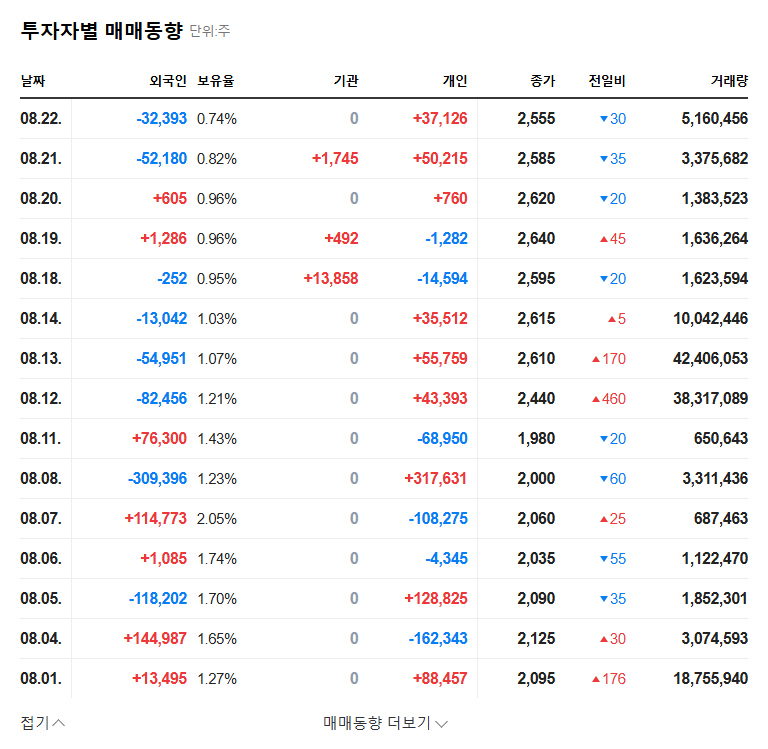
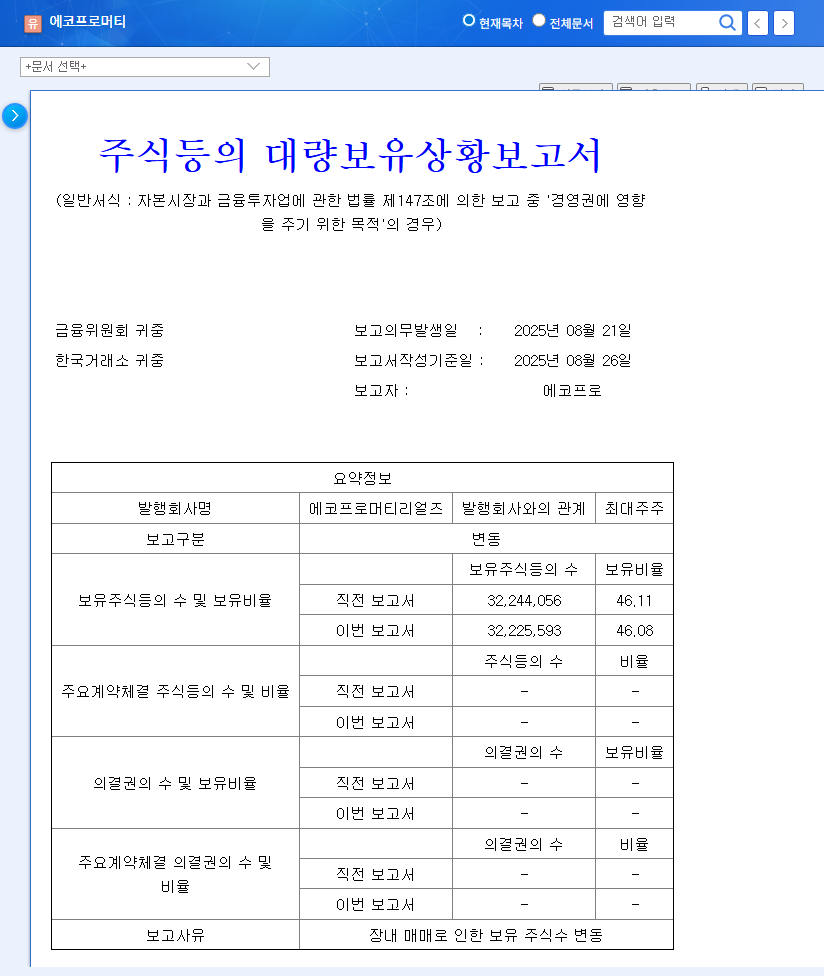
    EcoPro announced on August 26, 2025, a slight decrease in its stake in EcoPro Materials from 46.11% to 46.08%, a 0.03%p change. This resulted from Mr. Kim Yoon-tae selling 19,000 shares and Ms. Lee Hae-eun buying 437 shares.

    2. Why Does it Matter? : Implications of the Stake Change and Market Impact

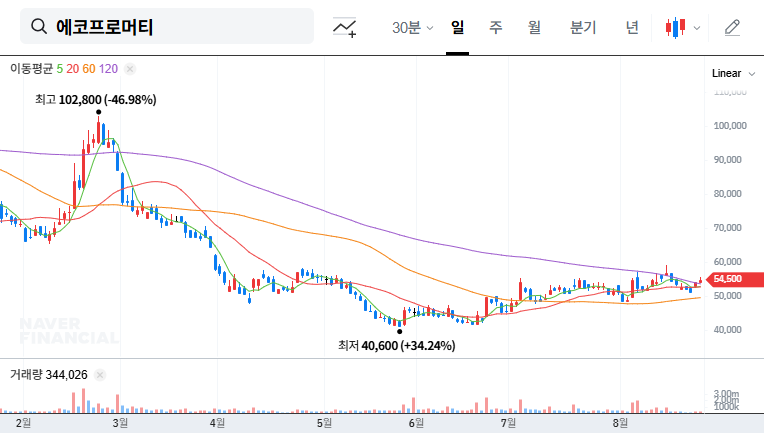
    The minor stake change is unlikely to impact management control. Investors should focus on the company’s fundamentals and market conditions. While H1 2025 revenue increased by 46.8% YoY, operating and net income recorded losses due to new investments and falling raw material prices. However, the long-term growth potential remains strong. The growth of the EV market and increasing demand for high-nickel precursors are positive factors for EcoPro Materials.

    3. What’s Next? : Future Outlook for EcoPro Materials

    EcoPro Materials has secured cost competitiveness through the commercialization of the RMP process and strengthened its financial position through preferred stock issuance. The company is expected to focus on expanding production capacity and strengthening technological competitiveness. While raw material price volatility and macroeconomic changes pose risks, the company is managing these through supply chain diversification and financial management.

    4. What Should Investors Do? : Investment Strategy and Key Takeaways

    Instead of reacting to short-term stock price fluctuations, investors should focus on the company’s long-term growth potential. Closely monitor future earnings announcements and business developments, while also paying attention to external factors such as EV market trends and raw material price changes. Specifically, observe when the factors contributing to short-term profit decline are resolved and when the effects of production capacity expansion through new investments become visible.

    Q: Will EcoPro’s stake change negatively impact EcoPro Materials’ stock price?

    A: The minor stake change is unlikely to directly affect management control or stock price. Focusing on the company’s fundamentals and market conditions is more crucial.

    Q: What is the long-term investment outlook for EcoPro Materials?

    A: The growth of the EV market and increasing demand for high-nickel precursors are positive factors. Long-term growth is expected through production capacity expansion and strengthening technological competitiveness.

    EcoPro Materials Stock Forecast: Major Shareholder Stake Change Analysis & Investment Strategy 관련 이미지
    EcoPro Materials Stock Forecast: Major Shareholder Stake Change Analysis & Investment Strategy 관련 이미지
  • LG Chem’s NCC Split: What Investors Need to Know

    LG Chem's NCC Split: What Investors Need to Know 대표 차트 이미지

    1. What Happened?: LG Chem’s H1 Report and NCC Split Announcement

    LG Chem’s H1 2025 report revealed strong performance from LG Energy Solution and growth in advanced materials and life sciences. However, the petrochemical division continues to struggle with losses. The announcement to consider splitting off the NCC business has added another layer of complexity.

    2. Why It Matters: Petrochemical Struggles vs. Future Growth Drivers

    The underperformance of the petrochemical division weighs heavily on LG Chem’s overall results. Meanwhile, LG Energy Solution, advanced materials, and life sciences are seen as key growth drivers for the future. The proposed NCC split is intended to strengthen the petrochemical business but also introduces uncertainty.

    3. What To Do: Investment Strategy and Considerations

    LG Chem has long-term growth potential, but short-term performance may be affected by the uncertainties surrounding the petrochemical division and macroeconomic factors. Investors should closely monitor future announcements regarding the NCC split and the petrochemical division’s turnaround efforts. The current investment recommendation is ‘Hold,’ and strategies should be reevaluated as the situation evolves.

    4. Investor Action Plan: Ongoing Monitoring and Information Gathering

    • Monitor petrochemical division performance and turnaround strategy.
    • Follow announcements regarding the NCC split and market reactions.
    • Assess the continued growth of LG Energy Solution, advanced materials, and life sciences.
    • Track changes in macroeconomic factors (exchange rates, oil prices, interest rates).

    Frequently Asked Questions

    What is the NCC split?

    NCC (Naphtha Cracking Center) is a facility that breaks down naphtha to produce basic petrochemical materials like ethylene and propylene. The split refers to separating this business unit into a new entity.

    What are the key risks of investing in LG Chem?

    Investors should be aware of the uncertainties in the petrochemical division, future announcements about the NCC split, and the impact of macroeconomic factors.

    What are LG Chem’s future growth drivers?

    LG Energy Solution, advanced materials, and life sciences are considered the key growth drivers for LG Chem.

    LG Chem's NCC Split: What Investors Need to Know 관련 이미지
    LG Chem's NCC Split: What Investors Need to Know 관련 이미지
  • Hyundai Bioland IR Analysis: Overcoming Challenges and Securing Growth Momentum

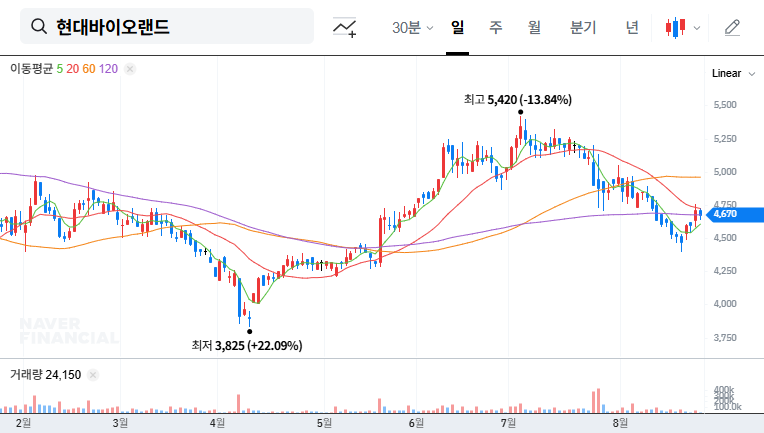
    Hyundai Bioland IR Analysis: Overcoming Challenges and Securing Growth Momentum 대표 차트 이미지

    1. What Happened? : Background and Key Takeaways from Hyundai Bioland’s IR

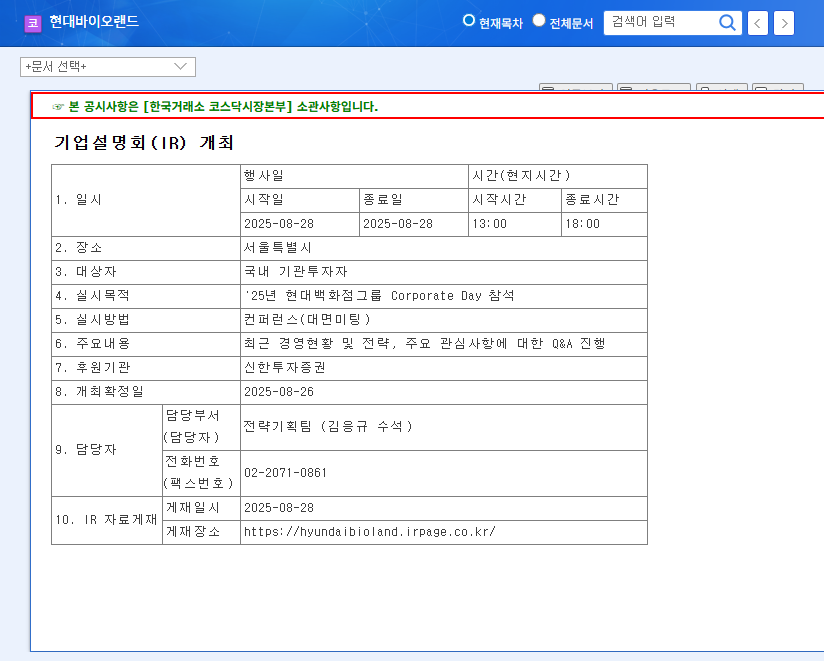
    Hyundai Bioland held an investor relations (IR) meeting on August 28, 2025, to present its recent performance and future strategies. This IR meeting provided a crucial opportunity to address investors’ questions regarding performance changes and future business direction following the sale of a subsidiary. Key topics included brand business expansion, new material development, and overseas market entry strategies to secure future growth momentum.

    2. Why Does it Matter? : The Changing Market Landscape and Hyundai Bioland’s Challenges

    Hyundai Bioland experienced a decline in revenue and a net loss due to the sale of its subsidiary. However, the growth of its brand distribution business and cost efficiency efforts are positive signs. While the rise in the KRW/USD exchange rate is favorable for exporting companies, the weakening KRW/EUR exchange rate could pose challenges for expansion into the European market. In this context, Hyundai Bioland is seeking growth breakthroughs through the development of new materials like vegan collagen and plant-based PDRN, and its collaboration with Nestlé Health Science.

    3. What’s Next? : Post-IR Market Outlook and Investment Strategy

    The market’s reaction to the IR meeting will likely be positive, neutral, or negative, depending on the presented future growth strategies and management’s responses. A clear vision for the company’s growth potential can lead to a positive response, but a lack of concrete plans for performance improvement could have a negative impact.

    4. Investor Action Plan: Key Information Checklist and Investment Decisions

    • Investors should carefully review the company’s financial status, business strategies, and market competitiveness through IR materials before making investment decisions.
    • Evaluate the company’s risk management capabilities and future growth potential based on management’s responses.
    • Adjust investment strategies by considering post-IR market reactions and expert analysis.

    Frequently Asked Questions

    What are Hyundai Bioland’s main businesses?

    Hyundai Bioland operates businesses in cosmetic ingredients, health functional food materials, and brand distribution. Recently, they are focusing on expanding their brand business.

    What is the reason for the recent decline in earnings?

    Sales decreased due to the sale of a subsidiary, but the brand distribution business showed growth.

    What is the future growth strategy?

    The company plans to strengthen its competitiveness in the cosmetics business and expand its global market presence through the development of new materials such as vegan-certified next-generation collagen and plant-based PDRN, as well as advanced formulation technology.

    Hyundai Bioland IR Analysis: Overcoming Challenges and Securing Growth Momentum 관련 이미지
    Hyundai Bioland IR Analysis: Overcoming Challenges and Securing Growth Momentum 관련 이미지
  • Leeno Industrial IR Analysis: Declining H1 2025 Earnings, Future Growth Potential?

    Leeno Industrial H1 2025 Earnings Analysis: What are the reasons for the decline?

    Leeno Industrial’s H1 2025 sales decreased by 31.3% year-on-year to 190.9 billion won, and operating profit decreased by 28.8% to 88.3 billion won. Both the core semiconductor test pin and socket business and the medical device segment experienced declining sales. This is analyzed as a result of the global economic slowdown and increased volatility in the semiconductor industry.

    Leeno Industrial’s Strategy for Securing Future Growth Drivers

    Leeno Industrial continues to invest for future growth amidst current challenges. The company is proceeding with a new facility investment worth 97.1 billion won, focusing on increasing production capacity and strengthening R&D capabilities. In particular, the growth of the semiconductor market due to increased demand for AI and cloud, and the expansion of the medical device market due to aging and chronic diseases, are expected to be positive factors for Leeno Industrial.

    Action Plan for Investors: Key Points to Focus On

    Investors considering investing in Leeno Industrial should pay attention to the following:

    • • Causes of sales decline and recovery strategies
    • • Specific performance outlook for new investment plans
    • • Countermeasures against macroeconomic uncertainty

    It is important to carefully analyze the information presented in this IR and future disclosures to make investment decisions.

    Frequently Asked Questions

    What are Leeno Industrial’s main businesses?

    Leeno Industrial manufactures semiconductor test pins, sockets, and medical devices.

    Why were H1 2025 earnings disappointing?

    Sales declined due to the global economic slowdown and increased volatility in the semiconductor industry.

    What is Leeno Industrial’s future growth strategy?

    The company is focusing on securing future growth drivers by increasing production capacity and strengthening R&D capabilities through new facility investments.

  • Coloray Holdings H1 2025 Earnings Analysis: Diversification Success or Risk?

    1. Coloray Holdings H1 2025 Performance: What Happened?

    Coloray Holdings reported revenue of KRW 22.9 billion and operating profit of KRW 1.2 billion for the first half of 2025. While revenue declined compared to the same period last year, operating profit saw a significant increase. This is attributed to new business ventures and efficient cost management.

    2. Analyzing the Drivers: Why These Results?

    • Revenue Decline: Primarily due to a slowdown in the Chinese domestic market. However, this was partially offset by growth in overseas sales and new business initiatives.
    • Operating Profit Growth: Driven by efficient cost control measures and cost reductions from the new production facility.

    3. Future Outlook and Investment Strategy: What’s Next?

    Coloray Holdings shows long-term growth potential with its new synthetic mica production facility and expanding new businesses. However, uncertainties in the Chinese market and exchange rate fluctuations pose risks. Investors should carefully consider these factors when making investment decisions.

    4. Action Plan for Investors: What Should You Do?

    • Monitor China Market Recovery: The recovery of the Chinese domestic market will significantly impact future performance.
    • Assess New Business Growth: Continuously monitor the growth trajectory of new businesses, including pet supplies and cosmetic ingredients.
    • Manage Exchange Rate Volatility: Develop investment strategies that consider the impact of exchange rate fluctuations on performance.

    Frequently Asked Questions

    What are Coloray Holdings’ main businesses?

    Coloray Holdings’ core business is the manufacturing of pearl effect pigments. They have recently expanded into the pet supplies and cosmetic ingredients markets.

    How did Coloray Holdings perform in H1 2025?

    While revenue declined year-over-year, operating profit increased significantly. See the article for details.

    What are the key investment considerations for Coloray Holdings?

    Investors should carefully consider uncertainties in the Chinese market and exchange rate fluctuations.

  • Major Shareholder Dumps All Stakes in Kodez Combine: What Investors Need to Know

    Major Shareholder Dumps All Stakes in Kodez Combine: What Investors Need to Know 대표 차트 이미지

    Major Shareholder Divestment: What Happened?

    Mr. Kim sold his entire stake of 2,868,103 shares between July 31st and August 12th, 2025, through on-market transactions, reducing his ownership from 7.18% to 0%. This move contradicts his initial investment objective of ‘simple investment’ and has sent ripples through the market.

    Why Now? Exploring the Reasons Behind the Divestment

    While the official reason for Mr. Kim’s divestment remains undisclosed, Kodez Combine’s recent poor performance is a likely contributing factor. The company reported an 8.3% year-over-year decline in revenue and a significant 54.6% drop in operating profit for Q2 2025. Increasing inventory levels and declining inventory turnover also suggest challenges in inventory management. Furthermore, the recent rise in the USD/KRW exchange rate could exacerbate these issues by increasing import costs and further pressuring profitability. Although the current trend of interest rate freezes and cuts by major central banks may offer some relief on financing costs, the volatility of international oil prices and shipping indicators remains a concern.

    Impact on Investors

    This significant divestment by a major shareholder is likely to exert downward pressure on the stock price. It could also negatively impact investor sentiment and raise doubts about the company’s fundamental strength. Short-term price volatility is expected, and the company’s ability to improve its performance will be crucial for its mid-to-long-term stock price trajectory.

    Investor Action Plan

    • Short-term Investors: Be cautious of increased price volatility and consider the potential for short-term losses. Factor in the possibility of further negative news and make prudent investment decisions.
    • Mid-to-Long-term Investors: Carefully analyze the company’s fundamentals and future business strategy before making any investment decisions. Continuous monitoring of management’s response and performance improvement will be essential.
    Why did the major shareholder divest their entire stake?

    While no official reason was given, the divestment likely stems from Kodez Combine’s recent underperformance and the uncertain economic climate.

    How will this divestment affect the stock price?

    It’s likely to put downward pressure on the stock price in the short term. The stock’s future trajectory will depend on how the market absorbs the selloff and whether investor confidence returns.

    How should investors react?

    Short-term investors should be wary of increased price volatility, while long-term investors should analyze the company’s fundamentals and future strategy before making decisions.

    Major Shareholder Dumps All Stakes in Kodez Combine: What Investors Need to Know 관련 이미지
    Major Shareholder Dumps All Stakes in Kodez Combine: What Investors Need to Know 관련 이미지
  • Hansaeg IR Analysis: Q3 2025 Outlook and Investment Strategy

    1. Hansaeg Q2 2025 Performance: A Mixed Bag

    Hansaeg’s Q2 2025 results showed a mixed performance, with revenue at ₩718.4 billion (down 2.3% YoY), operating profit at ₩22.5 billion (down 38.3% YoY), and net income at ₩20.8 billion (down 17.9% YoY). The decline in profitability is primarily attributed to the economic slowdown and weakened consumer sentiment. However, a significant decrease in the debt-to-equity ratio to 20% signals improved financial health, which is a positive sign.

    2. Key Takeaways from the IR: Focus on Online Expansion and New Businesses

    Hansaeg emphasized its strategies for strengthening online channels and expanding into new businesses. The company plans to increase investment in its online platforms like TheHandsome.com, H Fashion Mall, and EQL, and leverage live commerce to accelerate its digital transformation. Furthermore, Hansaeg’s entry into the alcoholic beverage market signals its ambition to evolve into a lifestyle platform and secure new growth engines.

    3. Hansaeg Stock Outlook: A Glimmer of Hope Amidst Uncertainty

    Over the past year, Hansaeg’s stock price has traded within a range of ₩14,000 to ₩21,000. While there were no significant trading volume changes before or after the IR, the stock price could become more volatile depending on the market’s interpretation of the announcements. Despite the challenging economic environment, positive factors such as online channel reinforcement, new business expansion, and improved financial health suggest that investors should keep a close eye on the stock’s future performance.

    4. Investment Strategy: A Long-Term Perspective is Key

    In the short term, investors should remain flexible and adjust their strategies based on the IR announcements and market reactions. Positive sentiment could create buying opportunities, while negative sentiment might warrant a wait-and-see approach. For long-term investment, careful analysis of Hansaeg’s brand competitiveness, online channel growth, and the potential success of new businesses is crucial. Continuous monitoring of sales recovery and profitability improvement is essential. Furthermore, investors should carefully consider the impact of macroeconomic trends on the company’s performance before making any investment decisions.

    What are Hansaeg’s main brands?

    Hansaeg operates its own brands like TIME, MINE, and LANVIN COLLECTION, along with various international brands.

    What are Hansaeg’s online sales channels?

    Their online channels include TheHandsome.com, H Fashion Mall, and EQL.

    What is Hansaeg’s new business venture?

    Hansaeg has entered the alcoholic beverage market to strengthen its competitiveness as a lifestyle platform.

  • Cosmecca Korea IR Analysis: Strong Q2 Earnings, What’s the Future Growth Strategy?

    1. Cosmecca Korea Q2 Earnings Analysis: Maintaining Robust Growth

    Cosmecca Korea continued its robust growth in the first half of 2025, recording sales of KRW 280.1 billion (a 4% increase year-on-year) and operating profit of KRW 35.3 billion (an 11% increase year-on-year). The improvement in profitability through efficient cost management is particularly noteworthy.

    2. Growth Drivers and Future Strategies: R&D Investment, Global Expansion, ESG Management

    Cosmecca Korea maintains a high R&D investment ratio, focusing on developing innovative products. Global production bases in Korea, China, and the US are expected to contribute to establishing a stable supply chain and responding to global demand. Furthermore, strengthening ESG management is expected to positively impact sustainable growth and enhance the company’s image.

    3. Potential Risk Factors: Debt Ratio, US Market Dependence, New Business

    Along with the positives, there are risk factors that investors should be aware of. Monitoring financial stability is necessary due to the rising debt ratio (99.05%), and the importance of US market performance has increased due to growing dependence on the US subsidiary. The uncertainty surrounding new businesses, such as the investment in new technology businesses related to the Pangyo land, should also be considered.

    4. Action Plan for Investors: Analyze IR Materials and Monitor Macroeconomic Changes

    Investors should thoroughly analyze the IR presentation materials and Q&A session and compare Cosmecca Korea’s performance and strategies with competitors to obtain information necessary for investment decisions. It is also important to continuously monitor future macroeconomic trends and evaluate the company’s response strategies.

    What were Cosmecca Korea’s Q2 earnings?

    Sales were KRW 280.1 billion (up 4% YoY) and operating profit was KRW 35.3 billion (up 11% YoY).

    What are Cosmecca Korea’s main growth strategies?

    Developing innovative products through R&D investment, expanding global production bases, and strengthening ESG management.

    What are the key risks to consider when investing in Cosmecca Korea?

    Rising debt ratio, increasing dependence on the US market, and uncertainty surrounding new businesses.

  • Tomocube IR Analysis: August 25th, A Turning Point?

    1. What Happened? : Recent Issues Surrounding Tomocube

    Tomocube has been attracting attention amid growth expectations since its IPO, but it has recently faced challenges due to sluggish performance and regulatory risks related to the non-submission of securities reports. In particular, the decline in sales and operating profit in the semi-annual results has dampened investor sentiment.

    2. Why is it Important? : Key Points to Check During the IR

    The August 25th IR is a crucial opportunity to address these uncertainties and re-evaluate the company’s value. Investors expect clear answers regarding the causes of the performance slowdown and future improvement plans, solutions to regulatory risks, and new business strategies. In particular, specific details about future growth drivers, such as the status of 2nd generation HT technology development and achievements in industrial analysis and semiconductor/display measurement equipment, are expected to have a positive impact.

    3. So What Happens Next? : Post-IR Stock Outlook and Investment Strategies

    Depending on the IR results, the stock price could experience significant volatility. While positive announcements could provide momentum for a rebound, if uncertainties are not fully resolved, a gradual recovery rather than a sharp rise is a more reasonable expectation.

    4. Investor Action Plan: Checklist for Wise Investment Decisions

    • Carefully review the IR announcements and evaluate management’s vision and execution capabilities.
    • Make investment decisions based on the company’s mid- to long-term growth story, rather than reacting to short-term stock fluctuations.
    • Focus on the specifics of the solutions to regulatory risks and profitability improvement strategies.

    Frequently Asked Questions

    What is Tomocube’s core technology?

    Tomocube develops innovative imaging equipment that observes and analyzes living cells in 3D using holotomography (HT) technology. This technology, which allows real-time analysis of cell morphology and components, is gaining attention in the biomedical research field.

    What are Tomocube’s main business areas?

    The main business is the development and sale of biomedical imaging equipment. They are expanding into industrial analysis for cell therapy quality control, and semiconductor/display measurement equipment.

    What should investors be aware of when investing in Tomocube?

    Consider the recent sluggish performance and regulatory risks. It is crucial to carefully analyze the announcements from the August 25th IR and focus on the company’s mid- to long-term growth potential rather than short-term stock price fluctuations.