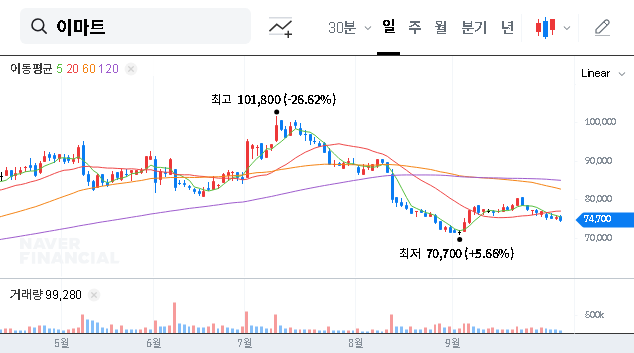
Tag: E-mart stock

  • (139480) E-Mart Stock (139480) Analysis 2025: Hold or Sell After NPS Stake Cut?

    (139480) E-Mart Stock (139480) Analysis 2025: Hold or Sell After NPS Stake Cut?

    The recent news surrounding E-Mart stock (139480) has created a complex picture for investors. On one hand, the National Pension Service (NPS) of Korea significantly reduced its stake, raising alarms. On the other, the company’s H1 2025 results reveal burgeoning growth in new sectors. This divergence leaves many asking: Is this a sign of impending trouble, or a buying opportunity in disguise? This comprehensive E-Mart stock analysis will dissect the fundamentals, decode the NPS’s move, and provide a clear investment strategy for Q3 2025 and beyond.

    The NPS Bombshell: Understanding the Stake Reduction

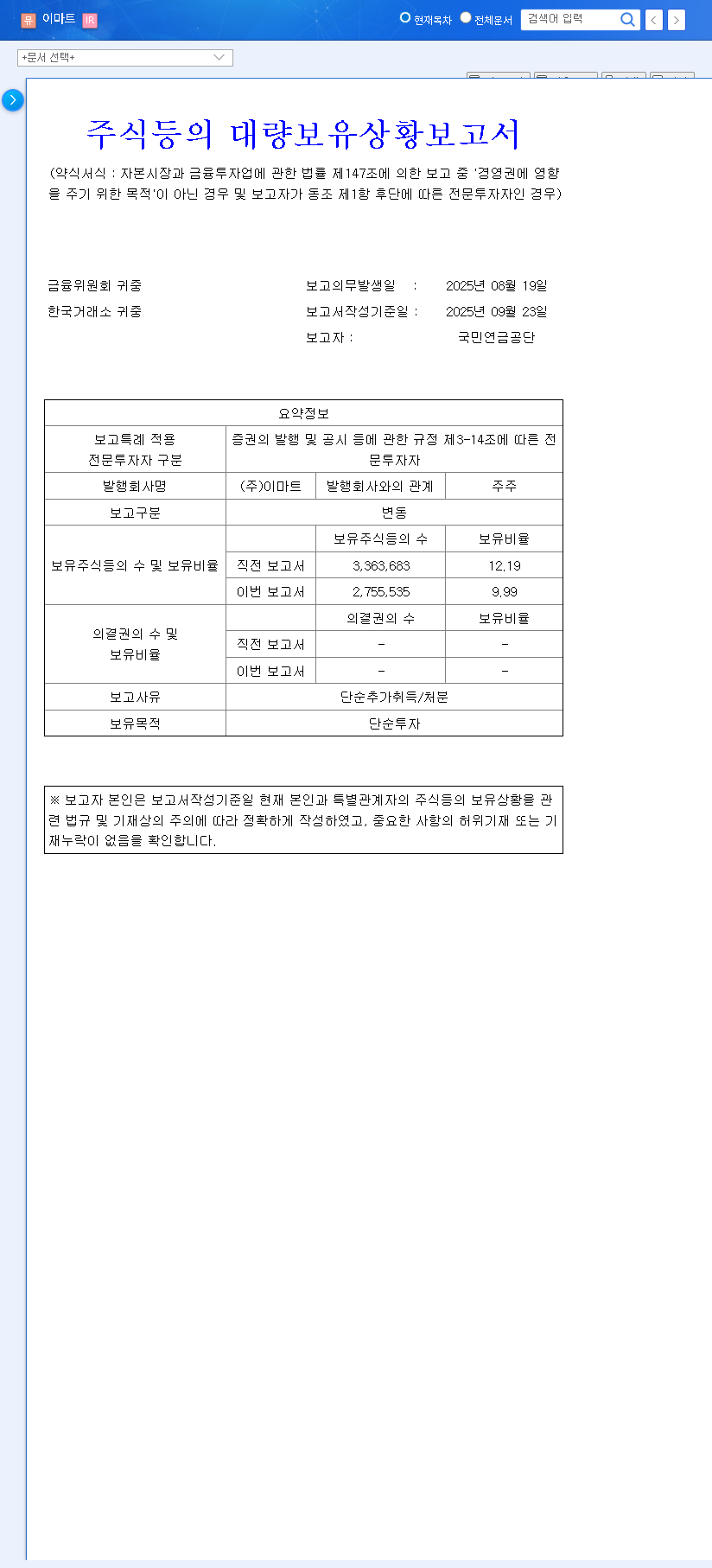
    The most significant recent event impacting E-Mart stock was the disclosure that the National Pension Service, a colossal institutional investor, reduced its shareholding from 12.19% to 9.99%. A move of this magnitude by a major stakeholder naturally triggers market anxiety. However, the context is crucial.

    The NPS classified this change as being for “simple investment” purposes. This typically means the decision is driven by portfolio management strategies—such as rebalancing, profit-taking, or managing risk exposure—rather than a negative verdict on E-Mart’s long-term corporate health. While this divestment could create short-term selling pressure and stock price volatility, its long-term impact is less certain. The official filing provides direct confirmation of this event, which you can review in the Official Disclosure (DART). Ultimately, the future of the 139480 stock will hinge on the company’s fundamental performance, not just the trading patterns of one institution.

    A Tale of Two Companies: E-Mart’s Financial Health Check

    E-Mart’s current financial situation is a study in contrasts. While its legacy business faces headwinds, new ventures are showing impressive vitality, leading to a consolidated operating profit surplus of KRW 180.9 billion year-over-year.

    The Bright Spots: Growth Engines Firing Up

    E-Mart’s strategy of diversification is bearing fruit, creating new pillars of growth that are offsetting weaknesses elsewhere. These are the key drivers:

    • Hotel & Leisure: This division’s sales surged by KRW 71.9 billion, capitalizing on the rebound in travel and leisure activities.
    • IT Services: With a sales increase of KRW 46.9 billion, this segment is proving to be a stable and profitable venture.
    • Overseas Business: The most significant contributor, with sales climbing by KRW 115.4 billion to KRW 1.18 trillion. Success in the U.S. market is demonstrating E-Mart’s potential for global expansion.

    Furthermore, the company’s financial structure remains stable, with a debt-to-equity ratio of 154.74%, providing a cushion against macroeconomic shocks.

    The Red Flags: Core Business Challenges Persist

    Despite the success of its new ventures, E-Mart’s traditional core businesses are struggling. The primary concerns are:

    • Retail Sales Decline: The hyper-competitive South Korean retail market, coupled with a low-growth economic trend, led to a KRW 130.6 billion decrease in retail sales. The rise of agile e-commerce players continues to chip away at the dominance of traditional hypermarkets.
    • Construction Division Sluggishness: Increased market uncertainty and a more selective order strategy have caused both sales and operating profit to fall in the construction division, weighing on the group’s overall performance.

    Macroeconomic Headwinds: The Bigger Picture for E-Mart Stock

    No company operates in a vacuum. Broader economic forces are exerting significant pressure on E-Mart. As noted by global financial analysts at sources like Reuters, a persistent environment of high inflation and high interest rates erodes consumer purchasing power, directly impacting retail sales. Rising government bond yields in both the U.S. and Korea also signal potentially higher borrowing costs for the company in the future. These factors create a challenging backdrop for E-Mart’s core domestic business.

    2025 E-Mart Investment Strategy: A “HOLD” Recommendation

    After a comprehensive analysis of the competing factors, our recommended E-Mart investment strategy is a ‘HOLD’. This position acknowledges both the inherent risks and the tangible progress the company is making.

    The ‘HOLD’ recommendation reflects a cautious optimism. While the core retail business requires a significant turnaround, the impressive performance of E-Mart’s diversified growth engines provides a compelling reason to wait and see how the company’s long-term strategy unfolds.

    Key risk factors to monitor include intensifying retail competition, continued sluggishness in construction, and sustained macroeconomic pressure. Investors should also be prepared for short-term price swings following the NPS E-Mart stake reduction. To learn more about assessing such risks, you can explore our guide on evaluating retail sector stocks.

    Frequently Asked Questions (FAQ)

    Q1: Why did the NPS sell its E-Mart stock?

    A1: The NPS reported the stake reduction was for “simple investment” purposes, suggesting it was part of a broader portfolio rebalancing strategy rather than a negative judgment on E-Mart’s future. While it can cause short-term price drops, the long-term direction of E-Mart stock will depend on business fundamentals.

    Q2: Can E-Mart’s core retail business recover?

    A2: The retail segment faces significant challenges from competition and a slow economy. However, E-Mart is actively working to strengthen its competitiveness through strategies like enhancing customer experience, developing popular private label products, and accelerating its digital transformation.

    Q3: What are E-Mart’s most promising growth areas?

    A3: E-Mart’s new growth drivers are its Hotel & Leisure, IT Services, and Overseas Business divisions. The overseas segment, especially, has shown massive growth, driven by its success in the U.S. market. This business diversification is critical to E-Mart’s long-term success.

    Disclaimer: This article is for informational purposes only and is based on publicly available data. It does not constitute financial advice or a guarantee for investment decisions. All investment decisions should be made based on your own judgment and, if necessary, consultation with a financial professional.
    (139480) E-Mart Stock (139480) Analysis 2025: Hold or Sell After NPS Stake Cut? 관련 이미지
  • E-mart Sells Treasury Shares: A Simple Bonus or a Sign of Crisis? (2025 Analysis)

    E-mart Disposes of 3,525 Treasury Shares: What Happened?

    First, let’s look at the facts. On July 17, 2025, E-mart announced it would dispose of 3,525 of its treasury shares (approx. 300M KRW) for executive performance rewards (RSU/RSA). This is an extremely small fraction of E-mart’s total outstanding shares, meaning its direct impact on stock supply and demand is almost nonexistent.

    The Problem is the Timing: Why is the Market Concerned Now?

    The core issue isn’t the ‘scale’ but the ‘context’ and ‘timing.’ The market is interpreting this announcement negatively because the fundamental and macroeconomic environments surrounding E-mart are highly unfavorable.

    1. A Deepening Slump: E-mart’s Fundamental Diagnosis

    E-mart’s recent performance has fallen short of investor expectations.

    • – Worsening Performance: In Q1 2025, both sales and operating profit decreased year-over-year. The slump in its core retail business is particularly painful.
    • – Declining Profitability: Since 2022, sales, operating profit, and net profit have all been on a downward trend. The operating profit margin hit an extremely low 2.36% at the end of 2024, raising concerns about the company’s fundamental health.

    2. Adding Insult to Injury: The Macroeconomic Headwinds

    The external economic environment is also placing significant pressure on E-mart.

    • – High-Interest Rate Pressure: Rising policy rates in Korea and abroad increase E-mart’s borrowing costs and can stifle new investment.
    • – Rising Commodity and Logistics Costs: Hikes in oil prices, raw material costs, and shipping container indices add to the cost burden for the retail and F&B sectors, directly hurting profitability.

    A Small Spark into a Wildfire? The Impact on Stock Price

    In conclusion, the treasury stock disposal itself has a negligible impact on the stock price. However, the combination of ‘poor performance + adverse macroeconomy + executive bonuses’ is enough to freeze investor sentiment. In a situation already fraught with concern over weak fundamentals, the sight of company resources going to executives instead of shareholders can erode market trust. This could intensify short-term downward pressure on the stock price.

    An Action Plan for the Savvy Investor

    If you are considering an investment in E-mart, this event calls for a more cautious approach. Instead of making a hasty decision, you should conduct a comprehensive analysis by checking the following points:

    • ✅ 1. In-depth Q1 Earnings Analysis: Identify the specific reasons for the Q1 performance decline and assess the likelihood of a recovery.
    • ✅ 2. Business Segment Evaluation: Quantitatively assess the individual profitability and growth potential of each business segment, including retail, hotel, and IT.
    • ✅ 3. Macroeconomic Impact Analysis: Specifically forecast how changes in interest rates, exchange rates, and commodity prices will affect E-mart’s future earnings.
    • ✅ 4. Competitor Comparison: Objectively judge E-mart’s competitive standing by comparing it with peers in the industry.

    This treasury share disposal could be a small clue revealing E-mart’s current state. We hope you make a successful investment decision through careful analysis.

    Q1. Is the scale of this E-mart treasury share disposal large enough to affect the stock price?

    A1. No. The disposal size is about 300 million KRW (3,525 shares), which is negligible compared to E-mart’s total market capitalization and number of shares. Therefore, it will not have a direct impact on stock supply and demand.

    Q2. Then why does the market view this announcement negatively?

    A2. It’s due to the ‘timing’ and ‘context’ rather than the scale. Disposing of treasury shares for executive bonuses when the company’s performance is poor and the economy is challenging can weaken investor trust and heighten concerns about the company’s financial health.

    Q3. What are the biggest risks currently facing E-mart?

    A3. There are two main risks. The first is ‘fundamental risk,’ which includes the slump in its core retail business and overall declining profitability. The second is ‘macroeconomic risk,’ such as high-interest rates and rising commodity prices.

    Q4. What else should I check if I’m considering investing in E-mart?

    A4. You should identify the specific causes of the earnings decline through upcoming quarterly reports and carefully analyze the profitability of each business segment. It is also crucial to comprehensively evaluate E-mart’s competitiveness and risk management capabilities compared to its rivals.

  • E-mart Announces ₩300M Stock Buyback: A Real Boost or Just Noise? (Investor Analysis)

    What Happened? E-mart’s Minor Share Buyback Announcement

    On July 17, 2025, E-mart disclosed its plan to acquire 3,525 of its own shares (approx. ₩300M) through on-market purchases. The stated purpose is for executive compensation, specifically for RSU (Restricted Stock Unit) and RSA (Restricted Stock Award) plans. However, this amount represents a mere 0.01% of E-mart’s total market capitalization, making it a very small-scale event.

    The ‘Why’: Stated Purpose vs. Underlying Message

    Officially, the purpose is ‘incentive payments for executives’. This can be seen as an effort to encourage responsible management through long-term performance rewards. Typically, a stock buyback can also be interpreted as a positive signal:

    • A Show of Confidence: It may suggest that the company believes its stock is currently undervalued.
    • Expectation of Long-Term Growth: Providing stock-based compensation reflects confidence in the company’s future growth.

    However, given the tiny scale of this buyback, any positive impact on the stock price is expected to be extremely limited.

    So What? The Impact on Fundamentals is a ‘Storm in a Teacup’

    In conclusion, the direct impact of this share buyback on E-mart’s corporate fundamentals is negligible. It does nothing to address the core problems revealed in the Q1 2025 report, such as declining sales, a high debt-to-equity ratio, and operating losses in its construction division.

    • 👍 The Upside (Limited): It might provide a minor, short-term boost to investor sentiment.
    • 👎 The Reality (Negative): The scale is too small to expect any meaningful enhancement of shareholder value, and it’s insufficient to dispel market concerns.

    If anything, investors might question the timing and small size of the buyback, which could further highlight how insignificant this event is compared to the company’s substantial underlying issues.

    Action Plan for Investors: What to Check Next

    Therefore, instead of reacting to this single announcement, investors should continuously monitor the following key indicators to assess E-mart’s long-term value:

    • 1. Future Management & Financial Strategy: Check for concrete plans from the company to lower its debt ratio and improve profitability in its core business segments.
    • 2. Analyst Reports & Market Consensus: Refer to how institutional investors are evaluating E-mart’s fundamentals and their target prices.
    • 3. Macroeconomic Indicators: Keep an eye on external variables like interest rates, foreign exchange rates, and commodity prices that directly affect E-mart’s costs and consumer sentiment.
    • 4. Earnings Reports: Ultimately, performance drives the stock price. The most critical factor will be whether the company shows improved sales and profits in its next quarterly earnings release.
    Q. Is E-mart’s recent stock buyback a major positive for the stock price?

    A. No, it is unlikely to be a major catalyst. While there might be a short-term psychological effect, the impact will be very limited because the buyback amount is tiny (0.01% of market cap) and it doesn’t address the company’s fundamental issues like declining sales and high debt.

    Q. What is the real purpose of this share buyback?

    A. The official stated purpose is for ‘executive RSU/RSA compensation’. It is most accurately interpreted as part of the company’s executive incentive program, rather than a strategic move to boost shareholder value.

    Q. As an E-mart investor, what should I focus on right now?

    A. The most important thing to watch is how the company addresses the deteriorating fundamentals seen in its Q1 report (e.g., falling revenue, high debt). Focus on the company’s specific business strategies and whether they can deliver improved results in the upcoming quarters.